Dams · DRP News Bulletin

DRP News Bulletin 1 October 2018: Hungry Water Effect due to Dams & Unsustainable Sand Mining Worsened Kerala Floods

Dams and reservoirs make rivers sediment-starved and menacing manifold downstream. While heavy rainfall is also a key factor behind the floods, hungry water had a more pronounced effect, says D. Padmalal, Scientist and Head, Hydrological process group, National Centre for Earth Science Studies.

– “When the sediment transport is interrupted, the potential energy of the hungry water released from dams will scour the river banks downstream, uprooting trees or riparian vegetation and damaging bridges and other engineering structures,” explains Dr. Padmalal. Overloaded with silt and clay from the eroding river banks, the highly turbid and viscous water clogs drainage channels. Subsequent discharge of water from the dam will lead to inundation and waterlogging of large areas.

– Hungry water can also develop in high gradient river channels devoid of adequate quantity of sand and gravel, especially during periods of high rainfall. “Years of uncontrolled sand mining have left most of the rivers in Kerala depleted or exhausted of sand and gravel. This creates a situation similar to the release of hungry water from dams,” notes Dr. Padmalal. When the river channel has adequate supply of sand and gravel, the potential energy of the water is used to transport the mixture. The water does not scour the banks or turn muddy.

Continue reading “DRP News Bulletin 1 October 2018: Hungry Water Effect due to Dams & Unsustainable Sand Mining Worsened Kerala Floods”

Dams · DRP News Bulletin

DRP News Bulletin 24 September 2018: If NGT Can’t Provide Environment Justice…

Unless immediate corrective action is taken, the NGT which has till recently served as an institution to provide environmental justice, will increasingly become an institution to perpetuate environmental injustice. If this is to happen, it will be a sad day for both India’s environment and democracy; writes Ritwick Dutta.

– Last few months have seen a massive decline in public confidence in the NGT. The first wake-up call was in July when the new chairperson of the NGT commented that around 50% of the petitions before the tribunal were filed by “blackmailers”. Nothing could be more distressing because this comes from an institution that was created to protect the rights of the people. Recently, the decision of the chairperson of NGT to rehear 18 cases, which were reserved for judgment, has raised concerns about both propriety as well as legality.

– The NGT, over the last two months, seems to have evolved four approaches to deal with litigations. First, dispose of existing cases. Second, form committees, comprising mostly people who were responsible for the problem, and outsource even adjudicatory functions. Third, refuse to entertain matters on the ground that the govt has approved the project or other hyper-technical grounds. And finally, rehear cases which were earlier reserved for judgment.

– One is not expecting the NGT to always give judgments in favour of those who approach it for protecting the environment. Rather, the cause for concern is the general reluctance of the tribunal to hear matters on merit, to consider the decision of the govt as virtually sacrosanct and submissions of project proponents as cast in stone. It must not be forgotten that the NGT is not a special tribunal, but a specialised tribunal set up to adjudicate on complex environmental issues through the use of both judicial and technical expertise.

Continue reading “DRP News Bulletin 24 September 2018: If NGT Can’t Provide Environment Justice…”

Dams · Floods

Overview of CWC Flood Monitoring Sites 2018: INDIA

Central Water Commission is the only agency doing flood forecasting in India. As per CWC’s Flood Forecasting website[i] the Data Flow Map has information about 226 Flood Forecast Sites in the country comprising of 166 Level Forecast Sites and 60 Inflow Forecast Sites. It also monitors 700 Flood sites, information made available through List Based Exploration and Hydrograph View, but no flood forecasting is done for these sites.

In order to better understand the CWC’s flood monitoring and forecasting work, SANDRP has published report of CWC’s Level Forecast, Inflow Forecast and level monitoring sites in 5 zones of North India[ii], North East India[iii], East India[iv], South India[v] and West India[vi].  Through this report, we have presented all the data at one place with links to separate zone wise reports with detailed description.

Continue reading “Overview of CWC Flood Monitoring Sites 2018: INDIA”

Dams · DRP News Bulletin

DRP News Bulletin 17 September 2018: How Much of This Drought Is Man Made?

  1. Gujarat suffering due to political use of water for elections in 2017.
  2. Rajasthan given more water for elections there in 2018. Will Punjab, Haryana suffer now?
  3. Kerala drought: how much could have been reduced if dams were operated more prudently?
  4. North Interior Karnataka is suffering, but Krishna basin dams are almost full? Issue of unsustainable cropping patterns, groundwater overuse, and neglect of recharge & regulation?

Gujarat Water scarcity looms large with state receiving only 74% rainfall so far

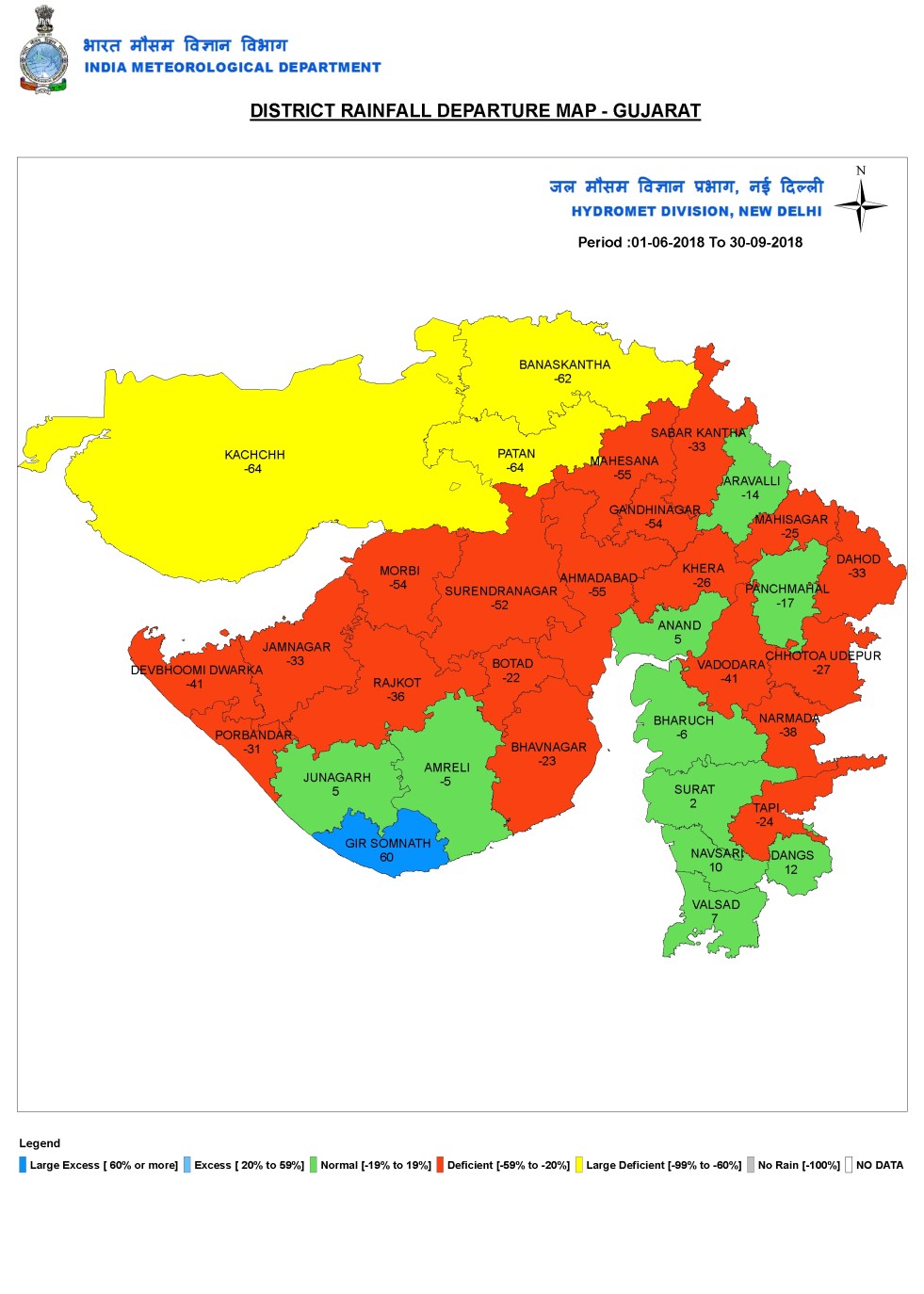
  • Kutch and North Gujarat are likely to face severe water scarcity this year, officials said. The Kutch region has received a mere 26.51 percent of average rainfall so far, while North Gujarat has received 42.93 percent, central Gujarat 66.83 percent, Saurashtra 72.20 percent and South Gujarat the highest 94.79 percent.
  • However, the Sardar Sarovar Dam is filled up to 125.82 meters, and it can provide drinking water for the entire state till the next summer, the govt said. As per Govt. storage in Sardar Sarovar Dam on the Narmada, which will be enough to meet the state’s need for drinking water through the next summer.
  • The Narmada water will also be used to fill up empty dams in Saurashtra including Aji 1, Macchu 2, Vadod and Ankadia through the Sauni scheme, officials said.
  • “The state govt will provide 20,000 cusecs water for the next 20 days to save the crops in water-starved areas,” Deputy CM Nitin Patel told reporters in Gandhinagar said.
  • “We plan to fill up 400 big and small ponds in North Gujarat by Narmada water through canals and pipeline network of the Sujlam Suflam scheme,” he said.
  • “We also plan to fill the dams in Saurashtra region and provide water for irrigation from Narmada Dam under the SAUNI scheme,” he said. https://www.firstpost.com/india/water-scarcity-looms-large-in-gujarat-with-state-receiving-only-74-rainfall-so-far-this-monsoon-says-government-5188271.html (15 Sept. 2018)

Himachal Pradesh Rajasthan quietly given extra water by BBMB to improve BJPs Poll prospects A detailed story about how BBMB, controlled by Central Power Ministry, released excess water to BJP ruled Rajasthan this poll year, which has deepened the water availability at BBMB dams this year. This is not that the first time that the water releases have happened to achieve poll objectives. https://www.huffingtonpost.in/2018/09/16/rajasthan-quietly-given-extra-water-by-bhakra-dam-board-to-improve-bjps-poll-prospects_a_23528788/  (14 Sept. 2018)

Rajasthan Rainfall deficit in many districts As per IMD, Badmer district of Rajasthan has received rainfall 48 percent below normal till Sept. 16. Similarly rainfall deficit in Hanumangarh 58 percent so far. Jallor district is facing maximum rainfall deficit of 60 per cent less than normal. Likewise the rainfall in Pali district is 35 per cent below the normal and in Jaislmer is facing a rainfall deficit of 38 per cent. In Western Rajasthan it rained only 193 mm during entire monsoon season causing a  deficit of 24 per cent below the normal.

Continue reading “DRP News Bulletin 17 September 2018: How Much of This Drought Is Man Made?”

Dams · DRP News Bulletin

DRP News Bulletin 3 Sept 2018: CHINA HAS STARTED DECOMMISSIONING DAMS

In a mountain village in southwest China’s Sichuan province, authorities have demolished seven small dam projects this year along a river to clear illegal developments in a new nature reserve. The demolition is part of a nationwide programme to close hundreds of tiny and often ramshackle dams and turbines and bring order to China’s massive hydropower sector after years of unconstrained construction.

The dams sat on an unnamed tributary of the fierce and flood-prone Dadu river, which feeds into the Yangtze, Asia’s largest and longest river, where the government says the “irregular development” of thousands of small hydropower projects has wrecked the ecology. But green groups say the campaign will not necessarily save the environment because it will not affect big state hydropower stations, which they say have caused the most damage.

On the 48 km Zhougong, authorities have already demolished small projects built in nature reserves or encroaching upon new “ecological red lines” drawn up to shield a quarter of China’s territory from development.

The government says small dams have disrupted the habitats and breeding patterns of many rare species of fish, although green groups argue the damage wrought by bigger dams is more severe, with entire towns and ecosystems submerged in water, which they say increases the risk of earthquakes, landslides and even climate change.

Continue reading “DRP News Bulletin 3 Sept 2018: CHINA HAS STARTED DECOMMISSIONING DAMS”

Dams, Rivers & People

DRP News Bulletin 20 August 2018: While Kerala Is Recovering From Unprecedented Flood Disaster, Will It Be Cauvery Or Krishna Basin Next?

Well-known ecologist Madhav Gadgil, founder of the Centre for Ecological Sciences at the Indian Institute of Science, Bengaluru, has described the devastating floods in Kerala as a man-made disaster and a reaction to the illegal excavations and stone quarrying done over a decade. https://www.hindustantimes.com/pune-news/illegal-forest-land-acquisition-major-reason-for-floods-in-kerala-says-ecologist-madhav-gadgil-calls-it-man-made-disaster/story-vMHPKUH623GEnjyQHI09NP.html  (19 Aug. 2018)

Further speaking to various regional media, Madhav Gadgil has said that irresponsible environmental policy is to blame for the recent floods and landslides in Kerala. He also called it a “manmade calamity”. He said that the committee report had recommended to protect the resources with the cooperation of local self-govt and people, but those recommendations were rejected.

He also pointed out that quarrying is a major reason for the mudslides and landslides. Other environmentalists also point fingers at the extensive quarrying, mushrooming of high rises as part of tourism and illegal forest land acquisition by private parties as major reasons for the recent calamity. https://energy.economictimes.indiatimes.com/news/power/kerala-floods-the-ghost-of-past-environment-policy-returns/65436707  (17 Aug. 2018)

Dams should never be filled before the end of the monsoons. Because then one doesn’t have any solution but to release the water in the surrounding areas: Himanshu Thakkar, SANDRP says as one of panellist discussing role of dams in aggravating Kerala floods.

https://twitter.com/ETNOWlive/status/1030487469320355840

Also see, NDTV discussion on Kerala flood crisis, it included SANDRP coordinator:

https://special.ndtv.com/kerala-floods-42/video-detail/kerala-floods-non-stop-special-coverage-of-the-unfolding-crisis-491815  (19 Aug. 2018)

Here is NDTV Hindi discussion on Kerala flood crisis, included SANDRP coordinator:

https://khabar.ndtv.com/video/show/ndtv-special-ndtv-india/ndtv-special-coverage-on-kerala-rain-crisis-491820  (19 Aug. 2018)

Here is admission about sudden, excessive releases and not foreseeing the coming disaster. The Kerala crisis could have been contained had the state “gradually released” waters from at least 30 dams, officials said, adding that the local authorities failed to foresee the imminent danger with high rain prediction. “Such floods have probably recurred after 100 years, exposing the state’s unprofessionally run reservoir management system and unpreparedness on disaster mitigation and disaster resilience, an official pointed out. https://timesofindia.indiatimes.com/city/kochi/gradual-dam-water-release-could-have-contained-crisis/articleshow/65436339.cms  (17 Aug. 2018)

Continue reading “DRP News Bulletin 20 August 2018: While Kerala Is Recovering From Unprecedented Flood Disaster, Will It Be Cauvery Or Krishna Basin Next?”

Dams · DRP News Bulletin

DRP News Bulletin 13 August 2018: Existing Sediment Management Draft Policy Promoting Navigation & Not Rivers’ Health

Traditionally, our river management strategies are mainly focused on the water flows, including flood management, and these have resulted in various interventions such as dams, barrages, canals and embankments. Most of these interventions have had very little consideration for sediment transfer and even if they did, they were generally defunct within a few years of their operations either due to improper design or inadequate maintenance.

A long-term sediment management strategy has never been a part of any protocol of river management, not just in India, but in several other parts of the world. It is amply clear that sediment management must form an important component of management strategies for the Himalayan rivers. The Union Water Ministry has recently circulated a draft policy on sediment management.

Continue reading “DRP News Bulletin 13 August 2018: Existing Sediment Management Draft Policy Promoting Navigation & Not Rivers’ Health”

Dams · DRP News Bulletin

DRP News Bulletin 6 August 2018 (2018 is Deficient Monsoon for Lakhs of Farmers)

(Feature Image: IMD Sub-Division wise Weekly Rainfall Map 26 July – 1 Aug. 2018)

Amid news of monsoon being normal, farmers in several parts in the country have started facing irrigation water problems affecting sowing of Kharif crops. Apart from, insufficient rainfall, mismanagement of water resources is turning the situation grim for them.  

As per reports, water levels in Bhakra and Pong dams in Himachal has plunged to lowest in decades. As a result dam authority has issued advisory to lakhs of farmers in Haryana, Punjab and Rajasthan to use water judiciously. Some official also said that the beneficiary states lacks efficient water management practices which is making the situation tough for them.

The Sri Ram Sagar Project in Telangana has no irrigation water. As per state water minister, a Rs. 1100 crore work was going on to renovate the dam. Meanwhile farmers of about 24 villages have started protest demanding irrigation water form SRSP for their standing crops. Given the tense situation, the State Govt has deployed heavy police forces to control farmers agitation.

At the same time, farmers in North Gujarat farmers have lost 40% of sown crops particularly in Ahmedabad, Morbi and Surendranagar. Non availability of Narmada waters have added to the problems. It is worth to mention that mismanagement of water during past four months in Narmada dam by the authority, has worsened the plight of farmers. Meanwhile, there are reports of furious Surendranagar farmers themselves opening the dam gates going against authority.

Similarly, lack of rainfall in Beed district which is part of Marathwada in Maharashtra has affected the rural population badly. In fact, the rainfall situation in a fourth of India, including Bihar and Uttar Pradesh, was in stark contrast to the rest of the country. Overall, the southwest monsoon in 2018 was only 2 % below normal by July, 27.

The southwest monsoon in Bihar was almost 40 % below normal till July 27 and the state was set to be formally declared ‘drought-hit’. It is worth to mention that the monsoon scenario seems less than reassuring, based on Skymet latest forecast and reading between the lines of IMD Aug. 3, press release.

Continue reading “DRP News Bulletin 6 August 2018 (2018 is Deficient Monsoon for Lakhs of Farmers)”

Dams · Floods

Overview of CWC Flood Forecasting Sites 2018: North India

Flood forecasting is an important activity during monsoon, considering the huge and increasing flood prone area, flood frequency, extent and flood damages. Accurate and timely flood forecasting can hugely help reduce the damages due to floods. Central Water Commission (CWC) is the only agency responsible for flood forecasting in India. To understand the CWC’s flood forecasting better, we have compiled the list of the various flood, inflow forecasting sites and flood monitoring sites in India.

In this compilation, we have given state wise list of CWC’s flood forecasting, flood monitoring and inflow forecasting sites, along with available details like rivers, sub basin, river basin, Warning level, Danger Level, High Flood Level, Full Reservoir Level, Maximum Water Level. As we see below, there are many gaps in this basic information for the sites that are part of CWC’s list.

Continue reading “Overview of CWC Flood Forecasting Sites 2018: North India”

Dams, Rivers & People

DRP News Bulletin 30 July 2018: Laos Dam DISASTER: Yet Another Wake Up Call?

The various aspects of tragic Dam Disaster in Mekong Basin in Laos are still unfolding. But it is clear from many accounts that it was an avoidable, man-made disaster due to neglect of contractors, decision makers, consultants and supervising agencies. There is a lot we can learn from this if we want to avoid such disasters in India. We still do not have credible Dam Safety Law or institution, CWC is clearly not the right agency considering the conflict of interest with the various other roles of CWC. But for now let us look at the reports of Laos Dam Disaster.

Reminding the world of one of the worst dam disasters, the under construction dam Xepian Xe Nam Noy Hydro power project breached releasing 5 billion cubic metres of water in Southern Laos on July 23.

The gushing water current swept the surrounding leading to death of about 26 people and displacing about 6600 residents. As per report hundreds of people are still missing from neighbouring villages of Yai Thae, Hinlad, Mai, Thasengchan, Tha Hin, and Samong, which bore the brunt of flooding. The deluge has reportedly destroyed thousands of homes.

Continue reading “DRP News Bulletin 30 July 2018: Laos Dam DISASTER: Yet Another Wake Up Call?”