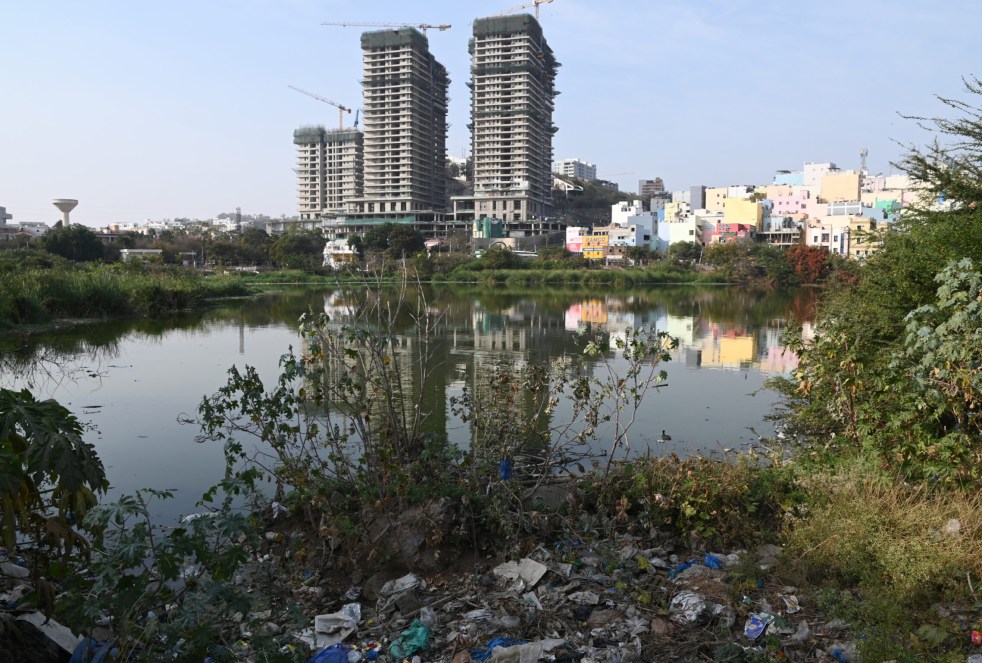
(Feature Image: Lakes in Hyderabad are infested with heavy growth of hyacinth and algae, reflecting the terrible condition of the water bodies. Surya Sridhar/Telangana Today)
The historic network of lakes in Hyderabad city has been under stress from increasing pollution and encroachment for past many years. In response, the govt in July 2024 formed Hyderabad Disaster Response and Asset Protection Agency (HYDRAA) to protect lakes, nalas and public assets from encroachments and address urban flooding problems. Since then, the agency is actively involved in lakebed reclamation, demolition of illegal structures, desilting, flood-management interventions and selected lake rejuvenation projects. So far, it has attracted both support for removing encroachments from several lakes and criticism for lacking holistic approach and sustainable outcome.
It was great to see that river figured prominently in the just concluded Delhi Assembly Elections where BJP has come to power in the state after 27 years. Prime Minister Narendra Modi assured Delhi that the BJP government will make every effort to clean Yamuna. “It may be a long haul but Mother Yamuna will surely bless our efforts,” he said. Will this help the cause of the River?
Mumbai BMC scarps Gargai dam, goes for alternatives In a wise move, the Brihanmumbai Municipal Corporation (BMC) has cancelled Gargai dam project. In January 2014, SANDRP had made submission to Expert Appraial Committee (EAC), highlighting the adverse impacts of this project on tribal people and Tansa Sanctuary stressing on exploration of alternatives including recycling of sewage and rain water harvesting. Finally, now the BMC has scrapped the unjustified project which would have caused felling of 4.5 lakh trees which BMC chief Iqbal Chahal rightly finds pointless in the wake of increasing climate change threats.
In May 2019 SANDRP wrote, with photo evidence, after a visit to the Drain No 8 that brings Delhi’s drinking water that it is running next to drain no 6 carrying untreated industrial toxics from Haryana, with only sand bags separating the two. A visit on 21st July, 2020 provided video proof that water from drain no 6 is still happily mixing with drain no 8 at several places.
A visit to drain number 8, one of prominent canal carrying potable water supply of national capital can be shocking experience to anyone concerned with water quality and health of people. The canal (called escape) flows close to Delhi Haryana border in Sonipat district. The drinking water in the escape is being repeatedly contaminated with all sorts of industrial effluents.
“A key reason for the failure of the river cleaning projects (Ganga and Yamuna action plans), says a recently-released citizen’s report, Rejuvenating Ganga,by the India Rivers Week, a consortium of seven NGOs, was their single-point focus on the main stem of the river, while the Ganga basin actually has eight major rivers (Yamuna, Son, Ramganga, Gomti, Ghaghra, Gandak, Kosi and Damodar). The majority of the funds were spent on pollution-abatement measures on the main stem of the Ganga and on the upper Yamuna basin, which constitute just 20% of the Ganga basin.”
(Feature image by Nishant Panwar, Vikas Nagar, shows Yamuna River in upper reaches in Jan. 2019)
On April 11, 2019, is the birthday of Yamuna river. The Yamuna Jayanti comes every year on the sixth day of ‘Chaitra’ (summer) Navratra. The Kapat (door) of famous Yamnotri shrine would be opened this year on May 7 for Char Dham Yatra.
In April-May 2019 India will vote to elect 17th Lok Sabha or Parliament. On April 11, the 1st of the 7 polling days, the home state of Yamuna river, Uttrakhand and the districts of Western Uttar Pradesh through which Yamuna river flows, will vote.
The two other states heavily dependent and Yamuna river, Haryana and Delhi will see voting on May 12. The district Mathura, Agra, Etawa, Kanpur, Hamirpur, Fatehpur and Allahabad of Uttar Pradesh located along Yamuna river will witness voting from second (April 18) to sixth phase on May 12.
Yamuna river at different locations between 8 to 11 April 2019. (Image Source: Yamuna Nadi Mitra Mandalis)
The NDA government come to power in May 2014 promising clean Ganga and Yamuna. The thousands of devotees of Mathura and residents of Agra were especially convinced of a promise of clean flowing Yamuna river. People were also hopeful that the government of the same party, BJP, in centre and in key basin states of Yamuna (Uttarakhand, Haryana and Uttar Pradesh) would bring a change in the situation. But over the five years, things have only deteriorated further. In fact, under the present government apart from dams and pollution a illegal sand mining has emerged as equally dangerous threat for the Yamuna rivers from upper reaches through middle and lower stretches.
On the occasion of Yamuna Jayanti, the Yamuna Nadi Mitra Mandli (YNMM) a voluntary group of villagers and concerned; established along the length of Yamuna by Yamuna Jiye Abhiyan is highlighting the issues affecting the Yamuna river and riparian communities which have remained unaddressed during past five years and none of the political parties even now have remotely focused on these. They also warn that ignoring the problems of Yamuna and dependent community will soon affect every state and dependent people in a significant way apart from endangering the river itself.
It’s not secret that water pollution is getting worse in India, including pollution of groundwater sources, thought we still donot know the full extent of the pollution of that source. But there is so little citizen action on such an important issue that affects so many so severely on daily basis. So it’s great to see four separate instances of such action this week, one each from Maharashtra, Gujarat, Karnataka and Kerala. In absence of any seriousness shown by governments at centre and states and any effective success from judicial intervention, this is welcome news. One only hopes this is no flash in the pan and rather beginning of citizens’ action to agitate against such rampant water pollution that goes on in India.
As this report narrates, a great volunteer effort is underway in Mumbai to clean up Mithi river. What they have achieved is just about 350 m of clean river, after labouring over weekends for several months. But this is such a daunting task to even venture to start. They have not only started, but made visible progress. Let us hope it will achieve all its objectives.
Two interesting orders from National Green Tribunal (NGT) marked important developments on water-environment issues this week. NGT asking for PERFORMANCE AUDIT of pollution Control Mechanism is indeed long overdue necessity, considering the complete, abject failure of the pollution control mechanism in India. The hopes of effective action, like in the past, however, were dashed since CPCB, which is PART OF THE PROBLEM has been asked to do the audit. An independent audit, in addition to one possibly by CAG may have helped. https://www.thehindu.com/news/cities/Delhi/ngt-slams-state-pollution-bodies/article26008687.ece (17 Jan. 2019)
Whatever positive signs were available by this order were further dashed by another NGT order in which it declared that EIAs (Environmental Impact Assessment) reports are already taking climate change into account, while the tribunal dismissed a petition asking that all development activities be screened/ regulated keeping climate change in mind.
This is totally WRONG contention. Just to illustrate, SANDRP has been pointing out to the EAC, MoEF and the developers how the EIAs of dams and hydropower projects are ignoring the climate change related issues and impacts. In response the consultants and developers have responded, approved by the silent or spoken nods by the EAC and MoEF that these were not even part of their TORs! One only wishes NGT was most discerning before making such claims and would have gone through a few EIAs to see if at all EIAs are dealing with these issues with any rigour or credibility. https://www.business-standard.com/article/pti-stories/climate-change-already-covered-under-environment-impact-assessment-ngt-119011600897_1.html (16 Jan. 2019)


 SANDRP