Drought

Can floods lead to drought? After the flood, severe drought looming over Kerala

Guest blog by: Madhusoodhanan C.G. and Sreeja K.G

The state of Kerala experienced extreme precipitation events during the 2018 South West monsoon period with multiple episodes culminating in devastating floods across the state during 14th-18th August 2018. This year, with an early onset of monsoons that dovetailed with strong summer showers, the state received about 41% excess rainfall (2394 mm against the normal of 1700 mm) during the period June 1st to August 22nd [1]. Almost all of its reservoirs were near full storage by mid-July.

The heavy downpour and the uncontrolled opening of the spillway gates of almost all reservoirs that inundated huge stretches of river banks and floodplains, along with massive landslides across the Western Ghats affected more than 1.5 million people, with close to 500 human casualties, immense losses to property, livelihoods and resource security apart from the extensive damage to forests, wildlife and biodiversity. Maximum destruction was observed along the rivers of Periyar, Chalakudy and Pamba, all having multiple dams on their tributaries. The debate is still on as to the various reasons, both manmade and natural, behind the floods and the resultant wide-ranging casualties [2,3,4,5,6]. Meanwhile things have taken a rather unexpected turn in the flood ravaged state.

Continue reading “Can floods lead to drought? After the flood, severe drought looming over Kerala”

Inland Waterways

Decoding the Economics of Ganga Waterway (National Waterways-1)

Guest Blog by Debadityo Sinha

The Government of India has undertaken the ambitious project of plying cargo ships from Haldia to Prayagraj on the river Ganga, also known as National Waterways-1 (NW-1).

The justification for promoting waterways on such a massive scale as stated in National Waterways Bill, 2015 when introduced is as follows:

  • …inland water transport is recognised as fuel efficient, cost effective and environment friendly mode of transport, especially for bulk goods, hazardous goods and over dimensional cargos. It also reduces time, cost of transportation of goods and cargos, as well as congestion and accidents on highways.

As per the Government of India’s Press Release dated 21 July 2016, the cost of transportation of goods by rail was estimated at about Rs. 1.36 per ton kilometre, by waterways at Rs. 1.06 per ton kilometres and by road at Rs. 2.50 per ton kilometre. At first glance, the waterway appears to be far more economical.

Continue reading “Decoding the Economics of Ganga Waterway (National Waterways-1)”

Sand Mining

Uttar Pradesh Sand Mining 2018: Key NGT orders slap for MoEF

RIVERBED MINING REPORTS

Disturbed by mining, man jumps in front of CM convoy One can just imagine the distress and anguish building against State Govt inactions over illegal sand mining in common people. In an attempt to draw the state govt’s attention towards the illegal sand mining, a man on Dec. 29, 2017 jumped in front of CM Yogi Adityanath’s convoy in Lucknow.

The man identified as Shyamji Mishra wanted to draw the attention towards the illegal river bed being done in Sonebhadra “under the patronage of BJP’s Sardar legislator and BJP’s district president.” He had earlier tried to meet the CM Yogi Adityanath a couple of times, but unable to convey his message the man was compelled to take this step. http://indianexpress.com/article/india/watch-video-man-jumps-in-front-of-uttar-pradesh-cm-yogi-adityanath-convoy-in-lok-bhawan-lucknow-5005359/ (30 Dec. 2017)

Continue reading “Uttar Pradesh Sand Mining 2018: Key NGT orders slap for MoEF”

Wetlands

World Wetlands Day 2019: Save Wetlands to Face Climate Change

The theme of the World Wetlands Day[i] 2019 is very fittingly, “Wetlands and Climate Change”. With climate change already upon us and its impact likely to increase due to increasing emissions and global temperatures, its high time we understand the importance of wetlands to face inevitable impacts of climate change, even as we must continue to do everything possible to reduce emissions.

On the occasion, Martha Rojas Urrego, Secretary General, Ramsar Convention on Wetlands has said[ii]: “Peatlands[iii] for example cover just three per cent of our world. Yet they store nearly a third of all land-based carbon. This is twice as much as all the world’s forests.

Continue reading “World Wetlands Day 2019: Save Wetlands to Face Climate Change”

DRP News Bulletin

DRP: 14 Jan 2019: Will the campaign of 17-yr old Alappad Girl Wake us up to the perils of unsustainable sand mining?

The coastline between Chavara and Alappad in Kollam district of Kerala, has a decades-long story of people’s battle for survival against mining companies. This stretch in Kerala is where the extensive mineral beach sand mining has been happening since the 1960s. The abandoned buildings are the remains of people’s failed agitations and indefinite strikes. One by one the villages in the area are vanishing from the map of Kerala.

Continue reading “DRP: 14 Jan 2019: Will the campaign of 17-yr old Alappad Girl Wake us up to the perils of unsustainable sand mining?”
Water

Uffrenkhal’s Legacy of Recharge Pits Ensures Water Security

Inspiring tale of three villages in Thalisain tehsil (Pouri Garhwal district, Uttarakhand) which have been putting in sustained efforts for years in creating recharge pits, plantation and forest protection that has ultimately resulted in revival of water sources and Gadganga a small stream part of East Nayaar River basin. Continue reading “Uffrenkhal’s Legacy of Recharge Pits Ensures Water Security”

Ganga

East Nayaar River: The Scenic Stream of Ganga in Trouble

The East and West Nayaar rivers[i] of Uttrakhand are small natural streams feeding the National River. They may meet the fate of Ganga and Yamuna, if the current trend damaging them remain unchecked. This pictorial report highlights the plight and beauty of East Nayaar river.  The River is also spelt as NAYAR by a number of documents. 

Degradation of Ganga river and its big tributaries gets adequate attention amongst concerned, while such small natural streams feeding the National River, largely remains absent in the mind and memory of stakeholders.

These perennial streams are making the River Ganga living and flowing in founding basin area. They seem healthy and living, however the problems of dumping of solid and liquid waste, construction debris, road cutting, water abstraction and hydro projects are rapidly catching up with the smaller streams.

Continue reading “East Nayaar River: The Scenic Stream of Ganga in Trouble”

DRP News Bulletin

DRP: 24 Dec 2018: MoEF & WII’s Compromises for Hydro Interests

In a shocking revelation, Jay Mazoomaar in this Indian Express report exposes how Wildlife Institute of India not only accepted consultancies from hydropower companies, but also diluted the mandate for the studies for given by statutory bodies like NGT, NBWL and FAC, but also provided compromised reports catering to the interests of the hydropower developers, thus trying to clear the way for the two controversial mega hydropower projects, one each in Dibang and Lohit river basins in Arunachal Pradesh. https://indianexpress.com/article/north-east-india/arunachal-pradesh/wildlife-institute-all-for-hydel-projects-in-arunachal-pradeshs-tiger-zone-5499656/

In case of the 3097 MW Etalin project being developed by Jindal and Arunachal Pradesh govt, the IE report says: “the WII was asked by the Ministry (MoEF) to assess the feasibility of the plan that requires 1,166 hectares of forestland in the valley. The Ministry’s move followed a recommendation from its Forest Advisory Committee (FAC) to conduct an environment impact assessment study. Instead, the WII initiated a study to find how the project’s impact on wildlife can be minimised”. Thus instead of doing the mandated scientific impact assessment, the WII initiated a study to minimise the project’s impact.

Continue reading “DRP: 24 Dec 2018: MoEF & WII’s Compromises for Hydro Interests”
Dams · Ken River

Ken River Yatra: A Glimpse into the Lives of River People

This multi-media report by Siddharth Agarwal based on a walk along the majestic Ken River in central India, now part of a contentious river-linking project, shows how essential it is to the communities living around it.

The idea of walking along a river has many key reasons, but the most important of them is to interact, discuss with and document the life of the actual stakeholders of this natural system. Traversing flood plains and riverbanks on foot takes us right where the story is, not in a far removed space, where even a few kilometres away from it can be a major shift. Location plays a wonderful role in rejigging memory and helps people imagine past situations. The discussions on the scale of the importance of a river suddenly have a realism and depth.

Continue reading “Ken River Yatra: A Glimpse into the Lives of River People”

Dams · Monsoon

Uttarakhand Monsoon 2018 Overview: Rainfall Normal, Distribution Abnormal

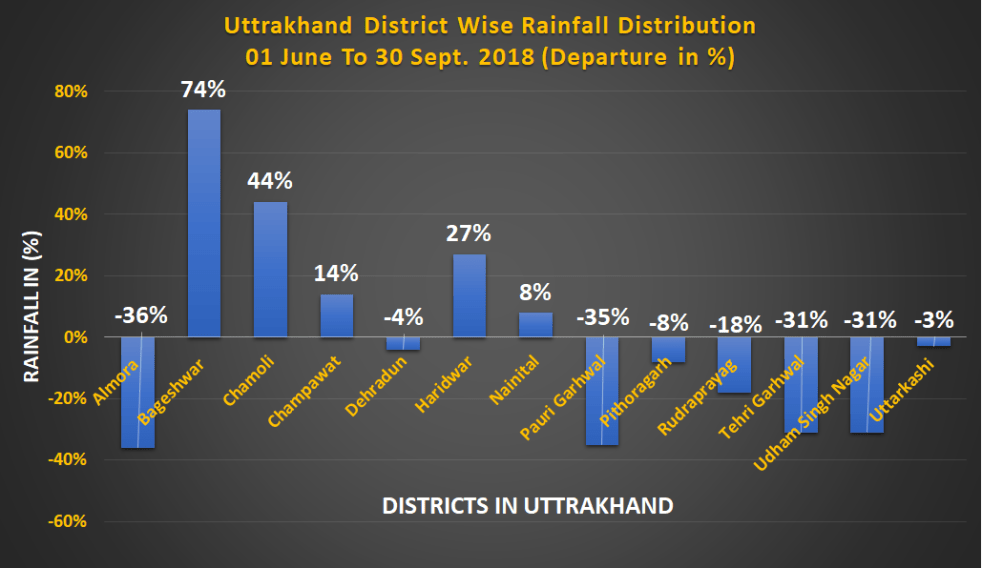
Uttrakhand has received 3% below normal rainfall during South West Monsoon 2018. Though the figure falls in normal category, however district level rainfall data paints a very different picture. Out of total 13 districts in the Himalayan state, four districts namely Almora, Pauri Garhwal, Tehri Garhwal and Udham Singh Nagar have received deficit rains, whereas three districts which includes Bageshwar, Chamoli and Haridwar have got rainfall in excess. Out of the rest six districts four are on marginally positive side and two are on marginally negative side.

Continue reading “Uttarakhand Monsoon 2018 Overview: Rainfall Normal, Distribution Abnormal”