Dams · DRP News Bulletin

DRP: 24 Sept 2018: If NGT Can’t Provide Environment Justice…

Unless immediate corrective action is taken, the NGT which has till recently served as an institution to provide environmental justice, will increasingly become an institution to perpetuate environmental injustice. If this is to happen, it will be a sad day for both India’s environment and democracy; writes Ritwick Dutta.

– Last few months have seen a massive decline in public confidence in the NGT. The first wake-up call was in July when the new chairperson of the NGT commented that around 50% of the petitions before the tribunal were filed by “blackmailers”. Nothing could be more distressing because this comes from an institution that was created to protect the rights of the people. Recently, the decision of the chairperson of NGT to rehear 18 cases, which were reserved for judgment, has raised concerns about both propriety as well as legality.

– The NGT, over the last two months, seems to have evolved four approaches to deal with litigations. First, dispose of existing cases. Second, form committees, comprising mostly people who were responsible for the problem, and outsource even adjudicatory functions. Third, refuse to entertain matters on the ground that the govt has approved the project or other hyper-technical grounds. And finally, rehear cases which were earlier reserved for judgment.

– One is not expecting the NGT to always give judgments in favour of those who approach it for protecting the environment. Rather, the cause for concern is the general reluctance of the tribunal to hear matters on merit, to consider the decision of the govt as virtually sacrosanct and submissions of project proponents as cast in stone. It must not be forgotten that the NGT is not a special tribunal, but a specialised tribunal set up to adjudicate on complex environmental issues through the use of both judicial and technical expertise.

Continue reading “DRP: 24 Sept 2018: If NGT Can’t Provide Environment Justice…”
Dams · Floods

Overview of CWC Flood Monitoring Sites 2018: INDIA

Central Water Commission is the only agency doing flood forecasting in India. As per CWC’s Flood Forecasting website[i] the Data Flow Map has information about 226 Flood Forecast Sites in the country comprising of 166 Level Forecast Sites and 60 Inflow Forecast Sites. It also monitors 700 Flood sites, information made available through List Based Exploration and Hydrograph View, but no flood forecasting is done for these sites.

In order to better understand the CWC’s flood monitoring and forecasting work, SANDRP has published report of CWC’s Level Forecast, Inflow Forecast and level monitoring sites in 5 zones of North India[ii], North East India[iii], East India[iv], South India[v] and West India[vi].  Through this report, we have presented all the data at one place with links to separate zone wise reports with detailed description.

Continue reading “Overview of CWC Flood Monitoring Sites 2018: INDIA”

Dams · Floods

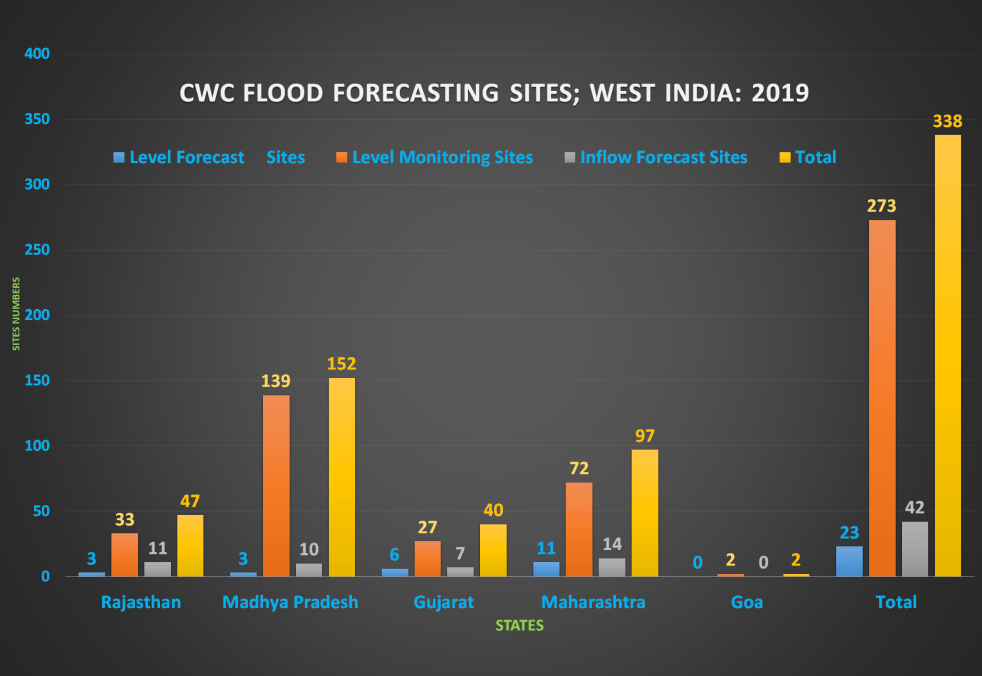
Overview of CWC Flood Forecasting Sites 2018: WEST INDIA

Central Water Commission is the only agency doing flood forecasting in India. As per CWC’s Flood Forecasting website[i] the Data Flow Map has information about 226 Flood Forecast Sites in the country comprising of 166 Level Forecast Sites and 60 Inflow Forecast Sites. It also monitors 700 other sites, information is made available through List Based Exploration and Hydrograph View, but no flood forecasting is done for these sites.

In order to better understand the CWC’s flood monitoring and forecasting work, in this article, we have given an overview of CWC’s flood forecasting and monitoring sites in West India. It includes state wise list of CWC’s Level Forecasting, Inflow Forecasting and level monitoring sites in 5 States in West India. Similar report has been published for North India[ii] and North East India[iii] and East India[iv] and South India[v]. This is the last part in the series.  Continue reading “Overview of CWC Flood Forecasting Sites 2018: WEST INDIA”

Dams · DRP News Bulletin

DRP: 10 Sept 2018: NIDM Lecture on Role of Dams in Kerala Floods

National Institute of Disaster Management, Ministry of Home Affairs, Govt of India invited Himanshu Thakkar, Coordinator of SANDRP,  to speak on the topic at IHC on Saturday. At the packed hall with participants that included members from Central Water Commission, National Disaster Management Authority, Embassies, Media and Civil Society,  the speaker explained how unwise and  unaccountable operation of dams, violating all norms, hugely contributed to the proportions of the Kerala flood disaster. Giving the example of Idukki dam, he showed, how if the dam was operated as per rule curve,  its contribution to the floods could have been reduced by over 50%. Similar is the story of other dams in Kerala.

Continue reading “DRP: 10 Sept 2018: NIDM Lecture on Role of Dams in Kerala Floods”
Dams · DRP News Bulletin

DRP: 3 Sept 2018: CHINA HAS STARTED DECOMMISSIONING DAMS

In a mountain village in southwest China’s Sichuan province, authorities have demolished seven small dam projects this year along a river to clear illegal developments in a new nature reserve. The demolition is part of a nationwide programme to close hundreds of tiny and often ramshackle dams and turbines and bring order to China’s massive hydropower sector after years of unconstrained construction.

The dams sat on an unnamed tributary of the fierce and flood-prone Dadu river, which feeds into the Yangtze, Asia’s largest and longest river, where the government says the “irregular development” of thousands of small hydropower projects has wrecked the ecology. But green groups say the campaign will not necessarily save the environment because it will not affect big state hydropower stations, which they say have caused the most damage.

On the 48 km Zhougong, authorities have already demolished small projects built in nature reserves or encroaching upon new “ecological red lines” drawn up to shield a quarter of China’s territory from development.

The government says small dams have disrupted the habitats and breeding patterns of many rare species of fish, although green groups argue the damage wrought by bigger dams is more severe, with entire towns and ecosystems submerged in water, which they say increases the risk of earthquakes, landslides and even climate change.

Continue reading “DRP: 3 Sept 2018: CHINA HAS STARTED DECOMMISSIONING DAMS”
Dams · Floods

Overview of CWC Flood Forecasting Sites 2018: SOUTH INDIA

Central Water Commission is the only agency doing flood forecasting in India. As per CWC’s Flood Forecasting website[i] the Data Flow Map has information about 226 Flood Forecast Sites in the country comprising of 166 Level Forecast Sites and 60 Inflow Forecast Sites. It also monitors 700 Flood sites, information made available through List Based Exploration and Hydrograph View, but no flood forecasting is done for these sites.

In order to better understand the CWC’s flood monitoring and forecasting work, in this article, we have given an overview of CWC’s flood forecasting and monitoring sites in South India. It includes state wise list of CWC’s Level Forecast, Inflow Forecast and level monitoring sites in South India. Similar report has been published for North India[ii] and North East India[iii] and East India[iv]. 

Tamil Nadu There are 3 Level Forecasting, 48 Level Monitoring and 14 Inflow Forecasting sites in Tamil Nadu State. Out of total 65 sites, 19 Level Monitoring and 2 Inflow Forecasting sites are inactive. MWL information is given only for 1 Inflow Forecasting site out of 14. IRRUKKANKUDI, Sathanur and Gomukhi sites are repeated with incomplete information. Out of 48, HFL figure and date is not provided for 25 Level Monitoring sites.

Continue reading “Overview of CWC Flood Forecasting Sites 2018: SOUTH INDIA”

Dams · Floods

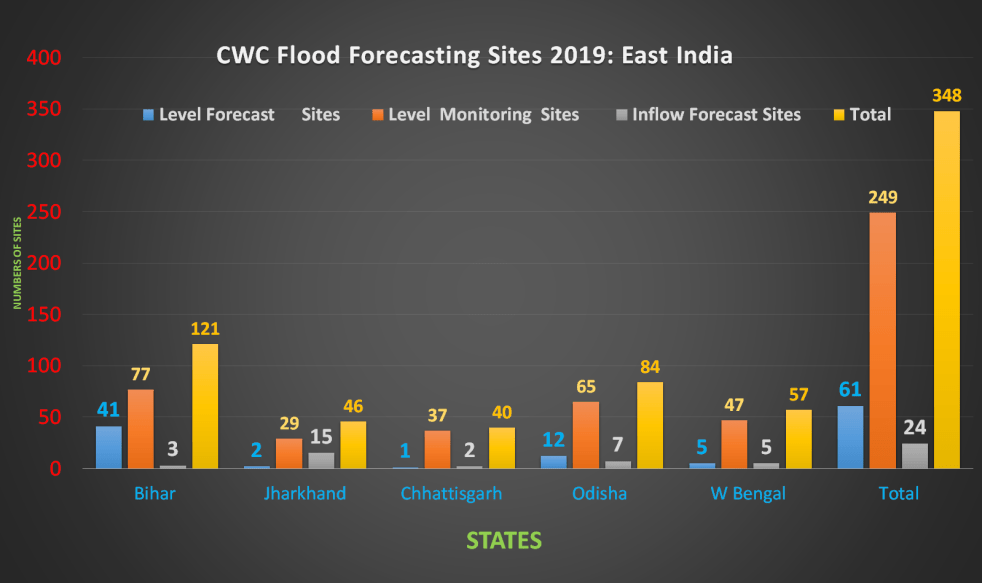
Overview of CWC Flood Forecasting Sites 2018: East India 

Central Water Commission is the only agency doing flood forecasting in India. As per CWC’s Flood Forecasting website[I] the Data Flow Map has information about 226 Flood Forecast Sites in the country comprising of 166 Level Forecast Sites and 60 Inflow Forecast Sites. It also monitors 700 Flood sites, information made available through List Based Exploration and Hydrograph View, but no flood forecasting is done for these sites.

In order to better understand the CWC’s flood monitoring and forecasting work, in this article we have given an overview of CWC’s flood forecasting and monitoring sites in East India. It includes state wise list of CWC’s Level Forecast, Inflow Forecast and level monitoring sites in East India. Similar report has been published for North India[II] and North East India[III] and we hope to publish reports covering other regions of India too. 

Continue reading “Overview of CWC Flood Forecasting Sites 2018: East India “

Dams, Rivers & People

DRP: 20 Aug 2018: Kerala Is Recovering From Unprecedented Flood Disaster, Will It Be Cauvery Or Krishna Basin Next?

Well-known ecologist Madhav Gadgil, founder of the Centre for Ecological Sciences at the Indian Institute of Science, Bengaluru, has described the devastating floods in Kerala as a man-made disaster and a reaction to the illegal excavations and stone quarrying done over a decade. https://www.hindustantimes.com/pune-news/illegal-forest-land-acquisition-major-reason-for-floods-in-kerala-says-ecologist-madhav-gadgil-calls-it-man-made-disaster/story-vMHPKUH623GEnjyQHI09NP.html  (19 Aug. 2018)

Further speaking to various regional media, Madhav Gadgil has said that irresponsible environmental policy is to blame for the recent floods and landslides in Kerala. He also called it a “manmade calamity”. He said that the committee report had recommended to protect the resources with the cooperation of local self-govt and people, but those recommendations were rejected.

He also pointed out that quarrying is a major reason for the mudslides and landslides. Other environmentalists also point fingers at the extensive quarrying, mushrooming of high rises as part of tourism and illegal forest land acquisition by private parties as major reasons for the recent calamity. https://energy.economictimes.indiatimes.com/news/power/kerala-floods-the-ghost-of-past-environment-policy-returns/65436707  (17 Aug. 2018)

Dams should never be filled before the end of the monsoons. Because then one doesn’t have any solution but to release the water in the surrounding areas: Himanshu Thakkar, SANDRP says as one of panellist discussing role of dams in aggravating Kerala floods.

Also see, NDTV discussion on Kerala flood crisis, it included SANDRP coordinator. https://special.ndtv.com/kerala-floods-42/video-detail/kerala-floods-non-stop-special-coverage-of-the-unfolding-crisis-491815  (19 Aug. 2018)

Here is NDTV Hindi discussion on Kerala flood crisis, included SANDRP coordinator. https://khabar.ndtv.com/video/show/ndtv-special-ndtv-india/ndtv-special-coverage-on-kerala-rain-crisis-491820  (19 Aug. 2018)

Here is admission about sudden, excessive releases and not foreseeing the coming disaster. The Kerala crisis could have been contained had the state “gradually released” waters from at least 30 dams, officials said, adding that the local authorities failed to foresee the imminent danger with high rain prediction. “Such floods have probably recurred after 100 years, exposing the state’s unprofessionally run reservoir management system and unpreparedness on disaster mitigation and disaster resilience, an official pointed out. https://timesofindia.indiatimes.com/city/kochi/gradual-dam-water-release-could-have-contained-crisis/articleshow/65436339.cms  (17 Aug. 2018)

Continue reading “DRP: 20 Aug 2018: Kerala Is Recovering From Unprecedented Flood Disaster, Will It Be Cauvery Or Krishna Basin Next?”
Dams · DRP News Bulletin

DRP: 13 August 2018: Existing Sediment Management Draft Policy Promoting Navigation & Not Rivers’ Health

Traditionally, our river management strategies are mainly focused on the water flows, including flood management, and these have resulted in various interventions such as dams, barrages, canals and embankments. Most of these interventions have had very little consideration for sediment transfer and even if they did, they were generally defunct within a few years of their operations either due to improper design or inadequate maintenance.

A long-term sediment management strategy has never been a part of any protocol of river management, not just in India, but in several other parts of the world. It is amply clear that sediment management must form an important component of management strategies for the Himalayan rivers. The Union Water Ministry has recently circulated a draft policy on sediment management.

Continue reading “DRP: 13 August 2018: Existing Sediment Management Draft Policy Promoting Navigation & Not Rivers’ Health”
Dam Induced Flood Disaster · Dams

Idukki Dam releases water when Kerala is in Floods: Could this have been avoided?

Kerala is facing serious floods. Army, Navy, NDRF, neighbouring states are all out. Dozens of people have died, landslides happening, houses washed away, the whole machinery is out to deal with the crisis.

In this flood crisis, Idukki & Idamalayar two of the Kerala’s biggest dams along with about two dozen others, are releasing water, adding to the floods and the disaster. Why are Idukki and Idamalayar, both having live storage capacity above a Billion Cubic Meters, releasing water NOW, when whole of Kerala is facing floods due to recent excessive rains? Standard excuse: The dams are full and they have no option but to release the water, they cannot store more. But why did they wait to start releasing water till the dams are full and they are faced with TINA: There is No Alternative. This love to be in TINA situation seems like a disease affecting all dam operators.

Continue reading “Idukki Dam releases water when Kerala is in Floods: Could this have been avoided?”