
The Karnataka High Court has taken up the petition challenging the constitution of the Expert Appraisal Committee (EAC) on River Valley and Hydropower projects. Notices have been issued to MoEF and also all the members of EAC on a petition filed by the United Conservation Movement Charitable Welfare Trust. Such a scrutiny of the appointment of the EAC was long overdue and urgently required. One hopes the High Court will take the matter to its logical conclusion and ensure that MoEF has a credible, transparent process of appointment of these committees as without such a process, the MoEF gets away with appointing only yes people on the committee who are happy to tow the government line. That nullifies the whole purpose of the constitution of the committee, the EIAs, the public consultations, the appraisals, the clearances and even credible monitoring and compliance. It is complete failure of environment governance and laws and MoEF even gets away with appointment of people with clear conflict of interest. MoEF has no process of selection of the chair and members of these committees. Hoping for the best for the case to correct all this.
Continue reading “DRP: 14 Dec 2020: Constitution of EAC for River Valley Projects Challenged in High Court”Tag: Climate Change

DRP: 30 Nov 2020: J&K SEAC denies EC to sand mining
In otherwise bleak governance of sand mining in India, J&K State Expert Appraisal Committee (SEAC) has denied environment clearance to sand mining projects on Jhelum river, since the proposals were not in conformity with the MoEF’s 2016 Sand Mining Management Guidelines, involved in-stream mining, did not have proper District Survey Reports, proper Sand Mining Plan or Replenishment studies. One hope this is emanating from genuine concern for proper governance and this needs to spread to more areas so that at least the guidelines get properly implemented.
Continue reading “DRP: 30 Nov 2020: J&K SEAC denies EC to sand mining”
DRP: 16 Nov 2020: India’s Environment Governance continues downhill journey
There are a number of stories here that shows that India’s environment governance continues its downhill journey. The first is a Third Pole story that narrates how Indian govt, through the Minister of State of MoEF misled parliament about the state of decline of biodiversity in India. The second is how MoEF is trying to bypass public hearing and public consultation process in oil and gas exploration projects even in the face of the severe consequences India experienced in the Assam episode of similar mis-governance in the past. The third one is how Kerala govt has failed to assess the impacts of tunneling in Western Ghats. These are only some of the signs. There are much bigger warning writ all over. Until and unless people rise up against these, there is little hope of any change here.
Continue reading “DRP: 16 Nov 2020: India’s Environment Governance continues downhill journey”
DRP: 9 Nov 2020: Welcome water initiatives
Nature in Focus features India’s 12 water heroes. This is an interesting exercise. We also add some interesting stories from this week that should possibly feature in such efforts.
Nature in Focus 12 heroes redefining the landscape of water conservation This is the final story in a series of articles launched by Astral Pipes and Nature in Focus to create awareness about the ongoing water crisis and to encourage necessary action to address it. The names include Vishwanath Srikantaiah, Veena Srinivasan, Aabid Surti, Aabid Surti, Kalpana Ramesh, K.J.Joy, Rajendra Singh, Shishir Rao, Parineeta Dandekar, Ajya Mittal, Nachiket Kelkar, Aditi Mukherji. Links to interviews with each of them can be found here: https://www.natureinfocus.in/save-every-drop. Great to see that Parineeta Dandkear of SANDRP is also there! https://www.natureinfocus.in/save-every-drop/the-answer-to-india-s-water-crisis (4 Nov 2020)
Continue reading “DRP: 9 Nov 2020: Welcome water initiatives”
DRP: 2 Nov. 2020: Citizen Efforts to Save our Rivers
It’s heartening to see at least three citizen efforts that media has brought to limelight this week, two in Odisha and one from the banks of Godavari river in Nasik. Besides being citizen efforts, one common theme is that all these initiatives is that they concern rivers. Great news to celebrate in this festival season, also when India Rivers Week is also conducting weekly Dialogues on River sand mining.
Continue reading “DRP: 2 Nov. 2020: Citizen Efforts to Save our Rivers”
DRP: 26 Oct 2020: Why Floods is not big issue in Bihar elections?
Or may be it is a major issue at a number of places. Like in Kishanganj district along Mahananda river in North East Bihar, as the report here mentions. We hope it is. Since floods and how they are managed affect so fundamentally and in so many different ways so many people, it should be an election issue. Particularly when the incumbent Chief Minister Nitish Kumar is fighting to be voted in after being the Chief Minister of the state for 15 years since Nov 2005 (except brief ten month period in 2014-15).
15 years is long enough time to have been able to make at least some dent in flood management. On ground, the situation seems to have only gone worse. It was in this 15 year period that the unprecedented Kosi floods happened after the Kusaha breach in 2008. But the word unprecedented has been used for several more floods in these 15 years, including by Nitish Kumar. He also raised a number of pertinent issues in this period, including impact of Farakka barrage on Bihar floods, need for its decommissioning, Bihar’s right to get Ganga water from the headwaters in Uttarakhand [currently it gets none except during monsoon]. He is currently silent on these issues, but voters and media do not have to be silent.
Continue reading “DRP: 26 Oct 2020: Why Floods is not big issue in Bihar elections?”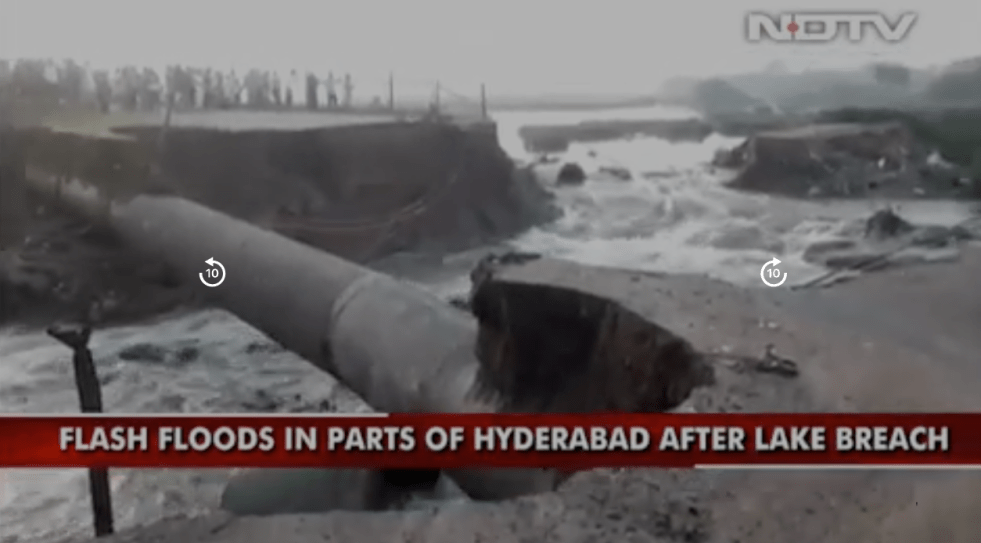
Krishna-Bhima basin floods in Oct 2020 breaks 56-year-old record
Krishna basin is again facing unprecedented floods, for the second straight year. Unprecedented is a bit of overused word these days, but consider the facts: At no less than ten locations, the Highest Flood Levels (HFL) ever recorded at those locations in the Krishna basin were surpassed (nine locations) or equaled (one location). Some of the HFLs surpassed this year were amazing 56, 51 and 44-year-old records! And imagine most of this happening in second half of Oct 2020, when South West monsoon is traditionally over by end of Sept! There is no doubt the floods were unprecedented.
Continue reading “Krishna-Bhima basin floods in Oct 2020 breaks 56-year-old record”
DRP: 19 Oct 2020: India Rivers Week 2020: IS SAND MINING KILLING OUR RIVERS?
India Rivers Week (IRW) Organising Committee is excited to announce that the theme of the forthcoming annual event IRW 2020 will be: “Is Sand Mining Killing our Rivers?”. As part of IRW-2020, India Rivers Forum is organizing a series of Dialogues (digitally). This includes four regional dialogues focusing on North (Oct 31), South (Nov 7), West (Nov 12) and East (including North East: Nov 21)) India, and the final one (Nov 28) focusing on Sand Mining as a National issue.
Sand mining or mining of River Bed Material (RBM, including sand, gravel, boulders) has a huge impact on Rivers, in multiple ways: physical, ecological, livelihood impacts among others. While sand is also sourced from sources other than rivers, IRW 2020 will focus on sand sourced directly or indirectly from rivers. Sand is by definition, a key ingredient of the rivers. It provides habitat for multiple species of the biodiversity in the river. It provides both sub surface storage space and a mechanism to recharge the groundwater. The sand, along with silt, clay, pebbles and boulders are part of the river and are supposed to reach the deltas and provide a key existential medium in floodplain and deltas. To achieve that, sustaining river connectivities is very important.
Continue reading “DRP: 19 Oct 2020: India Rivers Week 2020: IS SAND MINING KILLING OUR RIVERS?”
DRP: 12 Oct 2020: Why is India’s flood forecasting system ineffective?
This scholarly article shows why India’s flood forecasting system is ineffective. It is not location specific, provides too short a time, it does not provide the intensity of flooding, it is not comprehensive, there is no independent assessment. As far as dams are concerned, its performance is worst, and is unable to either expose wrong dam operations or take action against such operations. Its inflow forecasts are most of the time non existent. It makes numerous errors, but fails to correct them for long time. Its website is slow, sometimes totally non functional. It keeps changing the monitoring sites, their HFLs and provides neither consistency nor reasoning for many of its actions. In the middle of the monsoon it decided to curtail the hydrographs and information display system. Read on.
Continue reading “DRP: 12 Oct 2020: Why is India’s flood forecasting system ineffective?”
DRP: 5 Oct 2020: Nominations Invited for the 2020 Bhagirath Prayas Samman & Anupam Misra Medal
INDIA RIVERS WEEK 2020 invites Nominations for the Bhagirath Prayas Samman (BPS) and Anupam Misra Medal.BPS was constituted in 2014 with Late Shri Ramaswamy Iyer as the Chair of Jury. BPS aims to recognize the unsung heroes for their outstanding and sustained efforts towards protection and conservation of rivers. Shri Anupam Mishra Memorial Medal (AMM) constituted in 2017 aims to celebrate journalists and media professionals who have established an exceptional body of credible work on various aspects of rivers leading to changes in behaviour, public discourse, law and policy. Based on well defined criteria, the Jury of the BPS & AMM selects the awardees. Nomination forms can be submitted to any of the following e-mail addresses: indiariversweek2014@gmail.com or mpuri@wwfindia.net, with the subject line: BPS/ AMM 2020 Nomination. The last date for the submission of nominations is October 25, 2020. Forms are available at: https://indiariversforum.org/nominations-open-for-bps-amm-awards-india-rivers-week-2020/
Continue reading “DRP: 5 Oct 2020: Nominations Invited for the 2020 Bhagirath Prayas Samman & Anupam Misra Medal”
