
The minutes of the Apr 23, 2019 meeting of MoEF’s Expert Appraisal Committee (EAC) for River Valley Projects once again proves that this committee is least bothered to honour its mandate to protect rivers and environment and ensure adherence to rules and punish violations. In stead, it acts more like a lobby for Dams. This was apparent from a number of instances, but more glaringly from what it said about the proposed Lakhwar Dam on Yamuna river, in Ganga Basin. Lakhwar dam has had no EIA, public consultations, appraisal, management plan, disaster impact assessment, or cumulative impact assessment. SANDRP, after field visit and via more than one letters informed the committee before its meeting on April 23, 2019 about the violations and destruction of riverbed, flood plain and biodiversity happening, but the committee has not even bothered to acknowledge the submissions, leave aside the question of taking any action on them. (https://sandrp.in/2019/04/23/lakhwar-vyasi-dam-different-reality-before-the-window-dressing-for-eac/)
Continue reading “DRP: 13 May 2019: MoEF’s expert committee not bothered about rivers or environment, acts like lobby for Dams”Tag: Cauvery

DRP: 06052019: Delhi HC takes Suo moto action on RWH in Delhi
On April 16, 2019, Delhi High Court bench decided to initiate a Public Interest Litigation based on a newspaper report that not much rainwater harvesting or groundwater recharge is happening in spite of years of talk that seems to have remained empty. This is a welcome move and one hopes HC takes the issue to its logical conclusion.
Continue reading “DRP: 06052019: Delhi HC takes Suo moto action on RWH in Delhi”
DRP: 1 Apr 2019: Dead Sabarmati shows failure; Ganga going the same way?
As joint monitoring report by Paryavaran Surakhsha Samiti (PSS) and Gujarat Pollution Control Board (GPCB) shows, Sabarmati is severely polluted river, downstream of Ahmedabad and is practically a dead river. Upstream of Ahmedabad, the once perennial river has no water of its own and is stealing the Narmada water meant for drought prone areas.
This incidentally is supposed to be model river rejuvenation as told to SANDRP coordinator on a television channel by no less than Executive Director (Technical) of National Mission on Clean Ganga. In fact posters during the 2014 Parliamentary elections in Varanasi, where Mr Modi fought from, said exactly that. So is the National Ganga river going down that path? Narmada itself is in same situation downstream of the dam in Gujarat as another report here shows. Gujarat model has many examples to show, it seems.
Continue reading “DRP: 1 Apr 2019: Dead Sabarmati shows failure; Ganga going the same way?”
DRP: 25 Mar 2019: Gujarat groundwater pollution; Implications not assessed
A report of groundwater pollution in Luna village accessed by Paryavaran Suraksha Samiti (PSS) has once again pointed to the alarming rate of groundwater contamination in the industrial belt in Padra in Vadodara. The report accessed through RTI found that that the Chemical Oxygen Demand (COD) level in groundwater was an alarming 2225mg/I and 27222mg/I in October and December 2018.
It should be noted that even in treated effluent water the accepted levels of COD is 250 mg/I. For ground water the level should be nil. The report was a result of joint investigation carried out by the Gujarat Pollution Control Board (GPCB), Paryavaran Suraksha Samiti (PSS), Farmers Action Group (FAG) and affected farmers in October and December 2018.
Continue reading “DRP: 25 Mar 2019: Gujarat groundwater pollution; Implications not assessed”
DRP: 4 Mar 2019: INDIA SAND MINING 2018; SANDRP’s NATIONWIDE REVIEW
Punjab Sand Mining 2018 Overview: SAD SAGA OF STATE FAILURE
Rajasthan: SC Banned Riverbed Mining through 2018: Centre & State Show No Concern
Gujarat Sand Mining 2018: Can Technology alone help Stop Illegal Sand Mining?
Uttar Pradesh Sand Mining 2018: Key NGT orders slap for MoEF
Madhya Pradesh Sand Mining 2018: Unprecedented Violence by Sand Mafia
Karnataka Sand Mining 2018: Hopeless, But Action Packed!
Tamil Nadu Sand Mining 2018: Story of Nexus exposed by a brave Journalists
Kerala Sand Mining 2018: How a 17 year Allapad girl became anti sand mining icon
Maharashtra Sand Mining 2018: Panegaon shows Way To stop Illegal Sand Mining
North East India Sand Mining 2018: Emerging threat to Rivers
East India Sand Mining 2018: Will NGT order help restore Subarnarekha River?
Sand Mining 2018: Telangana and Andhra Pradesh
Illegal Sand Mining Violence 2018: at least 28 People died across India
Sand Mining 2018: Is Illegal Sand Mining A National Menace?
Continue reading “DRP: 4 Mar 2019: INDIA SAND MINING 2018; SANDRP’s NATIONWIDE REVIEW”
Tamil Nadu Sand Mining 2018: Story of Nexus exposed by a brave Journalists
Brave Journalists exposes the Nexus supporting illegal sand mining in Tamil Nadu
Reporter honoured for exposing illegal mining On January 4, 2019, Sandhya Ravishankar was conferred Ramnath Goenka Excellence in Journalism Award for her reportage on illegal beach sand mining in Tamil Nadu. https://www.thenewsminute.com/article/news18-editor-m-gunasekaran-becomes-1st-tamil-journalist-bag-ramnath-goenka-award-94522 (5 Jan. 2019)
Journalist stalked after reports on sand mafia Sandhya Ravishankar, Chennai-based journalist alleges multiple attempts to stalk and intimidate her in the recent past after she wrote a series of reports on the sand mafia. She is also fighting defamation cases. https://www.firstpost.com/india/chennai-based-journalist-sandhya-ravishankar-alleges-stalking-intimidation-after-reports-on-sand-mining-mafia-5295131.html (1 Oct. 2018)
Explosive reports on illegal beach sand mining in Tamil Nadu by Sandhya Ravi Shankar: Her report first person singular on Jan 31, 2017 provides blow by blow account of how the nexus involved in illegal sand mining was exposed. (https://thewire.in/culture/beach-sand-cartel, https://thewire.in/tag/beach-sand-mining)
Continue reading “Tamil Nadu Sand Mining 2018: Story of Nexus exposed by a brave Journalists”
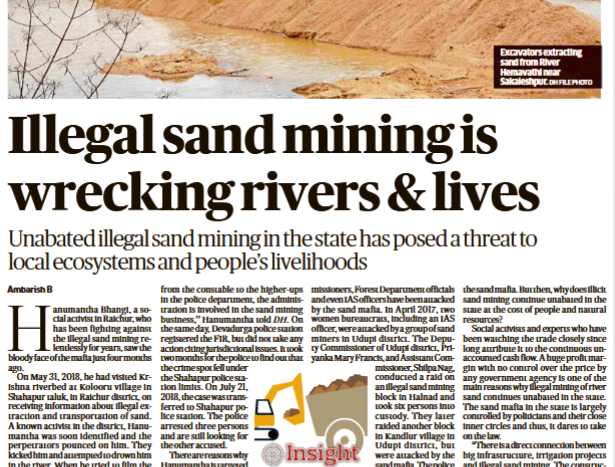
Karnataka Sand Mining 2018: Hopeless, But Action Packed!
Karnataka is one of the leading states to witness the devastating effects of rampant sand mining. Between 2015 and 2018, the state has officially registered 20,779 cases of illegal sand mining, and 9,599 FIRs.
The state govt is receiving approximately Rs 150 crore per year as royalty from legitimate sand mining. As per estimates, the state govt is losing around Rs 200 crore per year due to illegal sand mining.
According to cement manufacturing companies’ data, around 18 million tonnes (MT) of cement is sold in the state every year. The cement-sand mix ratio is either 1:4 or 1:6 (four or six bags of sand per cement bag). Even if 1:4 ratio is taken, 72 MT of sand is approximately used in the state every year.
The official data from the Department of Mines and Geology shows that from the blocks permitted by it, a total quantity of 30 MT of sand (from all types of blocks – river sand, patta land, blocks allocated to govt departments, and manufactured sand) is produced in the state. Thus, there is a difference of at least 42 MT sand compared to the cement sold in the state.
Continue reading “Karnataka Sand Mining 2018: Hopeless, But Action Packed!”

DRP: 10 Dec. 2018: Yamuna Pollution; Will NGT Panel Make Any Difference?
Feature image: A Hindu woman worships the sun god in the polluted waters of River Yamuna during Chhath Puja in New Delhi, on Nov. 14. (Image Source: Quartz India.)
In its latest report, the National Green Tribunal (NGT) appointed monitoring committee overseeing Yamuna River cleaning progress in Delhi says that the river is “fighting to stay alive” and it would not be possible to rejuvenate the Yamuna unless minimum environmental flow is provided as it is “virtually reduced to a trickle and remains dry in some stretches for almost nine months of the year”.
In the action plan, it is mentioned that “Although the Yamuna river flows only for 54 kilometres from Palla to Badarpur through Delhi, the 22 km stretch from Wazirabad to Okhla, which is less than 2 per cent of the river length of 1370 km from Yamunotri to Allahabad, accounts for about 76 per cent of the pollution level in the river”.
The committee has suggested that a team of scientists be formed from CPCB, DPCC and other institutions like IIT Delhi or NEERI to carry out inspections and submit reports to it for remedial action. The team can look into the risks and benefits of an alternative way of routing the same quantity of water which can help in reducing the pollution level, it said.
The monitoring committee also raised objection to the capacity utilisation of common effluent treatment plant (CETP) which is as low as 25 per cent. There are 28 industrial clusters in Delhi and 17 of these are connected to 13 CETPs. The remaining 11 clusters are not connected to any CETP. Another area of concern is the direct discharge of completely unregulated waste from industries and residences into the river.
Continue reading “DRP: 10 Dec. 2018: Yamuna Pollution; Will NGT Panel Make Any Difference? “
DRP: 19 Nov 2018: India Rivers Week 2018 to focus on Ganga Rejuvenation
The India Rivers Week 2018, in fifth year, will be held at WWF, Delhi during Nov 24-26, 2018. The focus of the IRW this time is: “Can India Rejuvenate Ganga?“. Shri Rajiv Ranjan Mishra, Director General of the National Mission for Clean Ganga will address the inaugural session with Chief Guest Shri Jairam Ramesh, former Union Minister, in Chair. The meeting will see over 150 people from all over India participate to discuss state of India’s rivers at the only meeting in India focussing exclusively on rivers.
The Annual River Lecture will be given by Prof Rajiv Sinha of Indian Institute of Technology, Kanpur. The Bhagirath Prayas Samman award for the best work on River Conservation and the Anupam Mishra Medal for exemplary media work on River conservation will be given away by famous Chipco leader Shri Chandiprasad Bhatt.
Shri U P Singh, Secretary, Union Ministry of Water Resources has agreed to the chief guest at the concluding session on Nov 26, Monday. Started in 2014, the meeting is collectively organised by Yamuna Jiye Abhiyan, WWF-India, INTACH, Toxics Link, People’s Science Institute (Dehradun), Peace Institute and SANDRP.
For more information, please see: https://indiariversforum.org/2018/11/19/india-rivers-week-2018/. Follow IRW at: https://www.facebook.com/IndiaRiversWeek/ and https://twitter.com/IndiaRiversWeek
Continue reading “DRP: 19 Nov 2018: India Rivers Week 2018 to focus on Ganga Rejuvenation”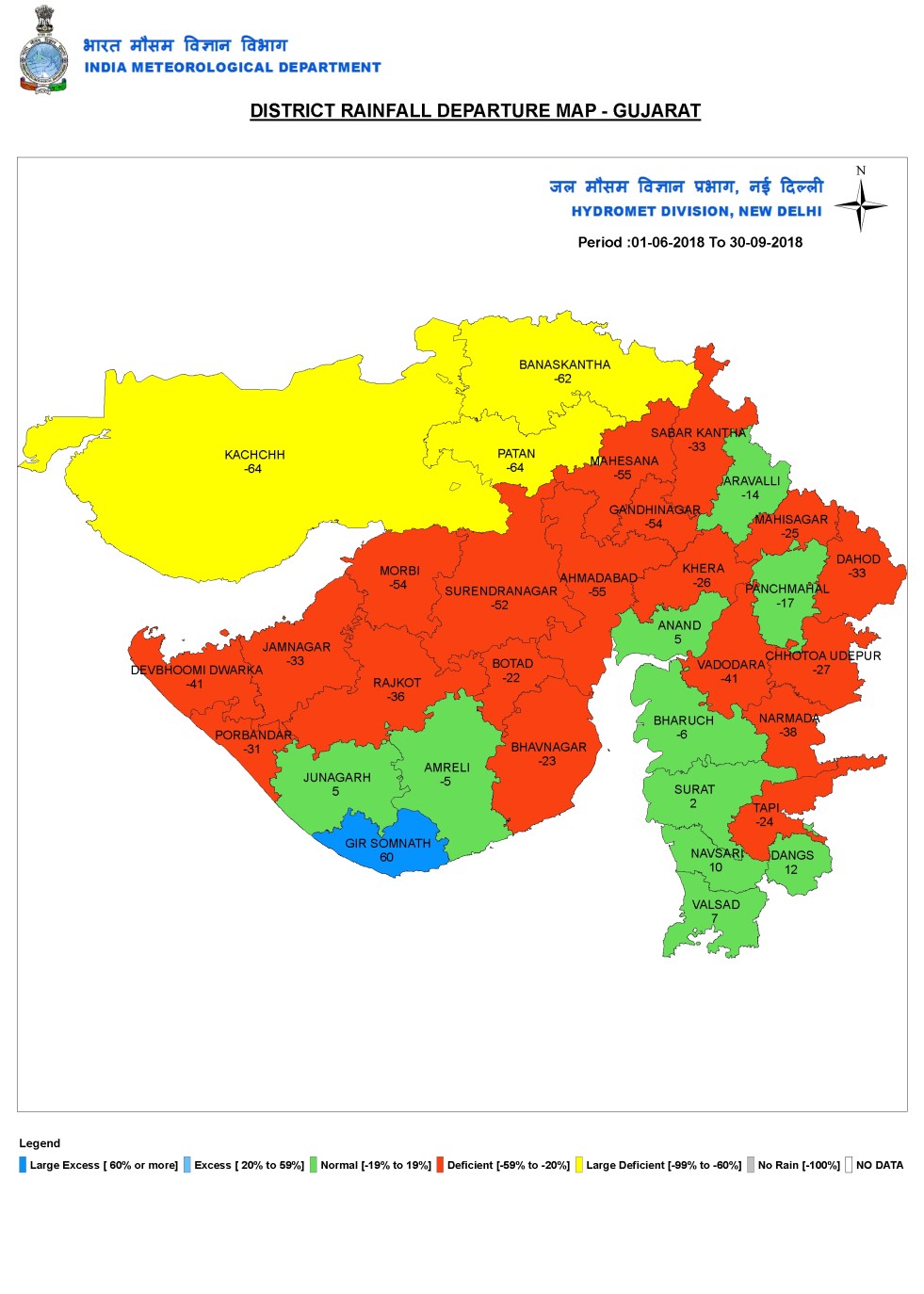
DRP: 22 October 2018: Looming Drought in Western India
(Feature image Gujarat state cumulative rainfall during SW monsoon 2018; Source: IMD)
Maharashtra State’s groundwater surveys and development agency (GSDA) has warned of a water scarcity in 11,487 villages of 167 tehsils in the State. In its 2018-19 report, the GSDA, which comes under the department of water supply and sanitation, has said the study of the groundwater level (in comparison to the level in October in the last five years) has shown that of the 353 tehsils in the State, 13,984 villages in 252 tehsils have shown a decrease by more than one metre.
Between October 15 and 21, 380 tankers were used across the State, against 91 tankers in the corresponding period last year. A week prior to that the number was 354, and 329 tankers were used in the first week of October.
Continue reading “DRP: 22 October 2018: Looming Drought in Western India” SANDRP