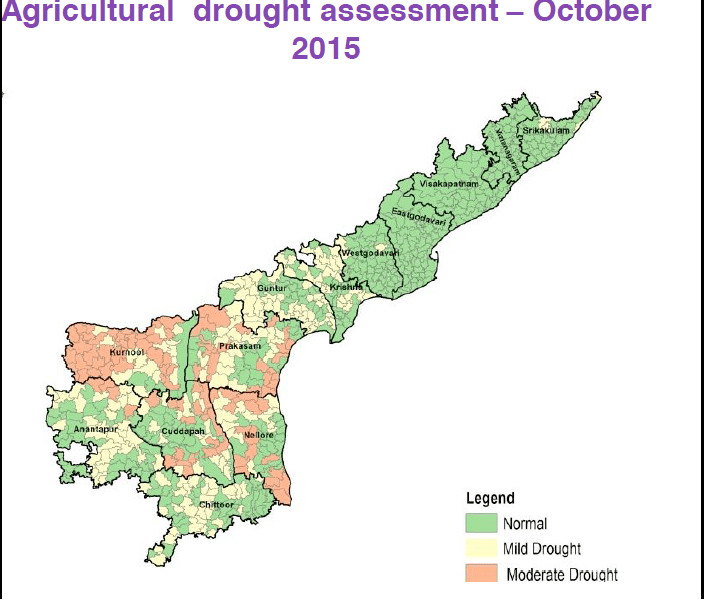
On Oct 28, 2015, the Andhra Pradesh government declared 196 mandals in seven districts, as drought-affected during the Kharif season 2015. The districts were Srikakulam (10 mandals), Prakasam (21), Nellore (14), Chittoor (39), Kadapa (33), Anantapur (39) and Kurnool (40). Consequent to the declaration of drought, the government directed the concerned district Collectors to notify the specific drought-hit areas in the District Gazette to enable farmers to avail credit facilities. On Nov 22, 2015, the Govt. added 163 mandals to the list of drought hit bringing the number up to 359 mandals. This included mandals in Guntur, Krishna, Vizianagaram. Drought was declared in 10 out of 13 districts. Crop loan and relief measures were to be taken up in these mandals as per guidelines. The state demanded central assistance of Rs 2,000 crore.
Category: Dams

Telangana Drought 2016
The severe drought in Telangana has caused acute shortage of drinking water and worsened the agriculture crisis in the state.
On Nov 24, 2015, the Telangana government declared drought in 7 out of 10 districts. It declared 231 out of 443 rural mandals (blocks) in the State as drought-affected and sought an immediate assistance of Rs. 1000 crore from the Centre. All the mandals in Mahabubnagar (64), Medak (46) and Nizamabad (36) districts were declared drought-hit. Other mandals declared drought-hit included 33 out of 37 in Ranga Reddy, 19 of 57 in Karimnagar, 22 of 59 in Nalgonda, and 11 of 51 in Warangal. None of the mandals in Adilabad (52) and Khammam (41) districts were on the list.

India facing its worst water crisis ever: Himanshu Thakkar
Find below interview of SANDRP coordinator Himanshu Thakkar by Aditi Phadnis, Business Standard. The interview was published in Business Standard on the 14th May 2016 (http://www.business-standard.com/article/opinion/india-facing-its-worst-water-crisis-ever-himanshu-thakkar-116051400704_1.html)
~~
Environmental activist and water expert Himanshu Thakkar tells Aditi Phadnis that India needs a comprehensive water-use policy immediately.
You are quoted as saying that India is in the grip of its worst hydrological crisis ever. Isn’t that a bit drastic? After all, India has endured endemic water scarcity in many parts of the country for several years now. What makes you so pessimistic?
I do not think it is statement of pessimism but possibly reflects a reality. What we are seeing this year is unprecedented in many respects: major perennial rivers like the Ganga, Godavari, Krishna and Netravati have dried up at several locations, which was unheard of earlier. Groundwater levels are at a record low. In many places hand pumps have dried up completely. The number ofpeople impacted, the intensity of the impact are huge. This is only the fourth time in a century that there has been a back-to-back drought, but on all previous occasions groundwater, an insurance in times of drought, had provided relief. That is no longer an available option in several places. Our rivers are in a much worse situation today than ever in the past, due to all the ill treatment we have meted out to them, including multiple and often unnecessary, unjustified damming. All this makes the situation this year much worse.
You are credited with making public a lot of information and anlysis about the circumstances of the current shortage of water in Maharashtra. What do your findings tell us about the issue of water in the state?
The first thing that strikes you about Maharashtra is that it has, by far, the highest number of big dams in India. According to the National Register of Large Dams of the Central Water Commission, of the total number of 5,100 big dams 1,845 are in Maharashtra. So about 35 to 36 per cent of all big dams in India are in the state. Yet Maharashtra is in the headlines for drought and water scarcity today. While nationally, 46 per cent of cropped area is irrigated, in Maharashtra the figure is hardly 18 per cent. There is a lot of evidence here that big dams have proved to be a failed water resources development model. The current chief minister did say in his famous Assembly speech on July 21, 2015, that farmers need irrigation, not dams, and dams are not the only means to achieve irrigation. Unfortunately, one of the major planks used by his party to achieve power in Maharashtra, the Rs 70,000-crore irrigation scam, seems to have been totally forgotten by the state government.
Parts of Maharashtra are facing multiple agrarian and hydrological crises this year. Rainfall deficits have been as high as 40 and 42 per cent in the last two years in Marathwada. In some districts and blocks the figure is even higher. So rain-fed kharif crops in many parts have failed for the last two years. The rabi crops were also hit by unprecedented hailstorms in 2014 and 2015. The 2016 rabi season has been hit by unusually dry conditions.
During the 2015 monsoon, we (my Pune-based colleague Parineeta Dandekar does most of our Maharashtra-related work) realised in mid-July that this year is going to be a crisis for most of Maharashtra, in addition to some other adjoining areas. So we wrote to the chief minister in August that the state needed to take certain measures urgently. This included stopping the diversion of about three billion cubic metres of water from the Bhima and Krishna basins to the high-rainfall Konkan area, stopping non-essential water-use activities, taking stock of available water and deploying it for priority needs, and so on.
The Maharashtra government did not wake up to this situation then or at the end of the monsoon or even now. While the Jalyukt Shivar Abhiyaan, the flagship scheme of current Maharashtra government, is welcome, leaving aside some problematic work they are doing in terms of deepening, widening and straightening of rivers, it cannot be a fig leaf to hide its incompetence in handling this crisis.
In Marathwada and western Maharashtra (similarly, also northern Karnataka) sugar cane cultivation on about four to five per cent of cropped land takes up about 70 per cent of available irrigation water. We have been saying that considering the rainfall, weather situation and water availability, sugarcane is not a sustainable crop in these regions. However, even when 2014 and 2015 monsoon had major deficits in Maharashtra, the area under sugarcane remained at record levels. This was after the 2012 drought in Maharashtra, when the same issues had cropped up and the government, including the then Union agricuture minister Sharad Pawar promised intervention. We saw no implementation of those promises then. The situation is the same now.
Industry and agriculture are both responsible for the water crisis. But industries can’t be shut and farmers can’t be told to stop farming. So what is the answer?
I won’t say industry and agriculture are responsible. The kind of industries we set up and the kind of agriculture we do in any region has to keep in mind the various factors prevailing in the region, including water. When we conduct water-intensive activities in water-starved regions, that is an invitation to an inequitable, unsustainable, conflict-generating situation and sooner or later we will face the consequences. We have seen this happening in Maharashtra over the last decade most starkly.
Shouldn’t everyone be made to pay for water? Punjab has 98 per cent irrigation. It has spent money over the years, setting up irrigation channels, etc. Nobody has paid for those. Worse, the water running in those channels is not paid for either. By contrast, Maharashtra has barely 18 per cent irrigated land. What is the solution?
About 80 per cent of the water we use is supposed to be used by farmers, and I think there is national consensus that farmers in most places are not in a position to bear additional input costs in the current situation. Farmers need to be guaranteed much better returns on their produce than they are getting now. Say, if the Bharatiya Janata Party is able to implement the promise it made to farmers in its election manifesto that they should get 50 per cent return on investment, then maybe we can start talking about making farmers pay for the water, as that cost will then be included in the input cost calculations.
Moreover, a lot of users of water even in urban and industrial areas are not paying for the water they use or pollute. For example, a lot of groundwater gets used up by them, but there is no payment or regulation of this. Nor are they being made to pay for the pollution their effluents lead to.
We also need more participatory decision-making in water resources development before we can start asking farmers to pay for all the wrong decisions that are being taken now.
In the midst of all this gloom over lack of water, some states -Telangana and Maharashtra, for instance – have signed a pact to interlink rivers (ILR). Andhra Pradesh and Telanagana have already effected the interlinking of two rivers. Is this the way forward?
Today groundwater is India’s water lifeline, as most of our water comes from it and in every water sub-sector the dependence on groundwater is increasing with each passing year. So whether we like it or not, whether we want it or not, groundwater is our water lifeline. Our water policy, programmes and projects need to focus and prioritise how to sustain the groundwater lifeline. Will ILR help achieve that? The answer is no. In fact, we also need to prioritise optimisation of use of our existing water infrastructure; second, making rainwater harvesting the central focus as that can help sustain groundwater. ILR is costly, environmentally destructive, socially disruptive and a non-optimum option, particularly in view of the changing climate, in addition to other issues.
In hill regions like Uttarakhand and Kashmir, the frenzy of the floods can hardly be forgotten. What is happening there?
Yes, all across the Himalayas, the high disaster vulnerabilities (to earthquakes, floods, landslides, erosion and flashfloods) have deepened because of the changing climate and the kind of interventions we are doing there. Our disaster management infrastructure remains a rather weak link, as the Supreme Court order on on May 11, 2016 about the current drought pointed out. We seem to have learnt little from the Uttarakhand disaster of June 2013 and the Jammu and K ashmir floods of September 2014 and March 2015. As the Nepal earthquake of April-May 2015 showed, these regions are prone to major seismic shocks. All this demands urgent action and possibly course change.
Original link: http://www.business-standard.com/article/opinion/india-facing-its-worst-water-crisis-ever-himanshu-thakkar-116051400704_1.html
DRP: 16 May 2016 (Water conservation: Lessons from ancient India)
Water conservation: Lessons from ancient India As drought-like conditions have gripped many parts of India this year, the pressure to drill borewells in search of increasingly scarce groundwater has escalated. Many regions are in the grip of a vicious cycle of drilling causing the water table to sink further. There is an urgent need to explore what benefits water conservation can bring, whether through modern or ancient water storage structures. This report explains, ecologically safe engineering marvels of water conservation have existed in India for nearly 1,500 years, including traditional systems of water harvesting, such as the bawari, jhalara, nadi, tanka, and khadin. Even today these systems remain viable and cost-effective alternatives to rejuvenate depleted groundwater aquifers, according to experts. With govt support, these structures could be upgraded and productively combined with modern rainwater-saving techniques such as anicuts, percolation tanks, injection wells and subsurface barriers. This may be a far more sustainable approach to alleviating the water scarcity crisis across India. Ultimately, water conservation has to be a key element of any strategy to bring an end to India’s perennial swings between drought and flood.
Continue reading “DRP: 16 May 2016 (Water conservation: Lessons from ancient India)”

Letter to PM: Devise a policy for curbing hydropower water diversions during drought years
Above: Red arrows indicate diversion of water from Tata Dams into surplus basin. Source: Google earth images and SANDRP
Since past three years, SANDRP has been raising the issue of West-ward water transfer during drought years by hydropower dams. Maharashtra annually diverts 3324 Million Cubic Meters of water from its water deficit Bhima and Krishna basins into the water surplus Konkan basin for hydropower generation. This happens though 6 dams on Bhima Basin privately owned by Tata Power and the Koyana Hydropower Project. Although drinking water is the first priority for any society and this is enshrined in the National and State Water Policies, there is no system in place to allocate the waters of these dams to the downstream, when there is dire need. During this drought, which is possibly Independent India’s worst droughts, Tata Dams have released nearly no water to the Bhima Basin and Maharashtra Government on its part has taken no stand on this issue.
After raising this issue several times at many platforms, SANDRP has sent a letter to the Prime Minister as well as to the National Human Rights Commission on this issue. If you agree with the points raised in the letter below, please send similar letter to the authorities. Continue reading “Letter to PM: Devise a policy for curbing hydropower water diversions during drought years”

Dr. Roxy Mathew Koll: “Warming Indian Ocean means a Weakening Indian Monsoon”
Above: All-India Summer Monsoon (June-September) Rainfall Anomalies during 1871-2015. Note that since 1950s, not only has the incidence of droughts increased, but rainfall in the excess of 10% has also decreased markedly Source: IITM Paper Interanual Variations of Indian Summer Monsoon
When it comes to Global Warming and Climate Change (not interchangeable terms), India and the world have witnessed a series of firsts in the past year. The last 11 months have been the warmest months in recorded history, each monotonously breaking a previous record[i]. In India, regions like Maharashtra including Marathwada have experienced back to back droughts, in addition to increasing frequency of Extreme Weather events like Hailstorms and unseasonal rainfall. Variability of Western Disturbances has increased, which is linked with extensive anthropogenic warming over Tibet[ii]. Our response to Climate Change and the challenges it poses has been far from satisfactory. There has been no impact of National Action Plan for Climate Change, due to the inherent problems in its inception[iii]. State Plans lay languishing for several years, without clear accountability and transparency[iv]. India’s INDCs (Intended Nationally Determined Contribution) indicate more harm than good.[v] Continue reading “Dr. Roxy Mathew Koll: “Warming Indian Ocean means a Weakening Indian Monsoon””
DRP: 9 May 2016 (Welcome initiative by Lok Sabha Speaker on draught and ILR)
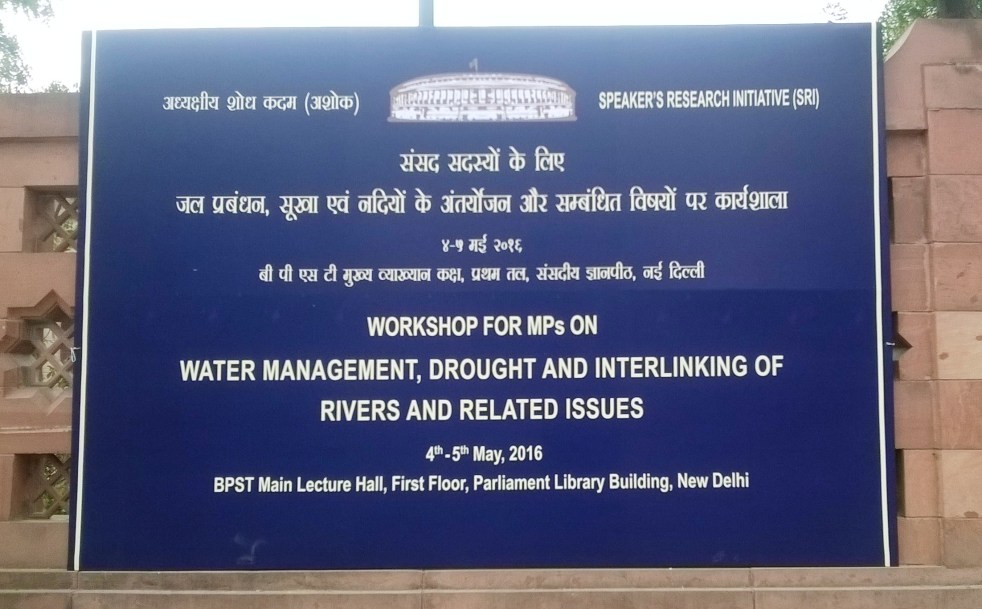
On May 4-5, 2016, Lok Sabha Speaker Smt Sumitra Mahajan took the lead in organising a workshop for Members of Parliament on Drought, Agrarian Crisis and ILR. As part of the newly constituted Speaker’s Research Initiative’s (SRI for short) work, Smt Mahajan inaugurated the workshop at 4 pm on May 4, 2016, where a panel of eight speakers were invited (4 on each day, SANDRP coordinator was one of the invited speakers on 1st day) to share their views, followed by questions from Members of Parliament. The idea was that on these important issues, Parliament Members are better equipped to raise the relevant issues when debating and raising questions in Parliament. It was heartening to see that at least 90 MPs (88 from Lok Sabha and 2 on Rajya Sabha) were present for 2.5 hours on first day, and they wanted to ask so many questions that there was not sufficient time to allow all of them to ask, nor sufficient time for speakers to make full presentations or answer all the questions. Similarly on second day too Speakers showed lot of interest on these issues. While inaugurating the workshop, Smt Mahajan mentioned how in Solapur, Maharashtra, because of the work of the collector and his team of officials, the impact of drought is lower than that in other districts. This was certainly heartening since it was SANDRP Associate Coordinator Parineeta Dandekar who first wrote on this issue, following her visit to Solapur and interview with the district collector. The workshop highlighted the need for many such workshops, possibly more focussed, but the impact of the workshop was already visible in the (as yet unfinished) debate under section 193 that started in Lok Sabha on May 5, 2016, hopefully to be continued in current week.
Continue reading “DRP: 9 May 2016 (Welcome initiative by Lok Sabha Speaker on draught and ILR)”
Karnataka: Profile of 2015-16 Drought
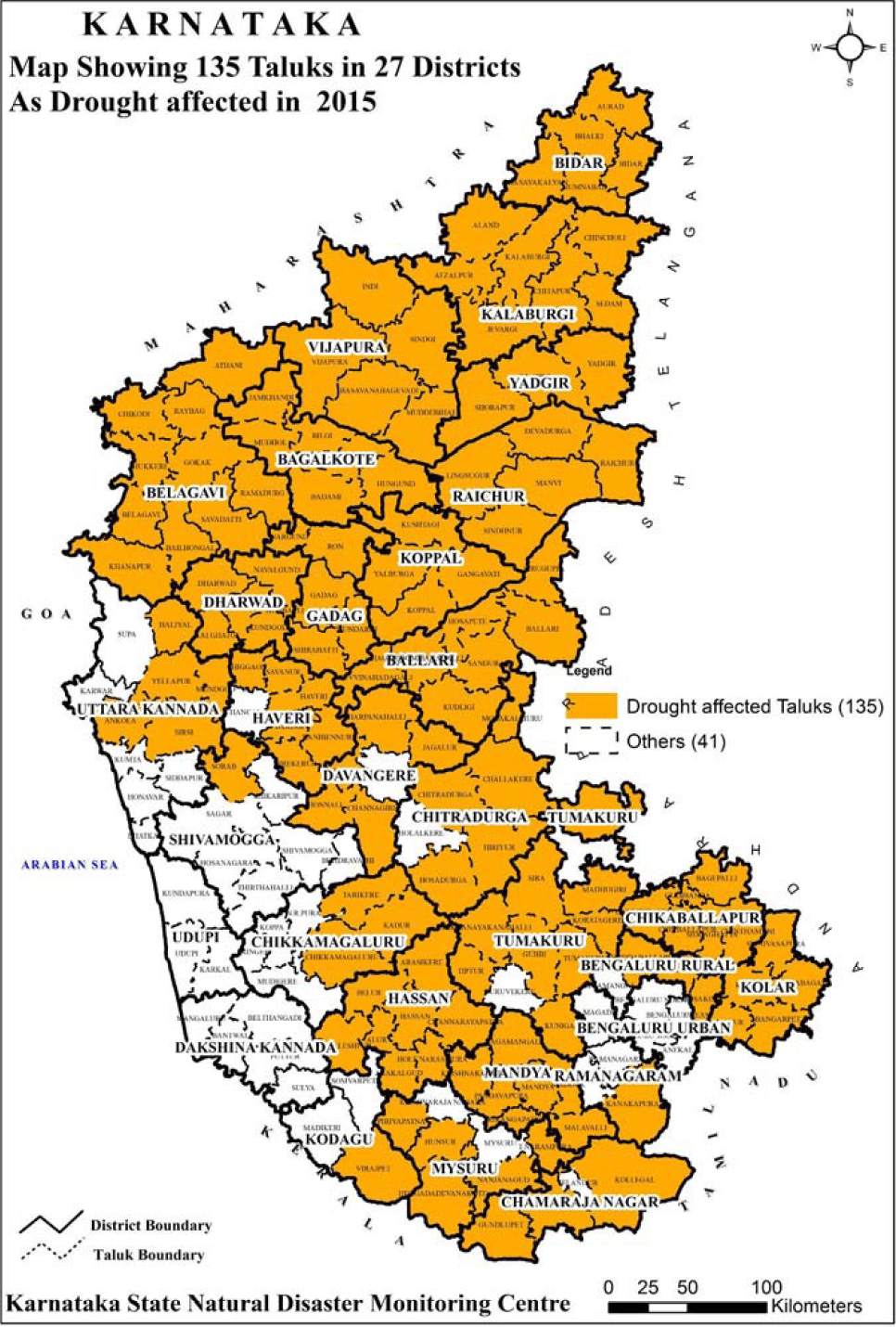
Karnataka is witnessing drought for the third successive year; rainfall has been deficient since 2012-13. Because of the rainfall deficit, reservoirs did not fill up completely. Coupled with the hot summer temperatures in March and April 2016, the stored water has now almost depleted. Groundwater, the saviour in times of failure of rainfall, has dipped severely because of years of reckless exploitation for irrigating water guzzling crops in semi arid soils. With even drinking water becoming scarce, agricultural activity has come to a standstill in the region. The drought in 2015 was preceded by unseasonal rains damaging the previous harvest. The monsoon deficit led to a dip in kharif output throughout the State in 2015. The drought spread even to the normally lush Cauvery basin prompting digging and deepening of borewells. While southern Karnataka received some heavy rains in November, districts in Northern Karnataka again saw failure of rains with some districts such as Kalaburagi, Koppal and Yadgir registering over 70% deficiency in rainfall. There has been a near complete failure of crops in Northern Karnataka, with both rabi and kharif crops being wiped out, even as area under sugarcane has gone up! The northern region, which also lags in development indices, is in the clutches of rural distress – over a thousand farmers have committed suicide. Mass migration to cities is being witnessed.
Shimla Gujran in Yamuna basin: Journey from a flourishing village to a living hell
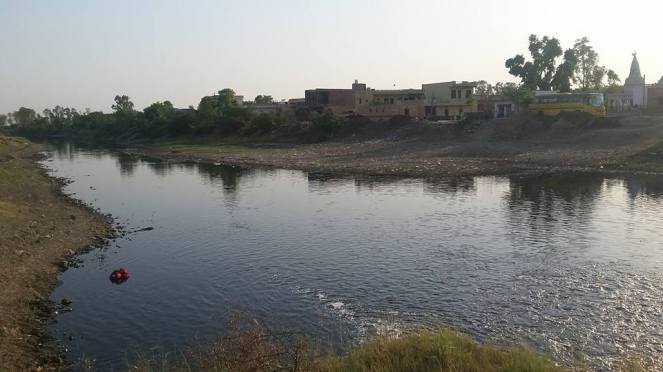
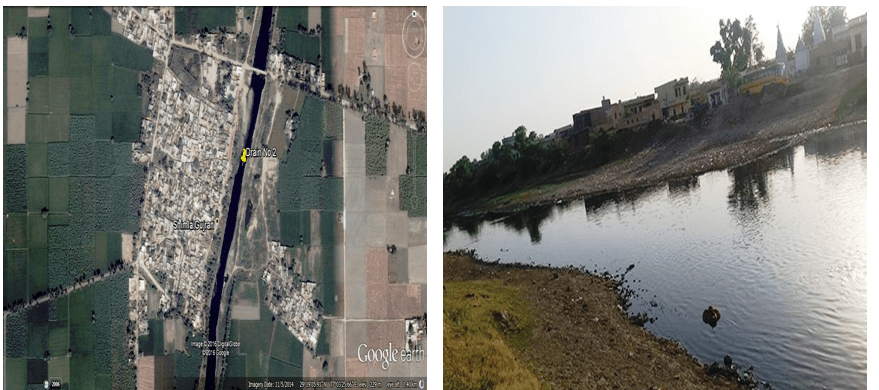
Shimla Gujran village on the other side of DN-2 (Photo by Vikas Sharma, village doctor who had to fix an air tight aluminimum framed glass door at his clinic to avoid to deadly stench)
The news of ammonia laden pollution entering Delhi’s water supply via Yamuna River has become more of a routine. The periodical nuisance forces closure of Delhi Jal Board (DJB) water treatment plants for few days, leading in disruption of water supply to lakhs of people. But as usual, within couple of days things fall back to normalcy until the cycle strike back.
The source of pollution remains undisclosed with only hint that the origin presumably a drain carrying pollutants from Haryana sneaks into river somewhere upstream of Delhi. Much is not talked or heard about the mystic drain and the problem largely remains unfixed. Haunted time and again Delhi Government has now installed one Ammonia-Neutralizers and planning to buy more as a remedial measures.
DRP: 2 May 2016 (Patoda: How a village in drought hit Maharashtra achieved water independence)
Patoda: How a village in drought hit State turned water self-reliant At a time when almost every village in drought-hit Marathwada is facing acute water scarcity tiny Patoda, on the fringes of water-starved Aurangabad city, is offering valuable lesson in water management conservation and harvesting. Though it is surrounded by arid villages but Patoda’s residents regard water as more precious than money. They follow strict rules about usage and strictly carry the water audits. Water meters are installed in every households and entire village recycles each drop of waste water it generates. Today no rain water flows out of the village. Percolation has recharged the aquifers and the water table has risen. So effective is its water conservation model that Patoda has now become a model for the rest of Marathwada and has won 22 state & national awards. But it did not happened over nights. In fact it is a result of over 10 years joint efforts done by villagers.

