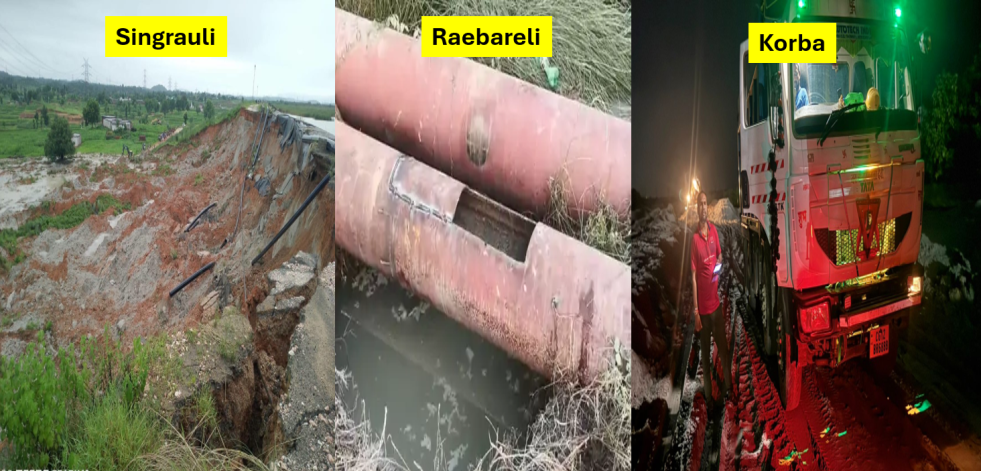
(Feature Image: Collage showing in left Sasan UMPP’s damaged fly ash dyke, in centre NTPC’s Unchahar plant damaged fly ash pipeline and on right truck found dumping fly ash illegally in Korba. Source: Amar Ujala, Dainik Bhaskar, ETV Bharat)
There have been at least three incidents of leakages from fly ash dykes at Reliance’s Sasan UMPP in MP & NTPC’s Unchahar Plant in Raebareli, UP in Aug. 2026. All the three incidents have considerably affected nearby village and farmer communities in both the states. Notably, both projects have also experienced ash dyke related leakages and failures in the recent past, raising serious concerns over safety of the structures and safe disposal of the toxic fly ash.
The Sasan ash dyke is located close to the Rihand river and reservoir, while the Unchahar ash dykes are located close to the Ganga river. A major failure at either site could therefore have serious consequences for downstream communities, farmland and water resources. The concerns are further reinforced by a separate incident in Chhattisgarh, where an NTPC contractor was found illegally dumping huge amount of fly ash at an unauthorised location. Together, these incidents have again underlined the persistent gaps in management, monitoring of fly ash dykes and disposal at thermal power projects.
Sasan Fly Ash Dyke Leakage: The Sasan Ultra Mega Power Project (UMPP)’s earthen fly-ash dyke near Siddhikhurd and Harrahwa villages in Singrauli district, Madhya Pradesh, suffered damage twice in Aug. 2026. The 3,960 MW coal-based thermal power project is owned and operated by Reliance Power. The project is described as the world’s largest integrated power generation and coal mining project.
The pentagonal shaped dyke covering about 3 sqkm area is located around 2km away from left bank of Rihand river and about 5 km from the Rihand Dam backwaters. Its location raises concerns about the potential impact of any ash slurry escaping into Rihand river system through local drains and farmlands.
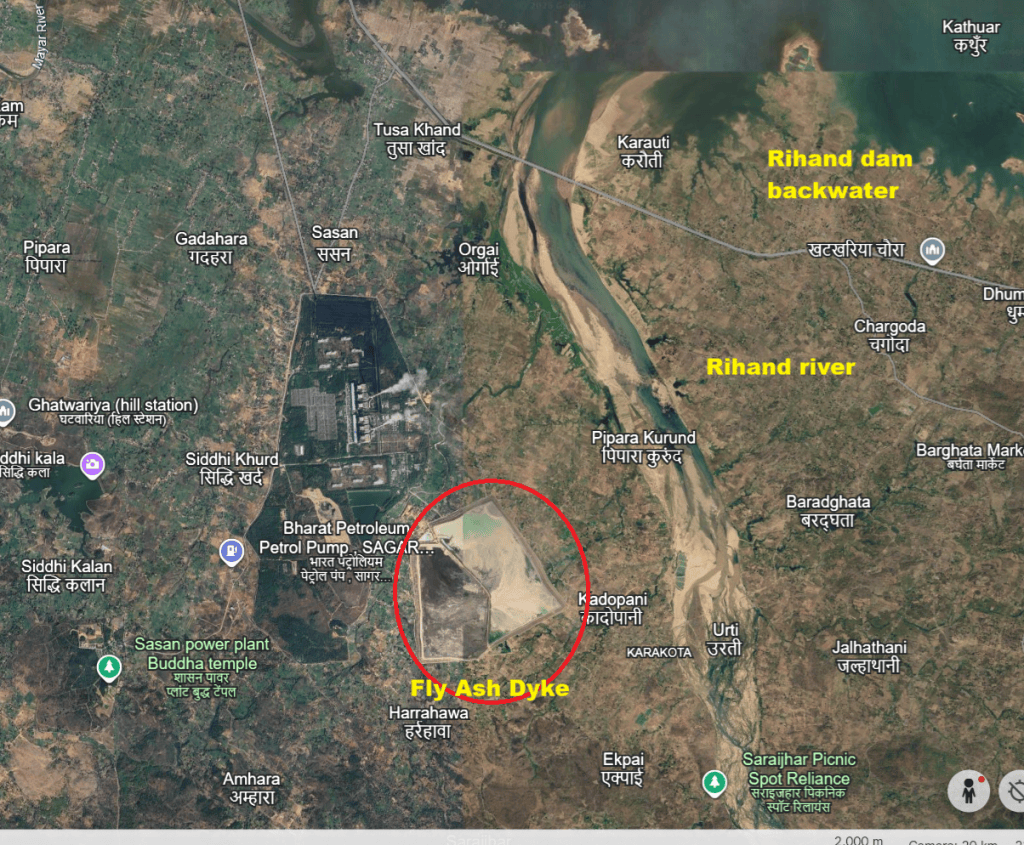
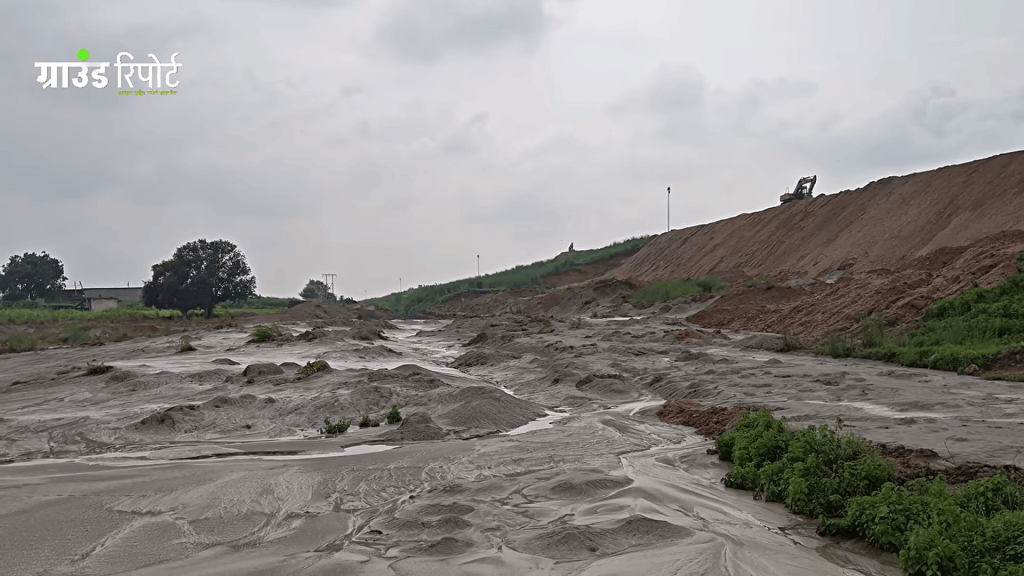
Leakages: The first incident occurred in the early hours of Aug. 14, when huge portion of the dyke’s outer wall subsided during heavy rainfall. The damage caused a large quantity of fly-ash sludge to leak from the facility. The sludge spread over nearby areas, affecting some homes, farmland and crops. As a precaution, the local administration reportedly asked people to move away from the affected area. A local report estimated that around 5,760 tonnes of fly-ash sludge had spread over the surrounding area.
The Sasan UMPP management repaired the damaged section. But fresh damage and leakage were reported at the same location in the afternoon hours of Aug. 22. The recurrence raised concerns about the stability of structure and quality of its repair, safety and monitoring measures. The administration also expressed concern that further leakage could contaminate agricultural land and nearby water sources.
Sasan UMPP Explanation: The company has reportedly attributed the first incident primarily to heavy rainfall. Company engineer Ashwini said that the facility undergoes inspections during the monsoon and there was no indication of any such problem. He said around 110 mm of rain fell within three hours describing it similar to a cloudburst. He maintained that there had been no negligence on the company’s part and that minor cracks can occur in an earthen dyke but were not necessarily dangerous.
The company therefore characterised the incident as a rainfall-induced natural disaster event rather than a failure of the facility. However, the recurrence of leakage at the same location just eight days after repairs has raised concerns among local residents about the dyke’s stability and potential impact on their land and lives in case of a major breach.
Administration’s Action: Following the first incident, the Singrauli district administration issued a show cause notice to Sasan UMPP management on Aug. 17 seeking a factual response. The administration also directed the company to stop disposing fly ash in the affected dyke. The administration warned the company of legal action and recovery of losses if crops or property were found to have been damaged by the incident.
After the second incident, the local tehsildar said a survey of affected land had been conducted and that a damage assessment repot would be prepared and sent to the company for compensation. The police also said that complaints from affected people would be investigated for appropriate action.
An expert committee was also constituted to examine the dyke’s design, construction, structural condition, operation and compliance with safety standards as well as possible impacts on water quality and the environment.
On Sept. 02, District Collector Gaurav Benal held a review meeting to assess the repair work on the dyke and rehabilitation measures in the affected area. He ordered an immediate ban on fly-ash disposal in the affected dyke and directed the company to make alternative arrangements for safe ash disposal. He instructed company to carry out the repair works in accordance with Madhya Pradesh Pollution Control Board (MPPCB) guidelines.
The Collector said that if any technical defects are found in the dyke’s design or construction, action will be taken against the company as per the rules. He also directed officials to send a proposal to the Union Ministry of Coal seeking permission to dispose of ash in the abandoned coal mines at Gorbi.
On Sept. 03, an expert team began site inspection and technical investigation of the damaged ash dyke. The team will assess the condition and stability of the structure, examine potential future risks to life, property and the environment and submit its recommendations.
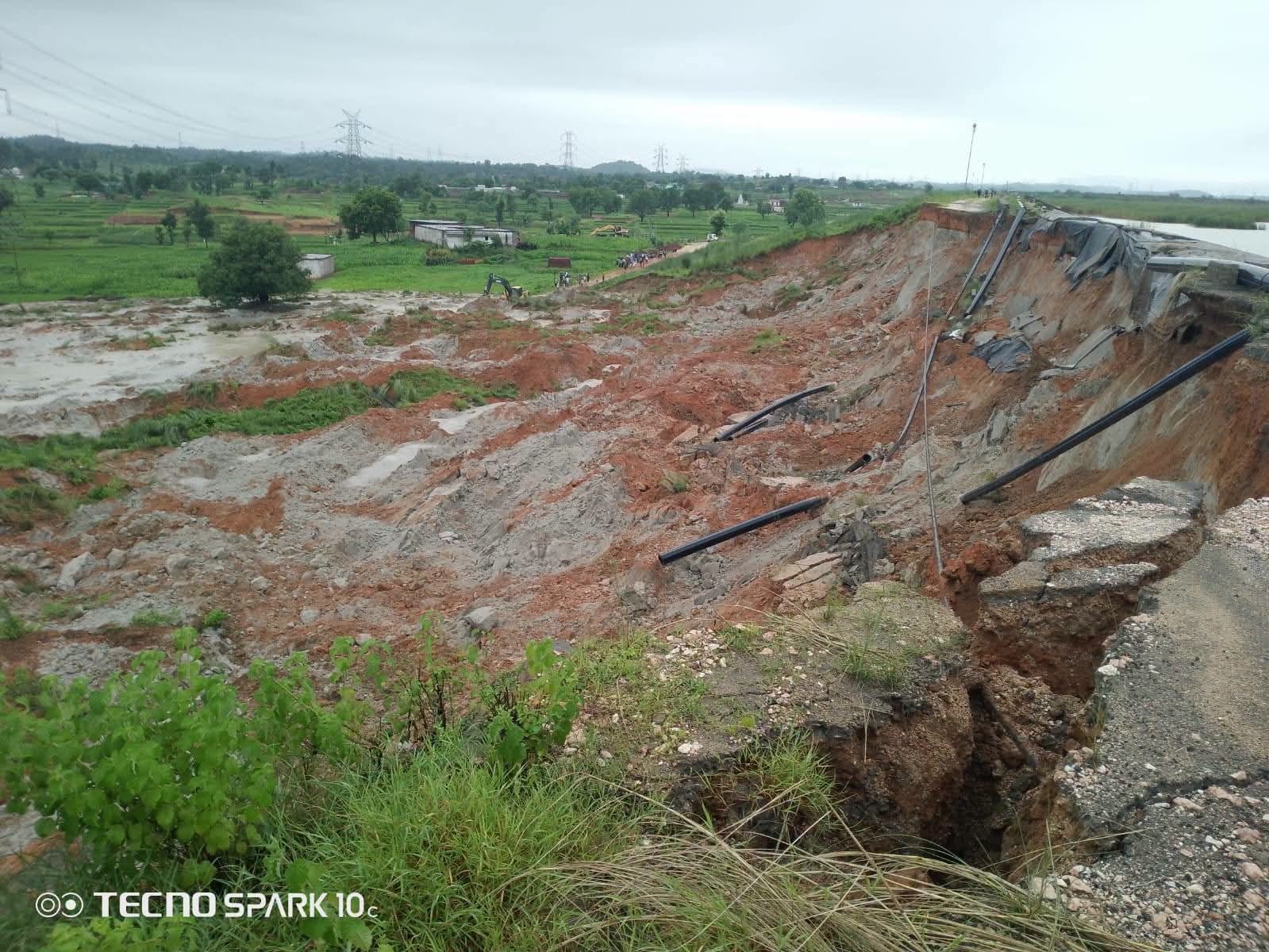
Villagers Concerns: Meanwhile, given the active monsoon season and rainfall spell, villagers are apprehensive about repeat of the April 2020 ash-dyke disaster. They questioned the safety of the structure and alleged that the company and administration have not learnt adequate lessons from the earlier incident. The affected villagers have also raised concerns over impact on their homes, farmland and livelihoods and sought compensation and relief.
April 2020 Disaster: In the evening of April 10, 2020 a major breach in the Sasan UMPP fly-ash dyke caused a massive slurry flow into the surrounding area, killing at least six people and damaging downstream farmland and other property. The ash slurry reportedly spread across several villages and destroyed crops over hundreds of acres.
Indeed, the back-to-back leakage in August 2026 raises serious questions about the structural safety of the ash dyke and warrants an independent technical assessment. The findings should also clarify responsibility and identify measures needed to prevent a recurrence that could potentially lead to a much larger disaster.
NTPC Dyke Leakage in Raebareli, UP: Besides Sasan UMPP, a third similar incident was reported at NTPC’s 1,550 MW Firoz Gandhi Unchahar Thermal Power Plant in Raebareli, Uttar Pradesh. The affected dyke covers about 80 hectares and is located between Umran and Raipur villages, around 5 km northeast of the plant. The plant sources its raw water from the Sarda Sahayak Canal.
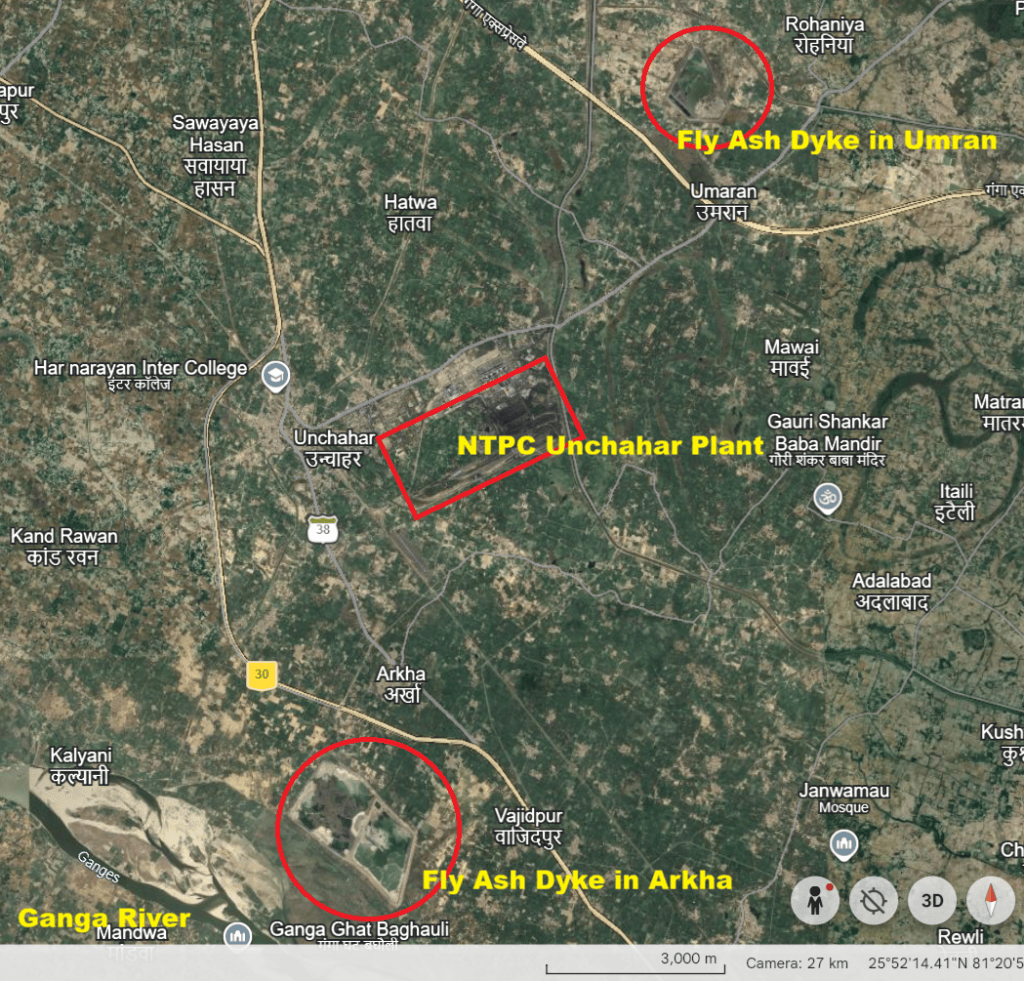
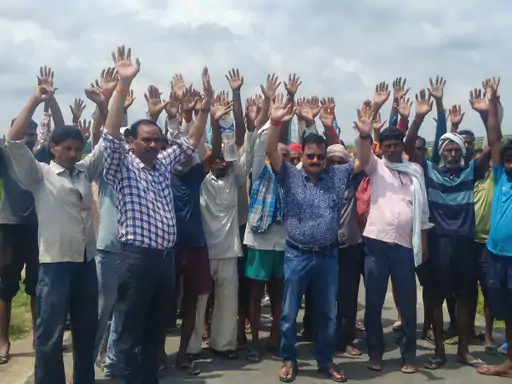
The leakage from the ash dyke on Aug. 31 reportedly submerged hundreds of acres of paddy fields in the Umran and Rohaniya areas. Ash slurry also entered nearby villages. Following this, the farmers and village pradhans staged a protest at Umran crossing on Sept. 01, demanding action.
According to farmers, fly ash-laden water has been leaking from the dyke for a long time, affecting crops in Umran, Raipur, Pure Baldu, Gauspur, Jhalabag, Powerganj, Sumerbagh, Ganghera, Gulalganj and Murarmau, among other villages. Heavy rain on Aug. 31 worsened the situation, causing further waterlogging in agricultural fields and nearby village areas.
Farmers alleged that despite repeated complaints to district administration and NTPC project authorities, no effective action had been taken. They said that stopping the leakage and cleaning the drainage channels could help prevent further crop losses. Unchahar SDM Vivek Rajput said the matter had come to his notice. He assured that NTPC would be asked to address the leakage and provide relief to the affected farmers.
Waterlogging at Unchahar Plant: Interestingly, the plant also experienced shutdowns of different units due to waterlogging between Aug. 31 and Sept. 03, 2026. On Aug. 31, rainwater reportedly entered the switchyard of 210 MW Unit 2, forcing it to shut down. Unit 5 was already under annual maintenance. On Sept. 01, waterlogging also forced 210 MW Unit 4 to shut down. NTPC deployed six pumps to drain water from the plant and protect the remaining units as rainfall continued.
By Sept. 03, waterlogging remained a problem. Although Units 2 and 4 had been restored, Unit 1 was shut down. NTPC stepped up its drainage efforts and deployed 45 pumps to remove the accumulated water. About 420 MW of generation remained affected, indicating that prolonged rainfall and inadequate drainage within the plant continued to disrupt operations.
Fly Ash Pipeline Damage in July 2026: Notably, a fly ash pipeline connected to another ash dyke of the same plant leaked near Parvat village on the night of July 28, 2026. The ash dyke covers about 4.20 sq km and is located near Arkha village, around 4.5 km north of the plant and barely 1 km from the left bank of the Ganga river.
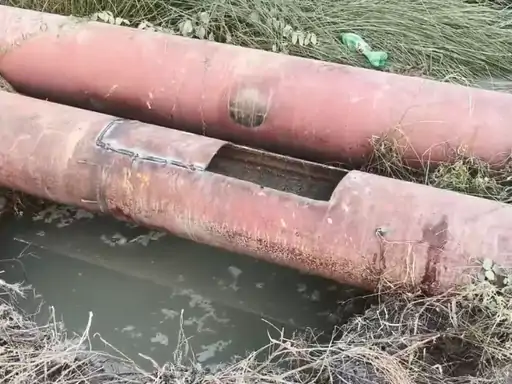
Villagers noticed the impact of the leakage the following day and immediately informed NTPC management. The supply of ash through the pipeline was subsequently stopped. Later that evening, when NTPC employees arrived to repair the damaged pipeline, farmers stopped them and demanded compensation for the crop damage.
The leaked ash slurry accumulated over about two bighas of farmland, extensively damaging the paddy crop of a farmer from Karseni Majra in Arkha village. SDM Vivek Rajput said the incident would be investigated and that NTPC would be asked to provide compensation to the affected farmer.
Fly Ash Pipeline Damage in July 2022: Before this, the fly ash carrying pipeline from Unit 6 of the plant to the Arkha ash pond developed a leak near Mughalpur village on July 05, 2022. The ash sludge spilled onto the village road, causing panic among local people. The NTPC officials stopped ash disposal through the damaged pipeline and started repairs. Engineers initially tried to divert ash through the remaining three pipelines. However, the leakage eventually forced the unit to reduce generation from 500 MW to 350 MW.
Chhattisgarh: NTPC fined ₹90 lakh for illegal fly-ash dumping: In a related development, the Chhattisgarh Environment Conservation Board has imposed a ₹90 lakh environmental compensation on NTPC for illegally dumping fly ash in Chhuri Khurd area of Korba district. On Aug. 31 night, the officials received information that trucks carrying ash from NTPC’s Dhanras ash dyke were dumping it at an unauthorised location instead of the designated site near the National Highway at Abhanpur.
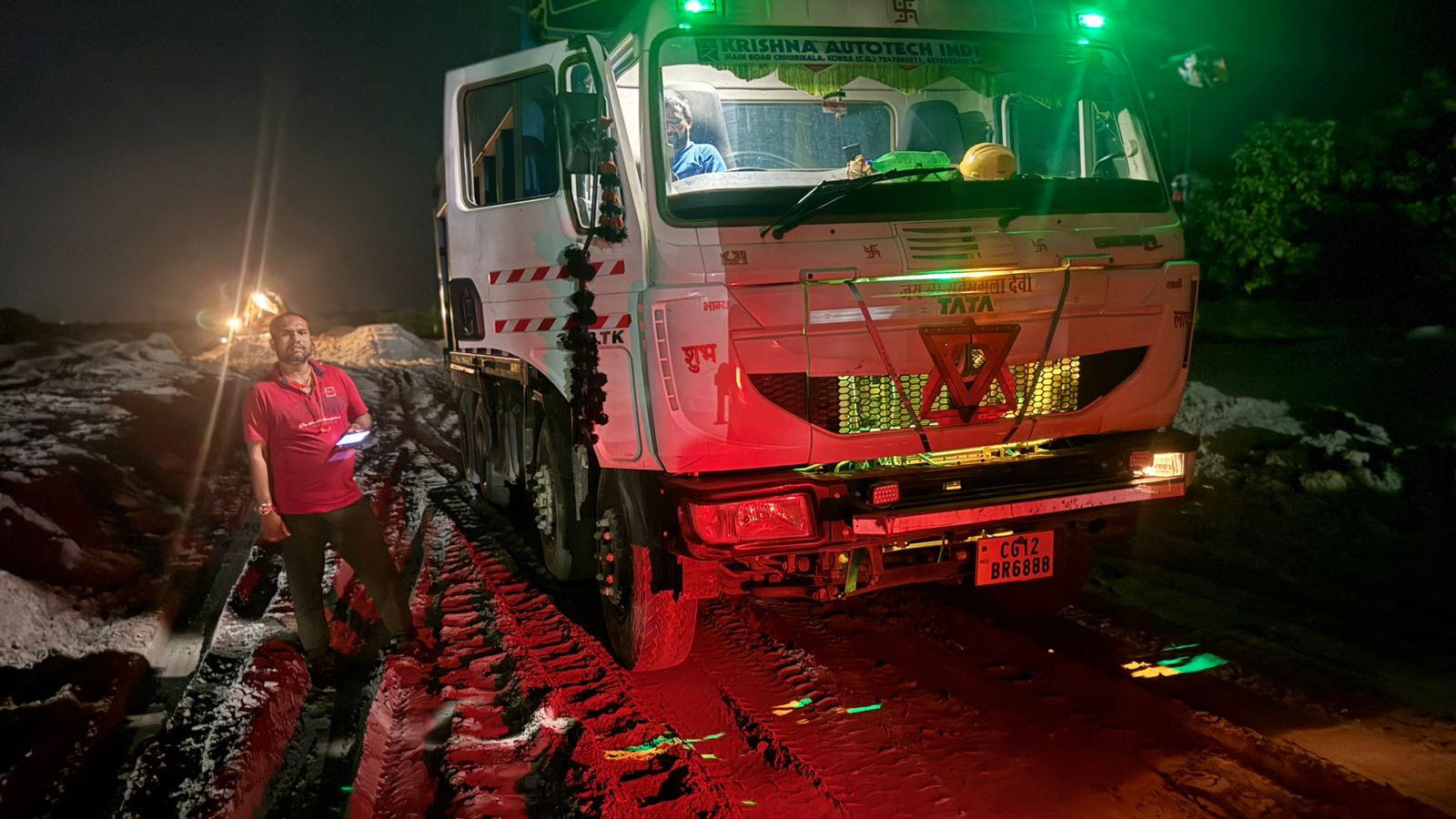
Officials inspected the site near Chhurikhurd and found four ash-loaded vehicles involved in the dumping. According to Regional Officer Prasanna Sonkar, around 6,000 tonnes of ash had been dumped and the ₹90 lakh compensation was calculated based on the quantity of ash. The action highlights concern over improper fly-ash management and unauthorised dumping which can affect surrounding land, air and water sources.
Summary: The incidents reported in Aug. 2026 point to a recurring problem in the management and containment of fly ash at thermal power projects. These incidents underline the need for independent technical assessments of ash dykes. Assessments should examine their design, construction quality, structural stability, monitoring and performance during extreme rainfall. Regular third-party safety audits, real-time monitoring and clear emergency-response plans should be made mandatory for vulnerable ash dykes.
Authorities should also ensure safe and scientifically sound disposal and utilisation of fly ash, prevent unauthorised dumping and impose strict accountability for violations. Compensation and restoration of affected farmland should be undertaken promptly where crop or property damage has occurred.
Given the proximity of these facilities to major rivers and densely settled agricultural areas, repeated leakages should not be treated merely as isolated rainfall-related incidents. They require systematic investigation, stronger regulation and preventive action before a much larger disaster occurs.
It is also clear that no agency is monitoring or regulating and ensuring safety of fly ash dams in India. It is not part of dam Safety Act. Fly Ash dams are not listed in National Register of Dams, Central or State Dam Safety agencies are not looking at these dams. No agency is giving environmental or structural clearances for such dams. This regulatory gap needs to be addressed urgently.
SANDRP


