A number of Rivers of Europe, including Rhine, Danube, Loire, Po and Elbe are flowing at record low levels during the last couple of weeks. Europe, in fact has been a region that has the most elaborate policy and institutional structures, better than any other place, for ensuring its rivers flow perennially and healthily. This is partly also because of its economic, social dependance on the rivers. When the rivers of such a region are in such dire situation, it is a major wake-up call, also for the rest of the world.
It’s clear Europe needs to begin thinking about its rivers more radically and more seriously, even more — as a strategic asset rather than just as an environmental entity. And that is equally true for the rest of the world. Particularly in South Asia, we need to really wake up as our dependence on river is even more in every sense, including economically, socially, culturally and environmentally.
Particularly we have neither proper policies, nor practices, and not even any institutions to monitor and ensure sustained healthy existence of the rivers. On the contrary, we are doing almost everything possible to further deteriorate our rivers. And the edit “Cry Me. A River” in the TOI on this subject last week did not even mention it. This is certainly not something that Justin Timberlake referred to when he wrote in his famous song “Cry Me a River” that needs to remain unsaid.
Europe is in Shock: its major rivers are drying Much of Europe is in the middle of a severe drought, and major rivers have been reduced to a fraction of their usual size. Europe’s second-longest river, the Danube, is now facing record lows, recently measuring just 9 inches deep in Budapest. Part of Italy’s mighty Po River is also at a record summertime low. And the Rhine, a major outlet for trade flowing from the Alps to the North Sea, is now shallower than at any time since records began.
This summer, the transport of chemicals, oil products and other goods on the Rhine and the Danube ground almost to a halt in places. Romania shut down a nuclear plant cooled by the Danube, and Hungary narrowly avoided doing so. The carmakers Dacia and Ford agreed to temporarily cease production in their Romanian factories to save power. Rivers can no longer be relied on to provide an inexpensive, reliable, relatively low-carbon alternative to road and air freight. Rivers cannot form the industrial backbone of the European Union’s push for autonomy from Chinese and American supply chains if they run dry. Nor can they provide reliable energy independence or guarantee food security.
Cry Me a River This Edit in TOI (Aug 17 2026) narrates how Rhine, Danube, Elbe and other rivers in Europe are in retreat, and are exposing Europe’s past and also a parched future. And indeed, as the edit underlines, this is equally true of Indian Rivers. The edit rightly notes that “A do-nothing lot are always harking on the cost of solutions.” But the TOI seems guilty of being in the same group when it says in the end: “We have to “make” water from the sea, sewage, wastewater. And when we get rain, we have to catch it before it runs away.” But there is a lot more we can do in terms of stopping river destructive projects like Big Dams, Big Hydro projects, River Front Development Projects, River Linking Projects (e.g. Ken Betwa Project) that can help save our rivers, forests, wetlands, water bodies and help recharge groundwater. The Edit does not say a word about it!
In the famous Justin Timberlake song titled “Cry Me a River”, there is a line: ‘’You know that they say that some things are better left unsaid.” Are the TOI editorial writers following this line literally? And keeping the most crucial things unsaid?
HYDRO POWER PROJECTS
Tapovan-Vishnugad HEP work halted after land subsidence The construction work on the Tapovan-Vishnugad hydroelectric power project in Chamoli district was halted, and workers were evacuated as a precautionary measure after land subsidence created a ‘cavity’ (small pit), triggering water seepage in the main tunnel, officials said on Aug. 17.
NTPC Public Relations Officer Rajendra Singh Jayada said the incident occurred on Aug. 15, in which a “small cavity” formed during tunnelling, leading to mild water seepage. Jayada further said that tunnelling work won’t be resumed and added that special workers have been deployed to fix the cavity.
The project, which began in Nov 2006, has been repeatedly hit by natural disasters and geological challenges. The latest incident has once again raised concerns over the geological challenges and safety measures involved in constructing large hydroelectric projects in the Himalayan region. The NTPC, however, clarified that the affected portion is being fixed in accordance with safety standards.
THDC Tunnel Disaster shows why Himalayan excavation needs hydrological rethink The death of 11 workers inside the Vishnugad-Pipalkoti Hydroelectric Project tunnel in Chamoli have raised fresh concerns about large-scale excavation in the fragile Himalayas. The accident highlights the risk of tunnelling through fractured, water-bearing and tectonically active mountain systems.
Similar incidents, including the 2009 aquifer breach at the Tapovan-Vishnugad project, show how tunnel construction can disturb underground water systems and affect springs, slopes and settlements. The article argues that future hydroelectric and railway tunnelling in the High Himalayas must be guided by stronger hydrogeological mapping, monitoring and risk assessment. What Really Caused the Chamoli Tunnel Collapse?
Fire ravaged Srisailam HEP unit restored after six years Six years after a 150 MW hydroelectric power unit was shut down after an accident and several trial runs failed, Telangana Genco has resumed trial runs of unit IV of Srisailam HEP. The trial runs will continue for some more days before it is put to full use. The Srisailam hydropower station has a total of six units of 150 MW each.
All six units of the hydroelectric power plant were damaged in a major fire mishap at the powerhouse in Aug 2020 in which nine people, including engineers and two employees of a private agency died. Since the fire started at Unit IV, it was completely gutted and two units, I and II, got partially damaged. Both I and II units were repaired and power generation was restored within a couple of months, while units III and V were restored in a phased manner. After completion of starter re-winding and rotor re-conditioning works in July 2023, the unit worked for 80 hours and tripped. The second trial run tripped due to an air gap in Oct 2025 due to some technical issues. Govt consulted HM Hydro, Japan, and resolved the issues.
DAMS
Kerala’s Chulliyar Dam desilting project under cloud over irregularities, impacts As the United Democratic Front (UDF) government in Kerala plans large-scale desilting of dams and other waterbodies, one of the first such projects – the Chulliyar dam desilting project in Palakkad – has come under a cloud over allegations of irregularities in dredging and transportation of sediments, especially sand. The KIIDC had entrusted the desilting work to a private firm in 2022 for removing 11.33 lakh cubic metres of sediment, with a contract period of one year.
The project, undertaken during the previous LDF government’s tenure, has also attracted allegations of environmental damage, multiple contract extensions, and possible financial irregularities. Kavassery Krishna Kumar, director of the Right Foundation, an NGO, recently petitioned Chief Minister V.D. Satheesan seeking government intervention.
The Kerala High Court, meanwhile, directed the Kerala Irrigation Infrastructure Development Corporation (KIIDC) to issue transit passes for transporting desilted material already stacked on the Chulliyar dam premises. The August 3 interim order followed a petition by the contractor after the KIIDC stopped issuing passes. The KIIDC told the court that 2,25,830.17 cubic metres of extracted material remained stacked at the site and that it had no objection to transporting material for which royalty had been paid, despite the contract having expired. The court directed authorities to measure the stock before issuing passes to prevent excess removal.
According to Mr. Kumar, the contract was subsequently extended thrice, with the final extension expiring in May 2026, “allowing the firm to desilt quantities several times higher than the permissible limit of 11.33 lakh cubic metres and transport materials, including sand.” “Despite the lower contract rate of ₹56 per cubic metre, geological royalty was also waived for Chulliyar, raising questions about the contractor-KIIDC nexus. No satellite survey or report was prepared before awarding or extending the contract. The contractor also levelled earthen embankments, causing environmental damage and biodiversity loss. Following the recent court order, excavation and transportation of silt and sand using JCBs and other machinery continue unabated,” Mr. Kumar alleged.
Environmental activists said the Chulliyar issue reflected “a broader pattern” in desilting works at multiple dams, including Walayar, and called for an independent inquiry into the tendering and execution of the five projects undertaken during the same period.
When contacted, KIIDC chief executive officer M. Sivadasan said that the corporation was bound to comply with the court order. “We had stopped issuing passes following local issues. However, as the contractor had already made the payment as per the agreement for transporting the dredged sediments stacked on the dam premises, the firm moved the High Court, which passed an order in its favour,” he said.
Polavaram Dam: Revised Cost approval The he Union Government has approved a revised cost estimate of Rs 30,436.95 crore at the 2023 price level for Phase-I of the Polavaram Irrigation Project (PIP), Union Minister of State for Jal Shakti Raj Bhushan Choudhary informed the Rajya Sabha on Aug 10. The approved framework limits total balance Central grants to Rs 12,157.53 crore, the project will achieve water storage up to +41.15 meters.
The revised financial approval comes alongside a total release of Rs 12,620.53 crore in Central assistance over the past five financial years. Concrete work on the main spillway structure has reached 98.84% completion, with earthwork at 96.87% and steel work at 92.95%. For the Earth-cum-Rockfill (ECRF) dam and its connectivities, earthwork stands at 75.56%, concrete work at 81.99%, and steel work at 81.31%. Earthwork for the main canals is nearly complete at 98.96%, accompanied by 88.44% concrete lining and 55.68% steel work.
The Jal Shakti Ministry detailed that out of 96,660 total Project Displaced Families (PDFs), 17,892 families under Phase-I have been physically shifted. A total of Rs 1,373.01 crore has been disbursed directly toward cash entitlements, while Rs 1,581.08 crore has been incurred on executing physical Rehabilitation & Resettlement (R&R) works. The Central Government reconfirmed that Phase-I of the project has been approved for completion by March 2026, with a provision for a one-year extension.
Mah Approves Jayakwadi Ph 2 The Maharashtra cabinet has approved a ₹6,477.88 crore allocation for Phase-II of Jayakwadi irrigation Project that includes Majalgaon Dam on Sindphana River in Godavari basin. Objective is to irrigate 1.31 lakh has in five districts including Chhatrapati Shambhajinagar, Ahilyanagar, Beed, Parbhani, Nanded.
National Dam Safety Panel hails HYDRAA efforts to protect lakes The National Dam Safety expert committee has praised the restoration and development of Hyderabad’s lakes by the Hyderabad Disaster Response and Assets Monitoring and Protection Agency (HYDRAA), saying its approach could serve as a model for other parts of the country. The committee said HYDRAA’s approach of protecting the natural features of lakes while improving their safety and water management systems could be replicated elsewhere.
Committee members, led by chairman Dr Shailesh Kumar Srivastava, visited Fox Sagar on Aug 19 and inspected the main bund, the condition of the lake and issues related to its safety. The committee was briefed on HYDRAA’s plans for protecting and restoring Fox Sagar Lake, which has a Full Tank Level area of 482.6 acres.
Kerala offers Tamil Nadu all water from new Mullaperiyar dam Kerala has assured Tamil Nadu that it is ready to provide the State with the entire water from a proposed new Mullaperiyar dam, provided Tamil Nadu agrees to the project. Kerala has also offered to bear the entire cost of constructing the new dam, while leaving its location, design and construction to Tamil Nadu. Chief Minister VD Satheesan made the assurance at the 31st Southern Zonal Council meeting held in Mahabalipuram, Tamil Nadu, on August 20.
Kerala has maintained that the existing 130-year-old Mullaperiyar dam in Idukki needs to be replaced with a new structure. Satheesan reiterated the State’s willingness to move ahead with a new dam while assuring Tamil Nadu that its existing water interests would not be affected.
FM directs early completion of DPR for high-level dam on Kosi Union Finance Minister Nirmala Sitharaman has directed the early completion of the DPR for the high-level dam on the Kosi River following a request from Bihar Chief Minister Samrat Chaudhary, according to a state government release. Sitharaman also directed the National Water Development Agency (NWDA) and the Ministry of Jal Shakti to take necessary action regarding the provision of funds for the first phase of the Kosi-Mechi Link Project and technical approval for the second phase. Discussions also took place regarding the early commencement of work on the Sone-Phalgu River Link Project.
Growing Global Challenge to Big Dams Opposing destructive large dams cannot mean opposing water security or renewable electricity. The alternative is to move from centralised, gigantic infrastructure to distributed, diversified and ecologically sensitive systems.
The global movement to remove obsolete dams offers an important lesson. Humanity is beginning to understand that restoring a river can itself be development. India should join that conversation—not merely by opposing a few particularly destructive projects, but by undertaking a national River Freedom and Dam Review Program: identify dams that are obsolete, unsafe, uneconomic or ecologically destructive; assess cumulative impacts basin by basin; stop building in the most fragile Himalayan reaches; restore environmental flows; protect free-flowing rivers; and consider removal where appropriate. (Soumya Dutta; MAUSAM)
INTERLINKING OF RIVERS
Ken-Betwa Project Sparks Protests In this documentary, we speak to villagers facing displacement, hydrology experts (Himanshu Thakkar, SANDRP)and activists to understand the project, the arguments for and against it, and what is at stake for the people living on the ground. (BY Sanjana James: South Era Network)
CLIMATE CRISIS
Western Himalayas warming faster than Central, Eastern Himalayas A new study combining 120 years of observed temperature records (1901–2020) has found that the western Himalaya, comprising Ladakh, Jammu and Kashmir and Himachal Pradesh, is warming faster than the central and eastern stretches of the range in every season. The study found that winters are warming faster than spring, while night-time temperatures are rising faster than daytime highs. It also projected that springtime snow loss over the western Himalaya could be three times higher by the end of the century under a high-emission pathway than under a low-emission scenario.
The study, titled Vulnerability of the Himalayan Region Under Climate Change, was published in the Journal of Earth System Science. Led by the Department of Remote Sensing and Geoinformatics at Birla Institute of Technology (BIT-Ranchi), the research was conducted in collaboration with the Indian Institute of Tropical Meteorology-Pune, and Ashoka University. As per the findings, if emissions remain high, winters during 2081-2100 could be 7.18°C warmer in the western Himalaya, 6.71°C warmer in the central Himalaya and 5.82°C warmer in the eastern Himalaya compared with the early 1900s.
RIVER FRONT DEVELOPMENTS
Scientist opposes Sabarmati model for Yamuna C R Babu, DU professor emeritus and chairman of the state-level expert appraisal committee, has advised the lieutenant governor and the capital’s bureaucrats against replicating the Sabarmati project. In a report addressed to Najeeb Jung and environment secretary Sanjiv Kumar, Babu has said that the Sabarmati is not a river rejuvenation project but an urban development one. Kumar had told TOI earlier that Sabarmati riverfront is “like an international destination”.
“There is no Sabarmati river. It’s stagnant water with concrete walls on two sides. The floodplains have been concretized to make pathways and real estate projects. It cannot be replicated for our Yamuna,” Babu told TOI. In his report, he has said that water for Sabarmati has been channelized from Narmada which has left the area upstream completely dry. Downstream, after Vasna barrage, the water is highly polluted and contains toxic effluents, the report informs.
Many river experts have raised the same concerns. Cosmetic changes to beautify Yamuna could increase the risk of flooding dramatically, they have said. “The sediment load in Yamuna is very high. It’s a Himalayan river and cannot be compared to a Thames or other rivers where riverfronts have been developed,” said an official from the environment department. The Inter-governmental Panel on Climate Change last year put Delhi among three world cities at high risk of floods. Tokyo and Shanghai are the two other cities.
Earlier, a committee appointed by National Green Tribunal and headed by Babu had advised that the Yamuna River-Front Development (YRFD) plan—which includes a promenade, parking lots, pavements and other constrictions and was developed by Delhi Development Authority—be scrapped. It also recommended a ban on development activity in the river’s zone ‘O’ in Delhi and its active floodplains on Uttar Pradesh side.
URBAN LAKES, WETLANDS
NGT Questions Retaining Walls Along Stormwater Drain in Bengaluru The NGT has raised serious questions over the construction of retaining walls along both sides of a stormwater drain connected to Madiwala Lake in Bengaluru. The tribunal questioned whether building walls up to ground level on both sides of the drain could prevent rainwater from entering it. If so, it asked, how would the stormwater drain serve its intended purpose?
On July 15, 2026, a bench headed by Justice Prakash Srivastava directed the Bruhat Bengaluru Mahanagara Palike (BBMP) to submit a detailed response within four weeks. The case relates to sewage being discharged into a stormwater drain connected to Madiwala Lake near Vakil Marina Housing Society in Kodichikkanahalli, Bengaluru.
The next hearing will therefore examine whether the retaining walls, which BBMP says are intended to protect Bengaluru from flooding, are actually helping drainage or creating new environmental and water-management problems.
URBAN WATER
HC Gives NMC Final Week to Explain Contaminated Water Crisis Expressing displeasure over Nagpur Municipal Corporation’s failure to file its response, Nagpur bench of Bombay High Court on Tuesday granted the civic body one week to explain the alleged supply of contaminated drinking water in nine of the city’s 10 zones.
Information presented at a meeting chaired by the mayor indicated that contaminated water was reaching residents in more than 50 localities and could affect around four lakh people. The reported affected areas include Ajni and East Samarth Nagar in Laxmi Nagar; Dabha, Pandhrabodi and Panchsheel Nagar in Dharampeth; and Vasant Nagar in Dhantoli.
DJB given 4 weeks to reply on RWH systems allegations NGT has granted the Delhi Jal Board (DJB) four weeks to file a compliance report following allegations that it failed to adhere to the tribunal’s directions on rainwater harvesting systems (RWHS), groundwater recharge, and quality monitoring in the Capital.
The applicant in the case claimed that while NGT had explicitly stated that RWHS should not be installed near storm water drains to prevent groundwater contamination, DJB and other agencies – including Delhi Development Authority (DDA), New Delhi Municipal Council (NDMC), Municipal Corporation of Delhi (MCD), and National Highways Authority of India (NHAI) – have not complied.
The applicant also pointed to NGT directives mandating the installation of piezometers near RWHS to monitor groundwater levels and water quality, as well as separators to remove pollutants before recharge. “Even after nearly seven years of the order, not a single piezometer has been installed by DJB. Each department installing RWH systems must install piezometers within a 1 square km radius. With Delhi spanning 1,500 sq km, 1,500 piezometers are required, but nothing has been done, particularly by DJB,” the applicant said.
Another concern pertained to the depth of recharge borewells. The applicant alleged that “most” borewells are 100 to 400 feet deeper than the water level, violating the NGT directive that they should be at least five metres above the static water table.
It was also alleged that deficient RWHS near storm water drains have not been closed or repaired. The applicant cited an action taken report filed by Delhi Pollution Control Committee in 2025, which showed that show cause notices had been issued to DDA and MCD over RWHS deficiencies.
DJB had sought four weeks to obtain instructions and file a further compliance report, which the NGT granted. The next hearing is scheduled for October 27.
The DJB filed a compliance affidavit on August 21, 2025 stating the steps taken to comply with the court order of 2019. The applicant, Mahesh Chandra Saxena submitted a tabular note on February 14, 2026 disclosing the status of non-compliance by the authorities especially the DJB.
The NGT had directed piezometers to be installed near the RWHS for monitoring of groundwater level and water quality of recharged water. The applicant stated till now, even after nearly seven years of the order to be executed not a single Piezometer has been installed by the DJB.
Water bills set to rise as Haryana govt introduces 5% annual hike Haryana’s Urban Local Bodies Department is set to revise water tariffs across municipal areas, introducing a 5 per cent annual increase and bringing rates at par with those charged by the Haryana Shehri Vikas Pradhikaran (HSVP).
The slab system will operate on an incremental basis, meaning each tariff rate will apply only to the volume of water consumed within that slab. If a domestic water connection is found to be used for commercial, industrial or institutional purposes, it will be disconnected immediately and a penalty of Rs 500 imposed.
The notification issued on August 18 states that if a water meter remains non-functional for more than two months after notice is served, the connection will be treated as unmetered and billed accordingly.
In addition to consumption-based charges, commercial and institutional consumers will be required to pay a minimum monthly bill of Rs 500 per connection, while industrial consumers will pay at least Rs 1,000 per connection regardless of usage.
The notification also states that villages falling within municipal limits will be charged the same water and sewerage rates as urban areas for domestic, commercial and industrial connections. It adds that wastewater charges shall be levied in all areas with a sewerage system.
URBANISATION
Can we build climate resilient, sustainable, liveable cities? As India celebrated its 80th Independence Day on Aug 15, urban development and planning ought to have come a long way to enable people to live freely and joyously, but this has not come to pass except for a wealthy few. The path ahead must focus on making cities that are liveable for all and sustainable in every way.
URBAN RIVERS
Nagpur’s rivers & lakes see huge construction Nagpur’s water network – Nag River, Pili and Pora flowing into it, Ambazari and Futala lakes – was its natural cooling infrastructure. Construction and pollutants have shrunk it from 5.76 percent to barely 1.08 percent of the city’s area in 25-26 years. (Aniket Sawargaonkar)
Survey Indrayani river blue line within 3 months: NGT The NGT has directed Pimpri Chinchwad Municipal Corporation (PCMC) to identify residential structures falling within the blue flood line of the Indrayani river at Moi Phata in Chikhali, and to demolish those found within the flood line within three months. The order dated Aug 14 concerns 20 residential structures along Ram Zara nullah, located around 2.5-3km from River Villa society, where PCMC demolished 36 bungalows in May 2025 following an earlier NGT order for the same reason.
RIVERS
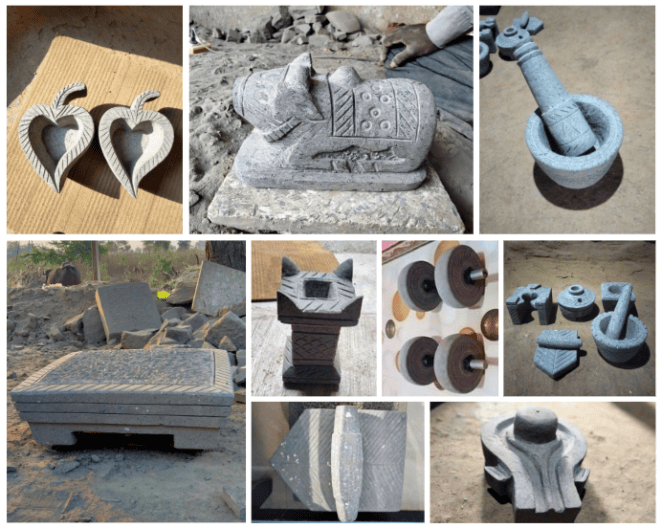
Riverbed stone a source of Life for Patharvat Stone Artisans in Anjani Basin In this Guest Post, Shreesai Kharat, with some great photogrphs, shows how a little known Patharvat community is dependent on creating some remarkable useful and artistic products from river bed stones of Anjani River in Girna-Tapi Basin in Jalgaon in Maharashtra.
High faecal contamination in six Keralam rivers An analysis of water samples carried out as part of the National Water Quality Monitoring Programme of the Central Pollution Control Board (CPCB) has revealed exceeding levels of faecal contamination along the monitoring stations on the Karamana, Periyar, Kadambrayar, Chitrapuzha, Chalakudy and Kallai rivers in Keralam.
FIR against Baddi, Nalagarh factories over alarming pollution An FIR was registered at City Ropar Police Station on Aug. 23 over the alleged alarming discharge and dumping of chemical-based industrial waste into the Sutlej. The complaint, which has been filed by Ropar AAP MLA Dinesh Chadha, alleged that toxic pollutants flowing in the Sirsa river which further contaminated the Sutlej were coming from the Baddi-Nalagarh industrial belt of Himachal Pradesh.
NGT issues notice to Centre against amendment on Ganga floodplains The NGT issued notice to the Centre on a petition challenging a Jal Shakti Ministry amendment issued earlier this month that removed the “construction-free zone” tag on the Ganga’s floodplains and redefined what counts as a floodplain. The petition, filed by environmentalist Amit Kumar, argues that the change alters the no-construction zone set out in the 2016 order and wrongly pegs the “active floodplain” to a one-in-five-year flood. The order had defined the floodplain largely by a once-in-100-year flood line. Mr. Kumar contended that the amendment runs counter to earlier rulings of the Tribunal and the High Courts, including a 2017 six-member Bench judgment that treated 100 metres from the river’s edge as a no-development zone on the Haridwar-to-Kanpur stretch.
NGT questions basis of flood plain zoning along Ganga The applicant raised concerns over construction allegedly being carried out by Sri Vaari Chemicals Private Limited near the River Ganga, claiming that it violated restrictions imposed for the protection of the river and its flood plains.
During July 20 hearing, the NGT observed that the River Ganga (Rejuvenation, Protection and Management) Authorities Order, 2016, does not define the term “Active Flood Plain” and directed the NMCG to clarify the basis on which it had sought demarcation of flood plains for the 1-in-5-year and 1-in-25-year return periods.
The Tribunal further noted that although the NMCG had referred to the Technical Guidelines on Flood Plain Zoning issued by the Central Water Commission in July 2025, the guidelines had not been placed on record. The NMCG was granted four weeks to submit the relevant documents. The Tribunal also allowed the applicant’s plea to implead the Ministry of Jal Shakti and the Central Water Commission as respondents in the matter. The case has been listed for further hearing on September 21.
Gorakhpur effluent plant delay over govt report: NMCG A delay exists in setting up a CETP at the Gorakhpur Industrial Development Authority (GIDA) because the government of Uttar Pradesh has not forwarded the detailed project report (DPR) to the National Mission for Clean Ganga (NMCG). This was stated in the report NMCG filed before the NGT on August 19, 2026. The matter related to discharge of untreated industrial effluent by GIDA through the Saraya drain into River Ami, a tributary of river Ganga, near village Adilapur, block Piprauli, district Gorakhpur, Uttar Pradesh.
In order to facilitate implementation of the proposed CETP, NMCG, August 6, 2025 requested government of Uttar Pradesh on August 6, 2025, to designate GIDA / UPSIDA / IIDD as the responsible agency for the construction, operation and maintenance of the proposed common effluent treatment plant. In February 3, 2026 the NMCG requested the Uttar Pradesh government to convene a meeting of the State Level Committee headed by the Additional Chief Secretary for consideration of the DPR for establishing the proposed 4 MLD CETP at GIDA Industrial Area, Gorakhpur.
SC sets aside NGT order against Art of Living over Yamuna floodplain damage The Supreme Court on Aug. 22 set aside a 2017 order of the NGT which had held the Art of Living Foundation responsible for damage to the Yamuna floodplains during its 2016 World Culture Festival. The tribunal allowed the Foundation’s appeal and directed the Delhi Development Authority (DDA) to refund the ₹5 crore environmental compensation deposited by the Foundation.
The Foundation maintained that the site had never been demarcated as a floodplain and that there had been no scientific assessment establishing the extent of environmental damage attributable to the festival. It also questioned the fastening of liability on it when the permissions for the event had been granted by the DDA. The Court today allowed the appeal, set aside the NGT judgment and directed the DDA to return the ₹5 crore deposited by the Foundation as environmental compensation. A detailed judgment is awaited.
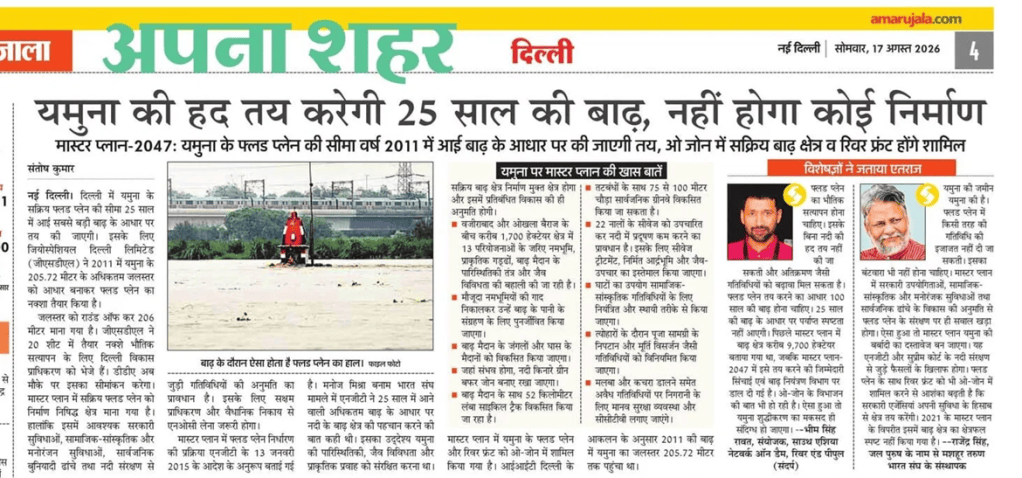
Unabated construction in floodplain Zone-O is not limited to private construction. Construction work is also underway at a Delhi Municipal Corporation primary school in Wazirabad village. This means that even government construction is taking place openly in an area where construction is prohibited. Zone-O, under the Delhi Master Plan, refers to the Yamuna floodplain stretching approximately 22 km from Wazirabad to Okhla. The area is considered highly sensitive from the perspective of environmental protection and flood management.
Delhi plans to route Tehri Dam water Delhi govt is working on a plan to increase Yamuna’s environmental flow by 1,300 cusecs by routing water through Tehri Dam reservoir to Hindon river, while separately undertaking measures to reduce major transmission losses in a canal network supplying the capital.
A presentation reviewed by Delhi govt shows plans to also divert 500 cusecs to Yamuna through a proposed 29-km-long pipeline, according to a senior Delhi govt official. The plan is intended to ensure that 1,800 cusecs of water is available at Okhla Barrage.
Delhi Jal Board (DJB) has issued a letter of intent to Water and Power Consultancy Services (WAPCOS) to prepare a detailed project report, with its completion expected by this Oct. Delhi govt will then submit to ministry of housing and urban affairs. A joint survey by DJB and Uttar Pradesh Jal Nigam was conducted in this regard on June 29, the official added.
The second major intervention focuses on reducing transmission losses in the canal network called Delhi sub-branch system. Currently, 330 cusecs is released for Delhi’s drinking water supply, but the city receives only around 230 cusecs after nearly 30% conveyance losses.
Govt is working with Haryana’s irrigation department on repairs and rehabilitation of the system. Three meetings have been held between DJB and the Haryana department on this, the official said. Delhi has also sought Haryana’s consent for bearing its share of the cost of lining the Delhi sub-branch.
A broader plan includes six projects covering different zones of Delhi, with a cost estimated at Rs 15,000 crore. Funding is proposed through urban challenge fund, Delhi govt/DJB contributions and loans, including financing from HUDCO and NABARD. Govt is also planning to regulate groundwater extraction in the capital and finalise a new policy in this regard.
RIVERS BIODIVERSITY
Kaziranga ESZ cut to 1 km may trigger industrial rush NTCA warned against The National Tiger Conservation Authority had, in fact, called for banning all mining, quarrying, and stone crushing activity in the entire Kaziranga-Karbi Anglong landscape with immediate effect – in sharp contrast to the State Government’s move to reduce the ESZ drastically. At present, several stone quarries/mining sites and stone crusher units are located in places of Karbi Anglong district that are within a distance of 2-5 km from the southern boundary of Kaziranga Tiger Reserve. The new ESZ regulation will grant legitimacy to all these units, besides triggering more industrial activities in the days ahead.
The latest assessment by the International Union for Conservation of Nature (IUCN) World Heritage Outlook has warned that external pressures and landscape changes threaten Kaziranga National Park’s (KNP) long-term ecological health. Amid a controversy over a plan to reduce the ESZ of KNP, a Supreme Court-constituted panel has pulled up the Assam government over its handling of mining on the southern boundary of the one-horned rhino habitat. The Central Empowered Committee (CEC) said the government did not address the mining issue in and around the Parkup Pahar Range, a declared wildlife sanctuary and vital ecological corridor, with the seriousness it deserved.
Assam mum on construction in Kaziranga animal corridors In March 2022, the Central Empowered Committee sought a response “without delay” from the Assam Chief Secretary on the list of activities undertaken in each of the nine corridors in violation of the Supreme Court’s order on April 12, 2019.
CM Himanta Biswa Sarma has argued that reducing the buffer zone was necessary to promote civic and urban growth in neighbouring towns. This is a specious argument. The park is already facing threats of encroachment by construction, mining, quarrying, stonecutting and industrial activities, which pollute water bodies and disrupt critical transit zones for wildlife during the rainy season. Official sanction for reducing the buffer zone will give these encroachers carte blanche to destroy a fragile ecosystem.
Gandak Villagers Are Bringing Gharials Back Once blamed for crocodile attacks it never committed, the critically endangered gharial was disappearing from Bihar’s Gandak River. Today, local communities, fishers and women observers are helping protect one of the world’s last major breeding populations of the species.
FISH, FISHERIES, FISHERFOLKS
Vadhavan fisherfolk: nets in troubled waters Fishers in Maharashtra’s ecologically fragile Dahanu region have resisted the proposed Vadhavan port for over three decades now. As the project steadily moves ahead, many fear loss of livelihoods – and a way of life.
Fishes of Chennai explores city’s native freshwater fish A field guide put together by two native freshwater fish enthusiasts and released on the occasion of the Madras Day on Aug. 22, has documented fish found in Chennai’s waterbodies and has explored the city’s long cultural connection with fish, including their presence and importance in ancient Tamil literature.

SAND MINING
NGT Rejects Incomplete Report on Illegal Mining in Baghpat On July 14, 2026, the Tribunal rejected the report submitted by the Directorate of Geology and Mining and expressed strong dissatisfaction with its contents. The NGT pointed out that the report was neither submitted as an affidavit nor signed by the Director or any competent authority. It also lacked details on compliance with the Tribunal’s earlier directions to stop illegal mining, the action taken so far, and the role and measures undertaken by the Baghpat District Task Force.
During the hearing, the Uttar Pradesh Pollution Control Board (UPPCB) referred to its April 10, 2026 affidavit, stating that an environmental compensation of ₹4,63,563 had been recovered in November 2025 from Smart Mart Stores for violations. The NGT directed that the amount be used for large-scale plantation along the 5-km embankment stretch between Mavikalan and Alipur villages, with UPPCB required to submit a progress report.
The Tribunal also directed the Mining Director and Baghpat District Magistrate to use funds allocated under the Mine Closure Plan to immediately close the illegal mines. If necessary, the costs may be recovered from the responsible miners. A report on the action taken is to be submitted before the next hearing. The Tribunal directed the Director of Mining to submit a fresh and comprehensive compliance report containing all the required information. The case concerns alleged illegal mining in Sankaraud village of Baghpat district, which the NGT has been monitoring.
The tribunal had completed hearing the arguments and reserved its order on May 8. However, after examining the material on record, the bench considered it necessary to conduct further hearing and to implead additional authorities whose presence was considered necessary for “proper adjudication of the matter”.
Etawah Transport Officer Claims Threat to Life In Etawah, ARTO Enforcement officer Huma Parveen has reported a threat to her life after seizing an illegal and overloaded truck. She has sought protection from police officials, alleging that some people have been following her and attempting to intimidate her.
18 Lakh MT’s of Clay, Sand, Bajri Excavated from Kashmir Karewas Illegally Environmental activist Dr Raja Muzaffar Bhat said that the Karewa landscape of Pulwama and Budgam has been subjected to “loot and plunder” on a scale far greater than the quantities reflected in official records. This, he said, after a joint committee constituted by the National Green Tribunal (NGT) documented extensive excavation and alteration of the terrain at Zadoora, Gowherpora and Rangeen Kultreh.
“Out of 18 lakh MTs , 130500 MTs of material has been excavated from Gowherpora and Rangeen Kultreh villages of Chadoora Budgam and around 5 lakhs MTs from Zadoora village of Pulwama in Hastikhud area,” he said. Bhat, who is the petitioner in the case before the NGT, said the government could not use the abrogation of Article 370 and the COVID-19 pandemic to explain away large-scale excavation during 2019-2024, arguing that curfews, lockdowns and heavy security restrictions made the movement of earth-moving machinery and mined material difficult.
RAMSAR WETLANDS
Calculate fine for damage to Lower Lake: NGT The NGT has asked the Madhya Pradesh Pollution Control Board to calculate the amount of penalty to be paid by the BMC (Bhopal Municipal Corporation) for environmental damage done to Lower Lake by allowing 8 to 10 MLD untreated sewage to flow into the waters and pollute it.
The green court said that the State Wetland Authority and the Environment and Planning Coordination department with a representative nominated by the member secretary, MPPCB, should examine the matter again and verify as to whether the constructions are newly raised constructions in violation of Wetland Rules, 2017. A clear report should be submitted by the authorities within 30 days.
On the issue of “deliberate and systematic damage of green trees and green belt by use of chemical toxic substances injecting into the tree trunks to cause their gradual drying and death within the 50 meters of the FTL Lower Lake, the tribunal said that the joint committee found that seven trees in a premises inside the buffer zone of the lake was sought to be destroyed in this manner. Out of these, two trees were found to be relatively healthy with green foliage, whereas five trees were found to be dry and withered.
The tribunal directed BMC/MPPCB to take necessary actions against the person who is responsible for the above activities and if trees have been damaged, the environmental compensation must be assessed against the person who is responsible for that or against the person in whose premises the trees exist. The petition will now come up for hearing on Sept 28.
The green watchdog further asked BMC To furnish information to the NGT on STPs, water supply, drains discharging untreated water into Lower and Upper Lake and measures taken to prevent it.
NGT questions AMRUT sewage system over in-flow of sewage into Lower Lake Raising questions over the effectiveness of the city’s sewage system under AMRUT, the NGT on Aug 17 formed another committee to visit Lower Lake and submit a report on drains allegedly discharging untreated sewage into the lake.
The Bhopal-based central bench of the NGT took suo motu cognizance of a media report that said that a total of 28 small and large drains are discharging waste water and polluting the lake. The report added that there is no remaining source of freshwater for the lake and only polluted water now enters the lake. NGT asked the newly formed panel to submit its report on the claims within six weeks.
Despite this recurring problem, no effective measures have been taken to prevent the overflow or stop sewage from polluting the lake, it added. “The chambers of the sewer line laid to prevent sewage from entering the lake overflow during the rainy season, causing foul-smelling and contaminated water to flow directly into Lower Lake,” said the green watchdog while fixing the case for further hearing on Oct 5.
The NGT has directed systemic removal of encroachments on central verges of roads in Bhopal using wire fencing, afforestation and geo-tagging and has further prohibited concretization in the green belt area. The tribunal further directed Bhopal’s Collector and the Divisional Forest Officer to undertake a joint survey and demarcate entire recorded forest land within the district preferably through GIS(Geographic Information System)/GPS and satellite imagery, submit the consolidated report and wherever illegal encroachment is found and there is no lawful impediment, the authorities have been directed to remove the same as per law within three months. With respect to wastewater, the Tribunal directed the Corporation to identify Sewage Treatment Plants in close proximity to plantation areas so that treated water could be effectively utilised to support plant growth. It also directed ward-wise mapping of the entire BMC area.
Construction activities around Pallikaranai marshland can be regulated: SWA In what could give hope to thousands of property owners around the 1,247.54-hectare Pallikaranai marshland in Chennai, the Tamil Nadu State Wetlands Authority (TNSWA) on August 20 told the Madras High Court that construction of buildings can be regulated and need not be necessarily banned in the ‘zone of influence’ (ZoI) encircling the wetland. First Division Bench of Chief Justice Sushrut Arvind Dharmadhikari and Justice G. Arul Murugan was also told that the National Centre for Sustainable Coastal Management (NCSCM) had come up with a plan for delineation of an interim ZoI until the final ZoI could be determined after conducting thorough scientific studies regarding site specific hydrological and land use characteristics.
WATER OPTIONS
On a mission to revive Tanks in Udupi For the past 7 years, Dr Satish Kamath, a reputed gynaecologist in Udupi, has been on a water mission — restoring one kere every year. Villages have witnessed derelict tanks turning into lakes and dried-up wells filling with water after a long time. The doctor’s diligent self-effacing work has turned his mission into a community effort with citizens joining in. 3 years ago, a retired engineer, Krishna Hebsur, joined himDr Kamath funds the work while Hebsur provides technical expertise. Together they search for neglected keres. They visit villages, consult local communities, and finally select a kere for restoration. This year, for the first time, they restored two instead of one.
Dr Kamath’s work gradually gained support across the twin cities of Udupi and Manipal. Last year, a turning point was reached when several citizens approached him saying they too would like to join in. Thirty people are now part of his mission. Dr Kamath created a WhatsApp group called Nature Care Group, largely comprising doctors.
TN WRD to build 27 check dams in State to conserve floodwater The Water Resources Department (WRD) will construct 27 check dams across 13 districts to conserve floodwater and harness groundwater at a cost of ₹206.75 crore, Minister for Rural Development and Water Resources N. Anand announced in the Tamil Nadu Assembly on Aug. 19. Replying to the discussion on the Demands for Grants for the WRD, Mr. Anand said one such check dam would be built across Amaravati river near Melapalayam village in Karur. Similarly, two bed dams would be constructed in districts such as Madurai at a cost of ₹31.50 crore to arrest riverbed erosion and facilitate groundwater recharge, he said.
The department would also carry out 96 works to repair, renovate, and restore waterbodies and channels, which are a part of the existing irrigation infrastructure, at a cost of ₹695.42 crore. The works would be executed in 30 districts, including Tiruchi. As part of efforts to conserve groundwater resources, 1,628 artificial groundwater recharge structures would be installed across 35 districts at a cost of ₹28.9 crore.
The Adyar in Chennai is among the sites covered under 49 works worth ₹218.29 crore to construct flood protection walls as part of disaster management measures in 19 districts. The work near Jaffarkhanpet across the Adyar would be executed at a cost of ₹25 crore.
Restoration of dam infrastructure in 11 districts, including Coimbatore, Tiruppur, and Ramanathapuram, at a cost of ₹246. 93 crore, repair of seawalls in north Chennai, and preparation of an impact assessment report to assess the functioning of existing schemes were among the other announcements.
Ladakh seeks Centre’s approval for 36 check dams to expand irrigation The Ladakh administration on Sunday submitted a proposal to the Union ministry of Jal Shakti for the construction of 36 check dams to strengthen water availability and expand irrigation potential in the Union Territory. The proposal includes seven Himalayan rock check dams in Leh and 29 reinforced cement concrete (RCC) check dams in Kargil, at an estimated cost of more than Rs 56 crore. According to the detailed project report submitted to the Jal Shakti ministry, the proposed check dams are expected to irrigate more than 18,600 acres of land.
India is turning to ancient water systems as modern ones run dry Water scarcity and climate change is driving communities to restore traditional water structures built centuries ago, bringing them back into use in the 21st Century.
Farmer Movement to Save 1,000 Forgotten Rice Varieties Inspired by a Japanese farming philosophy, Usha Soolapani spent decades travelling across India to save indigenous rice varieties — building a movement that now reaches 30,000 farmers across six states.
GROUNDWATER
Scant rain, more cane: Is ethanol fuelling the surge? Almost all major kharif crops — including paddy, pulses, coarse cereals such as millets and maize, and cotton — reported lower acreage by the end of July, compared with the same period last year. There was, however, one crop that bucked the trend: sugarcane. Despite being a water-intensive crop, it recorded a higher acreage than last year, and also a larger acreage than the average of the previous five years.
Sugarcane contributes to 30-35% of ethanol production as biofuel in India, even as grains — mainly maize and rice — contribute the remaining 65-70%.
The problem with this, of course, is sugarcane’s water-intensiveness. The increase in the crop’s acreage this year came despite substantial rainfall deficits in the five leading sugarcane-producing states — Uttar Pradesh, Maharashtra, Karnataka, Bihar and Tamil Nadu — during June.
Agriculture accounts for 87% of groundwater extraction: Union Minister India extracts 60.63% of its annual groundwater resources, with agriculture accounting for the largest share, followed by domestic and industrial uses, according to data provided by the Union government in the Rajya Sabha. Nine states and Union Territories — Punjab, Rajasthan, Haryana, Delhi, Puducherry, Tamil Nadu, Uttar Pradesh, Chandigarh and Karnataka — have groundwater extraction rates above the national average. District-wise data shows that 281 districts have extraction levels exceeding the national average.
In a written response in the Rajya Sabha, Union Jal Shakti Minister C.R Patil said agriculture accounts for about 87% of India’s total groundwater extraction, while domestic use accounts for 11% and industry for 2%.
According to the Dynamic Ground Water Resources Assessment for 2025, the country’s annual groundwater recharge is estimated at 449 billion cubic metres (BCM), while the annual extractable groundwater resource is 408 BCM. Total annual groundwater extraction for all uses is estimated at 247 BCM. Of this, 215 BCM is used for irrigation, 28 BCM for domestic purposes, including drinking water, and 4 BCM for industrial use.
Ground-water crisis has an electricity problem Cheap and free farm power can encourage groundwater extraction, with states spending Rs 1.89 lakh crore on power subsidies in FY25 as water tables continue to come under pressure.
The Centre’s approach has increasingly shifted from simply reducing the subsidy to changing how agricultural energy is supplied. The major vehicle is PM-KUSUM (Pradhan Mantri Kisan Urja Suraksha evam Utthaan Mahabhiyan), which promotes solar pumps and solarisation of agricultural feeders.
If solar irrigation is over-drawing groundwater Over the past five years, India’s agricultural solar program, PM-KUSUM, has installed over 2.5 million solar pumps, making them affordable for smallholder farmers through subsidies. As the government prepares PM-KUSUM 2.0, the challenge is to advance the clean energy transition without continuing to over-exploit groundwater.
Gujarat’s groundwater under growing stress The Central Ground Water Board’s (CGWB) 2025 assessment shows Gujarat extracted 14.33 billion cubic metres (bcm) of groundwater against an annual extractable resource of 25.61 bcm. Groundwater extraction rose from 13.86 bcm in 2024 to 14.33 bcm in 2025, a 3.4% year-on-year increase.
Meanwhile, annual groundwater recharge remained unchanged at 27.58 bcm. The rising extraction, despite virtually stagnant recharge, pushed Gujarat’s groundwater extraction stage from 54.21% to 55.95%, signalling mounting pressure on the state’s groundwater resources.
Agriculture accounted for 13.25 bcm, or 92.5%, of groundwater extraction in 2025. Domestic use was 0.88 bcm and industrial extraction 0.20 bcm, according to the CGWB. The figures underline the state’s dependence on groundwater for farming and its sensitivity to rainfall and irrigation demand.
TN Groundwater extraction NOC for commercial users to go digital by end of Sept The Water Resources Department is set to digitise the process of issuing no-objection certificates (NOCs) for groundwater extraction by industries and commercial users across Tamil Nadu by the end of September. The move is aimed at streamlining the monitoring mechanism and clearance process. At present, the State Ground and Surface Water Resources Data Centre (WRD) provides NOC manually to water-based industries for groundwater extraction by sinking borewells. WRD officials said the work, which is being taken up along with the Tamil Nadu e-Governance Agency, for online processing and issuance of NOC for commercial extraction is in its final stages. The service would be offered as one of the common online services through e-Sevai centres.
PPCB collects samples from Dhuri ethanol plant The Punjab Pollution Control Board (PPCB) has collected air, water and soil samples from Harp Chemicals Private Limited at Jahangir village in Dhuri after villagers alleged that the ethanol plant was causing water pollution. A PPCB team visited the factory on Aug. 18 along with sarpanches from five villages and former village representatives. The team collected air, water and soil samples for testing. Singla said the report is expected in around 15 days.
He said the department had also received a complaint in June regarding black-coloured water in a village, following which samples were collected. The report in that case is still under process. A sarpanch from Badshahpur village alleged that the factory was causing pollution and injecting polluted water into the groundwater through borewells. He said residents of several villages had contacted them, prompting them to approach the SDM office and seek an urgent inspection. Pushpinder Singh, managing director of Harp Chemicals, termed the allegations baseless.
INDUSTRIAL WATER POLICY
Thirsty data centres, thin regulation: Who is watching India’s water? India’s rapid AI expansion is driving a massive build-out of water-intensive data centres, yet regulation has not kept pace with the sector’s growing water footprint. With facilities concentrated in already stressed cities like Bengaluru, Mumbai and Chennai, weak monitoring, disclosure and planning threaten long-term water security unless stronger safeguards and efficiency standards are embedded now. None of the major state data centre policies in India currently require operators to disclose water consumption through a centralised reporting system. (Shruthi Srinivasan; Tania Sebastian)
AP IT Minister’s Defence of Hyperscale AI Data Centers Does Not Withstand Scrutiny The Human Rights Forum (HRF) rejects Andhra Pradesh IT Minister N Lokesh’s attempt to dismiss growing public concern over the proposed hyperscale AI data centers in Visakhapatnam as “deliberate misinformation”. Speaking in the Assembly on August 19, the Minister also asserted that environmental responsibility would be prioritised and defended the projects’ water and power requirements.
The government’s own record, however, points to precisely the opposite conclusion and the Minister’s assurances do not withstand scrutiny. How was environmental responsibility ‘prioritised’ when a hyperscale AI data center is being established virtually within the catchment of Mudasarlova reservoir, an important source of drinking water for Visakhapatnam? The Google-Adani 512 MW project site at Adavivaram is barely 120 metres from the reservoir. The fundamental question is not whether the project will plant trees later or adopt supposedly efficient cooling technology. It is whether an industrial installation of this scale should be located within the catchment of a drinking water reservoir in the first place.
As HRF has pointed out since May this year, site development and alteration of the Adavivaram landscape began as early as February 2026, months before Environmental Clearance was granted. If environmental concerns were genuinely being prioritised, how was the physical alteration of the reservoir catchment permitted – carried out in brazen disregard of the law – before the requisite environmental scrutiny was completed?
A data centre mired in controversy Andhra Pradesh’s proposal for a “Deemed Distribution Licence” benefitting the Google-Adani data centre, along with its liberal incentives for such ventures, is, critics say, legally unsound and fiscally unsustainable.

WATER POLLUTION
The Andhra Pradesh Assembly on Aug. 20 unanimously passed a resolution to implement the Centre’s Water (Prevention and Control of Pollution) Amendment Act, 2024, in the state.
JJM/ RURAL WATER SUPPLY
Madhya Pradesh: 23 Districts Have Less Than 70% Tap Water Coverage The Union Ministry of Jal Shakti told the Rajya Sabha that 23 of Madhya Pradesh’s 55 districts have less than 70% coverage of potable tap water supply. This means that in around 42% of the state’s districts, fewer than seven in every 10 households have access to domestic tap water connections. The information was provided in response to a question by Rajya Sabha MP Vivek K. Tankha, who sought details on water-quality testing, the functionality of household tap connections and districts with coverage below 70%.
Government data from these 23 districts shows that out of 4,949,461 households, only 2,955,970 have domestic tap water connections. This leaves 1,993,491 households—nearly 2 million—outside the coverage of household tap connections.
AGRICULTURE
Severe El Nino Impact On India Britain’s Met Office warned on Aug. 21 of a powerful El Niño that could make 2027 the hottest year on record. The Met Office informed that the event is already causing well below normal rainfall in India. The IMD projects India’s full monsoon season at 90% of the long-period average, its lowest level in 11 years. OP Sreejith, scientist and head of the climate monitoring and prediction group at IMD, said there is a high possibility 2027 beats 2024 globally. “For the Indian region, average temperature may not cross the 2024 record temperature. It will depend on the 2027 monsoon and ENSO conditions after the monsoon season then,” Sreejith said, adding India should still see strong heatwaves next year.
Raghu Murtugudde, emeritus professor at the University of Maryland and visiting professor at the Kotak School of Sustainability, IIT-Kanpur, said agricultural stress could extend through both this year’s Rabi season and into 2027. “2023 and 2024 were fairly bad years too, due to El Nino. This year too, for India, the Rabi output may suffer,” Murtugudde said. “The government is already taking safeguards, like the action on edible oil and sugar.” “In 2027, for India, a lot will depend on how the monsoon performs, but spring next year may also bring a lot of heatwaves, which will again impact crops,” Murtugudde said.
Vast swathes of farmlands still short of rain Nearly half of the 262 districts the Centre identified as vulnerable to a weak monsoon continue to face rainfall deficiency, despite a sharp recovery in July and the first half of August, raising concerns over crops in areas with limited irrigation and high dependence on rain, an HT analysis of Agriculture Ministry and India Meteorological Department (IMD) data showed.
Of the 262 districts identified for focused monitoring ahead of the kharif season, 117 are currently deficient or large deficient, while 144 have received normal or better-than-normal rainfall. One district has no cumulative classification in IMD data. As of August 19, all-India rainfall was 13% below the long-period average (LPA), down sharply from a 40% deficit at the end of June. The deficit narrowed to 13% by the end of July but has remained largely between 11% and 13% in August.
MONSOON 2026
June 2026: High Rainfall district days in India’s SW Monsoon An analysis of the daily district wise rainfall data from IMD for June 2026, the first month of India’s South West Monsoon 2026 shows that there were only 197 instances (415 in June 2025, 384 in June 2024, 451 in June 2023, 462 in June 2022 and 442 in June 2021) when district rainfall of a day was above 50 mm. The rainfall of India in June 2026 was 99.5 mm, the rainfall of India in June 2025 was 180 mm, the rainfall of India in June 2024 was 147.2 mm, the rainfall in June 2023 was 148.6 mm, the rainfall of India in June 2022 was 152.3 mm. The figures and analysis are based on IMD’s daily district wise rainfall bulletins for the 24 hours ending at 0830 am each day. The numbers are the lowest in 2026 compared to those in last six years. The next high number, 384 in June 2024, is almost double the number in 2026.
IMD predicts below-normal rain for next two weeks India’s monsoon is weakening at a point in the season when it should be at its most productive. The IMD said below-normal rainfall is expected across the country for at least the next two weeks — through September 2 — and the all-India deficit, already at 14% below the long-period average as of Saturday, will grow further as the monsoon trough stays pinned to the Himalayan foothills rather than sweeping across central India. The prediction was part of IMD’s extended range forecast dated August 20 and it now adds to growing worry over this year’s winter crop that has been sown over recent weeks.
The country as a whole has run up a rain deficit of 15.2 per cent (by Aug. 21), with South Peninsula logging the worst at 23.1 per cent, followed by Central India (16.5 per cent); East and North-East India (13.5 per cent); and North-West India (9.7 per cent). Overall figures for the season as a whole (June to August) are not inspiring either, with all-India deficit inching up to 13.2 per cent.
Climate change destabilising Western Ghats’ forest ecosystems in NBS: Researchers The lack of rains in The Nilgiris this year has brought into focus the impacts of erratic weather to the district’s water security. However, a less visible and more alarming facet of the warming climate in the Western Ghats is its impacts on native forests in the Nilgiri Biosphere Reserve (NBR), with researchers warning of “erratic, unpredictable seasons” leading to widespread mayhem within forest ecosystems.
According to a study titled ‘Mapping forest phenological shift in Nilgiri Biosphere Reserve, Western Ghats: Response to Climate Change,’ published in 2024 in ‘Remote Sensing’, an open access peer-reviewed scientific journal, researchers used satellite imagery to examine forests in the Nilgiri Biosphere Reserve over two decades between the years 2000 and 2020, and how they were responding to changing temperature and rainfall.
Extreme snowfall offers only temporary relief from Himalayan glacier loss: Study Extreme precipitation events, particularly heavy snowfall triggered by western disturbances, can “temporarily slow glacier loss in the western Himalaya but cannot reverse the region’s long-term ice decline”, according to a new study based on five decades of observations from 26 glaciers.
Published in Global and Planetary Change, the study analysed 182 in-situ (measurements collected directly on the glaciers), glacier-wide mass-balance observations recorded between 1974 and 2023 across Ladakh, Jammu & Kashmir, Himachal Pradesh and upper Uttarakhand. It found a cumulative mass loss of around 26 ± 1.67 metres water equivalent over the period, underlining the sustained decline of glaciers despite occasional years of heavy snow accumulation.
The study also found that the impact of extreme precipitation depended on whether it fell as snow or rain. Winter events bringing heavy snowfall could increase accumulation and improve mass balance, while events during warmer months could have the opposite effect if precipitation fell as rain, accelerating melting.
FLOODS 2026
Assam Floods: Experts call for better warnings and long term planning Experts said Assam and other states upstream must move beyond spending millions of dollars on flood-control structures and relief toward better early warnings, scientific mapping of changing risks and restoring the ability of forests, wetlands and floodplains to absorb water.
“It’s very important to study and understand flood risks better in Assam,” said Himanshu Thakkar, coordinator of the environmental group, South Asia Network on Dams, Rivers and People. “Once we understand, we can also forecast well. Then we can prepare well and less people will be affected. India is very good at rescuing people or providing relief after the disaster, but is particularly bad in doing anything significant to reduce the possibilities of such disasters.” (Associated Press Story by Sibi Arasu and Wasbir Hussain)
Flood impacts in Assam driven by high exposure and structural vulnerability Although Assam has invested heavily in structural flood-control measures such as embankments, anti-erosion spurs, town protection walls, road-cum-embankments, and wetland restoration, its reliance on rigid embankments and concrete engineering is not sufficient for adaptation. Embankments can worsen flooding by blocking natural drainage, trapping silt and raising riverbeds, and increasing the risk of severe breaches. Future adaptation will therefore need to focus less on controlling rivers and more on working with them, combining targeted engineering with floodplain restoration, wetland conservation, reducing development in floodplains, improved drainage and community-based preparedness. This would reduce reliance on rigid infrastructure while allowing landscapes to absorb and recover from flooding more safely.
Assam: After drought, Golaghat faced floods The paddy farmers of Golaghat could not sow the crop in June because of deficient rain. In July, their fields got inundated. This was unusual. Monsoon typically arrives in Assam in the first week of June. Between mid-June and mid-July, farmers across the region get busy in sowing and transplanting paddy. Many other villages in Golaghat recorded such conditions. According to reports by district authorities, three of Golaghat’s six revenue circles faced “drought-like” conditions as of July 14. Four days later, disaster struck.
On July 19, heavy rain caused the Gelabil river near Bora’s village to swell up, submerging homes and farmlands. In the week between July 16 and 22, Golaghat received 147% more rain than usual, data from the India Meteorological Department shows. Golaghat became one of the four worst-hit flood districts in Assam. Over 100 people have lost their lives and around seven lakh people displaced across the state in devastating floods. The waters have wreaked havoc in Upper Assam, areas which have rarely seen such intense floods in the past.
For the first time since 1998, Bora’s family has not been able to sow paddy. In Sarupatha revenue circle, official documents that Scroll saw indicated that 57 villages were affected by drought-like situation, impacting over 12,000 farmers. Six of these villages were subsequently flooded, according to the flood report prepared by the district disaster management authority.
While Assam battles floods every year, the July catastrophe was different – Nepalikhuti had never seen a flood before. What caused this unprecedented flood? How is it connected to illegal mining?
Extreme moist heat days in Assam have risen from around 20 to 100 annually in 50 years, Prof BN Goswami warns of serious health risks.
Odisha’s floods are a reminder that saving lives is only the first task Odisha’s 2026 floods show that saving lives is only the first step in a true humanitarian response. As waters recede, a second emergency begins for people with disabilities, single women, elderly residents and landless workers who struggle to access aid. Recovery must restore livelihoods and dignity, ensuring the most vulnerable are not left behind when rebuilding begins. (Debabrat Patra)
Floods hit 7.85 lakh people in 6 Odisha districts The flood situation in northern Odisha on Monday (August 17, 2026) worsened, with 7.85 lakh persons affected in six districts due to heavy rain received in three major river systems. Districts such as Jajpur, Bhadrak, Balasore, Mayurbhanj, Kendrapara and Keonjhar were hit by floodwaters due to high Average Areal Precipitation (AAP). AAP was 77.6 mm in the Burhabalang river basin, 47.9 mm in the Baitarani river basin and 36 mm in the Subarnarekha River basin. Odisha has received 28% excess rain between June 1 and August 17, 2026. As compared to an average rain of 760 mm during this period, the State recorded 972.9 mm of rain.
When the floodgate must open in Keralam Keralam already generates substantial rainfall, reservoir, river and ocean data; the next technological challenge is to connect that information into a single, actionable picture, from catchment to sea. (Ameer Ahamed)
Kosi Flood and Erosion Victims Protest in Bihar Flood and riverbank erosion victims from Supaul district staged a protest outside the office of the District Magistrate on August 20, demanding action on a 10-point charter of demands. The protest was organised by the Kosi Nav Nirman Manch. The District Magistrate assured the protesters that action would be taken on some of their demands.
The protesters demanded that erosion-affected families be rehabilitated on government land or at suitable alternative locations outside the vulnerable areas. Several affected residents shared their experiences of displacement and losses caused by floods and erosion. During the protest, district president Alok Rai read out the organisation’s 10-point demand charter, which was endorsed and signed by the affected residents. Protest leaders warned that if their demands are not addressed, they will launch an indefinite Satyagraha in September.
Rise in Yamuna flood levels Varying amounts of water released from the Hathnikund Barrage over the last two days have led to a staggered rise in the level of Yamuna river, with the Central Water Commission’s (CWC) monitoring stations recording different levels of water between the barrage and Delhi. The CWC has forecast a gradual rise in the river water in the Capital over the next two days.
“The water level in Delhi is likely to rise gradually over the next two days as the releases from Hathnikund Barrage have been staggered” Bhim Singh Rawat, SANDRP.
HFL BREACH
River Journala in Indravathi basin at Ghatakusumi site in Nabarangapur district, Odisha has crossed its HFL 544.9 meter dated 19.08.2025 at 16:00 hour on 23.08.2026.
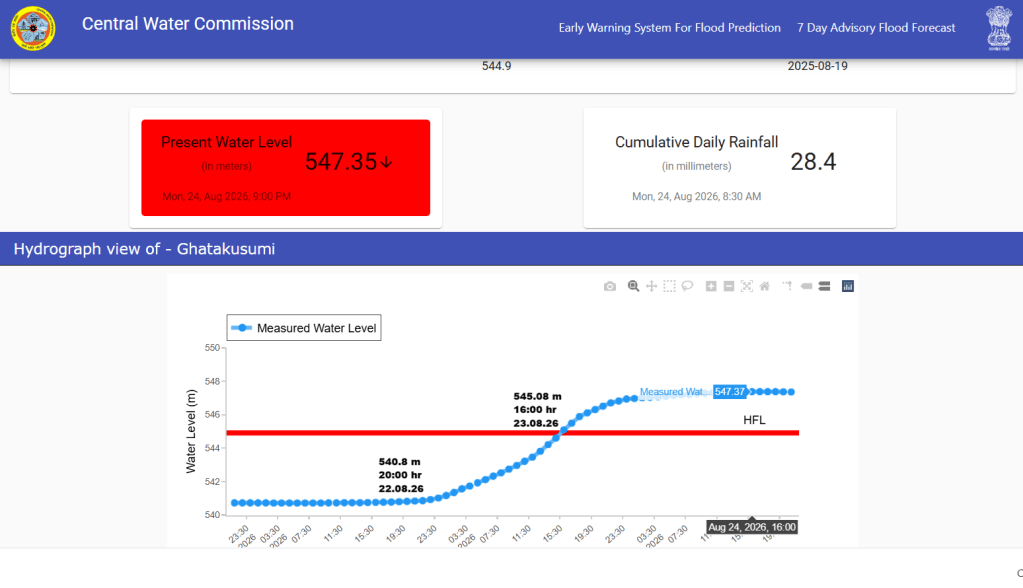
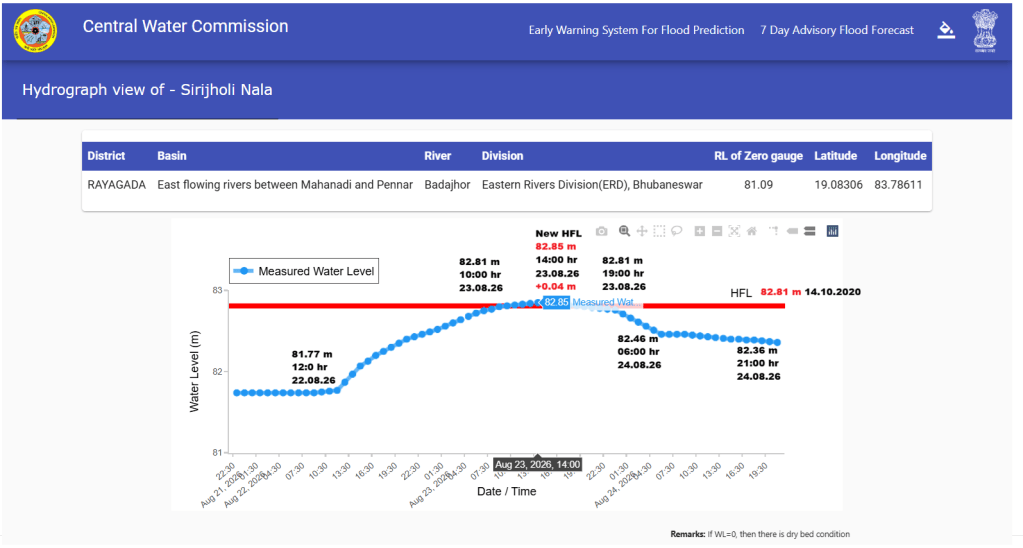
River Badajhor at Sirijholi Nala site in Rayagada district Odisha has crossed its HFL 82.81 meter dated 14.10.2020 at 10:00 hour on 23.08.2026 and has set 82.85 meter as new HFL at 14:00 hour on 23.08.2026.
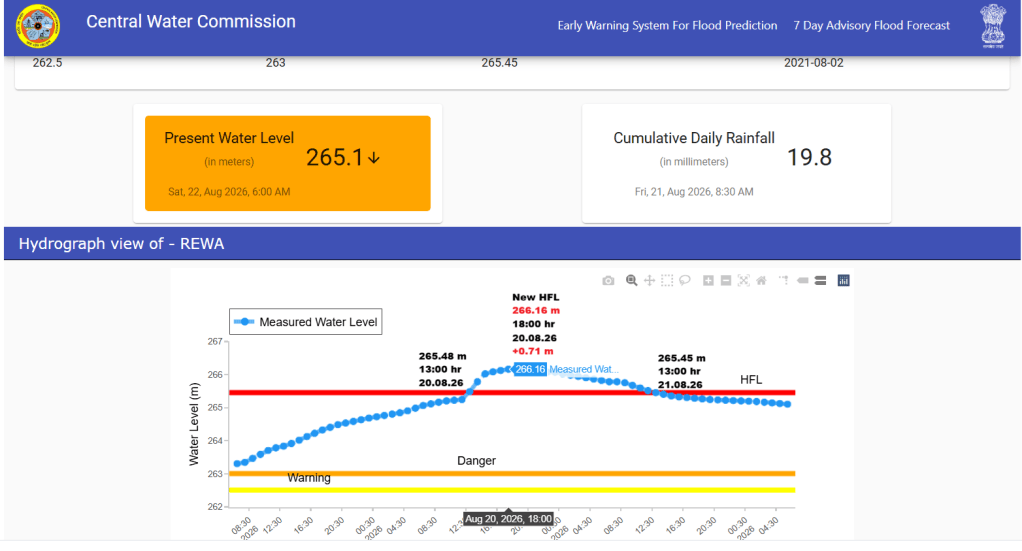
River Tons in Ganga basin at Rewa site in Rewa district, Madhya Pradesh has crossed its HFL 265.45 meter dated 02.08.2021 and has set new HFL 266.16 meter at 18:00 hour on 20.08.2026. New HFL is 0.71 meter higher than the old HFL and the river remained in extreme flood considtion for about 24 hours.
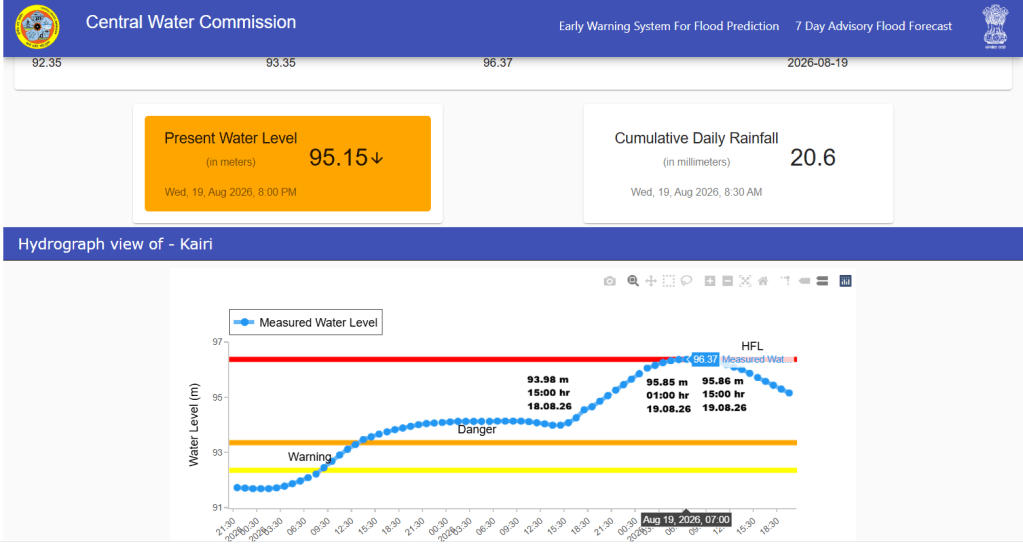
River Belan at Kairi site in Rewa district, Madhya Pradesh has crossed its old HFL 95.85 meter dated 01.08.2021 at 01:00 hour on 19.08.2026 and has set new HFL as 96.37 meter at 07:00 hour on 19.08.2026. The river is in still extreme flood situation at the site.
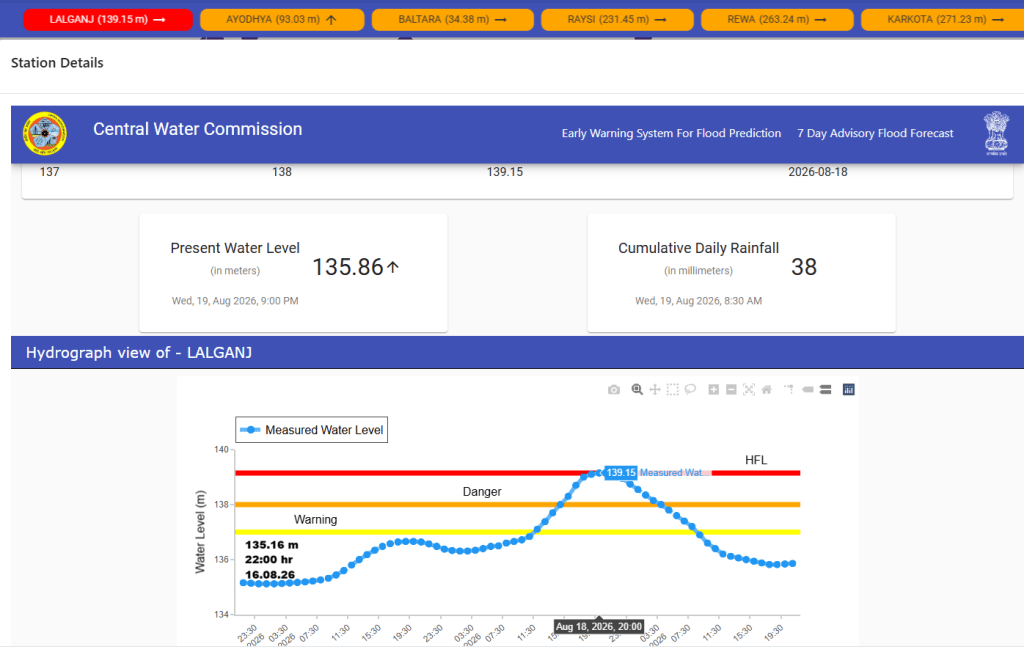
River Belan at Lalganj site in Mirzapur district has crossed its HFL 137.55 meter dated 17.07.2025 at 14:00 hour on 18.08.2026 and set a new HFL 139.15 meter at 20:00 hour on 18.08.2026. CWC has wrongly updated the new HFL as 139.1 meter.
DISASTERS
Not even half of emergency disaster funds transferred to states: CAG The Union govt has not spent even half of the funds under the National Disaster Response Fund (NDRF), meant for meeting expenses for emergency response related to disasters. More than 53% of funds, which would supplement the State Disaster Response Funds, remains unutilised, as per a report of Comptroller and Auditor General of India based on the accounts of Union government in 2024-25, tabled at the Parliament the other day.
Of the total Rs 11,474 crore sanctioned under NDRF as assistance to the state for calamities of severe nature, only Rs 5356 crore was transferred to the states. The remaining Rs 6117.97 crore is listed as ‘savings’ in the CAG report to indicate that it was unspent. This comes at a time when several states, including Kerala and Assam, are alleging that the Union government ignored its demand for more NRDF funds during devastating natural calamities.
CAG has noted this glaring disparity in the head ‘Transfers to state’, which also include assistance to state from National Disaster Mitigation Funds and special assistance. Nearly 75 % of funds under NDMF and over 83 % of special assistance to states were not transferred. The sanction provision for special assistance was Rs 20,000 crore, of which only Rs 3350 was spent. Under NDMF to states, only 719.72 cr was transferred from the sanctioned amount of Rs 2868 cr.
In addition to these, the Union government has a grant worth Rs 100 crore which can be transferred to states as ‘Loans as advance assistance for relief on account of natural calamities’. The government has not utilised a single penny from this account.
Year after Mandi disaster, affected residents waiting for relief Beru village is located in Mandi district, which bore the brunt of Himachal Pradesh’s 2025 monsoon. According to the IMD, the district received 1,910.5 mm of rainfall between June and September 2025 — 76% above normal, the highest in the state. Cloudbursts, landslides and flash floods damaged thousands of houses and washed away roads, bridges and agricultural land.
According to the SDMA’s Memorandum of Damages report, Mandi reported 2,439 damaged houses and 67 deaths, the highest in Himachal Pradesh. Thirty people remained unaccounted for. Across the state, the estimated losses stood at Rs 5,909.3 crore. Residents of Beru say the impact is still visible. Several families claim they are yet to receive disaster relief or have their homes assessed by revenue officials.
DROUGHT
Cauvery 2026: Karnataka Owns River. Who Owns Drought? Plethora of discussion took place about the legal architecture for deciding who owns the Cauvery. But it was never decided who loses when the Cauvery falls short of what the law assumed. Every basin in India governed by a rainfall-dependent tribunal award : the Krishna, the Godavari, the Mahanadi, rests on the same unexamined assumption. Karnataka and Tamil Nadu are simply the first, and by now the most practised, in finding out what happens when it fails. (Sagnik Debnath)
A dry spell along the Cauvery A weak monsoon has left farmers on both sides of the Cauvery struggling with dwindling water supplies. In Karnataka, farmers are worried about irrigation even as the State faces pressure to release water to Tamil Nadu, where large tracts of paddy fields remain barren. The competing demands have sharpened tensions between the two States (Laiqh A. Khan, T. Ramakrishnan)
ENVIRONMENT GOVERNANCE
Post Facto EC: Whose fault Is It Anyway? The Supreme Court has now allowed the Union Government to regularise non-compliant projects which did not obtain prior environmental clearance, provided they serve public interest. But the case didn’t attend to a crucial issue that in order to spot these violators and bring them to book, the government needs to first address the underlying institutional crisis that cripples the environmental law regime in the country, which has made the construction and operation of several projects without prior clearances possible over several years. (Himanshu Pabreja & Neha Miriam Kurian)
Parliamentary panel flags critical operational gaps at NGT A parliamentary panel has identified critical operational gaps at the NGT, including severe staffing shortage and reliance on contractual workers, inadequate digital infrastructure, prolonged pendency of cases across benches and weak enforcement mechanism, and recommended various measures to make it more efficient.
The panel — parliamentary standing committee on law and justice — that tabled its report in Parliament during the recently concluded monsoon session also found it unusual that at a time when govt is vigorously promoting digitalisation, an institution as important as the NGT continues to function without a dedicated computer/IT section and the required technical posts.
During the deliberation, the Tribunal informed the Committee that a total of 55,619 cases had been received since its inception, out of which 49,740 had been disposed of and 5,879 cases were pending, as on June 30, 2026. The zone-wise pendency of cases before NGT as on May 31, 2026 shows that the highest number of pending cases was before Principal Bench at New Delhi (2,318), followed by Western Zone Bench at Pune (1,730), Southern Zone Bench at Chennai (887), Eastern Zone Bench at Kolkata (587), and Central Zone Bench at Bhopal (277).
The new extractivism By centralising control over mineral-bearing land and weakening States’ fiscal powers, the MMDR Amendment Act, 2026, passed without discussion, clears the way for an expanded extractive regime that disproportionately benefits large mining interests.
Can India actually save its forests? In this episode, Dr. Shankar Raman exposes the flaws in India’s environmental policies. We dive into the Great Nicobar Project—a ₹90,000 crore gamble that threatens pristine rainforests and indigenous tribes for transshipment ports and casinos.
Ecotourism, minus the eco India has turned ecotourism from a conservation-oriented model into a rapidly commercialised tourism industry, and in doing so has weakened the very ecological and community principles that ecotourism was meant to uphold.
SOUTH ASIA
Bhutan JSW signs agreement to develop Punatsangchhu III HEP JSW Neo and Bhutan’s Druk Green Power Corporation have signed an agreement to jointly develop the 920 MW Punatsangchhu-III hydroelectric project in Wangdue Phodrang District, marking JSW’s first power generation venture outside India. The pact was concluded in the presence of the Prime Minister and establishes a joint venture company to develop the scheme. Druk Green Power Corp and JWS holds 51: 49% stack in the venture.
Why the Ganga treaty renewal with Bangladesh must be tied to Teesta But the Ganga treaty cannot be sensibly renewed as a standalone instrument. It should be negotiated alongside the still-unresolved question of the Teesta. This is because hydrologically, politically and strategically, the two rivers are no longer separable problems.
The case for treating Ganga and Teesta as isolated files was always thin, and three decades of experience have worn it thinner. Both are snow- and glacier-fed Himalayan systems whose lean-season flows have become the primary site of India-Bangladesh friction, both pass through West Bengal before crossing into Bangladesh, making the state government an unavoidable domestic veto player in any settlement, and both feed into a food-and-livelihood system in northern and western Bangladesh that has grown far more water-stressed than the drafters of 1996 anticipated.
Where the two rivers differ is instructive — Ganga has a treaty that Bangladesh regards as underperforming, while Teesta has no treaty at all, only a stillborn 2011 draft — 42.5 per cent to India, 37.5 to Bangladesh — that collapsed when Mamata Banerjee withdrew support during Manmohan Singh’s 2011 Dhaka visit and has stayed unsigned through every government in Delhi and Dhaka since. Bangladesh’s 54 shared rivers have produced exactly two water-sharing agreements in half a century — Ganga and the smaller Kushiyara — a track record that has convinced Dhaka that piecemeal, river-by-river diplomacy simply does not deliver. (Hindol Sengupta)
JD-U’s working president Sanjay Jha on Aug. 21 said the Farakka Treaty with Bangladesh, the 30-year term of which ends in December, should not be renewed, alleging that it has done “great injustice” to Bihar over the last 30 years. In an interview with PTI Videos, Jha said the treaty, signed in 1996, adversely affected Bihar by contributing to silt accumulation upstream of the Ganga river and requiring 1,500 cusecs of water to be ensured at Farakka during the lean season, when only around 400 cusecs enter Bihar at Buxar. “The treaty should not be renewed,” Jha said, adding that any future arrangement should take into account Bihar’s requirements for industry, irrigation, agriculture and drinking water as well as its projected population in 2050.
Dhaka will seek a “guarantee clause” in the renewed Ganges Water Treaty with India and is ready to approach international forums to protect its water rights, Bangladesh’s water resources minister Shahiduddin Chowdhury Anee reportedly said in Dhaka on Aug. 18. A guarantee clause promises a minimum amount of water to a downstream country, essentially aimed at protecting a nation’s water supply during dry seasons or when river levels drop unexpectedly.
REST OF ASIA
Myanmar to restart work on Myitsone HEP Fourteen years after public protests forced construction to stop, Myanmar is preparing to restart the $3.6 billion China backed Myitsone hydropower project in Kachin State.
The dam is planned at the meeting point of the Mali and Nmai rivers, which form the headwaters of the Irrawaddy. Construction was suspended in 2011 by then-president Thein Sein after large public protests over environmental damage and the displacement of communities. “It will begin shortly,” Htet Paing Htoo, a member of the Kachin State parliament, said. “An official announcement will be released. The president has stated that it will be restarted.” The proposed restart follows Min Aung Hlaing’s visit to China, which has supported the project for years.
The “Asian water tower” is losing 24 billion tonnes of groundwater every year Summary: -The “Asian Water Tower” is losing roughly 24.2 billion tonnes of groundwater every year, with some of the worst declines hitting densely populated farming regions. Glacier melt may temporarily soften the crisis around the 2060s, but without changes in water use, researchers expect depletion to accelerate afterward.
SANDRP
Also see: DRP 17 Aug 2026 & DRP 10 Aug. 2026
Follow us on: www.facebook.com/sandrp.in; https://twitter.com/Indian_Rivers


