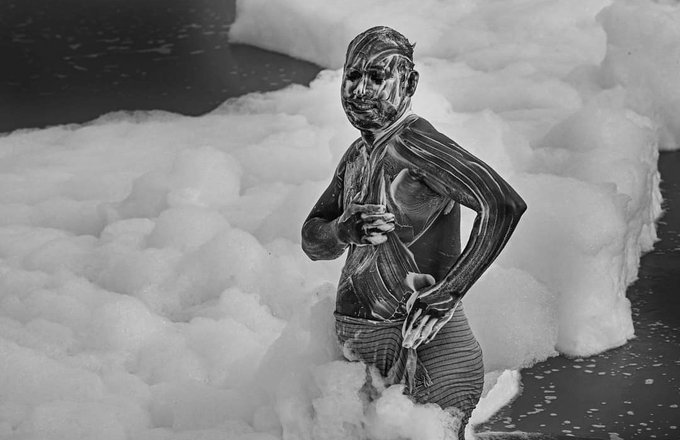
(Feature Image: A man bathing with toxic foam in polluted Yamuna in Delhi. Image is taken by Anindya Chattopadhyay @ANINDYAtimes Deputy Photo Editor,The Times Of India, Delhi and shared on X by Somreet Bhattacharya @Somreetb on Nov. 06, 2024)
This week there is some interesting news about a number of Urban rivers including Pune Rivers, Musi (Hyderabad), Chennai Rivers, Budha Dariya (Ludhiana), Gomti (Lucknow). All the news underlines some serious existential issues for Urban Rivers and raising of voices about it by local communities, governments or legal authorities.
In fact, this is part of a trend that is going on for some years. This sounds like a positive development. But unfortunately, it is not. In fact, this is sign of deteriorating condition of Urban Rivers and increasing Urban footprint on our rivers, going far beyond the boundaries of the cities. Closer examination shows that in spite of some efforts from environmental groups, local communities, some elements in the governments and the courts, the condition of our Urban Rivers is getting worse, much worse than the state of our rivers in general. More worryingly, there are almost no success stories, except some temporary respites at some places.
It indicates the deeper malaise where the short termism and narrow economic interests of a few are over powering the rest of the society and the interests of the future generations. Even the impacts of climate change where rivers can be a major natural resource that can help overcome some such impacts is not helping stop the deterioration of our rivers. Clearly lot more efforts are required.
URBAN RIVERS
Pune No river no vote https://www.youtube.com/watch?v=H06-8CWCFLY (10 Nov. 2024)
Environment issues shaping poll campaigns Rising air pollution, deteriorating rivers, and severe traffic congestion have driven citizens from all walks of life to rally for green spaces over new infrastructure. https://www.hindustantimes.com/cities/pune-news/environment-issues-shaping-poll-campaigns-across-maharashtra-101731005118733.html (08 Nov. 2024)
Musi; Hyderabad Our village on Musi, yet we can’t drink its water: Locals Sharing their tales of woe due to the polluted Musi river, Sangem villagers said cultivation and traditional occupations were badly impacted with the Musi turning into a sewer drain in the past several decades.
“There is no demand for the paddy cultivated in the area, and millers refuse to take it if the paddy is from Sangem. Similarly, since there is no ‘mud’ on the river banks, pottery is affected and even if we use it, it gets a stinking smell, and people won’t buy even pots from this area,” Kummmari Venkatesh, a native of Sangem, said while interacting with CM Revanth during his visit and later in the meeting.
Pouring out their problems, he said: “Our village is located on the banks of the Musi and yet we cannot drink the river water.” Since the groundwater is also polluted, people suffer from ailments like body aches, and even some people suffered cancer. “People bring agricultural labourers from Bihar and West Bengal during the seasons as the local people suffer from body aches after drinking the groundwater,” he said.
Another local, Nagaraj, said local fish ‘Chandamama’ has now become an endangered species and it cannot survive in the polluted and chemical waters of the Musi. “Locals drink toddy after their work almost every day. Now the toddy tappers are getting toddy from other areas, and trees are also not surviving in the village,” Nagaraj said. https://timesofindia.indiatimes.com/city/hyderabad/polluted-musi-river-leaves-sangem-villagers-suffering-from-contaminated-water-and-lost-livelihoods/articleshow/115094387.cms (8 Nov 2024)
EDIT Revival plan or cosmetic change The problem with such beautification plans, including the Musi’s, is that they are executed without consulting those who would be most affected. Moreover, the ‘revitalisation plan’, as the government likes to call it, is a cosmetic change — the eyesore disappears in the hope that it is replaced with a romanticised riverfront bustling with commercial activity. But it has not addressed the elephant in the room: permanently fixing the Musi’s sources of pollution from chemical effluents and untreated sewage. https://www.thehindu.com/opinion/editorial/the-musis-clean-up-on-hyderabads-river-plan/article68845434.ece (09 Nov. 2024)
After announcing that the DPR of River Musi Riverfront would be prepared in 18 months, CM Reddy said the project designs would be ready in a month. https://telanganatoday.com/musi-project-design-in-30-days-says-cm-revanth-reddy (08 Nov. 2024)
Chennai Govt scraps Buckingham Canal restoration A senior Water Resources Department (WRD) official confirmed the decision, citing lack of funds as the reason for the project’s cancellation. With the WRD facing challenges in maintaining even several smaller waterbodies across the state, officials now suggest that the responsibility for the Buckingham Canal may be handed over to the Greater Chennai Corporation (GCC).
During a recent Assembly session, WRD Minister Duraimurugan also discussed the possibility of transferring waterbodies that no longer serve irrigation purposes to local civic bodies for better upkeep. Following this, the Virugambakkam and Otteri Nullah canals were handed over to the GCC for maintenance a couple of weeks ago. “In a similar move, the Buckingham Canal may also be handed over to the GCC,” said a WRD official.
In September 2022, the Madras High Court ordered the demarcation and restoration of the Buckingham Canal. The WRD submitted a detailed project report to the state government in October last year for a large-scale restoration project. The department was expected to invest Rs 980 crore for the project, and the Chennai Rivers Restoration Trust Rs 716.5 crore. However, it did not take off due to fund crunch. https://www.newindianexpress.com/cities/chennai/2024/Nov/04/tamil-nadu-government-scraps-buckingham-canal-restoration (04 Nov. 2024)
Buddha Dariya; Ludhiana Villagers oppose move to release polluted water for irrigation Residents of 32 villages located on the banks of the Buddha Nullah, a Sutlej tributary passing through Ludhiana, on Saturday (Nov. 09) opposed the govt move to release polluted water for irrigation purposes in their fields. The move came to the fore during the ongoing proceedings before the NGT wherein the counsel for the polluting industries has submitted that the state govt had prepared a scheme to divert the water in the lower Buddha Nullah for providing the irrigation facilities in over 15 villages in the vicinity by lifting the water by use of diesel lift pumps.
Reaching out to aggrieved villagers, the activists of Kale Pani Da Morcha, a civil society movement waging a war on rampant water pollution, met the residents of 32 villages at Walipur — the confluence point of the nullah with the Sutlej. The villagers expressed opposition to the proposal for using dyeing effluent for irrigation purposes and demanded immediate dismissal of all those officers of the Punjab Pollution Control Board (PPCB), especially its chairman and member secretary, whom they accused of misleading the Vidhan Sabha committee formed to probe the pollution sources in Sutlej tributary.
Amitoj Mann of the Morcha said: “We are surprised that the state government and the industry have made this plan without consulting any one in these 32 villages. This plan is not practical and the industry and government only want to waste more time by creating more confusion around this issue.” He said if the PPCB, the state government and the dyeing industry did not stop the illegal activity before December 3, the people of the state would come forward to close their illegal pipes themselves. https://www.tribuneindia.com/news/ludhiana/villagers-oppose-move-to-release-polluted-water-for-irrigation/ (10 Nov. 2024)
Gomti; Lucknow LMC, UPPCB get notice over pollution The Uttar Pradesh Human Rights Commission has issued a notice to Lucknow Municipal Corporation (LMC) and UP Pollution Control Board (UPPCB) following a complaint by human rights activist Narayan Pati. Pati, a former general manager at SAIL, lodged the complaint with the commission, prompted by a TOI article titled ‘Sewage Water Chokes Gomti, Leaves It Gasping for Breath.’
Pati’s complaint mentioned the TOI’s report points, highlighting severe pollution in the Gomti river, particularly a drastic decline in dissolved oxygen levels over a 25 km stretch, largely attributed to uncontrolled effluent discharge. The river is facing critical conditions, with toxic foam and water hyacinth infestations near La Martiniere College. The pollution has been exacerbated by water diversions and obstructions at Gaughat, creating stagnant conditions and contributing to the problem. In response, the Commission has directed the Uttar Pradesh Pollution Control Board and the Municipal Commissioner to conduct a thorough investigation and submit a report by Sept 12, 2024. This report will be reviewed on Sept 13, 2024. https://timesofindia.indiatimes.com/city/lucknow/lmc-uppcb-get-notice-over-pollution-in-gomti/articleshow/113173835.cms (09 Sept. 2024)
HYDRO POWER PROJECTS
Jammu & Kashmir 5 activists detained under PSA over HEP protests In a controversial move that has drawn widespread criticism, five local union leaders have been detained under the Jammu & Kashmir Public Safety Act (PSA) in Kishtwar district, with authorities claiming they were attempting to obstruct projects of national importance. The detentions come amid growing tensions between local activists and authorities over implementing hydropower projects in the region.
According to local sources and social media posts of activists and journalists from the Chenab Valley, the detained activists were voicing several specific concerns about the hydropower projects including infrastructure damage, environmental concerns, and compensation issues. They alleged that local houses and properties allegedly suffered damage from project-related blasting and that construction work reportedly caused structural integrity issues in nearby buildings.
They also alleged blatant violations of environmental norms, increasing air pollution caused by these projects affecting local communities, and health hazards from construction activities. They alleged that the trade unionists were also protesting inadequate compensation for land acquisitions and disputes over fair valuation of affected properties. https://kashmirtimes.com/5-activists-detained-under-psa-in-kishtwar-over-hydro-project-protests/ (11 Nov. 2024) Those detained include Mohd Abdullah Gujjar from Sigdi Bhata, Noor Din from Kakerwagan, Ghulam Nabi Choppan from Trungi (Dachhan), Mohd Jaffer Sheikh from Nattas (Dool), and Mohd Ramzan from Dangduroo (Dachhan). Additionally, the District Magistrate of Kishtwar, as per the Daily Excelsior report, ordered close monitoring of 22 others suspected of obstructing key national projects, as per officials. https://thekashmiriyat.co.uk/raised-voice-against-hydro-projects-psa-imposed-on-five-persons-in-kishtwar-for-anti-national-activities/ (10 Nov. 2024)
HEP power generation drops as water level depletes State-owned power plants are currently generating merely 304 MW against their installed capacity of 1140 MW, primarily due to depleting water levels in rivers following deficient rainfall in J&K. “The unprecedented rainfall deficit over the past four months has severely impacted our hydropower generation capabilities,” a senior Power Department official said. “Current water levels are significantly below normal operating parameters, forcing us to run our plants at reduced capacity to ensure sustainable operations through the winter months.”
According to officials, the situation is particularly concerning at the flagship Baglihar project, which is currently generating 239 MW, while smaller installations like New Wanpoh and Kishenpur are contributing just 3 MW each. The Jammu Generation PDC adds another 3 MW, while Jammu Generation IPP and Kashmir Generation contribute 20 MW and 42 MW.
Of the existing installed generation capacity of 3500 MW, 1140 MW is contributed by J&K-owned plants, including projects like 900 MW Baglihar, 110 MW Lower Jhelum, and 110 MW Upper Sindh. The remaining 2300 MW comes from central sector plants, with prominent ones being Salal, Dul-Hasti, Uri, and Kishanganga. During winter months, the combined output from both central and state sector powerhouses typically drops to around 600 MW against their rated capacity of 3500 MW. https://www.greaterkashmir.com/gk-top-news/j-k-power-generation-drops-as-water-level-depletes/ (09 Nov. 2024)
Himachal Pradesh Follow higher royalty policy or lose 3 projects, SJVNL told The Central Government has fixed the deadline of January 15, 2025, for Satluj Jal Vidyut Nigam Ltd (SJVNL) to comply with the state’s energy policy of higher royalty. If it still fails to follow the order, the state government will take over the 210 MW Luhri Phase-1, 382 MW Sunni and the 66 MW Dhaulasidh hydropower projects. CM Sukhvinder Singh Sukhu gave an indication to this effect after a meeting with Union Power, Housing and Urban Affairs Minister Manohar Lal Khattar here today (Nov. 08). https://www.tribuneindia.com/news/himachal/follow-higher-royalty-policy-or-lose-3-projects-sjvnl-told/ (08 Nov. 2024)
Madhya Pradesh Gandhi Sagar dam power generation hit by non-operational turbines Gandhi Sagar dam, a significant hydroelectric project in Mandsaur, is currently facing a setback due to non-operational status of three of its five turbine units. With a total installed capacity of 115 Mw across five units, the dam is capable of generating substantial electricity. As of today, however, only two units (one Hitachi and one Siemens) are operational, producing a combined 29.5 megawatts of power. The remaining three units are undergoing maintenance and repairs, which were scheduled to be completed by Oct 25, 2024, but have been delayed.
The dam, which serves both Madhya Pradesh and Rajasthan, is currently filled to its full capacity of 1312 feet. To meet the increasing irrigation demand of both states, a joint technical committee of Madhya Pradesh and Rajasthan recently decided to release 7500 cusecs of water. However, due to the reduced power generation capacity of Gandhi Sagar hydroelectric plant, only 2700 cusecs of water are being discharged for power generation. The remaining water is being released through the Kota barrage for irrigation purposes.
-The delay in the maintenance and repair work of the three non-operational units has resulted in a shortfall in power generation and has necessitated the release of excess water without generating electricity. “One of the gates of the dam got jammed, which we are trying to open using all the available techniques and options. A team of professional divers has been hired, who are going to the bottom of the gate and placing hydraulic jacks to help in pulling it open,” power generation company managing director Manjeet Singh told TOI.
-He said that all possible efforts were being made to open the gate to pave the way for repairing the turbines. “We are expecting to finish the work in the days to come. However, only four out of five turbines will be functional as components of one of the turbines have already been used in fixing others,” Singh said. The MD said that a tender has been issued for replacement of turbines, which had a 30-year lifespan but have already served for more than 50 years. “The work of replacing the turbines is expected to take the next three years after the work is assigned,” he said. https://timesofindia.indiatimes.com/city/indore/gandhi-sagar-dams-power-generation-plummets-due-to-turbine-failures/articleshow/115095015.cms (09 Nov. 2024)
CWC Himalayan glacial lakes saw 10.81% area expansion from 2011 to 2024 Glacial lakes and other water bodies across the Himalayan region saw a 10.81 per cent increase in area from 2011 to 2024 due to climate change, signalling a heightened risk of glacial lake outburst floods (GLOFs), according to a CWC report. The report states that with a 33.7 per cent expansion of the surface area, the lakes in India experienced an even more substantial rise. “The total inventory area of glacial lakes within India was 1,962 hectares during the year 2011 which has increased to 2,623 hectares during the year 2024 (September)”, the report said.
– It also identified 67 lakes in India that witnessed an over 40 per cent increase in surface area, placing them in the high-risk category for potential GLOFs. Ladakh, Himachal Pradesh, Uttarakhand, Sikkim and Arunachal Pradesh showed the most notable expansions, signalling a heightened risk of GLOFs and the need for intensified monitoring and disaster preparedness. Glacial lakes and other water bodies across the Himalayan region saw an overall area increase of 10.81 per cent from 5,33,401 hectares in 2011 to 5,91,108 hectares in 2024 due to climate change, the report said. https://www.greaterkashmir.com/latest-news/himalayan-glacial-lakes-saw-10-81-per-cent-area-expansion-from-2011-to-2024-report/ (03 Nov. 2024)
NHPC Best Project award to Subansiri Lower Dam?? This reflects so poorly on NHPC when a project that has seen so many disasters, that has seen such huge cost and time over runs, that has faced such strong protests that compelled the project authorities to change so many of the project parameters and the project is still to be commissioned and its economic viability is under question, is adjudged the best NHPC project!! https://nenow.in/north-east-news/assam-nhpc-confers-best-project-award-to-subansiri-lower-dam.html (09 Nov. 2024)
NHPC’s Revenue In June Sept 2024 Quarter Fell By 41% Compared To The Same Period Previous Year. https://in.benzinga.com/news/earnings/24/11/41806582/nhpc-q2-profit-plunges-41-to-909-cr-misses-estimates?fbclid=IwY2xjawGb0- (07 Nov. 2024)
DAMS
Kaleshwaram Project Raising Medigadda capacity ‘serious blunder’: Panel he technical committee appointed by the Justice PC Ghose Commission of Inquiry to assist in the probe into the sinking of piers Medigadda and leakages in Annaram and Sundilla barrages is believed to have pointed out that enhancing the Medigadaa barrage capacity and converting the barrage into a ‘mini dam’ was a mistake that led to serious problems.
– If then govt considered drawing 60 tmcft of water from Tummidihatti, it would have reduced the burden on Medigadda and the project could have been taken up at Tummidihatti itself, the committee said. It said that third party checking of designs and drawings, etc., of all three barrages was also not done. The technical committee has reportedly submitted a report to the inquiry commission recently, stating that the previous BRS govt estimated that there would be 282 tmcft of water available at Medigadda and decided to draw 180 tmcft of water to Yellampally, which was a mistake. “Just to increase the storage, the irrigation department fixed radial gates instead of vertical gates and aimed to maintain water for 90 days a year,” it pointed out.
– Medigadda barrage lifting capacity was increased from 3 tmcft to 13 tmcft. The minimum drawdown level was also fixed at 99 metres, and the length of the water line was set to 93.5 metres to increase the capacity. Other issues such as changes in the designs of crestgates and increasing the size of piers also impacted the barrage. “As a result of this, the barrage has become a dam,” the committee is believed to have mentioned in its report. Regarding the reasons for the sinking of piers in Medigadda, the technical team said that problems in secant piles and gaps resulted in piping issues, which led to the sinking of piers. https://timesofindia.indiatimes.com/city/hyderabad/investigation-reveals-medigadda-capacity-increase-as-major-error-sparks-controversy/articleshow/115028898.cms (07 Nov. 2024)
Polavaram Project International experts assess project design The Centre is readying the roadmap to resume works on Polavaram project with a 3 day session starting on Nov 6 2024. Top officials from Central Water Commission (CWC), Polavaram Project Authority (PPA), AP water resources department, contract agencies were present. During the session the experts will also make field inspection (as they did on Nov 6 morning) to ready the designs. Jal Shakti ministry wanted to finalise the designs for the diaphragm wall and other crucial structures pending in the project.
– The Polavaram project works hit a roadblock almost two years ago after the executing agencies found the diaphragm wall getting damaged beyond repairs due to massive flood in 2019 and 2020. However, no agency was found in a sound position to finalise the structural designs prompting the Centre to summon the Panel of Experts to be present in Polavaram for discussions. https://timesofindia.indiatimes.com/city/vijayawada/international-experts-assess-polavaram-project-designs-to-overcome-dam-challenges/articleshow/115026908.cms (06 Nov. 2024)
Hydel project crucial phase begins Installation of the Stay Ring Segment at the Polavaram Hydroelectric Project commenced on Nov 8, marking a significant milestone in the progress of the project. The Stay Ring is a critical component of the Kaplan turbine, essential for efficient power generation. The successful installation of the Stay Ring and Runner envelope will pave way for the subsequent vital construction phases — including the building of a concrete spiral casing that will house the turbine and generator, and the construction of the steel generator barrel. A complete Stay Ring consists of four segments, each weighing 34 MT.
– A panel — including international experts, officials from the Central Water Commission, Polavaram Project Authority, Water Resources Department and MEIL, inspected the site where the construction of the diaphragm wall has been proposed. They discussed designs for the diaphragm wall and ECRF dam. https://www.newindianexpress.com/states/andhra-pradesh/2024/Nov/09/polavaram-hydel-project-crucial-phase- (09 Nov. 2024)
New D-Wall design approval likely by this Nov 25 Designs for the new Diaphragm Wall of the Polavaram Irrigation Project are expected to be approved by November 25 this year and the works are likely to commence from the end of December or January next year. According to sources, the new D-Wall, which is estimated to cost around Rs 900 crore, will be executed by German company Bauer Group and it is expected to be completed by March 2026, if not December 2025.
– The international experts’ team which studied the scoured portions of the project and other aspects, is likely to examine and submit its recommendations to the Central Water Commission (CWC) for its approval for the Earth Cum Rock Fill (ECRF) Dam by February. Works for Gap 1 of the ECRF Dam are likely to be taken up in March next year and Gap 2 in November. In other words, both the D-Wall and the ECRF of the project will be taken up simultaneously. https://www.newindianexpress.com/states/andhra-pradesh/2024/Nov/11/polavaram-project-new-d-wall-design-approval-likely-by-this-nov-25 (11 Nov. 2024)
Diaphragm wall construction to begin in Jan 2025 The irrigation department officials on Nov 5 said that the works on the Polavaram diaphragm wall will commence in January if the approvals for the designs are obtained from the CWC. The new diaphragm wall needs to be constructed over a length of 1,396 metres. The diaphragm wall, with a width of 1.5 metres, needs to be constructed at varying depths, ranging from 10 metres to over 90 metres in some places. Overall, the diaphragm wall construction needs to cover an area of 63,356 square metres.
– The representatives of Bauer Company told the chief minister that the diaphragm wall works will be completed within a year if started in January. They mentioned that starting ECRF dam works afterward would take 24 months. Representatives stated that if works are conducted in parallel, they could be completed by July 2027, or by March 2028 if done separately. https://timesofindia.indiatimes.com/city/vijayawada/polavaram-diaphragm-wall-construction-set-to-begin-in-january-2024/articleshow/115026868.cms (06 Nov. 2024)
Karnataka Major overhaul expected for TB dam gates amid safety concern A meeting involving representatives from all three riparian states (Karnataka, AP and Telangana) of the Tungabhadra dam is expected to occur here on either Nov 22 or 23, following the recent visit by SN Pandey, the chairman of the Tungabhadra Board. The agenda could feature a crucial decision regarding the replacement of all 33 crest gates of the dam, which have been in operation for over 71 years.
– The AK Bajaj-led inquiry committee, tasked with investigating the incident thoroughly, recently submitted its findings to the govt regarding the 10th Aug incident of collapse of 19th gate of the Tungabhadra dam. The committee’s report recommends that the govt take prompt action to secure the reservoir. It proposed the immediate replacement of all 33 gates, noting that the crest gates have been in use for over 70 years past their 45-year expected lifespan. TB Board secretary ORK Reddy indicates that all 33 crest gates will undergo strength assessment. The upcoming meeting will likely debate whether to replace gates selectively or implement a complete replacement. The participation of key officials from the three riparian states has sparked considerable interest. https://timesofindia.indiatimes.com/city/hubballi/tungabhadra-dam-gates-overhaul-urgent-safety-measures-on-the-horizon/articleshow/115059123.cms (07 Nov. 2024)
KRS Dam full for 60 days in a row From July 29 to Nov. 10, the water level has remained at 124.80 feet — 104 days. Although the Dam authorities have maintained a flood cushion level of 123.50 feet, this still qualifies as a maximum level. This year marks an exceptional period for the Dam, maintaining a constant maximum capacity of 124.80 feet — a rare occurrence in comparison to previous years. Although previous years witnessed substantial inflow, officials did not sustain the maximum level consistently. Despite Karnataka releasing more water to Tamil Nadu than mandated by the Supreme Court and the Cauvery Water Management Authority, the KRS Dam has managed to maintain its peak water level. https://starofmysore.com/krs-dam-full-for-60-days-in-a-row/ (10 Nov. 2024)
Kerala Greens raise concerns over seaplane project at Mattupetty dam Even as the government is proceeding with the trial run of a seaplane from Kochi to the Mattupetty dam in Munnar on Monday (Nov. 11), greens have raised concerns over the project. They say the Mattupetty dam is a pristine habitat of wild elephants and the seaplane service will disturb wildlife in the Munnar landscape.
Environmentalist M.J. Jayachandran filed a petition with the Chief Wildlife Warden demanding immediate cessation of the project in the Mattupetty dam. He said the proposed project violated the Supreme Court’s directive safeguarding national parks and eco-sensitive zones and proceeding with it may attract contempt of court and criminal proceedings. https://www.thehindu.com/news/national/kerala/greens-raise-concerns-over-seaplane-project-at-mattupetty-dam/article68849662.ece (10 Nov. 2024)
Sardar Sarovar Project Sardar Patel would have led struggle against Narmada project Built on Adivasi land by wrecking the environment, the Sardar Sarovar Dam and Statue of Unity are hollow symbols dressed up as a tribute to Vallabhbhai Patel… One wonders what Patel would have done had he known about this history and the unconstitutionally imposed “Statue of Unity Act” that crushed the Adivasis’ right to self-rule through the Panchayat (Extension to Scheduled Areas) Act. He might well have climbed down the hillock and joined their struggle. (Medha Patkar) https://scroll.in/article/1075299/why-indias-tallest-leader-would-have-led-the-struggle-against-the-narmada- (08 Nov. 2024)
INTERLINKING OF RIVERS
Ken Betwa Linking 1,191cr boost for revival of Ken canal system The Uttar Pradesh state cabinet on Monday (Nov. 4) approved the expenditure proposal of Rs 1,191.51 crore for the revival of the Ken canal system under the Ken-Betwa link project. The work proposed in the project for the restoration of the Ken canal system is scheduled from 2025 to 2028 with the canal closure period from January to June. The project is proposed to be completed in 2027-28. In the Banda district of the Bundelkhand region, in addition to the present irrigated area of 87,784 hectares, 79,191 hectares of unirrigated area can also be irrigated. According to an estimate in Banda district, a total of 166,975 hectares of area will be irrigated through this project, eventually benefiting approximately 160,000 farmers.
An MoU was signed between the UP govt, Madhya Pradesh govt, and the Centre on March 22, 2021, for the implementation of the Ken-Betwa link national project. Subsequently, the proposed works of the Ken-Betwa link project were approved by the Union cabinet on Dec 8, 2021. Accordingly, an approval of the project cost of Rs 44,605 crore was issued by the Union Jal Shakti ministry on Dec 22, 2021. https://timesofindia.indiatimes.com/city/lucknow/massive-rs-1191-crore-investment-to-revive-ken-canal-system-in-india/articleshow/114956787.cms (5 Nov 2024)
INTERSTATE WATER DISPUTES
Krishna Water Disputes KRMB calls for reduced water usage for hydropower generation The Krishna River Management Board (KRMB) has issued a directive to minimize water usage for hydropower generation, emphasizing the prioritization of irrigation and drinking water needs. This decision comes amidst ongoing disputes between Andhra Pradesh and Telangana over the utilization of Krishna River water for hydropower.
The KRMB has communicated this directive to the Engineers-in-Chief of both States, calling for measures to conserve water in both the Srisailam and Nagarjuna Sagar projects. The board has advised stopping water withdrawals through powerhouses and urged both States to restrain from excessive drawls through various outlets unless required to meet downstream needs, particularly for drinking water and irrigation. The Board has insisted that both States develop appropriate action plans to achieve this goal. Despite differing views from irrigation officials of both States—who believe that water used for hydel generation is reused for irrigation or drinking water—the KRMB’s directive aims to ensure efficient water management. https://telanganatoday.com/krmb-calls-for-reduced-water-usage-for-hydropower-generation (08 Nov. 2024)
Tension at Sagar dam as T &AP officials argue over water drawal Mild tension prevailed at Nagarjuna Sagar dam on Saturday (Nov. 09) when irrigation officials of Telangana and Andhra Pradesh argued over recording of drawal of water from Sagar right canal. This canal supplies water to AP. Telangana irrigation officials, suspecting that AP was drawing more water than allocated by the Krishna River Management Board, reached Sagar dam in the morning to take water readings on the right canal. However, AP officials objected to this. Since the Sagar dam is under the control of KRMB and with central forces guarding the dam, Telangana officials informed KRMB which said none should object to taking water readings. https://timesofindia.indiatimes.com/city/hyderabad/water-dispute-escalates-between-telangana-and-andhra-pradesh-at-sagar-dam/articleshow/115124014.cms (10 Nov. 2024)
RIVERS AS NATIONAL WATERWAYS
NW-1 बार–बार फंस रही थी क्रूज, गाद हटाने के लिए उतारी ड्रेसिंग मशीन हल्दिया से वाराणसी के बीच क्रूज पानी कम होने के कारण कई जगह गंगा में फंस रही है. अभी पिछले महीने राजमहल क्रूज जो विदेशी सैलानियों को लेकर वाराणसी की तरफ जा रहा था और जब वह गाजीपुर के सरहद में पहुंचा तो कई जगह गंगा के जलस्तर में कमी होने के चलते क्रूज वाराणसी तय समय से काफी लेट में पहुंचा. पानी की कमी के कारण क्रूज को कई जगह रोकना पड़ा. ऐसे में विदेशी सैलानियों को भी काफी दिक्कतों का सामना करना पड़ा था.
बरसात के दिनों में जलस्तर बेहतर रहने पर इन जहाज को चलाने में कोई परेशानी नहीं होती है, लेकिन जनवरी से जून के बीच गंगा में काफी जगहों पर जलस्तर काफी कम हो जाने से उनका परिचालन ठप हो जाता है. कई जगहों पर नदी में पानी की गहराई 3 मीटर से कम हो जाती है जिससे क्रूज के संचालन में बाधा उत्पन्न होती है. इसी को देखते हुए मुहम्मदाबाद के गौसपुर के पास सेक्सन ड्रेसिंग मशीन उतारने के लिए विभाग की ओर से कार्य योजना बनाया गया.
विभागीय जानकारों की माने तो इस मशीन के माध्यम से गंगा में क्रूज के आवागमन को लेकर 3 मीटर की गहराई तक खुदाई की जाएगी. जानकारी के मुताबिक, अभी इस कार्य के लिए विभाग ने पटना से गाजीपुर के बीच टेंडर कराया है. इसके बाद सर्वेक्षण के आधार पर ड्रेजिंग का काम शुरू होगा, लेकिन यह ड्रेजिंग का कार्य कब से शुरू होगा यह अभी स्पष्ट नहीं है. https://www.tv9hindi.com/state/uttar-pradesh/ghazipur-news-dressing-machine-launched-sand-cleaning-run-cruise-river-ganga-stwash-2934515.html (9 Nov 2024)
RIVERS
International Conference on River Resilience: E-Flows to River Health through the lens of ecosystem services: Feb 27 to March 1 2025. At NIT Calicut. https://sites.google.com/view/icrr-2025
Book Review Majhdhar Men Dhar is a Hindi book about river pollution in India by senior reporter & environmentalist Pankaj Chaturvedi , published by Pravasi Prem Publishing .

This book covers a vast knowledge about the cause and effects of river pollution in India. It also suggests some ideas to clean the rivers. https://www.youtube.com/watch?v=zf4g1m5g9Ek (5 Apr 2024)
Assam Why real impact of riverbank erosion is unclear –Many riverine districts in Assam are affected by erosion every year. According to an assessment by the Rashtriya Barh Ayog, about 40% of the state’s area, some 3.1 million hectares, is flood-prone. That is around 9.4% of the flood-prone area across India. Further, the state has seen about 8,000 hectares of riverbank erosion each year, on average, resulting in a total loss of 427,000 hectares or 7.4% of land area between 1950 and 2010.
-Last year, Mijanur Rahman, a grassroots social worker filed a request under the Right to Information (RTI) Act to find out three things about his area: how many people were affected in erosion, how much land has been lost due to erosion, and how many people have received rehabilitation. Rahman filed the RTI in person at the revenue circle office in Gossaigaon where three days later, he was told that there was no data available on the queries he had raised. No government data was available on rehabilitation either, Rahman said.
-While the government of Assam’s water resources department has information on overall area eroded and on the number of villages and families affected in the state till 2006, the data have not been updated since. Even the existing data do not provide a district-wise toll of riverbank erosion in Assam.
-Local social workers as well as experts say mitigating riverbank erosion is a big challenge for the Assam government, and that it needs a comprehensive strategy, which the state is yet to come up with. Further, the lack of data on how much land has been lost, how many people have been affected and how many received rehabilitation makes it difficult to assess actual impact, experts say. https://www.indiaspend.com/assam/why-real-impact-of-assams-riverbank-erosion-is-unclear-930558 (09 Nov. 2024)
Jammu & Kashmir Final NGT ultimatum on Doodh Ganga pollution NGT has issued a final warning to the municipal bodies of Chadoora, Budgam, and Srinagar in Kashmir valley to address severe pollution in Kashmir’s Doodh Ganga and Mamath Kull streams, demanding accountability for untreated sewage and poor waste management practices. The tribunal has given the municipalities four weeks to file a comprehensive response, highlighting that the delay in addressing pollution has persisted despite 3 years of hearings and more than ten proceedings.
The NGT’s recent directives follow significant environmental compensation fines imposed on the municipalities for ongoing pollution. According to the Tribunal’s records, the Srinagar Municipal Corporation (SMC) faces a fine of Rs 41.47 crore for discharging 12.25 million liters per day of untreated sewage into Doodh Ganga over 1,327 days. Budgam and Chadoora municipalities have also been fined Rs 3.72 crore and Rs 1.41 crore, respectively, for failing to implement proper waste disposal measures over 1,267 days.
In anticipation of the next hearing on February 18, 2025, the NGT has instructed the J&KPCC to submit a follow-up report on the actions taken to curb pollution in Doodh Ganga and Mamath Kull. The report is to be filed a week before the hearing, underscoring the Tribunal’s commitment to closely monitor compliance with its orders. https://www.etvbharat.com/en/!bharat/jk-municipalities-in-kashmir-face-final-ngt-ultimatum-on-river-pollution-hefty-penalties-for-non-compliance-enn24110603823 (06 Nov. 2024)
Documentary Save Doodh Ganga
(By Abdul Rashid Bhat, Dr Raja Muzaffar Bhat) Doodh Ganga is a drinking water source for more than 1/2 Million Srinagar residents but this drinking water stream is being polluted by liquid and solid waste. This has been plundered by Illegal Riverbed Mining as well. https://www.youtube.com/watch?v=cROTtKZSuFk (08 Nov. 2024)
Jhelum hit record-breaking low levels amid dry spell As per the details, Jhelum has recorded the all-time lowest amidst the persistent dry spell, which would likely to continue for the next five days. A private weather forecaster, Faizan Arif has shared the details, stating that the water level of river Jhelum at Sangam has dropped to -0.82 feet this (Nov. 7) morning, which is the lowest water level recorded at the station. At Pampore, the gauge reading according to him was -1.75 meters while at Ram Munshi Bagh Srinagar, it was 1.28 feet and 1.15 feet at Asham, he said, adding that some tributaries of Jhelum were also flowing at a record low level. The record-low water level has simultaneously affected the water supply in many areas of Srinagar and other parts as well. https://www.morningkashmir.com/parched-kashmir-jhelum-river-and-streams-hit-record-breaking-low-levels-amid-dry-spell/ (08 Nov. 2024)
GANGA Uttar Pradesh Water quality deteriorating due to sewage: NGT In an order dated November 6, a bench of NGT Chairperson Justice Prakash Shrivastava said according to the report from Uttar Pradesh, there was a gap of 128 MLD in sewage treatment in Prayagraj district. Also, 25 untapped drains discharged untreated sewage into the Ganga in the district and 15 untapped drains discharged the sullage into the Yamuna, the bench, also comprising judicial member Justice Sudhir Agarwal and expert member A Senthil Vel, said.
“We find that out of the 326 drains disclosed in the report of the CPCB dated October 22, 247 drains are untapped (in the state) and discharging 3,513.16 MLD of waste water into the river Ganga and its tributaries,” the tribunal said. Expressing dissatisfaction, it directed the state’s chief secretary to file an affidavit disclosing the information regarding each drain across different districts, the sewage generated from those, the STPs to which those were proposed to be connected and the timeline for making the STPs functional. “The affidavit will also disclose the short-term measures that will be adopted to prevent the discharge of untreated sewage in the river in respect of each of the districts and drain till STPs are made fully functional and 100 per cent household connectivity is achieved,” the bench said.
It also took note of the CPCB report disclosing the status of 41 STPs across 16 Ganga-front towns, which said 6 plants are non-operational and of the 35 operational STPs, only one complied with the rules. The tribunal also directed the chief secretary of Uttar Pradesh to disclose the steps taken or proposed for making the STPs functional and to ensure that all the plants comply with the specified norms. The affidavit has to be filed within four weeks, it said. The matter has been posted on January 20 for further proceedings. https://www.business-standard.com/india-news/ganga-s-water-quality-in-up-deteriorating-due-to-discharge-of-sewage-ngt-124110900702_1.html (09 Nov. 2024)
More than 17,600 trees felled in Kanwar route: NGT panel In an Order dated Nov 6, a Bench of NGT Chairperson Justice Prakash Shrivastava noted that a Joint Committee formed earlier to ascertain facts had submitted its interim report. “The interim report states that as per the information furnished by the Irrigation Department, 17,607 trees have been cut in all three districts till August 9, 2024,” said the Bench, also comprising judicial member Justice Arun Kumar Tyagi and expert member A. Senthil Vel. The tribunal noted that while permission was granted to fell 1,12,722 trees, it had later been decided to cut only 33,776 trees.
The tribunal directed the Additional Chief Secretary of the State’s Environment Department to file an affidavit within two weeks, stating the number of trees that will be cut in the course of the construction of the route. “Considering the fact that the seriousness of the issue relating to a public project, the Joint Committee is expected to complete the exercise as directed, expeditiously and submit the final report without any delay,” the tribunal added. The matter has been posted for further proceedings on November 25. https://www.thehindu.com/news/national/uttar-pradesh/kanwar-yatra-route-more-than-17600-trees-felled-in-uttar-pradesh-says-panel-to-ngt/article68852196.ece (10 Nov. 2024)
Uttarakhand Even Ganga’s Originating Point Is Polluted, Green Tribunal Told A NGT bench while referring to the state’s report, pointed out that a faecal coliform having the most probable number (MPN) of 540/100 ml was found in the sample collected from the 1 MLD capacity STP at Gangotri. In the order passed on November 5, the tribunal also noted CPCB’s report about the compliance of norms and functionality of the STPs and said that out of 53 commissioned STPs, only 50 were functional and 48 were not complying with the norms, including FC levels, BOD removal efficiency range and utilisation capacity.
Comparing the state’s report with the CPCB report, the NGT said, “We find that disclosures which have been made by the state govt in his latest report are doubtful.” “Thus, we require the Chief Secretary to duly look into the matter and ensure that a proper status report with due compliance is filed,” it added.
The tribunal also noted deficiencies in the state’s report about the STPs. It said, “Many of the STPs are either underutilised (Dehradun, Uttarkashi, Pauri, Chamoli) or receiving excess quantity of sewage against their designed capacity (Haridwar, Tehri) and there is no mention of inundation of STPs during flooding/backflow.” Regarding the status of drains in the states, the tribunal noted that 63 untapped drains were directly discharging untreated sewage into the Ganga and its tributaries.
“We also find that in towns of Kashipur, Bazpur and Kitchha of district Udham Singh Nagar, all the drains are untapped,” it said. “The next report of the state needs to clarify action to be taken in a time-bound manner to ensure that no sewage carrying (BOD) load and FC joins Ganga or its tributaries,” the tribunal added. The matter has been posted for further proceedings on February 13. https://www.ndtv.com/india-news/even-gangas-originating-point-is-polluted-green-tribunal-told-6989544 (11 Nov. 2024)
Tonnes of untreated waste being dumped in Kedarnath: RTI A total of 49.18 tonnes (13.2 tonnes in 2022, 18.48 tonnes in 2023 and 17.5 tonnes so far this year) of unprocessed garbage generated in Kedarnath was dumped at the two landfill sites near the temple between 2022 and 2024, an RTI query filed by a Noida-based environmentalist has revealed. Besides, the eco-sensitive area also generated 23.3 tonnes of inorganic garbage during the period. However, all of it was processed or recycled, the PIO of the Kedarnath Nagar Panchayat said in response to the RTI query filed by Amit Gupta.
The two landfill sites near the temple are reaching their saturation point. If things continue in this manner, another tragedy like the 2013 disaster is unavoidable, the activist said. What makes the situation even more worrying is that the response to the RTI query claims that no complaint was registered or action taken during the period against garbage disposal in an irresponsible manner. The NMCG issued the directions to the district administration on a complaint filed by Mr Gupta on the basis of an RTI query, which revealed that the absence of STPs in Kedarnath is leading to rising pollution levels in the Mandakini, a tributary of the Ganga, with untreated waste being released directly into it. https://www.ndtv.com/india-news/kedarnath-temple-tonnes-of-untreated-waste-being-dumped-in-landfills-in-kedarnath-rti-query-6972841 (08 Nov. 2024)
Bihar Agriculture in Mokama Tal faces existential crisis Mokama Tal is spread over more than 100,000 hectares of land in the four districts of Patna, Nalanda, Lakhisarai and Sheikhpura. According to local farmer leaders, Mokama Tal has a big role, directly and indirectly, in the livelihood of more than 2 million people across more than 500 villages.
The Tal is a natural water conservation area of the Ganga river. Every year, during the rainy season, water accumulates in the entire area up to a height of eight to 10 feet. After the rains end, this water drains into the Ganga through the local Harohar river around September or October. After this, farmers cultivate only pulses and oilseeds on this land. However, due to water logging in the Tal for the last several years, good quality crops are not being grown. Most of the farmers here, who depend on farming, have been unable to farm due to water logging.
Pranab Shekhar Shahi, a farmer who has raised the issue of farmers in this entire area, said, “Government negligence is the main reason for this problem. The state government has given a lot of budgetary assistance to improve the situation, but no change is visible on the ground. Due to silt, the height of the Ganga has increased, because of which the water from the Tal is no longer able to flow rapidly into the river. The traditional source of drainage from the Tal has been closed.”
Road construction in the areas adjacent to the Tal is also the reason for lack of drainage, according to many locals. The current government has built a bridge at the very spot from where water used to drain out. https://www.downtoearth.org.in/agriculture/agriculture-faces-existential-crisis-in-bihars-pulses-bowl-of-mokama-tal (08 Nov. 2024)
Report Coin collectors If someone donates coins in its waters, it is believed that the sacred river fulfils the wishes of devotees. With devotees donating coins in the water, several people could be seen retrieving these donated coins from the river. These people use magnets to extract coins and other metallic objects. This has become a source of livelihood for many families. https://www.news18.com/viral/boy-throws-magnets-deep-into-the-ganga-what-gets-stuck-keeps-his-family-alive-watch-9109601.html (05 Nov. 2024)
YAMUNA Delhi Lack of annual flush leaves river highly polluted this year -According to I&FC data, there have only been six occasions since 1963 when lower maximum levels have been observed — in 1984 (204.15m), 1987 (202.51m), 1991 (203.36m), 2004 (203.72m), 2006 (204.1m) and 2014 (204m). In the past 62 years, the warning level has been breached in 53 of them, making it a common annual occurrence.
-Bhim Singh Rawat, of South Asia Network on Dams, Rivers and People (SANDRP) said the lack of fresh water being released in the river and high pollution level also highlight the issue of ecological flow of the river now being maintained. “The river is dead because no water is being released into it. Low to medium flood level is an annual phenomenon and the river has rarely been this dry in the last decade. For a river like the Yamuna, the four-month monsoon cycle is critical for annual cleaning, when the river flows from mouth to tail in one flow — unlike the fragmented polluted river for remaining eight months. It is also crucial for recharging the floodplains and aquifers,” he said.
-Rawat said that the state of the river also brings the issue of e-flow under the spotlight. “An ecological flow of 23 cumec (1cumec = 35 cusec) has been recommended by National Institute of Hydrology as well as the parliamentary standing committee on water resources, but the river only get less than 10 cumec water. Besides the low rainfall, less water is being released from the Hathinikund barrage. A 15-day release before Chhath could also provide a temporary relief from frothing due to dilution,” he said.
-Diwan Singh, an activist who took up the cause of Yamuna protection in 2007, said: “Flooding recharges the aquifers in the river floodplains. More the flooding cycle, better the river health. Monsoon months are the only time when the river flows in its natural form. Otherwise, beyond Wazirabad, the river is almost dead.” https://www.hindustantimes.com/cities/delhi-news/lack-of-annual-flush-leaves-yamuna-highly-polluted-this-year-101731001096519.html (08 Nov. 2024)

Drains, soap, dyes: What plagues the river Experts attribute the foam issue to largely two causes – dumping of detergents in the river, and “churning points” that lead to bubble formation. Bhim Singh Rawat, an activist with the SANDRP, said the government has been slow to act on evidence of contamination. “In 2021, the DPCC banned detergents and soaps that did not meet BIS standards to prevent froth formation in the Yamuna, but the ban remains only on paper. The surfactants released from these detergents is one of the key reasons behind froth formation, which completely eats up any oxygen left in the river,” said Rawat.
The Yamuna Monitoring Committee, in its fifth report on the river in 2021, stated the presence of high phosphates and surfactants, released by detergents was the main reason behind high froth formation. It had also asked for action against illegal dhobi ghats, operating along the river. “There were plans of the government to create a platform to prevent churning in the river, but even that has not materialised,” he added. Meanwhile, illegal dyeing operations continue to release toxic effluents into the city’s drains. Many of these facilities, operating in areas not zoned for industry, funnel waste directly into the river, experts said. https://www.hindustantimes.com/cities/delhi-news/drains-soap-dyes-what-plagues-the-yamuna-in-delhi-101731001458707.html (8 Nov 2024)
HC refuses permission to Chhath Puja on river bank A PIL seeking permission for Chhath Puja on the Yamuna’s banks was dismissed by the Delhi High Court due to severe pollution concerns. The court emphasized health risks and noted nearly 1,000 alternative locations for the ritual. The Delhi High Court (HC) has on November 6 dismmised a PIL seeking permission to conduct Chhath Puja rituals on the banks of the Yamuna River, according to an ANI report.
The PIL challenged the public ban on Chhath festivites on the banks of the Yamuna River, which petitioner Purvanchal Nav Nirman Sansthan said was first imposed during the COVID-19 pandemic and re-imposed now, it said. However, the Delhi HC refused to scrap the ban and citied severe pollution, contamination and toxic foam issues of the Yamuna River, the report added.
The court also directed the petitioner to around 1,000 other alternative locations that have been designated for Chhath Puja with arrangements made for the celebration. The bench further said that puja can be performed safely at the designated areas. https://www.livemint.com/news/india/chhath-puja-delhi-hc-denies-permission-rituals-yamuna-banks-pollution-concerns-alternate-location-toxic-foam-health-news-11730884415323.html (6 Nov 2024)
“Please understand you will fall sick. The river itself is highly polluted; it isn’t as if you will pollute it. We can’t allow you (devotees) to go into the water. We have to be practical about it,” a bench of Chief Justice Manmohan and Justice Tushar Rao Gedela told the petitioner who challenged the ban on performing the puja on the banks of the river. “We can’t be discharging sewage into the river. Look at the unauthorised colonies, someone wants to build a banquet hall. The river is highly polluted. Cleaning it is a gigantic task, it cannot be done now. We can’t clean up the Yamuna in one day’s time,” the court said, observing the lack of consensus.
The court also referred to its recent order in another case in which judicial notice was taken about the fact that pollution in the Yamuna was at an all-time high. Delhi govt standing counsel Santosh Kumar Tripathi told the court that the Yamuna was highly polluted at this juncture and if the devotees were allowed to perform Chhath Puja on the river banks, they were likely to fall sick. https://timesofindia.indiatimes.com/city/delhi/delhi-high-court-denies-permission-for-chhath-puja-on-yamuna-river-banks-due-to-pollution/articleshow/115027318.cms (07 Nov. 2024)
The petitioner’s counsel argued for a reassessment of the complete ban on riverbed gatherings, suggesting that targeted clean-up efforts could make the area viable. The Chief Justice responded that effective river cleaning is an extensive endeavour, highlighting the persistent issue of untreated sewage flowing into the river from unauthorised settlements along its banks. He also expressed disappointment over the lack of political will to address the issue. https://www.newindianexpress.com/cities/delhi/2024/Nov/07/chhath-at-yamuna-can-harm-devotees-delhi-hc (07 Nov. 2024)
Health impacts of froth Contact with froth-laden water can trigger various immediate health issues. “The pollutants can cause skin irritation, rashes, and allergic reactions, as the chemicals strip the natural oils from the skin and cause inflammation,” says Dr Hiremath. More alarming is the risk of accidental ingestion or inhalation, which can lead to gastrointestinal problems, including vomiting, diarrhea, and stomach cramps. The respiratory consequences of exposure can be particularly severe. Skin-related problems are among the most visible effects of exposure. Perhaps most concerning are the long-term effects of repeated exposure. “Heavy metals like arsenic, cadmium, and lead, commonly found in polluted rivers, can accumulate in the body over time,” says Dr Hiremath, “potentially causing neurological disorders, kidney damage, and developmental issues in children.” https://indianexpress.com/article/lifestyle/health/skin-respiration-overall-health-problems-polluted-toxic-river-froth-9654071/ (06 Nov. 2024)
DJB plans froth suppression Delhi Jal Board (DJB) will set up an in situ treatment for froth suppression with the help of automatic sprinklers under the Kalindi Kunj flyover to manage the problem of froth in the Yamuna throughout the year. “This year, an experiment was done by creating two foam-suppressing zones on the river’s surface where solution is being sprayed. We have installed water sprinklers under the flyover and large nets,” a DJB official said.
DJB has created two ‘reaction zones’ where the froth generated near the barrage gates is collected and then suppressed with the help of spraying a defoaming agent. Every year, Chhath brings the visible pollution of the Yamuna back into focus. Last year, DJB used a defoaming agent to manage the situation, and this year it is being repeated. However, officials said the problem of froth and pollution in the river is a year-long phenomenon. Hence, the idea is to set up a permanent mechanism in place to reduce the problem. https://timesofindia.indiatimes.com/city/delhi/delhi-jal-board-launches-froth-suppression-initiative-to-tackle-yamuna-pollution/articleshow/115027314.cms (06 Nov. 2024)
Story The Han Meets the Yamuna… Every night as the moon peeps through the polluted sky, Yamuna sheds tears. She looks miserable and sick. Word of Yamuna’s ill-health spread over water boundaries and fell into the ears of Han–one of the longest rivers in South Korea. Everyone talked of Han’s beauty and came to appreciate her with their families and friends. Hearing about Yamuna’s health, Han decided to meet her and try to cheer her up. https://young.downtoearth.org.in/stories/water/jab-we-met-the-han-meets-the-yamuna-river–117374 (05 Nov. 2024)
Agra SC tells civic body to pay Rs 58.4 crore Affirming that civic bodies could be penalised for river pollution, the Supreme Court on Monday (Nov. 04) castigated Agra Nagar Nigam for “creating a hell” in Yamuna by allowing discharge of untreated sewage into the river and upheld NGT’s order imposing Rs 58 crore environmental damage compensation. A bench of Chief Justice D Y Chandrachud & Justices JB Pardiwala and Manoj Misra was anguished by the general lackadaisical approach of civic bodies across India to keep rivers pollution-free and said, “look at the way rivers are getting polluted everywhere, the municipal corporations are doing nothing.”
It upheld NGT’s April 24 order, which had found Agra Nagar Nigam liable to pay environmental compensation of Rs 58.4 crore, and directed it to deposit the same with UP Pollution Control Board. NGT had also directed UPPCB to take punitive action against those responsible for polluting Yamuna River under the Water Act, River Ganga Order, 2016 and the Environment Protection Act.
NGT had said, “Approximately 52 drains are pouring liquid waste directly into river Yamuna at Agra, just close to Taj Mahal, causing stagnation in river water as a result whereof fishes which used to check insect population by eating its larvae are dying and thereby disturbing the ecological balance,” it had said. NGT had also ordered the Mathura civic body to pay an environmental compensation of Rs 7.2crore.
Interestingly, SC had suo motu initiated proceedings in 1994 to clean the Yamuna. After nearly two decades of proceedings and after thousands of crores spent, proceedings were transferred to NGT. The river scarred by sewage and chemical discharges continues to froth, but neither NGT nor SC has ever hauled up the Municipal Corporation of Delhi for inaction or imposed any environmental cost on it. https://timesofindia.indiatimes.com/city/delhi/youve-made-yamuna-hell-sc-tells-agra-civic-body-to-pay-rs-58-4-crore/articleshow/114962197.cms (05 Nov. 2024)
Ghaziabad No water release in Hindon Brahmanand, an official from UP irrigation department, told TOI that the annual de-siltation exercise of the Upper Ganga Canal was still underway, and it was unlikely that the work would be over by Nov 7-8, when devotees will take a dip in the river before offering ‘argh’ to the sun. “Water will be released into the river only if the department gets a govt order,” the official said. Even with a govt nod, time may run out.
-Rakesh Tiwari, who performs Chatth puja with his family each year at a ghat near the Elevated Road, said it takes at least two days for water from the canal in Haridwar, about 185km away, to reach the city. “What is the use of a puja that puts our health at risk,” said another devotee. A report submitted in the NGT, during the hearing of Gupta’s petition, stated 55 drains across seven districts through which the river flows, empty 944 MLD of sewage into the river. Of this, 713 MLD are treated by 16 STPs. However, 231 MLD of untreated sewage still finds its way into the river. https://timesofindia.indiatimes.com/city/noida/up-water-release-uncertain-before-chhath-hindon-river-toxicity-concerns/articleshow/114891044.cms (02 Nov. 2024)
FISH, FISHERIES, FISHERFOLKS
Madhya Pradesh अधिकारों की मांग में एकजुट हुआ नर्मदा घाटी मछुआरा समुदाय बड़वानी में, सरदार सरोवर बांध से प्रभावित मछुआरों ने नर्मदा घाटी के जलाशयों पर पूर्ण अधिकारों की मांग की।
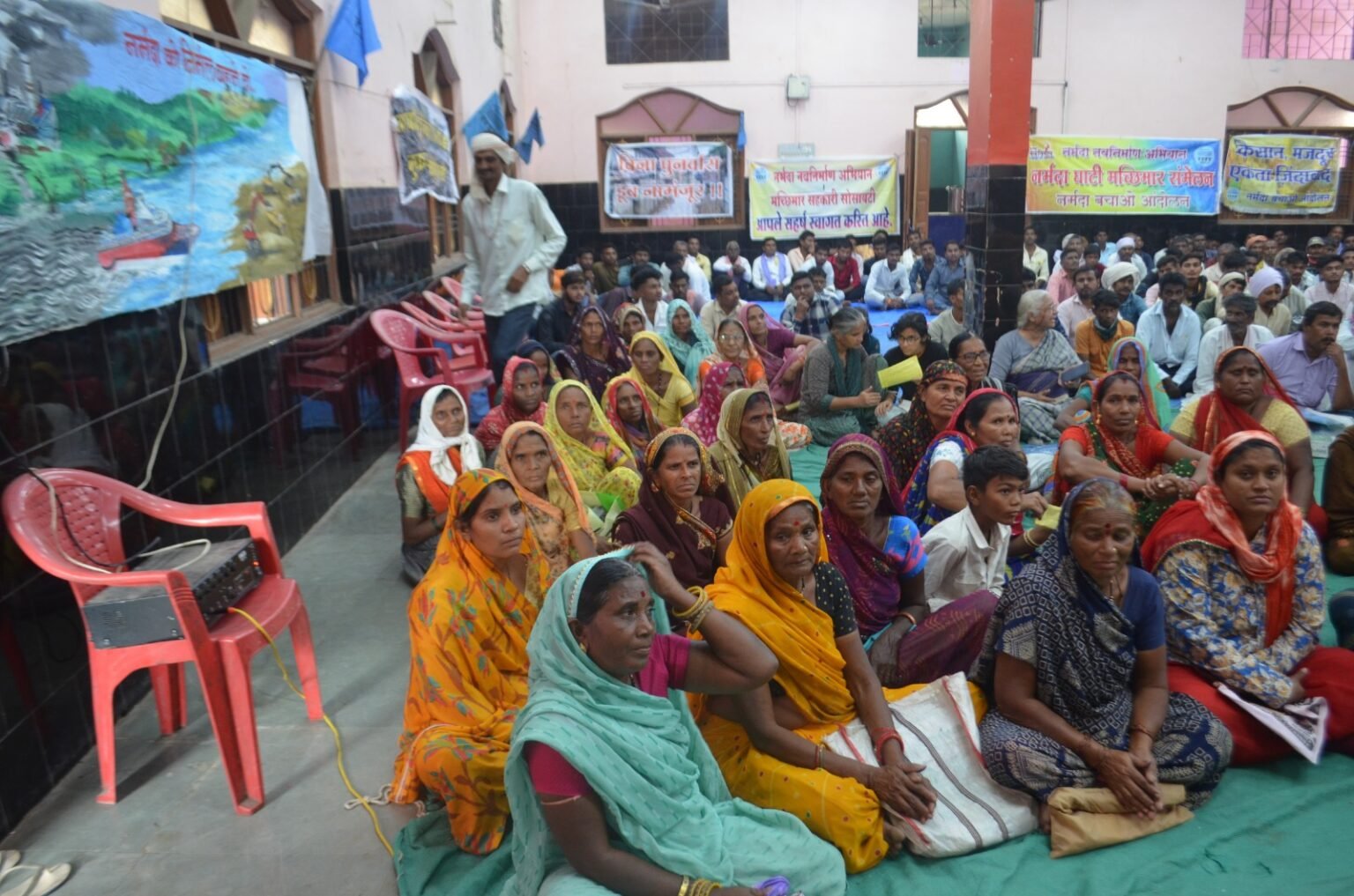
9 नवंबर को अर्जुन कारज भवन में आयोजित सम्मेलन में मछुआरों ने कानूनी पुनर्वास और महाराष्ट्र की तरह पूर्ण मत्स्य पालन अधिकारों की मांग की। मेधा पाटकर ने मछुआरों को संगठित करने और गैर संवैधानिक प्रक्रियाओं के खिलाफ लड़ने की जरूरत पर जोर दिया, ताकि वे जलाशय प्रबंधन और विकास में अपनी भूमिका निभा सकें। https://www.deshgaon.com/voices/narmada-fishermen-demand-their-rights/ (10 Nov. 2024) बड़वानी में मछुआरा संघ का सम्मेलन https://www.bhaskar.com/local/mp/barwani/news/fisherman-association-conference-in-barwani-133932762.html (09 Nov. 2024)
Odisha Poor catch in Chilika forcing fisherfolk to migrate Villagers blame state government focus on tourism and the new sea mouth for polluting the lagoon’s water, ruining its ecology and disrupting fish life. https://www.newsclick.in/odisha-poor-catch-chilika-forcing-fisherfolk-migrate (12 Oct. 2024)
Delhi Fish deaths in Yamuna: NGT seeks report from Haryana The NGT has issued a notice to Haryana SPCB and the secretary (environment) in Haryana govt after thousands of fish died in the Palla stretch of the Yamuna in July this year. The tribunal took note of the DPCC’s report, which stated that Haryana’s drain number eight was highly polluted and was releasing wastewater into the Yamuna. https://timesofindia.indiatimes.com/city/delhi/ngt-demands-report-from-haryana-over-massive-fish-deaths-in-yamuna-river/articleshow/115123461.cms (09 Nov. 2024)
‘Fish in Burari died of pollution’ In its report submitted on Tuesday (Nov. 05), the DPCC said an inspection was carried out at the location on August 29, and water samples were collected. The report said that there was a drain from Haryana (called Drain No. 8) which mixed with the Yamuna near the site. The sample results of three sites revealed the drain had a high pollution load, which deteriorated the river’s water quality, leading to fish deaths, especially during the pre-monsoon season. The DPCC urged the SPCB and the state’s urban development authority to take urgent action to control pollution in Drain No. 08. https://www.millenniumpost.in/delhi/fish-in-burari-died-of-polluted-hry-drain-mixing-with-yamuna-585935 (7 Nov 2024) https://www.hindustantimes.com/cities/delhi-news/delhi-pollution-body-blames-haryana-for-dead-fish-in-yamuna-101731001097645.html (08 Nov. 2024)
Kerala Mass fish kill in Ashtamudi lake raises alarm over pollution Hundreds of dead fish were discovered floating across Ashtamudi Lake on Sunday (Oct. 27) morning, unsettling residents and raising concerns about environmental contamination. Though isolated fish deaths have occurred in the past, the scale of this incident is unprecedented, with fish washing ashore across multiple locations. Many locals believe pollution from waste discharge is to blame, suspecting leachate contamination as the primary cause. Some worry the situation will worsen with an unbearable stench soon spreading across the area.
Communities living along the waterbody have reported frequent sightings of tankers dumping septic waste into the backwaters, often under the cover of night in remote areas. Factories and other businesses are also being blamed for releasing untreated waste into the lake, despite environmental regulations intended to prevent such practices.
The incident has left the local fishing community in distress, fearing the loss of income as residents hesitate to purchase fish from the lake. With rumors of chemical contamination spreading, fishers worry that public mistrust will linger, even if future catches remain unaffected. As officials investigate, both environmental advocates and fishers brace for the potential fallout, uncertain about the lake’s recovery and the livelihoods dependent on it. https://www.fishery.news/mass-fish-kill-in-ashtamudi-lake-raises-alarm-over-pollution/ (29 Oct. 2024)
Bengaluru Fishkill at Dorekere Lake, residents blame plastic pollution In a troubling environmental episode, Dorekere Lake, one of the oldest lakes in Uttarahalli area in South Bengaluru, witnessed a fishkill Saturday (Nov. 09) morning, raising concerns about water quality and ecological health. Though garbage inflow, triggered by the recent rains and drop in oxygen levels are said to be the reasons for fish deaths, the incident has also questioned the efficacy of the STP set up almost 10 years ago at the lake, which spreads over 28 acres. https://timesofindia.indiatimes.com/city/bengaluru/dorekere-lake-fishkill-residents-blame-plastic-pollution-and-poor-water-quality/articleshow/115123652.cms (10 Nov. 2024)
SAND MINING
SANDRP Blog Yamuna Manthan 061124: Save River from ‘Illegal’ Sand Mining Notably, the illegalities and violations are being mostly committed in government approved sand mines, where contractors showing no respect to norms deliberately indulge in obstruction of river flows, instream, mechanized mining even during night hours earning them ‘sand mafias’ tag. While they enjoy political patronage, the regulators including mine departments, pollution control boards in Yamuna basin states have been starved of resources thus proving inefficient to ensure compliance to norms.
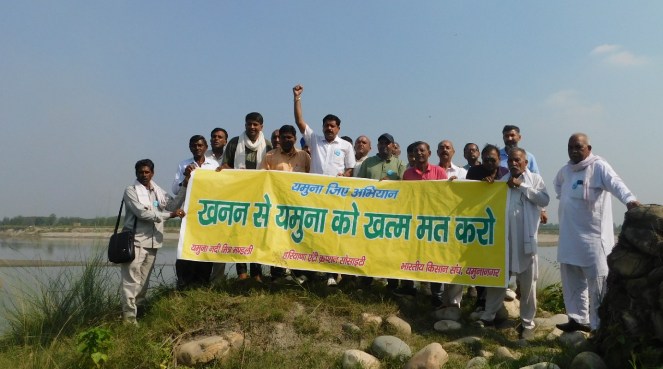
There have been multiples pleas on the issue, however the judiciary system too seems dealing with the cases in tokenistic manner by limiting itself to issuing notices, seeking reports and in some cases imposing nominal fines. https://sandrp.in/2024/11/07/yamuna-manthan-061124-save-river-from-illegal-sand-mining/ (07 Nov. 2024)
Uttar Pradesh Mafia split Ganga into two to carry on illicit trade The bulldozer grunts on the shore of Ganga in UP’s Unnao, baring its teeth. There are trucks and tractors waiting to be loaded with sand, and more on the way. This is how it is here, where the sand mining mafia built a road that cuts through Ganga at Sumerpur Ghat. This unauthorised road has split the sacred river into two streams, creating a pathway for transporting their illicit cargo under cover of night.
On another road of Unnao, shadows of a dark tragedy loom large over the Tripathi household. Shubham Mani Tripathi, a young journalist in his mid-20s, was gunned down in cold blood on June 19, 2020. His crime? Publishing a series of investigative articles exposing illegal activities of Kanhaiya Awasthi and his wife Divya Awasthi – known as “bhu mafia”. https://timesofindia.indiatimes.com/city/lucknow/how-mafia-split-a-sacred-river-into-two-to-carry-on-illicit-trade/articleshow/113174416.cms (09 Sept. 2024)
Uttarakhand हरिद्वार: रोशनाबाद क्षेत्र के नवोदय नगर में बरसाती नदी में नहाने गए एक बालक की अवैध खनन के गड्ढे में डूबने से मौत हो गई। जबकि दो बालकों को सुरक्षित बचा लिया गया। स्थानीय निवासियों ने पूरे मामले को लेकर पुलिस प्रशासन की भूमिका पर सवाल खड़े करते हुए कार्रवाई की मांग की है। पुलिस के मुताबिक, सिडकुल क्षेत्र की खालसा कॉलोनी निवासी तीन बालक गुरुवार (July 04) की शाम नहाने के लिए नवोदय नगर कॉलोनी के पीछे बहने वाली बरसाती नदी में गए थे। जहां तीनों बालक अवैध खनन से बने गड्ढे में डूबने लगे। आसपास मौजूद लोगों ने दो बालकों को बचा लिया, मगर 15 साल का प्रियांशु गड्ढे में डूब कर लापता हो गया। देर रात तक जल पुलिस के गोताखोरों ने उसकी तलाश की, लेकिन कुछ पता नहीं चल पाया था। शुक्रवार सुबह बालक का शव बरामद हो गया है। https://www.jagran.com/uttarakhand/dehradun-city-children-had-gone-to-take-bath-in-rainy-river-one-died-after-falling-into-the-pit-of-illegal-mining-23752816.html (05 July 2024)
Bihar Sands of crime & terror where police too fear to tread Illegal sand mining costs the state exchequer an estimated annual loss of Rs 7,000 crore, officials said.
On November 14, Prabhat Ranjan, additional SHO of Garhi police station in Jamui district, was crushed to death by a tractor-driver carrying illegal sand and a constable injured when the two tried to stop the vehicle during checks. The murder brought the menace to the fore again. It also offered a glimpse into the impunity with which the sand mafia operate, using earth-movers, JCBs and other machines after sunset and engaging local villagers.
The illegal trade’s tentacles have spread deep – the state government suspended two IPS officers (SudheerKumar Porika and Rakesh Kumar Dubey) in 2021 and 15 other officers, including four SDPOs, for alleged links with the mafia. The frequent attacks are a grim reminder of the threat. On November 1 this year, a home guard jawan, Ramraj Mahto, was killed, allegedly by the mafia, in Aurangabad. In October, at least four such attacks on cops were reported from Gaya, Jamui and Patna (Maner). These followed similar strikes at Kadirganj in Nawada, Delha in Gaya, Bihta-Maner in Patna and Saran districts between February and September this year.
ADG Gangwar says the cases are under investigation. “There is no such data of attacks on policemen by the sand mafias. In some cases, accidental deaths were reported as murders, though UD (unnatural death) cases had been registered,” Gangwar added. But the recent pattern suggests there is nothing “accidental” about these attacks. In February, sand miners tried to burn alive a mining official in Saran. In April, they were blamed for a brutal attack on some raiding mines officials, including a woman officer.
Cops and officials are not the only targets: the mafias engage in violent turf wars themselves. In September last year, at least four were killed and several injured in a shootout between two gangs at Amnabad-Katesar village in Patna’s Bihta area. Over 500 empty cartridges were found at the spot – a pointer to the cache the gangs have amassed. Four workers were burnt alive in a cylinder blast on a sand-laden boat on the Sone this August. In July, sand mafia henchmen killed a villager, Ramvichar Rai, in Bihta after he resisted mining in his Pathlautia village.
A local moneylender, preferring anonymity, told TOI that a truck-owner borrowed Rs 3 lakh from him at 10% monthly interest to pay fines for carrying illegal sand. He promised to repay within a month and he did, indicating the profit margins in this illegal trade. He promised to repay within a month and he did, indicating the profit margins. https://timesofindia.indiatimes.com/city/patna/bihars-sands-of-crime-terror-where-police-too-fear-to-tread/articleshow/105271594.cms (17 Nov. 2023)
Sub-inspector mowed down by sand mafia tractor A Bihar sub-inspector (SI) was mowed down Nov 14 by a tractor ferrying illegally mined sand in Jamui district, extending a pattern of such attacks on law-enforcers by the sand mafia. Prabhat Ranjan (28) was declared dead after being rushed to hospital. A home guard jawan, Rajesh Kumar Sao, was also hit by the tractor in Garhi police station area and is now under treatment. Ranjan was a 2018-batch SI and a native of Vaishali district.
Jamui SP Shaurya Suman said police had a tip-off about illegal sand mining in Chandwara area, around 5km from the Garhi police station where Ranjan was assistant SHO. Ranjan and Sao were out checking such activities when they spotted the tractor. “They tried to stop the tractor. However, the driver, Krishna Ravidas, ran the vehicle over them and fled. The tractor has been seized and a man accompanying the driver arrested,” the SP said.
Several such murderous attacks by the sand mafia have been reported in Bihar over the past few months, mostly from Patna, Bhojpur, Rohtas, Aurangabad, Saran and Vaishali districts. In April this year, three officers — including two women inspectors of the mines and geology department — were targeted by the mafia during a drive against them at Bihta, near Patna. Soon after, the department decided to train its 90 inspectors, including around 30 women officers, in countering such attacks, an official said. https://timesofindia.indiatimes.com/city/patna/bihar-cop-mowed-down-by-sand-mafia-tractor-mantri-says-such-cases-occur-in-other-states-too/articleshow/105217745.cms (15 Nov. 2023)
Haryana Sand mining racket busted in Palwal Sharing details, DSP Rajdeep Mor of the flying squad said a stock of around 400 metric tonnes (MT) of river sand mined illegally was found in the fields at Sultanpur village, which was located in the vicinity of the Yamuna river, in the district following a raid conducted on Friday (Nov. 08). He said while the sand was lying dumped at three places, there was no claimant found at the spot that led to the suspicion that the sand had been mined illegally and without any permission from the department concerned by some who had been involved in this type of activity.
The officials of the Revenue Department, including the Patwari of the region, have been asked to take action against the owners of the land, on which the stock had been detected. The DSP said no official record of the sand had been found by the team. It is claimed that a racket of illegal mining of river sand is reported to be in some of the villages located adjacent to the river in the district. While the stock was seized, the officials of the departments concerned have been asked to lodge an FIR against the owners of the land or those involved in the racket. https://www.tribuneindia.com/news/haryana/cm-flying-squad-busts-sand-mining-racket-in-palwal-detects-400-mt-stock/ (10 Nov. 2024)
Jammu & Kashmir Sand mafia destroys Jhelum embankment In a brazen display of criminal activity that has left nearly 400 households vulnerable to potential floods, risking both their lives and property, the sand mafia destroyed the Jhelum embankment near the Khankah Bagh area of Pampore in South Kashmir’s Pulwama district, with residents describing the incident as just the tip of the iceberg, pointing to widespread illegal mining activities throughout South Kashmir.
Residents witnessed suspicious vehicle movements in the area over the past few days and last night, heavy tippers and earth movers were spotted damaging the embankment to illegally remove sand from the Jhelum-a prohibited act under law. The locals took matters into their own hands and reached the site, seizing three vehicles, including a trailer truck used to ferry an earth mover. However, the culprits managed to escape with one earth mover. https://www.dailyexcelsior.com/sand-mafia-destroys-jhelum-embankment-puts-thousands-at-risk/ (09 July 2024)
Punjab Damaged bridge forcing 30-km detour Sand mining, a lucrative industry worth crores of rupees, has become a significant problem for residents of at least 200 villages in Ropar and Garhshankar in Punjab. The Kalwa-Nangal bridge over the Swan river, located in Algran village and connecting Ropar to Garhshankar, has been damaged since July 2023 due to the overexploitation of the river bed for sand. Despite the outcry over the bridge’s condition, sand mining continues unchecked even as residents are forced to take a 30-km detour because the Punjab Mandi Board lacks the funds necessary to carry out the repairs. The bridge has been closed to traffic since December 21, 2023. As residents have reported, the bridge was opened for traffic in 2002 and has witnessed illegal sand mining activities since 2006. Crushers operating in the area ran all night and this overexploitation of the riverbed for sand mining damaged the bridge’s pillars which were further compromised by the floods in 2023. https://indianexpress.com/article/cities/chandigarh/sand-mining-bridge-punjab-9657924/ (7 Nov 2024)
Meghalaya Mothers came out to protest against illegal sand mining Mothers came out today to register their strong protest against illegal sand mining in Dudhnoi river known as Manda in Meghalaya. The Mothers’ Union of Assam and Meghalaya Border under the chairperson Soma Marak organized a meeting today (Nov. 02) to firm up a plan to put a stop to illegal sand mining from the river that is threatening the lives of people in the area in both Assam and Meghalaya, their crop and their homes.
Leaders from Garo Students Union, Assam State Zone, Garo Women Council, All Bodo Students Union, Garo Gaon Burha Association and other organizations from both Assam and Meghalaya took part in the meeting. Dhiraj Basumatary, adviser of ABSU’s Goalpara unit urged all to join hands in the fight against illegal sand mining from the Dudhnoi (Manda) River, to save aquatic life and people’s lives and property from erosion. He alleged that hundreds of over loaded trucks are transporting illegal sand towards Guwahati while the police and forest officials are looking the other way. He said police and forest officials are allowing these sand-laden trucks to pass through in lieu of some petty cash. https://northeastlivetv.com/topnews/mothers-rise-against-illegal-sand-mining-in-dudhnoi-river-along-assam-meghalaya-border/ (02 Nov. 2024)
Odisha Mining officer attacked by ‘sand smugglers’ An assistant mining officer, Pitambar Mohanta, was allegedly attacked in the district on Wednesday (Sept. 25) during a crackdown on sand smuggling. The incident took place when Mohanta, part of an enforcement team, seized six hydra trucks and a tractor involved in unauthorized sand transportation. Following the seizure, one vehicle owner reportedly assaulted Mohanta. “When our enforcement team confiscated the vehicles, one of the owners attacked our official,” said deputy director of mines (minor minerals) Satyajit Rout. “A written complaint has been filed at Koraput Town police station, and we expect necessary action to be taken,” he added. Koraput police confirmed that the alleged attacker has been detained. https://timesofindia.indiatimes.com/city/bhubaneswar/mining-officer-attacked-by-sand-smugglers/articleshow/113681053.cms (26 Sept. 2024)
‘Unholy nexus’ in illegal sand mining under NGT scanner The NGT has directed the state govt to file fresh affidavit giving specific reply to an appeal alleging unholy nexus between authorities and private lessee behind inaction in case of violation of environmental clearance (EC) norms granted for the Subarnarekha river sand quarry at Rajnagar in Balasore district’s Jaleswar area. The NGT’s east zone bench in Kolkata issued the direction on petitioner Samir Kumar Pradhan’s appeal in his rejoinder to state govt’s counter affidavit. The bench of B Amit Sthalekar (judicial member) and Dr Arun Kumar Verma (expert member) issued fresh notice to the state govt taking on record the petitioner’s allegations. https://timesofindia.indiatimes.com/city/cuttack/unholy-nexus-in-illegal-sand-mining-under-ngt-scanner/articleshow/111794055.cms (17 July 2024)
Andhra Pradesh Man alleges assault over sand mafia dispute A man from Srikakulam district has accused supporters of a TDP MLA of attacking him over a dispute related to illegal sand transport. The incident occurred in the Amadalavalasa constituency, where the victim, identified as Sanapala Suresh, claimed he was targeted for opposing the illegal sand trade. Suresh alleged that while he was attempting to prevent sand smuggling near Ragolu, a group of individuals intercepted him. As Suresh tried to drive away quickly, two people sustained injuries. Following this, at Balaga Junction, his car was stopped again, where the assailants reportedly attacked him, smashing the car windows and causing further damage. https://www.newstap.in/crime/man-alleges-assault-by-tdp-mlas-supporters-over-sand-mafia-dispute-1554947 (17 Oct. 2024)
Construction workers to hold protest against sand mafia tomorrow Under the aegis of the AP Building & Construction Workers Union (affiliated to AITUC), construction workers will hold a large-scale protest on Monday, in front of the Rajahmundry Sub-Collector’s office, demanding action to curb the illegal activities of the sand mafia.
AITUC district vice-president and AP Building & Construction Workers Union district honorary president Tatipaka Madhu highlighted that sand, a naturally available raw material crucial for construction, has become inaccessible, leading to a loss of livelihood for construction workers. He criticised government officials for failing to fully implement the free sand policy, pointing out a lack of supervision and alleging that those affiliated with the ruling party are illegally exploiting sand resources. He demanded that the government immediately set up sand stock points and take responsibility for sand supply. https://www.thehansindia.com/andhra-pradesh/construction-workers-to-hold-protest-against-sand-mafia-tomorrow-920581 (10 Nov. 2024)
Boatmen’s associations reluctant to collect sand East Godavari district authorities have decided to cancel the permission given to 89 boatmen’s associations to manually procure sand from the Godavari after they failed to resume sand collection to tackle the scarcity of sand. By November 8, only 30 boatmen’s associations were engaged in sand collection in the river banks while 89 associations stayed away from the sand collection citing low remuneration. The payment that was fixed by the government as per the sand policy is barely enough to cover the costs of engaging workers coming here from other States, say the associations. https://www.thehindu.com/news/national/andhra-pradesh/boatmens-associations-reluctant-to-collect-sand-from-godavaris-banks-over-lack-of-remuneration/article68852560.ece (10 Nov 2024)
Plan to bring 108 new sand reaches into operation Speaking to mediapersons at the AP Mineral Development Corporation (APMDC) office on Monday (Oct. 14), Minister for Mines and Geology Kollu Ravindra said the new sand reaches will be identified along the course of rivers, and 40 sand reaches will be brought into operation in the first phase from October 16. Sand mining has been restricted due to the monsoon season and sand is being sourced from existing stock and desiltation points. Since Aug 15, 20 de-siltation points have been operational with proper clearances in coordination with the Water Resources Department. Now, 40,000 T sand is being supplied per day. It will be increased once the mining at the 108 new sand reaches begins,” the Minister explained. https://www.newindianexpress.com/states/andhra-pradesh/2024/Oct/15/plan-to-bring-108-new-sand-reaches-into-operation-to-meet-demand-in-andhra (15 Oct. 2024)
NGT refers illegal sand mining case to top court The NGT on Feb 21 referred the illegal sand mining case to Supreme Court as Andhra Pradesh govt has challenged its earlier orders imposing Rs 18 crore penalty for each of the Environmental Clearances (EC) issued. While issuing orders cancelling 110 ECs, the NGT also directed Ministry of Forests and Environment (MoEF) to constitute a joint committee to assess the environmental compensation for mining carried out by the project proponents.Following the orders of the NGT, the MoEF team conducted inspections in Krishna and Guntur districts and noted several violations including illegal sand mining without any environmental clearence. The NGT had red flagged the use of of heavy machinery. https://timesofindia.indiatimes.com/city/vijayawada/ngt-refers-illegal-sand-mining-case-to-supreme-court/articleshow/107898420.cms (22 Feb. 2024)
Tamil Nadu ED challenges HC’s decision in SC The Enforcement Directorate (ED) has approached the Supreme Court, appealing against a Madras High Court order that halted money laundering proceedings against several contractors implicated in a Tamil Nadu sand mining scam. The High Court had also rescinded provisional attachment orders, releasing properties tied to the allegations. The appeal was taken up by a bench of Justices Sanjiv Khanna and PV Sanjay Kumar, who directed the ED to furnish a concise note on the impact of the 2022 Vijay Madanlal judgment concerning provisional property attachments. The Supreme Court has not issued a formal notice to the respondents yet. https://lawtrend.in/ed-challenges-madras-high-courts-decision-on-sand-mining-case-in-supreme-court/ (04 Nov. 2024)
DMK neta’s son found dead, family blames sand mafia A DMK functionary’s son, reported missing since Saturday (Oct. 12), was found dead on a neighbour’s farmland at Pernampet in Vellore on Tuesday (Oct. 15). His feet were entangled in an iron wire and there were injuries to the head. Family claimed that this comes in the wake of complaints that the deceased, S Prasanth, and his father K Srinivasan, had lodged with police and the collectorate about large-scale illegal sand mining near their farm. Srinivasan, a functionary of Pernampet’s DMK unit, is a govt contractor from Pandalathotti.
His family had lodged a ‘missing person’ complaint with the Pernampet police on Saturday (Oct. 12). When they found his body on Tuesday (Oct. 15), his relatives, friends and others gathered in large numbers and prevented a police team from recovering it. They blocked the road linking the state with AP and Karnataka and dispersed after DSP Baskaran promised that a committee headed by a DSP rank officer would probe the death. https://timesofindia.indiatimes.com/india/dmk-netas-son-found-dead-family-blames-sand-mafia/articleshow/114294120.cms (17 Oct. 2024)
Confiscate vehicles used for illegal transport of sand: HC Granting bail to a man who was arrested for indulging in illegal transportation of river sand in Karur district, Madras high court directed the police to proceed with the confiscation of the vehicle as per provisions of the Mines and Minerals (Development and Regulation) Act. Justice B Pugalendhi granted bail to Kanthaiya, who was arrested by the Kulithalai police in Karur district for illegal transportation of river sand in a truck on Mar 21.
The judge observed that any tool or instrument or vehicle used for illegal quarrying/ transportation of sand is liable to be seized under Section 21(4) of the Mines and Minerals (Development and Regulation) Act, 1957. Any vehicle or instrument or tool which has been seized under Section 21(4) of the Act is liable to be confiscated under Section 21(4-A) of the Act. Though the above provision mandates the authorities to confiscate vehicles involved in the commission of the offence of illegal quarrying/ transportation of sand, the authorities have not invoked the provision. https://timesofindia.indiatimes.com/city/madurai/confiscate-vehicles-used-for-illegal-transport-of-sand-hc/articleshow/109098135.cms (07 April 2024)
Maharashtra Sand mafia tries to mow SDO down The sand mafia tried to run over Ramtek sub-divisional officer (SDO) Vandana Virani near Ghotitok in the tehsil during a 10km chase after surprise crackdown on smugglers on Jan 14. The officials have registered a case of attempt to murder and obstructing govt servants at Ramtek police station. The mafia members first obstructed Virani’s vehicle for some distance using another car, then the gang stepped down with hammers and other weapons. Seeing their intent to attack her and the revenue team comprising circle officers and naib tehsildar, Virani and her team retreated to a safe distance. The gang later opened the rear flap of the truck to let the sand fall out, before abandoning it at Ghotitok.
Despite the life-threatening circumstances, Virani & her team detained 8 vehicles illegally ferrying sand in the daylong action. Virani, after the incident, took up the matter with collector Vipin Itankar. “The transit pass (TP) of the detained vehicle showed it was issued from Rajnandgaon in Chhattisgarh and was going to deliver it in Nagpur. We need to check whether the TP was genuine, though it had already lapsed when detained by us. The trucks were all appearing heavily overloaded. The GPS location of the trucks are also required to be checked,” said Virani.
The Nagpur district sand mafia has deep connections within the police and revenue departments, it’s learnt. Some of these mafia are also sheltered by politically influential persons. Sources said the registration number of the Nano car suggested it is owned by someone at Kharbi in Nagpur. Revenue officials said the raid was planned on Sunday when there is significant rise in transportation of illegally excavated sand as revenue offices are shut and police presence is also down to skeleton strength. https://timesofindia.indiatimes.com/city/nagpur/sdo-chases-sand-mafia-for-10km-gang-tries-to-mow-her-down/articleshow/106842970.cms (15 Jan. 2024)
WETLANDS, LAKES, WATER BODIES
Assam Prepare note on wetlands restoration to divert floodwater: Centre The Central Govt has directed the Govt to prepare a concept note for the restoration of 271 wetlands for diversion of flood water within December this year. The North East Space Application Centre has already identified 271 wetlands, which can be rejuvenated for the diversion of flood water. The WRD has already identified 9 wetlands in 7 districts, which can be revived for diversion of flood water and an amount of Rs. 380 crore has been sanctioned for the project. However, the Centre is of the view that a feasibility study of all the 271 wetlands identified by the NESAC should be carried out.
Official sources told The Assam Tribune that after the preparation of the concept paper, it would be sent to the Central Government. If the Centre approves it, a DPR will be prepared. Sources said that the idea is to divert 3 million cubic meters of water to the water bodies during the flood season. However, diverting water itself will be a major challenge as it will lead to fiddling with the banks of the rivers. Earlier, the Govt was planning to dig big tanks to divert and store water during the flood season. But there is a shortage of vacant land in the Brahmaputra basin to dig up huge ponds to divert flood water and that is why, the decision to rejuvenate the existing water bodies was taken. https://assamtribune.com/assam/centre-directs-assam-govt-to-prepare-note-on-wetlands-restoration-to-divert-floodwater-1557278 (08 Nov. 2024)
Jammu & Kashmir EPG writes to CM about ‘wetland destruction’ In a letter addressed to CM Omar on Nov. 08, the Environmental Policy Group (EPG) highlighted the dire conditions of internationally-recognised wetlands like Hokersar, Haigam, Shallabugh, and Mirgund, which are facing “systematic destruction and mismanagement”. The EPG’s findings from on-the-ground visits present a grim picture of the state of these vital ecosystems.
“Hokersar Wetland, once known as the ‘Queen of Wetlands’, is now gasping for breath, with repeated failures to meet deadlines for water restoration. The wetland may not even be able to host migratory birds this season, further compromising its ecological importance.
“Haigham Wetland is in a particularly dire condition, with silt accumulation, widespread encroachment, and the conversion of wetland areas into orchards and paddy fields. Shockingly, some of these encroachments involve retired and serving employees of the Wildlife Department, a clear violation of the Ramsar Convention’s protection mandate.
“Shallabugh Wetland has been neglected, with breaches caused by last year’s flooding left unrepaired, leading to the wetland drying up. The Wildlife Department’s claims of impending repairs raise questions about the prioritization of these critical issues.
“Narakarra Wetland and Nambal: The EPG is deeply concerned about the encroachment and destruction of Narakarra Wetland – an important flood absorption basin. Despite status quo orders issued by the Division Bench of Jammu and Kashmir and Ladakh, the land mafia with official patronage has continued to play havoc with it by colonising it. Moreover, the land has also been allocated to some educational institutions. This needs to be seriously enquired into and violators and responsible personnel brought to book.
“Riverbed Mining: The illegal riverbed mining of minor minerals has caused severe damage and destruction to rivers and nallahs. “Across these wetlands, the EPG has documented widespread illegal encroachment and extraction of resources, often with the apparent collusion of Wildlife Department officials. The ‘Mitti Mafia’ has been particularly active in Hokersar, where large quantities of soil have been clandestinely removed.
The group is demanding a high-level inquiry into the mismanagement and degradation of these wetlands, as well as urgent steps to restore water levels, investigate illegal activities, and hold those responsible accountable. https://www.greaterkashmir.com/kashmir/epg-writes-to-cm-omar-about-wetland-destruction/ (09 Nov. 2024)
Lack of rainfall impacts Hokersar wetland The Hokersar wetland a Ramsar site in the Kashmir Valley is a crucial source of food, offering spawning grounds and nurseries for fish along with breeding habitat. According to the IMD, Kashmir is facing a rainfall deficit of 81 per cent. Between the first and third week of October, the Srinagar district where Hokersar is located has faced 36 per cent and 96 per cent rainfall deficit. In 2023, the district had experienced normal rainfall of 131 mm, according to IMD data. However, in 2022, the deficit was again 96 and 89 per cent for the same time frame. Experts said that the lack of rainfall alone is not responsible for impacting the arrival of migratory birds.
Reyan Sofi, a bird watcher said, “The shortage of water usually occurs post December-January as water recedes. But this year, it has been observed from October itself,” he observed. Sofi explained that illegal sand mining, degradation of habitat and encroachment have added to the woes of the region, which is already experiencing deficit rainfall. “The water from upstream Doodhganga (from the east) and Sukhnag Nallah (from the west) that provide water to the wetland has reduced. Also, mining activity has resulting in opening up a nullah that drains the water from the wetland,” he said. Raja Muzaffar Bhat, a RTI activist from Kashmir told DTE that encroachments, illegal dumping of sewage in the water and mining has resulted in further degradation of the wetland. https://www.downtoearth.org.in/wildlife-biodiversity/lack-of-rainfall-impacts-arrival-of-migratory-birds-in-kashmir-valleys-hokersar-wetland (10 Nov. 2024)
Rajasthan Over 40 migratory birds died at Sambhar Lake Over 40 migratory birds, belonging to two to three different species, have been found dead around Sambhar Lake in Jaipur district over the past fortnight, prompting concerns among the officials. The exact cause of the deaths remains under investigation, with viscera samples sent for analysis expected to provide clarity by the end of the week. Initial examinations suggest that the birds may have succumbed to avian botulism, a severe neuromuscular illness caused by the bacterium Clostridium botulinum, which thrives in low-oxygen environments. Earlier in 2019, more than 18,000 migratory birds from 13 to 15 species perished in the same region due to botulism. https://www.hindustantimes.com/cities/jaipur-news/over-40-migratory-birds-died-at-sambhar-lake-in-rajasthan-officials-101730032038799.html (27 Oct. 2024)
WATER OPTIONS
Vikalp Sangam Water conservation by Meo communities This article explores the transformative work of Tarun Bharat Sangh (TBS), an NGO that has rejuvenated over 16,000 traditional water bodies, including Johads and revived dead rivers including Sairni, Tevar, Jahajwali, Tildeh, Ruparel, Agrani, Bhagani, Sarsa, Arvari, Maheshwra, Sahibi across Rajasthan, Haryana and Maharashtra, without relying on modern civil engineering. Through collaborative efforts, TBS and the Mewatis have not only built resilient water infrastructure but also challenged prevailing misconceptions, proving that their eco-centric practices offer valuable insights for addressing today’s global climate and water crises. https://vikalpsangam.org/article/how-the-meo-community-fights-stereotypes-with-sustainable-water-management/ (29 Oct. 2024)
Chennai Finding solutions to water woes ‘Thisai’ way Comprehensive city planning is the answer to all of Chennai’s water problems, say Anandhitha and Madhulikaa, co-founders of ‘Thisai’, focused on providing a new direction when it comes to finding solutions. The regional water harvesting system, once renowned for its sheer efficacy, has now been systematically destroyed by encroachments and ecological imbalances.
Anandhitha and Madhulikaa, two architects with a dream to change the direction of urban planning and make cities liveable, launched their initiative ‘Thisai’ on Instagram earlier this year. Over the past few months, they have produced multimedia reports on various wetland systems in Chennai, seeking inputs from experts, simplifying scientific findings and relating it to everyday issues. “Architecture goes beyond buildings, it impacts the environment and therefore our everyday lives,” says Madhulikaa. ‘Thisai’ intends to make architecture accessible by looking at how architecture interacts with natural systems in Chennai, she adds. ‘Thisai’, currently focusing on water systems, intends to cover other city systems such as waste management, energy, heritage conservation, history and culture.
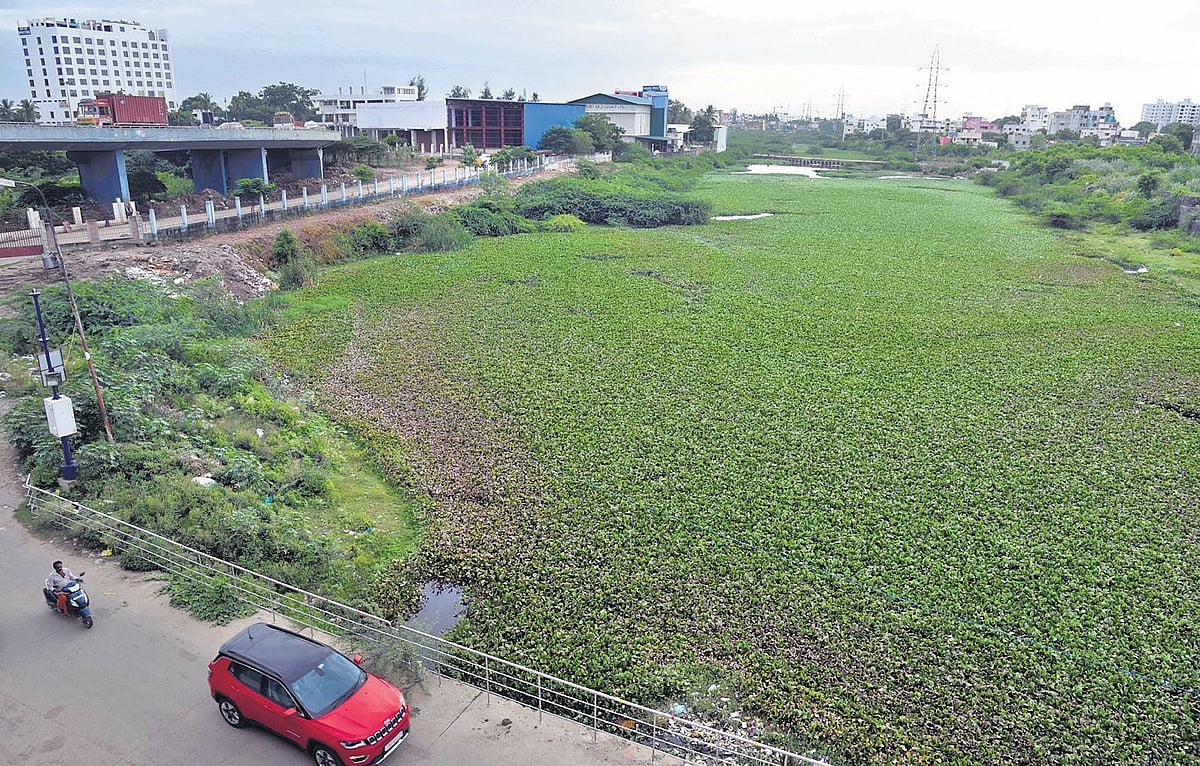
Thisai’s recent analysis of Otteri Nullah, a sub-catchment of the Kosasthalaiyar river flowing parallel to the Cooum river from Anna Nagar and eventually joining the Buckingham Canal, reveals that though desilting of the canal and storm water drains are hailed as a popular remedy for canal blockages, identifying site-specific conditions such as flow dynamics will help in formulating a more effective solution. Madhulikaa says that though the government attempts to take necessary measures towards the preservation of these structures, delays in coordination between departments often render these efforts ineffective, resulting in issues such as urban flooding. While government policies are perfect on paper, implementation is inefficient. https://www.newindianexpress.com/web-only/2024/Nov/05/arteries-of-chennai-finding-solutions-to-the-citys-water-woes-the-thisai-way (05 Nov. 2024)
Thirukazhukundram setting an example in reviving waterbodies Once a parched town relying on tractors to fetch water, Thirukazhukundram in Chengalpet district is now on revival mode. The panchayat leveraged multiple govt schemes to restore 16 long-neglected ponds and boost groundwater levels in nearby villages, investing 4.17 crore.
Fortunately, rainfall in subsequent years helped things, prompting residents to call for measures to strengthen groundwater levels. G D Yuvaraj, the panchayat chairman, said that upon taking office, he secured funds from the 15th Finance Commission to create a model pond. “We revived Sunambu Kulam in Mangalam by deepening it and raising the bund height, allowing it to hold up to 30 ft water. After the rains, water storage increased, and nearby wells saw improved water quality,” he said.
In 2023, Vannam Kulam in Thirukazhukundram town was selected for restoration under Kalaignar Urban Development Scheme (KNMT). C S Seenuvasan, a resident, says only a few ponds were desilted 15 years ago, and only one was successfully revived. “Our well water is also salty,” he noted, emphasising the long-standing demand for pond restoration. “It’s essential that these ponds are well-maintained in the years ahead, with regular desilting.” https://timesofindia.indiatimes.com/city/chennai/thirukazhukundrams-incredible-waterbody-revival-a-model-for-sustainable-water-management/articleshow/114956154.cms (05 Nov. 2024)
Tamil Nadu Project Nanneer improves groundwater quality, storage Farmers in Kadiyapatti village (Arimalam block) in Pudukottai district are harvesting two crops a year for the last two years and have water for a third crop too. Before 2021, they harvested just one crop. Two water bodies, spread across 85 acres and 33 acres, were rejuvenated by AMM Foundation and EID Parry through Siruthuli under project Nanneer, leading to improvement in quality of groundwater and better availability of water, says Uma Maheshwari Somasundaram, the panchayat president of Kadiyapatti village (Arimalam block) in Pudukottai district.
A steering committee member of Project Nanneer told that the AMM Foundation started discussions in 2020 to rejuvenate water bodies in Sivaganga district to replenish the groundwater and improve storage at the traditional water bodies known as Kanmais. The Foundation identified Siruthuli as the implementing agency. So far, 18 water bodies have been revived in Erode, Sivaganga, Cuddalore, and Pudukottai districts and works are on for 10 more. Most of the water bodies are irrigation tanks and are spread over 14 to 80 acres each. Apart from desilting the kanmais and strengthening the bunds, bio-fencing is taken up by planting palm seedlings. The local youth and farmers are involved in maintaining these water bodies, the member said. https://www.thehindu.com/news/cities/Coimbatore/project-nanneer-improves-groundwater-quality-and-water-storage-in-traditional-water-bodies-in-tamil-nadu/article68678846.ece (25 Sep 2024)
Gujarat Govt launches waster water recycling policy The Gujarat govt is developing a new policy focusing on wastewater recycling and reuse to address the increasing pressure on drinking water resources. The policy will require industries and commercial entities to use treated wastewater for non-drinking purposes. The govt, under the policy, also plans to offer incentives for treating and reusing water for purposes other than drinking. The policy plans to create a legal obligation for the use of treated wastewater & aims to incentivize it. Industries like chemical, chip makers, textile, and other water-intensive industries must ensure compulsory wastewater recycling.” https://timesofindia.indiatimes.com/city/ahmedabad/gujarat-launches-revolutionary-wastewater-recycling-policy-to-tackle-water-scarcity/articleshow/115029103.cms (07 Nov. 2024)
Bengaluru City to get groundwater data real time This is part of a study undertaken by researchers from the Indian Institute of Science (IISc), Bengaluru and officials of Bangalore Water Supply and Sewerage Board (BWSS). As part of the study, a portal and dashboard are also being created for real-time monitoring of data, where a balance sheet of groundwater will be maintained. The instruments near borewells and at designated places measure groundwater usage in a scientific manner. The study will tell how much is used and where it is going. It started in July and so far ground truthing of the wards has been done. BWSSB Chairman Ram Prasath Manohar sai, “Now a base line and critical level of each region is being created for comparison. Around 400 sensors will be put up in the city. The study will be completed before Mar 2025 and ready for the summer,” he said. https://www.newindianexpress.com/cities/bengaluru/2024/Nov/05/bengaluru-to-get-groundwater-data-real-time (5 Nov 2024)
Video Report Him Katha video story shows how the headwaters of Himalayan rivers support agriculture and the broader role they play in the life of the people – especially the women.
https://www.youtube.com/watch?v=SWsruvoJNzs (31 Oct. 2024)
URBAN LAKES, WETLANDS
Hyderabad HYDRAA team in Bengaluru for study on lakes The HYDRAA officials from Hyderabad, led by Commissioner A.V. Ranganath on a visit to Bangalore, inspected the methods with which the 300-acre Yelahanka Lake and the 164-acre Jakkur Lake are being transformed into a freshwater lake. Along with the beautification, the authorities also examined the method of separating the water from the silt by installing culverts in the upper part to prevent sewage from entering the lake. They also visited KSNDMC to study lake protection, restoration, rejuvenation and disaster management. On Nov 8, HYDRAA officials will inspect more lakes and will understand how they have been restored, and will also meet the Karnataka lake protection authority officials regarding lake protection and rejuvenation. https://www.deccanchronicle.com/southern-states/telangana/hydraa-team-in-bengaluru-for-study-on-lakes-1836252 (8 Nov 2024)
Noida Red faces at eco-tourism event in Okhla A govt eco-tourism event at Okhla Bird Sanctuary ended in many red faces as the main attraction – water birds – were missing conspicuously. Bird watchers and environmentalists criticised the event, saying it showed the degeneration of the bird sanctuary because of poor maintenance. Projects like ‘eco-tourism’, they said, had further affected the natural habitat, by relentlessly driving up footfall — which touched nearly 70,000 last year — and building watch towers and trails to draw more people, at the cost of the sanctuary’s natural wealth, its host and visiting bird species.
Winter migratory birds, among them Common Teal, Northern Shoveler, Northern Pintail, Gadwal, Common Pochard, and Bar-headed Geese, which usually start reaching the sanctuary by Oct, have not made a pit stop at Okhla this year yet. “The transformation of Okhla Bird Sanctuary into an entertainment venue, under the label of eco-tourism, by the forest division has severely impacted its ecosystem. This commercialisation, single-mindedly aimed at revenue generation, has significantly degraded the avian habitat,” said ecologist and ornithologist TK Roy. https://timesofindia.indiatimes.com/city/noida/okhla-bird-sanctuary-eco-tourism-event-flops-as-water-birds-go-missing/articleshow/115029388.cms (07 Nov. 2024)
Delhi Construction on pond land raises concerns In the urbanised village of Budhela, near Vikaspuri in West Delhi, the construction of a cultural complex for the Sahitya Kala Parishad was continuing on the land where a pond once stood, the residents said. In a recent letter addressed to the Delhi Development Authority (DDA), the Tehsildar (Dwarka) noted that the said land was registered as ‘Johar ‘in revenue records. The term ‘Johar’ stands for a traditional village pond. “Considering the above said facts and take necessary action according to the Rules and submit an action taken report to the office of District Magistrate,” it added.
Paras Tyagi, a village resident, said, “We are stuck between the DDA, which is the land-owning authority and the Delhi government which is managing the site. The DDA is not in a position to act against the construction as it not managing the land.”
Documents from the Delhi Parks and Gardens Society indicate that four ponds were originally listed in Budhela village, including the johar in question. In August 2021, the Wetland Authority of Delhi also included the pond in a list of 1,040 waterbodies identified and assigned unique identification numbers. The authority’s records show that the pond covered 0.6 hectares. https://www.newindianexpress.com/cities/delhi/2024/Nov/09/construction-of-cultural-complex-on-pond-land-in-delhis-vikaspuri-village-raises-concerns (09 Nov. 2024)
URBAN WATER
Noida Groundwater comes out while digging pit, govt stalls project Groundwater officials stopped work on a commercial project in Sector 153 for discharging groundwater into a nearby plot using large pumps for dewatering operations on Wednesday (Nov. 06). Officials had initiated checks after photos and videos of dewatering at the site began to circulate on social media.
During a visit to the site on Tuesday (Nov. 05), it was found that an 11m-deep basement excavation caused water to rise to the raft (concrete slab), necessitating pump usage to prevent structural damage, groundwater officials said. Officials noted that the Noida Authority had previously granted permission to the builder for a 15m-deep basement excavation. However, the current development has raised concerns about the Authority’s decision-making process, particularly regarding the absence of proper groundwater level assessment for the plot.
The dept also held a meeting with the Authority on checking the groundwater level before giving approval for the basement digging on Wednesday (Nov. 06), Ankita Rai, hydrologist, groundwater department said. When asked about the process to get approvals for basement digging, Noida ACEO Satish Pal said, “It is a decision to be taken at a policy level. We need to write to the govt and also need to put it up in the board meeting. We are going to discuss this issue further. In some sectors near Yamuna, the water level naturally goes up after the rain. We need to check such areas to avoid any issues, for which we will take up the matter with the higher level.”
Previously, in July, the district magistrate instructed the three industrial authorities—Noida, Greater Noida, and Yamuna—to assess groundwater levels of each plot before approving basement excavations for developers. However, a subsequent RTI inquiry revealed that no action has been taken on these directives thus far. Activist Vikrant Tongad had recently filed an RTI asking the Noida Authority, “De-watering has to be done for digging the basement. Therefore, depth of basement should be reduced so there is no problem in extracting groundwater. Provide a copy of the order in which the authority has decided to reduce the depth of the basement?” https://timesofindia.indiatimes.com/city/noida/up-government-halts-commercial-project-due-to-groundwater-concerns/articleshow/115063472.cms (08 Nov. 2024)
Delhi Govt wants artificial rain to tackle worsening air pollution Cloud-seeding was considered to curb pollution in 2023 too but the plan did not materialise due to unfavourable weather conditions. “I appeal to the federal environment minister…now in Delhi and north India, the pollution has reached the border of 400,” Rai told reporters, referring to the air quality index (AQI) score on Tuesday (Nov. 05). “The next 10 days are quite crucial…help us get permission for artificial rain, call a meeting,” he said. https://www.reuters.com/world/india/toxic-smog-wreathes-indias-capital-winter-nears-2024-11-05/ (05 Nov. 2024)
WATER POLLUTION
Agra Villagers disabled by water pollution In Patti Panchgai village, just 9 kilometers from Agra, drinking water is turning into a silent threat, leaving villagers disabled and putting their future at risk.
High levels of fluoride and arsenic in the water have affected everyone—from children and youth to the elderly. Watch this report to uncover the alarming impact of this toxic water crisis on the lives of the villagers. https://www.youtube.com/watch?v=GMmS52coJYE (06 Nov. 2024)
JJM/ RURAL WATER SUPPLY
Rajasthan Case against ex-minister in ₹1,000-cr JJM ‘scam’ A case has been registered against former PHED minister and Congress leader Mahesh Joshi and 22 others in connection with an alleged Rs 1000-crore Jal Jeevan Mission scam. In the FIR filed against Joshi & 22 other people, the Rajasthan Anti-Corruption Bureau claimed that the former minister misused his official powers.The allegations against Joshi included misappropriation of funds with the connivance of officials and contractors of the PHED department in the implementation of the scheme in Rajasthan. The ED also conducted multiple searches in this case, including at the premises of Joshi, and also arrested an alleged middleman and some contractors. The others accused in the scam include Sushil Sharma, a financial advisor to Joshi, Chief Engineers RK Meena & Dinesh Goyal, among others. https://www.indiatoday.in/india/story/rajasthan-case-against-congress-leader-mahesh-joshi-jal-jeevan-mission-scam-2628475-2024-11-05 (5 Nov 2024)
WATER
Uttarakhand ADB commits $200 mn to upgrade water supply, other services Government of India and the Asian Development Bank on Wednesday (Nov. 06) signed a $ 200 million (about Rs 1,680 crore) loan to help upgrade water supply, sanitation, mobility, and other urban services in Uttarakhand. “The project aims to create urban infrastructure that is resilient to climate and environmental risks such as floods and landslides, ensuring the safety and health of Uttarakhand’s population,” said Mio Oka, country director of India Resident Mission, for ADB, a joint statement.
It will also build the capacity of the state agencies in project management, climate and disaster-resilient planning, own-source revenue generation, and gender mainstreaming, she said. The project will enhance transportation, urban mobility, drainage, flood management, and overall public services in Haldwani, the economic hub of the state. Additionally, it will improve water supply delivery in four cities – Champawat, Kichha, Kotdwar, and Vikasnagar – by developing efficient and climate-resilient water supply systems. https://www.business-standard.com/india-news/adb-commits-200-mn-to-upgrade-water-supply-other-services-in-uttarakhand-124110601672_1.html (06 Nov. 2024)
AGRICULTURE
Rajasthan Karoli farmers hit by changing climate First a lack of rain and then an unseasonal downpour ruined Chatra Devi’s crops. “We cultivated bajra [pearl millet] and it was growing well. But when we had to water our farms, it did not rain. Then it rained during the harvest and ruined the crop,” says the 45-year-old farmer from Khirkhiri village in Rajasthan’s Karauli district. Changing rainfall patterns has forced farmers in Khirkhiri to rely on milk sales for sustenance. But changes in the weather also negatively affects the health of livestock who fall prey to various diseases. “My cow has not eaten properly in the last 5-10 days,” says Chatra Devi. https://ruralindiaonline.org/en/articles/karaulis-farmers-hit-by-a-changing-climate/ (07 Nov. 2024)
Report Secret of climate proofing crops is in dirt Experimental evidence is accumulating, they say, that by improving soil health, crops can be made more resilient to drought and extreme weather — and they want governments to offer financial incentives to farmers who use ‘regenerative’ practices to climate-proof farmland. These agricultural practices include boosting the soil microbiome — that is, its microbial community — by rotating crops between fields, rather than repeatedly planting the same crop in the same field, and by adding ‘cover crops’ to fields. These comprise plants that won’t necessarily be harvested, but that prevent soil erosion and boost soil nutrients. https://www.nature.com/articles/d41586-024-03480-5 (05 Nov. 2024)
MONSOON 2024
Study Microplastics trigger cloud formation & alter weather patterns Microplastics are a relatively new area of concern within atmospheric and climate science, and researchers like Freedman are now beginning to connect their widespread presence in the atmosphere to possible impacts on large-scale weather patterns and climate systems. The study highlights the importance of understanding the full life cycle and environmental behavior of plastics, especially as evidence mounts that microplastics influence processes fundamental to Earth’s climate. https://www.earth.com/news/microplastics-trigger-cloud-formation-and-alter-weather-patterns/ (08 Nov. 2024)
Report Plastic pollution is changing entire Earth system Plastic pollution is changing the processes of the entire Earth system, exacerbating climate change, biodiversity loss, ocean acidification, and the use of freshwater and land, according to scientific analysis. Plastic must not be treated as a waste problem alone, the authors said, but as a product that poses harm to ecosystems and human health. In 2022 at least 506m tonnes of plastics were produced worldwide, but only 9% gets recycled globally. The rest is burned, landfilled or dumped where it can leach into the environment. https://www.theguardian.com/environment/2024/nov/07/plastic-pollution-is-changing-entire-earth-system-scientists-find (07 Nov. 2024)
FLOOD 2024
Bihar Kosi island villages between neglected after floods Mahendra Yadav, the founder of Kosi Navnirman Manch, says: “People living inside the Kosi embankment do not exist for the Bihar government and the main ruling party of the state —Janata Dal (United) (JDU). Sanjay Jha, the executive chairman of Kosi and former Water Resources Minister should apologize to the people for the statement he made and asked why people are living inside the embankment in the first place.” Yadav adds: “Proper rehabilitation of people inside the embankment was not done and their land and livelihood were taken away. The Kosi Development Authority was formed on January 30, 1987, but no work was done. If the authorities had done their job, proper rehabilitation procedures would have been followed.”

He says that their demand is that the victims should be rehabilitated, and a survey should be conducted, or else people will suffer every year. “The provisions of the Kosi Development Authority should be implemented. There are many whose fields are submerged in water. The government should not levy taxes on them. The Kosi should be allowed to flow in its original stream. The flood problem cannot be solved by building more barrages,” says Yadav. It is noteworthy that to protect people from recurring floods, there are talks about building new barrages and raising and strengthening the embankments. https://india.mongabay.com/2024/11/island-villages-between-kosi-embankments-neglected-after-bihar-floods/ (07 Nov. 2024)
URBAN FLOODS
Bengaluru Missing natural waterways led to flooding A recent satellite imagery analysis juxtaposed with old ones revealed how five decades of unplanned urbanisation contributed to severe flooding that struck north Bengaluru on Oct 22, affecting areas from Yelahanka to Ballari Road. Analysing satellite data from India’s Cartosat-1 and Europe’s Sentinel-1, PG Diwakar, Isro Chair professor at NIAS and former Isro director (Earth Observation), identified the choking of natural drainage networks as the primary cause of the flooding, painting a stark picture of how the city’s development ignored its natural water flows. A comparative analysis of historical imagery from 1973 with current satellite data shows a dramatic transformation of the landscape. While the 1973 images show clear drainage networks and natural water channels, recent imagery reveals these vital waterways have largely disappeared beneath concrete and construction. https://timesofindia.indiatimes.com/city/bengaluru/satellite-proof-missing-natural-waterways-led-to-flooding-in-bengaluru/articleshow/114964564.cms (05 Nov. 2024)
-Bengaluru witnessed rampant flooding in several parts of the city, especially along the technology corridor after heavy rains last week. Raj Bhagat @rajbhagatt, Geoanalyst at @WRIIndia says that rampant urbanisation minus scientific planning is the main cause and if corrective measures are not taken, the situation will continue and likely worsen in the coming years. https://www.youtube.com/watch?v=4Skvo4vP2qs (29 Oct. 2024)
DISASTERS
CSE Extreme weather events claimed over 3,200 lives India faced extreme weather events on 93% of the days in the first nine months — 255 out of 274 days — in 2024 that claimed 3,238 lives, destroyed over 2.35 lakh houses/buildings and affected crops in 3.2 million hectare (mha) of land, the Centre for Science and Environment (CSE) said on Friday. The number of extreme weather events, including heat and cold waves, cyclones, lightning, heavy rain, floods and landslides, increased in 2024 compared to the first nine months of 2023.
The CSE’s data shows that the country recorded extreme weather on 235 of 273 days during the corresponding period last year, claiming 2,923 lives, affecting crops in 1.84 mha of land and damaging 80,293 houses. In its annual ‘state of extreme weather report’, CSE noted that MP experienced extreme weather events on 176 days – the most – whereas Kerala recorded the highest fatalities at 550, followed by Madhya Pradesh (353) and Assam (256) this year.
The report shows that Andhra Pradesh had the most houses damaged (85,806), while Maharashtra, which saw extreme events in 142 days, accounted for over 60% of the affected crop area nation-wide, followed by Madhya Pradesh in 2024. Region-wise data shows that central India faced the highest frequency of extreme events with 218 days, followed closely by the northwest at 213 days. In terms of lives lost, the central region had the most deaths (1,001), followed by the southern Peninsula (762 deaths), east & northeast (741 deaths) and northwest (734 deaths). The CSE’s analysts, however, pointed out that the reported damage could be an underestimation due to incomplete data collection on event-specific losses, particularly on public property and crop damage. https://timesofindia.indiatimes.com/india/extreme-weather-events-claimed-over-3200-lives-in-the-first-nine-month-this-year-kerala-recorded-the-highest-fatalities-cse-report/articleshow/115088028.cms (08 Nov. 2024)
January 2024 was India’s ninth driest month since 1901. The second-highest minimum temperature was recorded in February in 123 years. The fourth-highest mean temperature on record was recorded in May. The highest minimum temperatures since 1901 were recorded in July, August, and September. In Assam, heavy rains, floods, and landslides were recorded on 122 days, leaving large parts of the state submerged and communities devastated. As many as 1,376 lives were lost due to floods nationwide. https://www.hindustantimes.com/india-news/india-faced-extreme-weather-events-on-93-of-days-in-9-months-of-2024-report-101731052418153.html (08 Nov. 2024)
LANDSLIDES
2024 fatal landslides in India As the SW. Monsoon in South Asia withdraws, the landslide season in that part of the world is now mostly complete. The map below shows the fatal landslides that I’ve recorded along the Himalayan Arc this year to date. It does not include the huge number of landslides that occurred in Nepal in September. Every dot represents a human tragedy.

– As always, there are a large number of fatal landslides extending along the Himalayan Arc. They mostly occur in the southern foothills of the high Himalayan peaks, which are highly monsoonal and populated. This is the normal pattern. Note the different timings for the different parts of the mountains. To the west, in Pakistan and Kashmir, the landslides mostly occur in the spring (i.e. have green coloured dots on the map). Further east, the landslides occurred in the main part of the summer (orange and red dots). Note also that at each end of the mountain chain, the landslides are much more widely distributed, in the case of Pakistan extending into the higher mountains. This probably reflects both the topography and patterns of human occupancy. https://eos.org/thelandslideblog/2024-fatal-landslides-in-the-himalayas (08 Nov. 2024)
ENVIRONMENT GOVERNANCE
Report India added 16,000 new plant, faunal species to its biodiversity in 10 years In the last 10 years, 8213 new plant species and 8188 faunal species have been discovered in India many of which are endemic to its different biogeographic zones, while the country stares at an increasing number of both species threatened by various factors, from habitat destruction to climate change. The addition of new species means India is home to 9.24% of global plant species & 6.47% of world’s faunal species. However, the data also noted that 1663 plant species and 675 faunal species (animals and invertebrates) were in the threatened category as of 2022.
The government said there were several challenges in taxonomic research, starting with the lack of primary data. “Insufficient system/mechanism to organise previous taxonomic knowledge or databases with regular updates, inadequate subject matter specialists/experts dealing with systematics of important and major taxonomic groups and inadequate financial and human resources for digitisation of existing specimens,” were some of the constraints.
The govt also highlighted the gaps in measures to protect biodiversity were also highlighted. The first gap, the government listed was the inadequate protection to grassland, inland wetlands, coastal and marine ecosystems. Besides insufficient knowledge and understanding of human impact on biodiversity, the lack of investments towards ecosystem management and ineffective community engagements were major issues that need to be addressed. https://www.deccanherald.com/environment/india-added-16000-new-plant-faunal-species-to-its-biodiversity-in-10-years-3262091 (05 Nov. 2024)
Is green revolution poisoning India’s capital The government (of India) pushed a revolutionary plan. It promised to incinerate the trash safely in a state-of-the-art plant, turning the waste into electricity in an ingenious bid to tackle two major problems at once. Instead, the government’s answer to its bursting landfills and boundless need for energy is exposing as many as one million people to toxic smoke and ash, according to air and soil samples collected by The New York Times over a five-year period. Residents call it a mass poisoning.
– “We tested the smoke: Lead, arsenic and other toxic substances rain down on surrounding neighborhoods… The ashes, still filled with hazardous pollutants, then get hauled away in trucks… We followed the trucks for years — and found them illegally dumping the ashes in crowded neighborhoods like this one, next to schools, parks and homes… We tested the ashes — and found toxic substances way above safety standards… We also dug into the soil — and found that a schoolyard and a park were sitting right on top of toxic ash… Children play in ashes as trucks come to dump more. The chemicals and heavy metals in the air and soil can cause birth defects, cancer and other life-threatening conditions… Indian officials are well aware of the dangers… Without the proper controls and oversight, they and other experts say, such plants are essentially open-pit garbage fires… ” https://www.nytimes.com/2024/11/09/world/asia/india-air-quality-trash.html (09 Nov. 2024)
CLIMATE CHANGE
Report 2024 to be warmest year on record “It is now virtually certain that 2024 will be the warmest year on record. It is also virtually certain that the annual temperature for 2024 will be more than 1.5°C above the pre-industrial level,” said Samantha Burgess, Deputy Director of the Copernicus Climate Change Service (C3S) said in a statement on Nov. 07. October marked the fourth consecutive month of record-breaking night-time temperatures since measurements began in 1901, following similar records in July, August and September. https://www.hindustantimes.com/environment/2024-to-be-warmest-year-on-record-first-to-breach-1-5-degrees-celsius-limit-copernicus-101730970825851.html (07 Nov. 2024)
SOUTH ASIA
Bhutan Smoked fish tradition helps sustain a vanishing ethnic group Fascinating report about the Oleps, the last remaining hunter-gatherers living within Jigme Singye Wangchuck National Park, take pride in their ancestry as Bhutan’s first inhabitants. With the kingdom’s modernization in the 1960s, these nomadic hunters, once practicing slash-and-burn cultivation in the Jowo Durshing (Black Mountain) area, settled permanently in the Rukha Valley in the 1970s, in the southern part of Wangdue Phodrang district.

They brought with them the tradition of Nya Dosem, a specially prepared smoked fish made from snowtrout (Schizothorax genus)… Still, despite these myriad threats, the Oleps remain committed to their way of life — hoping that as long as the Harachhu River flows, their traditions will survive…. https://news.mongabay.com/2024/11/in-bhutan-a-smoked-fish-tradition-helps-sustain-a-vanishing-ethnic-group/ (04 Nov. 2024)
ASIA
MEKONG Thailand NHRC raises concerns about impacts of dams In early October, the National Human Rights Commission of Thailand (NHRC) sent a letter to Thailand’s Prime Minister expressing serious concerns about the plans for four more hydropower projects to be built on the mainstream of the Mekong River near the Thai-Lao territorial border— namely, the Sanakham, Pak Chom, Ban Kum and Phu Ngoy dams, all of which will be constructed in Laos but are expected to export electricity to Thailand.
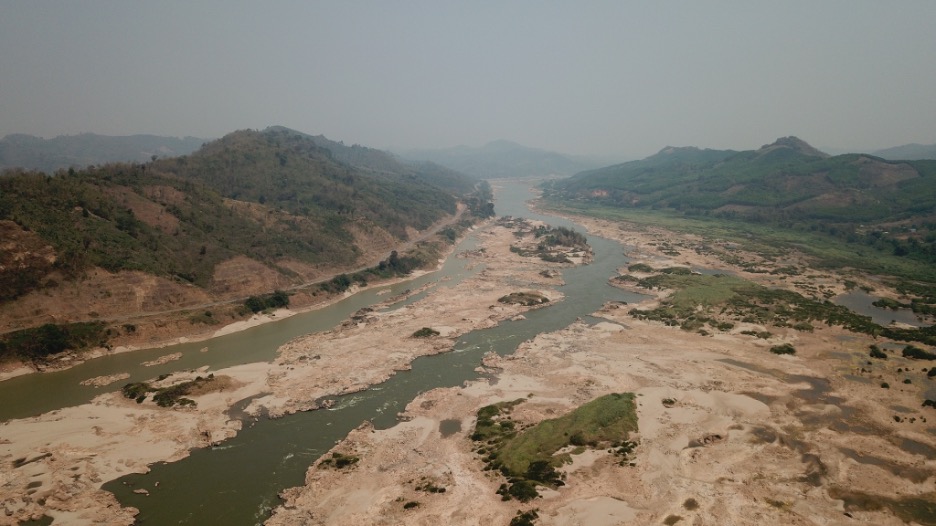
The NHRC letter to the Prime Minister comes in the midst of several high profile incidents of flooding of communities residing along the Mekong riverbanks and its tributaries. It is particularly timely, as the Thai government has been updating the country’s Power Development Plan (PDP) using assumptions based on outdated data and a process which has bypassed meaningful public participation. Meanwhile, government authorities have also failed to provide any assurance that adequate assessment of transboundary impacts have been done prior to moving forward with plans for this massive build-out of hydropower dams. On these matters, crucially, the NHRC findings and recommendations provided to the government echo critical concerns raised persistently by civil society and community based groups in Thailand as well as across the Mekong region. https://www.internationalrivers.org/news/thailands-national-human-rights-commission-raises-serious-concerns-about-impacts-of-mekong-river-dams/ (08 Nov. 2024)
Dams undermining region’s climate, economic health Last week marked five years since the 1,285-MW Xayaburi Hydropower Dam began commercial operations. Xayaburi was the first major hydropower project to be developed in Laos on the mainstream Mekong River. Though heralded by its proponents as a supposedly “transparent” and “community-centered” dam that could export “green” power from Laos to Thailand, the reality witnessed by the public on both sides of the river stands in stark contrast to these promises.
Local Thai and Lao people alike have reported a drastic decrease in fish populations, creating economic hardship due to the drop in related local income generation. They have also noted major fluctuations in the level and flow of the river, which has led to riverbank erosion and made it nearly impossible for families to grow subsistence crops along the riverside. Times when the water turns visibly blue, devoid of fertile sediments that would otherwise flow downstream to replenish soils for growing food, have been reported widely by local media.
Meanwhile, the public has been left in the dark about the actual impacts of the project. No verifiable assessments have been publicly released about changes to migratory fish populations, sediment loads, or water flow. Nor has there been any qualitative data collated to account for the sheer social and economic losses to Thai and Lao communities not only around the site but also upstream and downstream. In the meantime, the developers continue to profit, while the electricity bills of the average household in Thailand – the destination of most of the power generated by Xayaburi – are rising. https://thediplomat.com/2024/11/mekong-dam-plans-are-undermining-a-regions-climate-economic-health/ (04 Nov. 2024)
THE REST OF THE WORLD
Brazil BHP, Brazil and the Samarco Fundão Dam Class Action After nine years of negotiations and attritive legal proceedings, BHP has reached a settlement with Brazilian authorities regarding its role in the Fundão tailings dam collapse in Mariana, Minas Gerais. Taking place on November 5, 2015, the results were catastrophic to human life and nature, leaving 19 people dead and spilling toxic sludge over some 700 kilometres of land. The Samarco-owned facility, which held something like 26,000 Olympic-sized swimming pools’ worth of tailings (50 million cubic metres), was a joint venture between BHP and Vale. In addition to killing 14 company employees and five residents, the released tailings rapidly reached Bento Rodrigues, and part of the communities of Paracatu de Baixo and Gesteira and, for good measure, flooded the centre of the town of Barra Longa. https://countercurrents.org/2024/11/ruthless-settlements-bhp-brazil-and-the-samarco-fundao-dam-class-action/ (05 Nov. 2024)
UK Protesters call on government to tackle water pollution Thousands of people gathered in central London on Sunday (Nov. 03) to call for tougher action on keeping the UK’s rivers and seas clean. The March for Clean Water was advertised as a “one-off” event to petition the government to enforce laws that tackle water pollution and ensure “all polluting industries” upgrade infrastructure and reduce water wastage.
According to the Environment Agency, there were 3.6 million hours of spills in 2023 – more than double the total hours of spills in 2022. Water companies can release untreated sewage when it rains heavily to prevent homes being flooded but there have been instances where this has been done prematurely, and such spills are potentially illegal when it is dry. Contained within the spills is human waste, wet wipes and sanitary products, which can pose a serious risk to the local wildlife, swimmers and others who use UK waterways. On average in 2023, there were 1,271 spills a day across England, compared to 825 in 2022. https://www.bbc.com/news/articles/cvg4p0p6867o (03 Nov. 2024)
SANDRP
Also see: DRP 04 Nov. 2024 & DRP 28 Oct. 2024
Follow us on: www.facebook.com/sandrp.in; https://twitter.com/Indian_Rivers


