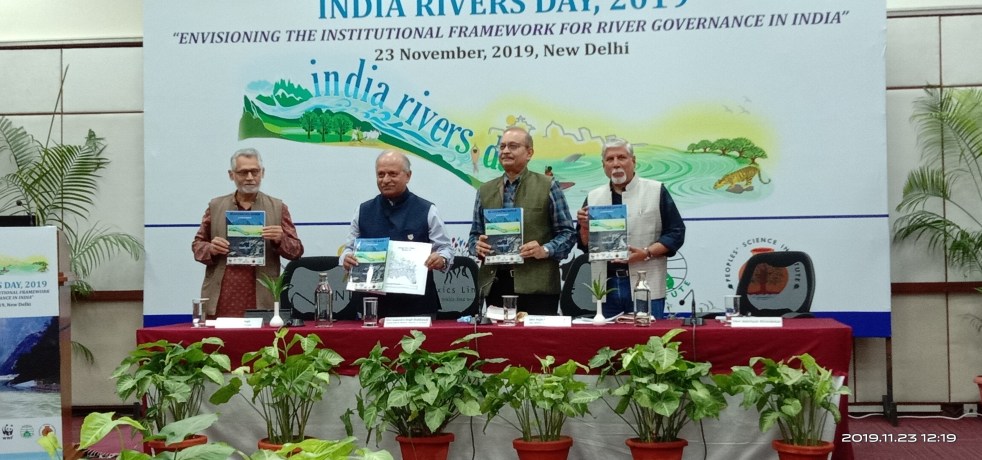
INDIA RIVERS WEEK 2020 invites Nominations for the Bhagirath Prayas Samman (BPS) and Anupam Misra Medal.BPS was constituted in 2014 with Late Shri Ramaswamy Iyer as the Chair of Jury. BPS aims to recognize the unsung heroes for their outstanding and sustained efforts towards protection and conservation of rivers. Shri Anupam Mishra Memorial Medal (AMM) constituted in 2017 aims to celebrate journalists and media professionals who have established an exceptional body of credible work on various aspects of rivers leading to changes in behaviour, public discourse, law and policy. Based on well defined criteria, the Jury of the BPS & AMM selects the awardees. Nomination forms can be submitted to any of the following e-mail addresses: indiariversweek2014@gmail.com or mpuri@wwfindia.net, with the subject line: BPS/ AMM 2020 Nomination. The last date for the submission of nominations is October 25, 2020. Forms are available at: https://indiariversforum.org/nominations-open-for-bps-amm-awards-india-rivers-week-2020/
Continue reading “DRP: 5 Oct 2020: Nominations Invited for the 2020 Bhagirath Prayas Samman & Anupam Misra Medal”Tag: wetlands

DRP: 28 Sep 2020: AAP to privatise Delhi Water supply which Arvind Kejriwal opposed?
Delhi Chief Minister Arivind Kejriiwal led govt seems to be now proposing privatisation of Delhi water supply.
Continue reading “DRP: 28 Sep 2020: AAP to privatise Delhi Water supply which Arvind Kejriwal opposed?”
World Rivers Day 2020: Celebrating Rivers across the world
The World Rivers Day[i] (WRD) is celebrated annually on the fourth Sunday of September. The event strives to highlight the invaluable ecological, hydrological services and cultural, recreational values offered by the rivers. Indeed, the most of the once wild, scenic, free flowing rivers across the globe are facing existential crisis on account of various anthropogenic activities hastened over the past century.
However, there are small but significant steps being undertaken by individuals, organizations and governments to restore some of the flowing eco-systems. This account attempts to compile some such positive developments that have taken place in the one year.
We have already published a compilation of the positive river stories of India on the occasion of International Day of Actions for Rivers being held on March 14 2020. In addition to Indian rivers, this compilation also covers some remarkable development concerning river conservation worldwide. There could be many more stories and developments happening, we invite readers to send us such stories they know about.
Continue reading “World Rivers Day 2020: Celebrating Rivers across the world”
DRP: 21 Sep 2020: IHA President accepts-Hydro faces massive slowdown & worse
International Hydropower Association (IHA) is essentially global leader of hydropower lobby. So when IHA President Roger Gill speaks about the problems hydro industry is facing, it becomes very interesting for all concerned.
In this interview the Roger Gill makes it clear that Hydro investments have been slowing down in last five years when compared with investments in immediate earlier decades. It has further slowed down in 2019 and has been further majorly affected by Covid-19 pandemic. Gill also accepts that the hydro is perceived as much more risky compared to solar and wind. The claim he makes of low levelised cost of electricity from hydro projects is a bit of fiction, since cost of any under construction or new hydro will be hugely costlier than solar and wind power projects. The IHA president is catching at the straws when he takes encouragement from investments in existing hydro projects and pump storage, though he keeps making it clear that market is still unclear as far as pump storage tariffs are concerned. A friendly interview also reveals a lot!!
It is high time that the Indian hydropower lobby led by NHPC and power ministry takes due note of the realities and would not push unjustified, unviable and destructive hydropower projects down the throats of reluctant states and people, using scarce public resources.https://energy.economictimes.indiatimes.com/news/power/hydro-power-requires-100-bn-investment-annually-roger-gill-international-hydropower-association/78131561 (17 Sep 2020)
Continue reading “DRP: 21 Sep 2020: IHA President accepts-Hydro faces massive slowdown & worse”
DRP: 14 Sep 2020: How should we define a Normal Monsoon?
IMD is happy to declare a monsoon as normal as long as total quantum of rainfall at national scale is within 4% of what is defined as normal monsoon rainfall during June 1 to Sept 30. Even if this means there is spatially or temporally or both spatially & temporally, the total rainfall or its distribution is abnormal in large parts of the country. It was good to see a national newspaper, asking question if the monsoon is normal even though it’s not temporally normal as was the case in large parts of the country this year.
The IMD normal only assures meteorological normal of national monsoon rainfall within given period. It does not assure hydrologic normal nationally or in different parts of the country, nor agricultural normal rainfall nationally or in different parts: sub divisions, states, river basins, districts, talukas/ tehsils or villages and wards. We clearly need much more realistic and nuanced definition of even meteorological Normal monsoon rainfall, which IMD needs to work on. But as far hydrological or agricultural normal rainfall is concerned, both temporally and spatially, those concerned outside IMD will need to work on.
Continue reading “DRP: 14 Sep 2020: How should we define a Normal Monsoon?”
DRP: 7 Sep 2020: On Himalaya Diwas, will Supreme Court stop destruction of Himalaya by Char Dham Road?
The people and state government of Uttarakhand would be celebrating Himalayan Diwas on September 9; the Supreme Court of India would be hearing the issues related to the controversial Char Dham Road project a day before it on September 08. During the last hearing on August 31, the apex court has rescheduled the case by extending the hearing date by a week amid concerns of recurring landslides raised by the petitioners.
The ongoing adverse impacts on forests, rivers, streams, soil covers, hills and people continue to concerns scientists, geologist who are alarmed by the scale of destruction and shocked by the brazen manner the state and central governments have been marching ahead without bothering to assess the impacts or address the genuine issues being raised by all concerned.
Multiple reports have been showing that the deliberate dilution of environmental rules and violations of already weakened norms applied by none other than governments themselves to avoid scientific scrutiny and push the project through climatically and ecologically sensitive mountains is proving to be a Himalaya blunder. There is still time to pause, ponder, review the project, assess the impacts, reduce road width and prepare an action plan to restore the damages and pay heed to scientific suggestions before the blunder leads to another inevitable disaster of Kedarnath or larger scale. Hope the apex court would not fail Himalayas.
Continue reading “DRP: 7 Sep 2020: On Himalaya Diwas, will Supreme Court stop destruction of Himalaya by Char Dham Road?”
DRP: 31 August 2020: No Rule of Environment Law in Char Dham Highway
Dr Ravi Chopra, Chairman of the Supreme Court appointed High Powered Committee has hit the nail when he questioned if there is any rule of Environment Law for the Ministry of Road Transport and Highways in their implementation of the Char Dham Highway in Uttarakhand. One hopes the Supreme Court does stand up for the Rule of law SOON and takes strictest action against violations. The violations are also affecting the people, the Himalayas and even the Ganga River, in its birth place. There is not too much hope from the Environment Ministry, but one hopes the Supreme Court does stand for the Rule of Law.
Continue reading “DRP: 31 August 2020: No Rule of Environment Law in Char Dham Highway”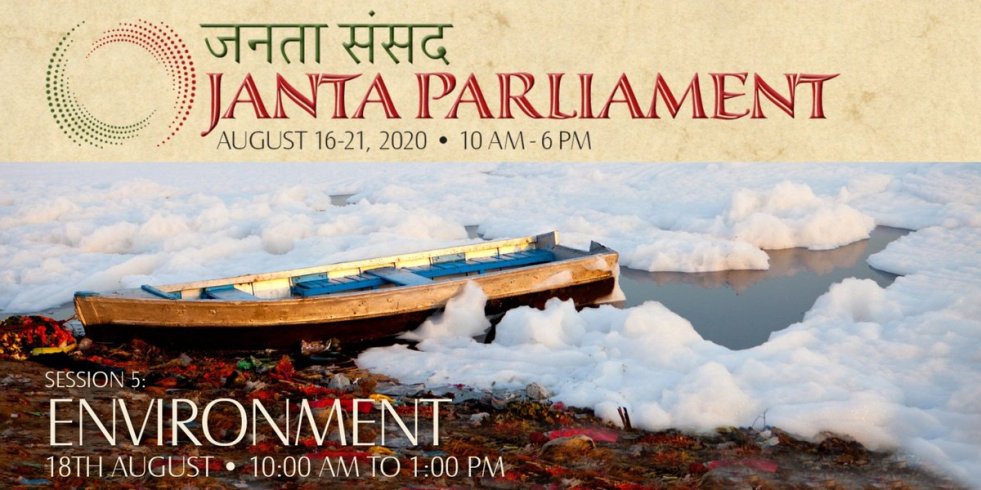
DRP: 24 August 2020: Janta Parliament discusses some serious water issues
While Indian Parliament has not met since March 2020, Civil Society Groups came together and held a Janta (people’s) Parliament from Aug 16 to 21 Aug 2020, where citizens from across the country from all walks of life enthusiastically participated. On Aug 18 there was a three hour session on Environment issues (such a session is a rarity in Indian Parliament), as part of which, there was a presentation on Water related issues where SANDRP coordinator was invited to speak. Two water related resolutions were passed among others, by the Janta Parliament, one on Flood Management and another on Urban Water Management. See below for details.
Continue reading “DRP: 24 August 2020: Janta Parliament discusses some serious water issues”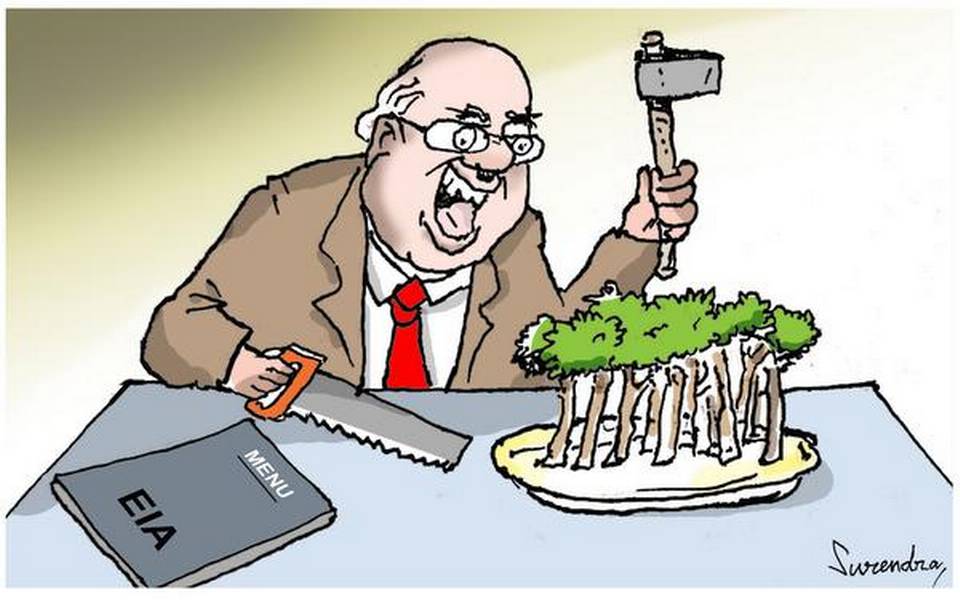
DRP: 17 August 2020: The Contempt of Court case against MoEF
[Feature image: Cartoon on Draft EIA 2020 by Surendra, The Hindu https://www.thehindu.com/opinion/cartoon/cartoonscape-august-12-2020/article32328005.ece (12 Aug. 2020)]
This last week, one Contempt of Court case was deservedly in news, when on the eve of India’s 74th Independence day, the apex Court found public spirited Prashant Bhushan guilty of contempt of Court. Prashant Bhushan’s commitment for the cause of the people and responsible governance of various institutions is beyond question. He is known for being critical of the government and judiciary’s track record and is supported in this by most independent minded persons.
However, there was another contempt case this last week, related to environmental issues, that was not so much in the news. On June 30, 2020, Delhi High Court bench of Chief Justice D N Patel and Justice Prateek Jalan in response to petition by environmentalist Vikrant Tongad had directed, among other things, that Union Ministry of Environment and Forests (MoEF) should translate the Draft EIA (Environment Impact Assessment) Notification of 2020 into all the official languages of India and disseminate widely in ten days. (https://www.thehindu.com/news/cities/Delhi/delhi-hc-extends-public-response-deadline-to-draft-eia-2020/article31951610.ece)
Continue reading “DRP: 17 August 2020: The Contempt of Court case against MoEF”
DRP: 10 August 2020: CANCEL EIA 2020!
Anyone who cares for India, its people and their future and who even remotely understands environmental governance and democratic process will come to just one conclusion about the Draft EIA (Environment Impact Assessment) 2020: CANCEL IT.
We certainly need change in the current EIA process. The whole thing is a major fraud at every stage, from the exclusion from large number of activities from the scope of EIA process, to scoping to quality of EIA, to the track record of the EIA consultants, to the process of selection of EAC (Expert Appraisal Committee) and its functioning, to public hearing and consultation process, to the complete absence of capacity or even will to monitor and achieve compliance of the approved project, every step needs strengthening, from the current EIA process based on the 2006 notification.
Continue reading “DRP: 10 August 2020: CANCEL EIA 2020!”
