Ganga Manthan to Ganga Act: No progress madeChairing the 6th meeting of the National Ganga River Basin Authority on July 04 Water Minister Uma Bharti has said that a new act will be formulated for speedy implementation of Namami Gange programme. On July 06, giving a major boost to Namami Gange Programme Ms Uma Bharti has also announced that 231 projects will be inaugurated at various locations in Uttrakhand, UP, Bihar, Jharkhand, West Bengal, Haryana and Delhi on July 07. Incidentally, on July 07, 2014 NDA Govt. launched the Namami Gange programme to rejuvenate the river to be executed over five years. The project has a budget outlay of Rs 20K crore which is 10 times more than what was allocated in previous Ganga Action Plan (GAP) phase I and II. But more money and the PM minister’s zeal, notwithstanding, Namami Gange seems a carryover from its predecessor in one crucial respect. The overwhelming emphasis on pollution abatement that had led to the GAP’s failure bedevils Namami Gange as well. In certain respects, Namami Gange is an improvement on the GAP. It seems that the govt has not learnt lessons from the GAP’s failure. The lag between sewage generation and treatment has remained between 55% & 60% even as new STPs were built under the GAP. This is because a lot of the waste is generated outside the sewerage network and is not conveyed to the STPs. A large section of the country’s urban population lives outside this network. Moreover, the STPs can only do so much. The official statistics show that the STPs are currently running at a deficiency of 55%. The problem of STPs is three-fold: underestimation, shortage and underutilization due to lack of a well-connected underground sewage system.
The problems associated with river Ganga, however, do not end or begin in its middle course dotted by factories. The upstream of the river, where Bhagirathi and Alaknanda join to form the Ganga, is part of a very fragile Himalayan ecosystem. Caution is needed in implementing the Namame Gange projects along this stretch. The Kedarnath flood of Uttarakhand is an example of what a combination of melting glaciers and mindless construction can do to a sensitive geological zone. With more than 40 dams, barrages and weirs and many more planned aviral Ganga seems nothing more than an empty catchphrase. Ganga is the sum total of the contribution of some 12 major tributaries. Without a rejuvenation strategy for each of Ganga’s tributaries, there can be no Ganga rejuvenation.
Meanwhile, increased fishing activity and vessel traffic are proving to be the disturbing element downstream. Deploying more scientific methods for fishing and limiting it to levels enough for species’ sustenance might help without significantly affecting livelihoods. The direct consequences of climate change are also felt in the lower belts, around the Ganga Sagar region. Land is disappearing but no comprehensive plans have emerged as yet to provide for the rehabilitation of the region’s inhabitants.
CentreSuggestions invited on Draft National Water Framework Billand Draft Model Bill for Conservation, Protection, Regulation and Management of Ground Water Ministry of Water Resources, River Development and Ganga Rejuvenation has uploaded the draft national water framework bill and draft model bill for conservation, protection, regulation and management of ground water on its website (http://mowr.gov.in). The Draft National Water Framework Bill provides an overarching national legal framework based on principles for protection, conservation, regulation and management of water as a vital and stressed natural resource, under which legislation and executive action on water at all levels of governance can take place. The comments/suggestions/views from all Individuals/Experts /Organizations/Institutions on the above bill may be sent to jspp-mowr@nic.in or sjcpp-mowr@nic.in latest by June 25, 2016. The Draft Ground Water Model Bill is based on the principles of subsidarity, equitable distribution in an integrated approach. The State should act as a public trustee of ground water, which should be treated as a common pool resource to make sure that groundwater is protected, conserved, regulated and managed. The comments/suggestions/views from all Individuals/Experts/Organizations/Institutions on the above bill may be sent to dirgw-mowr@nic.inor pratul.saxena@nic.inlatest by June 25, 2016.
India will not have power deficit situation in FY17 India won’t need any new power plants for the next three years as it is flush with generation capacity, according to a government assessment. The country can manage for the next three years with existing plants that are currently under-utilised, and those that are under construction and upcoming renewable energy projects, assessment made by the power ministry for reviewing the National Electricity Policy shows. Govt declares for the first time in history that India is POWER SURPLUS in 2016-17 with 3.1% power surplus in peak hours and 1.1% power surplus in off peak hours, both figures in 2015-16 were -3.2% during peak hours and -2.1% in peak hours. The western and Southern regions will be power surplus, but Northern, Eastern and Northeastern regions will have deficits. At the same time Power Minister Piyush Goyal says that Big hydro power units may come under renewable energyAccording to Minister the Centre has begun studies to decide whether to include big hydro power plants under the ambit of renewable energy. When India will be energy surplus for next three years why then Govt. of India is continue to pursue disastrous hydro projects on ground. Where ASSOCHAM is asking Arunachal govt. to do away with adverse tax policies on Hydro powerto boost construction of hydro projects in the State. NHPC has alsoraised relief amount for Kishanganga HEParound Rs 60 lakh and Rs 70 lakh to each family for the land acquired. And despite Delhi Govt. openly rejecting water from Renuka dam NGT panel has visited the area to look into the rehabilitation issue.
Above: All-India Summer Monsoon (June-September) Rainfall Anomalies during 1871-2015. Note that since 1950s, not only has the incidence of droughts increased, but rainfall in the excess of 10% has also decreased markedly Source: IITM Paper Interanual Variations of Indian Summer Monsoon
When it comes to Global Warming and Climate Change (not interchangeable terms), India and the world have witnessed a series of firsts in the past year. The last 11 months have been the warmest months in recorded history, each monotonously breaking a previous record[i]. In India, regions like Maharashtra including Marathwada have experienced back to back droughts, in addition to increasing frequency of Extreme Weather events like Hailstorms and unseasonal rainfall. Variability of Western Disturbances has increased, which is linked with extensive anthropogenic warming over Tibet[ii]. Our response to Climate Change and the challenges it poses has been far from satisfactory. There has been no impact of National Action Plan for Climate Change, due to the inherent problems in its inception[iii]. State Plans lay languishing for several years, without clear accountability and transparency[iv]. India’s INDCs (Intended Nationally Determined Contribution) indicate more harm than good.[v]Continue reading “Dr. Roxy Mathew Koll: “Warming Indian Ocean means a Weakening Indian Monsoon””→
Unprecedented water crisis in Delhi due to Jat stirTerming the water crisis in the national capital as “unprecedented”, Delhi minister Kapil Mishra has warned that the situation might worsen in the next few days if the supply from Haryana is not immediately restored. He said the Delhi Jal Board (DJB) had almost run out of water and advised people to use water judiciously. Delhi gets its bulk of water supply from Haryana and the stir has affected 65% of water supplyin Delhi has been cut with the shutting down of seven water treatment plants— Wazirabad, Chandrawal, Dwarka, Okhla, Haiderpur, Nangloi and Bawana which provide around 500 million gallons per day (MGD). In all Delhi has nine water treatment plants which together produce 820 MGD of potable water. Of these, only two Sonia Vihar and Bhagirathi fed by water from Uttar Pradesh are operational. The current production is only 240 MGD. Among theareas affectedwere Dwarka, Janakpuri, Munirka, Palam, Rajouri Garden, Punjabi Bagh, Vasant Kunj, Saket, Green Park and Lodhi Colony, where residents complained of little or no water. In another news report DJB is reportedto have made 140 water filling points functional to feed tankers which would be sent across the city, reeling under an unprecedented water crisis. Water Minister Kapil Mishra reviewed the contingency plan for water management in West, North, North-west, Outer and Central Delhi and said tankers will deliver water at 663 points to partially meet the shortage of 480 MGD. These points will keep rotating. Plan is to cover around 2,000 points by Monday evening. The DJB supplies around 900 MGD of water daily out of which around 600 MGD of raw water come from Munak Canal. Even if Haryana releases water immediately, it will take at least 24 hours to restore the supply. Meanwhile Supreme Court on 22 Feb.16 scolded Delhi government. for approaching the court instead of resolving the water crisis with Haryana. The Kejriwal government had approached the top court on in view of the severe water crisis in the national capital after Jat protesters blocked water supply through Munak canal in Sonipat. During the hearing on government’s plea, the court took strong objection to Water Minister Kapil Mishra’s presence inside the courtroom. On the other hand, the minister accuses Haryana & Central Government for providing no official information on the crisis He said the Delhi government was “repeatedly trying to communicate” with the two governments to find out when will the supply resume, but without much success. Also see Jat quota stir: Water supply cut, Delhi may go dry
86 Villages rise in protest against dam on Ghaggar A dam is proposed to be constructed on the Ghaggar, near Banur, at a cost of Rs 75 crore. An agreement was signed between representatives of various villages located downstream and the Irrigation Department in 2006 promising 200 cusecsto irrigate fields in thesevillages. Villagers now fear that they will not get the promised 200 cusecs after the construction of the dam. Their claim is that the water flow in the river is much lower than 400 cusecs, as claimed by the irrigation department. The department, on the other hand, sticks to its stand that the water flow in the river is sufficient enough to feed the canal and the villages downstream. However, a perusal of the monthly average discharge data of the river for the past 10 years, defies the department’s claim. It revealed that the average yearly discharge barely crossed 400-cusec mark over the past 10 years, excluding the peak period (July to September). Interestingly NABARD and the State Irrigation department had separately conducted studies of the project well before giving it a green signal.
Eight Indian States have already declared drought this year. Apart from UP the other states are Karnataka, Maharashtra, Madhya Pradesh, Chhattisgarh, Odisha, Andhra Pradesh and Jharkhand.
In 2015, India witnesses many weather extremes which can be linked to Climate Change. The unseasonal rains in March, then back-to-back failure of Southwest Monsoon that has led to severe drought conditions in many Indian states. Right now Tamil Nadu, Andhra Pradesh are facing severe flood conditions caused by heavier Northeast monsoon rain. The year 2015 also saw record breaking heat. Clearly Climate Change have started unfolding abnormal weather incidences in India impacting millions of people lives who have become victim of Climate Change despite no fault of theirs. But Indian government is neither connecting these disasters with climate change, nor identifying the victims, leave aside asking for justice for these victims.
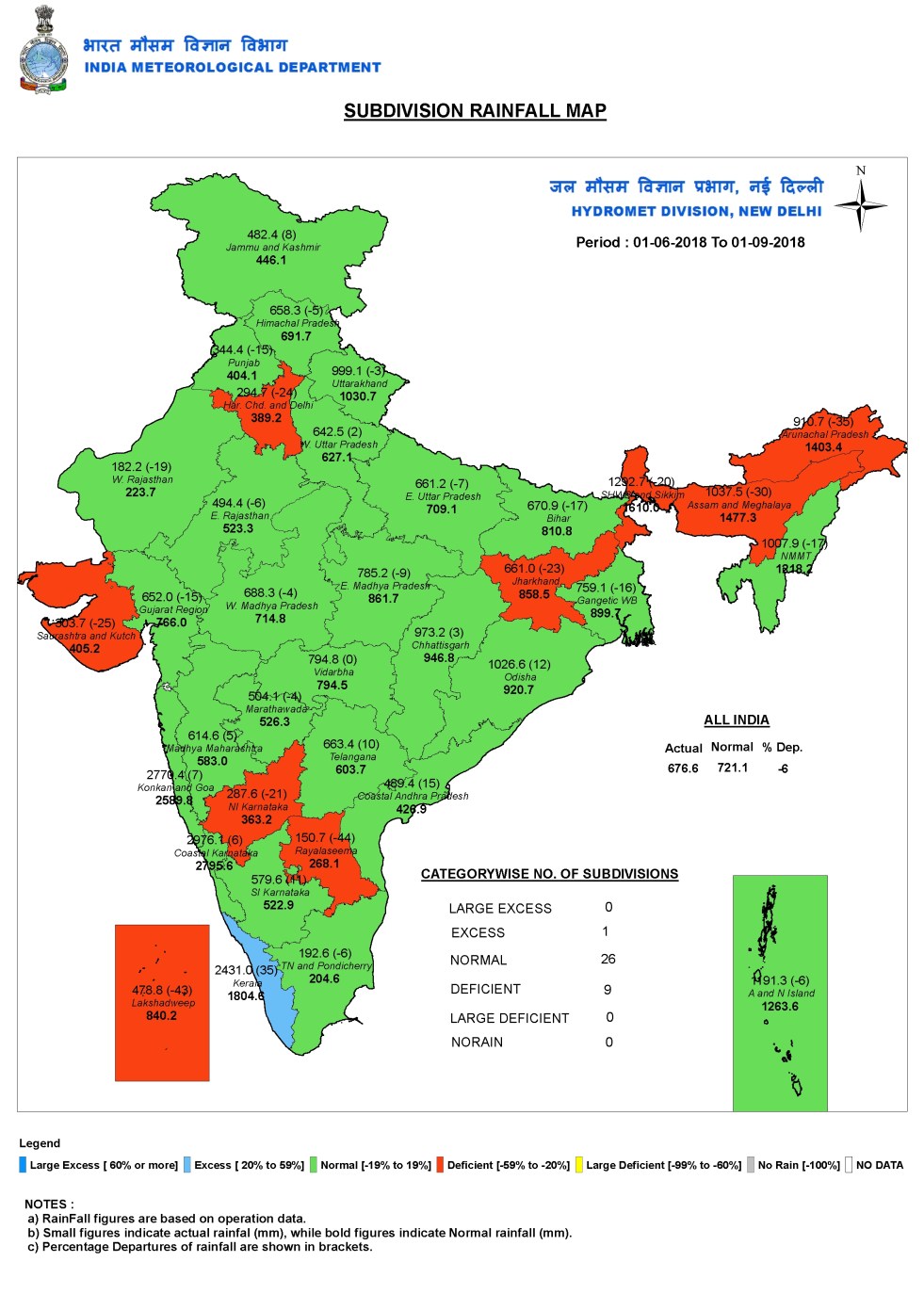
30th September marks the end of June-September South West summer monsoon in India and Maharashtra. The 2015 summer monsoon has proved to be the worst monsoon in the last six years for India. Rainfall deficits are seen in all major food-producing regions like UP (47% deficit), Bihar (28% deficit), Punjab and Haryana (32% deficit). This is India’s second successive year of high rainfall deficit, and only the fourth time this has happened since 1901.
Monsoon retreats from the country and the states on various dates. Some welcome showers are falling and are further expected in Maharashtra in the coming weeks, but the summer monsoon figures are now set. According to meteorologist Akshay Deoras. “Rain counters are refreshed on 1st October and new count of post monsoon season or winter monsoon season will start now.”
First week of October calls for an analysis of the summer monsoon, its performance in June, July, August and September and the implications this holds for various sectors.
People of Maharashtra have heard about, seen and experienced the dismal monsoon of 2015. Marathwada fared the worst, and was number one deficit state in the country at 52% deficit for a long time. However, at the end of monsoon, deficit of Marathwada is 40%. This is more worrisome as it comes piggybacking the 42% rainfall deficit in Marathwada in 2014, with rainfall of just 398.8 mm.
But, in order to understand the situation better, if one tries to analyse rainfall figures from various reputed official sources, one is taken aback by the disparities. We looked at official Indian Meteorological Department[i] figures, official Maharashtra Agriculture Department[ii] (Rainfall Recording and Analysis) figures and numbers from the 49th Cabinet Committee Note of the Government of Maharashtra dated 30th September 2015 accessed by SANDRP[iii].
All are concerned with Monsoon rainfall from 1-6-2015 to 30-9-2015. All of these contain different figures!
Indian Meteorological Department: IMD generates its rainfall data for Maharashtra based on its approximately 878 rain gauging stations spread across the state[iv]. According to IMD, regions of Maharashtra fall in rainfall deficit this year of varying proportions. Konkan region shows deficit of 31% with 2914 mm rainfall, Madhya Maharashtra shows deficit of 33% with 488.1 mm rainfall, Vidarbha shows deficit of 11% with 848.2 mm rainfall, but the highest deficit is Marathwada at 40% with 412.4 mm rainfall.
According to IMD, between 1st June to 30th September, Maharashtra has received 732.5 mm rainfall of its 1007.3 mm average normal rainfall, which is 73% of average rainfall (27% deficit).
5 Districts that have received 50% or less of the average rainfall include
The region-wise, month-wise rainfall in Maharashtra this monsoon, as per IMD figures was as per following table.
Rainfall, mm
Konkan-Goa
Vidarbha
Madhya Maharashtra
Marathawada
June
Normal
663
161
140
138
Actual
781
254
177
119
July
Normal
1147
318.9
247.8
192.5
Actual
581.5
137.8
111.7
26.8
Aug
Normal
759.6
305.7
289.1
188.2
Actual
388.7
288.9
56
112.2
Sept
Normal
344.7
169
152.4
164.2
Actual
253.8
167.5
143.4
154
Monsoon
Normal
2914.3
954.6
729.3
682.9
Actual
2005.0
848.2
488.1
412.4
Where is Madhya Maharashtra? Incidentally, IMD classifies the country in various categories. Maharashtra includes Konkan, Madhya Maharashtra, Marathwada and Vidarbha. Madhya Maharashtra includes Nashik and Pune Divisions of whopping 10 districts, from Nandurbar, Dhule, Jalgaon, Nashik, Pune, Ahmednagar, Satara, Solapur, Sangli and Kolhapur. This region is not uniform in any sense, neither rainfall-wise, nor geographically nor is it “Madhya (Central) Maharashtra”. Any assessment based on a Madhya Maharashtra is meaningless in a sense as it clubs Kolhapur, at the southern tip of Maharashtra whose normal rainfall is more than 1500 mm with Dhule at the northern end of the state whose normal rainfall is about 500 mm and includes areas of Tapi, Narmada, Krishna and Godavari basins. It is time IMD adds some rationale to its meteorological divisions in India.
Maharashtra Agriculture Department: Agriculture Department of GoM runs a very useful website: maharain.gov.in which displays detailed data from its Rainfall Recording and Analysis Department. It states: “The department of Agriculture, Maharashtra State initiated the project for recording daily rainfall in the state in year 1998. Initially rainfall data was recorded at tehsil level and subsequently same functionality was extended to circle level from 2013 as GoM has installed rain gauge at every circle. Circle officer sends daily rain data using mobile through SMS. In addition to SMS rain data can be entered directly on the web portal.”
Prima facie it appears that Agriculture Department may have a better spread in the over 40,000 villages in Maharashtra than IMD’s 878 rain gauging stations.According to Agriculture Department, of the 353 administrative blocks in the state (taluks):
65 bocks have received rainfall less than 50% rainfall (18.4% blocks). Most of these are concentrated in Solapur and Marathwada region.
174 blocks have received rainfall between 50-75% rainfall.
Just 23 blocks have received 100% or above of normal, and these are concentrated in Vidarbha and Nandurbar, Northern Maharashtra.
Cabinet Note of Government of Maharashtra, 49th Meeting, 30th Sept 2015: It reports that state has received 678.5 mm rain of the avergae 1131 mm, that is 59.9% or 60% of the average. But as we saw above, IMD says its 732.5mm of average 1007.3 mm, 73% of the average. There is no explanation for such widely different figures in the cabinet note.
Agricultural experts like Nishinkant Bhalerao states that the 60% magic figure will make any drought aid difficult and that it masks the monthly disparities which very badly affected this season’s Kharif. For example, Marathwada received barely 14% of its July average rainfall, a mere 28 mm, but cumulatively mainly due to late Spetmeber rains, this anamoly is hidden.
According to the note:
13 districts of Dhule, Nandurbar, Pune, Aurangabad, Buldana, Akola, Washim, Amravati, Wardha, Nagpur, Bhandara, Gondia, Gadchiroli received between 76-100% average rainfall,
17 districts of Thane, Palghar, Raigad Ratnagiri, Sindhudurga, Jalgaon, Ahmednagar, Satara, Sangli, Jalna, Beed, Latur, Osmanabad, Nanded, Hingoli, Yavatmal, Chandrapur eceived between 51-75% average rainfall and
In 4 districts, rainfall has been less than 50%, these include Nashik, Solapur, Kolhapur and Parbhani.
Strangely, IMD states Nashik received 729 mm rainfall till 30th Sept and has just 20% rainfall deficit but for the same period, Agriculture Department shows Nashik has received just 484.8 mm rainfall, and shows a rainfall deficit of about 52%! The difference between the two values is whopping 244.2 mm, more than entire seasonal rainfall of Solapur!!
IMD note also includes Beed (just about here at -50%) and Latur (-51%) in less than 50% rain, these are not included in the cabinet note.
Agriculture Department statistics includes Osmanabad in less 50% rainfall bracket, but it is not included in Cabinet Note
Cabinet note talks about 355 blocks, while Agri Dept considers 353 blocks and Government of India[v] considers 351 blocks in Maharashtra!
Sr. No
Cabinet Note, 30th September 2015
Agricultural Department Government of Maharashtra, 1st October 2015
Blocks with less than 25% rainfall
1
1
Blocks with 26-50% rainfall
49
64
Blocks with 51-75% rainfall
171
174
76-100% Rainfall
105
91
100% or more
29
23
While discrepancies in these sources is not the subject matter of this discussion, there is definitely a need to streamline and improve monsoon rainfall reporting. This is especially important at a time when policies, drought assistance, insurance payment to farmers and water allocation decisions are heavily dependent on rainfall figures. If we cannot get our rainfall figures right, it raises a lot of questions about our capacity to monitor and understand the most important weather event of the year, on which lives of over 50% of the population directly depend! There is a vast difference not only in observed rainfall, but also supposed normal rainfall figures, which skew up the percentages.
Below: Notable differences between IMD and State Govt Data
District
IMD (mm)
State Agriculture (mm)
Difference in Actual Rainfall (mm)
Normal
Actual Rainfall
% of Normal
Normal
Actual Rainfall
% of Normal
Dhule
523.5
533.5
101.9%
530.5
448.2
84.5%
85.0
Nashik
912.2
729.0
80%
1013
484.8
47.9%
244.2
Satara
723.8
455.7
63%
834.2
539.5
64.7%
83.3
Solapur
474.2
231.8
49%
488.8
193.9
39.7%
37.9
Kolhapur
1737.6
803.4
46%
1772.4
634.8
35.8%
168.6
Yavatmal
855
663.3
78%
911.4
479.1
52.6%
184.2
Nagpur
923.9
970
105%
988.5
938.2
94.9%
31.8
Solapur gets less than 1972 rainfall: According to Agriculture Dept, Solapur has received low rainfall of barely 193.9 mm from June-Sept. This is on top of 25% rainfall deficit in 2014 monsoon. In the epic drought of 1972 also, Solapur received more than this at 224.9 mm rainfall.[vi] This year, Solapur has received less than half of the rainfall Rajasthan received! This also seems to be the lowest monsoon rainfall Solapur received since 1901!
For two consecutive years, Parbhani has received less than 50% rainfall (326.9 mm this year). In fact it’s June –July August Rainfall this year is lowest in the century.
The district which has shown the highest deficit isKolhapur. As per Agriculture Department data, it has received just 634.8 mm rainfall, 35.8% of its normal average monsoon rainfall. Strangely, IMD shows 803.4 mm rainfall this monsoon for Kolhapur, which is 46% of normal. The difference of 168.6 mm is too huge to be ignored and needs to be explained.
Reservoir Storages:
Reservoirs storages at Maharashtra state level are at 56% of live storage capacity right now. But this is again masking the regional disparities. Marathwada has just 15% storage and 9 months ahead before the next monsoon. Four of its reservoirs are at 0 Live Storage (Mazalgaon, Manjara, Nimn Terna, Nimn Dudhna). The biggest Dam Jayakwadi is at a mere 7% storage.
Nashik division upstream of Marathwada also has relatively low storage at 59%.
Pune is slightly better at 61%.
Nagpur, Amravati and Konkan divisions are above 70%.
Some Contingency Planning steps:
Even in this situation, westward diversion of water from drought-hit Bhima-Krishna basin to high rainfall Konkan region and down to sea by Koyna and Tata dams continues, with no attempt to stop this completely wasteful diversion in this dry season.
No information is available in public domain about district-wise planning of available water resources till the commencement of next monsoon
No strong decision has been taken by the government about restricting or regulating sugarcane crushing which will commence from 15th October and which will consume lakhs of liters of water in the most severely drought-affected parts of the state.
No strong decision on limiting new area under sugarcane in Solapur and Marathwada regions, which will be planted after this harvesting and crushing season.
While IMD states that Maharashtra has received more than 70% average rainfall and State Government pegs it at around 60%, the reality is that water situation in Maharashtra especially Western Maharashtra, Nashik region and Marathwada is dismal. Erratic rainfall with long dry spell in July and August has affected Kharip crops, groundwater levels and surface water storages. There is a need to immediately work on a participatory contingency planning of the available water resources for the coming year.
This planning cannot happen in a closed door manner by the cabinet or group of ministers, but should include and respond to water users and farmers and should be built on the principles of equity and sustainability. MWRRA also needs to get into its act. The people of the state are waiting for such an initiatives from the government and MWRRA.
– Parineeta Dandekar, with inputs from Himanshu Thakkar
Above: Ashok Pawar’s motorbike cruises right inside his dry field, even after recent showers in Marathwada Photo: Ashok Pawar
After a heartbreaking gap, retreating monsoon is now blessing Marathwada with some showers. Small water harvesting structures and those built under the Jal Yukta Shivar Abhiyan, a flagship project of CM Devendra Fadnavis, are clocking an increase in water levels. 96.3% of average September rains in just the first 10 days of September (Dept of Agriculture, Govt of Maharashtra) is indeed a respite for a region that stands at the doorstep of an epic drought. What is lost in June-July-August in terms of crops failures, water scarcity, dismal dam storages etc., cannot be compensated by September rains, which are a fraction of total monsoon (June-July-Aug-Sept) rainfall. But if the rains continue, they can help drinking water situation and possibly Rabi crops. It is heartening to see the farmers celebrating this downpour.Continue reading “Sugarcane in Marathwada: A Syrupy debate amidst Lowest June-Aug Rainfall in the Century”→
UTTARAKHAND: National Institute of Disaster Management asks Govt. to make disaster study must for Uttarakhand hydel projects (17 Aug. 2015) This is good to see, it uses almost the exact language some of us having using since the disaster.
SIKKIM:Lanco in talks to sell Sikkim hydro power project (11 Aug. 2015) The Lanco group confirmed that it is in talks with strategic investors to sell its 500 megawatt (MW) hydro-electric power plant in Sikkim, as part of an effort to consolidate its businesses and reduce debt.
ARUNACHAL PRADESH: Neha Sinha (BNHS) in her article titledA bird, a dam and a belief explores the ethical and environmental aspects intertwined with construction of Nyamjang Chhu dam which will destroy the habitat of the Black-necked crane at Zemithang in Arunachal Pradesh. The Save Mon Region Federation (SMRF), a group spear-headed by local Buddhist Lamas, has challenged the environmental clearance in the NGT. LIFE are the lawyers for petitioners. Sanjay Upadhyay and Raj Panjwani are lawyers for Bhilwara group.
MANIPUR:Why Manipur is flooded (12 Aug. 2015) Interesting to see Down to Earth sees role of dams in Manipur floods: On the other hand continuing their agitation Mapithel dam affected downstream people hold protest meet(16 Aug. 2015) Joint Action Committee (JAC) for Mapithel Dam Downstream Affected People organized a protest meeting at Tumukhong Village, Imphal East District. The meeting demanded immediate rehabilitation and resettlement of Mapithel Dam affected people in the downstream areas. Also get to see a special news report on 26 years long protest of Chandog village against Mapithal Dam.