CAG Report · Maharashtra

Clean chit by the Chitale SIT Report on Maha Irrigation Scam?

 Ye jo Public hai, Ye sab Jaanti hai!

The much debated SIT Committee Report headed by Dr. Madhavrao Chitale was finally tabled in the State Assembly on the last day of the Assembly in the evening on the 11th June 2014, reading it one gets a feeling of déjà vu. Following the uproar due to unprecedented dam scam in 2012, GOM constituted Special Investigation Team (SIT) on the last day of the promise, on 31 December 2012. Members of the Special Investigation Team (SIT), chaired by Dr. Madhavrao Chitale include AKD Jadhav, retd. IRS official and also the past Chairperson of MWRRA, Dr. Krishna Lavekar, Retd. Agriculture Commissioner, GOM and Dr. V. M Ranade, Retd. Secy, Command Area Development, WRD, GOM.

The committee report was submitted in March 2014, after some extensions and was kept under wraps for past three months by the government possibly keeping the Loksabha elections in mind. Not that it mattered as Congress and NCP fared terribly in Maharashtra, winning just 6 of the 48 seats in Maharashtra, and the irrigation scam seems to have had a massive role in this. Now the government, especially NCP’s former and current water resources ministers Ajit Pawar and Sunil Tatkare are claiming that they have got a clean chit from the report, keeping the State Assembly elections in mind.

These claims will not help the political parties. On the other hand, they are likely to harm their political prospects.

But first let us look at some basic aspects of the report. Does it really give a clean chit to the political parties? Is it above shortcomings? Will it play an important role in overhauling dam-centric water management in Maharashtra?

TORs of SIT The TORs of the SIT, laid down by the Water Resources Department of the GOM were as follows:

  1. Investigate irrigation potential created, actual irrigated area (pratyaksha sinchit kshetra) and water use for non-irrigation use. In the actual irrigated area, find the irrigated area by wells, farm ponds, water conservation department and water resource department
  2. To ascertain if the revised administrative approvals given to projects by Irrigation Development Corporations (IDCs) are according to the existing rules and regulations.
  3. Investigate the reasons for delay in completing projects
  4. Investigate reasons behind change in scope from original administrative approval and increase in cost due to change in scope
  5. Suggests measures to increase the usefulness of Lift Irrigation Schemes (LIS)
  6. Suggest ways for quality enhancement in WRD
  7. Suggest ways so that project is completed in said time span and costs
  8. Suggest measures to increase irrigated area
  9. If irregularity found in the inquiry, investigate it, fix responsibility and suggest suitable action

Are TORs inadequate? The Chairperson Dr. Chitale has reiterated over and over again, in face of requests and submissions from media, civil society, petitions filed in court (there are at this moment about 23 PILs (Public Interest Litigation) filed in Bombay High Court about irrigation projects between 2009-2013), that it was not a part of their mandate to look at the modus operandi of the corruption involved in the scam, in the process of calling tenders and accepting contracts. As per section 9.8 of  SIT report, issues it has NOT looked at include: Misuse of clause 38 in tenders for addition of component in the main tender without re tendering, Sanctioning mobilization advances without appropriate justification, Manipulating estimates for accepting tenders, inclusion of unjustified and unrelated additional expenses and Dam Designs made by contractors. The Committee says that these irregularities are outside their TORs but there is ‘scope for doubt’ and the “government would need to investigate into this separately within the legal boundaries.” This is not true and the SIT should have gone into these issues, particularly when it has found ‘scope for doubt’ in these issues because per se the TORs are broad enough to include these.

The committee also says that going into these would have been difficult due to absence of man power, resources and time at the committee’s disposal. However, looking at the centrality of these issues in the Dam Scam, due to which the committee was set up in the first place, and the respect Dr. Chitale garners in the WRD (Water Resources Dept) and political circles, it would not have been impossible to get the TORs modified if at all necessary and very easy to get additional resources. But there is no evidence of the committee asking anything in this regard, indicating that this was not even attempted by the committee.

Apart from that, the committee could have addressed many of these issues being in their TORs as corruption, political-influence and contractor-led processes have affected nearly all the aspects covered in the TORs. Not looking at these issues has resulted in a situation where Dr. Chitale says one of the main reasons for cost escalation of projects has been rise in market prices. Now consider this: costs of Kondane dam increased from Rs 57 crores to Rs 614 cores in just six months, and market prices had nothing to do with this. There are several such examples, where cost escalations, time increase, technical problems had nothing to do with the issues looked at by the committee. The  exclusion of political and corruption issues have affected the quality of conclusions and recommendations of the report.

The committee notes that it relaxed the TORs in accepting submissions from organizations and NGOs, keeping the bigger picture in mind. Strange to see that committee did not think of doing so in issues related to corruption and political links.

CONCLUSIONS OF SIT:

Some of the good conclusions:

  • Environmental and Forest Violations: The report says that there are 2 projects without EC (Environment Clearance) and 31 projects without FC (Forest Clearance) and which did not get FC for more than 5 years. Without clearance, work on some projects stopped midway or dragged on, resulting in a dead investment. If work was started only after permissions, these expenses could have been avoided and money instead could have been spent only on those projects with permissions. The SIT has recommended strict action against officials who floated tenders and issued work orders without these clearances, which is welcome.
  • It has also recommended action to be taken against officials responsible for starting working without acquisition of land for the project as well as canals. (9.3.2)
  • Initiating work without detailed design: Recommends action should be taken against the officials. (9.3.3)
  • Initiating work in the absence of finance: Committee recommends Strict action against IDC, Chief Auditor and Executive Director of the IDC (9.3.4.) which started work without requisite finances.
  • River plugging without creation of irrigation potential: There are around 23 projects where the river plugging (ghal bharni) was done but there was no irrigation potential created then or even two years later. Committee recommends strict action against officials.
  • Projects with serious faults, suspicious transactions: Committee recommends that projects with multiple flawed parameters should be checked by an independent committee and recommends action against Executive Director for the respective IDC. Such projects include: Ujani, Krishna Koyna LIS, Seena Medium Project, Bembla Project, Lower Painganga, Jigaon, Kurka Wadoda Project (TIDC), Sulawade, Bodhawad Praisar, Lower Tapi, Mukatinagar LIS, Manjra, Vishnupuri (Godavari Barrages), Brahmangaon LIS, Upper Godavari Project, Krishna Marathawada project
  • The committee also notes serious irregularities in the following projects: Dhamani (Kolhapur) Kukadi (Seena Tunnel), Jigaon (Buldana, Kondane (Thane) and Chanera (Thane) and recommends special attention and investigation into these projects.

But many conclusions are flawed, unacceptable and some are even illegal:

  • Irrigated area in the State: The report relies only on data collected by WRD. It also states that WRD collects seasonal field data. However, this is not true. The WRD currently has no system in place for admeasuring irrigated area. Irrigation Status Reports and Benchmarking reports are also not available for the past three years. Chitale Committees’ conclusions based on data from WRD are not reliable.
  • TOR 9: Investigation and fixing responsibility The committee holds the entire state machinery including the Planning and Finance Department for not providing enough checks and balances on the work of WRD and classifies most blunders as “systemic errors” (9.04). While fixing clear responsibilities of these sectors could have helped, sweeping generalizations and repeated conclusion of “systemic errors” ensure escape route to all offenders.
  • The punishments are classified into mild and strict punishments, but even strict punishment is limited to departmental inquiries. The committee has also taken the circuitous route of not naming the offenders, but alluding to their posts and duration. Even this is extremely vague. So while the committee refuses to look at most contentious issues, it also refuses to name offenders and also does not name political hand behind the decisions. It does not seem to be an investigation team in any way. Also, when fixing responsibility is a part of the TOR, the committee cannot shirk from the responsibility and state that it will not name offenders. This is a public issue and committee does not have the privilege of overriding the TORs for its idea of leniency.
  • The committee says that investigation into irregularities indicates that major driving force has been stress to reduce backlog, pressure from ‘local’ political leadership, centralized decision making in the IDCs and conscious ignorance of rules and social responsibility. This lenient generalization washes any responsibility from the political leadership of the state and the contractor-engineer nexus.
  • Section 10.9 of the report states that the blunders committed by decision makers were not intentional and were mostly ‘errors of judgment’.
  • MWRRA: Committee reports that 12 Projects are without MWRRA permission. Mild action is recommended against responsible Executive Director. (9.4) While the committee recommends action even against Finance and revenue departments, it does not mention any strict action against MWRRA, which, as pointed out by the CAG Report 13-14 cleared 189 projects during 2007-2013 though the State Water Resource Plan, based on which the projects were required to be cleared, was not prepared, violating the MWRRA Act (2005). Significantly, CAG mentions that: “Authority also failed to perform its role as a regulator as envisaged in the Maharashtra Water Resources Regulatory Authority Act, 2005.”
  • On functioning of IDCs The report states that in 2004, at a meeting of the governing council and IDC members, it was decided that the rights of giving Revised Administrative Approval (RAA) will be given to the Chairperson (WRD Minister). Only a few members of the governing council were present for this meeting. The SIT notes that while the IDCs should have been going towards decentralization, this was a regressive step towards centralization and concentration of power and authority, however, the committee does not suggest ANY action against the Chairman!
  • As per a 2003 GR (Government Resolution) regarding Krishna, Godavari and Vidarbha IDC, all rights to provide RAA were given to the Chairperson and Executive Director by the Governing Council of the IDCs, thus concentrating power (and also scope of corruption related to RAA hikes).
  • CAG Report (2013-14) says regular monthly meetings of the Governing Council of IDCs were not held, in violation of Maharashtra Irrigation Development Corporation Acts. The Chairman (WRD Minister) is directly responsible for this. But the SIT Report does not mention this!

Action Suggested with respect to Specific Projects:

GoseKhurd: There should be action against respective officials who did not visit the canal works due to which concretization was to be done again. The SIT does not suggest any departmental inquiry or anything new other than the recommendations of the Mendhegiri committee report.

Barrages on Godavari: Several question marks have been raised about these projects, their utility and safety. Kulkarni Committee appointed to look into irregularities has come up with strong measures against defaulting officials. But rather than upholding Kulkarni Committee’s recommendations, the SIT asks for constituting one more committee to look into the irregularities!

Illegal suggestion of SIT Shockingly the committee says: (Page 210) for Human Project Forest and Forest Clearance was incorporated in project tender and recommends “it would have been good if a separate tender was issued for this” This is very disturbing. The entire process of Forest Clearance happens through the State Government Forest Department and there is NO role for any other agent here. Any such role indicates violation of the Forest Conservation Act, and SIT recommends precisely such a violation!

Similarly, Environmental Appraisal is supposed to be an unbiased process looking at the social and environmental impact of projects. There is again no scope for tendering here. The SIT’s recommendations in this regard are illegal.

WHY THE PEOPLE OF MAHARASHTRA WILL REJECT THIS REPORT

After pursuing the 600 pager main report and its 32 pager Executive summary made by WRD[1], and keeping in mind all the other available information, one is left with little doubt that Chitale Committee has not only refused to unravel the truth, but has tried to protect political parties.

The unprecedented Dam scam in Maharashtra highlighted massive corruption in tendering process, a collusion of politicians contractors, engineers and bureaucrats, shockingly poor quality of work endangering lives of people in the downstream, a huge number of incomplete projects, nonexistent increase in irrigated area, etc. Some of the main whistle blowers of this scam included Anjali Damaniya of erstwhile IAC, organisations like Shramik Mukti Sangathana and SANDRP and most notable, Vijay Pandhare,  who was then the serving Chief Engieer of META, WRD. Mr. Pandhare’s letters to Chief Minister, WRD Officials, his engagement with the media etc., was remarkable and helped people of Maharashtra in understanding the scope and impact of the scam. In the past too, reports from forthright officials like Kulkarni, Vadnere and Upase had exposes parts of the scam and raised public awareness. This is apart from the systemic problems of dam-based water management in Maharashtra on which many individuals and organisations like Lokabhimukh Pani Dhoran Manch, NAPM, etc have been working for many years.

Considering this, people of Maharashtra are not going to look kindly upon any vague report that gives escape route to corrupt politicians, engineers and bureaucrats, without seizing the opportunity available to it. Unfortunately Chitale Committee Report (referred to as Chitale report) does just that. 

In fact, in the minds of people of Maharashtra who have followed this scam and listened to people in power insulting the plight of the common man in the absence of water (like Ajit Pawar’s remark about urinating in the dry dams or cutting water supply of villages that do not vote for NCP),  the report has seriously discredited Dr.  Madhavrao Chitale and the team of past bureaucrats themselves for:

  • not being clear and forthright about the main causes of the problems,
  • basing their data on the same WRD which has proved to be incorrect,
  • not seizing the historic opportunity available which could have altered the course of the Maharashtra irrigation through exemplary recommended actions,
  • not questioning the merits of mega irrigation projects which have been eating into Maharashtra’s public expenditure, concentrating water and power, impacting communities and ecosystems without benefits,
  •  being shockingly protective of the political class that was at the driving seat of this scam at public expense, by ignoring proofs against political leaders and parties even when it was available to the committee,
  • by maintaining escape routes in the report through which political leaders can escape
  • mollycoddling most of the issues as ‘systemic failures’ when it was their responsibility to fix precise responsibility and there were specific known culprits and institutions,
  • making some suggestions which are in fact illegal.

The committee shows how protective it is of the status quo in irrigation department when it talks of possible negative impact of exemplary punishments (and even departmental inquiries!) on the morale of WRD officials and says that irregularities other than financial ones are due to systemic failures and a large scale investigation into these will affect the morale of the officials. What will really affect the morale of good officials in WRD is NOT fixing responsibility on the guilty, thus maintaining a poor public image of the entire department, while putting the burden of political decisions exclusively on WRD officials. This will foster the feeling that no one can touch the political class and hence, officials better toe the line. This is sending a completely wrong signal.

All Political Parties in it together: While members of BJP are saying that the SIT Report indicts some leaders like Ajit Pawar and Sunil Tatakare, these parties too are not stating upfront that there are serious flaws in the report & the projects, processes and systems the report was supposed to investigate and that neither the report, nor the flawed projects can be accepted. Neither do they raise the basic questions of the merits or lack of merits of having hundreds of irrigation projects without benefits at such huge expenses, and mostly unassessed social and environmental costs.

Nor do they talk about the real changes needed with the Water Resource Department, MWRRA (Maharashtra Water Resources Regulatory Authority), IDCs (Irrigation Development Corporations like the Konkan, Tapi, Kirshna Valley & Godavari basin) and related government machinery, to make them accountable, transparent and participatory.

The reasons for this are clear. The opposition parties are not untouched in this scam. Right now, they want to score political brownie points through the chaos while not aiming for any lasting changes or suggesting measures in the interest of people of Maharashtra. It should also be remembered that many of the current 600+ on-going irrigation projects under investigation were initiated at the time of Shiv Sena- BJP rule in the state.

The report protects political parties: While it has been shown by several reports, individuals and organisations that many decisions affecting projects were driven by financial and political interests, the report does not utter a word about political influence on WRD officials.

It should also be remembered Dr. Chitale, through his various roles as Chairman of Maharashtra Irrigation Commission, Secretary Water Resources for Government of Maharashtra & India, Secretary General of International Commission on Irrigation and Drainage, Chairperson of the Expert Appraisal Committee (EAC) of River Valley and Hydropower Projects MoEF[2] has been entirely pro dam in his approach. He has never questioned the basic need and merits of large dams, despite their poor performance, multiple safety issues, environmental and social impacts, hazy and unattained benefits, etc. His pro-dam attitude is very convenient for and coincides with government of Maharashtra’s push for large dam agenda: pushing dams at each and every possible location, without a thought about their performance and impacts. As a result, as pointed out by CAG report 2013, in June 2013, WRD has as many as 601 projects under execution with estimated balance cost of Rs 82,609.64 crore which is nine times the capital grant of the Water Resources Department for the year 2012-13.But the Chitale Committee Report does not say a word about  this.

The report protects the Central Government In sanctioning, monitoring and financing irrigation projects in Maharashtra, there is a huge role for several arms of the Central Government, including Union Ministry of Water Resources, Central Water Commission, Planning Commission and Union Ministry of Environment and Forests. Thousands of crores of money comes from the Center to this state each year. The scam could go on unhindered also due to the failure of these agencies. For example, large irrigation projects are funded through Accelerated Irrigation Benefits Programme that is supposed to be monitored by CWC and Planning Commission. The Planning Commission is supposed to release first installment only after projects have all the clearances and every next installment only after previous installment has been used as per required norms and necessary results achieved. The SIT should have looked into the role of these agencies and their failures, but by not doing so, SIT has again favoured status quo and protected these bodies.

Dr Chitale, Ignorance of law is not a valid legal defense In the most crucial section of the report, dealing with fixing responsibility in grating Revised Administrative Approvals (RAAs), the report says that the Irrigation Development Corporation (IDC) does not have the right to sanction RAA and the Managing Director and CAFO (Audit and Finance Officer) of the IDC did not bring this to the notice of the IDC and hence the responsibility lies with them. In addition it says that: “Permission of Finance Department is needed for issuing RAA and it seems improbable that the GOM does not know this. This clearly implies that although the committee knows that Chairperson of the IDC knows this, being a part of the GOM, it is not ready to say so, shifting the responsibility on the officials.

In the very next point on action suggested, however, the report says: “In cases where expense made exceed approval, the Executive Director of IDC did not have power to grant RAA. CAFO and Executive Director of IDC are responsible for not bringing this fact to the attention of the Governing Council. If they had brought this to the notice of the governing council of the IDCthen responsibility comes to members and Chairperson. GOM should take appropriate decision in this regard.”

This is the only place where the SIT mentions the Chairperson of the IDC (Water Resources Minister) in the entire report!

This is possibly the most dishonest part of the report. The committee implies that WRD Minister of the State not knowing the norms of WRD is fine, and the responsibility for minister’s ignorance should lie with the officials. But, ignorance of laws and orders is not an excuse for violating laws. It is clear that SIT should have firmly indicted the WRD Ministers and recommended strong action against them. The SIT has done nothing of this sort and has transferred the responsibility on the WRD officials, also keeping a clever escape route for the politicians. Sunil Tatkare is already exploiting this escape route. (Interview)

This is shocking, blatant and unacceptable.

RECOMMENDATIONS OF SIT The Chitale Committee has made following recommendations, translated by SANDRP from original Marathi:

1. Through Remote Sensing (RS) find the actual siltation of major, medium and some minor projects

2. Cities and industries should treat their sewage and effluents to 100% level to reduce non-irrigation water demand

3. Water charges should be levied on wells in command which have not been handed over to WUAs

4. Performance evaluation of minor irrigation projects and recommendations for betterment

5. In cases where perennial crops like sugarcane are taken on major projects and canals their area should ascertained by RS and water charges levied accordingly.

6. Revenue and Agriculture Department is causing extreme delay in collating irrigated area. This needs to be looked into urgently.

7. In depth assessment of why water use is less in Konkan, Amravati and Marathwada and undertake works accordingly

8. Study through MERI: why has carrying capacity of canals decreased?

9. Do not declare irrigation potential created unless distribution systems are in place and ascertained

10. Proper account of irrigated area should be kept with the Agriculture Commissioner

11. Any fraudulent use of non-irrigation water should be checked and detailed audit published every year

12. Methods of collecting data for Economic Survey Report should be improved.

13. Data in benchmarking report should be collated at project level and not Division level as it is done now.

14. The actual cost of projects (original cost + escalation) should be considered as Administrative Approval cost and if cost of the project exceeds 12% of this only then it should be considered for Revised Administrative Approval (RAA) according to CWC guidelines

15. In RAA while finding the benefit ratio, the expenses should be modified as per the escalation

16. WRD needs to have its own code of conduct and rulebook

17. LIS Projects should have a separate rate list, separate from the contractor

18. The WRD should publish escalation rates based on rates every year

19. Construction work should be audited at various stages.

20. After the project construction has been completed, the project should be handed to the management division, WUAs, distributaries work should be done asap (As soon as possible)

21. Some period before and after the project should be designated as project related time

22. Before clearing any further LIS, it should be checked whether it has complete financial support and its electricity expenses should also be considered

23. Separate maintenance fund for pumps, rising mains and other LIS equipment should be considered

24. Rather than giving water to PA’s through LIS, smaller WUAs should be formed and water should be given through smaller LIS

25. Manual for LIS needs to be developed which includes all aspects of LIS management, implementation and command area development

26. Quality control parameters for WRD Department are now out of date and new ones should be developed

27. Damaged and dysfunctional equipment on states dams should be immediately made functional and it should be seen if any changes in these are needed

28. A committee should be formed under MERI to implement and manage the recommendation of the Dam Safety Organization

29. Special training session on Colgrout masonry should be organized by META and only the certified employees should be used for overlooking related works.

30. Proper management of projects as per methods like PERT or CPM should be undertaken at Project formulation stage. Activity time considered should be from the start of initial work to the initiation of irrigation from the project

31. Limits of the five year plan should also be laid on project

32. Work on large projects needs to be broken down in smaller pieces and projects with irrigation potential higher than 1 lakh ha should be termed as Mega projects.

33. Investment made for non-irrigation use should be clearly indicated as such

34. Irrigation potential of the project should be adjusted as per the water used for non-irrigation uses.  Requisite area should be reduced from irrigation potential of the project. Not doing so bloats the irrigation potential created.

35. A separate cell should be set up for coordinating mandatory clearances in IDCs (Irrigation Development Corporations)

36. Help should be taken from Social scientists, NGOS etc in rehabilitation, water distribution and WUA formation

37. Completion report of the project should be prepared in which the responsible officer writes the history of the project and looks at future. A separate cell for this need to be created

38. Separate set up for Project related survey and this should have responsibility of awareness creation in beneficiaries.

39. All IDCS should have separate rules as they have separate regional needs.

40. To achieve the scope and participation of IDCS, noted non-government representatives heading financial institutions/ orgnaistiaons, MLAs and MPs etc should be deputed. There should be a quorum for IDC decision making meetings.

41. Steps should be taken to make IDCs self-sufficient through things like fisheries sale, water charges for HEPs, the water charges should be deposited with the IDCs. This will encourage the IDCs

42. High tech and region specific irrigation methods should be used like drip, sprinkles, piped supply, cropping pattern and volumetric water supply norms.

Suggestions Offered: Can they improve the current situation? While some suggestions of the SIT are indeed good, they still continue with the same status quo,  doing tinkering here and there.  When there was a need for substantive increase in transparency, accountability, independent oversight and participation in WRD, the suggestions largely remain at the superficial level. They follow the same system that was so easily manipulated by the officials as well as politicians, while blacking out the affected communities as well as local stakeholders from the decision making processes.

As it was pointed out by several groups (Example: Manch, NAPM, SANDRP, experts like Pradeep Purandare) at the time of appointing the committee, there were several fundamental flaws in the appointment of the members, the TORs of the Committees, the powers it had to take any meaningful action against the guilty. It was clear from the outset, and also vindicated by the report that the SIT committee Report under Dr. Chitale mainly protects the political masters.

However, after witnessing and sometimes even bearing the burden of the irrigation scam and political interference in water management,the people of Maharashtra know how deep the roots of this scam go. They also understand that any report which the political parties use as an escape route is not credible. To that effect, the SIT Committee Report under the chairpersonship of Dr. Chitale will not help the political parties. Ye jo Public hai, ye sab jaanti hai…

Parineeta Dandekar (parineeta.dandekar@gmail.com)

END NOTES:

[1] Exe Summary by WRD and not the SIT committee. Strangely committee report does not have an executive summary

[2] The EAC under the chairpersonship of Dr. Chitale gave environmental clearance to 2000 MW Lower Subansiri Project in Arunachal in 2002, which has been stalled for more than 2 years now for the want of comprehensive studies. When the EAC sanctioned the project, it was designed to release 6 cumec water for nearly 20 hours and suddenly 2000 cumeces for 2-4 hours to generate electricity, which would have disastrous impacts on downstream Assam. The environmental clearance and approval to this project caused a huge uproar and protests in downstream Assam and these are still continuing.

CAG Report · Forest Advisory Committee · Maharashtra · Ministry of Environment and Forests

Press Release:21.06.14: RAMPANT ENVIRONMENTAL VIOLATIONS OF MAHARASHTRA WATER RESOURCE DEPARTMENT

Press Release:                                          ___________                                                                21.06.14

RAMPANT ENVIRONMENTAL VIOLATIONS OF MAHARASHTRA WATER RESOURCE DEPARTMENT: STATE FOREST AND ENVIRONMENT DEPT AND CENTRAL MOEF NEED TO TAKE URGENT ACTION

A shocking expose by the CAG Report on Management of Irrigation Projects in Maharashtra, 2014, highlights the repeated and rampant Environmental Violations in Maharashtra which have led to huge impacts, environmental issues, stoppage of work, wastage of funds and violations of multiple laws.

CAG states that as many as 249 projects in Vidarbha Irrigation Development Corporation (VIDC) alone started work without receiving the legally required Environmental Clearance (EC) from the Central Ministry of Environment and Forests or the State Environment Department. There are large number of projects also from Konkan IDC, Tapi IDC, Godavari Marathawada IDC and Maharashtra Krishna Valley Dev Corporation. In test cases, an expenditure of Rs 376.96 crore was incurred up to March 2013 without obtaining EC by VIDC alone. In addition, work was started in 89 projects and Rs. 7,129.76 crore were spent without Forest Clearance, in violations of Forest Conservation Act by all IDCs. Issues due to this led to an additional expense of nearly Rs. 2000 Crores. Some of the important CAG findings:

  • There was no mechanism in the WRD to monitor compliance of environmental clearance conditions. However, the responsibility of monitoring compliance also falls with the State and Central Environment Departments and Ministries and the Pollution Control Board. They too have violated the laws by not taking any action against the WRD and are to blame for the terrible state of affairs. Following indicates that some of these agencies refused to take action even when SANDRP and other organisations pointed out the violations in the past.
  • Some examples of projects without Environmental clearance are: Surya, Virdi, Nardawe, Kondane: Konkan IDC, Janai Shirsai LIS and Chaskaman extension by MKVDC (Maharashtra Krishna Valley Development Corporation), Katepurna barrage, Lower Dnyanganga, Januna, Pangrabandhi, Warajahangir, Sukli and  Lower Wardha Major Project by VIDC, Kurha Vadoa project by Tapi IDC and Vishnupuri Project Phase II by Godavari Marathawada IDC which includes 13 barrages on the Godavari.

After the CAG report, the Environment Department, GOM has issued notices to 38 projects without EC. Director, Environment Department told SANDRP that Forest Department may issue a separate notice to projects violating the FC Act.

Violations of Forest Conservation Act (1980). Some of the important CAG findings:

  • 188 projects valuing Rs 46,652.44 crore under the jurisdiction of five IDCs remained incomplete (June 2013) because of pending forest clearances by GoI and GoM. 18 projects were not granted forest clearance due to violation of Forest Act.
  • 139 projects from above mentioned 188 projects needed 19,489 hectares of forest land.
  • An expenditure of Rs 7,129.76 crore was incurred on 89 projects out of these pending clearances under the Forest Act in violation of Forest Conservation Act (1980). For 61 projects and 7636 ha land, no NPV (Net Present Value, required to be deposited for use of forest land) was deposited.
  • In 19 out of 89 projects, commencement of work without forest clearances necessitated changes, stoppage of work etc. resulting in blocking of funds to the extent of Rs 1,944.92 crore.

While the CAG report has done a comprehensive assessment of the violations of Environmental Act, Chitale Committee Report, also brought out around the same time misses many of these projects and violations. However, the Chitale Report also recommends strict action to be taken against Executive Engineers for starting working without clearances.

SANDRP had tried to bring several such violations from bigger projects to the notice of both Govt of Maharashtra and Ministry of Environment and Forests, Government of India consistently. However, most shockingly, no action was taken about these violating projects by these bodies. Letter about irregularities in Nardawe Medium Irrigation Project to Mr. A. Rajeev, Principal Secretary Environment Department, GOM in July 2013, as also to the MoEF, has been unanswered till date.

  • Additional HUGE projects which have commenced without EC include the Krishna Marathwada Lift Irrigation Scheme in Solapur, Lower Tapi Project in Dhule, and as many as 9 lift irrigation schemes based on Ujani.
  • SANDRP had sent relevant information on the above projects in form of submissions to MoEF time to time, but NO ACTION WAS TAKEN BY THE MINISTRY.
  • The State Wildlife Board, Maharashtra, under the Chairpersonship of the Chief Minister has cleared violating projects in its last meeting which were under construction and had already violated the Supreme Court Orders as well as the Environment Protection Act 1986. These projects include Nardawe Medium Irrigation Project and Alewadi and Ar Kacheri Nallah Projects in Buldana. Here too, SANDRP had pointed out the violations to the SWB, but it chose to take no action.
  • Additional Environmental and Forest violations are documented by SANDRP in projects including: Balganga, Kalu, Shai, Talamba and Sarambale Dams of KIDC, Upper Godavari Interbasin Transfer and Manjarpada Phase I project and Components of Gosi Khurd in GMIDC.
  • Lift Irrigation Schemes like Shirapur LIS, Sangola LIS, Barshi LIS, Bhima Seena Link Canal, Dahigain LIS and Seena Madha LIS based on Ujani. All information about these has been given by SANDRP in January 2013 to the Expert Appraisal Committee of the MoEF which grants Environmental Clearance to these projects. But no action has been taken by MoEF.

This points to the inescapable conclusion that the state forest and environment department and ministry as well as the MoEF, Delhi, are equally responsible for consciously turning a blind eye towards violations by WRD, Maharahstra.

Any action taken  by these agencies following the CAG report is only to save face and is too little too late, as environment and forests are already impacted and huge amounts of public funds are already spent or locked in these projects without even basic impact assessments or appraisals. This shows that the government, politicians and bureaucrats have no respect for environment and forest clearances, appraisals, impact assessments & affected community’s opinion through public consultations. Strict action should be taken against all those ministers, officials, engineers & contractors, who are responsible for sanctioning and starting such work. Action also needs to be taken against agencies which have looked the other way and have failed to take necessary action, along with WRD Maharashtra for violating laws of the land and affecting forests, environment, people, society and economy of the state.

While the responsibility of ruling coalition of Congress and NCP is greater, the opposition alliance of BJP and Shiv Sena is also equally to blame for not raising these important issues which are crucial for the people of Maharashtra.

-Parineeta Dandekar (9860030742) parineeta.dandekar@gmail.com, Himanshu Thakkar (09968242798) ht.sandrp@gmail.com

South Asia Network on Dams, Rivers and People (SANDRP), https://sandrp.wordpress.com/, https://sandrp.in/

Climate Change · Maharashtra

Gawadewadi: A success story of participatory small scale water conservation

Background

Clean roads, lush green farms and wells having water even at the peak of summer is what one notices when one enters Gawdewadi Village of Ambegaon Taluka in Pune Distrct.

Ralegan Siddhi and Hiware Bazar villages of Maharashtra are two widely discussed success stories of sustainable village development through soil and water conservation works. There are however lesser known success stories of equal caliber. Gawadewadi is possibly one such story. Participatory soil and water conservation work started for improving water availability in the village for drinking and agricultural purposes has led to multiple other initiatives like cooperative dairy, gobar gas plants for the households, horticulture etc. A chain of benefits has unfolded over more than ten years of hard work put in by the villagers. The village is now tanker free, crops have diversified, agricultural production has gone up and so have income levels. Most rewarding benefit has been the homecoming of more than 165 families which had migrated to Pune or Mumbai in search of work.

Gawadewadi has successfully demonstrated how small scale ‘active solution’ of participatory soil and water conservation works can become a successful alternative to large scale ‘passive solution’ such as building dams.

The success story is even more important in the context of changing climate. The Working Group II of Inter-governmental Panel on Climate Change (IPCC), in its report titled Climate Change 2014: Impacts, Adaptation, and Vulnerability’released on 31st March 2014[i][ii], acknowledges that Ecosystem Based Adaptation (EBA) to Climate Change (such as soil and water conservation works) is a lower risk option as against engineering solutions (such as dams) as their application is more flexible, more responsive to unanticipated environmental changes and is more cost effective & sustainable. It also acknowledges that building large dams is not a climate friendly option. The report further states that EBA may contribute to achieving sustainable development goals (e.g. poverty reduction, sustainable environmental management, and even mitigation objectives), especially when they are integrated with sound ecosystem management approaches.

In this regard the success story of Gawadewadi assumes greater importance.

Journey towards sustainability

Gawadewadi (Ambegaon taluka, Pune district) with a total area of 1243 Ha is a village located about 10 km away from Manchar on the Pune-Nashik road and 70 KM away from Pune city. It is a rainfed watershed lying in the rainshadow region of Maharashtra state (Figure 1[iii]). Average annual rainfall is about 500 mm. The terrain is mostly flat. Southern boundary of the village is hilly which flatten in central and northern portion. Out of 1,243 ha of land 878 ha is cultivable. Most of the families in this village are small land holders. Current population of the village is about 3190. After drought of 1972-73 the village was dependent on tankers for drinking water during summer, agricultural productivity was low and a large number of people had migrated to Pune and Mumbai in search of employment.

Gawadewadi Figure 1

In 1985, residents of Gawadewadi with local leadership of Anna Pimpale visited Ralegan Siddhi village in Parner taluka of Ahmednagar District. Impressed by the holistic development of the Ralegan Siddhi the residents were determined to transform Gawadewadi. Vanarai, a voluntary organization based in Pune that was approached by the villagers agreed to act as a catalyst in this process of development. Soil and water conservation works started in 1991. Technical inputs needed for the watershed development works were given partly by Irrigation Department and partly by Agricultural department. Along with these funds no grazing and no cutting of trees was diligently followed. Since there are no landless cattle breeders following no open grazing regulation was easier.

Sr. No. Structure Number
1 Soil bunds 18
2 Loose Boulder Bunds 03
3 Underground Bunds 03
4 Gabion Structures 01
5 Check dams 03
6 Percolation Tanks 05
7 Vanrai Bund 01

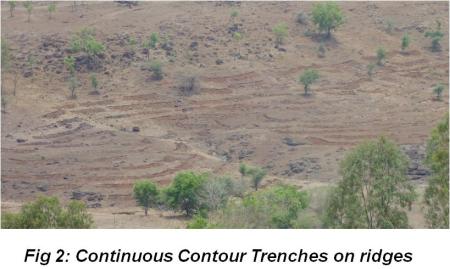
There are four catchment areas spread over 1400 Ha. Adopting top to bottom approach for watershed treatment Continuous Contour Trenches (CCT) (Figure 2), loose boulders and stone bunds were constructed on the ridges; soil bunds, cement bunds, gabion structures and percolation tanks were constructed at the bottom of the catchment. CCT works on the ridges is carried out by forest department. Under social forestry programme Village Panchayat has planted 1,10,000 trees on 34 acre land. Table above lists the existing watershed structures.

Gawadewadi Figure 2


Gawadewadi Figure 3

Total expenses incurred for the project were Rs 60 lakh for construction of watershed structures and Rs one lakh for trainings. This money was spent during first 5 to 6 years of work during 1991-97 and funded by various government departments like Agriculture Department, Social Forestry Department, Ground Water Survey and Development Agency and also by Vanarai.

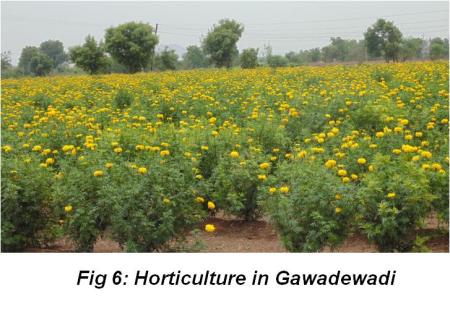
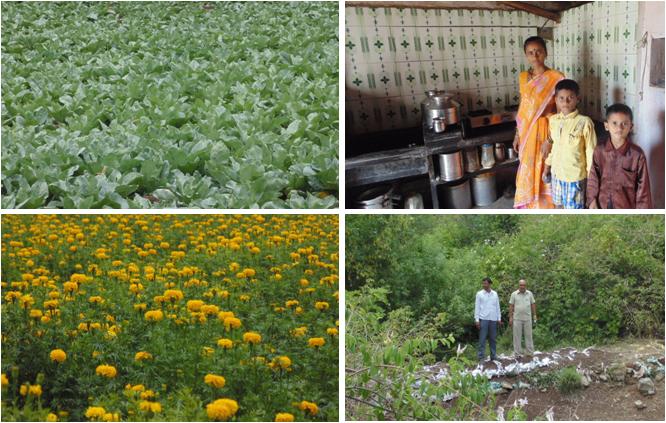
Water availability has slowly increased. After the great drought 1972-73 the village survived entirely on tankers post February every year. Government had to send two to three tankers per day to cater for drinking water. The village is now completely tanker free. Wells that had no water after December earlier now have water even at May end (Figure 4). Earlier the only crops harvested were bajra and jowar. Farmers could barely cultivate once a year. Now the crop diversity includes tomatoes, potatoes, groundnut, wheat, sugarcane etc. Village also produces export quality custard apples, pomegranates and grapes. Farmers take three rounds of crops in a year instead of one. The village now has irrigated area of 150 Ha. In 1991, 500 people from the village were daily wage labourers. Now there are nil. Area under horticulture was 11 Ha in 1991 which has now increased to 142 Ha (Figure 5 & 6). Increased fodder development resulted in increased milk production. Milk collection which was 200 lt per day in 1991 has gone up to 12000 lt per day. The village experienced no scarcity of water in drought of 2012. Domestic demand for water was unaffected by drought. For agriculture the usual round of water is once in 10 days which had to be adjusted to once in 20 days during the drought. “We did not even realize that there was a drought” says Jaywant Gawade a villager.

Gawadewadi Figure 4

Gawadewadi Figure 5

Gawadewadi Figure 6Vanarai has played a role of facilitator. It coordinated the local officers of various ministries & departments and pooled different resources to make them available to the village. Vanarai awakened the local leadership and conducted training programmes for developing different skills and also worked for empowerment of women and youth.
Watershed development worked as a platform for the villagers to come together. With resources made available from Vanarai the participatory initiatives soon diversified to other livelihood generating and development initiatives. Following footsteps of Ralegan Siddhi the village followed the principles of ban on alcohol, no use of axe, no grazing, shramdan and family planning. Latrines were constructed in all the households. Biogas plants have been constructed in 265 households and latrines have been connected directly to the biogas plants. Entire cooking for all these families is taken care of by biogas. Increased fodder availability has made it feasible to rear cattle and thus has ensured the availability of cow dung. There are 13 women Self Help Groups (SHGs) involved in activities like sericulture, vermi composting etc. The village now has nine dairies. These dairies were actively functioning till 2-3 years back. The milk collected was sent to Katraj Doodh Sastha (Pune). Since last two three years private milk product companies collect milk from individual households and pay for the same. Villagers opted for this as it is a more convenient option. In 1994 the villagers established Hirkani Vidyalay, a local school with contribution from village. The momentum of village development which geared up 10-12 years back is still very much alive. Currently Vanarai is involved in improving the marketing of agriculture produce. The villagers now want to focus on improving the agricultural practices. After increase in the water availability the cultivated area under sugarcane has also increased. Currently the area for sugarcane cultivation is 60% of the total cultivated land. The sugarcane is sent to Pargaon Cooperative Sugar Factory. The factory has been existing for last 15 years. About 90% of the sugar cultivators from the village are members of this sugar factory.

This is a matter of concern in such low rainfall area and it has intensified the water use. With this realization the villagers are slowly shifting towards drip irrigation. They are also keen on learning sound crop water management and organic farming practices. Data for the current water use and ground water levels for past few years could not be available for this study.

Dynamics with Dimbhe dam

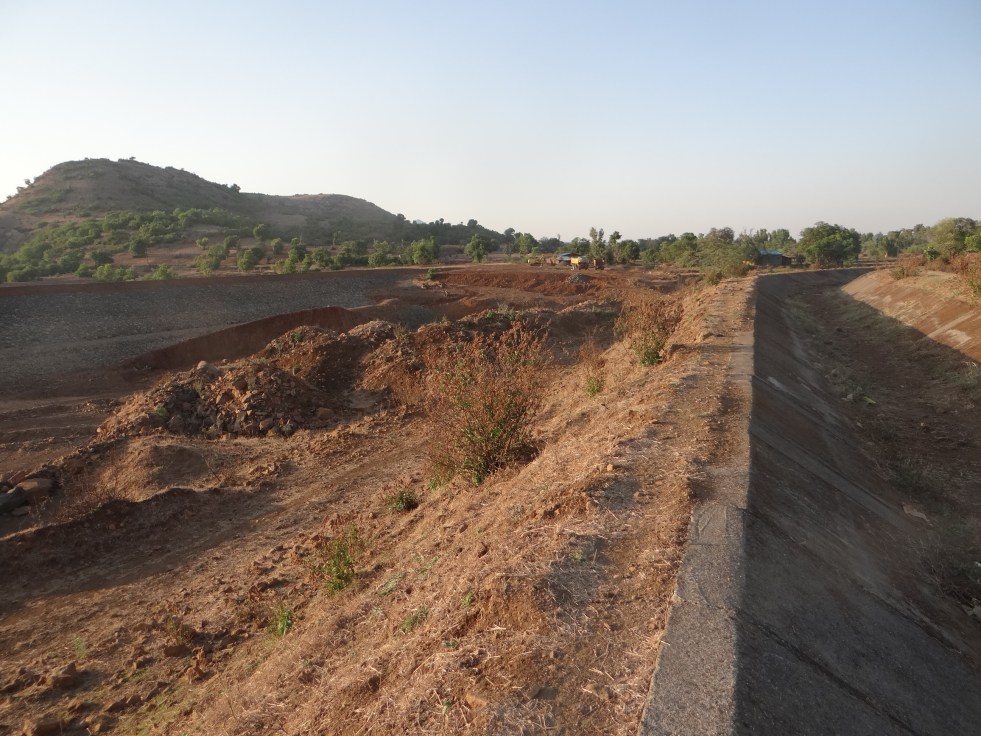
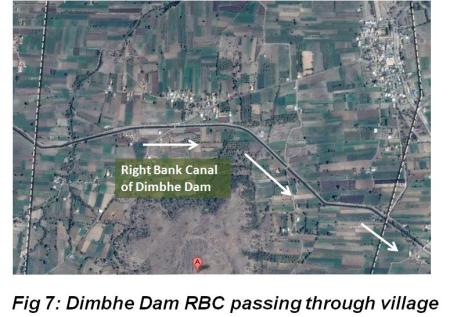
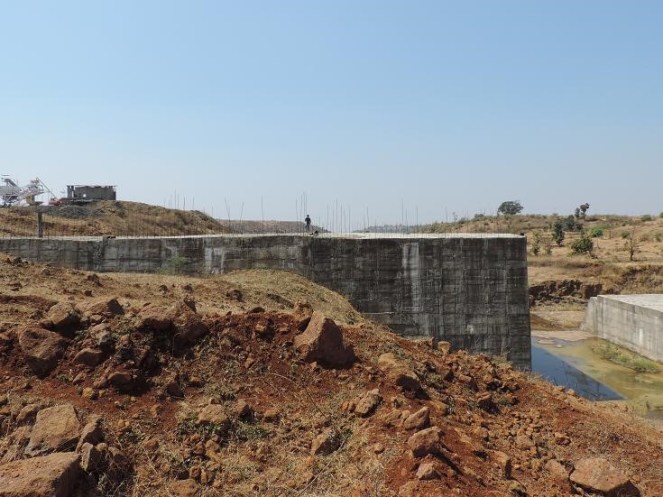
The village was self reliant in terms of water availability four to five years prior to irrigation canal provided by the government. Right Bank Canal (RBC) of Dimbhe dam which was constructed in 1997 passes through the village (Figure 7[iv] & 8). Dimbhe dam was filled to capacity in 2000, submerging 2202 hectares land of tribals in the Ambegaon taluka. 1253 families had to shift out, 11 villages were submerged fully and another thirteen villages were partially affected. Villagers inform that there is no fixed schedule followed for releasing water in RBC of the dam. The Left Bank Canal (LBC) constructed in 1987 has water throughout the year since it carries water downstream to Yedgaon dam[v]. However RBC receives water only thrice a year. The latest round of water release, as I write this was in February 2014. The water lasted for crops for about 30 to 35 days. The next round of water was due in May 2014 which is yet to be released. Agricultural fields only in the belt of 200 ft on both the sides of canal are benefitted. Villagers inform that in absence of watershed development work, coping with summer solely with canal irrigation was impossible.

Gawadewadi Figure 7

Gawadewadi Figure 8

Dimbhe Dam and its RBC share some more interesting dynamics with the village. Gawadewadi has hosted more than 70 families which were displaced because of Dimbhe Dam. Villagers point out that these families are a classic example of how the displaced families often remain away of benefits of the dam. The displaced families stay more than two KM away from the RBC and have no access to water from RBC. They were given land for land around 20 KM away from the houses that were built for them in Gawadewadi. Many of them sold the lands given to them under rehabilitation package as commuting was a problem. Problems of Dimbhe dam that have interface with Gawadewadi may just be a tip of ice berg. Even so these links with the government irrigation projects further highlight the need for participatory and decentralized water conservation.

Conclusion

Taking a close look at the development of Gawadewadi shows that the essential element behind success was the active public participation. This participation and ownership of the work resulted in completion of soil and water conservation works on 1400 Ha of area when no funding was available. This participation was also responsible for spurring of other allied developmental initiatives in the village which almost took a form of movement. Villagers voluntarily participated in various training programmes and diversified their livelihood options, improved farming practices, increased crop variety, increased milk production and in turn increased their income. In this sense such eco-system based works for conservation of natural resources like land and water become ‘active solutions’ as against the ‘passive solutions’ such as dams which come at a tremendous social and environmental cost.

It is worth noting that over 40% of India’s under construction dams are in Maharashtra. The state has spent about Rs 75000 crores over the last decade and will need to spend about Rs 76000 crores to complete the under construction projects[vi]. When Maharashtra is on such an irrigation spree, highlighting and replicating stories like Gawadewadi which demonstrate success of small scale solutions is definitely the need of the hour.

Amruta Pradhan, SANDRP, amrutapradhan@gmail.com, Photos by Author

 Note: This article is based on field visit, accompanied by Vanrai in early June 2014.

END NOTES:

[i] http://ipcc-wg2.gov/AR5/report/final-drafts/

[ii] https://sandrp.wordpress.com/2014/04/03/dams-are-not-climate-friendly-readings-from-ipcc-wg-ii-report/

[iii] Base map adopted from Wikipedia

[iv] Base map adopted from Google Maps

[v] Water from Yedgaon dam is further carried to Visapur dam and then to Karmala Dam.

[vi] https://sandrp.in/irrigation/MAHA_Irrigation_Scam_Nov2012.pdf

Gujarat · Madhya Pradesh · Maharashtra · Ministry of Water Resources · Narmada

Why is Government of India indulging in this unwarranted & unnecessary act of raising SSP Dam height?

Why this hurry to submerge tribals and farmers under

Narmada waters?

In a shocking decision[1] on June 12, 2014, the Narmada Control Authority (NCA), headed by the secretary, Union Ministry of Water Resources (MWR), & which includes secretary of Ministry of Environment and Forests (MEF) and senior officials of four states of Gujarat, Maharashtra, Madhya Pradesh & Rajasthan, have sanctioned, in what The Hindu called “emergency meeting” (http://www.thehindu.com/news/national/narmada-dam-to-be-higher-by-17-m/article6108571.ece) installation of 17 m high gates on the Sardar Sarovar Dam on Narmada River in Gujarat, taking the effective current height of the dam from 121.92 m to 138.68 m. This has been done after the Rehabilitation sub group (RSG) of the Narmada Control Authority, chaired by secretary, Union Ministry of Social Justice and Empowerment (MSJE) has also cleared this decision. This decision implies submergence of thousands of ha of land and displacement of lakhs of tribals and farmers in three states of Gujarat, Madhya Pradesh and Maharashtra, when their rehabilitation, as legally required, has not been done.

Strangely, the government that talks about transparency, had nothing to report on its website (either PIB website or MWR website till 12 noon on June 6, 2014) about this decision, who will be affected, reason for such emergency decision or basis for the decision.

Sardar Sarovar Dam

More importantly, Gujarat & Rajasthan can get their share of water from Narmada river without this height increase and are not able to use even 20% of the water already available to them at the current height. This is clearly unnecessary, unjust and unwarranted decision that is not likely to have even legal sanction. Only additional benefit that increase in height can provide is additional water storage, which will imply about 10-20% additional power generation, in which Gujarat’s share is only 16%: 57% share goes to MP and 27% share goes to Maharashtra.

There is some misinformation that this height increase is required to take the water to Kutch, Saurashtra and North Gujarat. This is completely wrong. The Full Supply Level of Narmada Main Canal is 110 m and once water enters this level in the dam, water can be taken to the canals. Once water enters the main canal, it can be taken to the Kutch, Saurashtra and N Gujarat. Based on information we have obtained from SSNNL under RTI, we have seen that Gujarat can get its full share of 9 Million Acre Feet of water at current height and no height increase is necessary. Had Gujarat built the necessary canal distribution system with branch canals, distributary canals, minors, sub minors and field canals to fields in Kutch, Saurashtra and N Gujarat, it could have taken Narmada water to these regions even eight years ago. To suggest that height increase will achieve this is clearly spreading misinformation. Similarly, as far as providing drinking water to the drought prone areas is concerned, height increase is not required to complete that.

Gujarat, in the meantime have increased the share of drinking water (1 MAF) and industrial Water (0.22 MAF) from 0.87 MAF for these combined sectors, at the cost of irrigation, without any participatory or transparent process. (see new share in this report in The Hindu on June 12, 2014: http://www.thehindu.com/todays-paper/tp-national/a-long-wait-ends-for-gujarat/article6109547.ece).

The claim of Gujarat government that cost of the project has increased because height of the dam has not been raised is completely wrong. The cost of the project is going up (TOI has reported on June 13, 2014 (http://timesofindia.indiatimes.com/india/Narendra-Modi-gives-Gujarat-its-lifeline-Narmada-Dam-height-to-be-raised-by-17-metres-lakhs-will-lose-their-homes-activists-say/articleshow/36453275.cms) that the project has already spent Rs 65369 Crores and ultimate cost is likely to be Rs 90 000/-) because Gujarat government has not been able to complete the canal network and has also been paying huge amounts to service the debt.

It is shocking that all the officials of the central and state governments and all the concerned ministers (including Water Resources Minister Ms Uma Bharti, Environment Minister Mr Prakash Javdekar, Social Justice Minister Mr Thaawar Chand Gehlot, Maharashtra Chief Minister Prithviraj Chavan in addition to Gujarat and MP Chief Ministers) have towed the line dictated by Prime Minister Mr Modi and Gujarat Government in this regard, within two weeks of new government taking over. No additional rehabilitation could have been accomplished in these two weeks, which seems to indicate that a political decision has been taken, without considering the ground realities, merits or justification of the decision or necessity of the decision. This does not bode good for the functioning of the new government.

It should be noted here that the installation of gates will take three years, and in any case, for closing the gates, the project will need clearance from Environment Sub Group, RSG and NCA again. Secondly, the gates have been lying in the yard of Sardar Sarovar Narmada Nigam Limited (SSNNL) for many years and a question mark was raised about the safety of the gates in a recent meeting of the Sardar Sarovar Construction Advisory Committee. Now, as The Times of India reported  on June 13, 2014 (http://timesofindia.indiatimes.com/city/ahmedabad/Use-of-30-year-old-gates-worries-experts/articleshow/36453333.cms), even former Gujarat Government officials are raising the issue of old technology of 30 year old gates when new technology gates would be also be safer. In view of all this, it may have been better, as Narmada Bachao Andolan has suggested, for the government to first take proper stock of the situation rather than rush into this “emergency” decision on the eve of the monsoon, when no work is in any case possible in monsoon.

It is also shocking that even before the RSG and NCA were to take the decision; Gujarat Government was already busy preparing for celebratory meeting at the Dam site. This shows that the functioning of the statutory bodies has been taken for granted and their decision was pre-determined, as directed by higher authorities.

Gujarat can get its water share without increase in height The new government wants to take the SSP Dam from its current height of 121.92 m to its final design height of 138.68 m. Firstly, there are serious doubts if this height increase is required since it can be shown that Gujarat and Rajasthan can get their share of water from Narmada without this increase in height. Secondly, Gujarat is not even in a position to use more than 20% of the water it already gets from the river at current height of the dam for the purposes for which the project was designed: providing water for the drought affected regions in Kutch, Saurashtra & North Gujarat. On the other hand, urban centres, industrials areas, SEZs, cosmetic river beautification schemes have appropriated a large chunk of SSP waters without legal, democratic sanction or justification. Gujarat really does not have a case for increasing the height of SSP Dam.

Moreover, this will also entail such massive additional submergence, displacement and disruption of lives of tribals and farmers that it is sure to create huge opposition. Narmada Bachao Andolan estimates that an additional 2.5 lakh people will face unjust submergence in three states of Gujarat, Madhya Pradesh and Maharashtra. The just rehabilitation of already affected people is far from complete, in fact, most of the affected population has not been given minimum 2 ha of land required under the Narmada Tribunal award and subsequent accepted policies.

Mr Modi during his tenure of 13 years as Chief Minister of Gujarat failed to complete the canal network of SSP in the drought prone areas in whose name the project has always been justified. It needs to be noted that the agitation against SSP did not stop Gujarat government from going ahead with construction of canal network. It was not for lack of finances that SSP could not complete the canal network. SSP has been getting largest quantum of money from the Government of India’s Accelerated Irrigation Benefits Programme ever since the AIBP scheme started in 1996. This support to SSP from AIBP was clearly wrong since SSP was never the last mile project for which AIBP was meant, but the big dam lobby in Union Water Resources ministry and Gujarat government were hand in glove in this misallocation of AIBP money for SSP. In fact, Mr Modi arm-twisted the Planning Commission in 2011-12 to sanction the escalated costs for SSP even when the issues raised by Planning Commission officers remained unanswered.

It is the ineptitude of Gujarat Government under Mr Modi that is on show as to why it could not complete the canal network on drought prone areas in Gujarat. Mr Modi would do well to remember the reasons for that failure before he considers the mega projects agenda as Prime Minister.

Moreover, on SSP, the issues of completing repairs of the damages the Sardar Sarovar dam structure suffered four years ago & related issue of safety of the dam are yet to be resolved[2] and Gujarat has embarked on building another Garudeshwar Dam in immediate downstream without any impact assessments, participatory democratic process or required sanctions[3]. The legality of the Garudeshwar Dam work stands challenged in the National Green Tribunal by the affected tribals.

Conclusion This unnecessary, unwarranted and unjust decision is not going to go down well with any right thinking person. The new government at the center is clearly treading a path that is bound to raise huge uproar and make the common person on street question: for whom and for what purpose is this government working. It would be in best interest of everyone if the government was so confident, to get this debated in the Parliament.

Himanshu Thakkar (ht.sandrp@gmail.com)

END NOTES:

[1] http://www.firstpost.com/india/decision-to-raise-narmada-dam-height-by-17-metres-makes-medha-patkar-furious-1567405.html

[2] https://sandrp.wordpress.com/2014/04/26/why-is-gujarat-neglecting-safety-of-sardar-sarovar-dam/

[3] https://sandrp.wordpress.com/2014/04/18/why-is-this-dam-being-constructed/

Interlinking of RIvers · Maharashtra · Western Ghats

Interbasin Diversion Dams in Western Ghats: Unknown impacts and uncertain Benefits

ManjarpadaBoxDiscussions on Interlinking of Rivers are gaining momentum as new government takes charge at the centre. It is predicted that the new government will be supportive of ecologically and socially questionable plan of interlinking rivers. In this backdrop, it will be interesting to study the fate of a little known scheme of diverting west flowing water to the Godavari Basin in Maharashtra. While the entire ‘grand’ plan includes many such schemes, we are focusing on one of the biggest interbasin diversion project under this scheme. Manjarpada Phase I project which is on a shared basin between Maharashtra and Gujarat, located in the Dindori Taluka of Nashik District. We also look at the status of about 28 interbasin diversion schemes proposed and under construction in this region, their justifications, benefits as well as impacts.
  1. Manjarpada Phase I under Upper Godavari Irrigation Project

Manjarpada Phase I forms part of the Upper Godavari Irrigation Project under the Water Resources Department, Maharashtra. The original proposal of the Upper Godavari Irrigation Project included Dams like Waghad, Karanjvan, Palkhed and Ozarkhed, which received administrative sanction in 1966. Work was started in 1968. From here on a number of components like Punegaon Dam, Tisgaon Dam, several canals kept getting added to the scheme. However, it remained essentially an intra basin project, there was no inter linking rivers component here.

In 2008 a radically different component was added to Upper Godavari Project. This was the inclusion of 12 diversion weirs on Paar, Taar, Damanganga Basin Rivers that in normal course would flow into Gujarat. These weirs envisaged near the ridge line, transferring waters of these into dams built in the Godavari Basin, via deep canals across the Western Ghats, which will transfer water from west flowing rivers to the east flowing Godavari. According to the White Paper on Irrigation Projects brought out by the Water Resources Department of Maharashtra in December 2012, these diversion weirs and Manjarpada Phase I scheme added an irrigation potential of about 30,000 hectares in the Upper Godavari Projects. The total irrigation potential of the entire Upper Godavari projects is estimated as 74,000 hectares (including 30,000 hectares from Diversion projects), of which potential of 69000 hectares is claimed to be created. This is unbelievable as the Diversion weirs, with a total command of 30,000 hectares, are just about half complete. The White Paper states that about 55% work on Manjarpada project and about 60% work on 11 diversion weirs has been completed.

An interbasin transfer scheme that claims a cumulative irrigation potential of 30,000 hectares will have significant impact on ecosystems, communities and downstream hydrology. But no such studies have been conducted for these projects, there has been no public consultation process and it is not even known if there is any interstate agreement for this transfer. The most striking example is Manjarpada Phase I project which envisages transferring about 500 million cubic feet (Mcft) from the Paar basin into Punegaon dam in the Godavari basin by way of a dam and two significantly big tunnels. Officials of Water Resource Department have stated that the project, submerging 95 hectares of land, also needs Forest Clearance for 65 ha forest land, which has not been granted yet, although work is in an advanced stage! This is clearly illegal as per the Forest Conservation Act (1980).

SANDRP’s visit to Manjarapada Phase I Project When we visited the site of Manjarpada project, we were first struck by the name. The project has nothing to do with Manjarpada village, but is entirely based in Devsale Village of Dindori Taluk. Work on the main dam has been stopped for many months now. The villagers say that this is due to local protests, while the officials claim this is due to paucity of funds.

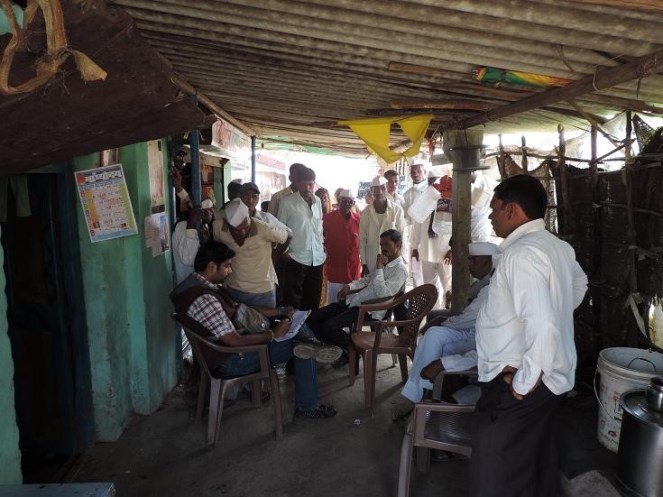
No impact assessment of the project has taken place. When we visited Devsale village, we were mobbed by villagers who wanted to show us the damages caused by the project for which they have received no compensations. The incessant blasting of the tunnel in the hardrock has resulted in cracks to many homes. More than 250 villagers claim that they have lost water from their shallow wells/ bore wells. More than 50 well owners have submitted a memorandum to the Collector and Zilla Parishad office about drying up of their wells.

M1

Above: Manjarpada Dam wall under construction. Photo: Amit Tillu for SANDRP

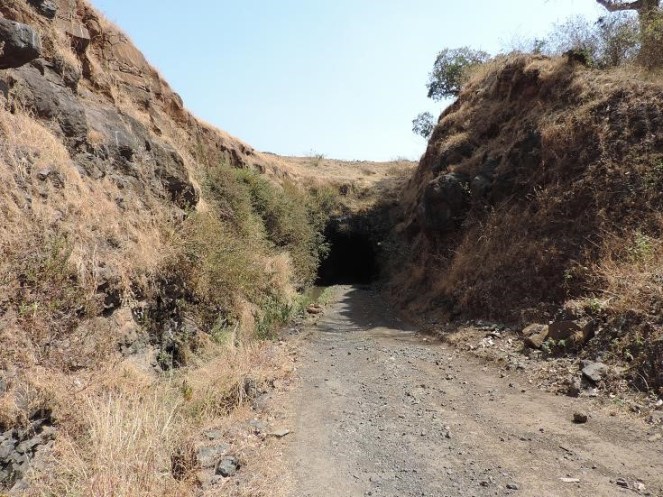
The villagers indicate 2 tunnels under construction for the same project, one of which is complete in 1 km length and the other complete in nearly 8 km length, with a huge air vent 20 m wide and over 150 m deep. The depth of the tunnel underground is about 150-300 feet.

m2

Above: Under construction tunnel at Manjarpada Phase I Photo: Amit Tillu for SANDRP

The laborers employed by the subcontractor do not understand Marathi and cannot respond to questions asked by the villagers. Work on the main dam wall has stopped since the last 2 years. Villagers say that blasting and tunneling has severely affected groundwater in the region, which has fallen drastically after tunneling. Blasting has resulted in not only cracks in over 100 homes, it has led to collapse of more than 10 built open wells, turning them into puddles. This was witnessed by us. Displaced families have not been resettled[1] yet.

Corruption involved in the unfeasible Manjarpada Project: Whistle-blower of the Water Resources Department Vijay Pandhare has been highlighting issues about Manjarpada project since a long time, when he was in service as Chief Engineer at Maharashtra Engineering Training Academy. He had pointed serious irregularities about this project in his letters to the Secretary, Maharashtra Water Resource Department, state Chief Minister Prithviraj Chavan as well as separately to Dr. Chitale who was supposed to be investigating the Maharashtra dam scam.

Pandhare talked exclusively with SANDRP on Manjarapada Project, he said: “This project is planned to transfer about 500 million cubic feet of water and is costing about Rs 500 crores and these estimates will increase. It should have costed a fraction of this. The entire process of Manjarapada Phase 1 was driven by the politician and contractor lobby and there was never any space for rational questioning. In addition to Manjarpada Stage I, the department is now also pushing for Manjarpada phase II downstream of this project, which will divert water right into the Tapi Basin. Now the catchment area of Manjarpada Phase I and Phase II actually overlap and the projects are simply unfeasible as there is no water availability as stated in the water availability certificates. This needs to be thoroughly investigated and I had written about this to many authorities, in vain.”

Shri. Pandhare is justified in raising these issues. If we look at the internal note of MID, with SANDRP, it states that in 2008 Manjarapada project was approved Rs. 62.54 Crores. Till December 2013, Rs 122.66 Crores were spent on this project! This has resulted in 30% work on spillway, 80% on connecting tunnel, 100% on open canal, 72% on diversion tunnel.

The last line on the project drops a bomb. It states: “An estimate for Third administrative approval for Upper Godavari Project, which includes the cost of this project at Rs 430.74 crores for Manjarpada project, has been presented before the government for approval.” So within 5 years, cost of the project shot up nearly 6 folds!

M3Above: One of the several open wells collapsed due to balsting for Manjarpada project Photo: Amit Tillu for SANDRP
Pandhare writes in his letter to the Secretary and Chief Minister, the letter that initially shook the water management circles in Maharashtra[2]. “The system that makes cost estimates in WRD is has been nearly killed. So the field officer has been made in-charge of working on estimates. In reality the contractor makes these estimates and they are sanctioned without checking. Otherwise such unfeasible and costly work would not be undertaken… In case of Manjrapada project, the cost estimates, especially tunnel excavation costs have been bloated beyond measure. The benefits are hazy. When Phase I is questionable, unfeasible and hugely costly Manjrpada II is being pushed by political backing. This project has a water availability certificate, when in fact the catchment does not have enough water.” He has specifically requested Dr. Chitale to investigate this project.[3]

When we met the Executive Engineer, MI Projects (Local Sector), for Nashik division, he agreed that there is controversy surrounding Manjarpada Projects, especially related to feasibility and overlap of catchment area, but refused to comment further. He softly added that political interference with water resource department should reduce. In the meantime, Chagan Bhujbal, former MP from Nashik region (he lost in 2014 Parliamentary elections by huge margin of close to 2 lakh votes) has been stating that Manjrapada II will happen at any cost.[4]

One of the official stated that Manjarpada project is the ‘Boss’ of these schemes as it will route water from many schemes in the Paar Basin into the Godavari Basin. Though he later added that the main reason for pushing Manjarpada was that the Punegaon Dam, downstream Manjarpada has not been filling up in monsoon and Manjarpada will aid it. This again underlines Pandhare’s claim that water availability certificates being given for projects in Maharashtra (like Punegaon) are not scientific and driven by other motives!

M4

Above: Villagers at Devsale talking about issues of Manjarpada Project I Photo: Amit Tillu for SANDRP
Incidentally, according to white paper, it’s interesting to see the list of water users downstream of these projects. They include Ranwad sugar factory, K Distillery, Ashokumar Hatcheries, Everest Industries, Seagram Distillery, Shivam chemical, Kadwa Sugar industry, Dinodri MIDC (which is a Wine MIDC in Maharashtra) & have a reservation on 136 MCFt. While Manmad taluka suffered acute water stress in drought in 2012-13, water supply to distilleries and wine industries continued.

This whole episode involving the project, its decision making process, lack of impact assessment and credible techno-economic appraisal and monitoring raises many questions. In the first place, the Manjarpada project highlights the need for thorough participatory processes that should be undertaken before taking up such projects, especially when they involve interbasin transfers.

Maharashtra and Gujarat have signed an MoU to transfer waters from Damanganga River into Vaitarna basin through Bhugad, Khargihill and Pinjal Dams and tunnel systems. The tunnel envisaged between Pinjal and Khargihill stretches over 64 kilometers, more than 5 times the tunnel in Manjarada. It is clear that the impacts of not only the dams, but the tunnel systems will be huge and need investigation.

More than 19 Diversion Projects diverting “unutilized water going waste to the Arabian Sea”

When we met officials at the Minor Irrigation Division (MID), they showed us the map of intricate links planned in the entire Damangagang, Paar, Naar Basin as well as parts of Vaitarna and Ulhas basin to transfer water “flowing unutilized to the Arabian Sea” into the Godavari Basin. It is difficult to imagine that a project of this massive scale, which can transfer nearly 400 MCM from West Flowing basins into the Godavari basin is going on without any project specific impact assessment, cumulative impact assessment, cost benefit studies, environmental appraisal, environment management plan, public consultations, environmental monitoring and based on questionable water availability studies.

The Maharashtra Irrigation Dept GR dated Sept 2005 approved the proposal of diversion schemes near the ridge line to divert water which was “going waste, unutilised into the Arabian Sea” to Godavari Basin in the East. 19 such schemes have received approval from the Hydrology Project (Jal Vgyan Prakalpa) Nashik. Of these 19 schemes, 13 have been included in the second administrative approval of the Upper Godavari Project, but there are in all nearly 28 diversion schemes under consideration. Table in Annexure 1 provides details of the various schemes under this project.

M5

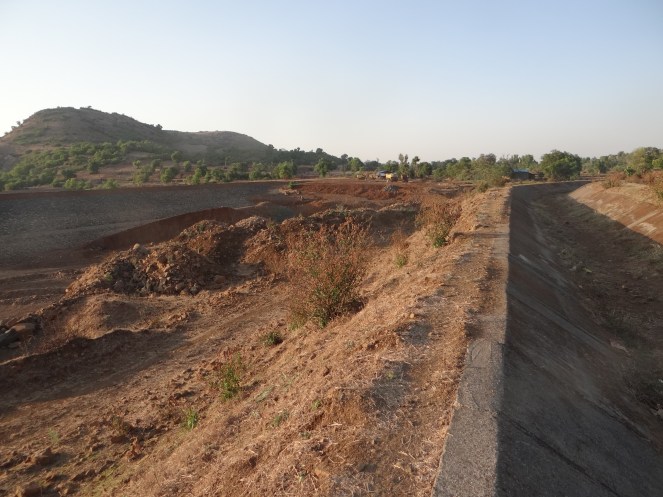
Above: Diversion Weirs at Dindori, with deep canal on the upstream transferring water Photo: Parineeta Dandekar, SANDRP

SANDRP team also visited some of these diversion weirs.

In case of Amboli Diversion Weir, its capacity is supposed to be close to 1 MCM (million cubic meters). It was bone dry in May when SANDRP team visited it. Sagar Marathe, who resides next to the weir states that the weir, now complete, hardly holds any water in it. The reason seems obvious. Just 200-300 mts upstream the dam wall, a high canal embankment runs, which means that the dam has nearly no catchment area! There is no study on the amount of water that is indeed diverted into Kashyapi River here, a tributary of Godavari.

M6

Above: Dam wall and the dry Amoboli Diversion Weir reservoir can be seen on the left, on the right is a tall embankment of an older canal which runs parallel to the dam wall and is much longer. Effectively, the dam has nearly no catchment. Photo: Parineeta Dandekar

In case of Waghera diversion weir, which is supposed to be under construction, the tribal villagers told SANDRP that the mud dam has been existing since the past 20-25 years and the only work going on is digging the canals! But the MID note does not state that the dam is already existing, possibly indicating an irregularity.

These examples are only indicative. They highlight the need for transparent and participatory studies surrounding these projects.

M7

Above: Unlined canal in Dindori, transferring water onto Waghad Dam. Photo: Parineeta Dandekar, SANDRP

Environment laws violated, but MoEF in dark and inactive! Manjarpada Diversion and other diversion dam projects are coming up in violation of the EIA Notification 2006, but MoEF seems to know nothing about it. Manjarpada or other diversion schemes cannot claim exclusion from the environmental appraisal process since it involves huge irrigation, in addition to inter basin transfer, domestic & industrial water supply.

The entire diversion scheme raises big questions about significant impacts, needs of the downstream population, local opposition and finally questionable and unassessed benefits. We hope MoEF will take cognizance of the legal violations and take stringent steps against Maharashtra government. Unfortunately Maharashtra is mired with too many of such examples, in addition to the dam scam.

– Parineeta Dandekar ( parineeta.dandekar@gmail.com), Amit Tillu ( amittillu@gmail.com) with inputs from Himanshu Thakkar ( ht.sandrp@gmail.com)

 ~~~~~~~~~~~~~~~~~~~

Annexure 1

Table 1 Overview of Interbasin diversion projects planned to divert water into the Godavari Basin.

Name Basin Basin in which water is transferred Quantity Remark
Manjarpada Diversion Project Nashik Par Godavari: Punegaon and Karanjvan Dams 17.16 MCM
Golshi Mahaji Flow Diversion Project, Dindori Damanganga origin 10 nallahs to be diverted Waghad Dam, Godavari 0.47 MCMto be transferred Current cost around 32 Crores( 12.97 spent, 21.31 requested)
Nanashi Flow Diversion Project, DindoriNashik Nar-Par. Dam at the origin of Par, from here to Hattipada DW, from there to Karanjvan Dam Karanjvan Dam, Godavari 1 MCM into Godavari 0.55 MCM for local use Initial estimate was 3.04 crores in 2008. Actually 3.81 crores spent, Now application for 17.1 crores made for 3rd administrative approval
4. Golshi 1, Flow Diversion Project, Dindori Dindori Damanganga Basin Waghad Dam 3.11 MCM 1.29 crores in 2008.3.15 crores asked in 3rd administrative approval
5. Hatti pada, Flow Diversion Project, Dindori DindoriNashik Paar Basin Karanjvan dam, Godavari Basin 0.93 mcm to Karanjvan Dam. 0.67 mcm for local use 3.11 crores in 2008, 7.64 crores spent till Dec 2013, now requested: 14.24 crores in 3rd approval
6. Dhondalpada Flow Diversion Project NA Godavari basin 1.73 MCM Consists of5 saddle dams
7. Chaphyacha pada Na Godavari 0.30 MCM
Ranpada Diversion project NA Godavari 0.35 MCM
Payarpada Flow Diversion Canal, Dindori Nashik NA Godavari 2.039 MCM Local opposition to Land aquisition. Hence work not started.
Ambaad Diversion canal. Dindori Nashik 0.40 MCM Local opposition to land acquisition. Work not started
Pimpraj F diversion Project NA Godavari 1.26 MCM
Ambegan F Diversion Prjct NA Godavari 1.40 MCM
Jharlipada F Diversion Prct Waghad Dam, Godavari Basin 1.05 MCM
Chimanpada Flow Diversion Project Dindori Godavari 0.83 MCM for diversion; 0.45 MCM for local use, No technical Sanction yet
Waghera Flow Diversion Scheme, TrimbakNashik Damanganga Basin Godavari ( no dam, u/s of Ganga pur Dam) 1.19 MCM Sanctioned cost in 2007 was 15 crores. 80% work complete, Link cut work under progress
Pegal wadi Flow Diversion Project, Trimbak, Nashik Vaitarna Basin Godavari 0.695 MCM In 2004, 17.92 crores approved
Amboli (Bombiltekpada) Godavari 0.92 MCM 17.92 Cr approved in 2004 (an error?)
Total 34.83 MCM
Schemes which do not have administrative approval, but are included in the Upper Godavari Project by the Godavari Irrigation Development Corp.
Velunje-Amboli Dvrsn Prjct Damanganga Godavari 1.447 MCM 16.07 crores estimated
Kalmuste Diversion project Damanganga Godavari 23.141 MCM by a diversion weir 333 Crores estimated price
3. Kapwadi Diversion Project Ulhas Godavari 7.04 MCM Estimated cost 60.8 Cr
Sub Total 31.62 MCM
Projects with survey permissions and administrative approval
Lift dvrsn prjct 3, Surgana Paar Godavari 94.37 MCM
Lift dvrsn prjct 4, Surgana Paar Godavari 89.12 MCM
Sub Total 183.49 MCM
Water Diversion from Upper Vaitarna Basin to Godavari Basin
Note: GOM approved the scheme to fit doors to the saddle dam of Vaitarna project and transfer water into Godavari. However, Thane Circle of KIDC had acquired 4689 hectares of Upper Vaitarna Project. Eventually, Dam height was reduced and 623 hectares was additional land left which should have been returned to the PAPs. But this was not done. There is a strong opposition of local people to any survey without this return. No has been conducted as yet. 28.50 MCM.
6 Diversion projects for Ahmednagar under very primary planning
Hivra Walvani Diversion Weir Pravara 18.46 MCM 13 hectares forest land
Samrand Diversion weir Pravara 17.98 MCM 6 hectares forest land bot fall in PA. Hydrology Project communicated that the project is not supported by the GOM. CE, KIDC has written in 2012 that there is no water to transfer to the east.
Sub Total 36.44 MCM
Transfer water from Shai and Kalu Basins into Akole between Harishchandragad and Ajoba Mountain into Mula basin
Tolarkhind Tunnel Project 18.08 MCM CE, KIDC has written in 2012 that no surplus water available in Shai & Kalu Basins for dvrsion.
Khirehwarer Tunnel Prject 40.01 MCM
Sadada Tunnel Project 11.13 MCM
Pathar Ghat dvrsn canal pr 7.67 MCM
Diverion from Kalu and Shai Basin 76.89 MCM
TOTAL PLANNED DIVERISON FROM WEST TO EAST in Godavari Basin 391.77 MCM

Source: Minor Irrigation Department, Nashik Division

~~~~~~~~~~~~~~~~~~~

END NOTES:

[1] http://indianexpress.com/article/india/india-others/land-lost-to-irrigation-project-tribal-families-reel-in-poverty/

[2] https://sandrp.in/irrigation/Letter_Maharashtra_Irrigation_Scam_Oct12.pdf

[3] https://sandrp.wordpress.com/2014/03/03/vijay-pandhares-letter-to-dr-chitale-please-fix-responsibility-of-the-irregularities/

[4] http://www.deshdoot.com/news.php/news/4313229

Maharashtra

El Nino and Maharashtra: Lets dig the Well before we are thirsty

2012-13 was described by the Maharashtra government as the worst drought in the state since 1972. Weather scientists are predicting that conditions are fast developing that seems like a repeat of 2012. The Reserve Bank of India has already warned the states about the possibility of El Nino and be ready for the worse. Maharashtra could take several steps to be ready for this developing situation, including using its available water storage in reservoirs around the state prudently.

Yes, it’s that time of the year again when we need to be alert to weather predictions and reservoir storages. Especially for Maharashtra. At this time last year, following poor 2012 monsoon, many of the bigger reservoirs were at 0% live storage for months (Ujani, Jayakwadi, several projects in Marathwada, etc). A satisfactory monsoon 2013 and some small contribution from the ill-fated hailstorms has resulted in better status of Maharashtra reservoirs storages at this point in time.

However, Maharashtra (like the country) needs to be extra cautious with using the available resources. Several institutes and bodies like Skymet, Buraeu of Meteorology, Australia, National Weather Service USA, etc. are predicting a strong possibility of El Nino effect this year, which generally results in poor monsoons.  Sky met is specifically saying that this year may be a repeat of 2012 poor monsoons. The report also states that Vidarbha, Marathwada and Central Maharashtra, could face monsoon deficit.[1] Bureau of Meteorology, Australia has issued notice stating a 70% or more chance of El Nino this year. They state “Although the El Niño–Southern Oscillation (ENSO) is currently neutral, surface and sub-surface ocean temperatures have warmed considerably in recent weeks, consistent with a state of rapid transition. International climate models surveyed by the Bureau indicate continued warming of the central Pacific Ocean in coming months. Most models predict sea surface temperatures will reach El Niño thresholds during the coming season.”[2] A similar prediction has been made by US agency National Oceanic and Atmospheric Administration’s Climate Prediction Centre.[3] While some weather scientists are saying that we should not panic and wait for IMD’s (India Meteorological Department) official forecast on April 25 and the next one in June, however, it would certainly be useful to be careful from now onwards.[4]

According to the latest Central Water Commission (CWC) Reservoir bulletin of 090414 regarding water levels in 85 selected major reservoirs in India, the 12 major reservoirs of Maharashtra have a combined storage of 4.471 BCM (Billion Cubic Meters) which is still good 38.73% of live storage capacity of 11.544 BCM.  This is down from 6.522 BCM (over 50%) on Feb 6, 2014. It is not clear where this huge 2 BCM water has been used up in these two months.

However, Maharashtra is indeed lucky to have this 4.471 BCM water in 12 major reservoirs[5] at this time. We need to use this prudently in view of the forecast that situation similar to what prevailed in 2012 when Maharashtra experienced bad drought could get repeated in coming monsoon. Government needs to take advance steps to ensure that storage capacity is not frittered away and there is less land under water intensive sugarcane and such other crops. Media, civil society and independent observers need to be vigilant in this regard to ensure that mistakes of 2012 are not repeated and available resources are used wisely.

In terms of wise water management and effective use of available reservoir storage, waiting for June IMD forecast will be much too late. It will be wiser if water management is cautious starting from now. At this time, already some regions are facing water scarcity.

Maharashtra farmers are already in dire states due to 2012 drought followed by hailstorms and the disastrous impacts of extreme weather events in 2014. Another drought possibility is bad news, but impacts can be reduced with wise planning and prudent advance steps. Maharashtra Water Resources Department Website[6] provides further details about storage position. Let us look at basin-wise water storage position.

Godavari Basin

Marathwada: In Marathwada, the overall live storage is 31% on 17th April 2014, including Major, Medium and Minor storages. However, this gives a misleading picture as many dams with better storages (like Vishnupuri) are placed at the end of the basin.

Dams like Manjra, Lower Terna and Seena Kolegao are already at 0 live storage, while Jayakwadi is at 15% (It was at 0%, along with six other dams of Marathwada even before this time last year).

In the upstream of Godavari Basin, Kadwa sub basin is showing severe water scarcity already. The region consists of premier onion and grape growing belt of Maharashtra, as well as wine processing centre. The chronically drought affected town of Manmad lies here and last year, it received water after 51 days in March from the upstream Palkhed Dam.[7] Surprisingly, Palkhed is currently at 5% Live Storage, when this time last year it was at 19% live storage. Water releases from Palkhed were extremely contentious last year. This year with even lesser storage, things may flare up again and wise water management, curb on non-essential uses (in dry period) like wine industry, preventing siphoning water from canals for cash crops, etc., needs to be observed to avoid stress in coming two months or more. Kadwa Dam shows a dipping live storage at 2%, while Nilwande Dam in downstream Ahmednagar shows just 3% against 7% last year.

Vidarbha shows a better picture at 58% live storage, Lowest being Bagh Kalisarar inn Bhandar at zero live storage. Now this project, though in heavy rainfall region of Bhandara has been at 0 live storage since January for the past 6 years! Either the information about the project is incorrect, or the dam has serious issues which need urgent attention.

Krishna-Bhima Basin

Ujani which was at 110% LS earlier this year after many years because of the monsoon in 2013 is now showing LS of 22% on April 17.[8] Two irrigation rotations have been released from the dam. It was reported that last rotation was used up largely by sugarcane,[9] leaving little for other crops. Ujani was at sub-zero storage (-39%) at this time last year. According to that standard, it has a good storage now, which should be used very cautiously. Solapur has added several new sugar factories this year, in addition to the 28 factories and the area under sugarcane has increased tremendously because of good rainfall.[10] Keeping the possibility of a weak monsoon in 2014, water to sugarcane must be controlled and curtailed, else we will see a repeat of 2013, only on a larger scale.

1920 MW Koyana Hydropower Project: Surprisingly in Koyana, the reservoir level this year is worse off than last year at the same time, which is not the case for any other Maharashtra reservoir in CWC bulletin. While this year it is at 30%, last year it was at 47% as on April 9.

Falling Groundwater tables: Recent GSDA report[11] has warned that groundwater levels in more than 2700 villages in Maharashtra has fallen below 1 meter than the average levels in the past 5 years. This is definitely alarming as groundwater is the water lifeline of rural Maharashtra. Out of the 2700 villages, levels in nearly 1200 villages have fallen below two or even three meters (for 497 villages).

Sugarcane: Area under sugarcane has increased in Maharashtra following good rains in 2013. This cane will demand more water in its lifecycle in farm and also for crushing. Agricultural Minister of India too did not find it appropriate to curb the wide spread plantation of sugarcane in drought prone areas even when national and global sugar prices were falling.It is estimated that current year may see more than 10,00,000 hectares of sugarcane which will demand water.The government has not even taken its own promise of enforcing drip to sugarcane.

There seem to be turbulent times ahead and it will be advisable if water management in Maharashtra tightens up to respond to upcoming challenges. The fact that there is useful water storage in some reservoirs and that warning is available in advance could be blessings if necessary steps are taken.

Parineeta Dandekar, parineeta.dandekar@gmail.com

Himanshu Thakkar, ht.sandrp@gmail.com


END NOTES:


[1] http://www.skymet.net/

[2] http://www.bom.gov.au/climate/enso/

[3] http://www.cpc.ncep.noaa.gov/products/expert_assessment/sdo_discussion.html

[4] http://www.downtoearth.org.in/content/el-nino-may-disrupt-monsoons

[5] These 12 reservoir include: Jayakwadi, Ujani, Koyna, Khadakwasla, Isapur, Mula, Yeldari, Girna, Upper Vaitarna, Upper Tapi, Pench and Upper Wardha.

[6] http://mahawrd.org/default.htm

[7] http://www.thehindu.com/todays-paper/tp-national/tp-newdelhi/a-drop-in-the-bucket/article4560869.ece

[8] http://www.agrowon.com/Agrowon/20140415/5237052667319190169.htm

[9] http://www.agrowon.com/Agrowon/20140415/5237052667319190169.htm

[10] https://sandrp.in/Sugarcane_and_Drought_in_Solapur_june2013.pdf

[11] http://www.esakal.com/esakal/20140416/4977647275092496415.htm

Maharashtra

Vijay Pandhare’s letter to Dr. Chitale: “Please fix responsibility of the irregularities”

It has been reported that the Special Investigation Team under the Chairpersonship of Dr. Madhavrao Chitale has submitted its 1300+ pages report on the Dam Scam and practically no increase in irrigated area in Maharashtra, to the Chief Minister.

Dr. Chitale has reportedly said that no political person has been named in the report, supposedly because it was not the mandate of his committee. In his words: “There was no question of mentioning the name of any minister or bureaucrat for the wrongdoings in irrigation sector as it was not permissible under the given guidelines. At the very beginning, it was made clear that findings will be very impersonal. The objective of the committee was never to engage in fault finding of any individual (politicians or bureaucrats) but rather larger concerns related to the systemic lapses that resulted in the cost overruns and allowed manipulation of rules,” 

This, though expected from Dr. Chitale, is entirely incorrect as the TORs to the SIT by the GOM, dated 31st Dec 2012 clearly mention 2.9: “If irregularity is found in investigations, the committee will fix responsibility and suggest further action.” in addition, the systemic lapses that have occured in Maharshtra have been sytematically abetted by many for personal gains. Not even attempting to fix the responsibility,is akin to giving a clean chit to the strong perpetrators.

The SIT report is not in the open domain as yet, but if it has indeed shied away from specifically naming guilty politicians, bureaucrats and engineers, then it is hugely problematic. The links between politicians, bureaucrats and engineers have been made clear by a number of whistle blowers of the irrigation scam at grave personal risks. The SIT had all the resources, the mandate, the time and the opportunity to investigate charges and radically influence Maharashtra’s irrigation sector. But right from the beginning, the SIT refused to look into matters of corruption, clearly indicating that it will not ‘dirty its hands’ and will go with the status quo, which suited the ruling government. Supporting Status Quo at such important juncture comes at a huge social cost. SIT’s composition as well as its stand was challenged by many, including SANDRP. (SANDRPs Press Release, Piece by Pradeep Purandare, New Reports, Pani Dhoran Manch PR)

One of the most significant whistle blowers of the Dam Scam, Vijay Pandhare, who was then the Chief Engineer of Irrigation Dept had written a scathing letter to Dr. Chitale in March 2013, when Chitale refused to investigate any evidence given by leader of opposition Vinod Tawde about corruption in the Irrigation sector.

This letter ( obtained and translated from Marathi into English by SANDRP) indicates Pandhare’s impassioned appeal to Dr. Chitale to investigate charges and fix responsibility as per the mandate of the committee.  Pandhare in fact says that: “If the SIT is going to be escapist about the issue of corruption, then it is better that you resign, listening to your inner voice, because such escapism would not be in the interest of the state.” He produces many evidences of wrong doings in the WRD. The scale of the problem described in the letter is staggering. We look forward to how these matters have been treated by the SIT Report.

Parineeta Dandekar, SANDRP

VIJAY PANDHARE WRITES TO DR. MADHAV CHITALE, MARCH 2013

 From: 

Vijay Balawant Pandhare

Chief Engineer,

Maharashtra Engineering Research Institute, Nashik, and

Member, State Technical Advisory Committee,

Nashik- 422004


Dt- 16th March 2013

To,

Shri. Madhavrav Chitale,

Chairman,

Special Investigation Team,

WALMI, Aurangabad

Subject- About inquiry into technical and financial discrepancies in Water Resources Department of Maharashtra


Respected Sir,

Regarding the subject sited above, it is learned through news reports of 6th March 2013 and through the broadcasts of Marathi news channels that, you have wrote to the Leader of Opposition Mr. Vinod Tawade stating your committee is not empowered to inquire officers and political representatives.[1]

In fact, while determining the mandate of your committee TORs explicitly mention “fixing the responsibility against any discrepancy and suggesting suitable action against it”.[2] The government has clearly mentioned in your mandate that “fix the responsibility against the discrepancy”. So, your stand that the Special Investigation Team (SIT) doesn’t have any investigating power is against this mandate. It is like Lord Ram deciding that he will not attack the evil spirit or will not oppose it. If you are not going to unmask these corrupt spirits through the special investigation team, would we have the moral right to seek respite from Lord Ram? Moderate and honest people like you are required to lead the bandwagon against such corrupt people and dishonest mentality. Such an opportunity is created because of the constitution of SIT. We believe that you would capitalize on it. ( Emphasis added, throughout the letter) The anarchy created in Water Resources Department is because of the non-functional office-bearers. If the officers would have been alert and selfless, such a catastrophic situation would have never come, however, it has been difficult in our times to see good officers rising through the ranks. It seems that picture would be very gloomy from here on. Therefore, it is your first responsibility to identify people who are responsible for such a situation, those who have created discrepancies and fix the responsibilities. After outlining the mandate, the state government has thrown a ball in your (SIT) court. Therefore, it will not be acceptable to adopt a stand which turns a blind eye towards all of these malpractices. The government has nowhere said that the committee has not investigative powers. The very name of the committee itself is a “Special”. Isn’t it contradictory to take up such a stand when the committee itself is called “Special Investigation Team” then? On the other hand, the committee should ask for complaints from all the people and investigate them all. But your stand seems to be something else altogether. Please don’t continue with that. (Emphasis added). There is no prohibition on any committee for accepting complaints from the people and collecting sufficient information pertaining to the investigation. If the committees like Vadnere, Kolwale, Mendhegiri etc. can determine the responsibilities on the defaulters, why can’t the SIT under Mr. Chitale?[3]

Earlier officers never took a firm stand against such malpractices which eventually culminated to degradation of Irrigation department. The responsibility of improving the situation has been entrusted with your team, otherwise, history will never forgive us. If the committee is going to be escapist about the issue of corruption, then it is better that you resign , listening to your inner voice, because such escapism would not be in the interest of the state. I can understand (although don’t justify) the attitude of political representatives about the scam, but honorable people like you need to take a strong stand to make the department disciplined. Im sure that escaping from this duty and saying that Pseical investigation team does not have the power to investigate is not something that your conscience would agree with. Despite that, your statement regarding Tawade’s letteris a clear indication that the team would shy away from such investigation. To improve the situation in Irrigation department, some surgical measures should be taken otherwise the financial crisis of the state would persist in the foreseeable future. I want to remind you that around 14-15 years back we personally met in Aurangabad and I had told you how pathetic and corrupt the administration has become. That time too, you had said that the political representatives have taken charge of everything and you were resigned in saying that it’s difficult to change the situation. But now the destiny has entrusted you with the responsibility to end these malpractices. We request you to please carry it out with the help of Mr. Ranade. It would be very unfortunate for Maharashtra if you are not going to fix the responsibilities against the observed malpractices, something which is clearly in the mandate of your team. If the projects are not getting completed even after 25-30 years, isn’t it a serious blunder by the policy makers? Shouldn’t we fix the responsibility ? Is it not sinful to float tenders, make payments against inflated costs, financially weaken the state and push people into drought situations? If you’re not going to prevent such practices, then who will? I was extremely surprised to learn about your stand. If you really want to serve for the betterment of Maharashtra, then taking a strong stand against such practices so that nobody would dare to tread this path is very much expected from you. If we all decide, then we will have “Ram-rajya” in our country. But if we are moving away from Lord Ram’s ideals, we have no turn to him for the help. (Emphasis added)

I’m enlisting the discrepancies that I observed while working in Water Resources Department. Kindly investigate them and fix the responsibilities against the defaulters so that nobody would ever dare to indulge in such practices.

Discrepancy No. 1-

Without investigating or envisaging properly, irrigation development corporations have approved budgets with inflated costs and have granted tenders at higher price to the contractors. This has resulted in wastage of billions of rupees of public funds. We request you to thoroughly investigate all the discrepancies and fix the responsibilities. So that, no political representative or contractor or engineer would ever indulge into it.  If no inquiry is conducted, these people would keep looting the state as well as nation with boosted confidence. That’s why the honest and selfless people should try to prevent such malpractices otherwise it is beyond doubt that our coming generations, our nation and the democracy will have a dark future.

For example, please note the projects in Tapi Irrigation Development Corporation-

  1. A.      Sulwade Lift Irrigation Scheme (Cost ₹ 2100 Cr)
  2. B.      Bodwad Lift Irrigation Scheme ( Cost ₹ 2200 Cr)
  3. C.      Prakasha-Burai Lift Irrigation Scheme (Cost ₹ 700 Cr)
  4. D.      Varangaon-talwel Lift Irrigation Scheme
  5. E.       Padmalay Lift Irrigation Scheme
  6. F.       Kurha-vadoda Lift Irrigation Scheme

Like these, thousands of tenders have been awarded. It is requested to permanently stop such cases.

Discrepancy No. 2

The projects that have been approved by respective development corporations have always witnessed increase in their scopes. You can find many such projects. White paper enlists such modifications under each scheme. Such modifications/ increments have been approved without giving proper thought to their impacts and hence these projects are bound to fail. Because, the projects which have been approved at inflated costs get less funds allocations and eventually results in the projects remaining incomplete for more than three decades and there is no way these projects would be complete in next 30 years either. Therefore, the officers and politicians who approved such changes should be held responsible for these discrepancies.

Discrepancy No.3-

The way in which each development corporation has cited their cost break-up would stun anyone. It is clear that the interests and the benefits of the contractors have been secured by employing multiple tricks. It has been a very common trend in Konkan and Vidarbh Irrigation Development Corporations. Other corporations are not an exception either. The episode of the inflated costs paid against the steel pipes in Jigaon Project Lift Irrigation Scheme is indeed well-known. Vidarbh Irrigation Development Corporation itself has cancelled ₹ 2900 Cr tenders because those were based on such inflated costs. We request the SIT to investigate such discrepancies in the budget of the said projects. To prevent such incidences from happening again, such incidences should be thoroughly investigated and defaulters must be brought to the book. Please investigate the cost sheets of following items-

  1. 1.       Hearting and casing items
  2. 2.       Pitching items
  3. 3.       Rising main and steel pipe items in lift irrigation schemes
  4. 4.       Radial gate fabrication rates
  5. 5.       Dewatering items, excessive dewatering
  6. 6.       Concrete and masonry items

The SIT should also probe the various reasons cited for increasing the costs.

Discrepancy No-4

There have been humongous discrepancies in the “C” grade tenders. In most of the cases, despite being “C” level tender, “EIRL”s of hundreds of thousands of rupees have been passed and even the claims have been settled too. Therefore, it is necessary to investigate all the EIRLs and claims against them from all the development corporations. The SIT should ask for information in a tabular form about all the EIRLs and respective settled claims from all the irrigation development corporations, and probe the serious cases. Otherwise there would be no check on such malpractices.  For example, I’m referring to the Nardawe project EIRL here. Despite being a “C” tender, KIDC (Kokan irrigation Development Corporation) has granted EIRLs worth ₹ 30-40 Cr. Moreover, it has also settled the claims for machinery idle charges without taking due permission from the state government. Due to less availability of funds, the contractors have made it a trend to show that their machinery have been idle on paper and have been receiving the idling charges. Big projects have been approved with administrative approvals and now idling charges are being paid citing the unavailability/ insufficiency of funds. Projects are incomplete for years because of unavailability of funds and according to price escalation clause of the tenders, hundreds of thousands of crores are being paid to the contractors. The situation is so grim that the actual expense incurred on work is marginal and that on price the escalation is multifold. For example, let’s see the Sulwade Lift Irrigation Scheme of Tapi Irrigation Development Corporation. Work order was granted 14 years ago. Because of unavailability of funds, ₹ 15 Cr have been spent on the actual work. However, during the same period, the price escalation has been of ₹ 700 Cr! There are many such projects which have not begun in last 14 years. The responsibilities of such agonizing planning must be fixed on responsible people.

Discrepancy No. 5-

The earthen dams which are being constructed under B-1 tender, exhibit “excessive” cross-sections while the works under “C” tender have “under-sized” cross sections. Engineers from Central Design Organisation:  MERI must have had a hand in this. This is commonly known but nobody talks about it. The best example of how these engineers from the mentioned organizations have given wrong design is of Radial gates. The variations made for the same sized radial gates are worth visiting. The radial gates size of Gosi-khurd, Shelgaon barrage, and Lower Tapti projects are same. In fact, their weights should have been more or less identical. But, their weightages have been absolutely irrational. Weightage of Lower Tapti is 208 MT/Gate but that of Gosikhurd has 159 MT/ gate weightage. This one example is sufficient. The weight of steel has been increased by around 1000 folds. To stop such things, SIT should give special emphasis on such practices and prevent their repetition.  Against this backdrop, Konkan, Krishna valley, Tapti, Godavari and Vidarbha Irrigation Development Corporations should be thoroughly investigated. Nardawe project of KIDC has two Cut of trench (COT). Such technical irregularities have been followed which must be stopped. The investigation of Balganga project would yield many shocking cases. It would be interesting to check how much cement grouting and expenses have been incurred to stop the leakage of Bhatsa project.

Discrepancy No.6.-

There have been numerous attempts in Maharashtra to raise the height of the dam wall. The existing dams do not get completely filled in the first place. Despite that, the department has consented to raise the dam wall height in hundreds of dams. Raising height has always been an expensive affair which has resulted in increased expenses. It has been a norm with Maharashtra’s Irrigation Department that anybody would ask for raising the height and the department would float the tender.  Considering the availability of funds with the state, contemplative policy makers would not have indulged in such things. But the unwise leadership has encouraged such attempts and dealt a permanent damage to all of us. It is clear that receiving cuts (percentages) against floating tenders has been a common norm here. If you would enlist the projects which witnessed such height raising, the SIT would understand the irregularities.

Discrepancy No. 7-

Many high cost and unviable projects have been undertaken/ are proposed to be undertaken under the name of increasing irrigation. When there has been no feasibility on the site, is there a case for floating high cost budget? While we have shortage of funds, such expensive affairs would not have been advisable. But some political representatives and engineers have made us bankrupt. I’m enlisting few projects here, the SIT should probe into them-

  1. 1.       Manjarpada Project Phase 1, Nashik
  2. 2.       Nerdhamne Project- Akola
  3. 3.       Shahapur Project- Akola
  4. 4.       Waghadi Project- Amaravati
  5. 5.       Chandrabhaga Project- Amaravati
  6. 6.       Kawatha Project- Amaravati

Despite the financial crunch in the state, nobody has bothered to talk sense into the cost estimates. How could we ever adopt the projects worth ₹ 15, 10, 5, 4, 3, and 2 thousand crores? The SIT must probe into this. It shows the prevalent mentality of satisfying political agendas from public funds and siphoning it off as much as possible. It is our responsibility to uproot such mentalities. Otherwise the democracy will not survive. We will see selfish anarchy rising in our country. We have come a long way from selfless leaders like Gandhi- Nehru to our current tender-floater leadership.

Discrepancy No-8

There is an urgent need to probe the tunnel works being done in Krishna river valley. There have been many tunneling works undertaken in Krishna valley without any rational basis. If one checks the rate analysis of all the excavation work, the rates would appear to have been inflated. There have been many big tunnels undertaken instead of small ones. It is a common practice to float the tender with small sized tunnels and increasing the size of the tunnel later on. SIT should probe into the works undertaken for all the tunnels so that such mistakes won’t be repeated. If the team would investigate the tunnel works in Manjarpada-1 project, such practices would be unmasked.

Discrepancy No.-9

Many projects have been granted water availability certificates from the जलविज्ञान कार्यालय (Hydrology Project) of the government as a special case, which are violations of law. The SIT should make a list of all such cases and probe them to avoid repetitions. Despite the lack of water, projects are undertaken and then they never fill up for years together. Painaganga valley has seen several such examples and still, the water availability certificates have been granted 1.5 times more than the actual water availability on ground. We request you to investigate them all.

Discrepancy No 10-

There has been no master plan for any of the irrigation development corporation approved at the government level. In absence of approved master plan, the projects have been pushed forward. We would not have been in such an unfortunate situation if the state government would have prepared a master plan and then adopted the projects accordingly. Policy makers and secretary level bureaucrats are responsible for not approving such a master plan. There is a need to fix the responsibility of this irregularity and the government must plan its irrigation-related works according to a master plan. But some political leaders don’t let this happen because they want to earn unfair profits out of it. Kindly suggest a measure which would permanently do away with this malpractice.

Discrepancy No 11-

There has been an unfortunate trend in Maharashtra of showing a new project as a part of old project on the papers and floating the tenders without taking administrative approval. Hundreds of projects have been undertaken in such a fashion. SIT should ask for the information from all the development corporations and fix the responsibility of respective irregularity. 12 barrages of Godavari, Manjarpada 1 project could be cited for example. Therefore, we request you to suggest a permanent solution against this malpractice.

Discrepancy No. 12-

It is such a shame that the projects are not being completed for 20-40 years. It reflects our poor thinking and planning. We need to put a cap on the budgets of the projects. The planning should be such that any project must be completed within 5 years. We should stop the costs of projects running as high as ₹ 5, 10, 15 thousand crores. If the political leaders from the areas of Takari, Mhaisal, Tembhu lift irrigation schemes have not been able to complete these projects despite being in power, when would the projects of other areas be completed? The team must contemplate on this and create a work discipline in Maharashtra. Kindly fix the responsibility for taking so many lift irrigation schemes when not even 1% of the 300 schemes undertaken by the irrigation department are operational. Kindly suggest the measures for future so as to prevent the wastage of public funds.

Discrepancy No. 13-

There have been many irregularities in Mechanical department (यांत्रिकी विभाग) of Water Resources Department. Vigilance cell has received many complaints. Executive engineer, vigilance team, Pune has submitted the report to the government saying there have been humungous irregularities in the Mechanical wing. I request to inquire into it so that there would be a discipline within the mechanical wing. Nobody is paying attention to irregularities in that division.

Discrepancy No. 14-

There has been no provision for technical audit in the department. Therefore, there has never been a verification of technical matters. To prohibit people from indulging in technically flawed work, it is requested to start a technical audit on the basis of AG. Therefore, there would be check on technically flawed decisions. All planning has collapsed because of the wrong estimates.

Discrepancy No 15-

Currently the state government doesn’t supply the cement for the project works, contractors buy it on their own. Therefore, the department has lost control on cement usage. There has been a tremendous corruption in cement related matters. The main reason behind stopping the supply of cement has been that the contractors find it difficult of sell the cement after the work is done. However, no irrigation development corporation has ever undertaken the thorough check up of delivery challan and excise gate passes as per the tender conditions. Therefore, there is a huge corruption in cement usage. SIT can easily prove it. There would be a shocking revelation- and it should come out- if once checks the used cement, verified delivery challans and gate passes. Every engineer knows it but they prefer to keep quiet. But, SIT should probe this and fix the responsibilities. 23 km long lining of Gosikhurd Left Bank Canal has been completely taken out because of the poor quality. The reports of executive engineers of Maharashtra Engineering Research Institute (MERI), exposing the poor quality of work done in Lower Tapi and Tarali have been suppressed. Please at least stop this corruption by supplying cement to contractors. People would be grateful to you if you could do that.

Discrepancy No. 16-

There have been too many irregularities in the irrigation department under the name of Arbitration. A closer look at all the cases of arbitration would surface these irregularities and malpractices. Especially in Marathwada, Pune, Konkan divisions and more so, in Koyana project, the corruption has been many folds. The arbitration has been the best example of how the officials indulge in corruption instead of taking the decisions in the best interest of the country. Therefore, there is a need to re-audit all the arbitration cases. Please suggest strong measures to prevent such things from happening again.

Discrepancy No. 17-

Right now, the IPI circles are almost equal to none in the water resources department. Therefore, the contractors themselves prepare the budget estimates. They prepare the estimates as they please, get them approved using political pressures and siphon off the public funds. That’s a norm! This has to stop immediately and the department must newly create IPI circles in each regional department. Isn’t it obvious to the government? To the political representatives? But they all have deliberately made those mistakes. I request to find the defaulters in those cases.

Discrepancy No 18-

Earlier the state also used to provide steel to the contractors. But now contractors themselves buy the steel. Like cement, the department has lost its control on steel usage and the risk of re-rolling steel being used in the work has increased. This is indeed serious. Therefore, it is requested that the steel should be supplied under Schedule-A like before. People who have taken such wrong decisions must be identified along with their faults.

Discrepancy No. 19-

I also request you to probe into all the steel gate fabrication works done by contractors for the rates of fabrication. In Jigaon Lift Irrigation Scheme, the fabrication rates- like the steel pipe rates- have been divorced from reality. If you would check the gates on Tapi, you can realize how the costs have been inflated. If all the irrigation development corporations are asked to submit the steel fabrication rates, irregularities of crores of rupees would be exposed.

Discrepancy No 20-

There has been a tremendous corruption in all the corporations under the clause 38 and claims. Therefore, it is requested that all the clause 38 and claims cases of all the corporations be investigated. One would be surprised by the subsequent revelation of how the costs and respective works are inflated. It is worth investigating how the officers and politicians have joined hands to commit “mistakes”. Engineers know the kind of pressure and tensions faced by the good officers who were opposing these decisions. Everybody knows how the people opposing it were insulted. These incidences are common in KIDC and so also in other corporations. Those should be investigated.

Discrepancy No. 21-

Cost of many items has been inflated beyond comprehension in all the corporations. It would be really an eye-opener exercise to check how the revised administrative approvals have been granted year-wise. For example, if you would compare the earlier tenders with the budget estimates in the Tapi Irrigation Development Corporation, you would easily find the irregularities. They have been happening all over. The rates have been inflated tremendously. Comparing the rate analysis method that was adopted before 1980 and the one in effect now would prove it. By use of machines, the rates should have actually gone down but they have been raised by deploying various tricks. Investigating in such cost escalation and finding the defaulters is the need of the hour so that nobody would ever dare to indulge in such malpractices.

Discrepancy No 22-

The tenders have been awarded with high costs across all the corporations. If the true competitive bidding would have taken place, the tenders would have been awarded with 25-30% lesser rates and the works would have also been done because the rates of the rate index were higher as well. Instead of that the tenders are awarded with the higher percentage. Everyone knows how the tenders are floated at the government level. SIT should probe into all the tenders which have been awarded above percentage. The 3 large bridges which were built by Tapti Irrigation Development Corporation in the submergence area are higher than the current rate index by 60%, 70% and 80%. This is a serious irregularity. Probing into such high cost tenders awarded by all the corporations would yield the serious corruption in public expenditure. That’s why ₹ 2900 Cr tenders had to be cancelled in one go. Such a shame!

The costs of barrages built on Godavari, are raised by constructing a large dam without any reason. This is a shameful waste of money when there has been a financial crisis. Everybody has fallen prey to such hideous plans. All of these actions should be investigated into and the defaulters must be brought to the book.

Discrepancy No. 23-

Some of the irregularities have been brought to your notice. Apart from these, it is requested to you to suggest strong measures to prevent ground level and foundation level scams. Please assign at least three people to cross check such activities. It saddens me to think how much state is losing in all of such scams. But everyone seems to have become insensitive. Those who oppose it are transferred. Politicians don’t even know about technical sins. We need to stop all such mismanagement and misuse of power. The crimes pertaining to such adjustments would be exposed by checking the earlier Cement delivery chalan and gate passes of RA-bills.

Discrepancy No 24-

All the corporations have been routinely floating the tenders for a project based on the designs of other project and later on escalating the costs by several folds based actual design. It is requested that such information be collected from all the corporations and identifying the responsible people so that these irregularities would never occur.

Discrepancy No 25-

The high cost tenders are floated just to siphon off public funds. What can you call this practice- of preparing a budget estimate with hundreds of thousand crores, awarding the tender, spending around ₹ 10-15 Cr only in the beginning against the advance, and then for next 14 years, the project doesn’t get any money while the cost of the project rises from ₹ 600 Cr to ₹ 2100 Cr!

Do you think these projects would ever be complete? The worst cases in this regards are Sulwadi, Jamphal Lift Irrigation Scheme, Prakasha-Burai Lift Irrigation schemes etc. The tenders of hundreds of thousands of rupees of the projects on which less than 25 % of funds have been spent must be cancelled with immediate effect. Instead, the works costing less than ₹ 100 Cr should be undertaken otherwise the state would never come out of the financial crunch.

Discrepancy No 26-

There needs to be a thorough investigation into Takari, Tembhu, Mhaisal Lift Irrigation Schemes. Despite spending crores of rupees in last 25 years, the farmers are not getting water. The responsible people must be unmasked after thorough investigation. The machinery installed 20-25 years ago has its days numbered. Isn’t the expenditure totally wasted? What is the use of the projects which can’t even irrigate 10-15 % of the promised irrigated area? It is requested that kindly compile the information from respective departments and probe into them. Please suggest strict measures about Lift Irrigation Schemes as well. (It is also requested that please investigate Krishna Marathwada Lift Irrigation Schemes, Khuntefal storage lake, Kurha- Vadoda Lift Irrigation Schemes as well).

Discrepancy No 27-

Granting the advance money while there is no provision in the tender has also been one of the unfortunate norms. It is requested to collect the information from the respective corporations and identify the defaulters. For example- Five lift irrigation schemes of the Tapi Irrigation Development Corporation.

Discrepancy No. 28-

All the irrigation development corporations have indulged in floating and awarding the tenders without legitimate surveys and optimum designs. I request you to seek the information on all such cases and find the defaulters. All the “C” Tenders awarded in the state fall under this irregularity. Therefore, please fix the responsibility of such “C” Tenders after conducting due investigations, especially in case of “C” tenders awarded under Krishna valley, Tapti and Kokan irrigation development corporation.

Discrepancy No. 29-

We have many projects in Maharashtra which have violated the I. S. Code norms and received approvals. 12 barrages on Godavari are the best examples of such violations. I would not be surprised if sooner or later these barrages would create some or the other kind of problem. Not taking flood design into account as per I. S. Code, especially in case of river like Godavari, is a serious blunder. I request you to investigate all such cases from respective corporations and fix the responsibilities.

Discrepancy No 30-

All the corporations have been floating and awarding the tenders without completing land-acquisition and rehabilitation of the affected families and obviously projects keep lagging for years together in absence of such important formalities. It is requested to find the responsible people and fix their responsibility

Discrepancy No 31-

It’s an open secret why the files are sent back to cabinet minister for “Liability Sanction” after completing all the due procedures of awarding the tender. The truth would come out if the data-wise investigations are carried in all such cases of liability sanction. Such kind of hegemony never takes place in any of the states in India. Please look into the matter and suggest preventive measures.

Discrepancy No 32-

In most of the estimates about the projects of Konkan and Vidarbha, though the excavation works have been done with the help of machinery, lift schemes are proposed in the rate analysis. So also in cases of pit filling works done using the machinery of hearting. Please summon the respective corporations over such irregularities, ask for the detailed reports and fix the responsibilities on defaulters.

Discrepancy No 33-

The budgets and estimates prepared by all the corporations are never checked/ cross-checked properly and are directly submitted to the state technical advisory committee. All the irrigation development corporations have been indulging into this. Nobody has so far been suspended no matter how many blunders the person committed. So, everyone has become fearless of law and the politicians have become god fathers of such corrupt people. Kindly investigate into all such matters and find the defaulters so that such activities would stop.

I’ve highlighted some of the major irregularities happening in the department. I request the SIT to come out with the measures which would prevent repetition of such things. It is further requested to take away powers to transfer the officers from politicians. The situation would be much different if the politicians are kept out of these transfer mechanisms.

Also, there should be no involvement of politicians as far as tender processes are concerned. The unfathomable corruption in tender processes would stop only if the politicians are kept at bay. Kindly recommend robust measures for that.

Lastly, I beg you for recommending the government to move away from constructing large dams, big canals, huge lift schemes, and budgets spanning over millions of rupees etc. otherwise the situation would never improve.

There is a need to revisit the fundamentals of irrigation schemes and adopt small dams, water conservation measures like Shirpur patterns etc. Large dams should be taken up only in exceptional cases. The situation seems pretty grim considering the large dams, canals, and distribution networks that we have undertaken in last 50 years. We need to check if the area which was supposed to be irrigated, has really been benefited. There is no point in digging wells for the purpose of percolation either. What has happened to the commitment that we had made in the beginning? Its review would prove that our total irrigation efficiency doesn’t even exceed 15%. So please review and revisit our irrigation policies. The state would have had much better irrigation had the Shirpur of such small, appropriate technology patterns had been adopted. Unfortunately the state has suffered the most because of the people with insatiable greed for power and money- be it engineers, or politicians or contractors. The political leaders have stripped the state of all its possessions. Therefore, I beg you to drastically change the irrigation policy. I pray to the ultimate creator that you would change the situation for the betterment of Maharashtra.

It does not matter if the team would need an extension, or if an additional investigation team would be composed, but, please create an order in the state.

Yours,

Vijay Pandhare

Chief Engineer META and

Member, State Technical Advisory Committee

Nashik 4

Attached:

Letter dates 20.02.12 ( 9 pages)

Letter dated 5.5.12 (15 Pages)

Letter dated 12.10.12 ( 4 pages)

Copy to:

Hon. Governor, GOM, Mumbai for appropriate instructions

Hon. Chief Minister, GOM, Mumbai for appropriate instructions

Hon. Chief. Secy, GOM, Mumbia for appropriate action

Hon. Principal Secy, Irrigation Department, GOM, Mumbai

Shri. V. M. Ranade, Retd. Secy and Member, SIT

Translated from Marathi to English by Damodar Pujari


[2] From SANDRP: TORs of SIT , GOM, 31 December 2012, Point No. 2.9 States: If irregularity found in the investigation, it should be investigated, responsibility should be fixed and action to be taken should be suggested.

[3] We have shifted the placing to this para

Dams

A review of water issues in Maharashtra in 2013

2013 will remain a memorable year for Maharashtra’s water sector in many ways. The year saw several remarkable events, including country’s the biggest dam scam, a severe drought followed by floods, unprecedented intrastate water conflicts, court rulings in many hues, disaster management preparedness, push for urban and industrial water, etc. These issues have raised a question mark over institutions and governance mechanisms around water in the state. 2013 year has been a crucible of sorts through which the flaws and strengths of prevailing water management in Maharashtra can possibly be assessed. This is an attempt to give an overview of the important water happenings in Maharashtra during this year.

As the year 2012 ended, a White Paper on Irrigation Projects[i] was published by the Water Resources Department (WRD)  Government of Maharashtra after much pressure from civil society and media following colossal corruption charges[ii] against the WRD, and also against the NCP (Nationalist Congress Party) which held the portfolio for more than 11 years. This was looked at primarily as a political move in the ongoing tussle between NCP and Congress. Immediately after its publication, Deputy Chief Minister Ajit Pawar who had resigned over corruption charges in WRD was reinstated, without clearing his name. Modus operandi of the dam scam included pushing and initiating multiple projects, incomplete works, unbelievable and irregular cost escalations post tendering: some to the tune of 300%, favoring a cartel of contractors, poor quality of construction, absence of essential studies like water availability, detailed designs, DPRs, absence of canal networks, etc.  All this culminated into the fact that after spending Rs 70000 crores on irrigation projects in the past 10 years, the actual increase in irrigated area was extremely low.

Poor quality work at Gosekhurd Canals, Vidarbha Photo: Tehelka

The white paper provided a status report of projects under the WRD, the money spent, cost escalations and reasons, status of clearances, etc. As was predicted by many, the white paper has been a white wash. Not only has it presented false information about many projects, it has chosen not to report many controversial projects, and has not given any convincing reasons for delay and cost hikes. It nonchalantly reported illegalities like the on-going work without mandatory Forest and Environmental clearances.

One of the remarkable features of the dam scam and white paper has been that both issues were highlighted and pushed by the civil society and the media and also the CAG report.  Parts of the Dam scam was unearthed after organizations like IAC (India Against Corruption), Shramik Mukti Sangathan, SANDRP, etc. which worked on individual projects, mainly of the Konkan Irrigation Development Corporation (KIDC), strung together evidence to understand the scope and scale of the scam. One of the eloquent voices in this group has been that of Ms Anjali Damaniya, now with the AAP (Aam Aadmi Party), who joined the dots across Maharashtra and collected a body of evidence which irrefutably indicated the massive corruption and problems in the WRD. Equally remarkable was Chief Engineer Vijay Pandhare’s unshaking stand against the functioning of his own department. Not surprisingly, he was deemed as being mentally imbalanced by the Ministers.[iii]

In this entire episode, Chief Minister of Maharashtra and his government succumbed to the pressures of vested interests in the pro dam lobby, losing a golden opportunity to purge the irrigation sector of its collective corruption.

The White paper was followed by the constitution of a Special investigation Team (SIT) in December 2012 under the chairpersonship of Dr. Madhav Chitale, to investigate the corruption charges and to recommend further action to the WRD. Unfortunately, not only did the constitution of the SIT interfere with taking the WRD into the court, the members, including Chitale, are all known for toeing the government line. Chitale is also known for his pro-dam stance. On top of this, the SIT refused to accept any evidence about the scam from anyone outside the WRD. This move was criticized by many, after which the SIT started accepting such submissions. However, many view the constitution only for buying time and diluting and delaying actual strong action which is deserved by the WRD. [iv] This again shows how the Maharashtra government led by Chavan did not understand the issue and did not have the courage to provide transparent governance.

Massive Drought: Monsoon of 2012 had been poor in many regions across Maharashtra. End of 2012 itself saw severe water stress in many regions and increasing conflicts. The situation needed quick appraisal and strong, urgent measures. But the MWRRA (Maharashtra Water Resources Regulatory Authority), expressly constituted in 2005 to provide equitable water distribution in the state was busy holding meetings about water rates.[v] By December 2012 live storages of many projects, including Ujani, touched zero. Months that followed saw one of the most severe droughts experienced by Maharashtra. This was dubbed as a drought worse that 1972 by political leaders, to underline the “natural disaster” and escape responsibility. However, SANDRP’s analysis proved that rainfall in 2012 had been more than that of 1972 in almost all of the 17worse drought-affected districts in Maharashtra. This proved that 40 years after 1972 and after spending thousands of crores on dams and institutions, the impact of a drought less severe than that of 1972 was more severe, highlighting the mismanagement of water on a large scale.[vi]

Water released from Bhama Askhed Dam to downstream Ujani, as per High Court orders. Photo: SANDRP

Sugarcane concentrated in the worst drought hit regions There were many reasons behind this situation, including inequitable water allocation, pollution, dam scam, etc. One of the major culprits was wide spread cultivation of water intensive sugarcane, promoted by the politicians and the government. The water use efficiency of Maharashtra’s cane farming is dismally low, as compared to other states like Uttar Pradesh.[vii] Solapur region, worse hit by drought has the maximum concentration of sugar factories (28) and maximum area under sugarcane.[viii] It also includes Union Agricultural Minister’s (Shri Sharad Pawar) constituency of Madha. Water required for cultivating sugarcane on 155 864 ha area under sugarcane in Solapur works out to be 2630 Million Cubic Meters (MCM). This is 1.73 times the live storage capacity of Ujani Dam (Live Storage: 1517 MCM), the largest reservoir in Bhima basin and third largest reservoir of Maharashtra.[ix] All this cane was crushed when drought was at its worst. In regions like Osmanabad, all of the cane over 50,000 ha was crushed when all of the dams in the region were at dead storage! The same drought-hit region was also going to host several new (mostly private) sugar factories. SANDRP analysed the impact of sugarcane on drought and highlighted this at multiple fora[x]. Some, like Rural Minister Dhobale, promised that new factories will not come up in drought regions. But this has not been implemented.

Most of the water of Ujani Dam in Solapur was diverted for sugarcane, without any checks from anyone. As it reached dead storage, drinking water to villages was affected. The High Court, while hearing a case filed by Prabhakar Deshmukh of Solapur ordered in April 2013 that dams upstream Ujani should release water immediately for the downstream Ujani Dam and other areas. The rationale behind water releases to Ujani has been questioned. Importantly, even in the village of Prabhakar Deshmukh, sugar industries continued to crush cane using huge quantity of water every day, even when he was on fast.[xi] The government has been completely ineffective in dealing with this issue.

DSC00724

Marathwada was most severely hit by drought and was also at the receiving end of a complex upstream-downstream water conflict. After commissioning the massive Jayakwadi Dam near Aurangabad in this region, several (more than 11) dams have been built in the upstream Godavari Basin in Nashik and Ahmednagar Districts. These dams have reduced the water flow into Jayakwadi.[xii] In keeping with Section 11 and 12 of MWRRA, All dams within a basin should have approximately same percentage of water in October each year. However, in Godavari, upstream dams held upto 90% water, even when Jayakwadi was at Dead storage. Multiple cases were filed in Aurangabad bench of High Court which twice ordered release of water from upstream dams. How much water of it actually reached Jayakwadi remains an unanswered question.

Thus the year also saw complete ineffectiveness of MWRRA as an institution. It was shamed by the High Court. More than 13 posts, including the chairperson and expert members were not filled for several years and the authority was all together nonfunctional. Rules of the Act were not made 8 years after formulating the act. They were hastily made after HC orders and very significantly, tried to delete the same clauses which were significant for equitable water distribution. This again was and is being contested by civil society, especially in Marathwada. Now, the WRD has appointed a committee under the chairpersonship of Mr. Mendhegiri, Director WALMI, specifically tasked with making MWRRA “practicable”.  Marathwada groups see this as a clear threat to Jayakwadi and have written to the government as well as Mendhegiri Committee. The road ahead seems long.[xiii]

Drought of 2013 was not without bright sparks, though. Collectors from places like Beed, Jalna and Osmanabad took some strong stands. Notable amongst these was Dr. Nagargoze from Osmanabad. Many of their recommendations were however ignored. Civil society groups became active and vocal about equitable water management. Many villages joined initiated desilting tanks and weirs. Several new watershed structures were erected. All this led to considerable storage in 2013 monsoons.

However, quick fix methods like Shirapur pattern which entail deepening and widening of streams and rivulets, was pushed indiscriminately for all, as was string of cement nallah bunds, but this again was contested for its impacts on groundwater and environment. It is now reported that Government has applied for a Rs 60,000 crores loan for drought proofing works, with support from the World Bank. Before such big ticket expenses, we need to check what happened to the thousands of crores spent on watershed management and specifically minor irrigation projects? Large number of minor irrigation projects are dysfunctional and poorly maintained, like their big counterparts. People’s participation in management is the key, but is entirely absent.[xiv] The year 2013 also saw tragic death of five engineers of the WRD, while inspecting a flawed minor irrigation project, which caved in during the inspection.

Unviable LIS also violate laws At the same time, many Lift Irrigation Schemes (LIS) of Maharashtra applied for TOR clearance or Environmental clearances with the Ministry of Environment and Forests, Central Government. SANDRP was following this closely and we were shocked to find that many projects which applied for clearances were already underway, some were nearly finished. All such work before clearance is in complete violation of the Environmental Protection Act 1986 and EIA Notification Sept 2006. All of these projects: Lower Dnyan Ganga, Ar kacheri and Alewadi nalla, Shirpaur Lift Irrigation Scheme and Krishna Marathwada Lift Irrigation scheme were rejected clearance by the MoEF’s Expert Appraisal Committee on River Valley Projects after SANDRP wrote to the EAC about the violations. Though White paper stated Forest and Environmental clearances as hurdles to its work, we see that projects do not wait for these processes and WRD pushes on with illegal works.

2013 Monsoon 2013 monsoon (June-Sept) has been satisfactory for most of the state: Vidarbha got 1360.4 mm (43% above average) rainfall, Madhya Maharashtra got 880.1 mm (21% above average) rainfall, Konkan got 3502.6 mm (20% above average) rainfall and Marathawada got 747.3 mm (9% above average) rainfall. Thus Vidarbha, already stressed by water diversions for thermal power plants and farmers plight, faced severe floods this year. Standing crops of cotton and soyabean were destroyed and the impacts of soil erosion continue till date. Same is the case with Dhule and Jalgaon districts. Operation of Dams has been held responsible for compounding the flood losses in places like Wardha and Chandrapur. Compensation announced to the farmers is meager, with some receiving single digit checks.

The Krishna Water Disputes Tribunal announced its final verdict in November 2013, disallowing Maharashtra to make any further interbasin transfers, especially through the Krishna Marathwada Lift Irrigation project. The work on this project is already progressed to considerable extent. Mostly, this again will be money down the drain. The project also applied for environment clearance, but was denied that following SANDRP submission that work has already progressed before the clearance.

Western Ghats 2013 also saw a huge upheaval and public discourse surrounding the Western Ghats, following the Western Ghats Expert Ecology Panel (WGEEP) Report by Prof. Madhav Gadgil and the problematic Kasturirangan Committee report, mainly to dilute WGEEP recommendations[xv]. The affidavit submitted by Principal Secretary Maharashtra on the WGEEP report is extremely flawed. Even when SANDRP and other organizations highlighted the gross violations in KIDC irrigation projects, the Forest and Irrigation department continued to ignore that[xvi]. The affidavit[xvii] says that interbasin water transfers in Western Ghats are necessary in Maharashtra for the water security of the drought affected region in the Deccan plateau, but ironically, all the current water transfers of more than 2000 MCM annually though Koyana HEP and TATA HEPs is transferring water FROM this very drought hit region TO the water surplus region of Konkan And this was not checked even when the 2012-13 drought was at its peak and organizations like SANDRP raised this issue during the drought.[xviii]

Bhivpuri

The dithering ways of Congress government at the centre and state are epitomsed in a recent event of appointing Veerapa Moily, a completely unsuitable candidate[xix], as the Union Environment Minister. One of the first persons Mr. Moily met after becoming the Minister of Environment was Mr. Prithviraj Chavan, along with Kerala CM, with the CMs advocating putting a hold on the ESAs in Western Ghats recommended by the Kasturirangan committee and Mr. Moily promptly obliging. In earlier meetings, which I attended, Mr. Chavan intentionally depicted WGEEP report in incorrect light. This may have something to do with entrenched interests another congress MLA, Narayan Rane, in mining and destructive activities in the Western Ghats of Maharashtra.

Looking at Rahul Gandhi’s absolutely incorrect depiction of Environment and Environmental clearances as hurdles at the FICCI meet, it looks like the congress establishment has just not got the message from the AAP episode in Delhi. People have indicated that they want clean, participatory and responsive governance and not just growth at any cost. The establishment seems to have no clue about the dependence of the poor on the environmental resources.

Dams around Mumbai, in the Western Ghats 2013 saw frenzied activity by the Mumbai Metropolitan Regional Development Authority (MMRDA) and Municipal Corporation of Greater Mumbai (MCGM) to push more and more drinking water supply dams in the tribal areas of Western Ghats MMR region. Around 12 dams are now in various stages of completion, construction and planning for the MMR Urban areas. They will together affect more than 100,000 tribals and submerge more than 22,000 hectares of land including over 7000 hectares of forests and protected areas. Looking at options that Mumbai has and its current water management, these dams are totally unjustified. Some dams like Kalu started even before statutory Forest clearance. Balganga dam is 90% complete without land acquisition! In Suseri Dam, the contractor secured permission for a farm house and built a site office instead. SANDRP and other organizations held a workshop focusing on these issues in Mumbai on the 18th December 2013.[xx]Here too, the fight for sustainable and equitable water management looks tough as the power equation is skewed in favour of the urban areas.

Forests in Tansa Wildlife Sanctuary. 750 hectares of these forests will be submerged for the Gargai Dam. Photo: SANDRP

Significantly, it was at Mr. Chavan’s request letter to Union Environment Minister that Kalu Dam was considered again by the Forest Advisory Committee, MoEF in April 2013 and was given in-principle clearance a month later, after being categorically rejected just one year back. The dam will submerge 1000 hectares of forests in Western Ghats and will affect at least 18000 tribals. Mr. Chavan, in one of his meetings, had said that no project will go ahead without assessing its impact on the environment. I had then publicly reminded him there that no assessment has taken place for Kalu and he himself is pushing it without assessment.

The urban water scenario in Maharashtra is seriously problematic at the moment. Many urban areas are in a hurry to build new dams as the only option to their increasing water supply, but are not ready to harvest rain, or to treat and reuse any sewage they generate or to revive their rivers and other local water sources or achieve any participatory governance. Nashik, which receives additional funds from the National River Conservation Directorate for cleaning up Godavari is converting the river into a drain, while hankering for a new dam called Kikvi. SANDRP raised objections about this proposal and it is yet to receive final Forest Clearance from the MoEF.[xxi] Godavari Gatarikaran Virodhi manch, a civil society group in Nashik has filed 3 petitions against the Municipal Corporation and MIDC for polluting Godavari. The corporation is actually releasing untreated sewage in the river, just a few hundred meters upstream the holy Ramkund in which devotees take a dip and consume teerth, especially during Kumbh Mela.

All in all, 2013 exposed the gaping holes in Maharashtra’s water governance. Events which happened this year are not one-off accidents but underline systemic flaws. Some of the main factors include blind push for big dams, no post facto analysis of existing projects, absence of equitable water distribution, exclusion of communities in decision making and management, absence of transparency and accountability in management and corruption and arrogance linked to powerful vested interests.

As the year 2013 closes, Chief Minister, Union Agriculture Minister and all the dignitaries so very linked with sugar sector again came together at the Vasantdada Sugar Institute’s Annual General Meeting in December 2013. The same leaders had met at the same forum in March 2013 in the middle of the drought, when the Union Agriculture Minister had said that from next year flow irrigation to sugarcane will be stopped and drip will be made compulsory.[xxii]  But just after 9 months from the “worse drought in 40 years”, these promises seem to have been forgotten. The same Minister did not even mention drip in his December 2013 address.

Union Agriculture Minister Sharad Pawar, Maharashtra Chief Minister Prithviraj Chavan, Deputy CM Ajit Pawar at the award presentation ceremony at the 37th Annual General Meeting (AGM) of the Vasantdada Sugar Institute (VSI) at Manjri in Pune, Maharashtra. Photo: ePrahaar

In conclusion 2013 ends in India on a historical note, with the Aam Admi Party taking over the reins of the government in Delhi, riding to power on the promise of clean, corruption free, pro-people and hence pro-environment governance. The key operative term here is transparent and democratic governance.

In Maharashtra, Chief Minister Prithviraj Chavan assumed office on a similar promise of clean governance, but the CM and his government has completely lost this claim. It was shocking to see that the Chavan government rejected the Adarsh Scam report hat indicting the ruling Cong and NCP leaders, highlighting the misguided, dishonest and weak governance in the State. Political opposition has also completely failed here. In the dam scam or other episodes described above, neither the BJP, nor the Shiv Sena nor any other party could play an effective pro-people role.

Thus, as far as current political set up in the state is concerned, the writing is clearly on the wall. Rural poor who do not receive irrigation, farmers whose water is stolen by industries, urban poor and the middle class who do not get assured water despite the city spending thousands of crores on water supply projects, rivers which are drying up, they all need alternatives and pro people governance.

Let us hope and work to ensure that 2014 will be a different year. It is a tough road ahead.

Parineeta Dandekar (parineeta.dandekar@gmail.com) ,

with inputs from Himanshu Thakkar (ht.sandrp@gmail.com)

END NOTES:


Dams

Serious question marks over the SIT under Dr. Chitale

Pradeep Purandare, Retd. Associate Professor, Water and Land Management Institute, Aurangabad writes about the basic problems and limitations of the Special Investigation Team, under the Chairpersonship of Dr. Madhav Chitale, constituted by the Govenrment of Maharashtra to investigate the unprecedented Irrigation Scam in Maharashtra

Maharashtra’s infamous irrigation scam highlighted the agonizing state of Maharashtra’s water sector exposing the establishment, the government, the engineers and the numerous “Vikas-purush” who pulled irrigation projects (and not water!) for their constituencies. Drought that followed the scam highlighted the far reaching impacts of playing irresponsibly with water and rivers. Even the fraudulent White Paper on Irrigation Projects could not quell the huge discontent generated by the scam. Very reluctantly, state government constituted “Special Investigation Team” (SIT) on 31st December 2012, on the last day of such a commitment. The team was supposed to submit its report to the government within 6 months, i.e. till 30th June 2013. The committee has not submitted its report yet. Instead, it has asked for an extension of 6 months to the government which has been granted with alacrity. Thus, the Chitale committee has now become a “twelve monthly” committee, like the sugarcane which completes its cycle in 12 months! But looking at the constitution and the real motive behind forming this committee, it will not be surprising if this committee follows the eighteen month cycle like sugarcane in the state! In fact, looking at the remuneration and allowances given to the committee, it will not be a surprise if it even becomes perennial!

According to a leading Marathi Daily dealing with issues related to agriculture, (11th May2013), Dr. Chitale receives a remuneration of Rs. 1.50 Lakhs per month as the chair of the committee, while other members receive Rs. 1.25 lakh per month, with travel and related allowances being paid separately. Considering these details, I remember a washing powder ad, “Daag acche hai!!” In this context, it will be important to know exactly when officials like Dr. Chitale and Mr. Ranade retired, how many committees they worked on and how much of remuneration did they earn meanwhile. This information must also be made public.

Significantly, it cannot be forgotten that “Sinchan Sahayog,” [SS] an organization closely related with Chitale has been receiving tremendous government patronage since its conception. There has been a separate government resolution issued to facilitate government officers attending events organized by SS. Its office is in government premises at Aurangabad. All correspondences for SS take place through Godavari Khore’s e-mail id. Many government officers are office holders and/ or active members in SS. The questions like- whether government facilities are being used for programs organized by SS, whether the officers guilty of corruption/ scams are/ were part of SS, and whether SS receives government grants – are unanswered despite me raising them in a  reputed newspaper (27th March 2013).

As an illustrious Engineer, Dr. Chitale is not known to have taken any position against corruption/ scandals and misuse of post/ power. In fact, other officers of Water Resource Department – like Shri. Mendhegiri, Shri.Kulkarni, Shri.Vandere, Shri.Upase etc. – who do not get attention like Chitale but are equally capable, have already highlighted engineering defects, gross corruption and serious issues about several projects through their reports. Keeping this in the context, what more can the SIT achieve? The only implicit mandate of the team seems to be to buy time and eventually justify the white paper. Dr. Chitale’s response, “Investigating any allegations does not fall under the mandate of the SIT” in response to a demand by opposition leader, Mr. Tawde, speaks volumes about the committee.

Immense corruption, intentional irregularities, and misuse of power have been the hallmarks of the irrigation scam. Most allegations are quite serious and do not only limit themselves to engineering related issues. Transparency, public participation and accountability are totally missing in Maharashtra’s water resource development and management policies. Inclusiveness and participation have been consciously sidelined. There has been too much of engineering arrogance in such policies. Adjustments and impractical conditions accepted by so called vanguards of economic development – just to push the project forward- are now back-firing. Adamant “supply side management” rationale of increasing water availability at any cost as well as criminal and blatant neglect towards “demand side management” involving equitable, efficient water distribution underline our pathetic water management. We are experiencing the cumulative impacts of this approach. Overemphasis on supply side management has been one of the main drivers of the irrigation scam and Dr. Chitale has been a staunch supporter of such supply side management. Keeping this in mind, what investigation would he indulge in?

Despite knowing very well that Maharashtra WRD does not measure either the exact volume of water used or the actual area irrigated, Dr. Chitale believes that the same department has been successful in publishing – with fraudulent figures of- water audit, benchmarking and status of irrigation report. While speaking to a newspaper on 6th July 2012 Dr. Chitale said, “WRD’s records of the area irrigated are based on water-bills and hence, compared to Revenue, and Agriculture department, Water Resource Department’s data are more reliable”. It would be appropriate that I objected the same statement on 7th July 2012.

“To verify the created irrigation potential & actual area irrigated and water used for non-irrigation purposes; to study the details of area irrigated (such as area irrigated on wells, farm ponds & that irrigated by Water Conservation Department & WRD) and to find out reasons behind less area irrigated” constitutes the very first point of Chitale committee’s mandate. The committee is yet to submit even its interim report. It will, therefore, be interesting to see which statistics in this regard have been used & reported by Chitale Committe to Kelkar Committee.[1] Dr. Chitale is member of Kelkar Committee too. If the data furnished by WRD has been simply passed on to Committees without unbiased and fair checking, then it is a serious matter & may adversely affect the reports of both the committees. This point needs to be clarified by all concerned.

Water audit for 2009-10 was published in 2011. I raised some critical objections to the report and the figures published under it. The WRD did not clarify these points. However, there has been no water audit, benchmarking and irrigation status reports published since then!

Maharashtra Water Resource Development Centre (MWRDC) is said to be helping SIT in daily technical matters. MWRDC had been publishing water audit and benchmarking reports for many years without measuring water used and actual irrigated area. Many experts say privately that the MWRDC did not cooperate with Kulkarni Committee which was constituted to investigate barrages on GodavariRiver. Kulkarni Committee reportedly has mentioned this fact in its report.

Above details are part of the current reality of water management in Maharashtra. However, complications in the situation are because of another reason too. Dr. Chitale has been a proponent of a certain school of thought and he has seldom concealed his political inclination. His opinions and actions bear a special strategic meaning. In fact, he appears to behave as if he is on a mission of his parent organization. Against this backdrop, his constant tie-up with ruling class for shaping its water policies while keeping close links with opposition party warrant a detailed political analysis. What is he suggesting? What are his two recent comments pointing at?

7th Annual Marathwada Janata Vikas Parishad was organized on 21st April 2013 at Aurangabad. As an inaugural speaker, Dr. Chitale said, “Our decisions are going wrong because our water discourse is clouded by the dark shadow of agriculture”

Dr. Chitale specially guided industrialists during water management conference organized by Confederation of Indian Industries on 27th June 2013, again in Aurangabad. He said, “Considering the economic growth due to agriculture (4%), industry (8%) & service sector (15%) parallel weightage to all sectors is required.” (Times of India, Aurangabad, 28 June 2013)

Treating water as an economic commodity and referring to agriculture as a ‘dark shadow’ bears disastrous implications for farmers in the state. It underlines the hidden mandate that the Chitale committee is following. Keeping irrigation projects incomplete and transferring water from agriculture to industries seems to be a strategy. It is important to keep a keen watch on the SIT under Dr. Chitale’s chairpersonship (and even Kelkar committee for that matter), its credibility has many question marks already. The issues range beyond corruption.

[Edited Marathi version of this article is published in Divya Marathi (all editions) on 6th July 2013.

Translated by Damodar Pujari, SANDRP, with the permission and approval from the author.)


[1] Kelkar Committee, Headed by former finance secretary Vijay Kelkar, was appointed in May 2011 by Government of Maharashtra to analyse regional development imbalance, especially for regions like Vidarbha, Marathwada and Konkan which are lagging behind in terms of irrigation facilities, road network and spread of education and health infrastructure as compared to regions of Maharashtra.

Environment Impact Assessment · Western Ghats

No Chief Minister Sir, we are not doing social/ecological assessment of large dam projects

Maharashtra’s Chief Minister Prithviraj Chavan was the Chief Guest for one day symposium regarding water management in Maharashtra organised by the Gokhale Institute of Politics and Economics in Pune on the 2nd of July 2013.

In his address, the CM raised a number of important topics about water management in Maharashtra. Some of his thoughts were encouraging. He talked about the problems and expense of large irrigation projects, their underperformance and underlined the need for decentralised water management systems. He mentioned that the 2000 crores spent on tankers and animal shelters during 2013 drought was an avoidable expense, if we had developed decentralised water sources. He highlighted the problems of water regulatory authorities like MWRRA. He also mentioned that improper dam operation is a reason behind many disasters like the floods in Surat in 2006 due to Ukai Dam, Sangli floods due to mismanagement of Almatti Dam and stressed that Maharashtra should be concerned about this.

Significantly, he mentioned that while we are assessing the economic costs and efficiency of large dams, we are not looking at their social and ecological and that such assessments should take place. He also said that there should be an in-depth study on the ecological costs of these projects. This is a very welcome statement.

In reality, there has been a huge gap on what he said and what is happening on the ground.

The most blatant example of this is the Kalu Dam where work has stopped currently due to a stay order by the Hon. Bombay High Court. This dam is coming up in the Murbad block of Thane District and falls entirely in the tribal sub plan area and ecologically sensitive region of the Western Ghats. It is set to submerge 1000 hectares of Western Ghats forests and will affect more than 18000 primarily tribal population. The dam, being built by the Konkan Irrigation Development Corporation (KIDC,) has not done any Social Impact Assessment as per the National Rehabilitation Policy. Nor has it undertaken an Environmental Impact Assessment or Cumulative Impacts Assessment of its impact on the Forests. The individual and community Forest Rights have not been settled, in violation of the Forest Rights Act, 2006. Despite all this, the construction started illegally, without a Forest Clearance and is halted only because of a petition filed in the High Court by Shramik Mukti Sangathana.

Illegal Work on Kalu Dam Site by FA Constructions Photo: SANDRP, May 2011

The Forest Clearance of this dam was rightfully rejected in 2012 by the Forest Advisory Committee (FAC) of the Ministry of Environment and Forests (MoEF). But exactly a year later the Forest Advisory Committee went back on its decision and gave Forest Clearance to this project unjustifiably.

One of the important reasons as, stated by the FAC in in its minutes is that

“(The FAC) also noted that Hon’ble Chief Minister of Maharshtra has specifically requested for a review of the decision of the Forest Advisory Committee” (FAC Minutes 3-4th April 2013)

How is it that the CM actually pushed for a Forest Clearance which would destroy over one lakh trees in Western Ghats, without any studies or options assessment?

When we asked this to the CM after this meeting, he replied that there is no law which says that EIA study for a drinking water supply dam is needed. While this is true and attributed to the erroneous omission in the EIA notification 2006, there is no law which says that such studies should not be conducted! Especially for a dam which is going to submerge 1000 hectares of forests and affect 18000 tribals! A Chief Minister with vision would in fact ask for such studies suo motto.

Dams around Mumbai which are mainly for drinking and industrial water supply can together submerge more than 6000 hectares of Forest. Even the State Forest Department under the Chief Minister himself has said that EIA of Kalu Dam is necessary. Chief Conservator of Forests, Central Circle has said that Cumulative impact Assessment of Dams coming up around Mumbai is necessary.

In this scenario, rather than urgently demanding for such a study the CM has in fact pressurised the FAC into giving a Forest Clearance to Kalu Project, WITHOUT any assessments.

Forests in Tansa Wildlife Sanctuary. 750 hectares of these primer forests will be submerged for the Gargai Dam. Photo: SANDRP

During his speech, the CM said how important afforestation is. He said that he has asked all departments to undertake afforestation. “The issue is so important that even tanker water should be given for afforestation”. When afforestation is so important, why are we submerging last remaining forests of  Western Ghats without any studies?

Misrepresentation of Western Ghats Expert Ecology Panel (WGEEP) Report: The CM also said that WGEEP Report has banned all development from Gujarat to Kerala and that the on-going laterite stone mining in Sindhudurga-Ratnagiri districts  is a result of WGEEP which will hamper development in these places. It has laid a blanket ban on development.

CM seems to be entirely misinformed on this count. Firstly the laterite stone mining ban has nothing to do with WGEEP Report, but is in place due to a Supreme Court Order. This point has been reiterated several times and it is surprising to see the CM still claiming this. Secondly the WGEEP has not banned developmental activities, but has said that local communities should be in the driving seat while taking decisions affecting their regions. This is also upheld by several laws including the Forest Rights Act. So CMs statement about the WGEEP is clearly ill informed.

It was great to see the CM mention Climate Change, its impacts, need for advanced weather monitoring, etc. It was also good to hear from him about ecological importance for rivers and their flow. It will be good if environmental flows are released from dams of Maharashtra, as also upheld by the Krishna Water Disputes Tribunal. This is currently not happening.

The CM seems to have progressive opinions about water and natural resource management. Hence, we are sure that the CM will demand for an Environment Impact Assessment, Social Impact Assessment and Cumulative Impact Assessment of dams coming up around Mumbai, especially Kalu Dam and will take a critical look at dams coming up across Western Ghats in Konkan being undertaken by KIDC, breaking laws like Forest Conservation Act, Forest Rights Act, Environment Protection Act, National Rehabilitation Policy with impunity. In fact he should see that KIDC and contractors which started work illegally are brought to the books.

We hope that the CM walks his talk about decentralised water management and valuing ecology.

-Parineeta Dandekar and Himanshu Thakkar, SANDRP

Indavi Tulpule, Shramik Mukti Sangathana

Suhas Kolhekar, Convener, NAPM Maharashtra