UTTARAKHAND: Vishnugad-Peepalkoti Hydroelectric Project affected protested against World Bank (09 July 2015) The affected people of Vishnugad-Peepalkoti Hydroelectric Project (VPHP) have surrounded the officers of World Bank with the slogan of “World Bank Go Back, Let Ganga free”. In even the bad weather and rain, almost 70-80 people have surrounded the hotel in which the team of World Bank was staying. Their officers were present there from 03rd July without the knowledge of villagers. After the incident, Ms.Sona Thakur of World Bank has came out and asked them to sit and talk inside the hotel. https://www.facebook.com/sandrp.in/posts/1083146828379656
MHA to Monitor Landslide Dams to Avoid Any Disaster (10 July 2015) The threat of severe earthquakes in the Himalayan region close on the heels of the devastating one in Nepal, as indicated by several scientific studies, has prompted India to put hundreds of landslide dams or LSDs under constant monitoring so that they do not break with catastrophic consequences. The Centre has roped in the National Remote Sensing Centre, Central Water Commission and the Indian Air Force as part of the new SOPs to ensure continuous monitoring of the quantity of water flow of all major rivers in the upper reaches by visual, instrumental, aerial and satellite surveillance, and ascertaining the cause of a reduced water flow at the earliest. http://epaperbeta.timesofindia.com/Article.aspx?eid=31818&articlexml=MHA-to-Monitor-Landslide-Dams-to-Avoid-Any-10072015003067
NAPM Press Release: Frustrated over long delay in rehabilitation, Sardar Sarovar Project Affected Commits Suicide (10 July 2015) Yesterday, on 9th July 2015, in the village Chimalkhedy, barely 10 to 12 kms away from the Sardar Sarovar Dam, TembhryaKutarya consumed poison and committed suicide. This news reveals the actual dire reality underlying the false tall claims of rehabilitation by Maharashtra Government. While this press note is being drafted the dead body of the old man Tembhrya Kutarya is decaying on the banks of the river Narmada in the village Chimalkhedy and the Govt. is “still thinking” how to take MBBS doctor there to do postmortem. Dr. Anil Patil appointed on the riverine dispensary on the medical barge that is very irregular, in spite of being in Kevadia colony (the colony near SSP) since yesterday morning was apparently neither aware of nor was concerned about this incident. https://www.facebook.com/sandrp.in/posts/1083835098310829
“Right now, hydel is almost stalled”: Piyush Goyal (18 May 2015)
Union Power Minister makes some candid comments on Hydro: “Right now, hydel is almost stalled. We have Teesta stuck for various reasons. Subansiri, Maheshwar, Lower Subansiri, all of them have different challenges. Small hydros are facing challenges of transmission, they are facing challenges of local area problems. So, by and by, the hydro sector will need a more holistic thinking. The courts have also taken up certain matters, particularly in Uttarakhand, post the tragedy (of floods in 2013). There is the mission of Ganga to ensure that there is a reasonable flow—Aviral Ganga, which we are committed to. We are working on all of these plans… For example, Subansiri had an issue where the local population had concerns. We immediately got an eight-member very, very high-level expert committee, including Central Water Commission, Central Electricity Authority, and experts from Assam. They are all working together to see the environmental impact, structural impact, riparian state impact and riverbed impact.
“The actual construction costs of large dams are too high to yield a positive return” this was the unequivocal conclusion of a recent study done by a group of experts from Oxford University on dams around the world[1]. Similar conclusions can be reached from a recent analysis done by SANDRP on five large irrigation dam projects from northeastern region of India, where project costs have increased as high as 35 times from its original costs and projects are under construction for 35 years but yet not completed. The Oxford study which has assessed 245 large dams built between 1934 and 2007 in 65 different countries in five continents, including 97 hydropower projects, 59 irrigation projects and 89 multipurpose projects with hydropower component, had identified enormous cost and time overrun as a major problem with large dam projects.
SANDRP had recently done an analysis (https://sandrp.wordpress.com/2014/03/19/lack-of-transparency-and-accountability-remains-the-norm-of-functioning-for-mowrs-advisory-committee/) of the decisions of the Advisory Committee in the Union Ministry of Water Resources for consideration of techno-economic viability of Irrigation, Flood Control and Multi Purpose Project Proposals (TAC in short) for North East India. This analysis covered decisions taken by TAC from 95th meeting of January 2009 to 122nd meeting of December 2013. Within these five years, TAC has given clearance to 38 projects in North East India out of which major number of the projects i.e. 26 are flood and erosion control projects. Rest of the 12 projects includes 6 irrigation projects, 3 barrage projects and 3 multipurpose projects. All these 12 projects involve irrigation as a major component.
Among the 12 projects, five projects draw specially attention because of the humongous cost escalation and time overrun in the construction of these projects. But this focus on five projects out of twelve should not be taken as an ‘All is well’ certificate for the remaining seven projects. There are significant issues with those projects as well but from the perspective of time and cost overrun, these five projects present a very critical picture.[2] Besides, all the five projects discussed here are under construction projects. TAC had paid little attention to these critical issues and therefore very little information is available in the TAC meeting minutes regarding the five projects discussed here. In this analysis, along with details cost and time escalation other important issues related with the projects have been brought together. Three out of these five projects are located in Manipur where as two are located in Assam.
Starting with the three projects from Manipur, the table below summarizes the cost incurred in these three projects. All these projects are age old projects and how much benefits will be acquired from them once there construction is complete, still remains uncertain.
Name of the Project
Year of Starting
Original cost
Considered in 2009
Considered in 2012
Khuga Multipurpose Project (Major- Revised)
1980
15
381.28
433.91
Dolaithabi Barrage Project (Medium – Revised)
1992
18.86
251.52
360.05
Thoubal Multipurpose Project (Revised)
1980
47.25
982
1387.85
Total (all costs in Rs Crores)
81.11
1614.8
2181.81
Khuga multipurpose project was first considered in the year 1980 when the cost of the project was Rs 15 crores. 1. The Khuga multipurpose project is located near Malta village in Churachandpur district of Manipur, at least 10 km from the district headquarter. The project was to irrigate 15,000 ha of land, provide 10 million galons for drinking water and have installed capacity of 7.5 MW hydropower. The Khuga (considered in the 110th and 115th meeting of TAC) project witnessed cost escalations of 25.42 & 28.92 times respectively from its original cost.
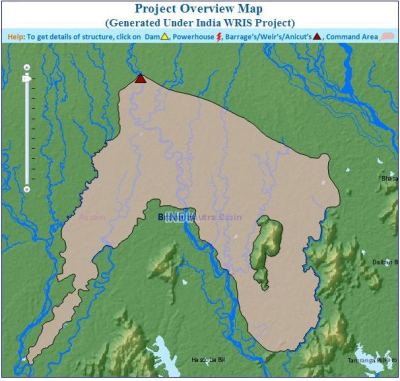
Map of Khuga multipurpose project; Source: India WRIS Wiki
In the 115th meeting of TAC held in July 2012, the completion deadline of Khuga multipurpose project was stated as March 2013 which implies that it would take 33 years only to complete the project. The minutes of the 115th meeting stated “The project authorities indicated that the increase in cost was due to frequent blockades and law and order problem in the project area, as a result Project authority were unable to obtain construction materials like cement, steel etc, in time, which in turn slowed down the progress of the project significantly. Regarding revised target date of completion, the Project authorities informed that land acquisition had been completed and the project would be completed by March 2013.”
We came across some of very crucial issues about these projects discussed in detail in the Manipur based website Manipur online, Hueiyen Lanpao[3]. These issues were very much related with the viability of the Khuga project but none of these issues found any mention in the TAC meeting discussions. The project proponent seemed to have completely ignored these issues, some of these are given below.
The Khuga project is reported to be inaugurated by Congress chairperson Sonia Gandhi in November 2010.
This project was visualized to solve the irrigation, drinking water and electricity problem of Churachandpur district in particular and Manipur in general since agriculture is the main livelihood option of the region.
But, in terms irrigation it seemed unrealistic to many since Churachandpur is a hill district where jhum cultivation is practiced. In fact an inspection of the main right canal of the Khuga multi-purpose project showed the very sorry state of the canal.[4] The inspection led by an ex-Minister N Mangi came to the conclusion that the canal had never provided any irrigation to nearby paddy fields.
An audit report of Khuga multipurpose project of March 1999 on the performance review of the dam had stated “Since 1984, the IFCD, Manipur, carried out construction work on 25.37 km of canal over an area of 40.27 hectares of forest land in Dampi reserve forest without obtaining the required clearance for diversion of forest land. Barring the unaccounted environmental destruction (that still continues) the overall concept of the multipurpose Khuga Dam project in itself was unpractical and paradoxical.”[5]
Regarding drinking water, people in the area when faced with drinking water scarcity, were not sure whether the water reserved in Khuga dam would qualify as good enough for drinking. People of several villages living in the vicinity of the dam had reported that stagnant water actually smells.[6]
The electricity generation component had been scrapped totally even after the power house was reported to be completed by almost 80%. It was said that there were flaws in the design of the Khuga multipurpose project right from the beginning and the electricity generation was not a viable option. It was learnt that the power component was planned and designed without studying its operational feasibility and the power component can be operated for only about 3 or 4 months in a year when there is excess water.
There was also a report that a Joint Action Committee on Khuga Dam visited the national capital and submitted a petition to Deputy Chairman of Planning Commission demanding an expert team to investigate the execution of the project.[7] The Joint Action Committee also demanded that the 1.5 MW electricity for the people of Churachandpur district and compensation and rehabilitation money to the affected the villages should be cleared. None of the above, even the petition submitted to the planning commission was not mentioned in the minutes of the TAC meeting.
Dolaithabi Barrage Project was first approved by the Planning Commission of India in 1992 with a cost of Rs 18.86 crores to be constructed in Imphal East district of Manipur.[8] 22 years have passed since then, but the project is yet to be completed. The cost of the project has increased 19 times from its original cost when it was considered in the 115th TAC meeting held on 24th July 2012. In that meeting price escalation, change in design on the basis of model studies, detail examination of the project proposal by the CWC field unit had been cited as the reasons for increase in costs of the project. But there was no question on why the design of the project had to be changed 20 years after the project had started. TAC meeting minutes did not mention any completion year for the project, but state Chief Minister Okram Ibobi Singh in an inspection tour to the project site in October 2012, had announced that this project would be over by March 2014.[9] This clearly sounds unrealistic.
Location map of Dolaithabi and Thoubal project. Source: India WRIS Wiki
Thoubal multipurpose project was first considered by Planning Commission in the year 1980 and the original cost of the project was Rs 47.25 crores. The project is still far from completion and witnessed huge cost escalations. From 2009 to 2013, the Thoubal multipurpose project was considered in two meetings. In the 101st TAC meeting, when this project was considered the cost escalation was already 20.78 times the original cost. As per minutes of the 115th TAC meeting, the cost by then was 29.37 times higher from the original cost. The Thoubal project was also considered in 123rd meeting held on January 30th, 2014 where the projected cost was Rs 1694.27 crores. This is a 35.86 times increase in costs from its original cost. It is interesting to see that in the minutes of the 115th meeting the reasons provided to justify the delay in the construction of Thoubal Multipurpose project are exactly same as those given for Khuga multipurpose project.
Dhansiri irrigation project in Darang district of Assam is another glaring example of mind blowing time and cost overrun. This project was discussed in the 119th meeting on 29th August 2013 for consideration of cost of Rs 567.05 crores. This project started in 1975 and the original cost of the project was Rs 15.83 crores as per the information available in Assam State Irrigation Department website.[10] The same website states that project is supposed to be completed in 2010, 35 years from the time it started. But in the 119th TAC meeting March 2015 was stated as the new completion target. This implies that the cost of the project has increased by 35.82 times over a period of 40 years but even after that the advisory committee accepts proposal without much scrutiny or enquiry. There was no detailed assessment of the reasons for time and cost overruns (there is no question of delay due to clearances or agitations here) or on whether this project which will take 40 years just to complete will be viable or not.
Dhansiri irrigation project command area: Source: India WRIS Wiki
The project proponent stated that due land acquisition and law and order problem the project has not been completed and the TAC seemed to be contended with this. But the minutes of the 119th meeting also showed that major components of the project were in advanced stages of construction with 93% of barrage work, 99% of the canal works and about 83% of works in the distribution system completed. There was no detailed assessment of any of these aspects.
Champamati irrigation project in Chirang district of Bodoland Territorial Area District (BTAD), Assam presents a very unique case. This project started in 1980 with an original cost of 15.32 crores. It was discussed in 103rd meeting of TAC held on 11th March 2010 with a revised cost of 309.22 crores which is clearly a 20 times increase from the original cost. This was 30 years after the project had started and referring to the observation of the Chairman, TAC minutes stated “both physical and financial progress of the work was rather going on a slow pace. He enquired to know whether there was any land acquisition problem persisting or not.”
Map of Champamati irrigation project command area. Source: India WRIS Wiki
Replying to this, the project authorities had stated that “the delay was mainly due to lack of fund and land acquisition problem. However, the main canals had been completed by about 80% while distribution system completed upto 30% which is likely to be completed in another two years.” But in the list of major/medium schemes in the website of Irrigation department, Govt. of Assam the proposed year of completion of this project has been mentioned as 2009.
But in midst of these tall claims of project completion, what is the present status of this irrigation project cannot be confirmed. There is little information available on this project in the internet and from those it can be clearly said that the project was not completed till the mid of 2013. In a news report titled “Centre worried over Cost overruns in old irrigation projects in NE” published in The Sentinal on 26th August 2013 the delay in construction of Champamati irrigation project was also highlighted. On other hand an earlier report “Irrigation scheme damned by delays” published in the Telegraph on 21st August 2006, had indicated that this project had substantial amount of construction left to be done “Till now, only the sluice gate (headwork) of the Champamati irrigation project has been completed, sources said. Of the 37 regulators, only eight are complete, of the 120 canal falls only 20 are complete, while 72 cross-drainage systems have been completed out of a total of 270. Of the 197 bridges, just 50 are finished. The earthwork of the main canal and the branch canal are also incomplete, with only 97.67 km out of 145.95 km finished.”
How much benefit these projects will do to the people of India’s Northeast is the question which may appears in the minds of many after going through this analysis. After such humongous in costs and time overrun, the benefits expected to be derived from these projects, would hardly justify the costs incurred. Similar concerns were raised by the representative of the Planning Commission regarding Dhansiri Irrigation project “the benefit cost ratio of the project was 1.2 and any further escalation in cost would result in the project becoming techno-economic unviable.”
Whether these projects can actually deliver what had been promised remains uncertain at best. From the history of Khuga project, it is very clear that the promises are never fulfilled and the benefits never reached the people. In fact the Khuga project is also an example of how the expected benefits of the project never become a reality even after completion of construction. The benefits from irrigation largely remained on paper.
This is the case with the several other irrigation projects in northeast. The case of Loktak Lift Irrigation project in Manipur can be cited here about which the minutes of the 122nd TAC meeting (20th December 2013) stated “Loktak lift irrigation project was commissioned in 1986 with an original command area of 24000 ha and 40000 ha as annual irrigation. Due to scarcity of funds from State Government the normal repair and maintenance could not be taken up and as of now the annual irrigation has reduced to 1800 ha.” This is possibly indicative of how much irrigation benefits have actually been accrued from irrigation projects.
Functioning of TAC Barring the cost and time overrun of these projects, the functioning of TAC also needs to be looked into. The Advisory Committee of MoWR very much works like a rubber stamping committee, clearing everything that comes to it. A reading of the minutes of its meetings reveals that there are hardly any critical questions asked on merits of the projects and for the massive delay and cost escalations that most of the considered projects suffer from. Nor is there any discussion about the performance of the projects. Considering the importance of TAC in India, we believe the committee needs to be more serious in performing its duties. It needs to question the merits and need of a project before clearing and need to do performance evaluation. It should no way become a clearing house for projects. Effective steps need to be taken to ensure that the functioning of this committee becomes more transparent, participatory and accountable. SANDRP has written letters to the concerned authorities in this regard, but we are yet to see an effective change.
Parag Jyoti Saikia (with inputs from Himanshu Thakkar) (meandering1800@gmail.com)
A typical irrigation project comprises of dam, reservoir, main canal, distributaries, minors, sub minors, field channels & farms. Components from reservoir to minors/sub minors are termed as Irrigation Main System [IMS]. The main purpose of IMS is to store & convey water to irrigation outlets. IMS, at present, is up-stream controlled, manually operated, mostly open channel system. Water Governance of projects critically depends upon IMS. Good governance of irrigation projects is practically impossible without compatible physical system & adequate legal support. This paper makes an attempt to highlight this basic fact with particular reference to M&MIP in Maharashtra.
Water Resources Development in Maharashtra Water sector in Maharashtra is passing through a difficult period. Following exposure of the irrigation scam in 2012, the Maharashtra Government had to publish white paper on irrigation. But that created more problems. Appointment of Special Investigation Team (SIT) further aggravated the controversy. Several public interest litigations have been filed. Investigation by CBI is being demanded. And opposition political parties have been keeping the issue alive in legislative council & assembly. The message is loud & clear. Water Governance is conspicuous by its absence.
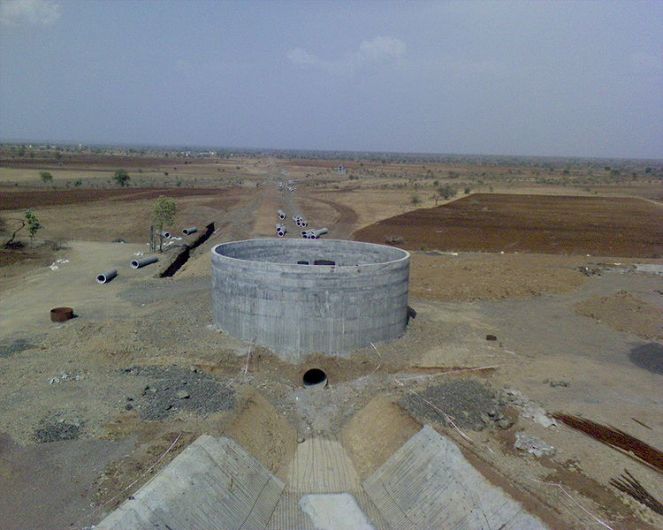
One of the several incomplete Lift Irrigation schemes in Vidarbha, Maharashtra. Courtesy: Wikipedia
Issues that have become controversial are listed below & they do substantiate the absence of water governance.(1,4,6,7)
1) Validity of water availability certificates
2) Completion of irrigation projects in the truest sense of the term
3) Accurate, credible figures of Created Irrigation Potential (CIP)
4) Reduction in CIP
5) Truth about Actual Irrigated Area (AIA)
Present Scenario of Water Management in Maharashtra: The present scenario of water management in irrigation projects in the State is equally disturbing (2,3,4,5). Cropping pattern dominated by perennial & hot weather crops, inefficient water use, illegal lift irrigation schemes, diversion of water from irrigation to non-irrigation, absence of water – & crop area – measurement and non implementation of water laws are some of the important challenges before water governance.
Infrastructural Constraints Water governance demands compatible infrastructure. Infrastructure, in irrigation sector, includes reservoirs, canals & distribution network (DISNET), that is, mainly Irrigation Main System (IMS). Better the IMS better will be the water governance. IMS comprises of earthwork, structures & measuring devices. Earthwork & structures help store & convey water. Gated structures, in addition, facilitate control & regulation of water. Measuring devices, measure water & make possible other three most important & basic things of water governance, namely, monitoring, evaluation & water audit. Control, regulation & measurement together create “Water Control Situation” (WCS).WCS facilitates water level- & discharge- control which is the heart of canal operation. WCS, at least in Maharashtra, is largely conspicuous by its absence. That is a big infrastructural constraint from Water Governance point of view. Listed below are the highlights WCS in Maharashtra. The list is indicative & not exhaustive.
(1) IMS is an open channel system which, by its very nature, is difficult to control & regulate.
(2) IMS is an upstream controlled system. Such a system, by design, works as per the logic of supply side management & is operator – friendly. Here, the operator means officials of WRD. Participatory Irrigation Management is, not provided for in the design.
(3) IMS is basically designed for flow irrigation purposes. Lift irrigation & non-irrigation have not been considered in the original design. But IMS, in practice, is used for all purposes.
(4) Actual capacity of canals & DISNET is significantly less than design capacity; defective construction & lack of maintenance & repairs (M & R) being the main reasons.
(5) Actual conveyance losses of canals & DISNET are far more than generally expected. Overall Project Efficiency (ratio of water received at root zone & water released at canal head) is hardly 20-25% in most of the systems.(2,3)
(6) Less carrying capacity & more losses make mockery of irrigation schedules. Timely & predictable water supply remains on paper. Inordinate delays & grossly inadequate water supply inevitably lead to water conflicts.
(7) Gates of different type & size at strategic locations in canals & DISNET are of vital importance to control & regulate water supply. But most of the gates are either out of order or simply missing. Poor M & R, tampering & vandalism are common.
(8) Gates at present are cumbersome to operate. Their manual operation limits flexibility of canal operation. In absence of real time data, gate operation becomes ad-hoc. There is hardly any water level- & discharge-control.
(9) Measuring devices are generally not provided at the head of canals & DISNET. Wrong design, improper location, defective construction & poor M &R of measuring devices and moreover, no reliable staff to record measurements are some of the features of the volumetric supply. Both officers & influential irrigators simply don’t like the idea of water measurement for well known reasons.
Even if the WCS does not exist as described above, WRD used to religiously publish Water Audit, Benchmarking & Irrigation Status Reports regularly. The author of this paper sent some objections in 2011(5). WRD did not respond.
Poor quality work at Gosekhurd Canals, Vidarbha Photo: Tehelka
Story of crop area measurement is similar to that of water measurement. It is not being measured. On the background of Irrigation scam, white paper & SIT, though GOM published its Economic Survey, it does not give statistics of irrigation. That is just “Not Available-NA”!
In view of above, one is compelled to agree with following two well known comments which have serious implications for Water Governance
(i) There is no management in irrigation, its only administration.
(ii) Whatever irrigation takes place, it is not the result of any planning as such. Its irrigation by accident.
Water Laws Maharashtra has enacted several Irrigation Acts. But those are not being implemented. Maharashtra Water Resources Regulatory Authority (MWRRA), the first of its kind in India, has proved to be a failed institute. It has simply lost an opportunity to streamline water governance in the State in spite of having quasi-judicial powers. Lawlessness has become a hallmark of water sector in Maharashtra. Rule of Law is WANTED! (8)
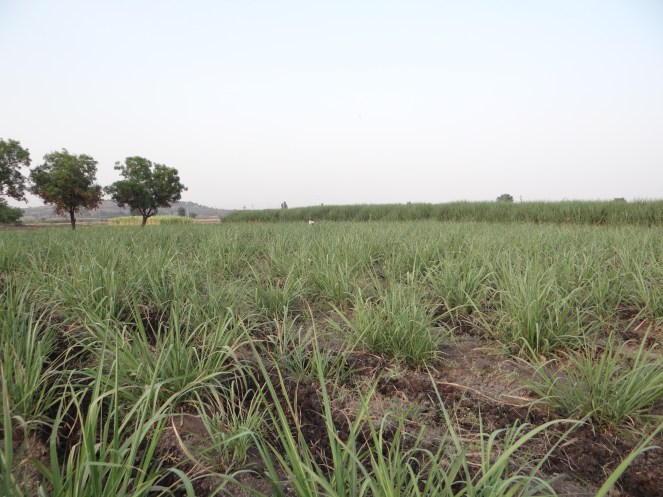
Sugarcane growing in Solapur at the height of 2013 drought, April 2013. Photo: SANDRP
Water Governance Constraints listed above lead to mismanagement in water sector which in turn gives rise to water conflicts. Absence of Rule of Law increases both number & severity of water conflicts. Given the situation, water governance then becomes virtually impossible. Good water governance is possible only if the infrastructure in water sector is improved & modernized and water laws are scrupulously implemented. Most importantly, when there is bottom up participatory process with key role for the local people. Implementation of water laws depends on political will & awareness amongst water users.
It’s time to switch over from “administration to management” in water sector & say good bye to “irrigation by accident”.
Till then good water governance may have to wait!
-Pradeep Purandare (Retd. Associate Professor, Water and Land Management Institute (WALMI), Aurangabad. E-mail: pradeeppurandare@gmail.com)
REFERENCES:
1) WRD,GoM(1999): “Report of Maharashtra Water & Irrigation Commission”
2) WRD,GoM(2011): “Report on Benchmarking of Irrigation Systems in Maharashtra State, 2009-10”, Mar 2011, www.mwrdc.org
3) WRD,GoM (2011): “Report on Water Auditing of Irrigation Systems in Maharashtra State, 2009-10”, Mar 2011, www.mwrdc.org