
India’s Dams and decommissioning As per the Parliamentary Committee for Ministry of Jal Shakti, in its 20th report dated March 2023[i], the committee had asked the Department of Water Resources, River Development & Ganga Rejuvenation under the Ministry of Jal Shakti about the mechanism put in place in India to assess the viable lifespan and performance of dams and projects, which has a direct bearing upon the consideration for dam decommissioning. The Department had replied: “There is no mechanism to assess the viable lifespan and performance of dams… However, no information/recommendation from the dam owners has been submitted for de-commissioning of any of their dams.”
Continue reading “Why India needs Dam Decommissioning policy and program”Tag: India

June Aug 2023: District wise rainfall in in India’s SW Monsoon
In the just concluded month of Aug 2023, India received just 162.7 mm (263.8 mm in Aug 2022, 3.5% above the normal[i]) or 36.2% below normal rainfall against Aug normal rainfall of 254.9 mm as per India Meteorological department (IMD). In Aug 2021, the rainfall was 195.9 mm[ii], about 24.13% below normal and in Aug 2020, the rainfall was 327 mm[iii], or about 26.6% above normal.
Continue reading “June Aug 2023: District wise rainfall in in India’s SW Monsoon”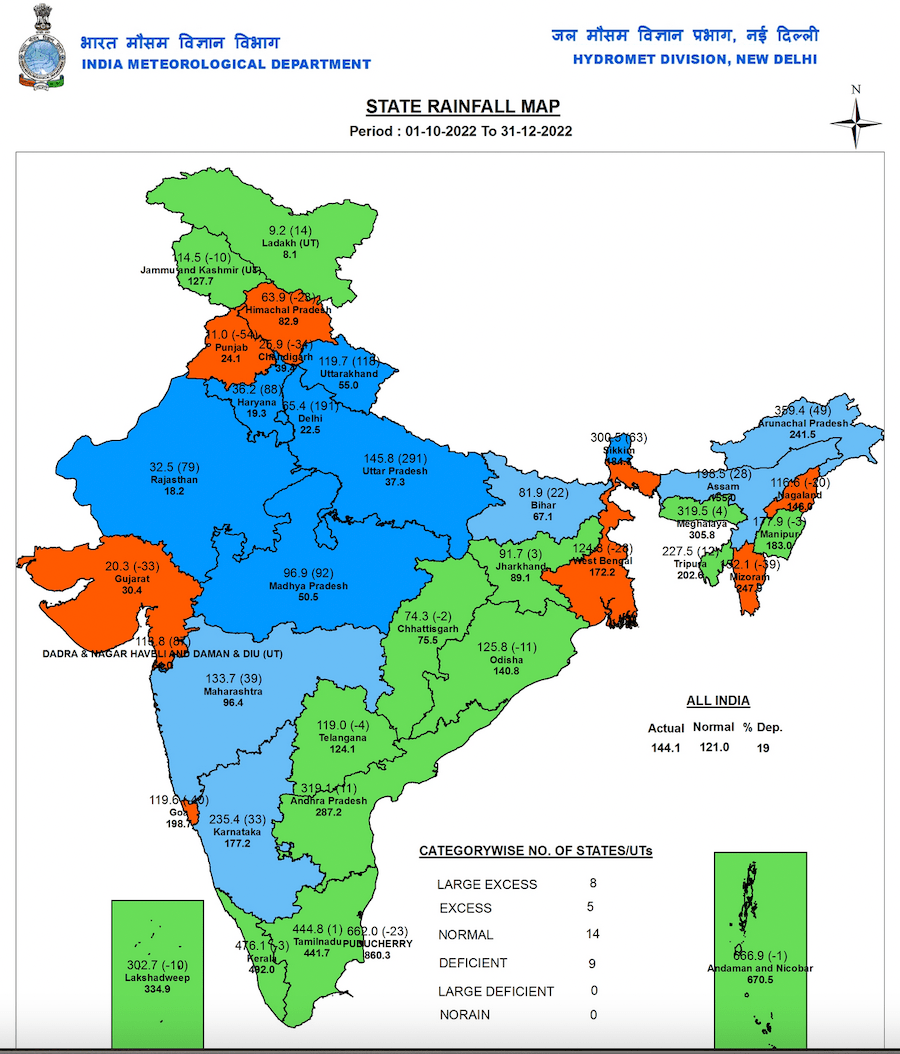
Post Monsoon 2022: District wise Rainfall in India
According to India Meteorological Department (IMD), during the just concluded Post Monsoon Rainfall for 2022, that included rainfall during Oct-Dec 2022 months, India received 144.1 mm rainfall, 19% above normal (177.7 mm rainfall, 43.54% above normal in Post Monsoon 2021[i]) rainfall of 121 mm. In the same period in 2020, India received 124.6 mm rainfall, 0.64% above the normal rainfall. As per IMD[ii] definition, the rainfall was in Normal category.
Continue reading “Post Monsoon 2022: District wise Rainfall in India”
WMO Global Water Report asks for better & shared water data; reduced terrestrial water storage in North India
On Nov 29, 2022, the World Meteorological Organization (WMO) has published its first State of Global Water Resources report to assess the effects of climate, environmental and societal change on the Earth’s water resources. The aim of this annual report is to support monitoring and management of global freshwater resources in an era of growing demand and limited supplies. For report and other related materials, see: https://public.wmo.int/en/our-mandate/water/state-of-global-water-resources
Continue reading “WMO Global Water Report asks for better & shared water data; reduced terrestrial water storage in North India”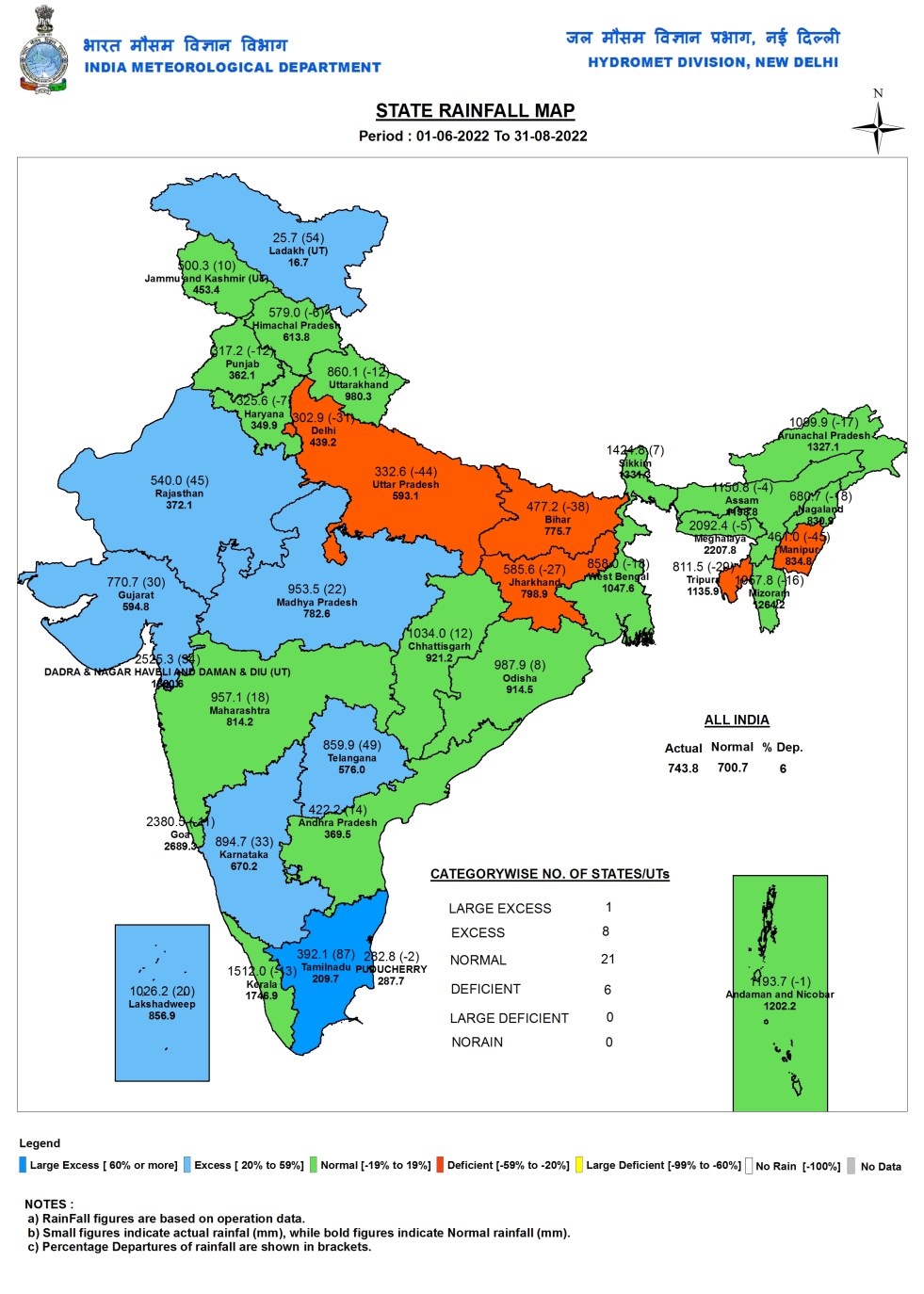
High Rainfall days in India’s districts in August 2022
An analysis of the daily district wise rainfall data from India Meteorological Department (IMD) for the month of Aug 2021, 3rd month of India’s South West Monsoon 2021 shows that there were 667 (much higher than 431 in Aug 2021) instances when district rainfall of a day in a district was above 50 mm. The normal monthly rainfall of India Aug is 258.2 mm and actual rainfall was 3.5% above normal at 263.8 mm[i]. Such high rainfall instances included 553 (371 in Aug 2021) instances when rainfall was 50-100 mm, 98 (48 in Aug 2021) instances when it was 100-150 mm, 13 (11) times it was 150-200 mm and 3 (1 in Aug 2021) above 200 mm. Interestingly, in June 2022[ii] and July 2022[iii] there were 462 and 809 instances when rainfall in a district was above 50 mm. The July 2022[iv] and June 2022[v] rainfall all over India was 16.8% above normal and 8% below normal respectively.
Continue reading “High Rainfall days in India’s districts in August 2022“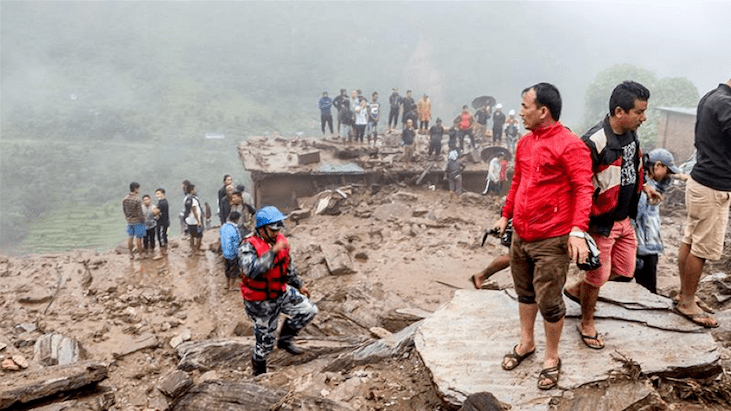
Dams, Rivers & People overview of Nepal 2020
This report provides and overview of key developments in Nepal about Dams, Rivers, Environment and people in 2020, we had provided similar overview in 2019[i] too. We have divided the overview into these sections: Hydropower projects, Power Trade, Governance, River Sand Mining, Monsoon 2020 dominated by Landslide news, Climate Change, India-Nepal issues dominated by Pancheshwar and border dispute issues, Nepal China issues.
Continue reading “Dams, Rivers & People overview of Nepal 2020”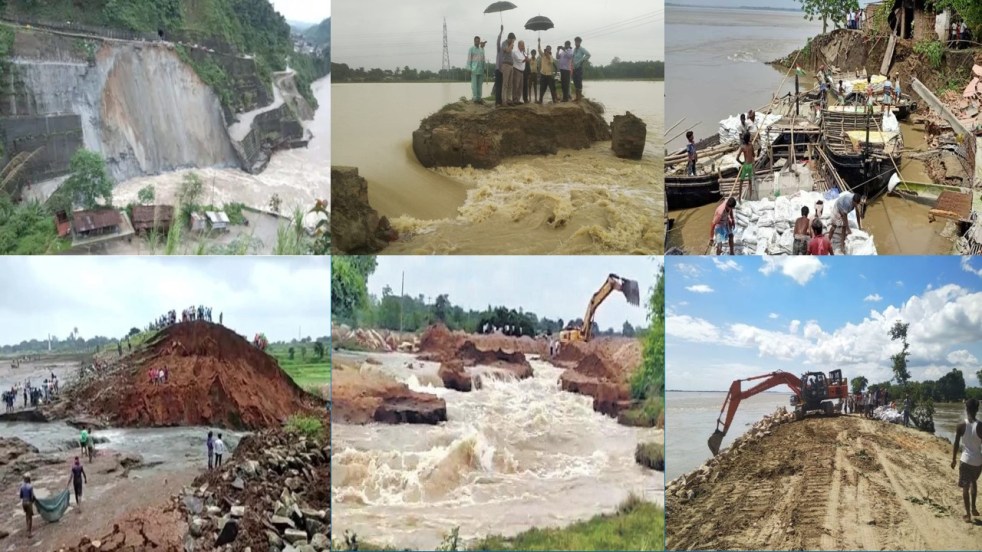
Dam Floods & Embankment Breaches in South West Monsoon 2020
Improper operations of dams, disasters related to dams and hydro projects and breaching of embankments have been aggravating flood disasters during every monsoon. There have been several such incidents during South West Monsoon 2020, taking heavy toll on people and property which could have been avoided or impacts reduced in many cases with proper dam operations and proper maintenance of the embankments. This compilation attempts to put together all such instances when avoidable flood disasters were created by improper operation of dams and breaching of embankments in the south west monsoon 2020.
Continue reading “Dam Floods & Embankment Breaches in South West Monsoon 2020”
World Water Day 2020: Positive Stories from Rural India
The theme for the World Water Day 2020 is ‘Water and Climate Change’. The changing climate has disrupted the water cycle in a number of ways.
The rural areas in India have facing increasing water crisis due to mismanagement, top down government projects, unequal distribution of available resources and now also climate change. However there are several individuals, groups and government initiatives that have led improvement in the situation. We have presented positive water stories from farmers and urban India in earlier WWD 2020 articles. This last compilation in the series presents the positive water actions reported from different rural areas of country in past one year, beginning with top five positive water stories. Continue reading “World Water Day 2020: Positive Stories from Rural India”
GermanWatch Report: Can India not assess its Climate Risk & Vulnerability?
The Climate Risk Index Briefing Paper “GLOBAL CLIMATE RISK INDEX 2020: Who Suffers Most from Extreme Weather Events? Weather-Related Loss Events in 2018 and 1999 to 2018” released by the Environmental Think tank German Watch[i] on Dec 4, 2019[ii] made a media splash in India[iii] since the report ranked India as fifth country (it was 14th in 2018 report) most at risk in the context of climate change.
Indeed, it is worth taking note that maximum number of deaths (2081) and Economic losses (USD 37808 million[iv], equivalent to four times country’s annual health sector budget) due to climate change happened in 2018 in India. Both these numbers were highest among the top ten Climate Risk countries of the world in 2018. This is one of the many reports which are coming out on the occasion of 25th Conference of Parties happening in Madrid (Spain) in early December 2019. Continue reading “GermanWatch Report: Can India not assess its Climate Risk & Vulnerability?”
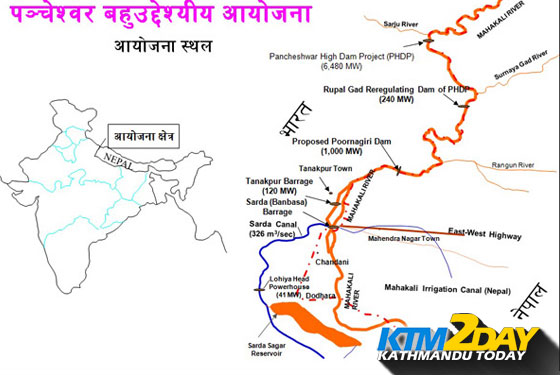
Cancel Pancheshwar Dam Public Hearings: It involves too many violations and illegalities
From: SANDRP,
50-D, AD block, Shalimar Bagh, Delhi 88
we4earth@gmail.com, https://sandrp.wordpress.com/
August 11 2017
To
1. District Magistrate,
Pithoragarh, Uttarakhand
2. Chairman/ Regional office incharge,
Uttarakhand Environment Protection and Pollution Control Board,
Dehradun, dkjoshi21@yahoo.com
COPY to: 1. IA Division (River Valley Projects) MoEF, Delhi
2. Chairman and Members of Expert Appraisal Committee on River Valley Projects
Respected Members of Public Hearing Panel for Pancheshwar Dam,
The public hearing now being conducted for the massive Pancheshwar Dam at Pithoragarh today, as part of the requirement under the EIA notification of Sept 2006 is being held in complete violation of letter and spirit of many norms of the EIA notification. Hence these public hearings should be cancelled. They should be rescheduled after appropriate conditions are achieved for the public hearing. Some of the key reasons for this are listed below, but these are not exhaustive reasons, but only a list of key indicative reasons. Continue reading “Cancel Pancheshwar Dam Public Hearings: It involves too many violations and illegalities”
 SANDRP