Dams

India Rivers Studies 2017: Rivers Succumbing To Dams, Pollution & Climate Change

After reviewing status of India rivers, SANDRP presents an account of research, studies and important reports on erratic monsoon, climate change, floods which all are severely affecting the rivers, their aquatic life and livelihood of dependent communities.

Rivers and Monsoon

Number of rainy days falling across river basins in India The study has found that number of rainy days is falling across river basins in India and rainfall intensities are seen to be increasing. The analysis determined changes in heavy precipitation and peak flood for seven river basins in India—Krishna, Godavari, Mahanadi, Narmada, Cauvery, Sabarmati and Brahamani and Baitarani. For the study, data pertaining to daily flows for about 30 odd years and precipitation for 61 years (from 1951 to 2012) were analysed.

The analysis also said the rivers which flow from west to east direction (in India) have more rainy days compared to those which flow towards the west. The study also held that anthropogenic activities (construction of storage reservoirs, diversions, urbanization, land-use change, and soil and water conservation measures, among others) have probably affected the generation of peak floods in the rivers of India. http://www.livemint.com/Politics/c7v8oXmsMDHIldjDv9k6lK/Number-of-rainy-days-falling-across-river-basins-in-India-s.html (Live Mint, 27 April 2017)

Continue reading “India Rivers Studies 2017: Rivers Succumbing To Dams, Pollution & Climate Change” →

Dams · DRP News Bulletin

DRP: 12 Mar 2018 (Swami Gyan Swaroop Sanand To Go On Fast For Ganga)

Swami Gyan Swarup Sanand (Prof G D Agarwal formerly) writes to Prime Minister on Feb 24 with three demands on Ganga and says if these are not satisfied by Ganga Dashera (June 22, 2018), he will go on fast unto death. The three demands are: 1. stop work on Vishnugad Pipalkoti, Singoli Bhawari and Phata Byung HEPs 2. Pass in Parliament the Draft Ganga protection act drafted by Just (retired) Girdhar Malviya headed committee and 3. Create a National Ganga follower committee whose permission will be necessary before taking any decision about Ganga. See the detailed blog by Arun Tiwari ji and link to the letter to PM. http://hindi.indiawaterportal.org/Swami-Sananda-open-letter-pm-modi-clean-ganga

Continue reading “DRP: 12 Mar 2018 (Swami Gyan Swaroop Sanand To Go On Fast For Ganga)” →
Dams

West India Rivers Review 2017: Governments, Industries Destroy Rivers

After review of North India and Maharashtra Rivers, SANDRP presents the development surrounding rivers in rest of West Zone: Gujarat, Goa, Madhya Pradesh and Rajasthan states in 2017.

Gujarat Rivers

Dams, industrial pollution killing State Rivers In MoEF report, Gujarat ranks 4th among top 5 states with highly polluted rivers. Sabarmati is among Gujarat’s 20 most polluted rivers including Narmada and Mahi. Over Rs 200 cr has been spent to curb pollution in Sabarmati & Mindola rivers. This fund is the highest amount ever spent outside the Ganga river conservation project on which Uttar Pradesh has spent Rs 917.24 crore, West Bengal Rs 411.26 crore and Bihar Rs 216.46 crore. As per activist, Rohit Prajapati, industrial effluents are being released in big rivers like Sabarmati, Mahi and Narmada without being treated and big dams have been built on big rivers due to which the rivers are drying up and vanishing as a result, the condition of rivers in Gujarat is going from bad to worse. https://timesofindia.indiatimes.com/city/ahmedabad/polluted-rivers-guj-ranks-4th/articleshow/62685910.cms (The Times of India, 29 Jan. 2017)

Continue reading “West India Rivers Review 2017: Governments, Industries Destroy Rivers” →

Dams · Rivers

North India Rivers Review 2017: Pollution Poisoning Lifelines

In an effort to assess the situation of Rivers in 2017, SANDRP is presenting the compilation of key rivers related development in the country. The first part of this Rivers Review 2017 includes Northern States including Jammu and Kashmir, Punjab, Haryana, Himachal Pradesh, Uttarakhand, Uttar Pradesh and Delhi. The following parts will present separate accounts for Rivers in North East, West, East and South Zones. There will also be separate review reports on Ganga & Yamuna rivers.

Continue reading “North India Rivers Review 2017: Pollution Poisoning Lifelines” →

Dams · DRP News Bulletin

DRP: 26 Feb 2018 (Banda People Also Protest Against Ken Betwa Link)

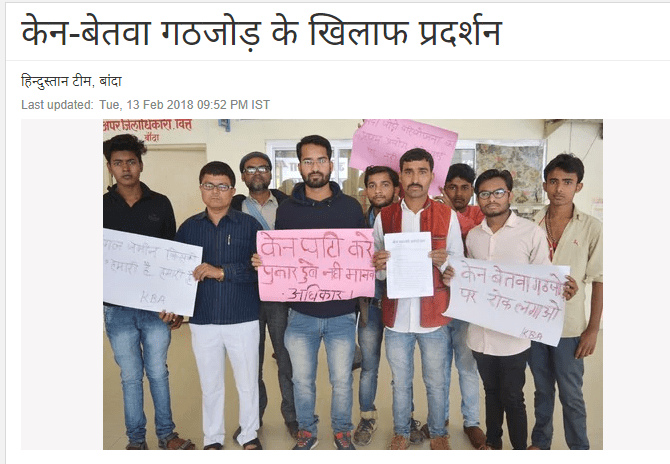
When Central Government is trying to push Ken Betwa link project terming it as beneficial for both Madhya Pradesh and Uttar Pradesh, local people of Banda are now also protesting against it, in addition to the people of Panna that are already opposing it. On Feb. 13, 2018, the Ken Bachao Samiti comprising of farmers, citizens and social workers in Banda sat on a Dharna before district magistrate office. The group have also sent a memorandum to the President of India, demanding immediate cancelling of the project. Raising serious concerns over environmental and social of the linking project, they asked demanded proper impact assessment and public consultation and said the project wont be allowed to go forward. Indeed, as they have said, there has been no downstream impact assessment and people of Banda are likely to loose their river.  https://www.livehindustan.com/uttar-pradesh/banda/story-demonstrate-against-ken-betwa-alliance-1800951.html (Hindustan Hindi,13 Feb. 2018) 

Continue reading “DRP: 26 Feb 2018 (Banda People Also Protest Against Ken Betwa Link)” →
Dams · DRP News Bulletin

DRP: 19 Feb 2018 (How Are We Treating Our Urban Rivers?)

In this comprehensive article Mumbai-based author Vaishnavi Chandrashekhar throws the light on the plight of Uraban Rivers. “Rivers and streams have borne the brunt of the recent urban explosion in India, a nation whose population has nearly doubled in the last 40 years to 1.35 billion. Unplanned growth has led to the use of water bodies as dumping grounds for sewage and industrial effluent. According to CPCB, 63 % of the urban sewage flowing into rivers (some 62 billion liters a day) is untreated.

In addition, riverbanks, wetlands, and floodplains have been claimed over time by infrastructure, slums, offices, and housing developments – all of which has narrowed natural river channels and distorted flow, greatly reducing the ability of India’s rivers to buffer flooding. It also has taken a toll on biodiversity. http://e360.yale.edu/features/dying-waters-india-struggles-to-clean-up-its-polluted-urban-rivers (Yale Environment 360, 15 Feb. 2018) 

Continue reading “DRP: 19 Feb 2018 (How Are We Treating Our Urban Rivers?)” →
Dams · Indus

Rivers are Us

Above: Sindhu by Anoop Patnaik, Outlook Traveller

“To choose safe waters

is the route of imposters:

Those who love

take on the mighty river.” (Seeking the Beloved, translations of Shah Abdul Latif Bhitai’s Poems)

Sohni
Sohni in modern art by Aparna Caur

In the inky, starless night, beautiful Sohni plunged into the flooded River Chenab to meet her beloved Mehwal, knowing well that she will never make it to the other side. Sohni is one of the seven heroines brought to life by Shah Abdul Latif Bhitai, a remarkable 18th Century Sufi poet, mystic and reformist living on the banks of Indus. Sohni was the wife of a potter, in love with Mahiwal, a cattle herder from the banks of the Chenab. Like all poignant love stories, Sohni-Mahiwal’s tale was short-lived, but 300 years later, the legend of Sohni flows through the Chenab and lives on in the songs of peasants. In Punjab, the land of five rivers, they sing of Sohni, of the roaring, helpless river and of mad, wilful love. The narrative is so unwrinkled and dewy that till this day, silent figures sweep the modest tombs of Sohni and Mahiwal, hoping that their love will meet a better fate. Like Sur Sohni (Sohni’s poem) from Shah jo Risalo (Poetry of the Shah) prophecised:

“Hundreds were by the river drowned,

But the river was drowned by this maiden.” Continue reading “Rivers are Us” →

Dams · DRP News Bulletin

DRP: 12 Feb 2018 (With Innovative Ideas Hyderabad, Chennai & Delhi Are Reviving Its Wetlands)

This week there are exemplary and encouraging wetlands revival stories from three metro cities of Chennai, Hyderabad and Delhi.  In the first example from Hyderabad, meticulously chosen plant species such as tulsi, aswagandha, citronella and hibiscus have been used to create an artificial island to clean Neknampur Lake. The treatment islands are composed of four layers of which the bamboo base keeps the entire structure afloat. Based on soil-less hydroponics, these floating treatment wetlands absorb excess nitrates, thereby reducing the chemical content of the lake water. Microorganisms present in the wetland break down organic matter while the root systems filter out pollutants and sediments. https://www.thenewsminute.com/article/3500-saplings-floating-islands-help-rejuvenate-hyd-neknampur-lake-75819 (The News Minute, 3 Feb. 2018)

Similarly, Chennai-based Care Earth Trust along with the public works department (PWD) and the civic body has managed to restore three urban lakes. While many of the smaller wetlands have vanished over time, many mid-sized wetlands seem to have shrunk by almost 65 percent. Thanks to their joint effort, invasive hyacinth was removed from the Narayanapuram Lake in Pallikaranai, while sewer lines, which emptied into the Perungalathur Lake, have now been plugged. A detailed restoration proposal has been forwarded to the PWD regarding the Korattur-Madhavaram-Ambattur lakes. https://timesofindia.indiatimes.com/city/chennai/hyacinth-out-sewer-line-plugged-three-water-bodies-restored/articleshow/62748110.cms (The Times of India, 2 Feb. 2018)

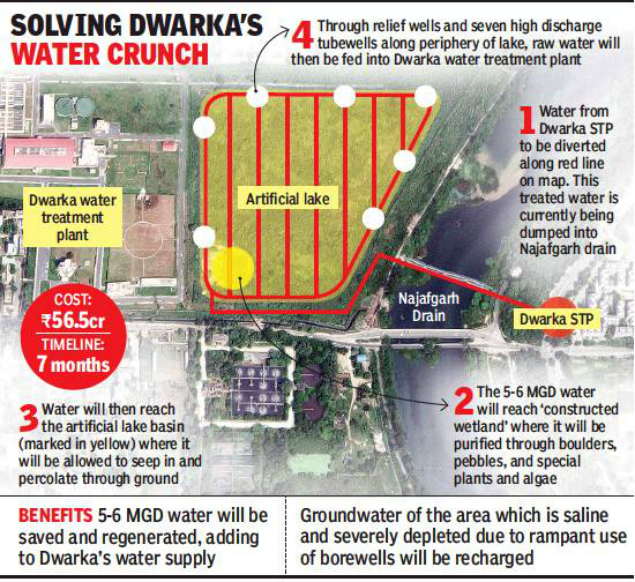
Meanwhile, Delhi Jal Board (DJB) has taken up interesting new project of creating an artificial lake in Dwarka. The project will supply water in sub-city and improve ground water level too. DJB has approved Rs. 56 crore for the project which will be completed in next seven months.  This would the first model project wherein a lake will be used to augment water supply. The special lake is being created next to the Dwarka water treatment plant (WTP) will have a sand bed to allow maximum percolation of water into the ground. It will have a capacity of 10 million gallons (MGD). The project is expected to add supply of 5-6 million gallons water to Dwarka every day.

Continue reading “DRP: 12 Feb 2018 (With Innovative Ideas Hyderabad, Chennai & Delhi Are Reviving Its Wetlands)” →
Dams · DRP News Bulletin

DRP: 05 Feb 2018 (J&K To Assess The Viability Of Big Hydro Pojects)

In a remarkable development, Jammu & Kashmir Govt is reviewing its Hydro policy to assess whether the Hydro Electric Power Projects (HEPs) are still viable. As per sources, this is for the first time that the Govt is discussing the viability of generating hydro power.

An empowered committee led by the Chief Secretary has started this discussion by calling for an “approach paper” that will give an overall picture of the hydropower industry in India. Top sources in the State Power Development Corporation (SPDC), a government-owned company, told Kashmir Reader that the empowered committee wants to lay a roadmap for power generation in the state. “It will reflect the vision of the government. It will give the picture of hydropower generation in India, its rates, market, demand and supply. It will also lay down a roadmap for large power projects,”

The approach paper will be part of a new hydropower policy which will be submitted before the same committee, and then before the cabinet for approval. The SPDC had submitted a hydro policy draft in April last year, which was returned to it in December. Sources said the approach paper has to be submitted in two months’ time.

At present, India has a surplus generation of hydropower, which has plummeted its rate. This has led to losses for SPDC as it invested in projects whose generation costs were high. The blunt example is that of the 450-MW Baglihar II. SPDC has failed to lure any buyer for more than a year as its selling cost of per unit of energy, Rs 4.4, is nearly Rs 2 higher than the market rate. The SPDC has finally managed to sell the power at about Rs 4 per unit to the Uttar Pradesh government but for one year only. The SPDC may have to struggle again next year if the state of UP does not continue the contract.

Another example is that of Nimuno Bezgo, and Chutak hydropower projects, which sell energy at Rs 13 per unit. The SPDC also buys power from Dulhasti project at Rs 7, when the available rates for power in the market is around Rs 2 and Rs 4. https://kashmirreader.com/2018/02/02/cs-led-panel-to-lay-roadmap-for-power-generation-in-jk/ (Kashmir Reader. 2 Feb. 2018)

As per another report, facing a growing demand for electricity and unable to tap its vast potential for generating hydroelectric power, the state government is looking to boost solar power generation. Given the long gestation period of hydel projects, it is unlikely the generation of hydroelectric power will expand significantly in the near future, said. Hence,  the focus on solar power. Indeed, when solar power potential exists, with lower installation and operation costs and impacts, why States continue after destructive, expensive hydro projects? https://scroll.in/article/866058/kashmir-can-generate-a-lot-more-hydel-electricity-than-it-requires-why-is-it-eyeing-solar-power (Scroll.In, 30 Jan. 2018)

There is one more interesting hydro power development in which the state cabinet of Bihar has approved closing 3 and cancelling the development of 2 others in addition to handing over of 8 hydropower projects to neighboring Jharkhand.

Continue reading “DRP: 05 Feb 2018 (J&K To Assess The Viability Of Big Hydro Pojects)” →
Dams

Union Budget 2018: Looking for farmers, rivers or environment

Finance Minister Arun Jaitely presented the last full budget of the Modi led NDA govt at centre on Feb 1, 2018. Considering the impending elections and the prospects of facing the elections next year (possibly earlier as some speculate), one thought the Budget will try to do justice to the promises the BJP made to the people in 2014 elections, particularly to farmers, about Ganga and other rivers. Modi has just returned from Davos where he said climate change is one of the biggest challenges of future, so one expected that the budget will also have something on environment and climate change. Even the ECONOMIC SERVEY 2017 put out on Jan 29, 2018 was focused on climate change impact on farmers. Considering the Rural distress that got reflected in Gujarat election results in Dec 2017, one expected credible and substantial better deal for villages and agriculture.

Unfortunately, we are mostly disappointed in all these aspects. Continue reading “Union Budget 2018: Looking for farmers, rivers or environment” →