Dams · DRP News Bulletin

DRP NB 10 August 2020: CANCEL EIA 2020!

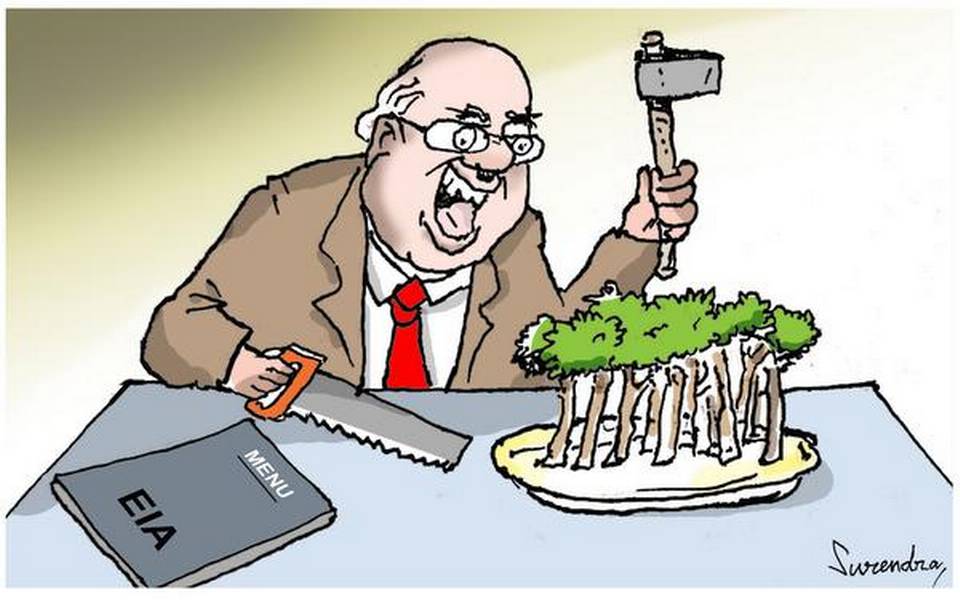
Anyone who cares for India, its people and their future and who even remotely understands environmental governance and democratic process will come to just one conclusion about the Draft EIA (Environment Impact Assessment) 2020: CANCEL IT.

We certainly need change in the current EIA process. The whole thing is a major fraud at every stage, from the exclusion from large number of activities from the scope of EIA process, to scoping to quality of EIA, to the track record of the EIA consultants, to the process of selection of EAC (Expert Appraisal Committee) and its functioning, to public hearing and consultation process, to the complete absence of capacity or even will to monitor and achieve compliance of the approved project, every step needs strengthening, from the current EIA process based on the 2006 notification.

But the Draft EIA 2020 takes the current EIA process in opposite direction: Weakening it every step of the way. So there is no doubt that the only real option before the govt is to CANCEL IT.

Continue reading “DRP NB 10 August 2020: CANCEL EIA 2020!”

Dams · DRP News Bulletin

DRP NB 03 Aug 2020: India needs to demand info from China on Brahmaputra issues

Two important developments this week underline once again the need for Indian govt to demand clear responses from China. One is about the threat of landslide outburst flood that may enter India via Siang. A landslide dam has been formed on the Jianpu glaciers that feeds the Yigong Tsangpo, a tributary of Yarlung Tsangpo, as Siang is known by that name in Tibet. This landslide dam can breach anytime, and bring a high wave of sudden & destructive flood in Arunachal Pradesh. Chintan Sheth, who monitors this area through use of satellite imagery, has once again (his warnings on such landslide outburst dams in the past has been very accurate and useful) warned us about this through an excellent and detailed article quoted below, in Arunachal Times. Such information should actually be coming from Govt of India’s elaborate satellite imagery capabilities. At least now the Govt of India needs to ask China to share all information about this landslide dam and share that information with the people of Arunachal Pradesh at greatest risk due to such floods.

Continue reading “DRP NB 03 Aug 2020: India needs to demand info from China on Brahmaputra issues”

Bihar · Floods

Making sense of 2020 Gandak floods

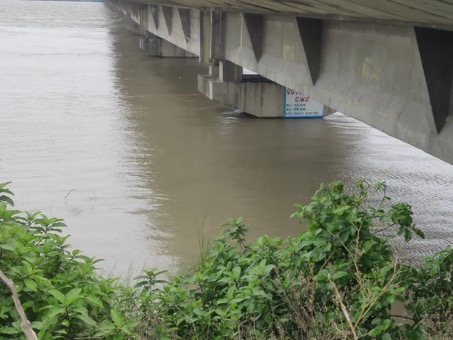
While Bihar is again facing one of the worse floods this monsoon, one basin in Bihar that has possibly faced the maximum floods is Gandak, as a number of reports[i] have described. The floods in Gandak basin were pretty serious, as embankments along Gandak breached at multiple locations, first on western side (Gopalganj district) starting on July 23-24 night and then on Eastern side (Purbi Champaran district).  The flood lead to breaking of three year old HFL (Highest Flood Level) record at Dumariaghat, 19 year old HFL record at Lalganj and most shockingly, 34 year old HFL record at Rewaghat. Continue reading “Making sense of 2020 Gandak floods”

Dams · Sand Mining

Bihar Sand Mining 2020: Ruining rivers; aggravating floods

{Feature image: Up to 300 trucks a day take their fill of sand at a mine on the Sone River in Bihar state. India’s construction boom is stripping large volumes of sand, a vital ingredient in concrete, from its rivers. Environmentalists say the extraction is unsustainable, harming local hydrology and wildlife. Paul Salopek}

The 2018 review of sand mining[i] for Bihar highlighted how mismanagement by govt and then National Green Tribunal (NGT) ban on sand mining in Ganga river, Son rivers particularly during monsoon months resulted in sand scarcity and soaring prices affected public and livelihoods of mining laborers.

The video report featuring local people revealed that illegal mining was causing floods in West Champaran by damaging embankments. Similarly, the report on Gaya mentioned sand mining among reasons behind increasing air pollution. The death of four kids by drowning into sand mine pits was shocking. This compilation presents the situation after 2018 so far.

Continue reading “Bihar Sand Mining 2020: Ruining rivers; aggravating floods”

Dams · DRP News Bulletin

DRP NB 20 July 2020: Will the Supreme Court stop destruction of Ganga & Himalayas in the name of WIDER Char Dham Road?

Feature Image: Pithoragarh-Tanakpur Road widening work going and muck being dumped in Saryu river under Chardham project. (Manoj Matwal, April 2019) 

The Supreme Court appointed Ravi Chopra committee has submitted the report on Char Dham Road. It has not said NO to the all weather road which is the slogan of Gadkari and rest of the Union Government. It has in fact, going by the Union Ministry of Road Transport’s’ circular, as late as 2018, suggested that the road be of 5.5 m width with necessary precautions. It has provided elaborate justifications and reasons why it took this decision. And yet twelve govt members of the committee, claiming in the name of religion (as per interview by one of these twelve members in media today) has insisted that the road should be of 10 m width. Not bothering that religion was not part of their mandate, not bothering what impact such a road will have on the Ganga (and the impact will be massive, we will know the full extent only if the impacts are scientifically assessed), on Himalayas (again starting from deforestation, landslides, flash floods and so on will be unbelievably huge) and on people and future generations. One only hopes the Supreme Court will see through the mindlessness of the economic fundamentalism being pushed in the name of religion and not allow the proposal to go ahead.

The Union Environment Ministry is clearly out to destroy even the Bhagirathi Eco-Sensitive Zone by sanctioning the Zonal Master Plan without due process and in complete violation of the letter and spirit of the Bhagirathi notification. This will further open the flood gates for destruction of remaining stretch of Bhagirathi, considered original Ganga stream as it flows from Gangotri. Again one hopes the judiciary will strike this down.

One wonders what is the NMCG, National Mission for Clean Ganga, whose mandate is Ganga rejuvenation, is doing amidst all this? Why is it silent?

Continue reading “DRP NB 20 July 2020: Will the Supreme Court stop destruction of Ganga & Himalayas in the name of WIDER Char Dham Road?”

CWC - Central Water Commission · Floods

CWC flood forecasting: Inadequate, non transparent, inconsistent

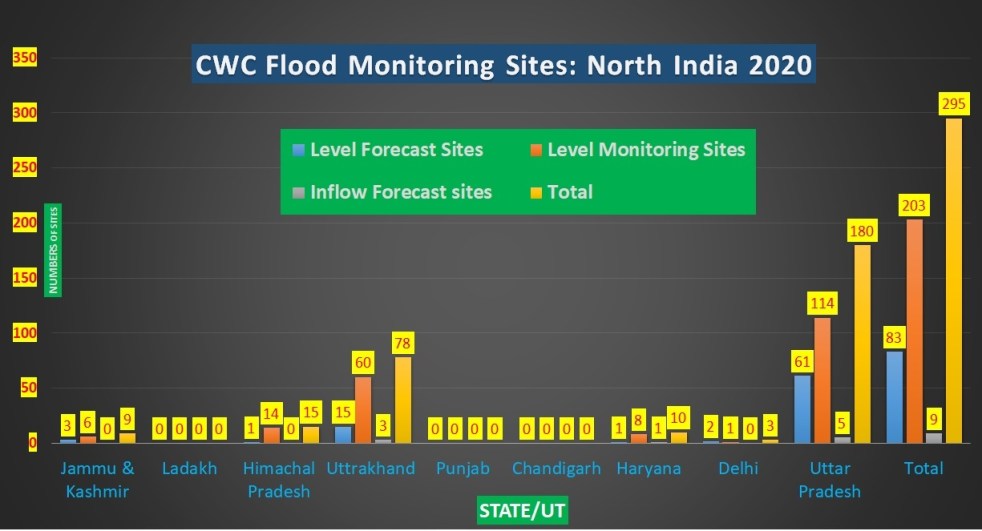
As over 4 million people in the flood prone areas of North East go through second wave of floods and Ganga basin enters the long flood season, nation’s focus should be on one particular agency, Central Water Commission which is not only the only flood forecasting agency, but is also answerable in multiple other ways for the recurring flood disaster. But the flood forecasting of CWC[i] is grossly inadequate, inconsistent and non transparent.

To illustrate, let us look at the available information about CWC’s flood forecasting and compare it with happened in 2019 flood season. Out of 29 sites[ii] (7 level monitoring sites and 22 Lavel forecasting sites) where rivers crossed the previous Highest Flood Level as per CWC’s own hydrographs of last year, CWC has not updated HFL for at least 8 sites so far this year. In case Salavad in Jhalawar district in Rajasthan, on Kali Sindh river, in stead of updating the new HFL, CWC suddenly discovered this year that that the site had higher HFL achieved 35 years ago in 1985, though till last year, it listed 1996 HFL! Continue reading “CWC flood forecasting: Inadequate, non transparent, inconsistent”

Rivers

River Stories, Walking Across India – I

Guest Blog by Siddharth Agarwal

In the years 2018 and 2019, I spent months walking East across India with Paul Salopek on the Out of Eden Walk[i]. His trail started in the Great Rift Valley of Ethiopia in East Africa, roughly following the path of the early human migration out of Africa and across the globe.

The India trail of the Out of Eden Walk started from the India-Pakistan border at Wagah, Punjab. It then moved East through the Indus Basin, followed by the basins of West flowing desert rivers like Luni, then a large chunk through the southern Gangetic plains in Central India before crossing over to the Brahmaputra basin close to Siliguri in West Bengal. The crossover to Myanmar happened at Moreh in Manipur, also incidentally very close to the basin boundary of Brahmaputra and Irrawady. He entered India in March 2018, and crossed over to Myanmar in July 2019. Continue reading “River Stories, Walking Across India – I”

Dams · DRP News Bulletin

DRP NB 13 July 2020: “Rainwater harvesting is key to solving India’s water woes”

INDEED. With all the emphasis available at our command. We are in the midst of the rainiest season and such a statement is indeed music. It would become even more melodious if one knows who said it: it was none other than Mr G. Asok Kumar, Additional Secretary & Mission Director, National Water Mission, Department of Water Resources, River Development & Ganga Rejuvenation, Ministry of Jal Shakti, Government of India who said it. Speaking on July 8, 2020, he said: “Rainwater harvesting has become inevitable in the current scenario of water scarcity across the country… The idea is to save the rainwater be it on the rooftop, compounds, and premises.” Mr Kumar also emphasised the importance of groundwater recharge. 

We can pass it as run-of-the-mill statement from the government, but one is tempted to think there is more to it than that. One wishes if there was a way to hold these officials accountable for such statements and ask as to how this translates into policies, projects and practices. There is no evidence of any of these, unfortunately. Unless we were to interpret it cynically the way Central Water Commission ideologues do: Dams are also rain water harvesting structures! By that definition, even river linking is also rain water harvesting structure!! But Mr Kumar do not seem to suggest that. So let us hold on to this statement optimistically and push the water resources establishment to implement through right policies, practices and projects. Since that is where solution to India’s water problem indeed is. Unfortunately so far there is no sign that this wisdom is accepted in any serious way by the water resources establishment.

Continue reading “DRP NB 13 July 2020: “Rainwater harvesting is key to solving India’s water woes””

Dams · DRP News Bulletin

DRP NB 6 July 2020: Dear NGT, Yamuna Monitoring Panel needs extension

In July 2018, the National Green Tribunal appointed a Yamuna Monitoring Panel for Delhi, the term of this panel is over and it has submitted its final report. NGT had also appointed similar committees for Haryana and Uttar Pradesh stretch of Yamuna, but those panels never functioned as actively as did the Delhi panel. We urge NGT to accept the petition now filed by Manoj Mishra to give extension to the Delhi Yamuna Monitoring Committee (DYMC) and direct that this committee will continue to function and monitoring and compliance panel for Yamuna river in Delhi.

There is a lot one can say positively about this committee, but arguably the biggest factors are its activeness, responsiveness and transparency. This can be easily seen visiting its website or its twitter page (https://twitter.com/ngtmcyamuna2). The committee also acted as a bridge between various institutions dealing with Yamuna in Delhi and ensured better coordination. The committee’s work is also evident in the number of reports it has submitted, all available on its website. There is always room for improvement in functioning of any such organisation, but this a lot and there are very few cases where one can say this.

Continue reading “DRP NB 6 July 2020: Dear NGT, Yamuna Monitoring Panel needs extension”

Dams · DRP News Bulletin

DRP NB 15 June 2020: Athirapally, Bodhghat, Cauvery, Dibang, Etalin: New growth alphabets from the PMO?

A for Athirapally, B for Bodhghat, C for Cauvery, D for Dibang, E for Etalin, seems to be the new growth alphabets from the Prime Minister’s Office. With the economic growth in negative territory, depression in the corner, the old and trusted Big Dams as major infrastructure to push up expenditure and hope for the growth was a formula used even in 1930s by US president Franklin D Roosevelt to bring the US economy out of the Great depression of 1929. It started with the Tennessee Valley Authority Act of May 1933, which then was pushed as growth model to other countries. In India it came in the form of Damodar Valley Corporation (DVC) Act of 1948.

However that 20th century model was a failure even then, as the first CEO of the DVC, Sudhir Sen wrote. That model is no longer relevant in 21st century except possibly as an easy route to corruption and kickbacks. These dams and hydropower projects are no longer even economically viable and better options are now available for irrigation and power. In the changing climate scene they are even less relevant places of worship (temples). Dams and hydropower projects are seeing slow down across the globe, not just in India.

Continue reading “DRP NB 15 June 2020: Athirapally, Bodhghat, Cauvery, Dibang, Etalin: New growth alphabets from the PMO?”