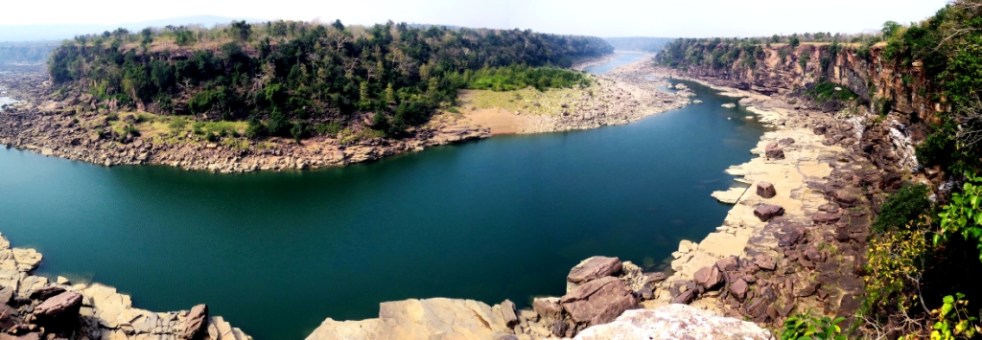
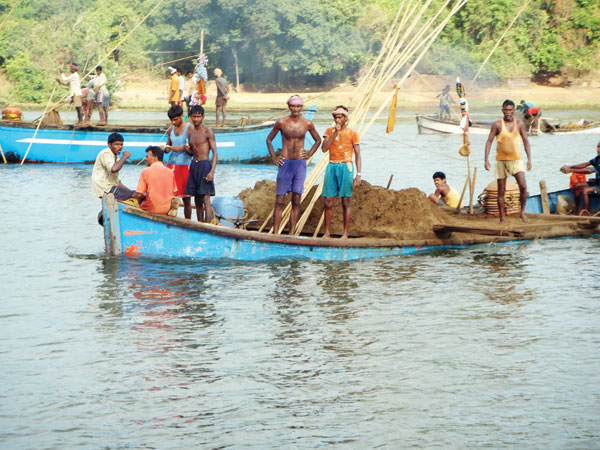
Above: Standing at the edge of a river island, the Gaga river upstream of Farakka barrage seems to stretch out forever like the sea (Photo by Siddharth Agarwal)
GUEST BLOG BY: Siddharth Agarwal
The monsoons had begun their annual ritual about the same time I found myself bereft of my old company while walking along the Ganga from Ganga Sagar to Gaumukh[i]. The documentary crew that was traveling along with me had decided against venturing into the states of Jharkhand, Bihar and Uttar Pradesh, hence I ended up travelling alone upstream from Farakka.[ii],[iii]Continue reading “Farakka Refugees: Walking along Ganga from Gangasagar to Gaumukh”→
(Above: Anupam ji speaking at the inaugural function of India Rivers Week 2016)
“I need to go and pay respect to the people fighting for India’s Rivers” insisted the weak Gandhian, barely able to walk, on Nov 28, 2016. In his speech at India Rivers Week inaugural function that day, an ever alert Anupam ji with his characteristic wry humor, said if changing stones and electric poles at the ghats, morning and evening prayers on loud speakers is all that the government had to offer to rejuvenate the Ganga, than no amount of faith or funds is going to help the river. We first need to understand from where the rivers are getting fresh and polluted water and see how we can sustain the former and stop the latter. Continue reading “Anupam ji: Aaj bhi kharen hai simplicity and quite hard work”→
Above: Menawali Ghat at Wai, Satara Dist (Photo: Sanket Deshpande)
The mighty Krishna River bears the name of Lord Krishna; the beloved dark and dusky lord worshipped throughout the country. Originating but a few kilometers from Arabian Sea, the river has chosen to flow towards Bay of Bengal becoming a lifeline of four states viz. Maharashtra, Karnataka, Telangana and Andhra Pradesh. In its journey of thousands of kilometers and thousands of years, the river witnesses an amazing diversity in language, lifestyle, food and culture.
Maharashtra is blessed to be an upper riparian state in the Krishna Basin. Sahyadri ranges of Western Ghats falling in Maharashtra are abode to early flows of Krishna River. In Maharashtra the river is perceived in a feminine form called ‘Krishna Mai’ meaning ‘Mother Krishna’. The River Krishna is one of the important rivers flowing through Maharashtra and has a tremendous religious and cultural significance. Agriculture and economy of districts like Satara, Sangli and Kolhapur thrive on Krishna mainstream.
Here we make an attempt to provide glimpse of Krishna River within Maharashtra. The article is based on Maharashtra specific river profiles that SANDRP has prepared for India Rivers Week 2016.Continue reading “Krishna River in Maharashtra: A Profile”→
अत्यधिक दुखःद समाचार है कि अनुपम मिश्र जी नहीं रहे। 19 दिसंबर 2016 को प्रातः 05:27 पर दिल्ली के एम्स अस्पताल में उनका देहांत हो गया।
पानी के मुद्दों और भारत की नदियों पर स्पष्ट विचारों वाले, सरल किंतु प्रभावशाली भाषाशैली के धनी, अत्यंत उदार और विनम्र अनुपम जी समान व्यक्तित्व दुर्लभ है। जैसा रवि चोपड़ा जी ने कहा है वे सही में अनुपम थे।
अनुपम जी भारतीय नदी सप्ताह 2016 के आयोजन समिति के अध्यक्ष थे और वर्ष 2014 भगीरथी प्रयास सम्मान चुनाव समिति के सदस्य थे और वर्ष 2015 में इस समिति के अध्यक्ष बने।
खराब स्वास्थ्य के बावजूद वे भारतीय नदी सप्ताह की आयोजन समिति की बैठकों में वे लगातार उपस्थित रहें, अंतिम बार सितंबर 2016 की बैठक में वे मौजूद थे और भारतीय नदी सप्ताह 28 नवंबर 2016 के शुभांरभ के समय भी वे उपस्थित रहे , जहॉ पर हमेशा की तरह उन्होने अपना सरल, स्पष्ट किंतु मर्मस्पर्शी व्याख्यान दिया। वे शाररिक रूप से थके और कमजोर थे , इस सबके बावजूद वे आए जो पर्यावरण के प्रति उनके समर्पण की मिसाल है।
व्यक्तिगत तौर पर वे मेरे (हिमांशु ठक्कर) प्रति बहुत उदार थे और मुझे हमेशा प्रेरित करते रहते थे। हमने कभी भी नहीं सोचा था कि एक दिन हमें उनसे अलग होना पडेगा। उनके चले जाने से देश और पर्यावरण को हुई क्षति की भरपाई नामुमकिन है। परंतु उनकी प्रकृति शिक्षा और अनुभव उनके द्वारा रचित स्पष्ट, सरल और सारंगर्भित लेखों और पुस्तकों के माध्यम से हमेशा हमारा मार्गदर्शन करती रहेंगी।
किताबों के समान उनके व्याख्यान भी ज्ञान और अनुभव से भरे हुए प्ररेणास्रोत है। उनके दिखाए मार्ग पर आगे बढ़ते रहने के लिए, दुख की घड़ी में हम, उनके द्वारा भारतीय नदी दिवस (28-30 नवंबर 2016) में दिए गए उनके अंतिम व्याख्यान को, उन्हें श्रृद्धांजलि के तौर पर अर्पित करते हुए, आपके साथ सांझा कर रहे हैं ।
Above: Anupam Mishra ji at the inaugural session of India Rivers Week 2016
Very sad to say that Anupam Mishra ji is no more. He breathed his last at AIIMS, Delhi at 5.27 am today (Dec 19 2016).
A person with such clarity of thought on water and river issues of India, such effective and simple way of communication, so affectionate and yet so humble will be difficult to find. As Ravi Chopra says, he was truely ANUPAM.
He was chairman of organising committee of India Rivers Week 2016 and also member of of Bhagirath Prayas Samman Jury since inception in 2014 and chairman since 2015. In spite of his poor health and weak body, he came to our organising committee meeting several times, last one in Sept 2016 and also came to the inaugural session of IRW 2016 on Nov 28, 2016 and spoke with characteristic clarity and simplicity and yet effectiveness. He was completely exhausted and pain at the end of it, but that he came in spite of that showed his dedication to the cause.
Personally he was most affectionate and encouraging to me, for so many years. God only knows how can one think of losing someone like that.
India Meteorological Department of Pune (IMD) functioning under Ministry of Earth Sciences has recently (Nov 2016) published a study titled “Rain water harvesting potential for different locations in state of Maharashtra”.[i] The study was undertaken to assess the potential of roof top rain water harvesting based on mean annual rainfall. The need for the study was prompted by requests from a number of NGOs for information on how much rain can be harvested in Maharashtra during a good rainfall.[ii] The study basically estimates volume of rainwater (in liters) that could be harvested per sqft of roof area at 326 locations across Maharashtra where IMD stations are located.
Though this study is an important step, there are a number of ways in which such a study, which IMD plans to eventually conduct for other states as well, can be improved, in addition to a number of limitations that the study has, as elaborated subsequently.Continue reading “IMD estimates rainwater harvesting potential of Maharashtra”→
In an interview with The Third Pole, Shashi Shekhar, secretary in the Ministry of Water Resources, River Development and Ganga Rejuvenation discussed the problems and prospects of India’s water sector. A number of issues which SANDRP and several other water experts and environmentalists have been calling attention to for decades were affirmed by the ‘man behind the scene’.
Perhaps most importantly he reiterated what he admitted at India Rivers Week held in Delhi in Last week of November that the ‘politician-bureaucrat-contractor nexus’ was the “biggest bane of India’s water sector”.
Pinpointing to the average gap of about 45% between irrigation potential and actual irrigation he said- “The interest is not in irrigation but in constructing assets because that is where the money is. All the states have sizeable budgets for this. After all that, the total (canal) irrigated area in the country is 10-15%. So why should it get such vast resources? It does so because the contractor is interested, and there are below the table payments. This is the problem.”
All of them are working to ‘let the rivers flow’. The settings in which they work… their convictions and their understanding gives each of their work a unique flavour…
From colourful personality of Dinesh Mishra who has contributed single handedly to a gradually changing perception of flooding rivers as a catastrophe or “something to be tamed”…. to Himdhara’s deep love for mountains and urge to protect them…. to struggle of CCDD to save their rivers from grabs of corporate hydro-power sector in the armed conflict zone of Manipur…. SANDRP captures flavours of relentless efforts of recipients of Bhagirath Prayas Samman of 2016.
When I talk with Manshi, a friend and co-traveler from Himdhara Collective about Bhagirathh Prayas Samman that the collective received during the India Rivers Week 2016, she is modest, even slightly hesitant. She simply says, “We love the mountains, we want to protect them and help mountain communities fight the unequal battle against unplanned hydropower. That is one motivation of our work. But the other is recognition of the fact that we are privileged… privileged to be able to speak English, to work on a computer, to understand the bureaucratic procedures that alienate a tribal or forest dweller from her land. That understanding also drives us.”
Citation of Bhagirath Prayas Samman given to Himdhara Collective states: “Himdhara’s strength is its engagement with communities, movements and organisations. It has created an effective discourse around issues of resource distribution and their ownership and the resultant impacts on ecological spaces of mountain communities, especially vulnerable groups like indigenous people, dalits and women. It is an honor to recognize and celebrate Himdhara Environment Research and Action Collective’s extraordinary Bhagirath efforts in maintaining the integrity of rivers in Himachal Pradesh.”
In their own words, “Himdhara is an autnomous and informal non registered environment research and action collective, extending solidarity and support, in research and action, to people and organisations asserting their rights over their natural resources and agitating against corporatisation of these resources for destructive development in the state.”
Face of Hydropower in Kinnaur Photo: Himdhara
A collective of young, passionate and questioning minds, Himdhara has been working with communities in far flung areas of Himachal Pradesh include Lahaul and Spiti and Kinnaur in their fight against the onslaught of ill-planned and bumper to bumper hydropower projects in Himachal, amongst other issues.Continue reading “Bhagirath Prayas Samman: Himdhara Collective: Relentless Questioning and Doing”→