Above: Dahisar river inside SGNP Photo Aslam Saiyad
Guest Blog by Aslam Saiyad
While documenting the work of the River March organisation[i], whose goal was to rejuvenate Mumbai’s rivers, I came across Adivasi communities who lived inside the Sanjay Gandhi National Park (SGNP). I noticed some children standing in school uniforms a few kilometers inside the park. They were getting ready to go to a school which was 7km away. And it surprised me because people living in one of the world’s richest municipalities didn’t have a basic mode of transportation to go to school. Continue reading “The Hype, Hypocrisy and reality of Mumbai River Anthem”→
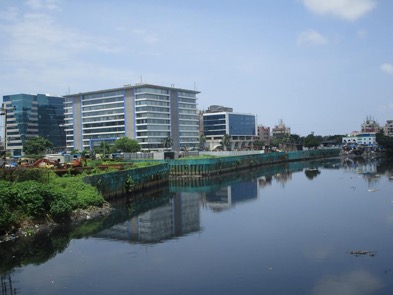
Above: Mithi River at Bandra-Kurla Complex; Photo by Nidhi Jamwal
Guest blog by Nidhi Jamwal
The four rivers of Mumbai —- Mithi, Oshiwara, Dahisar and Poisar —- now have an anthem of their own. Released recently by T-Series and Leelaa, the music video, “Mumbai River Anthem”, has already created uproar in the state Assembly, as it features the state chief minister (CM), Devendra Fadnavis; the state finance minister, Sudhir Mungantiwar; Mumbai civic commissioner, Ajoy Mehta; and the city police commissioner, Datta Padsalgikar lip-syncing and striking poses to urge Mumbaikars to come together to save the rivers. The anthem also features Amruta Fadnavis, wife of the chief minster, who, along with Sonu Nigam, a playback singer, has sung the song. While celebration of rivers is welcome, when not accompanied by necessary actions to improve the pathetic state of Mumbai’s rivers, it sounds like hypocrisy. Continue reading “Anthems alone don’t save rivers: Treat sewage & create room for the rivers”→
Residents of Muruga Tholuvu Harijan Colony in Chennimalai Union have urged the district administration to take steps to provide them water on a regular basis. In a petition, they said that villagers have to go in search of water from other areas and transport it in bicycles regularly. They said that most of the people were labourers and their livelihood is lost when they go in search for water. They said that the situation is worse during summer season, as water is not available at nearby areas and they are unable to purchase water from the market too. http://www.thehindu.com/news/states/provide-drinking-water-villagers/article22935093.ece (The Hindu, 5 March 2018)
With the beginning of summer season, there are several news reports describing the growing water crisis in different parts of country. Here are details of various Indian states suffering from water scarcity for industrial, irrigational and even for drinking purposes which given the due summer months could develop into grim scenario. These stories also show how the mismanagement of dam storages, exploitation of ground water resources and pollution of rivers have significant role in aggravating the situation.
Gujarat The state is staring at a water crisis this summer, with low water levels in the Narmada dam and almost all other major dams. On March 3, the CM Vijay Rupani has held a meeting with senior minister and bureaucrats to take stock of the water situation in the state and discussed ways to ensure drinking water availability. The government also has decided to allocate Rs 200 crore in special grants for augmentation of local water sources and instructed all collectors to form district committees, have weekly review meetings and start supply of water by tankers wherever required.
In an effort to assess the situation of Rivers in 2017, SANDRP is presenting the compilation of key rivers related development in the country. The first part of this Rivers Review 2017 includes Northern States including Jammu and Kashmir, Punjab, Haryana, Himachal Pradesh, Uttarakhand, Uttar Pradesh and Delhi. The following parts will present separate accounts for Rivers in North East, West, East and South Zones. There will also be separate review reports on Ganga & Yamuna rivers.
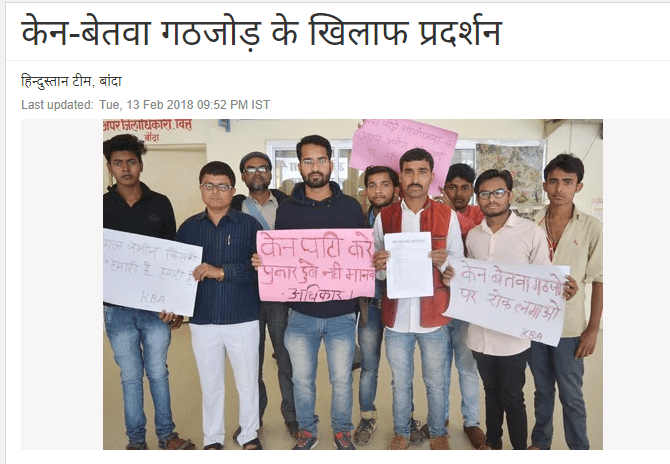
When Central Government is trying to push Ken Betwa link project terming it as beneficial for both Madhya Pradesh and Uttar Pradesh, local people of Banda are now also protesting against it, in addition to the people of Panna that are already opposing it. On Feb. 13, 2018, the Ken Bachao Samiti comprising of farmers, citizens and social workers in Banda sat on a Dharna before district magistrate office. The group have also sent a memorandum to the President of India, demanding immediate cancelling of the project. Raising serious concerns over environmental and social of the linking project, they asked demanded proper impact assessment and public consultation and said the project wont be allowed to go forward. Indeed, as they have said, there has been no downstream impact assessment and people of Banda are likely to loose their river. https://www.livehindustan.com/uttar-pradesh/banda/story-demonstrate-against-ken-betwa-alliance-1800951.html (Hindustan Hindi,13 Feb. 2018)
In this comprehensive article Mumbai-based author Vaishnavi Chandrashekhar throws the light on the plight of Uraban Rivers. “Rivers and streams have borne the brunt of the recent urban explosion in India, a nation whose population has nearly doubled in the last 40 years to 1.35 billion. Unplanned growth has led to the use of water bodies as dumping grounds for sewage and industrial effluent. According to CPCB, 63 % of the urban sewage flowing into rivers (some 62 billion liters a day) is untreated.
In addition, riverbanks, wetlands, and floodplains have been claimed over time by infrastructure, slums, offices, and housing developments – all of which has narrowed natural river channels and distorted flow, greatly reducing the ability of India’s rivers to buffer flooding. It also has taken a toll on biodiversity. http://e360.yale.edu/features/dying-waters-india-struggles-to-clean-up-its-polluted-urban-rivers (Yale Environment 360, 15 Feb. 2018)
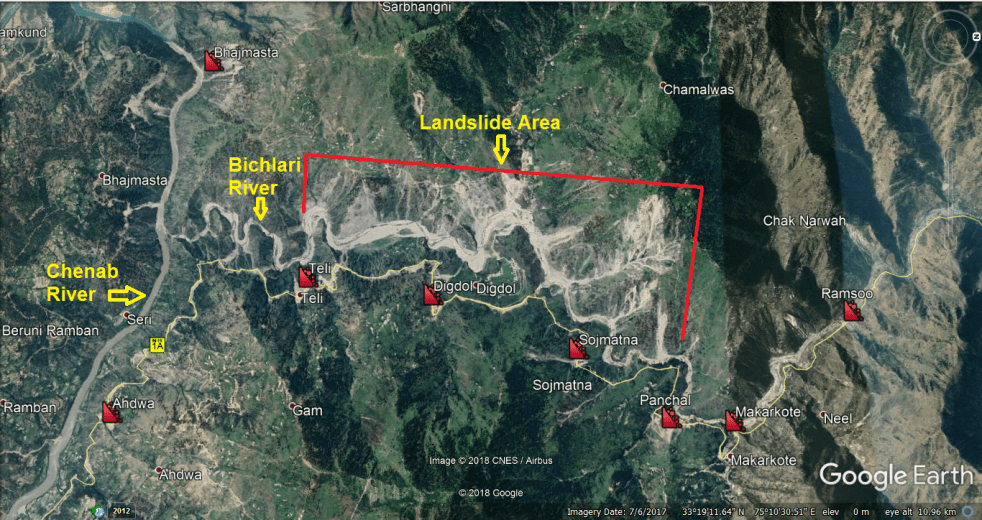
Finally, after five days gridlock, the Jammu-Srinagar National Highway (NH-1A) has been opened to traffic, on Feb 17, 2018, but only for one side. The all weather road was closed since February 12, 2018 following landslides at multiple locations along Bichleri (Bichiari) stream (a tributary of Chenab River) between Banihal and Ramban area. The highway was briefly re-opened for traffic on February 14 only to be closed again on February 15, due to recurring landslides.
We have narrated below some details of the landslides along Jammu Srinagar Highway in Feb 2018 as well as earlier since 2011.
take on the mighty river.” (Seeking the Beloved, translations of Shah Abdul Latif Bhitai’s Poems)
Sohni in modern art by Aparna Caur
In the inky, starless night, beautiful Sohni plunged into the flooded River Chenab to meet her beloved Mehwal, knowing well that she will never make it to the other side. Sohni is one of the seven heroines brought to life by Shah Abdul Latif Bhitai, a remarkable 18th Century Sufi poet, mystic and reformist living on the banks of Indus. Sohni was the wife of a potter, in love with Mahiwal, a cattle herder from the banks of the Chenab. Like all poignant love stories, Sohni-Mahiwal’s tale was short-lived, but 300 years later, the legend of Sohni flows through the Chenab and lives on in the songs of peasants. In Punjab, the land of five rivers, they sing of Sohni, of the roaring, helpless river and of mad, wilful love. The narrative is so unwrinkled and dewy that till this day, silent figures sweep the modest tombs of Sohni and Mahiwal, hoping that their love will meet a better fate. Like Sur Sohni (Sohni’s poem) from Shah jo Risalo (Poetry of the Shah) prophecised:
Supreme Court of India passed the much awaited 465-page Judgment on Cauvery Water Dispute on Feb 16, 2018[i]. After the Cauvery Water Disputes Tribunal declared its award on Feb 5, 2007, a number of Appeals were filed in the SC, challenging the Tribunal Award, including those by Karnataka and Tamil Nadu. By this Judgment, the SC has partially allowed the Karnataka Appeal (Civil Appeal 2453 of 2007) and disposed off all the appeals. The Award was published in gazette only in 2013, following an earlier SC order. The SC Judgment provides additional 14.75 TMC (Thousand Million Cubic Feet) of water to Karnataka and thus reduces Tamil Nadu’s share to that extent.
This week there are exemplary and encouraging wetlands revival stories from three metro cities of Chennai, Hyderabad and Delhi. In the first example from Hyderabad, meticulously chosen plant species such as tulsi, aswagandha, citronella and hibiscus have been used to create an artificial island to clean Neknampur Lake. The treatment islands are composed of four layers of which the bamboo base keeps the entire structure afloat. Based on soil-less hydroponics, these floating treatment wetlands absorb excess nitrates, thereby reducing the chemical content of the lake water. Microorganisms present in the wetland break down organic matter while the root systems filter out pollutants and sediments. https://www.thenewsminute.com/article/3500-saplings-floating-islands-help-rejuvenate-hyd-neknampur-lake-75819 (The News Minute, 3 Feb. 2018)
Similarly, Chennai-based Care Earth Trust along with the public works department (PWD) and the civic body has managed to restore three urban lakes. While many of the smaller wetlands have vanished over time, many mid-sized wetlands seem to have shrunk by almost 65 percent. Thanks to their joint effort, invasive hyacinth was removed from the Narayanapuram Lake in Pallikaranai, while sewer lines, which emptied into the Perungalathur Lake, have now been plugged. A detailed restoration proposal has been forwarded to the PWD regarding the Korattur-Madhavaram-Ambattur lakes. https://timesofindia.indiatimes.com/city/chennai/hyacinth-out-sewer-line-plugged-three-water-bodies-restored/articleshow/62748110.cms (The Times of India, 2 Feb. 2018)
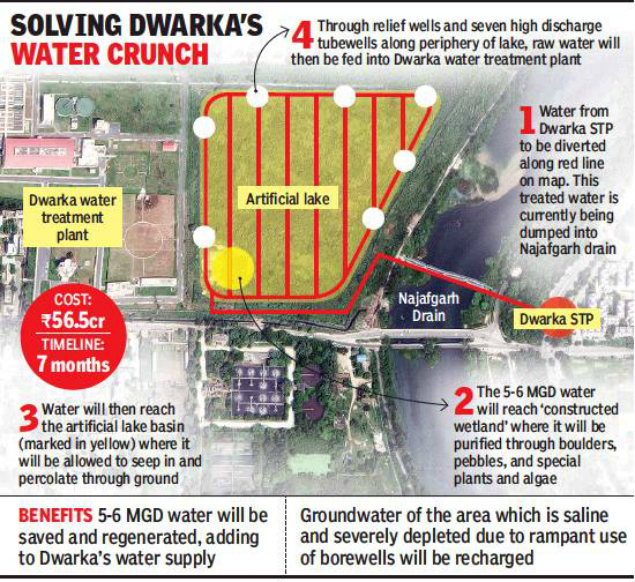
Meanwhile, Delhi Jal Board (DJB) has taken up interesting new project of creating an artificial lake in Dwarka. The project will supply water in sub-city and improve ground water level too. DJB has approved Rs. 56 crore for the project which will be completed in next seven months. This would the first model project wherein a lake will be used to augment water supply. The special lake is being created next to the Dwarka water treatment plant (WTP) will have a sand bed to allow maximum percolation of water into the ground. It will have a capacity of 10 million gallons (MGD). The project is expected to add supply of 5-6 million gallons water to Dwarka every day.