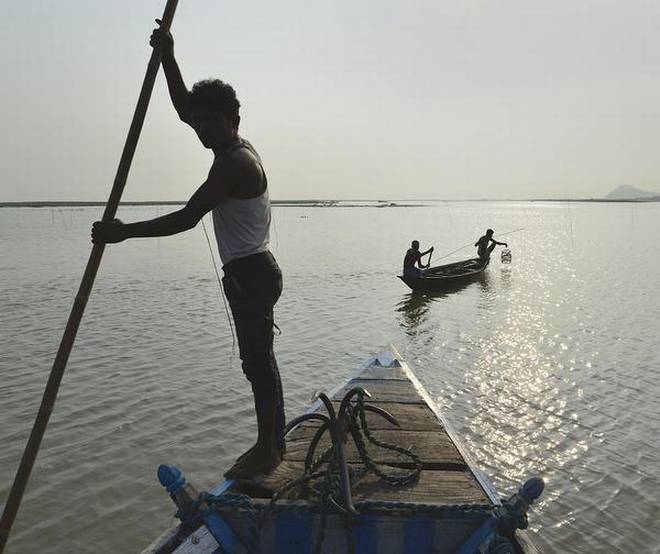
The Brahmaputra is believed to have two mythological fathers – Lord Brahma and sage Shantanu. In the 16th-century text Yogini Tantra, dedicated to the worship of goddesses like Kali and Kamakhya, the river is linked to an ancient ablution ritual with the following invocation:
O Son of Brahma! O Son of Shantanu! O Lohit! O Son of Lohit!
I bow before you, wash away my sins of the last three births.
Category: Dams, Rivers & People
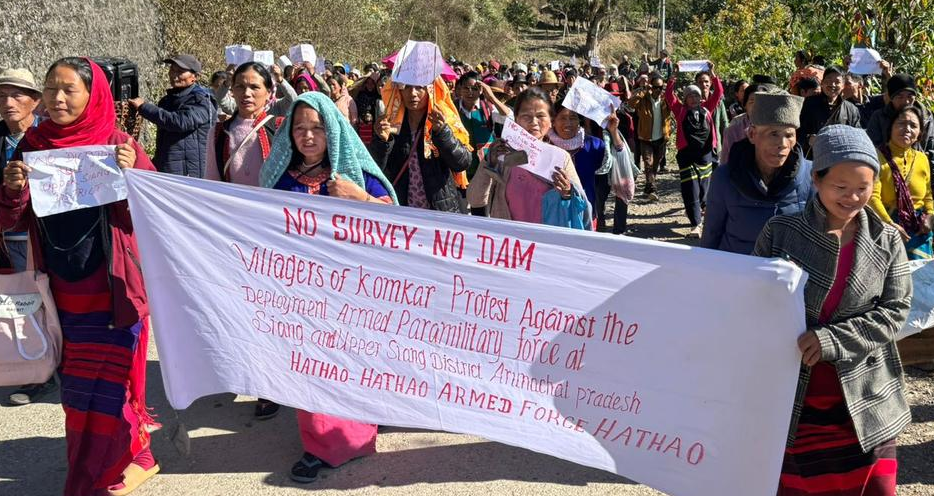
2024: People’s Resistance against Dam, Hydro Projects in Himalayan States
(Feature Image: Tribals in Siang river belt in Arunachal Pradesh demonstrating against a proposed mega hydropower dam. Photo Credit: Special Arrangement/The Hindu)
All through 2024, the vulnerable communities across Himalayan states have continued their resistance and struggles against proposed, under construction & damaged hydro and dam projects as can be seen in this yearend roundup.
The tribals in Siang valley have been urging Central and State govts to stop pushing the giant SUMP. In Teesta valley the GLOF, flood and landslide though have served as wake-up call, the planners seem to ignore the warnings. Facing adverse impacts, the native people in Manipur have resolved to stop further extension to Loktak lake HEP. In Nagaland, fearing damages, the villagers have made the future of Dikhu HEP uncertain.
Continue reading “2024: People’s Resistance against Dam, Hydro Projects in Himalayan States”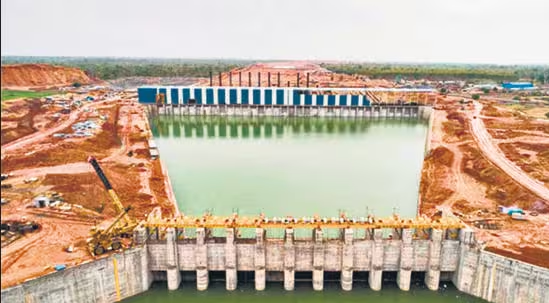
DRP 180324: Electoral Bonds disclosures confirm political economy of large dams
(Feature Image: A controversy over alleged engineering lapses in the ₹1 lakh cr Kaleshwaram project on Godavari triggered an electoral slugfest. HT, 03 Nov. 2023)
The Electoral bonds details now in public domain, thanks to the Supreme Court of India orders, has once again highlighted the political economy of large dams, hydropower projects and irrigation projects. It has once again confirmed what was publicly known that such large water projects involve kickbacks to political parties.
The details so far available involves companies like Megha Engineering, Rithwick Projects Pvt Ltd, Navayuga Engineering Company Ltd, among others. The projects so far that seems to be involved include Polavaram Dam, Kaleshwaram Lift Irrigation Project, Sunni Dam and Hydro projects, Kundah Pump Storage Hydropower project in Tamil Nadu and Silkyara Tunnel, almost all of them also involved in some kind of disaster or other.
Continue reading “DRP 180324: Electoral Bonds disclosures confirm political economy of large dams”
DRP 110324: Bangalore reminds us: Ignore groundwater at your own peril
(Feature Image: People stand in a queue with water cans to get drinking water at Jnana Jyothi Nagar, in Bengaluru. Image Source: PTI/Live Mint, 10 March 2024)
One central lesson of the ongoing Bangalore water crisis is essentially that ignore groundwater sustainability at your own peril. The surface water availability in Bangalore has not decreased, it is the groundwater depletion that is leading to crisis. There is of course the expansion of the city both horizontally and vertically that is increasing demands, but simple arithmetic tells us that if groundwater levels are sustained, it can take care of these increased demands.
The Groundwater sustainability includes sustaining the groundwater recharge and ensuring that extraction does not go past the recharge. Sustaining the groundwater recharge means first understanding the groundwater recharge mechanisms, zones and protecting them. BDA has been sitting for four years on desilting of two lakes: Bellandur and Varthur, which has caused huge impact on groundwater depletion. It also means increasing the groundwater recharge through rainwater harvesting (Bangalore’s failure here is apparent from the fact that government is collecting crores of rupees as fines from those not following the mandatory rainwater harvesting requirements), groundwater recharge wells and diverting tertiary treated sewage, available in Bangalore of upto 300 Million Liters per Day, to lakes and other such recharge zones.
Continue reading “DRP 110324: Bangalore reminds us: Ignore groundwater at your own peril”
DRP 040324: Ganga Water not fit for even bathing in Uttarakhand, UP, Bihar, W Bengal
(Feature Image: A drain falling into Ganga in Varanasi. Source: Amar Ujala)
A number of reports given below from this week shows that Ganga River water is not fit for even bathing at a number of locations in Uttarakhand, Uttar Pradesh, Bihar and W Bengal. These are all official statements, mostly given in reports submitted to judicial bodies or statements by the judicial bodies.
This shows how little progress has been achieved by the government, including by the Prime Minister, central and concerned state governments including by schemes like Namami Gange and scheme of National Mission for Clean Ganga and expenditure of tens of thousands of crores of rupees. This is in spite of the promises given in the past by the Prime Minister and Union Ministers including Nitin Gadkari to clean the river by deadlines that have come and gone.
The worst part is that if we look at the trajectory of various work being done in this regard, we see no hope of any improvement in the foreseeable future unless there is major change in the way this problem is dealt with. But how will such a major change happen?
Continue reading “DRP 040324: Ganga Water not fit for even bathing in Uttarakhand, UP, Bihar, W Bengal”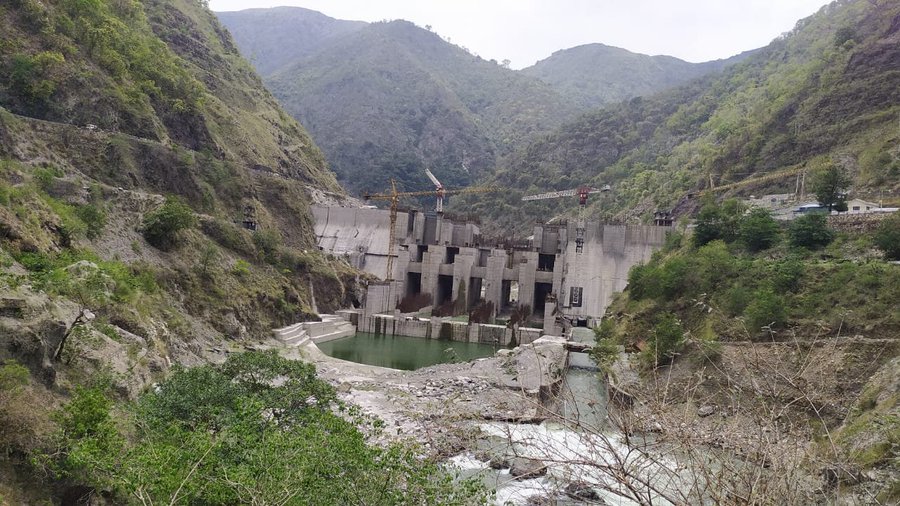
DRP 28 Mar 2022: Is Climate Change making big dams MORE dangerous?
That big dams are dangerous, disaster prone is well known, the parliament having passed the Dam Safety Act is just one of the clear evidence of it. However, are big dams becoming even MORE dangerous in changing climate? All the science and also practical evidence seems to suggest that. This is also what the SCROLL report mentioned below concludes.
What is shocking is that the CWC (Central Water Commission), India’s premier technical body on dams and water, when asked about this through an RTI, is in slumber. CWC told the journalist that there are no such cases! This should be worrying for everyone concerned including those in the risk zone of the dams, the beneficiaries of the dams and also the dam operators. This also exposes how weak is the mechanism set up by the Dam Safety Act passed recently by the Parliament is. This is because under the act, CWC Is the main organisation responsible dam safety in India. Can CWC really save us from unsafe dams, structurally unsafe or operationally unsafe? The SCROLL article illustrates through the example of Andhra Pradesh dams that CWC has not. It also quotes the compilation of SANDRP where to the frequency of disasters are only going up and there is again no confidence inspiring role from CWC.
Continue reading “DRP 28 Mar 2022: Is Climate Change making big dams MORE dangerous?”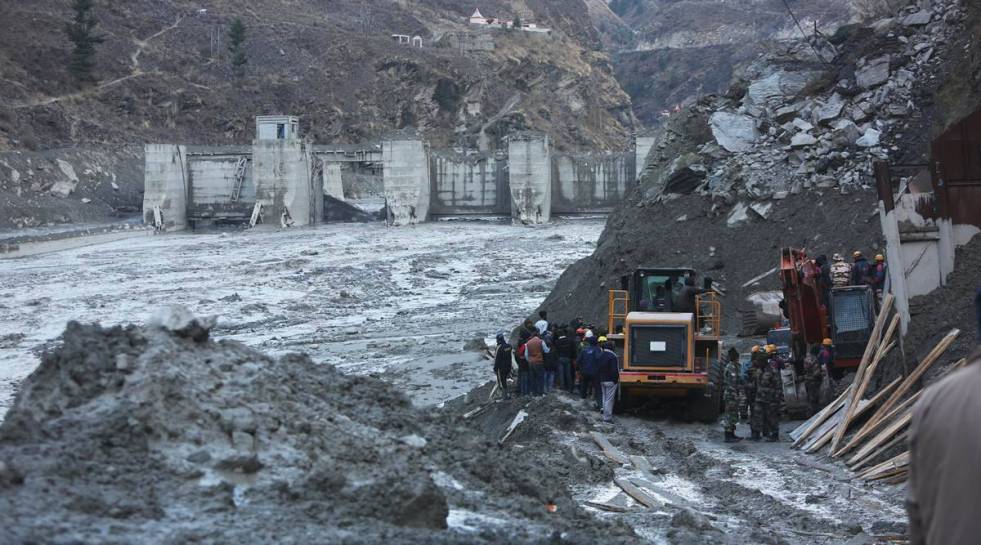
DRP 150221: Why Mangshri Devi of Tapovan Should Head Uttarakhand’s Disaster Management Department?
Feature image Tapovan-Vishnugad hydropower project in Chamoli district on Feb., 7 by Gajendra Yadav, Express Photo
In a fantastic story, Shivani Azad of The Times of India has reported possibly the most remarkable story of the Chamoli avalanche disaster that started on Sunday morning on Feb 7, 2021. She reported that Vipul Kairuni of Dhaak village in Tapovan, working at the time at the now destroyed Tapovan Vishnugad project, got saved thanks to frantic calls by his mother Mangshri Devi as she and his wife saw from their village home, situated at a height from the river, that a massive flood is approaching the dam site. It was thanks to frantic, repeated calls by Mangshri Devi that not only Vipul, but at least two dozen more people could run to safety of a ladder and saved their lives.
So effectively, Mangshri Devi has saved at least two dozen lives in Chamoli disaster. Who else can claim to have achieved anything like that in the disaster? The disaster management department seems completely absent from the scene either in terms of pre disaster monitoring or in taking steps to save lives during the disaster. In fact, there should have been an early warning system in place that could have saved many more lives. But it does not exist. Either in Rishiganga/ Dhauliganga basin or anywhere else in Uttarakhand. NTPC’s Tapovan Vishnugad Project has faced so many disasters already since 2008, but is only now talking about putting in place early warning system. Should not the NTPC and power ministry top brass as well as Uttarakhand disaster management department held accountable for that?
Continue reading “DRP 150221: Why Mangshri Devi of Tapovan Should Head Uttarakhand’s Disaster Management Department?”
DRP 080221: Will NITI Aayog study the costs of overturning the Radhakrishnan Judgement on Uttarakhand?
NITI Aayog, we learn, has started studies of implications of the Supreme Court and NGT orders on environment issues. In the context of the massive Chamoli disaster now unfolding in Uttarakhand, NITI needs to urgently institute an inquiry as to who all are responsible for overturning the Justice Radhakrishnan led verdict of Aug 13, 2013 about the June 2013 Uttarakhand disaster and role of hydropower projects in the disaster and the costs of overturning that verdict. In fact if the Justice Radhakrishnan verdict were to have been sincerely and honestly implemented to its logical conclusion, the proportions of the current Chamoli disaster and others would have been majorly reduced. So the costs are no doubt huge and mounting. Will NITI Aayog institute such an independent inquiry urgently?
Continue reading “DRP 080221: Will NITI Aayog study the costs of overturning the Radhakrishnan Judgement on Uttarakhand?”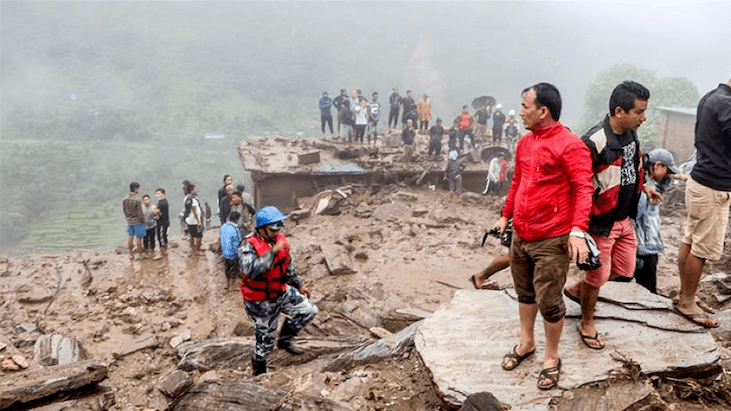
Dams, Rivers & People overview of Nepal 2020
This report provides and overview of key developments in Nepal about Dams, Rivers, Environment and people in 2020, we had provided similar overview in 2019[i] too. We have divided the overview into these sections: Hydropower projects, Power Trade, Governance, River Sand Mining, Monsoon 2020 dominated by Landslide news, Climate Change, India-Nepal issues dominated by Pancheshwar and border dispute issues, Nepal China issues.
Continue reading “Dams, Rivers & People overview of Nepal 2020”
Dams, Rivers & People 2020 through the DRP LEAD STORIES
In SANDRP’s weekly News Bulletins, we select lead story each week. Here we try to look back and take stock of major happenings of 2020 through a compilation of DRP lead stories to recapitulate major happenings related Dams, Rivers, Water and Environment. While doing this we are aware that this may not completely capture all the key happenings in this sector, since not all the major developments are captured by the media and their headlines. However, it does provide some idea about what were the major developments in this sector in the just outgoing year 2020. We have divided the lead stories under several key classifications like River Management, Environment Governance, Dams, Hydropower projects, Flood management, groundwater management etc.
Continue reading “Dams, Rivers & People 2020 through the DRP LEAD STORIES”
