Dams · DRP News Bulletin

DRP: 22 Feb. 16 (Unprecedented water crisis in Delhi due to Jat quota stir)

Unprecedented water crisis in Delhi due to Jat stir Terming the water crisis in the national capital as “unprecedented”, Delhi minister Kapil Mishra has warned that the situation might worsen in the next few days if the supply from Haryana is not immediately restored. He said the Delhi Jal Board (DJB) had almost run out of water and advised people to use water judiciously. Delhi gets its bulk of water supply from Haryana and the stir has affected 65% of water supply in Delhi has been cut with the shutting down of seven water treatment plants— Wazirabad, Chandrawal, Dwarka, Okhla, Haiderpur, Nangloi and Bawana which provide around 500 million gallons per day (MGD). In all Delhi has nine water treatment plants which together produce 820 MGD of potable water. Of these, only two Sonia Vihar and Bhagirathi fed by water from Uttar Pradesh are operational. The current production is only 240 MGD. Among the areas affected were Dwarka, Janakpuri, Munirka, Palam, Rajouri Garden, Punjabi Bagh, Vasant Kunj, Saket, Green Park and Lodhi Colony, where residents complained of little or no water. In another news report DJB is reported to have made 140 water filling points functional to feed tankers which would be sent across the city, reeling under an unprecedented water crisis. Water Minister Kapil Mishra reviewed the contingency plan for water management in West, North, North-west, Outer and Central Delhi and said tankers will deliver water at 663 points to partially meet the shortage of 480 MGD. These points will keep rotating. Plan is to cover around 2,000 points by Monday evening. The DJB supplies around 900 MGD of water daily out of which around 600 MGD of raw water come from Munak Canal. Even if Haryana releases water immediately, it will take at least 24 hours to restore the supply. Meanwhile Supreme Court on 22 Feb.16 scolded Delhi government. for approaching the court instead of resolving the water crisis with Haryana. The Kejriwal government had approached the top court on in view of the severe water crisis in the national capital after Jat protesters blocked water supply through Munak canal in Sonipat. During the hearing on government’s plea, the court took strong objection to Water Minister Kapil Mishra’s presence inside the courtroom. On the other hand, the minister accuses Haryana & Central Government for providing no official information on the crisis He said the Delhi government was “repeatedly trying to communicate” with the two governments to find out when will the supply resume, but without much success. Also see Jat quota stir: Water supply cut, Delhi may go dry 

Continue reading “DRP: 22 Feb. 16 (Unprecedented water crisis in Delhi due to Jat quota stir)” →

Dams · DRP News Bulletin

DRP: 15 Feb. 2016 (Govt plans National Water Commission)

Govt plans National Water Commission In one of the most significant reforms in the water sector in a long time, the govt is in the process of ordering a complete restructuring of the organisations responsible for regulating the use of water resources, with the objective of bringing in greater efficiency, better planning and increased emphasis on conservation of water. According to news report the Central Water Commission (CWC), which oversees irrigation projects, flood management and drinking water supply, and the Central Ground Water Board (CGWB) are likely to be disbanded, and a National Water Commission is proposed to be set up in their place. A few other smaller organisations with specialised mandate like data gathering and analysis are also likely to be created.

A team under Mihir Shah, a former member of the then Planning Commission of India, is already preparing a blueprint for better management of water resources. The idea of institutional restructuring is said to have the backing of this panel. It is likely to submit its report in the next two months. In the new scheme of things, more emphasis is being given to judicious use, and conservation, of ground water. It is estimated that despite elaborate irrigation projects, about 60 per cent of irrigation during the non-rainy season is still done by pumping out ground water. The large irrigation projects, meanwhile, have given sub-optimal results.

A large number of sewage treatment plants, being built as part of the Clean Ganga initiative that will eventually spread to other rivers as well, will provide a new source of water that is fit not only for industrial use but also for irrigation and many other purposes. The river rejuvenation plans, not just of Ganga but others as well, will become an integral part of overall water resources management. Apart from reducing pollution in the rivers, and maintaining a minimum ecological flow, the rejuvenation plans would also ensure that the rivers are able to adequately recharge the aquifers in its basins.

Allocation of water resources to each state is also on the agenda. But this process is likely to take time as it would involve extensive consultations with the state governments. Once a consensus emerges, a central legislation on allocation of water resources is planned to be brought in. This is aimed at reducing inter-state water disputes.

Continue reading “DRP: 15 Feb. 2016 (Govt plans National Water Commission)” →

Dams · Sand Mining

River Sand Mining in India in 2015–III–Judicial Actions

Unsustainable sand mining from riverbeds can have huge social, environmental, geomorphic and disastrous impacts for rivers. In this three part reports; SANDRP is trying to provide a picture of what happened on this issue in 2015 in India. The first part covered the detail of illegal sand extraction across many Indian States in 2015. The second part presented an account of measures and actions taken by Central and State Governments (Govts).

This third and final part provides information on significant judicial decisions issued by different Courts particularly National Green Tribunal (NGT) in 2015.  Continue reading “River Sand Mining in India in 2015–III–Judicial Actions” →

Dams · Maharashtra · Western Ghats

Large Dams in Konkan Western Ghats: Costs, Benefits and Impacts

Introduction 

Konkan is that narrow and spectacular strip of land encompassing coastlines, estuaries, lateritic plateaus, foothills of Western Ghats and dense forests, which runs from Maharashtra to Goa. Bound by the Arabian Sea to its west and the mighty Sahyadri ranges (Western Ghats) to its east, the region has a distinct and rich culture of folklore, performing arts, music, literature, culinary art. Konkan, its temples, rivers and forests have an entire Sahyadrikand of the SkandPurana dedicated to it. Several poems and songs have been penned about the beauty, the mystery and the people of this region. Many of our celebrated singers, poets and authors come from Konkan. Community conservation practices that thrive here include some of the most pristine Sacred Groves, Temple Tanks, Fish Sanctuaries and sacred trees. Continue reading “Large Dams in Konkan Western Ghats: Costs, Benefits and Impacts” →

Dams

LETTERS TO EAC & MOEF: KEN BETWA LINK IS A TRAGEDY: DON’T BURN LIFEBOATS TO STAY WARM ON SINKING TITANIC SHIP

Even as the Expert Appraisal Committee on River Valley and Hydropower Projects sits to decide about Environment Clearance to Ken Betwa River Link Proposal on Feb 8-9, 2016, a number of people have written to the committee against recommending clearance to the project. We are publishing here some of them: Continue reading “LETTERS TO EAC & MOEF: KEN BETWA LINK IS A TRAGEDY: DON’T BURN LIFEBOATS TO STAY WARM ON SINKING TITANIC SHIP” →

Dams · DRP News Bulletin

DRP: 8 Feb.2016 (Hiding Environment Information-Against Sabka Sath, Sabka Vikas?)

SANDRP Open Letter to MoEF&CC Is Not Hiding Environment Information Against Sabka Sath, Sabka Vikas? Even as the Ministry of Environment, Forests and Climate Change has been sanctioning cascades of hydro power projects on here-to free flowing rivers in the Himalaya and North East India, Cumulative Assessment of the Impacts of these projects became a crucial area of concern. The cumulative impacts of these projects on the hydrology, downstream flow, sudden water releases, deforestation, muck disposal, influx of migrant workers, seismicity of the region etc. is huge as compared to individual impacts. The projects together stand to change the social and ecological fabric of these regions.

Cumulative Impact Assessment (CIA) studies are a part of the Environment Impact Assessment Process under the EIA Notification (2006) and Environment (Protection) Act 1986. The documents of these CIAs have been uploaded on the Environment Clearance website in the past, as was required under number of laws. However, as the EAC is slated to consider whopping 4 CIAs in its upcoming meeting on the 8 and 9th Feb, not a single CIA-related document is available on the MoEF and CC website! We are told that these may not be made available in the future.

Continue reading “DRP: 8 Feb.2016 (Hiding Environment Information-Against Sabka Sath, Sabka Vikas?)” →

Arunachal Pradesh · Cumulative Impact Assessment · Dams · Himachal Pradesh · Ministry of Environment and Forests

Cumulative Impact Assessment documents not in public domain anymore? Letter to MoEF and CC

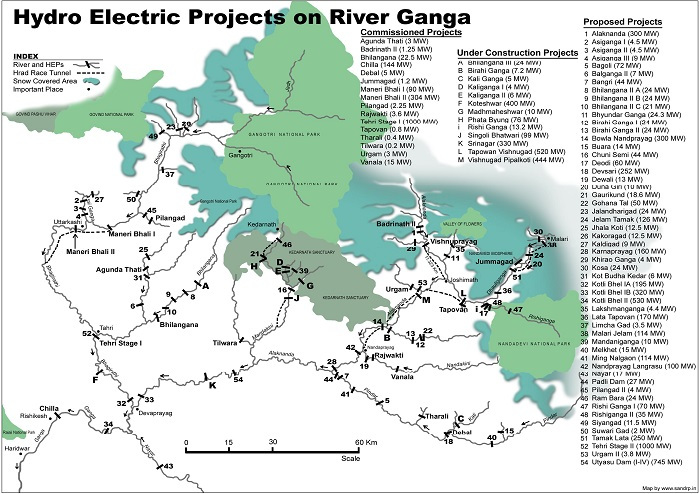
Even as the Ministry of Environment, Forests and Climate Change has been sanctioning cascades of hydropower projects on here-to free flowing rivers in the Himalaya and North East India, Cumulative Assessment of the Impacts of these projects became a crucial area of concern. Over 70 dams are planned one after other for the rivers of the Upper Ganga Basin, 44 dams across the Siang Basin in Arunachal Pradesh famed for its pristine forests and biodiversity, 12 dams across the Lohit Basin, 19 for Subansiri basin. These are bumper to bumper projects, one starting where the other ends. Continue reading “Cumulative Impact Assessment documents not in public domain anymore? Letter to MoEF and CC” →

Dams

River Sand Mining in India in 2015 – II – Government acts of omissions and commissions

Unsustainable sand mining from riverbeds can have huge social, environmental, geomorphic and disastrous impacts for rivers. In this three part reports; SANDRP is trying to provide a picture of what happened on this issue in 2015 in India.

In the first part SANDRP has published the detail of illegal sand extraction that was found rampant across many Indian States in 2015. It specifically covered the increased numbers of attacks on Govt. officials including common men against their attempt to expose and oppose illegal removal of sand from riverbeds. 

This second part presents detail of some of the significant steps taken by Central and various State Governments (Govt.) to control and regulate unsustainable excavation of riverbed sand mining.

Continue reading “River Sand Mining in India in 2015 – II – Government acts of omissions and commissions” →

Dams · DRP News Bulletin

DRP: 1 Feb 2016 (Experts suggest ways to revive Madurai’s dying rivers)

Tamil Nadu Experts suggest six ways to revive dying Madurai’s rivers According to a paper entitled Future Proofing Indian Cities: Towards an approach to spatial and social analysis for sustainable development of Madurai by Jayaraj Sundaresan Development Planning Unit, University College London J. Kanagavalli DHAN Foundation, Madurai their documentation has revealed the significant role of Kruthumal River in the historic, cultural, ecological and economic growth of Madurai. Centuries ago, Madurai city developed as a small urban settlement on the banks between the rivers Kruthumal and Vaigai. Appearing in epics and sacred texts such as Srimad Bhagavatham and Narayaneeyam, Kruthumal has significant presence in the written history of Madurai. It was also known as Narayana Cauvery. It supplied water to the Ahazhi (moat) around the Tirumalai Nayakkar palace in Madurai. The paper gave six methods to look after Vaigai and Kruthumal Rivers in Madurai.  Looking at the condition of the rivers one feels it is hopeless, but there is hope if together with the government, something is done to control the destruction of the river, by law. And with organizations like DHAN Madurai can hope for a clean Vaigai in the future.

Continue reading “DRP: 1 Feb 2016 (Experts suggest ways to revive Madurai’s dying rivers)” →

Dams · DRP News Bulletin

DRP: 25 Jan. 2016 (FAO supports SRI)

“Save & Grow” FAO supports SRI A new FAO book out on 18 Jan.16 takes a close look at how the world’s major cereals maize, rice and wheat can be grown in ways that respect and even leverage natural ecosystems.  FAO also underscores that “Save and Grow” farming systems are knowledge-intensive, and need to be built on local knowledge and needs, recognizing the important role of farmers as innovators. GREAT to see that this FAO publication (http://www.fao.org/3/a-i4009e.pdf ) contains a very detailed discussion and presentation on SRI, the first time that there has been such an endorsement of SRI (System Rice Intensification). With this publication, FAO joins the World Bank (http://info.worldbank.org/etools/docs/library/245848/) and IFAD (http://www.ifad.org/english/sri/  and http://www.ifad.org/english/sri/documents.html).

Continue reading “DRP: 25 Jan. 2016 (FAO supports SRI)” →