Dams

How Efficient is Maharashtra’s Sugarcane Crop?

That question may sound slightly irreverent and irrelevant.

Maharashtra is the highest sugar producing state of India. Its sugarcane yield in 2011-12 was 80.1 t/ha, compared to the yield of 59.6 t/ha for the second highest sugar producing state Uttar Pradesh and national average of 70.3 t/ha. The average sugar recovery rate of the four sugarcane cultivation methods in Maharashtra was 11.32% in 2011-12, the recovery rate of Adsali sugarcane was even higher at 12.3%. The Maharashtra average was way above that of UP at 9.16% and all India rate of 10.2%. In fact the land productivity adjusted for recovery rate is even higher for Maharashtra at 98.8 t/ha (161.14 t/ha for Adsali) compared to 61.04 t/ha for UP. The yield per month when adjusted for recovery rate is 7.56 t/ha/month compared to 6.33 t/ha/month for UP.

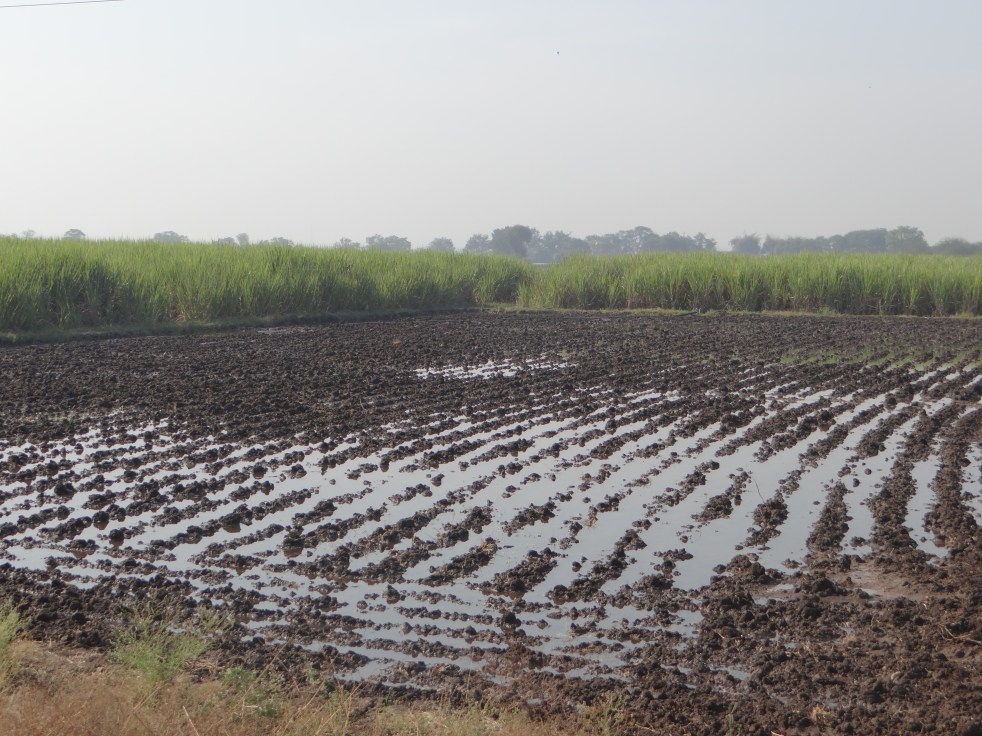
DSC02055

 So with the highest production, high yield and high recovery rate, there should be no question of efficiency of Maharashtra sugarcane crop.

Indeed.

Methods of Sugarcane cultivation in Maharashtra Let us understand the basic parameters of how sugarcane crop is grown in Maharashtra, see the table 1 below.

 Table 1. Basic parameters of sugarcane crop in Maharashtra in 2011-12

Table_SugarcaneEfficiency

Source: Price Policy for Sugarcane: the 2013-14 Sugar season, Commission for Agricultural Costs and Prices, Ministry of Agriculture, Government of India, Aug 2012, Table 5.1

 Of the four sugarcane cultivation methods prevalent in Maharashtra, Ratoon is most popular with 40% cane area under it, possibly since it has shortest duration at 11 months, fitting almost perfectly with the annual Oct to March cane crushing season. Same can be said about Suru method, having duration of 12 months and coverage of 20%, both methods requiring 22.5 irrigations, each of 7.5 cm depth. Adsali method has the highest yield and recovery rate, but only 10% of the sugarcane area is under this method, possibly since it has the longest duration at 17 months. It is most water intensive, requiring 32.5 irrigations. Pre-seasonal method, as the name suggests, is planted about 2.5 months before the season, and stands between Ratoon and Adsali in terms of duration, yield and recovery rate.

DSC02339

 Water Productivity The latest report from CACP from which the above figures are taken, however states that land productivity alone does not give correct picture, “…as land and water are increasingly becoming scarce in India with high opportunity costs. Therefore, the real resource cost of growing sugarcane in different regions cannot be correctly compared unless land productivity is normalised for the time duration of crop, its water intake, and its recovery rate.” To make such a comparison, CACP made a table, a part of which is given above in Table 1.

 However, CACP has gone a step further than the figures in Table 1 (though there is an error in CACP calculations here, we have pointed this out to CACP). CACP has calculated water productivity of different sugarcane methods in Maharashtra and compared them with the water productivity in UP. The average water productivity of sugarcane in Maharashtra comes to 0.403 T/ha/month/’000 m3 water, compared to 1.11 for UP. This means that while UP seemed inefficient in sugarcane productivity in everyway, Maharashtra is inefficient by 175.43% when productivity per unit of water consumption is considered.
Dry Seena in Madha Block Solapur

 How is this possible? The reason why sugarcane productivity of UP in terms of water is higher is simple: UP sugarcane crop is of shorter 9-10 months duration and requires only 7-8 irrigations, approximately less than once a month. As against this, Maharashtra sugarcane crop requires irrigation every 15 days and that too for longer duration. To put it another way, while on average Maharashtra needs 25 irrigations for sugarcane crop, UP needs 7.6.

Water required per kg of sugar The CACP report further calculates that in Maharashtra every kilogram of sugar needs 2068 litres of water, where as in UP the requirement is almost half, at 1044 litres. This is indeed a telling figure. Add to it, as CACP report puts it, “real cost of water in Maharashtra is at least 2 to 3 times higher than that in UP”.

In response to a specific question, CACP chairman Dr Ashok Gulati wrote to me that this water calculation does not include the water used by sugar mills. If water used by sugar mills and water used in further downstream processing is included, the water consumption in sugar production is will go up substantially.

This analysis is very relevant for a state like Maharashtra that has much lower rainfall and per capita water availability compared to northern states like UP and Bihar. It is even more relevant when 79.5% of Maharashtra’s sugarcane is grown in drought prone districts as we showed in another blog.

How sugar mills lock up Maharashtra’s water future Considering water becomes even more important, looking at the kind of impact sugarcane cultivation is having in Maharashtra this drought season. Here it may be recalled that sugarcane is a long duration trans-season crop that has implications for water consumption beyond the point where decision for planting is taken. So even if the rainfall is normal or above when the crop is planted, the same crop will continue to have high water demand in the following year when it may be drought year. This creates really serious implications for water availability in the drought year particularly in drought prone, low rainfall areas. The impact on water available becomes even more serious in a state like Maharashtra where sugar mills are set up irrespective of water availability, violating the norms of distances, where sugar factories operate at way beyond their sanctioned capacity, where they violate the norms of no more than 5% of cultivable land under sugarcane, they dump untreated effluents into water bodies, thus polluting the water in such water bodies and so on. The lock in becomes even more stronger with the setting up of sugar mills, since their owners would like to get maximum cane every year, irrespective of water availability situation.

Sugarcane going to factories in drought affected Nagar District in March 2013

 The CACP report says Maharashtra is further worse off in terms of cost of providing water for sugarcane, “If this costing is included in calculating water productivity, the difference in sugarcane yields will be so high that, Uttar Pradesh and presumably Bihar, would turn out to be the most efficient producers of sugar per unit cost of water, adjusted for time duration and recovery.” CACP goes on to say that Maharashtra sugarcane grown on 3% of the total cropped area of the state, takes away 60% of irrigation water in the state, “leading to massive inequity in the use of water within the state”. These figures might be slightly outdated considering the expansion of sugar factories and sugarcane cultivation in recent years.

Band aid solutions won’t help One recommendation CACP report makes for Maharashtra is that much of sugarcane in the state must be brought under drip. Even the Chief Minister of State and the Union Agricultural Minister has made same recommendation. We are not sure if this is really a solution since this is unlikely to curb the unsustainable levels of sugarcane in drought prone districts of Maharashtra, considering the politics involved in the issue with large number of politicians owning sugar factories.

As per the Maharashtra Economic Survey figures for last two years, Maharashtra has provided subsidy for drip irrigation in 5.68 lakh ha and for sprinkler irrigation in 2.33 lakh ha between 2005-06 and 2011-12, thus providing subsidy for covering 8.01 lakh ha for these two techniques in these seven years. However, we see no impact of so much area under the drip and sprinkler irrigation on water situation in the state, nor do we see much of sugarcane under drip. State institute like the VSI does not even know how much sugarcane is under drip even though it has a section just for drip irrigation. More investment in drip for sugarcane is likely to give reasons for expansion of sugarcane empire in drought prone districts, in addition to opening the doors for more corruption.

 Another method called Sustainable Sugarcane Initiative can help the farmers to produce at least 20 per cent more sugarcane, and that too with 30 per cent of reduced water consumption and 20 per cent less chemical inputs. CACP report, though is silent on this.

DSC02239

Options like drip irrigation and sustainable sugarcane initiative should be explored for sugarcane cultivation in relatively water rich areas. However, in immediate future, Maharashtra needs to cancel all new licenses for sugar mills and put a halt to new mills and expansion of existing sugar mills in drought prone districts. For existing sugar factories, it needs to decide the level of sustainable sugarcane cultivation in each drought prone district through a transparent, independent process. Immediately in this drought year, no more water should be allowed to be used for sugarcane cultivation in drought prone districts.

Maharashtra faces a very challenging water future even if all these steps are implemented. Its water future is very bleak if no serious move is made in this direction.

Himanshu Thakkar (ht.sandrp@gmail.com)

South Asia Network on Dams, Rivers & People (www.sandrp.in)

References:

1. Price Policy for Sugarcane: the 2013-14 Sugar season, Commission for Agricultural Costs and Prices, Ministry of Agriculture, Government of India, Aug 2012 http://cacp.dacnet.nic.in/RPP/Sugarcane-2013-14.pdf

2. How is 2012-13 Maharashtra Drought worse than the one in 1972?, March 2013, SANDRP, https://sandrp.wordpress.com/2013/03/30/how-is-2012-13-maharashtra-drought-worse-than-the-one-in-1972/

3. Economic Survey for Maharashtra for 2011-12 and 2012-13

4. Sugarcane leaves farmers crushed, Business Line, April 15, 2013
http://www.thehindubusinessline.com/opinion/sugarcane-leaves-farmers-crushed/article4620505.ece

International Water Issues

Latest meeting of Committee of Secretaries: Govt of India pushes unviable hydro projects in North East Without due process

Latest meeting of Committee of Secretaries

Govt of India pushes unviable hydro projects in North East

Without due process


In a recently held meeting (see the latest updates on this issue from http://www.energylineindia.com/ on this below), the Committee of Secretaries have pushed for large hydro power projects in Arunachal Pradesh. As the agitation against the under construction 2000 MW Subansiri Lower HEP on Arunchal Pradesh border has shown any such move, without credible, independent and comprehensive options assessment, social and environmental impact assessment at project and basin level in a transparent and democratic way would prove to be disastrous not just from social and environment point of view, but also from economic aspects. Hurrying through such projects in the name of establishing prior use rights in the name of Chinese projects in Brahmaputra basin would not be helpful. The fact that the river and its ecology are in use by the people of Arunachal Pradesh, Assam, other North East and east India states, Bhutan and Bangladesh should be sufficient if prior use was indeed a tenable argument in international context.


Some new facts that have come to light from the CoS meet include:

  • According to the 9th report of the Inter-Ministerial Expert Group (IMEG), discussed during the course of the meeting, there has been an increase of three project sites on the mighty river since IMEG’s last report, prepared a few months earlier. A total of 39 Rune of the River projects/sites are now present on Brahmaputra and its tributaries.
  • Dam related peripheral infrastructural activity has gathered speed at Lengda, Zhongda and Langzhen, which are on the main course of Siang or Yarlung Tsangpo as it is called in Tibet. The Bome-Medog road which passes through the Great Bend Area is also being upgraded. The Joint Secretary, Ministry of External Affairs said that keeping in mind China’s bad track record to resolve water disputes, he was of the opinion that India should cooperate with other countries facing similar issues with China.
  • This report suggests that no instance of water diversion activities is discerned on the main course of the river and its tributaries.
  • Jiacha could be the next hydroelectric project on the mainstream of Brahmaputra River. It may be followed by hydroelectric projects at Lengda, Zhongda, Langzhen, where dam related peripheral infrastructural activity (including 4 new bridges) has gathered speed.
  • Dagu and Jiexu projects, which are also on the main course of Brahmaputra River, along with Nangxian project may see considerable development activity in future.
  • The China is carrying out series of cascading ROR projects in the· middle reaches of Brahmaputra, the same may be replicated in the Great Bend Area as a viable alternative to a single mega project and this needs further monitoring.
  • The CoS has directed the Technical Expert Group (TEG) to submit its action plan for establishing India’s user right within a month’s time. Cabinet Secretary directed TEG to submit a blueprint for action with indicative time lines within a month. CoS has recommended Additional Secretary, Ministry of Power to chair the TEG. Notably, the TEG along with other standing groups like IMEG, will continue to submit their six monthly reports.


Unfortunately, none of the reports of the TEG or IMEG are in public domain, nor are they available under RTI Act. The people of north east are kept in complete darkness about the decisions these officials take.


About the projects in the NE India, the CoS meeting noted:

  • Special Secretary, Water Resources, stated that 92 HEPs (above 25 MW) with aggregate capacity of 36,272.5 MW have been allotted of which about 20 are at some progressive stage of development.
  • While for 11 HEPs, aggregate capacity of 8,510 MW, the detail project reports (DPRs) have been submitted to CEA for examination, 9 projects worth 10,570 MW have been concurred by CEA.
  • In the case of Pashighat (2700MW) project, Techno Economic Clearance has been received and public hearing is scheduled next month.
  • Indeed as SANDRP analysis of functioning of EAC shows, the Expert Approval Committee has said yes to the largest of projects from Arunachal Pradesh.


An important agenda of the CoS meeting was to assess the progress of the measures suggested by the committee in its 4th meeting held on April 26, 2011. The committee had directed a Joint Steering Committee consisting of representatives from NHPC and Assam government to end the long standing deadlock at the 2,000 MW Subansiri HEP. Notably, the Joint Steering Committee has submitted its report in July 2012. In response to the CoS decision that Ministry of External Affairs (MEA) should firm up views on the modalities of initiating a more informed public debate on the issue of the Brahmaputra water diversion, MEA and MoWR have formed a joint mechanism to pursue the same. An FAQ has also been prepared on the subject to disseminate awareness. Apart from this, MoWR has initiated action on the decision of the CoS to hold informal discussion between concerned ministries for constructing multipurpose projects in Arunachal Pradesh. An inter-ministerial informal discussion was held in October 2011. An outcome of the meeting was that discussion of rehabilitation, an issue hampering many projects, should be project specific. Further, the Planning Commission has formed an Expert Panel to take up the sub-basin wise Environmental Impact Assessment (EIA) study under the chair of Chairman CWC which will submit its report this month.


Many of these actions of CoS and other related bodies clearly lack credibility. The Central Water Commission itself largely acts like a lobby for big dams in India and it is never known to have taken any credible steps for environment or EIA. Under the circumstances, the sub basin wise study that is expected from CWC would not have any credibility.


South Asia Network on Dams, Rivers & People (www.sandrp.in)


Some recent postings on this issue:
1.
http://tehelka.com/a-damned-race-for-power/#

2. https://sandrp.wordpress.com/2013/02/09/cutting-off-nose-to-spite-the-face-whose-nose-and-whose-face/

3. https://sandrp.wordpress.com/2013/02/11/india-pushing-for-a-water-treaty-with-china/

4. http://www.thehindu.com/news/national/expert-group-calls-for-monitoring-chinas-runoftheriver-projects/article4599260.ece

Dams

HC asks Maharashtra Govt to release water for Ujani: But will it help the drought affected?

Through its order on April 9, 2013 the Mumbai High Court has asked Maharashtra Govt to release water from upstream dams to  Ujani dam for mitigating drought in Solapur. The decision is welcome if the water released from upstream dam were to be used for the drought affected in Solapur. A division bench of Chief Justice Mohit Shah and Justice M S Sanklecha directed the government to release as much water as possible within 24 hours. The High Court’s order came in response to a PIL filed by a Solapur-based activist, Shankarrao Sathe. The PIL says that the Ujani dam gets water from the Bhima River which starts from Karjat in the Western Ghats. Between the source of the river and the dam, there are 20-22 dams.

Image

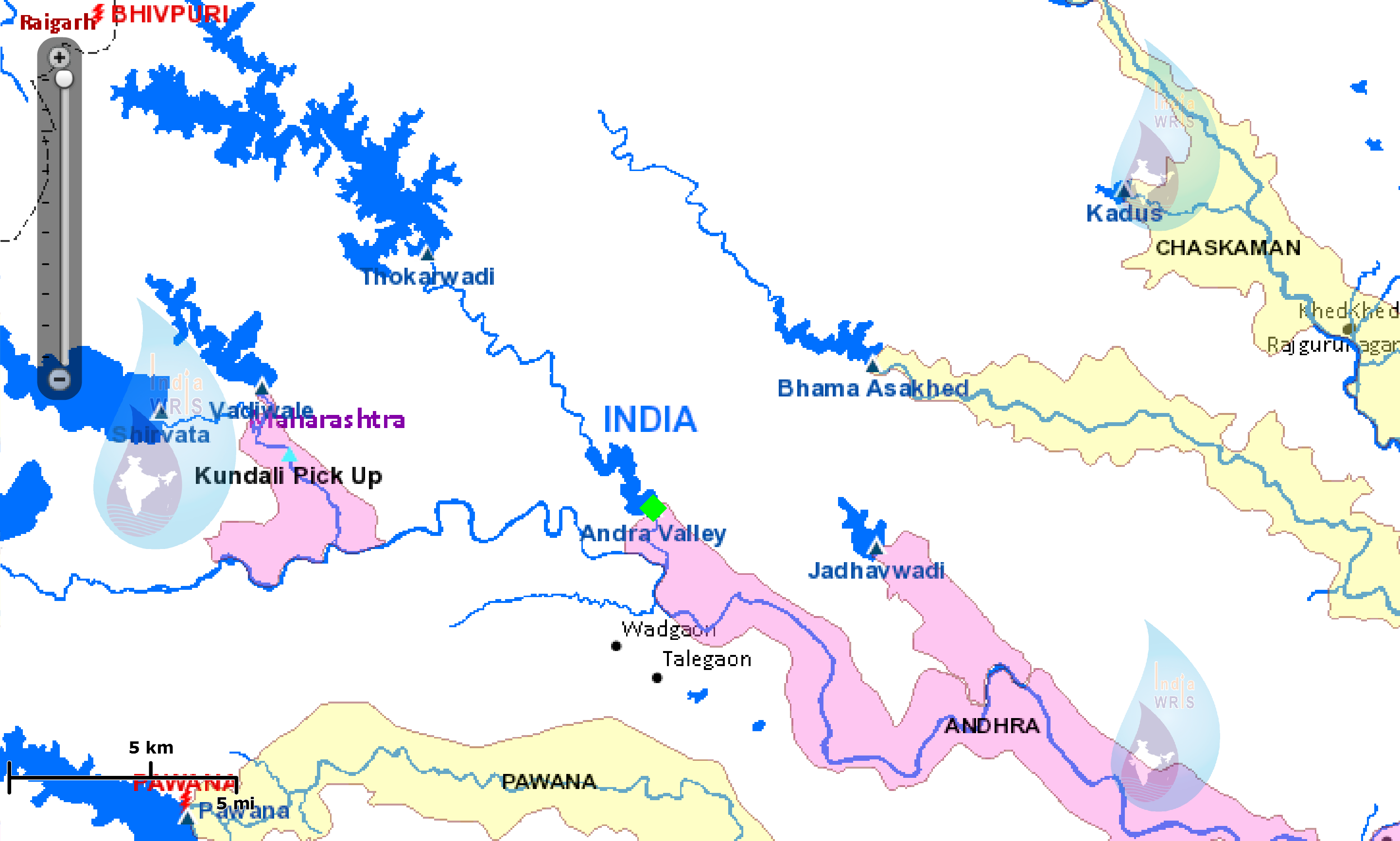
Highly-placed sources informed that soon after the High Court order, a high-level meeting was held in Mumbai to discuss the issue of release of water for Solapur as per the court orders.  Senior officials from Sinchan Bhavan in Pune attended the meeting which explored the options best suited for release of water to Ujani dam. The sources informed that it is likely that 2.5 TMC (70.8 MCM) water would be released from Bhama Askhed dam while half a TMC (14.16 MCM) water would be released from Andra dam, the WRIS map above shows the location of both these reservoirs. The water release would start from April 10, 2013, an official said. Bhama Askhed dam has design live storage capacity of 208.11 MCM and as per the latest (April 8, 2013) information, the dam had 124 MCM. Andra Valley dam has live storage capacity of 82.75 MCM. Both are irrigation and hydropower projects.

However, the moot question is, how much water would actually reach Ujani dam and how of that, how much water will really reach the drought affected people. Under the current circumstances, it is seriously doubtful if any significant proportion of the water released from upstream dams would reach the drought prone people, unless specific steps are taken to ensure the water is not diverted for non drought relief purposes.

Image

In that context, it needs to be noted that the water released from Bhama Asakhed and Andra Valley dams will have to travel about 250 km before it would reach the Ujani Dam. A very large portion of the water would be lost in evaporation and seepage and some also would be taken out by the enroute farmers as happened in the past with other water releases in Maharashtra earlier this year.

Moreover, Bhama Asakhed dam has irrigation potential of 29,465 Ha, but as per Irrigation Dept white paper, had irrigated area of just 434 ha by June 2012. The dam has 124 MCM storage now because it has not developed its irrigation potential over a decade since the dam has been completed. Why has that irrigation potential not realised? Pune has been eyeing water from Bhama Askhed for augmenting its water supply for a long time now, a demand backed by the same politicians who made mocked drought affected farmers.Similar questions also arise for Andra Valley dam.

Secondly, as per Solapur CADA website, the water level in Ujani dam as on April 9, 2013 is 16.74 TMC (474.3 MCM) below the live storage level. So even if the 3 TMC proposed to be released were to reach Ujani, the water level would still remain far below dead storage level.

Unfortunately, the Maharashtra Water Resources Department has never been able to control unauthorised use, let alone promote equitable usage of water from canals, dams and rivers. In our earlier blog, we showed how, even when it was clear that Maharashtra was going to face serious drought in 2012-13, no attempt was made to curb sugarcane farming, running of sugar mills or wine distilleries even when district officials have asked for such steps. This is also highlighted in the current drought, water conflicts in Manmad, in Nandur Madhyameshwar, in Mula Dam for Jayakwadi could not be resolved by the Water Resources Department.

With this background, though it is indeed a welcome decision that HC has ordered water release for Ujani from Pune Dams, it will be doubtful how much of that water will reach the purpose and area that it is meant for. The fact that all dams in a basin should have uniform water by the end of October is enshrined in the MWRRA Act 2005. It says:

Section 11: Power, functions and duties of the Authority states:

  • to determine the priority of equitable distribution of water available at the water resource project, sub-basin and river basin levels during periods of scarcity;

Section 12: General Policies of the Authority states:

in order to share the distress in the river basin of sub-basin equitably, the water stored in the reservoirs in the basin or sub-basin, as the case may be, shall be controlled by the end of October every year in such way that, the percentage of utilizable water, including kharif use, shall, for all reservoirs approximately be the same”. 

However, the establishment has made a mockery of this law by actually claiming that[1] MWRRA does not effectively exist as it does not have a Chairperson or expert members!

How can we then depend on the same WRD to ensure that water reaches Solapur and affected regions? When we know that the Khadakwasala RBC and LBC as well as Ujani RBC and LBC canal systems are leaking and in a state of dispair? That there are hundreds of unathorised lifts and siphons all along the way from Pune to Solapur?

Mismanagement and misuse of Ujani water has reached its new heights during this drought, when, the dam water was supplied water exclusively to sugarcane lobby and factories.

Under the circumstances, firstly, the High Court and the Govt of Maharashtra, in stead should consider the option of stopping the west ward diversion of water from the six Tata dams, as that would provide much more substantial water for the downstream Bhima basin.

Secondly, the High Court should also direct Maharashtra govt to formulate a policy for reservoir operations so that through out the filling period, there is sufficient water releases from all dams so that at the end of the monsoon, dams in any basin or sub basin have equitable water storage. This will ensure that High Court orders does not remain a fire fighting step, but has longer term implications.

The High Court would also need to ask the State govt as to what steps it has taken to ensure that the water released for Ujani actually goes to the deserving drought prone area and also what steps have been taken to stop the unjustifiable, unviable and unsustainable water use activities like westward diversions, sugarcane cultivation and sugar mill operations in drought period are stopped. Without all these steps, the welcome decision of High Court may not really serve the purpose it is supposed to serve.


Parineeta Dandekar(parineeta.dandekar@gmail.com), Himanshu Thakkar (ht.sandrp@gmail.com)

South Asia Network on Dams, Rivers & People (www.sandrp.in)


[1] Agrowon Newspaper, 29th March 2013


Dams

Bhima Water Crisis: Genesis and Way forward

Introduction Two weeks back I visited these farmers protesting at Azad Maidan and requesting for water to be released to canals (Right and Left Bank Canals of Ujani dam) for the Solapur district for their drinking water needs. They (there were women too)  represent Solapur Jilha Janahit Shetakari Sangathana (SJJSS). The man with prominent injury in the center is their leader Mr. Prabhakar (bhaiya) Deshmukh, who was publicly mocked at by no other than Maharashtra Dy. CM, Ajit Pawar on April 7, 2013 in absolute tasteless language. There can be different views over effectiveness of releasing the water from canals for drinking water needs in Solapur villages. Nonetheless, the public sentiments cannot be ridiculed by any one, leave aside the Dy. CM. Particularly when the Maharashtra government has some real options to solve the problems raised by Prabhakar Deshkukh.

Image

Solapur farmers on satyagarha in Mumbai for drinking water for two months Photo- SANDRP

Analysis Ujani dam, the biggest dam on Bhima River (Bhima river meets Krishna river in downstream Karnataka near Raichur), which supplies water to Solapur district, does not have any water left in its live storage – in fact, the attached graph shows that the level has gone in negative, which means the water level has gone below its live water storage capacity- in such case, judicious water consumption should have been the norm. It should have been adopted once it was confirmed by Aug 2012 that the area will be facing drought this year. Strict ban on sugar cane crushing, sugar cane plantation, effective water recycling, stopping westward water diversions from Bhima river, etc. are some of these options, none of which the administrators have perused with any seriousness.

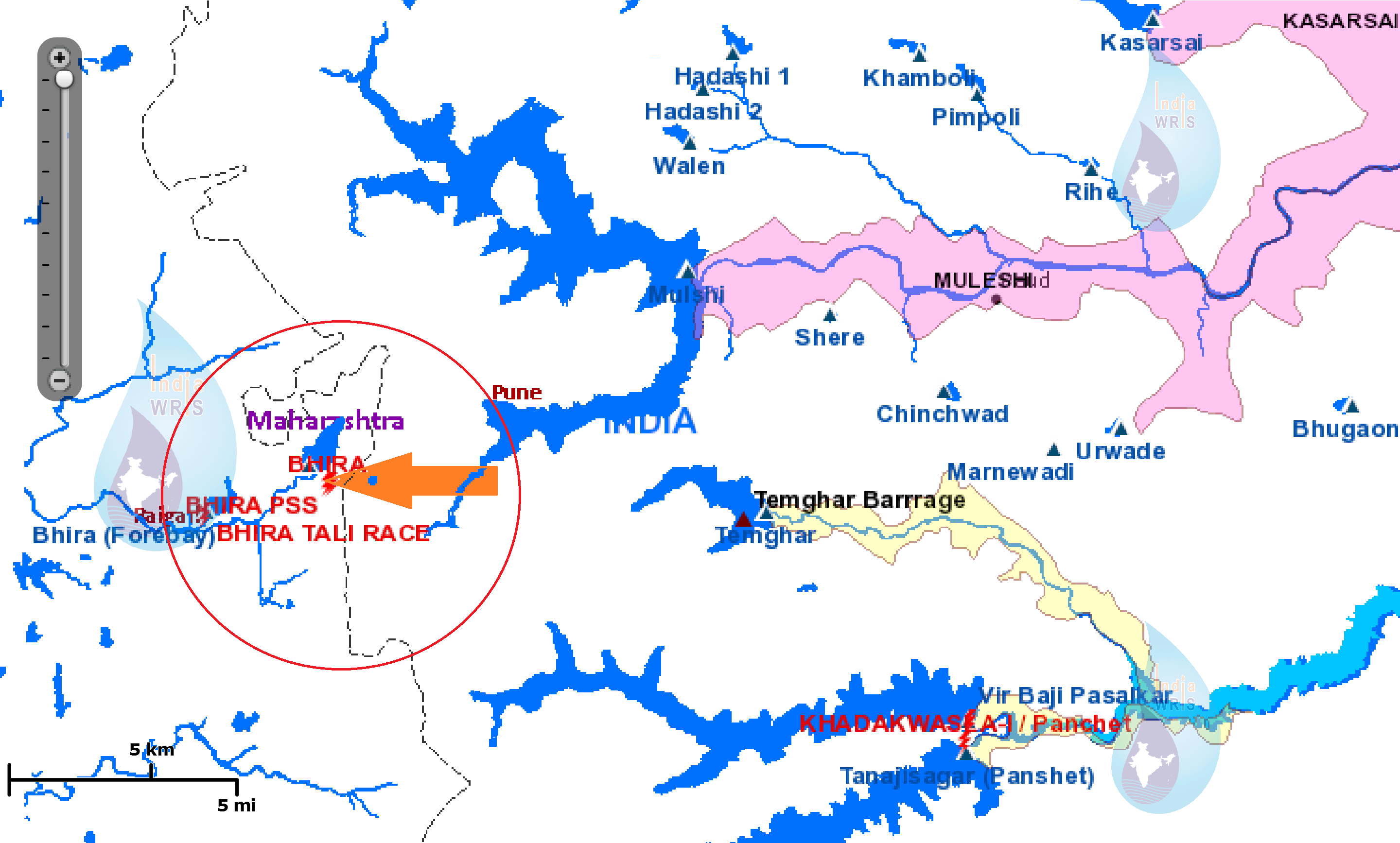
Bhima before it reaches Solapur It is important to study the upstream situation of Mula, Mutha, Pavana and Bhima rivers before it flows down to Ujani dam. This first leads us to west-ward transfers of water from drought affected Bhima river basin to high rainfall (3000 mm or more annually) Konkan region for power generation. The attached maps depict this westward diversion projects. For hydro power generation, Tata Power transfers the water from these rivers across the Western Ghats through underground water tunnels, to the western side i.e. Konkan region which actually receives surplus rainfall. Such projects are highlighted in the Maps obtained from Water Resources Information System (WRIS). The six water reservoirs (Mulshi, Thokewadi, Shirawatha, Walwan, Lonavvala and Kundali), parts of the three Tata hydropower projects (150 MW Bhira, 72 MW Bivpuri and 72 MW Khopoli) could be seen on the eastern side of the dotted line which is Western Ghats ridge line.

Image

Figure 1– Bhira Power Project

Considering the fact that the downstream basin is reeling under severe drought, one must critically evaluate the question whether millions of cubic meters of water should be allowed to flow west into Konkan region.

Image

Figure 2- Khopoli Power Project        

Image

Figure 3-Bhipuri Power Project

Water supply in Pune district Pune is intersected by rivers Mula, Mutha, and Pawana which are tributaries of Bhima. In Pune and Pimpri Chinchwad region, there are 5 major dams which control the river flow downstream viz. Temghar, Panshet, Varasgaon, Khadakvasala and Pawana. There is Ujani dam in Solapur on Bhima River itself. It is indeed a cause of concern that the live storage in Ujani dam has reached in its negative capacity (-30%) when, upstream all these dams are showing quite healthy trend of water storage of their capacity. The following graph is compiled using the most recent available figures from Water Resources Department and Command Development Authority (CADA), Solapur.

Image

It is clear that while Solapur is reeling under sever water crises, Pune and Pimpri Chinchwad metropolitan area have adequate water supply. This situation raises question on the equity of our water sharing practices; not just on inter-state but even also on inter-district ones! In fact a case has been filed in which Maharashtra Water Resources Regulatory Authority is a respondent, asking for water release from upstream dams  in Pune for Ujani Dam.  In Pune district, apart from annual draft of underground 1015 MCM out of available 1442 MCM water[1], a study[2] on Urban water distribution states that, PMC is supplying so much water today that it would be sufficient to sustain Pune’s projected population of 2050[3]. There is unevenness in the water distribution with lack of well-designed inter-city water supply coordination. The demand for water has reached 1,164 MLD for Pune city. Water for the city predominantly comes from Khadakvasala dam. On the other hand, large part of the over 1.7 million rural population in Pune district are supplied the drinking water from tankers in March 2013[4]. The government officials claim that the district has enough water storage in the four dams to supply 1.5 TMC water every month till mid-July[5].

Water pollution in Pune district Pune’s record of sewage treatment has been one of the most dismal ones in India, pronmpting even the erstwhile Env. Minister Jairam Ramesh to write a strong letter condemning the Municipal Corporation. Pune Municipal Corporation admits that there is still a gap of over 250 MLD of sewage which is left untreated out of total 700 MLD generated[6]. In case of Pimpri-Chinchwad Municipal Corporation, the administration claims that there is about 50 MLD of sewage still being discharged into river untreated[7]. Experts believe that these figures are entirely misleading. Pune and Pimpri Chinchwad effectively do not treat even 25% of their sewage. Though Pune is required to do so, it does not return a single drop of recycled water into Khadakwasla Left Bank or Right Bank Canals for downstream usage. Pollution Control Board had filed a case against Pune Municipal Corporation in this regard, without any positive outcomes. Out of 30 stations across Maharashtra assessed by the Maharashtra Pollution Control Board for exceptionally poor Water Quality Indices, a whopping 18 stations lie in Pune.  The picture becomes even grimmer considering the fact that there are 25% of the population who are not connected by established sewage carrying mechanisms[8]. DO of Mula Mutha is routinely near zero is Pune and BOD and COD are extremely high. Even after building more than 6 sewage treatment plants, the condition has not improved.

Sugar mills and sugarcane cultivation Sugar factories also consume huge quantity of water and deliver surplus pollutants in the river. CPCB newsletter Parivesh confirms that sugar factories consume around 1,500- 2,000 liter of water and produce about 1,000 liters of sewage for every ton of sugarcane that they crush[9]. As on 28th February 2013, there are 27 operational cooperative sugar factories in Pune and Solapur combined[10] with total crushing capacity of 83750 tons/day. In addition, in the same region, according to government records, there are 19 private sugar factories[11]. It is not clear whether any of these  follow the rule of not establishing a sugar mill in 15 km circumference from any other sugar mill. The staggering figure of daily crushing capacity of 173250 tons/day imparted by 55 sugar cane factories in Pune division (not to be confused with district), leaves us wondering how much of water pollution they would have been caused[12].  In fact people from Daund and Indapur have been protesting about pollution from Pune for the past few years. Moreover there is the issue of massive water consumption by the sugarcane farms that cater to these sugar mills. Even as some of us travelled in these districts in this drought year, we could see sugarcane fields on both sides of the road as we travel from Pune to Solapur, as far as the eye could see. The plantation of sugarcane even after the declaration of drought continued and there was no attempt to curb that by anyone. Nor was there any attempt to stop the functioning of the water mills even in drought. There is of course the larger question of appropriateness of sugarcane cultivation and allowing sugar mills in this drought prone area. We learn that the administration has already sanctioned 31 more sugar factories in Solapur district.

 Conclusion There is a huge disparity between water availability  in Pune and Solapur districts.

  1. There is no effective machinery to ensure judicious inter-district water sharing.
  2. In the wake of severe drought also, we continue to divert our water to water surplus basins from water deficit Bhima basin
  3. Whatever water is left in the basin, Pune district degrades it, leaving the people downstream in Solapur demanding clean water in addition to their demand for supply of water in the first place[13].
  4. The addiction to sugarcane cultivation and sugar mills is very high even in the drought hit areas. In fact at least the crushing in Pune and Solapur districts should have been stopped right in October when it became clear that the state is going to face drought.

These conclusions also tell us that Dy. CM has a lot of options to work on instead of what he suggested in Indapur on 7th April 2013. The demand for water by Prabhakar Deshmukh and his organization cannot be brushed aside and certainly not in the fashion that Mr. Ajit Pawar did. In stead, he could have immediately directed stopping of westward diversion of water from the six Tata dams so that the water instead flows to the Ujani dam, which can than be used for providing water to the drought hit villages.

Damodar Pujari (damodar.sandrp@gmail.com)

South Asia Network on Dams, Rivers & People (www.sandrp.in)


[2] From Centre for Science and Environment

Ministry of Water Resources

India Water Week 2013: Another evidence of MoWR working like a big dam lobby?

India Water Week 2013

Another evidence of MoWR working like a big dam lobby?

It is well known that India’s water resources ministry in India and its offices like the CWC and NWDA work more like a big dam lobbies, now increasingly working for the private sector business organisations, rather than the communities that they are supposed to serve. If an additional proof was needed, it has become available in the form, content, inclusion and exclusion of the concerned groups in its India Water Week being organised at Vigyan Bhawan in Delhi during April 8-12, 2013.

Ministry of Water Resources, Govt of India, along with organisations likes Central Water Commission, Central Ground Water Board, National Water Development Agency, some related ministries of Govt of India are collectively organising India Water Week during April 8-12. Sponsors of the week long show include some state dam and irrigation organisations to private sector business organisations like L&T and Jain Irrigation and also hydro power company from neighbouring country like the Punatsanchu Hydropower Authority of Bhutan. The theme of this year’s event is: “Efficient Water Management: Challenges and Opportunities”.

The official website (http://www.indiawaterweek.in/) says about the event, “Ministry of Water Resources, Government of India have established a key annual policy and technology showcase event… The event is targeted at International and National audience comprising of policy planners and technologists involved with water resources management in all key sectors of economy”.

Further elaborate statement (http://www.indiawaterweek.in/html/aboutus.html) says something different, “the Ministry of Water Resources, Government of India have made a comprehensive plan for creating a unique platform for deliberating the issues involving all stakeholders including decision makers, politicians, researchers and entrepreneurs of water resources not only from Indian arena but also from International avenues”. So all stakeholders involved in India water sector are supposed to be participating in this. However, we see no sign of any scope for the most important stakeholders: farmers, women, tribals, fisherfolk or even critical voices from civil society. The organiser claims to have made efforts “for effective civil society involvement too in the consultative processes of India Water Week 2013”. We have not noticed any, but that must be our fault.

The registration fee: Who can afford? The fee is nominal: only Rs 8000/- per participant. Needless to add, the stakeholders have to make their own travelling and staying arrangements, not included in this registration fees. 99% of Indians cannot afford such fees, but we guess its not for them. The trouble, however, is that this is happening at public expense by the government of India agencies, in the name of people of India, most of whom cannot even participate it it.

The programme page of the official site (http://www.indiawaterweek.in/html/programme.html) opens with a telling statement: “Keeping in view the priorities of the Government of India towards making optimal usage of all the available water resources”. So, very interestingly, whatever the organisers are doing, is not only on behalf of water resources ministry and its subordinate offices, but the entire Government of India.

Commodification of Water That the event organisers equate water resources with water is apparent when they say: “the water resources are a single entity, which are shared by all the above sectors out of a common pool of utilizable water”. They simple do not seem to understand that water is an ecological good, embedded in the ecological entities and when water is taken out, it has consequences.

Enlightening definition of wide consultations What the Ministry understands by wide consultations is abundantly clarified by them. The Programme page says: “The theme for the event has been decided after wide consultations amongst the national and international level stakeholders and workers in the field. You can view the deliberations here.” When you click to view the deliberations, it takes you to: http://www.indiawaterweek.in/pdf/programme1.pdf. This page contains minutes of the meeting held on April 30, 2012, chaired by the Central Water Commission Chairman. It actually includes the list of 15 participants, and no prize of guessing that all, each one of them happen to be government officers! It is thus quite enlightening to know what is the meaning of wide consultations. Obviously those mortals who are not government officials have no place in the consultations.

National Water Policy It is learnt from the statements of the Union Water Resources Minister Harish Rawat that he will launch the new National Water Policy from the inaugural function on April 8, 2013. Here it should be noted that people of India have yet to see the final version of the new NWP, but those who pay the registration fees, will be first to see it! More importantly, it may be recalled that majority of the states that participated in the National Water Resources Council meeting held on Dec 29, 2012 opposed the policy. If one were to go by the latest draft available on MWR website (see: http://mowr.gov.in/writereaddata/linkimages/DraftNWP2012_English9353289094.pdf), the new policy is likely to advocate treated water as an “economic good”, encourage private sector to be service provider in public private participation mode and largely support business as usual practices rather than learn any lessons from past experiences. For more detailed comments on the new NWP draft, see: https://sandrp.in/wtrsect/Letter_to_NWRC_on_New_National_Water_Policy_Dec2012.pdf.

Buyer Seller meet for Dam Rehabilitation and Improvement Project There is an interesting session in the event with above sub title. DRIP is a World Bank funded programme managed by CWC for rehabilitation of some 243 dams that are more than 50 years old. The official programme website says, the objective of the event is to facilitate state dam agencies to get “exposure to state of the art technologies and solutions”. Its bit of a mystery what is going to be bought and sold, since even contours of the DRP programme are not in public domain. We hope, it is not about buying and selling of the old dams, as seems to be the case from the title of the session.

Hydropower A quick look at the detailed programme (see: http://www.indiawaterweek.in/html/event_plan.html) shows that the event will have four sessions on hydropower: 1. Water Availability and issues in development of hydro / thermal power 2. Hydro Power Green Power 3. Hydro Power Generation – Impact on Environment 4. Accelerated Development of Hydropower. The formulation, description and available names of moderators of these sessions clearly show how the MWR is acting like a big dam lobby.

For example, the page on first session (see: http://www.indiawaterweek.in/pdf/IWW-2013-IB2_30.pdf) does not talk about water availability issues at all, but about the huge untapped hydropower potential, like any lobbyist would do. The moderator is Mr A B Pandya, who is known to be proponent of big dams.

For the second session on Hydro Power Green Power (see: http://www.indiawaterweek.in/pdf/IWW-2013-IB2_49.pdf) the very title says that it is going to play the usual pro hydro jingle. Not surprisingly, the moderator is Mr Dasho Chhewang Rinzin from Bhutan’s Druk Green Power Corporation Limited. The session description includes, “Environmental Impacts of Hydro Projects need to assessed in proper keeping in view all aspects”. While former environment minister Jairam Ramesh, Assam Power Minister and many others are on record to have said that almost all EIAs in India are mostly dis-honest, cut and past jobs, to expect Managing Director of Bhutan corporation to moderate such a session is clearly inappropriate decision. It is open secret that Bhutan, in spite of its slogan of Gross Happiness Index, gives scant regard for social or environment issues of hydropower projects. Only where you can do that, can you get away with calling Hydro Power as Green Power.

For the Third Session on Accelerated Development of Hydro Power, (see: http://www.indiawaterweek.in/pdf/IWW-2013-IB2_42.pdf), the session is, to be moderated by the Chairman of Central Electricity Authority, which has been sanctioning every hydropower project that comes its way, without even fulfilling its  duty under Section 8(2) of India Electricity Act 2003, which asks CEA to evaluate the impact of the projects on basin wide context.

For the fourth session on Impact of Hydro Power on Environment (see: http://www.indiawaterweek.in/pdf/IWW-2013-IB2_15.pdf), the description actually talks only about positive impacts of hydropower on environment! Even about negative impacts, it says, “These impacts, however, may not necessarily be characterised as negative impacts”. The description actually shows how ostrich like the organisers are: “there is no universally accepted methodology for monitoring the downstream, reservoir or upstream ecological responses of the river systems”. They would not even like to acknowledge the existence of the report of the World Commission on Dams.

Session on Environment Flows It is indeed welcome to see the session titled: “Case for setting aside gains for environment flow”, though the title should be talking about gains from and not for environment flows. More worryingly, the organisers could not find anyone more credible than former Power Sector Shri Anil Razdan to moderate this session. Mr Razdan clearly has no environmental credentials and is rather known for his advocacy for more hydropower projects. This shows how insincere the organisers are on such vital issues.

There is only one more session on “Water Management and Sustainable Ecosystem” where there is likely to be some discussion on Ecosystem (see: http://www.indiawaterweek.in/pdf/IWW-2013-IB2_28.pdf). The session is to be moderated by Ms Sui Coates, Chief, WSH UNICEF. Good to see some representative of fairer gender at last. We hope UNICEF will in future speak up when dams destroy rivers, forests, biodiversity and livelihoods in future, which they have not done in the past, even though they are active in India.

In Conclusion: No-Water-weeks in India’s Drought Prone areas Even as the mandarins of water resource establishment host this multi crore  water week, very large parts of India, including parts of Maharashtra, Gujarat, Karnataka, Tamil Nadu and Kerala are facing drought and crores are people are suffering no-water-week, week after week. The organisers of India Water Week have clearly scant regard for these crores of unfortunate people. They may in fact join in chorus with Maharashtra Deputy Chief Minister Ajit Pawar (see: http://www.ndtv.com/article/india/ajit-pawar-apologises-for-shocking-remark-if-no-water-in-dam-do-we-urinate-in-it-351163) in mocking at these people. It would however be useful to remind them that Maharashtra is the state of India that has the highest number of big dams, more than a third of India’s big dams are in that state, and yet that state is claimed to be suffering drought worse than the 1972 drought, when the rainfall is much higher than the 1972 drought in most drought affected districts (for details see: https://sandrp.wordpress.com/2013/03/30/how-is-2012-13-maharashtra-drought-worse-than-the-one-in-1972/) and when the states has built close to thousand big dams in these 40 years. Big dams are not going to be solutions of India’s Water Future, they are actually going to create more problems and we need to find real solutions, beginning with some honest review of past experiences, which is what such event should start from. But the organisers of India Water Week seem in no mood for any such exercise.

Himanshu Thakkar (ht.sandrp@gmail.com)

South Asia Network on Dams, Rivers & People (www.sandrp.in)

Manoj Mishra (yamunajiye@gmail.com)

Yamuna Jiye Abhiyaan, Delhi (http://www.peaceinst.org/)


Dr Latha Anantha (rrckerala@gmail.com)

River Research Centre, Thrissur, Kerala


Parineeta Dandekar (parineeta.dandekar@gmail.com)

SANDRP, Pune


Shripad Dharmadhikary (manthan.shripad@gmail.com)

Manthan Adhyayan Kendra, Pune

Dams

How is 2012-13 Maharashtra Drought worse than the one in 1972?

Maharashtra is facing one of the worst droughts this year. Union Agriculture Minister Sharad Pawar as well as Chief Minister Prithviraj Chavan have said that this year’s drought is worse drought than the one in 1972, which was termed as a ‘famine’. Maharashtra has the highest number of large dams in the country and is now claimed to be suffering the worst drought in four decades or more.

(For more detailed analysis, with tables, please see:

Click to access Maharashtra_Drought_2012_13_worse_than_1972_March2013.pdf

https://sandrp.in/otherissues/PR_How_is_Mah_Drought_2012_13_worse_than_1972_March_30_2013.pdf)

 DSC02370

Sugarcane going to sugar factories against teh backdrop of a dry Ujani Canal in Solapur                              Photo: SANDRP

However, an analysis of the rainfall figures and the monthly rainfall pattern in 1972 and 2012 with respect to the normal rainfall pattern in seventeen drought affected districts shows a different picture. From a Meteorological and agricultural point of view, this year’s drought cannot be called worse than that in 1972. It is possible that hydrologically, this year’s drought may prove to be worse than 1972 for some districts. The blame for this lies entirely on wrong decisions about building unviable and undesirable large dams, wrong cropping patterns, diversion of water for non priority uses, neglect of local water systems and unaccountable water management by the Maharashtra government, MWRRA (Maharashtra Water Resources Regulatory Authority, set up in 2005 under a World Bank funded programme) as well as the Union Government.

Let us look at the figures of the rainfall of 1972 and 2012. Table 1 shows monthly normal and actual rainfall for 1972 and 2012 for the months of June to October and their total for the seventeen districts[1] mentioned as drought affected. When the monthly rainfall of 1972 and 2012 shows more than 50% deficit[2] from normal, it is marked in red background for 1972 and in red numbers for 2012.

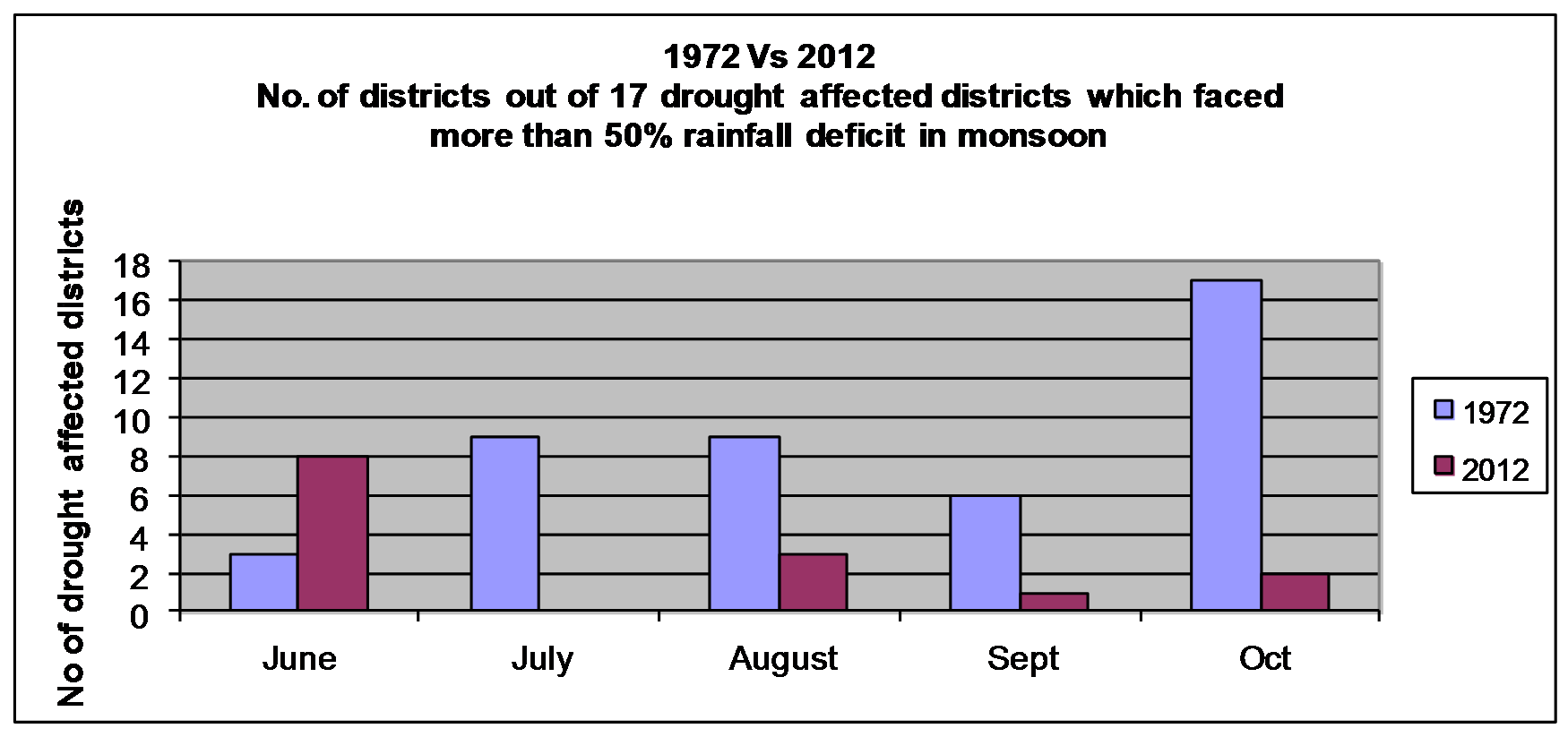
It is clear from the Table 1 that in June 2012, eight districts had monthly rainfall less than half the normal. In July 2012, no district showed a deficit rainfall more than 50%. In August 2012, the deficit was more than 50% in case of three districts: Aurangabad, Jalna and Osmanabad (these three districts also experienced over 50% deficit in June). This was the case for only Jalna in Sept 2012 and for Dhule and Jalgaon in Oct 2012. It seems from this comparison that Aurangabad, Jalna and Osmanabad were some of the worst drought affected districts this year, which is indeed the case.

In comparison, the number of districts that faced more than 50% deficit in monthly rainfall in 1972 were: 3 in June, 9 in July, 9 in August, 6 in September and all 17 in October 1972. This comparison between 1972 and 2012 for the number of districts facing over 50% deficit in monsoon months clearly tells us that the 1972 rainfall was much lower than the 2012 rainfall for every month with the sole exception of June.

Sugarcane

Sugarcane in various stages of growth in Solapur, in March 2013                                              Photo: SANDRP

Table 2 gives the total rainfall of these five months (June-Oct) in a normal year, in 1972 and in 2012 for these districts. This table also gives the 2012 rainfall as % of the normal rainfall and as % of 1972 rainfall in separate columns. It is clear from this comparison that only in case of two districts (Sangli and Dhule) is the 2012 rainfall substantially lower  than 1972. In two other districts (Jalna and Satara) the rainfall in 2012 is lower than that in 1972, but difference is less than 7% in both cases. In remaining thirteen districts, the monsoon rainfall in 2012 was more than that in 1972.

While comparing the 1972 and 2012-13 droughts, it must be kept in mind that rainfall in 1971, the year before the 1972 drought was also low. In comparison, rainfall in Maharashtra was above average in 2011 & most of the dams were full. Maharashtra Economic Survey for 2011-12 notes, “Total rainfall in the State during 2011 was 102.3 per cent of the normal rainfall.” The state agriculture commissioner had stated in 2011: “The good distribution of rain has resulted in good quality of crops. The above average rainfall has filled up nearly all dams, which will help replenish the soil in the run-up to the rabi season.”[3]

Table 1 Normal, 1972 and 2012 Rainfall (in mm) in Drought Affected Districts

District

Year

June

July

August

September

October

TOTAL

Ahmednagar

Normal

101.4

102.5

84.3

148.1

61

497.3

1972

80.36

80.29

60.2

97.87

1.2

319.92

2012

39.6

86.8

63.8

93.6

99.5

383.3

Pune

Normal

139.9

286.6

181.4

144.9

77.3

830.1

1972

132.41

338.48

68.74

120.42

1.08

661.13

2012

55.8

161.2

205.6

116.8

137.2

676.6

Solapur

Normal

102

101.1

104.3

181.4

70.9

559.7

1972

49.35

64.28

20.03

91.4

25.99

251.06

2012

56.1

93.6

53.2

103.8

105.3

412

Satara

Normal

149.3

339.9

204.5

140.5

87.9

922.1

1972

241.54

535.62

73.65

127.79

1.75

980.35

2012

114.2

270.1

278.2

123.9

131.4

917.8

Sangli

Normal

92.9

132.1

96.7

133.6

96.3

551.6

1972

151.5

337.19

54.05

107.24

15.17

665.16

2012

48

78.7

58.8

68

154.4

407.9

Aurangabad

Normal

131.4

168.1

166.7

157.3

51.8

675.3

1972

92.07

46.64

64.63

85.64

0.85

289.84

2012

49.1

118

67.6

84.7

49.4

368.8

Jalna

Normal

138.9

171.8

166.7

156.7

54

688.1

1972

105.46

54.83

73.32

102.16

0.61

336.39

2012

43.4

95.2

62.7

78.4

44.3

324

Beed

Normal

128

161

138.8

177.6

63.1

668.5

1972

78.35

36.69

48.09

105.09

2.84

271.06

2012

54.9

108.6

82.7

107.3

81.4

434.9

Latur

Normal

145.6

192.7

181.8

205.2

63.3

788.6

1972

64.32

46.54

84.57

123.98

6.48

325.88

2012

115.6

183.4

160.8

163.9

136.3

760

Osmanabad

Normal

163.3

141.6

221.9

148.6

66.3

741.7

1972

59.03

32.23

33.48

115.17

17.54

257.44

2012

45.8

142.1

46.2

106.8

49.7

390.6

Nanded

Normal

164.8

273.9

246.9

197.2

60.9

943.7

1972

128.16

74.17

115.95

60.02

3.99

382.28

2012

108.4

219.3

154.9

125.5

52.6

660.7

Akola

Normal

135.2

231.3

182.8

148

37.6

734.9

1972

119.26

130.75

244.64

72.22

0.58

567.45

2012

151.4

292.9

148.8

198.7

36.3

828.1

Nashik

Normal

154.4

378.1

282

198.5

60.9

1073.9

1972

101.476

252.837

207.496

78.948

2.37

643.127

2012

83.2

262

280.1

162.4

75.7

863.4

Dhule

Normal

116.6

168.7

131.8

113.3

36

566.4

1972

87.68

159.823

240.364

48.517

1.578

537.962

2012

32.5

171

112

79.6

10.6

405.7

Jalgaon

Normal

130

206.8

187.8

139.2

39.1

702.9

1972

88.734

80.941

149.924

59.197

0.836

379.632

2012

19.6

181

102.5

86.2

15.3

404.6

Parbhani

Normal

126.6

210.8

203.5

180.7

55

776.6

1972

98.107

61.838

97.434

84.497

0.783

342.659

2012

99.5

192.4

107.4

159.3

78.5

637.1

Buldhana

Source: 1972 Rainfall Data: http://indiawaterportal.org/met_data/

Normal and 2012 Rainfall Data: http://www.mahaagri.gov.in/rainfall/index.asp

In addition, Maharashtra has by far the largest number of Big Dam in India. In 1972, some of the big irrigation projects in the worst drought affected districts. In 40 years since 1972, Maharashtra has built a very large number of big dams, ostensibly to help these drought prone areas. For example, Aurangabad has Jayakwadi project (completed in 1976), Beed has Mazalagaon Project (Jayakwadi Stage II), Jalna has Upper Dudhna and Lower Dudhna projects. Osmanabad depends partly on Ujani Dam, partly on schemes in Krishna basin, Solapur completely depends on Ujani. Live storage of most of the dams in drought affected districts is either 0 or near zero today. All these projects and increased groundwater use facilities in 2012 should actually be able to reduce the impact of rainfall deficit in 2012, which is lower than the deficit of 1972. But the situation is actually the worse in 2012 compared to 1972, claims the Chief Minister and the Union Agriculture Minister. So what are the reasons for this? For one, area under sugarcane in Maharashtra was 167 000 ha in 1970-71, going up to 1022 000 ha in 2011-12 (Maharashtra Economic Survey 2012-13).

districtwiseSugarcane

Chart showing district-wise Normal, 1972 and 2012 rainfall for the 16 drought affected districts of Maharashtra

Table1

As can be seen from the profiles of some of the districts given in Table 3 and accompanying chart, Solapur, Pune, Ahmednagar, Sangli, Satara, Osmanabad, Beed, Latur, Nashik, Jalna, Parbhani and Aurangabad, all drought prone and drought affected districts are major sugar producing centres of the State. They collectively produce 79.5% of sugar produced in Maharashtra. According to Maharashtra Economic Survey for 2012-13, “As on 31st December, 2012, out of the total sugar production in the country, the share of State was 35.3 per cent”. So more the drought prone districts of Maharashtra produce more than a quarter of India’s sugar!

Table 2 Total Rainfall in drought affected districts in 1972 as against 2012 (in mm)

  Districts

Normal

1972

2012

2012 as % of Normal

2012 as % of 1972

1 Ahmednagar

497.1

319.9

383.3

77.1

119.8

2 Pune

830.1

661.1

676.6

81.5

102.3

3 Solapur

559.7

251.1

412.0

73.6

164.1

4 Satara

922.1

980.4

917.8

99.5

93.6

5 Sangli

551.6

665.2

407.9

73.9

61.6

6 Aurangabad

675.3

289.8

368.8

54.6

127.2

7 Jalna

688.1

336.4

324.0

47.1

96.3

8 Beed

668.5

271.1

434.9

65.1

160.4

9 Latur

788.6

325.9

760.0

96.4

233.2

10 Osmanabad

741.7

257.4

390.6

52.7

151.7

11 Nanded

943.7

382.3

660.7

70.0

172.8

12 Akola

734.9

567.5

828.1

112.7

145.9

13 Nashik

1073.9

643.1

863.4

80.4

134.3

 14 Dhule

566.4

538.0

405.7

71.6

75.4

15 Jalgaon

702.9

379.6

404.6

57.6

106.6

16 Parbhani

776.6

342.6

637.1

82.0

186.0

17 Buldhana

713.0

453.2

612.2

85.9

135.1

As one travelled during March 2013 in some of the drought affected districts like Pune, Solapur, Ahmednagar and Nashik one saw unending fields of sugarcane,  and some of Banana and Grapes on both sides of the road. Many of these fields were planted after August 2012 when it was known that Maharashtra would be facing a drought this year. There was no attempt by anyone in the Maharashtra govt or administration to curb either planting of sugarcane and other water intensive crops or to curb any of the water intensive activities like running of sugar and wine factories in the drought affected districts. The builders continued to advertise sale of houses attached with swimming pools in drought affected areas. Maharashtra continues to divert millions of cubic meters of water everyday, out of the Krishna and Bheema basin, to the Konkan area with average rainfall of over 3000 mm. The manager of Solapur Hotel said that there is no water scarcity. Groundwater levels are down, but there seemed little sign of drought in most of these areas. The poor and the cattle are facing the water shortage. However, it seems those who had the money and power continued to get as much water as they needed, for whatever purpose they want it for. An NDTV programme on March 29, 2013 accused NCP leaders of stealing water in times of drought[4].

Dry Seena

Table 3: Profiles of some of the drought affected districts

Area in ‘000 ha Ahmednagar Aurangabad Beed Jalna Osmanabad Sangli Solapur Pune
Geographical area

1702

1007.7

1068.6

772.6

748.5

861

1487.8

1562

Sown area

1146.3

654

876

529

519.3

557.1

919.7

945

Net Irrigated area

330

163.3

137.7

116.5

106.66

174

251.5

287

Canal irrigated area

84

31.05

108.92

22.17

18.72

45

31.4

121.5

GW irrigated

246

130.31

Nil

91.28

102.74

38.5

193.5

92.3

Sugarcane area 2007-08

133.3

34.3

74

25.1

53.8

64.7

154.5

104.2

2010-11

126

23.3

58.8

19.3

43.2

76.3

163.1

111.5

Amazingly, the Maharashtra Economic Survey for 2012-13, published after March 19, 2013[5] does not mention that the state is suffering from drought, leave aside giving details of the drought prone areas. Interestingly, it says that during 2012 monsoon, Maharashtra suffered rainfall deficit of 9.7% and that 10 districts and 136 talukas had deficit over 25%. And Yet the survey reported that water availability situation was alarming in Aurangabad, Jalna, Beed, Osmanabad, Nanded, Ahmednagar, Nashik, Jalgaon Pune, Satara, Sangli, Solapur and Buldhana (13 districts). These districts, the survey said, suffered “very severe water scarcity”. It said 1779 villages were supplied water through tankers as on March 4, 2013, topping the list was Aurangabad division with 771 villages. 4709 wadis were also supplied water through tankers, topping the list here was Pune division with 3197 wadis.

MWRRA and the state machinery have entirely failed in managing water levels at Jayakwadi & Ujni dams and releases from the upstream dam releases. There has been no serious attempt at controlling area under sugarcane and sugarcane crushing in the drought areas or controlling unauthorised sugarcane cultivation around Ujani backwaters, or unauthorised lifts from upstream of many dams like Nandur Madhyameshwar and through canal systems Majalgaon Project or lifting of water from the river beds for sugarcane or curbing other non essential water intensive activities. In fact all efforts have been towards increasing the area under sugarcane and other water intensive activities in the drought prone areas. In affidavit in the High Court, Maharashtra government said on March 28, 2013 that MWRRA effectively does not exist!

40 years after Maharashtra’s worst drought of 1972, the state seem to be in worse situation this year, despite spending lakhs of crores on irrigation projects and despite putting in place numerous institutions and authorities to manage water. While 1972 drought could be called a natural calamity, 2012-13 drought is a disaster of water management accompanied by corruption, extremely water intensive cropping pattern unsuitable for the drought prone areas, pushed by the government and the politicians, top heavy institutions without local participation or transparency, absence of responsive disaster management system and absence of a long term view to manage drought.

Parineeta Dandekar (parineeta.dandekar@gmail.com) and Himanshu Thakkar (ht.sandrp@gmail.com)

South Asia Network on Dams, Rivers & People (www.sandrp.in)


[1] Ahmednagar, Pune, Solapur, Sangli, Satara, Aurangabad, Beed, Jalna, Latur, Osmanabad,Nanded, Akola, Parbhani, Buldhana, Nashik, Dhule and Jalgaon

[2] It may be noted here that India Meteorological office calls rainfall deficient when deficit is 20-60% and scanty when deficit is more than 60%. We have used the figure for 50% just for comparison here.

Floods

Build them Higher and Higher!!

This week, there was news that Nepal and India have agreed to ‘strengthen’ the embankments on shared rivers like Bagmati, Kamla and Khando in a bid to control floods. “Both the countries have already agreed to strengthen embankments of Bagmati, Kamla, Lalbakeya and Khando rivers and extend the embankments along these rivers to higher ground in Nepal to control spilling of flood water,” Water Resources Minister Harish Rawat said” (http://economictimes.indiatimes.com/news/politics-and-nation/india-nepal-agree-to-strengthen-river-banks-to-avoid-floods/articleshow/19035269.cms)

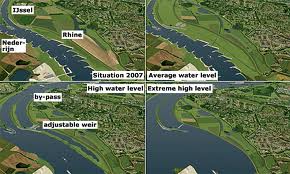
Now while we are busy building our embankments higher and higher, one of the most flood prone country in the world: The Netherlands is doing something drastically different. Through its ‘Room for the River’ Program, Netherlands is actually leaving spaces for floods to spill, and minimise the damage, rather than building higher and higher embankments.roomfortheriver1

“After 800 years of building dikes, we’ve been making them higher and higher,” said Gert-Jan Meulepas, project manager at Royal Haskoning, an engineering and environmental consultancy that developed the project. “But if something goes wrong, the damage will be greater.” (http://www.scientificamerican.com/article.cfm?id=how-the-dutch-make-room-for-the-river)

roomfortheriver2

With Climate Change and extreme weather events a reality, the focus in Europe and America has shifted from making ‘Zero Failure’ infrastructure to infrastructure that is ‘allowed to fail’ with other protective measures in place like flood dissipation, protected floodplains, alert disaster management, etc. “Designing projects so they are safe to fail,  is often cheaper and more efficient, Kirshen believes. A community might opt to build a dam designed to contain up to a 100-year flood, then develop a comprehensive evacuation plan for the surrounding area in the event of a more severe flood. This strategy anticipates that the dam may not control extreme flooding, but adds other protective measures for higher levels of safety.”http://www.climatecentral.org/news/for-engineers-climate-failure-becomes-an-option-15769

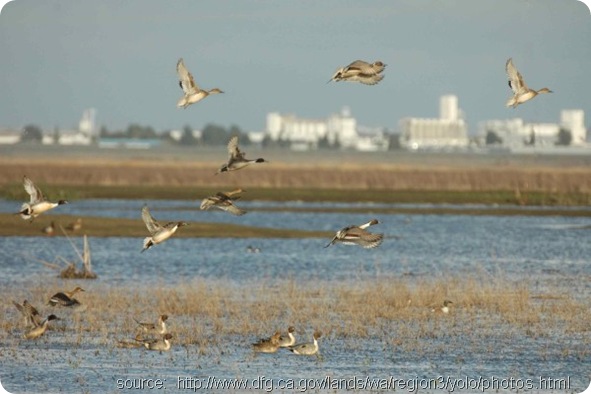
One of the best examples of this flexible management is the Yolo Bypass in the Sacramento Basin in California. Yolo Bypass actually accumulates floodwaters in case of extreme floods and is used by water fowl and wildlife. It is the largest public/private restoration project west of the Florida Everglades. The entire bypass forms a valuable wetland habitat when flooded during the winter and spring rainy season. In the summer, areas of the bypass outside the wildlife areas are used for agriculture.(http://www.yolobasin.org/wildlife.cfm)

Image

Image

India and South Asia on the other hand, though facing severe threats from climate change and floods and with a history of embankment breaches are refusing to learn lessons. The recent discussion about strengthening embankments between India and Nepal seems to be  a result of this mindset which is not flexible to include ecosystems, goods and services of floodplains and climate change challenges.Image

Shri. D. K. Mishra jee has written extensively about embankments and floods in Bihar. His latest book on Bagamati: https://sandrp.in/pub/River_Bagmati_Bounties_Become_A_Curse.pdf

Image

Image

Dams

Fish Ladders: Do they Work?

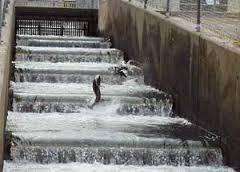
During the last few months several contradictory facts have been surfacing about fish ladders. Fish Ladders are small elevated steps or passes made in dams, with water releases to enable fish to migrate in the upstream (or downstream) of the dam.

Image

This upstream migration is a part of the reproductive cycle of many fish, like Hilsa and Mahseer in India.

Image

A study in the United States, a country with comprehensive attention to impacts of dams on fish, has concluded that actual numbers of fish who make it to their spawning grounds above dams with fish passages is a small fraction of targeted goals of these facilitie.  For example, for American shad (Incidentally, Hilsa is also a type of Shad) – an important species for commercial and recreational fisheries that sustained generations on the East coast of the US – on average about only 3% percent of the fish that pass the first fishway make it past the last dam with a fishway in these rivers. Another example is that species such as Atlantic sturgeon cannot pass fish ladders—so for certain species, fishways do not work at all. Thus, in these systems, effective up and down stream passage is not being provided for anadromous fish. The result is that these species are getting listed as endangered or threatened one by one. The study actually concludes that looking at the dismal success rate of fish ladders and hatchery based recovery programs, “Ecologically and economically significant species restoration is not possible without dam removals”. (International Rivers)

Image

A spectacular film “End of the River” chronicles the impact of small hydropower dams on fish in Europe. The film says that water released from the fish ladders is not enough for the fish species to survive in the downstream. https://sandrp.wordpress.com/2013/03/16/the-end-of-the-river/)

At the same time, ecologically designed fish ladders do help the fish get across the impediment of dams in some cases. For example, a weir on River Elbe in Germany counted its Millionth migrating fish in January 2013, 3 years after it was built.(http://www.dw.de/german-fish-ladder-celebrates-millionth-user/a-16509927)

Image

Lesson for India seems to be that, in keeping with our livelihood dependency on riverine fish and their ecological value:

  • Dams should not be built in ecologically important regions with documented fish diversity like in Western Ghats, Eastern Himalayas, near river confluences and near estuaries.
  • Existing dams, where feasible, should have  fish ladders and passages designed for Indian species, these should be monitored by independent committees with local participationImage
  • all small hydel projects should have functioning fish ladders and most importantly,
  • ALL dams should release e-flows which exceed the flows needed for fish survival and migration. E-flows should be released through fish passages and not turbines. They should keep in mind the need for longitudinal and lateral connectivities.
  • No in stream sand mining should be allowed. No diversion of water for sand mining should be allowed. Sand mining should only be done manually, use of machine should not be allowed.

Unfortunately, even India’s premier research institutes like CIFRI are recommending eflows which are insufficient for species like trouts to survive. Its not a coincidence that these recommendations are very convenient for the private dam developers who are funding these studies.

SANDRP (ht.sandrp@gmail.com)

POST SCRIPT: Some related articles on SANDRP blog:
1. https://sandrp.in/2016/11/24/narora-barrage-fish-ladder-ganga-and-memories/
2. https://sandrp.in/2016/08/12/sushri-umaji-hilsa-fisherfolk-and-ganga-deserve-more-than-a-fish-ladder-by-cifri/
3. https://sandrp.in/2014/02/02/fish-ladder-at-kurichhu-hydropower-project-bhutan-some-thoughts/
4. https://sandrp.in/2014/12/17/larji-dam-fishladder-an-unlovely-trinket-a-deceptive-ornament/

Hydropower

Hydropower at the Cost of Drinking Water?

Even as the state faces one of the most severe droughts in recent history, the irrigation department continues to divert water from the water-deficient Krishna valley to the water-surplus region of Konkan. Around 50 thousand million cubic feet of water (TMC) is annually diverted for three private hydro electricity plants in the Bhima sub-basin, which ultimately flows into the Konkan region.

Image

While engineers of the water resources department claim that the diversion is necessary for production of hydro electricity, water experts say drinking water should be given more importance in a drought year.

Located in the upper Krishna Basin, Koyna Dam has the largest live water reservoir (2,836 TMC) in Maharashtra. The dam also houses five powerhouses with a total capacity of 1,956 MW. Of this, 1,920 MW installed capacity takes out water from the Krishna basin that flows into the water-surplus region and only the smallest 36 MW powerhouse at the dam toe allows the water to flow into the Krishna basin in Maharashtra. Krishna basin also houses some of the worst drought-hit areas of the state, such as the taluka of Maan and districts of Sangli and Solapur.

The diversions are taking place from the dams of Shirawantha, Walwhan, Lonavala, Kundli, Thokewadi and Bhira for the three privately operated hydro-electric projects. The total power generation capacity of these three plants is around 300 MW. However, the water so used in generation of hydro-electricity flows to the westward flowing rivers, which drain ultimately in Konkan.

As per the latest available storage position of the reservoirs, Koyna dam has a live storage of 68.78 TMC, while the dams catering to the private hydro-electric stations have a live storage of around 18.75 TMC of water.

This stock, say experts, can cater to the drinking water and domestic requirements of 7 crore people for an entire year.

Water expert and South Asia Network on Dams, Rivers and People (SANDRP) founder says post the usage in the privately owned dams, the water flows into the rivers of Vashisthi, Kundalika, Patalganga and Savitri, which flow via Konkan and drain into the Arabian Sea. “The rivers pass through chemical hubs and thus get polluted and become unsuitable for human consumption,” he says.

Making a strong case for stopping this diversion, Thakkar says the water, if not diverted, would be sufficient to meet the water needs of Sangli and Satara immediately. “In neighbouring Karnataka, the government has stopped five hydro power generation stations, to preserve the water for drinking purposes for Bangalore city. In Maharashtra, we need to initiate a dialogue and take a decision to stop the diversion in the worst drought year for the state,” he adds.

Engineers associated with the project, however, point out that the proposal, though feasible, can’t be executed for technical and other reasons. To start with, they say, since the canal distribution system to carry water downstream is not ready, and due to the gradient difference, lifting water would be difficult.

D N Modak, chief engineer of the Koyna project, says it is the power generated from these projects that is required for the state. “There is sufficient water available in the Koyna dam,” he claims.

Dams

Drought engineered by state govt

Drought engineered by state govt: expert
DNA Correspondent; March 24, 2013

The current drought situation in the staImagete has been engineered by the state government, which has diverted water to cash crops, alleged Himanshu Thakkar, coordinator of the South Asia Network of Dams, Rivers and People.

He was speaking at the opening session of the two-day conference titled, ‘The water sector of India – challenges and prospects’ here on Saturday. The event was organised by the Karve Institute of Social Service as part of its golden jubilee celebrations.

Thakkar said, “If we compare the 1972 rainfall to this year’s, we can see that the rainfall this year is higher. The sugarcane crop has not been affected this year, though there is a severe drought. This shows that water is being diverted to sugarcane at the expense of other crops. At the same time, water is being diverted from the Krishna basin to the Koyna power plant to be used for electricity generation.”

Thakkar added that though thousands of crores of rupees had been spent on building dams in the last 20 years, the net irrigated area in the country has not increased much.

He said the drought in Maharashtra was engineered. “Despite what we hear about the severity of the drought, the fact is that the sugarcane production in the state has not dropped,” he said.

The sugarcane crop has not suffered at all. Though the government of Maharashtra has spent thousands of crores of rupees on new dams in the last 20 years, irrigated area in the state has not increased much. The irrigation department officials are not accountable to the people.”

He said that today groundwater was the mainstay of the people, especially in rural areas. “Both rural water supply and irrigation are largely supplied through groundwater, but there is no regulation of this resource. With every passing day, our dependence on groundwater is rising, but we are not doing anything to protect or preserve our groundwater sources,” he said.

Thakkar added that rising water pollution was another major challenge. He slammed the central and state pollution control boards for their failure to ensure clean water bodies. The Water (Prevention and Control of Pollution) Act was passed in 1974, after which the states set up the state pollution control boards. But today, there are hardly any water bodies that have been made clean by these boards. “There is hardly any example of a polluted water body in the country that was cleaned by the boards since 1974,” he said.

Another expert too pointed out the different treatment given to the sugarcane crop. Shripad Dharmadhikari, a policy researcher at Manthan Adhyana Kendra, Pune said, “The major problem over water is that there is no mechanism of allocating water. Though Maharashtra has over 30 per cent of the nation’s major dams, the water is only being used for sugarcane crop. What one sees in many villages is that people are struggling to get drinking water, while on other hand the sugarcane crop is well-irrigated. We should give priority for drinking water over all other requirements.”

Some experts spoke on the need for planning. Himanshu Kulkarni, secretary of the NGO, Advanced Centre for Water Resources Development and Management (Acwadam), said that the biggest problem today is the absence of planning to meet water needs. “We need to have a plan for the next 15 years in order to preserve water sources, especially groundwater. There is a clear link between the current drought and the over-extraction of groundwater.”

Magasasay awardee Rajendra Singhji of Tarun Bharat Sangh and Jal Biradari said there were four key components in protecting natural resources like water. “One is to control water evaporation; second, enhance ground water; third, take control over your own life (uske bad apna jivan chalawo); and finally stand up against those who loot your resources.” He spoke at the last session of the first day of the state-level event organised as part of Karve Institute’s golden jubilee celebrations.

http://www.dnaindia.com/mobile/report.php?n=1815072&p=0