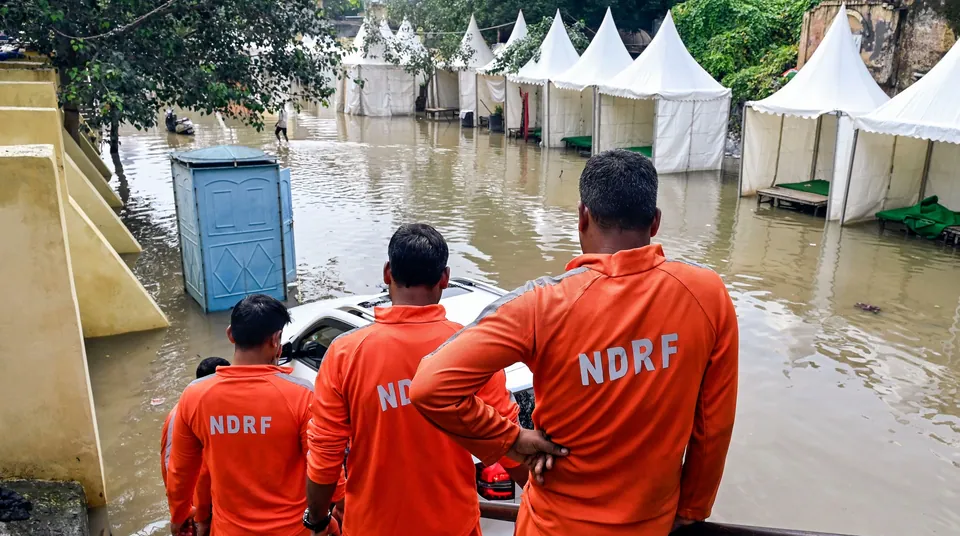
(Feature Image: NDRF team gazing at flooded relief camps at Yamuna bazar, Delhi)
In first week of September 2025, Yamuna river in Delhi has again witnessed another unusual flood spell. This is happening two years after the river recorded unprecedent flood event in July 2023. This report compares the July 2023 flood with the one in Sept 2025 underlining the probable factors making these deluges uncommon and man-made flood disaster.
July 2023 vs. September 2025: There are some basic differences between these flood spells. The July 2023 flood was in 2nd month of monsoon in 2023 when Yamuna has not seen significant rise in water levels in the preceding month. The catchment and the riverbed were not well saturated and floodplain areas were drier in the segment between Hathni Kund Barrage (HKB) and Delhi.
Contrary to this, the September 2025 flood spell has taken place in the last month of monsoon season which is well known for high flood events in the history of the river. Secondly, all throughout the August 2025, the river has already received considerably good flows. The flood release from the HKB crossed 1 lakh cusecs for 11 hrs between 13:00 – 24:00 hrs on Aug 17, 2025 with the peak being 1.78 lakh cusecs at 16:00 hr this volume is technically termed a medium scale flood.
(In Yamuna a low flood is considered when HKB flood volume is between 70,000 to 1.5 lakh cusecs. Flood volume staying between 1.5 lakh to 2.5 lakh cusecs is categorized as medium flood and beyond 2.5 lakh cusecs is termed as a high flood event.)
As a result, the flood level at Delhi Railway Bridge (DRB) managed to cross the danger level of 205.33 meter thrice in Aug 2025. In 2024, due to deficit monsoon and lack of flood spell, the river was not even to breach the warning level 204.5 meter at DRB.
The scale of Sept 2025 flood volume is lower than July 2023 flood in upper segment of the river, but the impact in national capital is significant. The table below shows the peak flood volume recorded at HKB on July 10-11, 2023 and September 01, 2025.
| 10.07.2023 | HKB Peak Flood | 01.09.2025 | HKB Peak Flood |
| 03:00 hour | 3,09,526 | 08:00 hour | 3,11,029 |
| 04:00 hour | 3,09,526 | 09:00 hour | 3,29,313 |
| 05:00 hour | 3,05,768 | 10:00 hour | 3,21,653 |
| 11.07.2023 | 11:00 hour | 3,19,367 | |
| 08:00 hour | 3,20,873 | 12:00 hour | 3,23,180 |
| 09:00 hour | 3,20,873 | 13:00 hour | 3,22,416 |
| 10:00 hour | 3,44,035 | 14:00 hour | 3,03,519 |
| 11:00 hour | 3,59,760 | 15:00 hour | 2,96,810 |
| 12:00 hour | 3,59,760 | 16:00 hour | 2,93,848 |
| 13:00 hour | 3,02,026 | 17:00 hour | 2,92,365 |
In July 2023, these relatively moderate peak flood volumes at HKB have registered unprecedented flood levels at DRB forecast station of the Central Water Commission (CWC). Here is a look at peak flood level attained on CWC’s 5 flood monitoring stations on Yamuna river upstream of Delhi and at DRB in July 2023 and September 2025.
| No. | Site | HFL (m)/ Date | July 2023 Peak Level/ Time/ Date | Level below HFL by margins in July 2023 | Sept 2025 Peak Level/ Time/ Date | Level below HFL by margins in Sept. 2025 | Gap in July 2023 & Sept. 2025 Peak |
| 1 | Kalanaur | 268.66 m/ 09.09.2010 | 268.00 m/ 09:00 hr/ 10.07.2023 | -0.66 m | 266.9 m/ 18:00 hr/ 01.09.2025 | -1.76 m | -1.10 m |
| 2 | Karnal | 250.07 m/ 17.06.2013 | 248.91 m/ 01:00 hr/ 11.07.2023 | -1.16 m | 248.78 m/ 22:00 hr/ 01.09.2025 | -1.29 m | -0.13 m |
| 3 | Mawi | 232.75 m/ 08.06.2013 | 232.30 m/ 16:00 hr/ 12.07.2023 | -0.45 m | 232.1 m/ 14:00 hr/ 02.09.2025 | -0.65 m | -0.20 m |
| 4 | Baghpat | 217.18 m/ 27.09.1988 | 216.53 m/ 01:00 hr/ 13.07.2023 | -0.65 m | 216.34 m/ 02:00 hr/ 03.09.2025 | -0.84 m | -0.19 m |
| 5 | Palla | 212.80 m/ 08.09.1995 | 212.55 m/ 10:00 hr/ 13.07.2023 | -0.25 m | 212.27 m/ 18 hr/ 03.09.2025 | -0.53 m | -0.28 m |
| 6 | ORB | 207.49 m 06.09.1978 | 208.66 m/ 18:00 hr 13.07.2023 | +1.17 m | 207.48 m/ 06:00 hr/ 04.09.2025 | -0.01 m | -1.18 m |
In July 2023 flood, river Yamuna breached 1978’s Highest Flood Level (HFL) at DRB site by a huge margin of 1.17 meter and set 208.66 meter as new HFL on 13.07.2023. In September 2025 too, the flood level was just short by 0.01 meter to reach the historic 1978 HFL at DRB. Like July 2023, the peak flood level in September 2025 has been lower than the respective HFLs at all the upstream flood monitoring stations.
Significantly, the 1978 HFL at DRB was attained after peak flood volume passed 7 lakh cusecs at HKB. But again, like in case of July 2023, with less than half the peak flood volume at the HKB, the 1978 HFL is almost touched at DRB in September 2025.
It seems if the September 2025 peak HKB flood volume had been closer to July 2023 peak flood volume, the 1978 HFL at DRB would have been breached again. This also broadly suggests that the factors which intensified July 2023 Yamuna flood impact in Delhi, have remained unaddressed and unresolved.
The table below shares the high flood years in Yamuna since 1978 along with peak flood volume in lakh cusecs recorded at the HKB and peak level at DRB, Delhi.
| Year | HKB Peak Flood | ORB Peak Level |
| 03 Sept 1978 | 7,09,000 | 207.49 m |
| 25 Sept 1988 | 5,77,522 | 206.92 m |
| 05 Sept 1995 | 5,36,188 | 206.93 m |
| 20 Sept. 2008 | 4,09,576 | 206.00 m |
| 20 Sept 2010 | 7,44,507 | 207.11 m |
| 17 June 2013 | 8,06,464 | 207.32 m |
| 28 July 2018 | 5,03,925 | 206.05 m |
| 18 Aug 2019 | 8,28,000 | 206.60 m |
| 11 July 2023 | 3,59,760 | 208.66 m |
| 01 Sept. 2025 | 3,29,313 | 207.48 m |
Notably, the flood in Yamuna have crossed 207 meter level at DRB just 5 times in past 47 years. On first 3 occasions the threshold was breached only after peak HKB flood volumes exceeded 7 and 8 lakh cusecs in 1978, 2010 and 2013. Even the 206 meter level at DRB is crossed only after peak HKB flood volume surpasses 5, 6 lakh cusecs as seen in September 1988, September 1995 and July 2018.
However, first in July 2023 and now in September 2025, the river flood levels have gone beyond the 207 meter at DRB with less than half of the earlier peak flood volume recorded at the HKB.
This is a very serious matter and suggests at a catastrophic flood event to unfold in national capital whenever HKB records more than 5 or 6 lakh cusecs the peak flood volume or repeats 1978 or 2010 or 2013 or 2019 like flood spells.
So, this again brings us to the same important question about the probable reasons leading to unusual rise in Yamuna flood levels in Delhi. SANDRP in July 2023 report has already focused on some of the possible factors. In the wake of the similar unexpected flood in September 2025, we again revisit the causes which could have been responsible for the unpredicted rise in Yamuna water level during floods in the national capital in Sept 2025.
Rainfall Runoff: Like July 2023, heavy rainfall run off in Yamuna catchment downstream HKB is being cited as one major reason behind unexpected rise in flood level at DRB in September 2025. Indeed, the Indian Meteorological Department (IMD) rainfall data in table below shows 9 districts – 5 in Haryana and 4 in Uttar Pradesh – upstream of Delhi and Delhi state itself, forming large part of Yamuna catchment downstream HKB of received excess to large excess rains in first 4 days of September 2025 coinciding with the flood spell in the river.
| Dates | 01.09.25 | 02.09.25 | 03.09.25 | 04.09.25 | ||||
| Districts | Actual (mm) | Normal (mm) | Actual (mm) | Normal (mm) | Actual (mm) | Normal (mm) | Actual (mm) | Normal (mm) |
| Yamuna Nagar | 13.5 | 5.8 | 61.9 | 9.1 | 43.6 | 8.4 | 22.9 | 6.9 |
| Karnal | 11.3 | 3.7 | 23.1 | 3.7 | 34.8 | 3.5 | 9.5 | 4.8 |
| Panipat | 33.0 | 3.2 | 7.2 | 4.3 | 86.3 | 3.6 | 22.6 | 5.2 |
| Sonipat | 32.8 | 3.9 | 14.4 | 3.6 | 61.4 | 5.1 | 11.5 | 5.2 |
| Gurugram | 6.7 | 2.9 | 62.2 | 4.8 | 17.4 | 4.7 | 9.5 | 5.3 |
| Saharanpur | 51.0 | 4.7 | 66.6 | 6.1 | NA | 7.4 | 16.6 | 5.9 |
| Muzaffar Nagar | 22.0 | 3.1 | 38.3 | 7.2 | 34.8 | 7.6 | 17.3 | 7.6 |
| Shamli | 1.0 | 2.1 | 1.0 | 2.8 | 20.1 | 4.3 | 36.9 | 7.0 |
| Baghpat | 33.0 | 2.7 | 37.7 | 2.8 | 103.0 | 5.8 | 50.0 | 3.7 |
| Delhi | 1.1 | 7.4 | 46.2 | 5.5 | 23.7 | 5.4 | 28.6 | 6.8 |
It may be added here that not all the runoffs from these districts, particularly lying in Uttar Pradesh and Yamuna Nagar in Haryana drain into Yamuna River. Parts of all the districts listed above in Uttar Pradesh also feed Hindon river basin. Similarly, part of Yamuna Nagar’s runoffs goes into Ghaggar basin.
Even in Delhi a portion of runoffs joins Yamuna downstream of DRB where flood level is monitored and some downstream of Okhla barrage where river exits the city. Notably, the outlets of all the major drains are shut during passage of high floods in Delhi.
It is also true that over past 4 decades degradation of Yamuna catchment downstream of HKB due to land use change, deforestation and urbanization could have increased the volume of rainfall runoffs feeding the river. So, a scientific study is required to quantify the final runoffs reaching Yamuna river and assess its cumulative impact of increasing the flood levels in Delhi stretch.
But, can this runoff be such a huge amount as to double the peak HKB flood volume (from about 3.5 lakh cusecs to over 7 lakh cusecs as July 2023 and September 2025 flood spells have) before it enters into Delhi? The runoff theory does not sound very convincing. It must be remembered that the great 1978 Yamuna flood spell also coincided along with over a weeklong rain spell in all the river adjoining districts in Haryan and Uttar Pradesh.
Floodplain Carrying Capacity: One of the important reasons behind unconventional flood levels in Delhi could be great reduction in flood carrying capacity of the Yamuna floodplain due to various activities some of which are listed below.
1 Large scale infrastructural projects: In just 22 km Yamuna stretch in Delhi, there 3 barrages and about 26 bridges built over the river. Some more bridges are under construction. Additionally, several new roads have been built and widened along the floodplain. This large number of crisscrossing infrastructures along with the supporting embankments and guide bunds have severely fragmented the floodplain and longitudinal connectivity of the Yamuna floodplain and in turn greatly compromised the flooding pattern and carrying capacity of the river in Delhi.
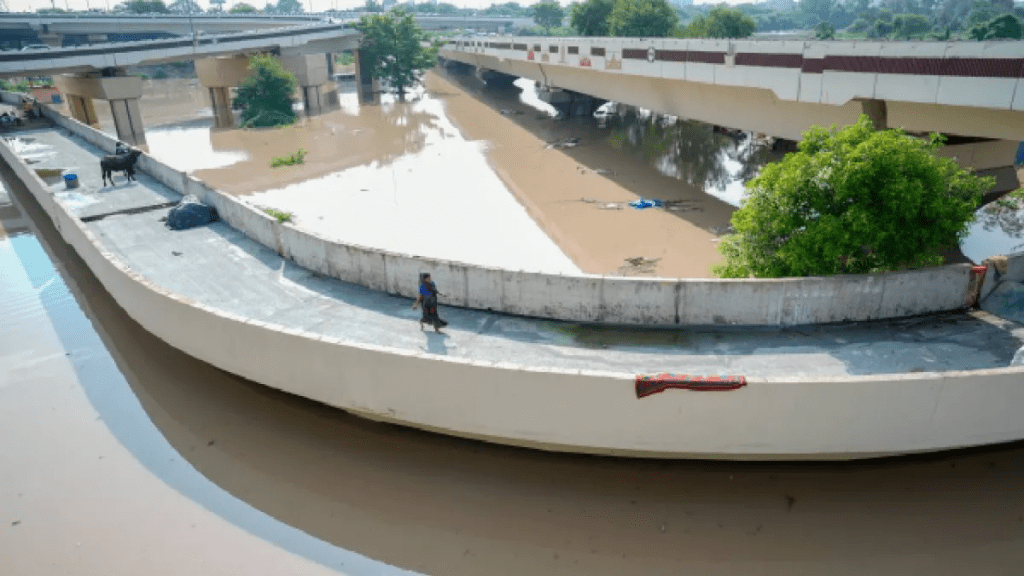
The back-to-back 4 double lane road bridges near Sarai Kale Khan and DND bridge are examples of how these structures have created a bottleneck situation during floods and disrupted floodplain connectivity. Recently widening of the eastern embankment cum road at Gandhi Nagar and creation of service road for Delhi-Mumbai Expressway stretch between Maharani Bagh and Okhla has considerably squeezed the floodplain width there. Separately, these structures have facilitated several permanent encroachments on the floodplain. The details of the bridges on Yamuna in Delhi and their impact on river hydrology can be seen here and here.
2 Permanent constructions on floodplain: Today a huge part of floodplain in Delhi has been lost to big construction and road widening projects. Most of the floodplain land on western bank has already been permanently occupied by several governmental projects.
Since the eastern floodplain of the river is lower, it is quite vulnerable to severe submergence during periodical floods. This part of floodplain is required to allow spread and absorption of flood water. However, over the past one and half decade, a huge chunk of eastern floodplain has also been reclaimed for construction projects. The Metro Depots, CWG Village, Akshardham Temple have alone eaten into over 250 ha of the floodplain on eastern bank.
Interestingly, based on a survey, the DDA in August 2024 claimed that more than 75 percent of 9700 hectares of Yamuna floodplain in Delhi has been encroached upon. As we could not find the survey report in public domain, it is not clear if the DDA has listed the big construction and road projects occupying large part of floodplain land as encroachment or not. However, the agency in the helm of floodplain management affairs has gradually been grabbing more floodplain land for various activities. It has also attempted to dilute the provision of O-zone under Master Plan 2041 to regularize several illegal settlements built on the river floodplain.
4 Unabated encroachment & abuse of floodplain: Disappointingly, under the very watch of the government, the floodplain land in Delhi is being encroached and abused. The DDA itself has allotted over 30 hectares of floodplain land for casting yard and RMC facilities to DMRC, NHAI, PWD and L&T etc. near Usmanpur and Sarai Kale Kha. For over a decade, the developers have hugely raised floodplain land there by dumping concrete materials. DDA has also not restored about 25 hectares of floodplain land taken for Millennium Bus Depot in 2010.
Further, the dumping of construction materials, solid waste, illegal construction on floodplain has been taking place all over the floodplain area. This field visit report by us in July 2025 shows the grave scale of violations happening on floodplain downstream of Wazirabad. Though, the report was sent to Delhi LG, CM, DDA and NMCG, we have received no reply so far. This only suggests level of seriousness among govt bodies regarding protection and management of floodplain. The situation upstream of Wazirabad and downstream of Okhla barrage is even worse.
5 Cosmetic beautification projects: In the name of restoration, the DDA has been working on 11 beautification projects costing about Rs. 800 crores and covering about 1600 acres of floodplain since 2017. Red stone, marbles, rocks, concrete blocks and materials have been substantially used in most of these projects to create permanent structures including at Vasudev Ghat, Ashita West, Bansera and Amrut projects. These violations were also flagged by NGT committee in April 2024.
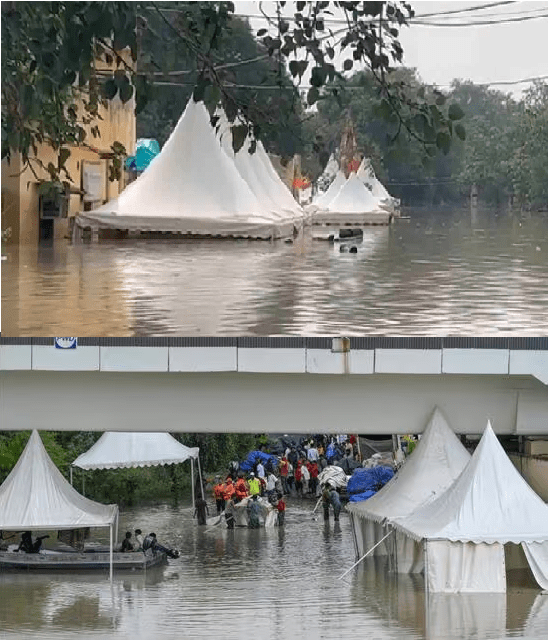
All of these built and under construction projects along with the plantation, pit digging, fish ponds were massively damaged in July 2023 floods and resulted in financial losses of over Rs. 40 crores. Despite this, DDA remained unbothered and planned to connect all the projects as river front development. The Sept 2025 flood has again submerged almost all the project sites causing damages to structures and plantation. Apart from financial losses, these projects have cumulatively affected the flood spread and absorption capacity of the river floodplain.
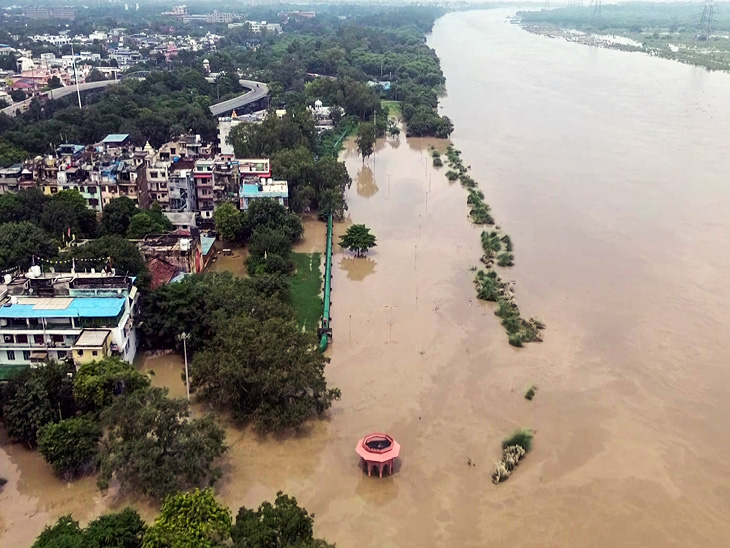
It is worth mentioning that DDA in 2024 levelled and raised about 19 hectares of floodplain land by dumping hundreds of trucks of soil to protect plantation near Vansthali project site. Similarly, about 50 acres of floodplain land has been levelled by huge amount of soil dumping in Gandhi Nagar over the years and being used for large gatherings. As eastern floodplain is lower and undergoes submergence frequently these blatant violations have greatly damaged the flood cushion and groundwater recharge it provides to the city.
6 Increase in riverbed level: Round the year huge amount of silt and sediments have been entering Yamuna system through the river itself and via multiple drains. However, in absence of adequate flows it is getting trapped behind the barrages and near the bridges in Delhi increasing the riverbed level. The formation of sand bars and islands along Yamuna course in Delhi clearly shows increasing level of siltation in the river.
This is also evident from the fact that after July 2023 flood spell, the government has considered raising the Warning Level (WL) and Danger Level (DL) at DRB from 204.50 meter and 205.33 meter to 205 meter and 205.75 meter. Interestingly, the WL and DL were already increased from 204 meter and 204.83 meter in 2019. Further, a recent study has also suggested about 7.5 feet rise in Yamuna riverbed between Wazirabad and Okhla barrages due to siltation and recommended controlled dredging of the silted up riverbed.
Operation of Barrages: Notably, in just 22 km stretch of the river in Delhi, there are 3 barrages Wazirabad, ITO and Okhla being managed by 3 different state governments of Delhi, Haryana and Uttar Pradesh. These barrages are being operated without coordination as mentioned by CWC in the court and in a non-transparent manner and have huge potential to create artificial flooding in downstream areas.
To precisely examine their role in aggravating July 2023 flood and now Sept 2025 flood, their hourly discharge data is required which neither have they disclosed nor CWC has been able to ensure. The issue of coordination among these barrage operators and formation of a nodal agency for the purpose has yet to be achieved.
The ITO barrage has particularly been suspectable for aggravating July 2023 floods as 5 of its 32 gates could not be opened. The MoJS committee in its August 2024 report have also suggested this in indirect manner. Notably, for more than a decade the barrage has been serving no purpose except creating unnecessary obstruction to smooth passage of floods. Yet, both the Upper Yamuna River Board (UYRB) and CWC have been indecisive regarding its decommissioning plans.
Interestingly, the MoJS report has found hydrological discharge computation methods being practiced by all the barrages in Delhi and by the HKB as erroneous and suggested correction. It is unclear whether the barrage operators have revised their water discharge methods and followed other recommendations given by the committee. Most importantly, the objective of flood management in Delhi is incomplete unless hourly discharges of the 3 barrages are made public in real time to ensure their proper and accountable operation during floods.
Missing Governance: Finally, it is the absence of river governance at the heart of the two unusual flood episodes in Delhi. Be it flood monitoring, forecast, management, maintaining flood carrying capacity of river and protecting floodplain from fragmentation & concretization, the concerned agencies including the CWC, UYRB, NMCG, DDA and Irrigation & Flood Control have failed miserably in each of these aspects. This reflects a negligent and shortsighted approach being adopted in governing the floodplain and underestimating the flood potential and threats from the river in Delhi.
Way Forward: All the concerned agencies are required to take concrete measures based on credible assessments to address the causative factors in the context of the two recent flood disasters.
Undoubtedly, the river eco-system and floodplain functioning have already been overstrained by large-scale infrastructure and construction projects in Delhi stretch. So, Delhi must begin undoing the adverse impacts of completed projects to possible extent. A holistic policy is needed to increase the flood carrying capacity of the river by restoring the lateral, vertical and longitudinal connectivity of the river and the floodplain.
Government must positively consider a halt in new projects dissecting the floodplain and squeezing the river channel; removal of some of the structures the city can do fine without; increasing flood passage in cross sectional structures; restoring floodplain land occupied by big projects; prioritizing ecological restoration of floodplain over cosmetic projects which are further concretizing and privatizing it. River cross sections must be urgently assessed at various key points along the river in Delhi.
Equally important is ensuring transparency and accountability in the operation of 3 barrages in Delhi. As ITO barrage has no function, it is right time to plan its decommissioning. Quantifying the rain runoffs from Yamuna catchment downstream of HKB entering Delhi and scientific dredging of silted up riverbed are also essential steps.
Yes, flood monitoring, forecast and floodplain protection are very serious business. Presently, the agencies in charge of these tasks – the CWC and DDA – both have poor track record and have on many occasions -including during these two uncommon flood spells in Delhi- failed to perform their basic objectives. As long as they are at the center of flood monitoring, forecasting and floodplain protection affairs in current avatar, expecting drastic but required changes in these aspects is futile. Hence, time is opportune to replace them with independent bodies.
The two recent extraordinary flood episodes in Delhi with comparatively moderate peak flood volume at HKB have served clear warnings about scale of flood destruction the city will undergo whenever the Yamuna inevitably repeats its historic flood cycle like that of 1978, 2010, 2013 or 2019. Can Delhi afford to continue ignoring the message on the wall or will it make use of it as an opportunity to restore the invaded floodplain for the better and in the larger interest of the city, river and people?
SANDRP
Post July 2023 Yamuna flood disaster in Delhi, SANDRP has covered the new developments on the topic and highlighted unabated destruction of floodplain in the city. Some of our reports on the subject can be seen below.
July 2023 Delhi Floods: Why Unprecedented Yamuna Water Levels even at moderate releases?
Restore Yamuna Floodplain Raised by Illegal Soil Dumping near Shashtri Park, Delhi
The 2023 Yamuna floods of Delhi only a trailer of bigger floods to come in future?
Delhi July 2023 Floods: Parliamentary Committee Report Raises More Questions
Yamuna Manthan 040724: A year after historic floods, where is River Governance?
MoJS Comm. Report on July 2023 Delhi Floods: Fails to explain unprecedented flood levels
Yamuna Manthan 090525: Will we STOP Commercialization of River Floodplains?
Letter: Encroachment of Yamuna floodplain near Wazirabad Barrage
Yamuna Manthan July 2025: Is Delhi Ready for July 2023 like Yamuna Floods?

 SANDRP