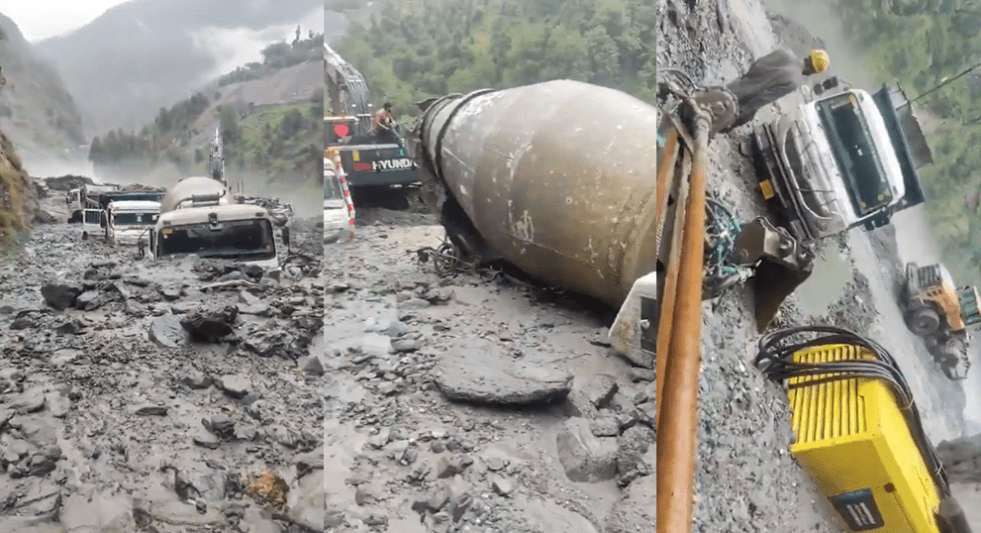
(Feature Image: Screenshots from Akashvani News Jammu video showing flash flood imapct at Kwar HEP site on July 06, 2026.)
A major flash flood and landslide on July 06, 2026 affected the Kwar Hydroelectric Project (HEP) near Padhyarna in Kishtwar district of Jammu and Kashmir. The disaster occurred in the early morning hours following intense overnight rainfall.
Though the official rainfall measurements for the affected catchment are unavailable, local media have attributed the disaster to a ‘cloudburst’. The resultant flash floods carried enormous quantities of mud, rocks, boulders and debris into the Kwar project site, inundating the tail race tunnel (TRT) portal and construction areas.
As a result, several of the project’s heavy machines including dumpers, excavators, JCBs, trucks and other construction vehicles were buried or damaged. Construction materials were also washed away or damaged forcing suspension of construction activities. The approach road to the project site was also damaged but was restored later in the afternoon.
The same debris flow blocked stretches of the Doda–Kishtwar NH-244 near Prem Nagar, damaging sections of the highway, trapping several vehicles and disrupting connectivity between the two districts for several hours. The district administration and project authorities deployed heavy earth-moving machinery to clear debris and restore connectivity.
There is no official information shared by the District Commissioner (DC), Kishtwar and the District Information and Public Relations (DIPR), Kishtwar on their social media handles including X (Twitter) (@dckishtwar; @DICKishtwar) and Facebook (District Administration Kishtwar – DIPR Kishtwar; Information & PR, Kishtwar) about the incident. The official X account of the Jammu & Kashmir Disaster Management Authority (JKDMA) @jk_sdma and the Facebook page of SDMA J&K have not been updated since May 13, 2026 and Dec. 01, 2021, respectively.
Further, the websites of JKSDMA and the Disaster Management Kishtwar have no official information about this disaster. The last circular and order available on the JKSDMA website were issued in Dec. 2024 and June 2024, respectively. Similarly, there is no record of meeting minutes after Sept. 2018 on the website.
Notably, the Chenab Valley Power Projects Private Limited (CVPPL) is developing four major hydro projects in Chenab valley including 1000 MW Pakkal Dul HEP on the Marusadar river a tributary of Chenab, 624 MW Kiru HEP, 540 MW Kwar HEP and 930 MW Kirthai II HEP.

As can be seen from the map above, the region is dense with commissioned, under construction and planned hydropower and other infrastructure development. At the same time, the region is also under threat of extreme weather events as highlighted by the study by Kashmir University and Central Jammu University. According to the authors, “Rapid expansion of the proglacial Mundiksar Lake has potential to affect the critical infrastructure such as Bursar and Pakal Dul dam sites in the downstream region.
Though, the Kishtwar District Disaster Management Plan (DDMP) 2024-25 acknowledges the potential flood and landslide risks of hydro projects, however it appears to rely primarily on CVPPL’s Disaster Management Plan (DMP). According to the DDMP the CVPPL has its DMP ready to tackle with any disaster like situation. However, the CVPPL has yet to issue an official press release detailing the overall impact of the disaster on the project and its infrastructure.
The only official statement so far has come from Union Minister Dr. Jitendra Singh, who posted on X and Facebook that the flash flood water had entered the premises of the Kwar HEP, but there was no loss of life. According to his statement, the project machinery was moved to safety without damage and the project’s permanent structures had remained intact.
Referring to project authorities, this report also mentions that preliminary inspections found no structural damage to the dam or other permanent civil works, although cleanup operations and detailed assessments were going on.
Notably, in the latest environmental compliance report of the project for Oct. 2025 to March 2026 period, the Multidisciplinary Monitoring Committee (MDMC) had expressed concern over delays in implementing the DMP. The report states that CVPPL had installed two V-SAT communication systems for emergency communication and three Early Flood Warning Systems (EFWSs) upstream the Kiru HEP as part of DMP.
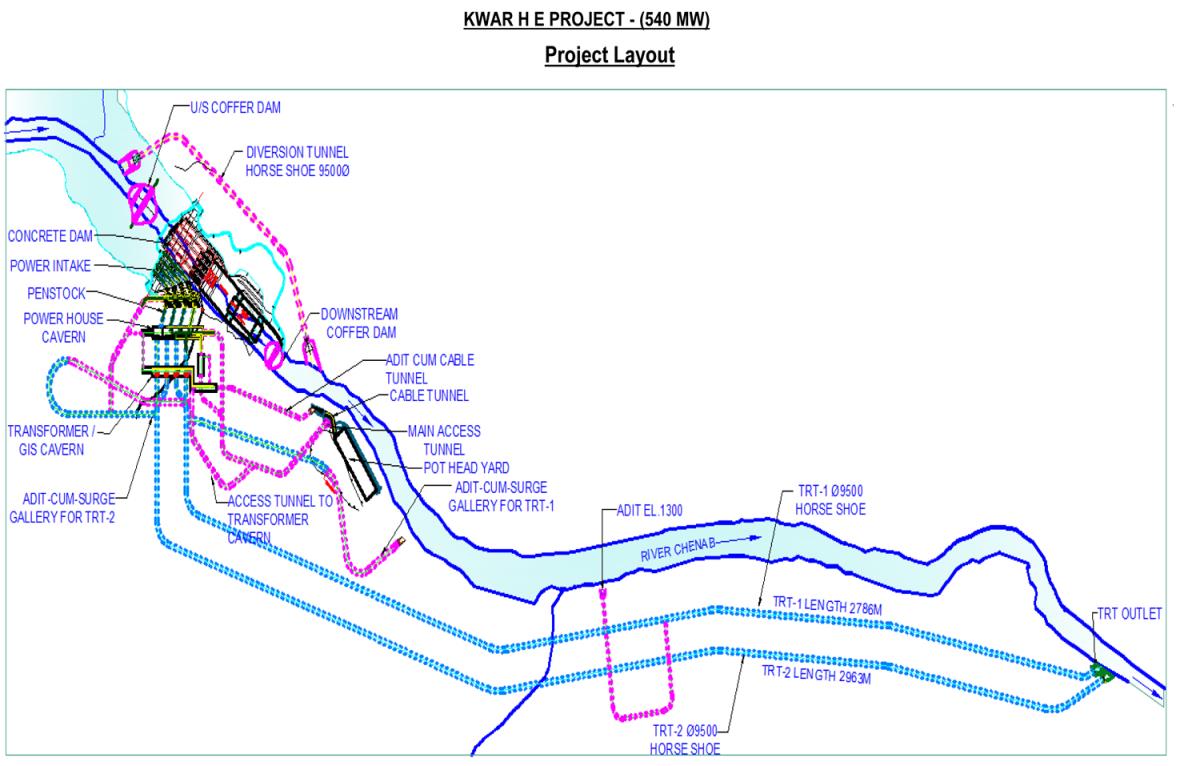
The 540 MW (4X135) Kwar HEP is one of several large hydropower projects under construction in the Chenab basin. Located about 28 km upstream of Kishtwar town, the project comprises a 109-m high concrete gravity dam, an underground powerhouse and a network of headrace and tailrace tunnels. Construction of the project, estimated to cost about ₹4,526 cr, commenced in 2022 and the project is expected to be commissioned around March 2028.
Although this disaster appears to be the first reported flash flood directly impacting the Kwar project site, the Chenab valley has witnessed several severe hydro-meteorological disasters in recent years.
In July 2021, cloudbursts in the Honzar area of Dachhan in Kishtwar district caused extensive destruction of roads, bridges and settlements. More significantly, the Chishoti cloudburst of August 2025 claimed at least 62 lives, left dozens missing and devastated villages in the district, underlining the region’s increasing exposure to extreme rainfall events. The Kwar project itself also experienced a major safety incident in Nov. 2025, when a fire inside one of its construction tunnels led to the evacuation and rescue of workers.
The latest disaster has renewed concerns among local residents, environmental groups and disaster experts regarding the cumulative impacts of multiple hydropower projects, road widening and large-scale excavation across the Chenab Valley. They argue that extensive hill cutting, tunnel excavation and inadequate management of excavated muck may be increasing slope instability and altering natural drainage, thereby aggravating the effects of intense rainfall events.
SANDRP


