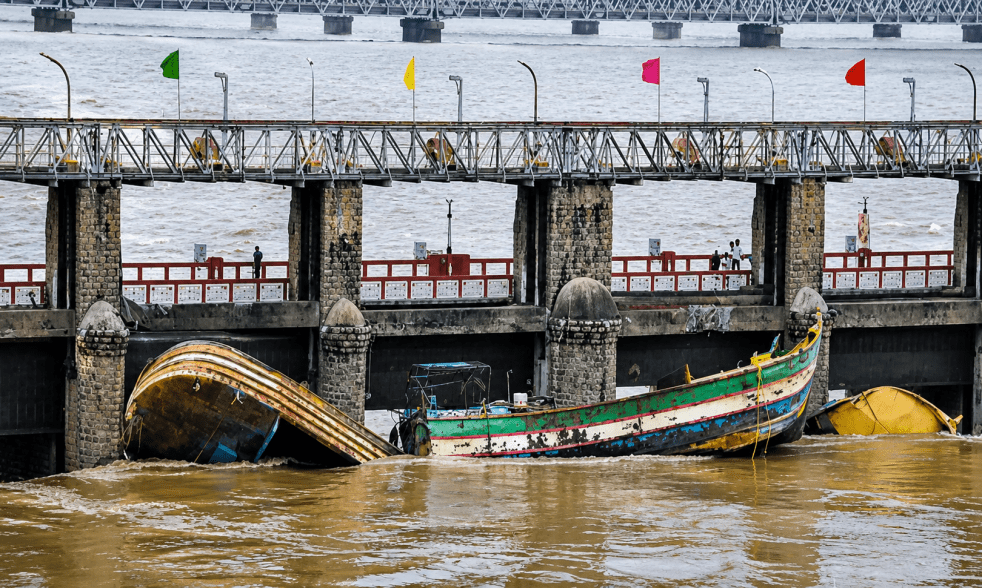
(Feature Image: Sand boats stuck in Prakasam barrage during Sept. 2024 floods. Source: Hans India)
This overview tracks the incidents of damage and threats to bridges and other river infrastructure across India between March 2023 and June 2026. The compilation shows that at least six bridge collapse incidents were reported where riverbed sand mining, sand transportation or excessive riverbed disturbance either directly contributed to the collapse or emerged as a significant risk factor alongside floods, poor construction and overloading.
The notable examples include the collapse of the Bailey Bridge over the Singla river in Assam after two overloaded sand-laden dumpers attempted to cross it; the collapse of a rural bridge between Bhimavaram and Dongapindi villages in Andhra Pradesh while a sand-laden lorry was crossing; the partial collapse of the Dudhei Bridge in Odisha, where local residents linked illegal sand mining to weakened foundations; and the Barnar river bridge in Bihar, where reports suggested that illegal sand mining may have intensified riverbed scouring around bridge piers during floods.
The review also documents several other bridges facing serious threats from illegal or excessive sand mining. These include the Vaitarna Railway Bridge (Maharashtra), NH-44 Chambal Bridge (Madhya Pradesh), Chhata River Bridge and Radhu River Bridge (Jharkhand), century-old Budhabalanga Bridge and Kathajodi T-Bridge (Odisha), Badrighat Bridge (Assam), NH-44 Bridge on the Tungabhadra River (Andhra Pradesh) and the Edappalam–Moorkanad Bridge (Kerala), where mining has exposed bridge foundations, intensified riverbed erosion or increased the risk of structural instability.
The compilation further reveals that the impacts of sand mining extend beyond bridges. A worth mentioning case is the Prakasam Barrage on Krishna river in Andhra Pradesh, where at least four boats reportedly used for sand mining were swept away and stuck in the barrage during floods in Sept. 2024 causing damage to a gate of the barrage. It also highlights WII (Wildlife Institute of India) warnings against excessive sand mining in the Godavari river. Similarly, the illegal mining near the NH-44 bridge on the Tungabhadra river raised concerns about both bridge safety and drinking water security.
Our reports on these issues for J&K, Punjab & Haryana and Uttarakhand & Himachal Pradesh states and sand mining damage to check dams in Telangana can be seen by clicking the hyperlinks.
CENTRAL INDIA
Maharashtra: Vaitarna Railway Bridge The police on March 29, 2023 detected illegal suction dredging of sand from the Vaitarna river near the railway bridge between Vaitarna and Saphale stations in Palghar district, on the Western Railway suburban network. During an inspection, authorities found a suction pump mounted on a boat extracting sand from around the bridge. According to the FIR, continuous removal of sand from the riverbed had made the railway bridge unsafe by threatening its foundations and disturbing the river environment.
Police registered a case against two persons under the Railways Act, the Indian Penal Code, and the Environment (Protection) Act. The suction pump and boat used for illegal mining were destroyed, though no arrests had been made at the time of the report. The case also revived concerns over illegal sand dredging around the Vaitarna bridge, where similar mining activities had previously prompted judicial intervention.
Madhya Pradesh: NH-44 Chambal Bridge The NH-44 bridge over the Chambal River is a vital inter-state link connecting Morena and Dholpur and carrying thousands of vehicles daily. On 7 April 2026, reports revealed extensive illegal sand mining beneath and around the bridge pillars, where excavators, tractors and dumpers had dug 30–50 ft deep pits, raising serious concerns over the bridge’s structural stability and public safety.
The Supreme Court took suo motu cognizance on 13 March 2026 over illegal sand mining in the National Chambal Sanctuary, issued notices to Madhya Pradesh, Rajasthan and Uttar Pradesh on 20 March, and during the 13 April 2026 hearing was informed that a fact-finding committee had been constituted to investigate mining near the bridge. In its 17 April 2026 order, the Court warned that excavation around bridge foundations posed a serious risk to critical infrastructure and directed enhanced surveillance, GPS tracking of mining vehicles, CCTV monitoring, and stronger enforcement. The Court continued monitoring compliance through subsequent hearings.
EAST & NORTH EAST INDIA
Bihar: Barnar River Bridge A road bridge over the Barnar river in Jamui district collapsed on Sept. 24, 2023 after heavy monsoon rainfall caused a sharp rise in water levels and strong river currents, which led to severe scouring around bridge pillars and structural failure. The bridge, built in 2009, lost multiple supporting pillars as floodwaters eroded the riverbed and weakened its foundations, resulting in disruption of local connectivity. While officials mainly attributed the collapse to flood pressure and natural river erosion, local residents and reports suggested that illegal sand mining near the site may have contributed by deepening the riverbed and destabilizing soil around the bridge foundations, increasing its vulnerability during high-flow conditions. The incident also reflected broader concerns about weak regulation of sand mining and inadequate maintenance of river infrastructure in Bihar, where combined natural forces and human activities are increasingly impacting bridge stability.
Falgu River The March 31, 2026 report highlighted that indiscriminate sand mining along the Falgu river has severely damaged the river’s physical structure and adjoining infrastructure systems. Continuous extraction using heavy machinery has led to deepening of the riverbed, destabilisation of riverbanks and increased erosion, making nearby embankments and crossings more vulnerable during seasonal floods.
Experts noted that such unregulated mining alters the natural flow of the river, increases turbidity, and weakens structural stability around river-linked infrastructure such as local roads, embankments, and bridge approaches. The degradation has also raised concerns about long-term risks to flood management systems and connectivity in the Patna–Jehanabad belt, where riverbank collapse and shifting channels have become more frequent due to excessive sand extraction.
Multiple Bridge Collapse; July 2024: This report mentioned collapse of at least 12 bridges within 17 days across multiple districts including Saran, Siwan, Kishanganj, Madhubani and East Champaran triggering concerns over infrastructure safety during the monsoon season. The report highlighted that these incidents are linked to a combination of extreme rainfall, river dynamics, weak construction practices and maintenance failures. Officials noted that many bridges were either old or built with substandard materials and shallow foundations, making them highly vulnerable to flood pressure and scouring during heavy monsoon flows. Experts and state officials also pointed to recent desilting activities and changes in river channels, which may have weakened support around bridge pillars.
While not identified as a direct cause, sand mining and riverbed disturbance are considered significant contributors, as they deepen river channels and accelerate erosion around bridge foundations, increasing vulnerability during floods.
Jharkhand: Chhata River Bridge During a district-wide inspection on 24 April 2025, the Khunti district administration discovered that illegal sand mining had exposed the foundations of a bridge over the Chhata river in the Torpa area, raising fears of a possible structural collapse. The inspection, led by Sub-Divisional Officer Deepesh Kumari, also uncovered an illegal stockpile of about 2.5 lakh cubic feet of sand, valued at approximately ₹18 lakh, on the banks of the Koel River in Rania. Officials found that sand had been illegally stored on forest and private (raiyyat) land.
Radhu River Bridge This May 2026 report mentions that illegal sand mining in the Radhu river has raised serious concerns after reports indicated that it is weakening the foundation of a key bridge that serves as an important connectivity link for nearby villages and facilitates movement of people and goods across the river. Continuous and largely unregulated extraction of sand from the riverbed near the bridge has disturbed the natural sediment balance, leading to intensified erosion around the bridge pillars and exposing structural components to potential damage.
The problem is being driven by high demand for construction sand in surrounding areas, weak enforcement of mining regulations, and the active involvement of illegal mining networks operating without proper permits, often using mechanised equipment and heavy vehicles that further destabilize the riverbed. This ongoing activity has increased the risk of structural failure, threatened local transport connectivity and raised safety concerns for commuters, while also degrading the river ecosystem and altering its natural flow patterns.
Odisha: Dudhei Bridge The 300-metre-long Dudhei river bridge, built in 2011 near Sujanpur village in Dharmasala block, partially collapsed on Sept. 19, 2024 after persistent heavy rainfall, severing the only road link connecting several riverside villages with Jajpur town. Two people fell into the river during the collapse but swam to safety, and no fatalities were reported. The incident disrupted transport, access to markets, schools, and essential services for thousands of residents. While officials launched an inquiry and found no immediate design flaws, local residents and a retired engineer alleged that illegal sand mining near the bridge, along with possible structural deficiencies, may have weakened its foundation and contributed to the collapse.
Old Bridge on Budhabalanga River: On Feb 23, 2024, residents raised concerns that illegal sand mining around the Budhabalanga river was threatening the structural stability of a century-old bridge near Madhuban in Mayurbhanj district. Despite a 2015 district administration order prohibiting sand extraction within a 500-metre radius of the bridge’s protective pillars after a rescue operation found several pillars weakened by excavation, illegal mining reportedly continued unabated. Residents alleged that numerous tractors were transporting sand daily in violation of mining regulations, increasing the risk of bridge failure, flooding, river course changes, and landslides in nearby Madhuban and Poda Astia areas.
Kathajodi River T-Bridge The Sept. 23, 2024 report raised concerns over illegal sand quarrying in the Kathajodi river near the T-Bridge at Khannagar in Cuttack. Residents alleged that heavy mechanised sand extraction was taking place close to the bridge despite restrictions, exposing its foundations and increasing the risk to the structure. Locals warned that continued quarrying could weaken the bridge, alter the river channel, and endanger public safety. They also accused the authorities of failing to curb illegal mining despite repeated complaints.
Assam: Singla Bailey Bridge A Bailey bridge over the Singla river at Anipur, on the Ramkrishna Nagar–Sribhumi PWD road in Sribhumi district collapsed on Feb. 11, 2026 when two overloaded dumpers carrying river sand attempted to cross the bridge simultaneously. Officials said the bridge’s middle span gave way under the excessive load, with preliminary findings indicating overloading as the primary cause.
The collapse damaged five vehicles (including the two sand-laden dumpers), injured four pedestrians, and completely disrupted road connectivity, affecting commuters and students appearing for HSLC and HS examinations. Authorities ordered a magistrate-level inquiry and arranged temporary boat services while planning an interim crossing until the bridge could be rebuilt.
Barak River Badrighat Bridge Residents on Sept. 17, 2025 expressed concerns over illegal sand mining beneath the newly constructed Badrighat Bridge across the Barak river in Berenga, Silchar, where locals alleged that excavators and JCB machines were extracting sand every night without valid mining leases. Residents warned that continuous excavation directly below the bridge was deepening the riverbed, weakening the bridge foundation and approach roads, and increasing the risk of erosion and structural instability, especially during the monsoon.
The report also highlighted allegations of a nexus between the sand mafia and certain Forest Department officials, claiming that the illegal activity had continued unchecked despite its proximity to the local forest range office. Locals demanded immediate intervention to stop the illegal mining and prevent potential damage to the bridge.
West Bengal: Dudhiya Bridge A detailed report on Oct. 10, 2025 from Mirik subdivision of Darjeeling district, highlighted that severe flood damage along the Balason river was significantly influenced by not only by heavy rainfall but also by extensive human interference in the river ecosystem. According to the report, unregulated construction of hotels, homestays and commercial structures on riverbanks and floodplains along with illegal sand mining and riverbed excavation, altered the natural flow and stability of the river.
Experts, including river specialist Kalyan Rudra, noted that such encroachments in active floodplain zones intensified erosion and increased the destructive impact of flash floods, as rivers naturally expand during high-flow events. Local residents also claimed that rapid commercialisation, removal of natural river barriers and political patronage for construction activities worsened the situation, turning Dudhiya into a vulnerable settlement during extreme rainfall events. The combined effect of these factors led to damage to roads, small bridges, and houses, and disrupted connectivity along the Siliguri–Mirik–Darjeeling corridor.
Study The article discusses a Presidency University study led by Dr. Priyank Patel on the impacts of riverbed sand mining in the Ajay, Damodar and Subarnarekha rivers of southern West Bengal. The study found that sand mining is altering river channel morphology, increasing riverbank erosion, disrupting sediment transport, degrading aquatic habitats, lowering dissolved oxygen, increasing suspended sediment concentrations beyond CPCB standards, and affecting adjacent floodplains and groundwater levels.
SOUTH INDIA
Andhra Pradesh: Prakasam Barrage SANDRP documented the Sept. 02, 2024 incident where several boats reportedly used for sand mining or sand transport were swept away by floodwaters in the Krishna river and collided with Gate No. 69 of the Prakasam Barrage at Vijayawada, damaging the gate’s counterweight and concrete support. The report notes that similar incidents occurred in 2019 and 2023, raising concerns over the recurring threat posed by sand-mining boats to the barrage. It called for an independent inquiry into the ownership of the boats, possible violations of sand mining rules, and measures to prevent such incidents.
On May 31, 2026, a rural bridge connecting Bhimavaram and Dongapindi village in West Godavari district collapsed when a sand-laden lorry was crossing it, causing the structure to suddenly give way. The bridge spanned a local irrigation canal/stream that supports surrounding agricultural lands and aquaculture ponds, making it an important rural connectivity route for daily transport and goods movement.
The collapse disrupted connectivity between nearby villages, blocking access to farmland and fish ponds, and affecting local transport and livelihoods. No casualties were reported, but the incident highlighted concerns over the movement of heavily loaded sand transport vehicles on weak rural infrastructure. Authorities initiated an inspection into the structural condition of the bridge and traffic load issues.
Tungabhadra River NH 44 Bridge: On April 3, 2026, residents of Kurnool district raised alarm over large-scale illegal sand mining in the Tungabhadra river near the National Highway-44 bridge, a key transport link connecting Kashmir to Kanyakumari. Hundreds of tractors were reportedly extracting sand from the riverbed in close proximity to the bridge, prompting fears that excessive removal of sand could weaken the bridge’s foundations through erosion and increase the risk of structural damage.
The report also warned that uncontrolled mining had reduced water flow in parts of the river, raising concerns about an impending drinking water crisis, as the Tungabhadra river is the primary source of potable water for lakhs of people in Kurnool district. Residents accused officials from the police, revenue, and mines and geology departments of failing to curb the illegal activity and urged immediate action to protect both the bridge and the river ecosystem.
Kerala: Edappalam-Moorkanad Bridge On April 18, 2026, residents warned that rampant sand mining in the Thootha river at Edappalam Kadavu, Palakkad district, had exposed the foundations of the Edappalam–Moorkanad Bridge, a key road link connecting Palakkad and Malappuram districts. Sand extraction from a 1.5-km stretch of the river to deepen the channel for the Moothikkayam regulator-cum-bridge project exposed four piling pillars, raising fears of structural instability and a possible bridge collapse. Mining, which had earlier been halted following local protests and a Kerala High Court stay, resumed after the stay was vacated. Local residents demanded immediate intervention to stop further mining and protect the bridge.
Telangana: As per the Sept. 2025 report, the Wildlife Institute of India (WII) has warned that excessive sand mining in the Godavari river poses a serious threat to dams, bridges, and other river infrastructure. The warning was issued during a meeting between WII Dean Dr. Ruchi Badola and Telangana CCF Dr. Suvarna as part of an environmental assessment of the Godavari River basin, which was studied across its upper (Maharashtra), middle (Telangana), and lower (Andhra Pradesh) reaches.
According to the WII, unregulated extraction of sand can undermine the stability of structures built across the river and damage the river’s ecological balance. The institute recommended imposing stricter restrictions on sand mining, restoring riverbanks through plantation of trees and grasses, and ensuring regular monitoring of the river ecosystem. The study also cautioned that unscientific fishing practices and the spread of invasive fish species are affecting the river’s biodiversity, calling for scientific management of both sand mining and fisheries.
SANDRP


