DRP News Bulletin

DRP: 8 July 2019: Kerala CRZ Norms Violation; Senior Lawyers ‘Play Fraud’ On Court, Invite SC Wrath

Irked over “judicial impropriety” by some senior advocates in taking relief from its vacation benches by suppressing facts, the Supreme Court July 5 blasted them for “playing fraud” upon it. Terming this practice as “the height of judicial misconduct”, a bench comprising Justices Arun Mishra and Navin Sinha said senior advocates were “not above the law” and such conduct reflected that “no morality” is left in some of them.

It also took exception to the passing of order by the vacation bench, which had stayed the demolition of some buildings in Kerala for six weeks. Hearing the matter earlier, a bench headed by Justice Mishra had directed on May 8 that these buildings be removed within a month as they were constructed in the notified Coastal Regulations Zones (CRZ), which is part of the tidally influenced water body in Kerala.

When the matter came up for hearing on July 5, the bench said it has “serious objection” to what has happened in the case as “height of judicial impropriety has been done”. “During the vacation, the matter was mentioned before me but I refused to hear it. Then it came before another vacation bench. That bench should not have passed the order. You (lawyers) are permitting the court to commit judicial impropriety,” the bench told senior advocate Kalyan Banerjee, who is also a Lok Sabha MP from All India Trinamool Congress.

Continue reading “DRP: 8 July 2019: Kerala CRZ Norms Violation; Senior Lawyers ‘Play Fraud’ On Court, Invite SC Wrath”
DRP News Bulletin

DRP: 1 July 2019: If Govt is serious about water, begin with sustaining groundwater lifeline & watersheds

For several decades now, groundwater has been India’s water lifeline. It is going to remain India’s water lifeline for long time to come. So when Prime Minister Modi called for people’s movement on water conservation during his MANN KI BAAT Radio program on June 30, 2019 (http://pib.nic.in/PressReleseDetail.aspx?PRID=1576353), the first thing the people would expect the government to do is to acknowledge the reality that groundwater is India’s water lifeline and make the sustenance of that water lifeline as the focus of all National Water Policies, programs and plans.

India also urgently needs a National Urban Water Policy that would also define what is a water smart city. The government will need to show it is serious by putting in place rainwater harvesting and groundwater recharging systems at ALL government buildings and lands across the country and show that these are functioning.

The government will also need to bring back the watershed development as the focus of its work on water conservation and reverse the wrong steps this government took five years back (see the detailed report below).

The government also needs to urgently start work on restructuring of water institutions of India, starting with CWC. Unless people see the government’s seriousness through actions, the one listed here are the initial steps, there is little likelihood of credibility of what the government says.

With rainfall in June 2019 during the South West Monsoon already showing a deficit of massive 33%, the fifth highest deficit in last 100 years, its possibly the most opportune time to take these steps on URGENT BASIS.

Continue reading “DRP: 1 July 2019: If Govt is serious about water, begin with sustaining groundwater lifeline & watersheds”
DRP News Bulletin

DRP: 24 June 2019: Questions about Kaleshwaram as big as the project

June 21 seemed like a new day with all the national newspapers carrying full front page advertisements about Kaleshwaram project of Telanagana, advertised with more than usual share of superlatives: Lifeline of Telangana, record breaking projects, the world’s highest lift project completed in fasted time and so on. At three (Maharashtra – the upstream state- Andhra Pradesh – the downstream state and Telangana the project state) Chief Ministers and one governor gathered on the banks of Godavari river in Jayashankar Bhupalpally district to inaugurate a project that opposition mocked, saying it is just 20% completed.

But there were many serious unanswered questions and problems around the costliest irrigation project of India from a region and sector that is infamous for corruption. Water availability itself is in doubt, the impact assessments are hardly done even in name sake, public consultations non existent. Even statutory clearances are being questioned. If this is the best or even least cost option for the Telangana is not even debated, for a project that may need over 5000 MW of power for lifting the water to over half a km height. That too in a state where no district has below 500 mm rainfall.

Continue reading “DRP: 24 June 2019: Questions about Kaleshwaram as big as the project”
DRP News Bulletin

DRP: 17 June 2019: If the Rains Fail; Is the Nation Ready?

Indian Express, one of the India’s leading and most respected National Newspapers, has an editorial on the above subject on June 17, 2019. The Edit has some rather dire warnings: “If current conditions persist — the US Climate Prediction Center has forecast an 81 per cent chance of El Nino, the abnormal warming of the equatorial eastern Pacific Ocean waters known to adversely impact rainfall in India, continuing till July and 66 per cent up to August — kharif crop production will take a hit.”

The monsoon, after its rather reluctant entry into Kerala, so far is already 43% deficit till June 17. Out of 36 meteorological divisions, 18 had large (over 60%) deficiency and 13 more had 20-60% deficiency, so 31 of 36 sub divisions already faced over 20% rainfall deficit. If the El Nino prediction of US Climate Centre comes true, we could be in for meteorological, agricultural and even hydrological drought, considering our water management situation.

Continue reading “DRP: 17 June 2019: If the Rains Fail; Is the Nation Ready?”
Urban Rivers · Yamuna River

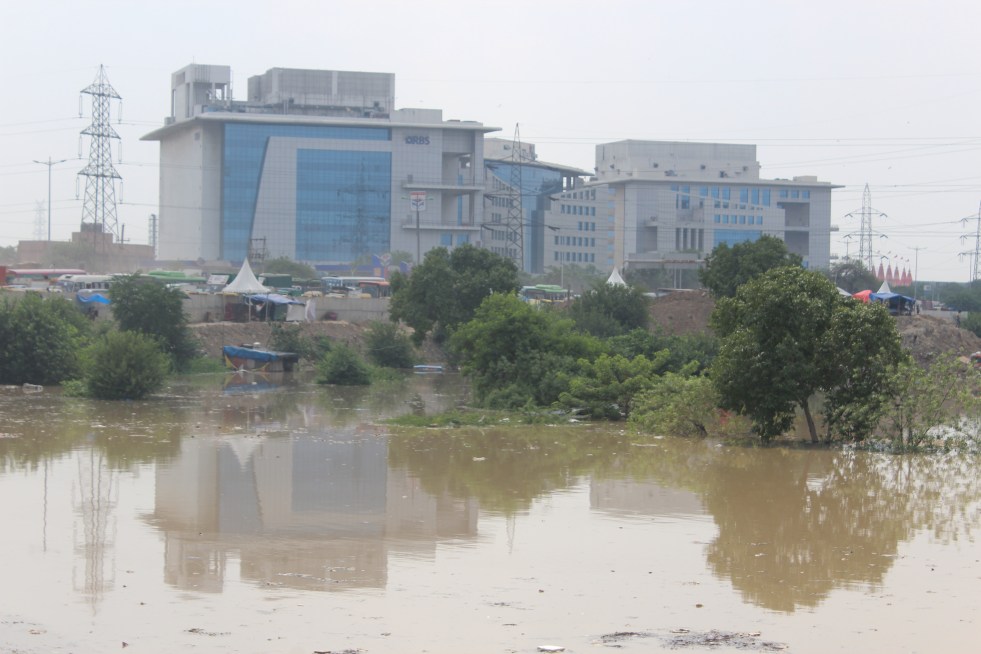
Abuse of Remaining Yamuna River Floodplain in Delhi Continues

The stretch of Yamuna River & its floodplain lying between Palla and Wazirabad Barrage in Delhi is still in reasonably good state. Though bisected by an embankment, the floodplain is free of too many recent major encroachments. The River keeps meandering between physical boundaries of Delhi and Gaziabad district of Uttar Pradesh on the other side. The average width of floodplain from embankment to embankment is 2 kilometres. The width of active river current varies from 200-300 metres.

Most parts of the floodplain on both sides of this embankment are under agriculture. The crops grown here includes paddy, vegetables and floriculture as cash crops apart from wheat, traditional riverbed crops of melons, cucumber, tomato and bottle guards etc. Use of chemicals is also growing. There is not much information available about the impact of chemical farming on floodplain and river eco system.

Continue reading “Abuse of Remaining Yamuna River Floodplain in Delhi Continues”

DRP News Bulletin

DRP: 10 June 2019: Some real solutions from Bihar, Punjab, Karnataka as Centre indulges in name plate change

(Feature image from Hindu file photo of a kalyani filled with weeds in the vicinity of Devanahalli Fort near Bengaluru.) 

Even as the Union government is AGAIN busy changing the name plate of Ministry of Water Resources, some real water solutions emerge from Bihar, Karnataka and Punjab.

Punjab Many takers for ‘Phagwara technique’ of paddy direct seeding Some farmers had experimented last year with a direct seeding technique of paddy, developed by a Phagwara-based farmer, which reduces water requirement by 90%. Seeing the results — low water usage and high yield — many more farmers have signed up for the same this year. As they require much less water for the first two to three weeks, these farmers have also managed to sow paddy much before the schedule fixed by the Punjab government.

Continue reading “DRP: 10 June 2019: Some real solutions from Bihar, Punjab, Karnataka as Centre indulges in name plate change”
DRP News Bulletin

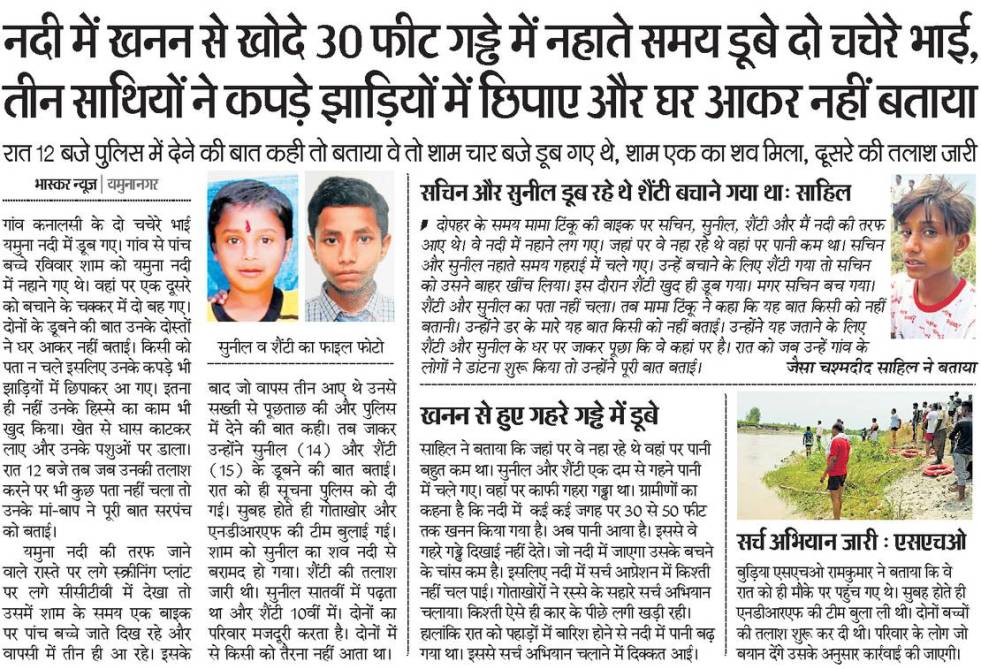
DRP: 3 June 2019: Illegal Sand Mining Impacting Rivers, People & Infrastructure across India

Five months have passed of 2019. There is apparently no reduction in illegal sand mining activities which are continue to  ruin rivers, kill people and damage public infrastructure across the country.

In North India, the Ghaggar, Yamuna, Ken, Betwa and Chambal rivers have been severely affected. The Narmada, Krishan, Godavari and Cauvery are prominent rivers bearing the burnt of unsustainable extraction.

There are reports hinting that uncontrolled mining menace is also aggravating the drought situation. On one hand it is causing siltation of reservoirs thus reducing storage capacity while on the other it is inhibiting recharge of shallow aquifers supplying base flow to rivers during lean season. This is one of the main reasons many of perennial rivers like Cauvery, Narmada, Yamuna, Ken, Betwa and Godavari at many places are running dry this year.

Continue reading “DRP: 3 June 2019: Illegal Sand Mining Impacting Rivers, People & Infrastructure across India”
Yamuna River

Perennially non functional Common Effluent Treatment Plants in Yamuna Basin

Chances are higher that you find a CETP malfunctioning on repeated visits for same commonly made lame excuses. (Feature image 4 MLD Kundli CETP discharging effluents without any treatment into drain number 6, while drain number 8 flowing next to it. Image taken on May 11, 2019 by author)

“Oh my God, its unbearable” was the first expression came out of my mouth instinctively and instantly, while standing at the outlet of Common Effluent Treatment Plant (CETP) in Sonipat District, Haryana. The plant was located in Kundli Industrial Area along DN (Drain Number) 8 at Delhi Haryana border. It was the morning of May 11, 2019 while observing status of DN 6, along with my friend Yayati Bhardwaj.

DN 6 carries industrial and domestic effluents from a large area of Panipat and Sonipat districts while DN 8 supplies potable water to Delhi via Yamuna river. Both drains run parallel for a length of 10 km and more than often intermix due to breaches and spill-overs. To know more about this, see: Delhi’s Drinking Water is 9 inch Wall away from Toxic Industrial Effluents & Sewage.

Continue reading “Perennially non functional Common Effluent Treatment Plants in Yamuna Basin”

DRP News Bulletin

DRP: 27 May 2019: Water Sector Agenda for the new Govt: ILR cannot be part of it

The new government at the centre, headed by Shri Narendra Modi, if we go by the signals so far, is likely to push the mega project agenda including Inter Linking of Rivers (ILR). It also seems that Gadkari may continue to be the Water Resources Minister, if we go by the statements and signals so far. Both these steps would be wrong. The PM has said he wants to provide piped drinking water to everyone in the country in his new term. Such one size fits all solutions are likely to create more problems than solutions, as we can see from the dumping of honey sucker tankers close to drinking water sources, thanks to building of crores of soak pit toilets.

If the government wanted to listen, this weekly bulletin (like any other week) from SANDRP provides enough food for thought. Very large part of India, including huge parts of big dam building states of Gujarat and Maharashtra are in grip of drought. Like they have been repeatedly over the last few years. ILR is an extension of the big dam agenda and no amount of false promises of Godavari water are going to fetch votes, as they did not for the BJP in current elections in Tamil Nadu or Andhra Pradesh. Similarly big hydro is no longer viable, and pushing them either in Ganga basin or in North East India will only invite dis-satisfaction, destruction and distress. Big dams are making the floods worse as Kerala example showed in Aug 2018, among many others. We can choose to close our eyes to these realities, but that wont change the realities.

Continue reading “DRP: 27 May 2019: Water Sector Agenda for the new Govt: ILR cannot be part of it”
DRP News Bulletin

DRP: 20 May 2019: This drought, Big Dams recognised as elephants by media

At least 40% of India is facing worst drought of 30-40 years as per various researchers. A very large part of that happening in areas that are focus of India’s dam building. These areas are facing drought in spite of so much dam building. But the official agencies never saw the link. Its heartening to see some media reports and edits have started recognising the elephant in the room. Hope this is change for the better and if the media continues to highlight the situation and linkages, may be, may be we will also see impact on the governments. A silver-lining as they say in otherwise dark situation.

Continue reading “DRP: 20 May 2019: This drought, Big Dams recognised as elephants by media”