
The Maharashtra government submitted an affidavit in High Court that the state has 15865 wetlands, down from 44714 in 2010. How did 28849 wetlands disappear from the very definition of wetland? While all of these wetlands may not have disappeared from ground, their disappearance from govt papers as wetlands means that they are now open to all kinds of abuse and encroachments. It along with other wetlands related stories here shows how little the governments are concerned about the wetlands.
Continue reading “DRP: 17 Feb 2020: Case of “disappearance” of 28849 wetlands in Maharashtra”Tag: Sand Mining
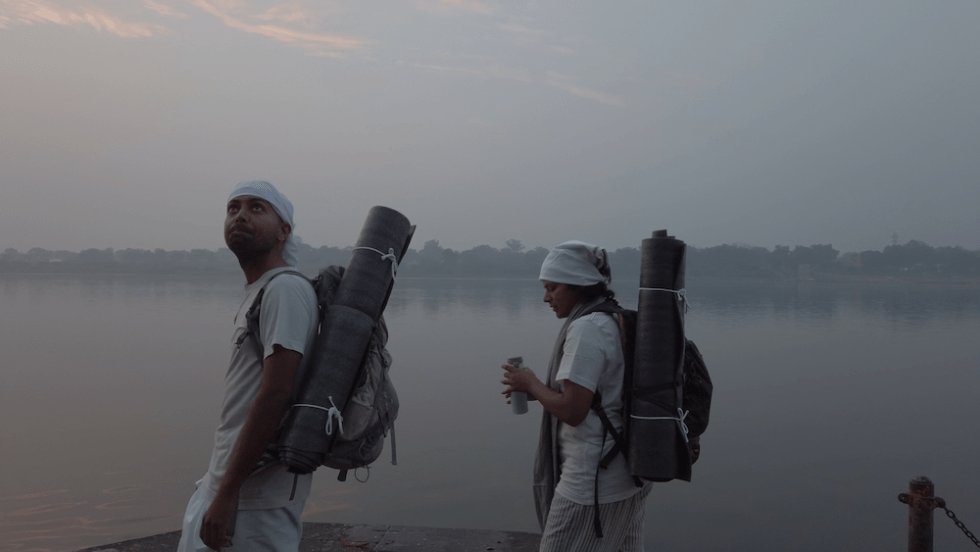
Experience of Narmada Parikrama in 2020: a 3500 km pilgrimage along the river
Guest Blog by Jubin Mehta
Narmada is a sacred river originating in the Maikal Hills of central India from a place called Amarkantak. Parikrama is a Sanskrit word derived from the root ‘pari‘ meaning around and ‘krama‘ meaning going. And hence, Narmada Parikrama means circumambulating the river. This is a spiritual/religious tradition of the Hindus existing from centuries wherein pilgrims start walking from any point along the river after collecting Narmadaji’s water in a vial and start walking with the river to their right.
If a person has started from the north bank, they’d walk upstream to the origin of the river in Amarkantak, cross over from beyond the origin point, come to the south bank and walk downstream till the point where the river meets the ocean in south Gujarat. From here, pilgrims board a large boat for an estimated four to seven hours to cross over and reach back to north bank at a place called Mithi Talai. From here, the pilgrim starts walking upstream again to arrive again at the point where they started from. At the end of the journey, pilgrims go to the super sacred Omkareshwar which is one of the 12 ‘Jyotirlingas’ and also a river island which means a person cannot go to this point during the parikrama. One of the rules of the walk is that a person cannot cross over the river and go to the other bank or in the middle. At Omkareshwar, the pilgrim pours back the water that she collected in a vial when she started the walk and completes the parikrama. Continue reading “Experience of Narmada Parikrama in 2020: a 3500 km pilgrimage along the river”

DRP: 10 Feb 2020: Examples of Better Water Management Options
This week’s news bulletin has a number of examples of Better Water Management Options that India has, let us focus on the example from state. These examples come from Kerala (achieving a barren land free constituency & KERI study showing the need for desilting of Malampuzha reservoir), Tamil Nadu (lessons from implementation of System of Rice Intensification in large parts of cultivable land and also declaring the Cauvery Delta as protected agriculture zones that will help stop the problematic hydrocarbon exploration project as also, hopefully other destructive projects), Odisha (govt filing affidavit in the Supreme Court asking it to stop work on Polavaram Dam of Andhra Pradesh is hugely belated but right move), Telangana (rejecting the Godavari Cauvery River Linking proposal of NWDA for its shoddy water balance), Uttarakhand (Dehradun DM accepting in affidavit to High Court that 270 acres of river bed land is encroached in the district), Kashmir (drive to remove encroachments of Khushal Sar lake, even if selective, hopefully it will be a beginning), NGT (cancelling the township coming up in lake eco sensitive area in Bengaluru) among others. We have listed only the welcome initiatives from the govt. Even if these initiatives are taken to logical conclusion and also emulated by other states, it can go a long way in moving towards better water management.
Continue reading “DRP: 10 Feb 2020: Examples of Better Water Management Options”
DRP: 3 Feb 2020: Some welcome news on Pinjal & other dams
A number of welcome developments around dams appear in this week’s DRP News Bulletin from SANDRP. The prominent is the Brihanmumbai Municipal Corporation declaring that it may not need Pinjal Dam, which SANDRP had said in its report way back in 2012-13 and the then BMC commissioner had agreed to in an interview to NDTV. This should also lead to cancellation of the Damanganga Pinjal River Link proposal. The Maharashtra govt decision to review the need for Human dam is also welcome. The Kerala State Information Commissioner’s decision to direct that the Dam Break Analysis should be in public domain is also a useful precedent that all states and CWC need to follow immediately and also amend the proposed Dam Safety Act to include a provision that all Dam Safety related information, including meeting minutes, agenda, decisions, status reports etc will be in public domain.
Continue reading “DRP: 3 Feb 2020: Some welcome news on Pinjal & other dams”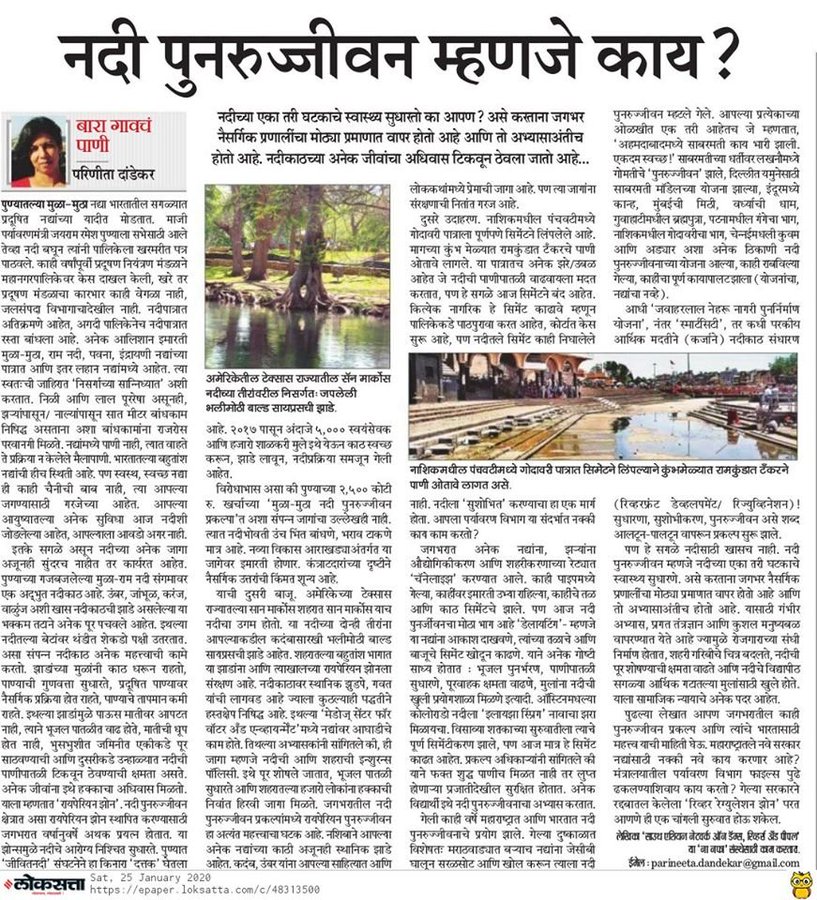
DRP: 27 Jan. 2020: Beginning of Corporatisation of Rivers?
The statement of Shri U P Singh, secretary, Union Water Resources Ministry, that “industry (private or public sector) could adopt small rivers” seems to suggest that the government is moving towards handing over the rivers to Corporate bodies. The example Mr Singh gave of Drayavati River of Jaipur is even more disturbing since that river has been completely destroyed by the project implemented by the Tatas. It should not surprise though, considering that no less than the Prime Minister has been giving the example of canalisation of Sabarmati as an example of rejuvenation of the river. If this is what the government means by rejuvenation, that even Ganga and Yamuna are facing major risks of destruction. Its not less shocking that while Nitish Kumar, the Chief Minister of Bihar has questioned Modi government’s attempt to achieve Nirmal Ganga without attempting Aviral Ganga, his own government is basically following the same Sabarmati model on Ganga in Patna. If this is the example of “rejuvenation” of river according to the top most bureaucrat of of the government in charge of Water resources, nothing can save India’s rivers except a people’s movement against such moves wherever such destruction of rivers is attempted.
Continue reading “DRP: 27 Jan. 2020: Beginning of Corporatisation of Rivers?”
DRP: 20 Jan 2020: India urgently needs national urban water policy
A large number of stories this week remind us that India urgently needs national urban water policy.
The water footprint of urban areas is gradually on the rise. The cities have several problems with management including destruction of water sources, groundwater exploitation, poor performance in treating and recycling the polluted water, pollution and encroachment on water bodies etc. To fulfil their growing demands new dams, barrages and check dams are being planned, proposed and built on the rivers in faraway places, which is in turn displacing and depriving the local people of equitable water share.
Even before onset of summer, the Army in Sagar district have started patrolling Chitora dam to prevent water thefts (denying farmers to take dam water for irrigation).
Continue reading “DRP: 20 Jan 2020: India urgently needs national urban water policy”
DRP: 6 Jan 2020: When will Inland Fisheries get its due in decisions about rivers & other water bodies?
In shocking instance, the Govt of India has provided just 17 days for commenting (Submission of Comments of NPSSFW _Inland_ on the Draft NFDB Bill 2019_ with rejoinder) on Draft National Policy for Inland Fisheries (Draft_NFDB_Bill_2019). As can be seen from the comments by National Platform for Small Scale Fish Workers (Inland) on the draft policy, the draft policy has major lacunae. The most glaring one is the complete lack of any role for the Inland fisher people in the decision making about rivers and other water bodies in India. Every dam and hydropower project has adverse impact on the fishes and fisher people, but the impact assessment reports rarely if ever even mention such impacts, leave aside question of any rehabilitation for them or even compensating them for the losses.
This is in complete contrast to the situation in US and a number of other countries where fish and fisher people have a much bigger role. Even as millions of people depend on Inland fisheries in India, we do not have even reliable census of the people who depend on Inland fisheries. One had hoped that in new year, the situation would improve, but going by the Draft Policy, there is not too much hope on that front. The least the govt can do is to immediately accept the suggestions of the National Platform and circulate the draft in all major languages and provide three months for comment period and institute a confidence inspiring process of including such comments.
Continue reading “DRP: 6 Jan 2020: When will Inland Fisheries get its due in decisions about rivers & other water bodies?”
DRP: 30 Dec. 2019: Attention to Groundwater is much needed, but will ABY help?
Groundwater is India’s water lifeline for some decades and will remain so. So attention to Atal Bhujal Yojana (ABY) is welcome, but key question is, will it help sustain our Water Lifeline? The World Bank funded project ABY has been in limbo for several years, but for some unknown reasons, took years to enter implementation phase. Secondly, why did it need the World Bank funding and how that will help for a scheme that essentially needs bottom up regulatory system, where the global banker has far from confidence inspiring track record?
Groundwater sustainability requires: 1. Identifying, understanding existing groundwater recharge systems 2. Protecting such recharge systems. 3. Enhance recharge from such systems. 4. Create additional recharge systems 5. Acknowledging in National Water Policy, programs and practices that Groundwater is India’s water lifeline and most importantly 6. Creating a bottom up legally empowered groundwater regulatory system.
Continue reading “DRP: 30 Dec. 2019: Attention to Groundwater is much needed, but will ABY help?”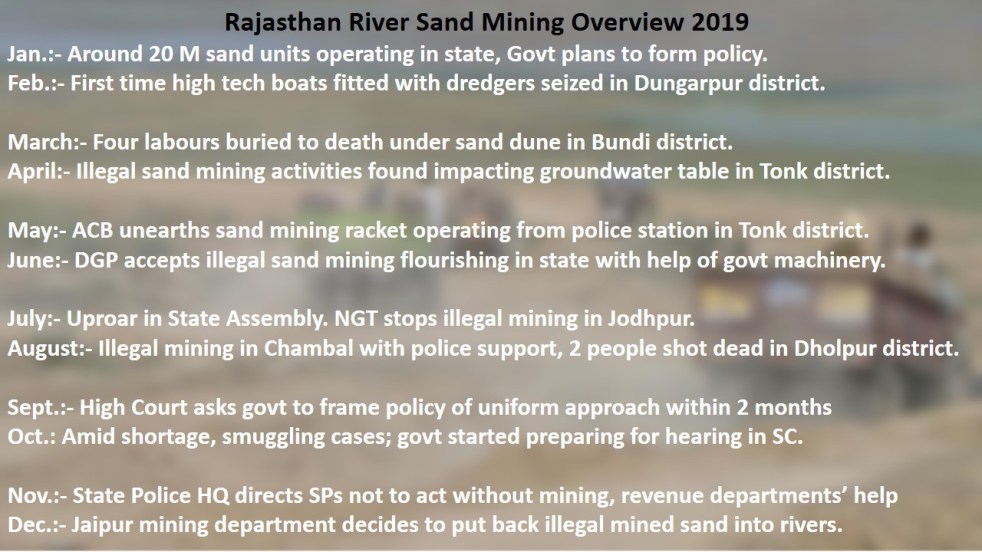
Rajasthan River Sand Mining Overview 2019: SC Ban Remains, Police-Mafia Gang Rules
Seeing large scale impacts of unsustainable riverbed sand mining, the Supreme Court (SC) of India had banned sand mining activities in the state on Nov. 16, 2017. The apex court had also asked the 82 lease holders to get fresh permission of Ministry of Environment, Forest and Climate Change (MoEF&CC) after submission of replenishment study.
Following this, the state government had formed a committee to look into the issue. All through 2018 the ban remained[I]. The status has not changed even as the year 2019 is ending. Meanwhile cases of illegal sand mining are continuously taking place in across the state. So are the police actions as routine process, some political statements, and few court orders. Like last year, this annual round up by SANDRP compiles, all these and other relevant developments on the issue from the state of Rajasthan.

DRP: 23 Dec 2019: Monsoons are more powerful than Wars
A new study has shown how powerful the monsoons and their abnormalities are: It’s these abnormalities that ended reigns of multiple dynasties in medieval India, not wars. But the society does not seem to understand this basic reality today, and we are not only doing everything in our power to make the monsoon abnormal through human induced climate and natural world changes, but not even valuing the rainwater in our water policies, programs and practices. The changes we are bringing in natural world is making even the smaller monsoon abnormalities bring catastrophic impacts as the capacities of the people and societies to cope with the changes is decreasing. These studies are another wake up call, if only we were interested one.
Continue reading “DRP: 23 Dec 2019: Monsoons are more powerful than Wars” SANDRP