
On the 7th August 2015, SANDRP published a Press Release titled “As Krishna Bhima basin farmers in Maharashtra, Karnataka, AP & Telangana face drought, crop failure, Water scarcity, Maharashtra DIVERTED 350 MCM water from the basin & stored another 2535 MCM reserved to release, literally to sea!”[1]. On August 9, 2015[2], DNA, a leading newspaper in Mumbai published a report based on this story as their front page top story titled “Drought? Last month alone Maha govt drained 350 MCM water into sea!” Continue reading “Tata Power responds on the issue of Tata dams diverting water from Drought hit Bhima Krishna basin to Konkan, but it is a vacuous, insensitive response”
Tag: Maharashtra

As Krishna Bhima basin farmers in Maharashtra, Karnataka, AP & Telangana face drought, crop failure, Water scarcity, Maharashtra DIVERTED 350 MCM water from the basin & stored another 2535 MCM reserved to release, literally to sea!
(Photo above: Koyna Dam)
Large parts of Krishna basin spanning Maharashtra, Karnataka, Andhra Pradesh and Telangana are facing massive rainfall deficits, drought like conditions and crop failures. The tail-end reservoirs of Srisailam and Nagarjun Sagar are almost empty. Telangana and Andhra Pradesh are already thinking of conserving the available water for drinking water. They are not even thinking of releasing any water for saving the crops in delta farmers. In upstream Maharashtra itself, the Ujani dam has ZERO live storage and perennially dry Marathawada has the highest rainfall deficit. Shockingly, in this very period from July 1 to Aug 6, Maharashtra has diverted more than 350 Million Cubic Meters of water (at most conservative estimates) FROM this very Krishna and Bhima basins to the High Rainfall area of Konkan (it already has had 1467.1 mm rain till Aug 7, 2015) and down to the sea! If this diversion was stopped since July 1, when the signs of severe monsoon deficits in the three states were already there[1], this water would have been available to save crops in lakhs of acres in the river basin, and some of it would have also flowed to Andhra Pradesh and Telangana and water may have been available for saving some crops. Even now these Koyna and Tata dams have 2535 MCM water in live storage that is reserved for diversion to Konkan and to sea, but wont be release for the failing crops across the basin. How can we continue such wasteful use of water in a water deficit basin, at the cost of livelihoods of lakhs of farmers? Even now it is necessary to URGENTLY review this situation and consider stopping diversion of water FROM Krishna basin to sea. This may save crops and livelihoods of lakhs of farmers. Continue reading “As Krishna Bhima basin farmers in Maharashtra, Karnataka, AP & Telangana face drought, crop failure, Water scarcity, Maharashtra DIVERTED 350 MCM water from the basin & stored another 2535 MCM reserved to release, literally to sea!”

White Elephant, Black Fish
How a 15 MW project with 55 mts high dam threatens 5 villages and a fish sanctuary
After an analysis of a particularly nasty dam, I felt like going back to flowing rivers. It is monsoon after all. The plan was to visit Kal River in Western Ghats of Raigad District in Maharashtra to understand how a community in a small village called Walen Kondh is protecting the river and Mahseer fish. Mahseer (Deccan Mahseer, Tor tor) is classified as endangered as per IUCN classification and most wild Deccan Mahseer populations have been wiped out in India. And hence a small, out of the way place, protecting these fish as well as the river voluntarily was like a breeze of fresh air. Continue reading “White Elephant, Black Fish”

Lower Penganga Project: Two decades after inception, the struggle continues…
Lower Penganga, an interstate Maharashtra-Telangana project, proposes to build a dam across River Penganga (a tributary of Godavari river) near Tadsaoli Village in Ghatanji Tehsil of Yavatmal District, Maharashtra to irrigate a massive 2,18,129 ha. It has failed to take off even after two decades of its inception. It is a Vidarbha Irrigation Development Corporation (VIDC) which has been in limelight for corruption and controversies due to over seven fold increase in project cost in just 10 years. In this project contractors with political backing were favored so much so that even the Environmental Impact Assessment of the project was carried out by one of the contractors! The project floated tenders for securing Forest Clearance! The construction was started illegally violating the environmental laws. It is set to submerge around 1000 ha of forest land and affect some 11,000 tribals dependent on it. There has been a decade long struggle of the affected people to protect their rights. Anti Corruption Bureau (ACB) was asked to probe into massive corruption in the project. Continue reading “Lower Penganga Project: Two decades after inception, the struggle continues…”
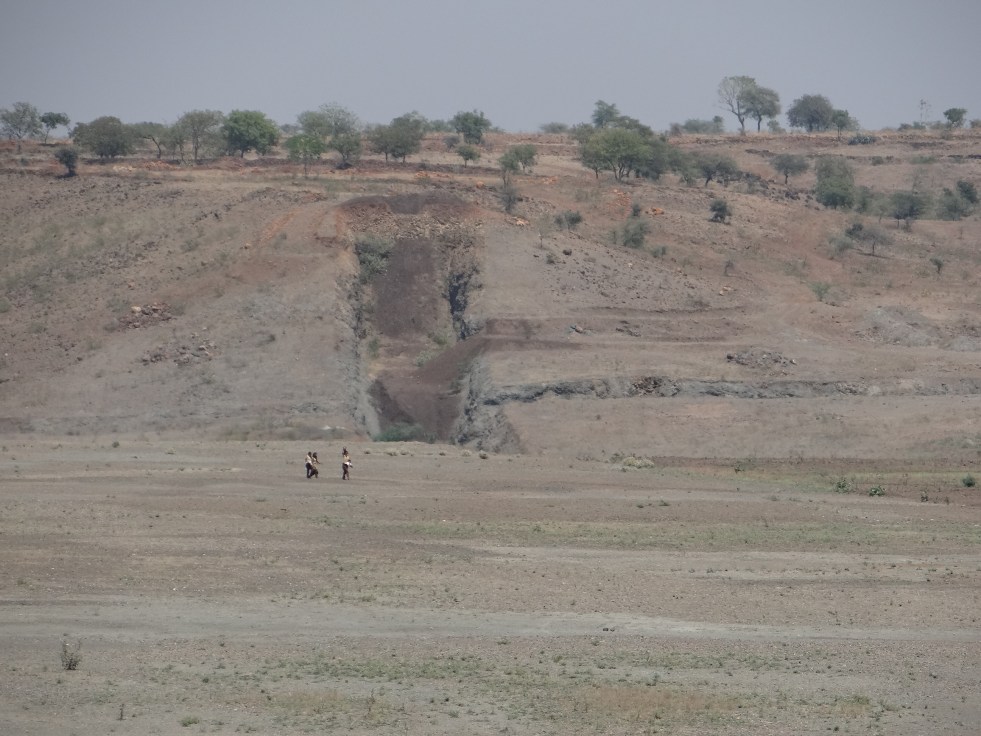
Krishna Marathwada Scheme receives Environmental Clearance WITHOUT Water Availability!
Why is the Maharashtra Govt and the MoEF misleading people of Marathwada?
Press Release 29.06.15
On the 24th June 2015, the Union Ministry for Forests, Environment and Climate Change (MoEF for short) granted Environmental Clearance[1] to Krishna Marathwada Lift Irrigation Scheme for diverting 23.66 TMC (Thousand Million Cubic Feet) water from Krishna 1 Sub basin to Krishna 3 Sub basin of Krishna River Basin. The media has reported the development as a “Respite for Marathwada”.
However, as SANDRP had written to the MoEF several times[2], this Environment clearance is based on non-existent water availability and a misleading EIA[3] by Science and Technology Park, University of Pune. Continue reading “Krishna Marathwada Scheme receives Environmental Clearance WITHOUT Water Availability!”

Digging deeper into water scarcity after watershed development
Above: Watershed measures in Maharashtra Photo: WOTR
~ Guest Post by Zareen Pervez Bharucha
Farmer after farmer had the same story: fields were parched, wells were empty, it was painful to see the land crack up and peel away like the soles of ones’ feet. ‘What can we do? This is what Nature has become,’ they said, in interview after interview.
I was speaking with farmers in Parner taluka in Maharashtra’s Ahmednagar district. My conversations were part of a research project on the long-term impacts of watershed development. In the same taluka, the village of Ralegaon Siddhi had turned dry fields into green farms using soil and water conservation and a strict set of rules governing land management. Their example and those of other seminal cases have shown the amazing potential of decentralized soil and water conservation. These successes have helped launch watershed development as India’s foremost strategy for dealing with the nexus of dryland degradation, rural poverty and hunger. I was curious about the lived experiences of people in ‘normal’ – rather than well-known – watershed projects. Continue reading “Digging deeper into water scarcity after watershed development”
Maharashtra Groundwater Authority: Can it save the state from deep trouble?
(Photo from Outlook)
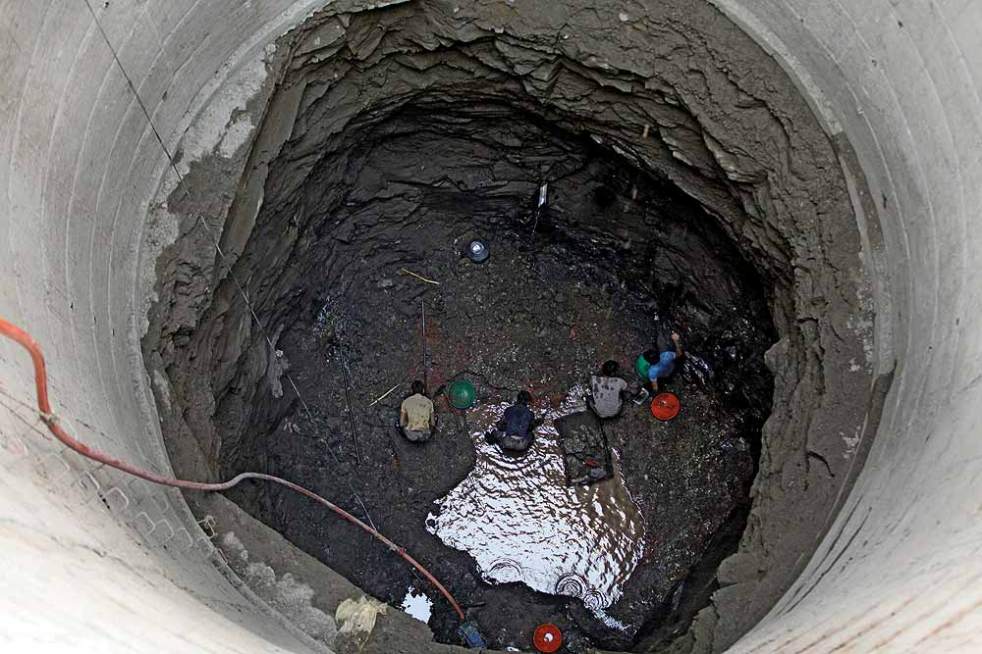
Harischandra Yerme from Latur (Maharashtra) sunk not one or two but 60 borewells in his field in Marathwada in the hope of finding water for his orchard. None of these 60 borewells yield water today. Mr. Yerme has taken on himself the task of educating farmers in his region that there is no sense in growing an orchard on bore wells: the supply may dry up at any moment, resulting in huge losses. He told me, “We don’t even consider 250 feet borewells now, all bores are at least 700-800 feet deep and even then they don’t work.” Marathwada is reportedly drilling as many as 10,000 borewells[1] per month in this drought: a boom that is sustained by the “boring mafia” from Andhra Pradesh and Tamilnadu using travelling rigs… In as many as 247 villages of Marathwada, the draft has exceeded recharge to such an extent that the aquifer has literally gone dry.. Water in villages is plummeting even by 7 meters of the 5 years average.[2] The density of borewells is so high that is villages near Tasagaon, a 40-50 square kilometer area has more than 210 deep bore wells. Officials from GSDA tell SANDRP of multiple instances where farmers only lose money in the hope of going deeper for groundwater, deeper than 800-900 feet. The landscape is likened to a “Chaalan”: a sieve in Marathi, but also several gunshot wounds.. Continue reading “Maharashtra Groundwater Authority: Can it save the state from deep trouble?”

Par-Tapi-Narmada Link: Divided States, United Tribals
Above: Just a few hundred meters upstream the proposed Jhari Dam, a tribal woman struggles to find water in the dry Par river bed Photo: Parineeta Dandekar
Village of Jhari at the northern most corner of Western Ghats has some of the loveliest houses I have seen. Appreciation for the evolved vernacular architecture goes beyond the obvious urban romanticisng of anything tribal. Homes in this region of tribes like Kokani, Warli, Thakurs, etc, are unique in their architecture, building materials, craftsmanship and the seamless mix of beauty and functionality. The tiled roof of our host Haribhau had intricate wooden trimmings, the mudfloor was cool and the door frame was carved in exquisite motifs. Vines arched and spread in disarray over courtyards. We were assembled under a passion fruit or ‘Rasna’ vine, bursting with white flowers. Inside, cane baskets creaked under the weight of Ragi, Udid and Rice filled to the brim: This year’s harvest has been good, though that’s not always the case. The hosts, both men and women, were busy with lunch preparations. Continue reading “Par-Tapi-Narmada Link: Divided States, United Tribals”
Pranahita Chevella Project: What it means for the affected people in Maharashtra
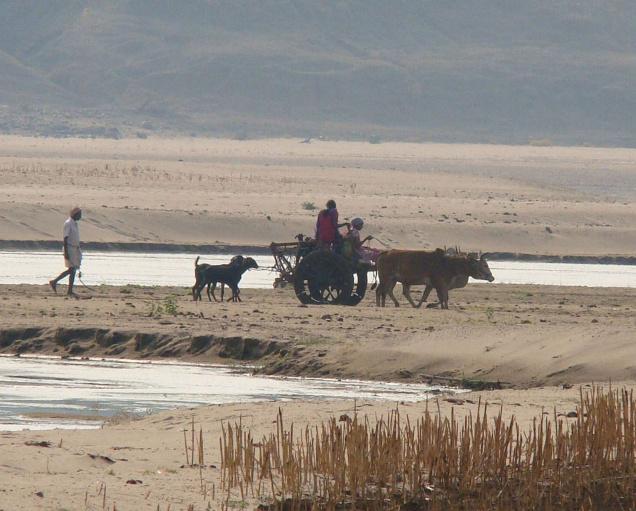
Above: A farmer family crosses the Pranahita river close to the Pranahita-Chevella project barrage site. Photo: Harpal Singh, The Hindu
Shivni is a small village of about 700-800 population in Gondpimpri Tehsil of Chandrapur District situated right at the confluence of Wardha and Weinganga rivers. These two rivers meet at juncture of three districts of two states (viz. Gadchiroli & Chandrapur of Maharashtra and Adilabad of Telangana) to form River Pranahita which is one of the biggest tributaries of Godavari. Pranahita travels a length of 113 km and meets Godavari at Sironcha tehsil of Gadachiroli Dist. Continue reading “Pranahita Chevella Project: What it means for the affected people in Maharashtra”
Krishna Marathwada Project: A costly pipe dream?
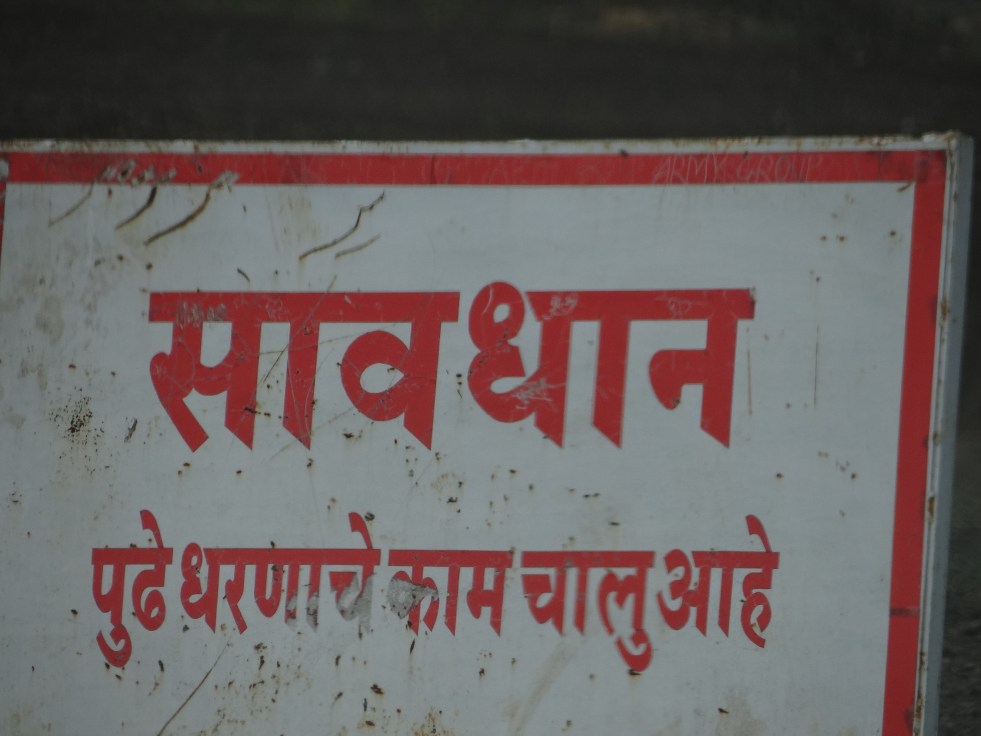
Above: A board at the dam site proclaims: “Beware, dam work ahead”. The warning pretty much sums up the situation of Krishna Marathwada Project Photo: Parineeta Dandekar
It was a blazing hot afternoon, made hotter by the subconscious association of Marathwada with all things dry, parched and drought-stricken. I was standing on the half completed dam wall of the Khuntephal Storage Tank in Beed, along with Macchindra Thorave and his colleagues. I’ve seen many dams and many dam walls, but it was impossible to believe this was a dam wall, supposed to impound 5.68 TMC of water (TMC=Thousand Million Cubic Feet. 1 TMC=28.317 billion liters). Primarily because there was no water in sight on either sides of the dam! There was no river in sight either! It actually looked like an under-construction road connecting two hills.
But as I realized later, being a part of the Krishna Marathwada Lift Irrigation Scheme and Krishna Bhima Stabilisation Project, issues like water were inconsequential. This was Dam for Dam’s sake.

Continue reading “Krishna Marathwada Project: A costly pipe dream?”

