Collapsed Bridge: Bride and Groom wait on the banks of flooded Jahlma even as farmers carry their harvests on their backs Photo: Govind Phurpa
“The sun was so hot, we knew the floods would be coming.” Says Jagdish ji, resident of Lindur village in the Lahaul Himalayas.
His home and fields are adjacent to a glacial stream called Jahlma Nallah which shoots from the Pir Panjal range to meet the Chenab River below. And just as he predicted, on the afternoon of 29th June 2026, like the past five years[1], Jahlma Nallah flooded and roared. In a matter of minutes, the thin flow transformed into a terrifying, brown debris-laden force. The sludge raced towards Chenab and nearly blocked the river by the brute force of water and debris it collected on its way. It cut off the connectivity of hundreds of villages.[2]
“When Jahlma Nallah starts roaring, we cannot sleep. It has been flooding for the past three years at least” said octogenarian Devi Singhji in October 2024. Jahlma Nallah, which joins the Chenab and blocks it occasionally, flooded again catastrophically in the monsoon of 2025.
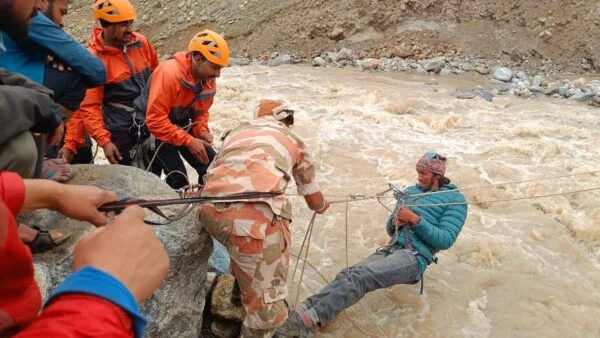
(Feature image: Rescue work being done at Selti-Masrang HEP site in Kafnu, Kinnaur on March 11, 2024. Image Source: News 18 Hindi)
A snow avalanche has killed three workers of under construction Selti-Masrang hydroelectric power (HEP) project in Kinnaur district of Himachal Pradesh. The incident occurred in after noon hours reportedly around 01:00 pm on March 11, 2024.
The 24 Mw project is being built by Hyderabad based Ramesh Hydro Power Private Limited on Wangar khad, a tributary of Sutlej River near Kafnu village panchayat in Bhaba valley of the district. The basic information about the project can be seen here. A forest land of 4.75 ha was diverted for the project wide permission given in May 2013. In 2016, 0.64 ha more forest land was applied for. The project cost then in 2016 was Rs 154. 27 cr.
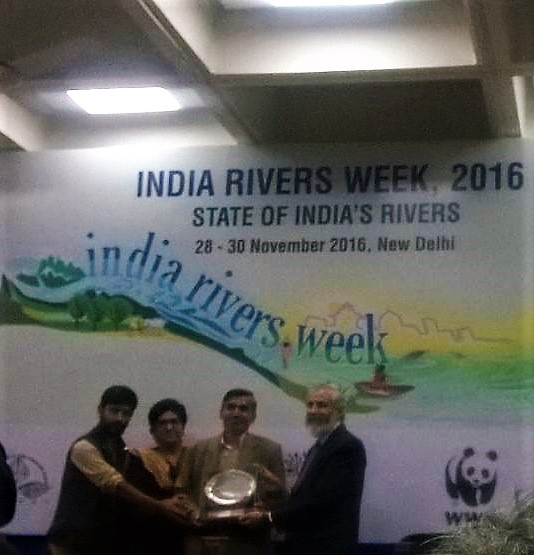
When I talk with Manshi, a friend and co-traveler from Himdhara Collective about Bhagirathh Prayas Samman that the collective received during the India Rivers Week 2016, she is modest, even slightly hesitant. She simply says, “We love the mountains, we want to protect them and help mountain communities fight the unequal battle against unplanned hydropower. That is one motivation of our work. But the other is recognition of the fact that we are privileged… privileged to be able to speak English, to work on a computer, to understand the bureaucratic procedures that alienate a tribal or forest dweller from her land. That understanding also drives us.”
Citation of Bhagirath Prayas Samman given to Himdhara Collective states: “Himdhara’s strength is its engagement with communities, movements and organisations. It has created an effective discourse around issues of resource distribution and their ownership and the resultant impacts on ecological spaces of mountain communities, especially vulnerable groups like indigenous people, dalits and women. It is an honor to recognize and celebrate Himdhara Environment Research and Action Collective’s extraordinary Bhagirath efforts in maintaining the integrity of rivers in Himachal Pradesh.”
In their own words, “Himdhara is an autnomous and informal non registered environment research and action collective, extending solidarity and support, in research and action, to people and organisations asserting their rights over their natural resources and agitating against corporatisation of these resources for destructive development in the state.”
Face of Hydropower in Kinnaur Photo: Himdhara
A collective of young, passionate and questioning minds, Himdhara has been working with communities in far flung areas of Himachal Pradesh include Lahaul and Spiti and Kinnaur in their fight against the onslaught of ill-planned and bumper to bumper hydropower projects in Himachal, amongst other issues.Continue reading “Bhagirath Prayas Samman: Himdhara Collective: Relentless Questioning and Doing”→



 SANDRP