Dams · DRP News Bulletin

DRP: 3 Sept 2018: CHINA HAS STARTED DECOMMISSIONING DAMS

In a mountain village in southwest China’s Sichuan province, authorities have demolished seven small dam projects this year along a river to clear illegal developments in a new nature reserve. The demolition is part of a nationwide programme to close hundreds of tiny and often ramshackle dams and turbines and bring order to China’s massive hydropower sector after years of unconstrained construction.

The dams sat on an unnamed tributary of the fierce and flood-prone Dadu river, which feeds into the Yangtze, Asia’s largest and longest river, where the government says the “irregular development” of thousands of small hydropower projects has wrecked the ecology. But green groups say the campaign will not necessarily save the environment because it will not affect big state hydropower stations, which they say have caused the most damage.

On the 48 km Zhougong, authorities have already demolished small projects built in nature reserves or encroaching upon new “ecological red lines” drawn up to shield a quarter of China’s territory from development.

The government says small dams have disrupted the habitats and breeding patterns of many rare species of fish, although green groups argue the damage wrought by bigger dams is more severe, with entire towns and ecosystems submerged in water, which they say increases the risk of earthquakes, landslides and even climate change.

Continue reading “DRP: 3 Sept 2018: CHINA HAS STARTED DECOMMISSIONING DAMS”
Dams · Floods

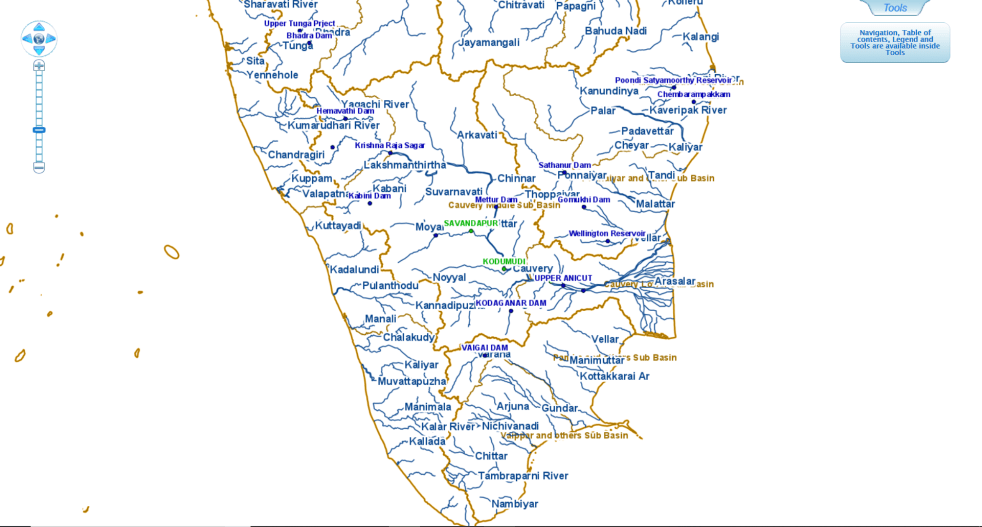
Overview of CWC Flood Forecasting Sites 2018: SOUTH INDIA

Central Water Commission is the only agency doing flood forecasting in India. As per CWC’s Flood Forecasting website[i] the Data Flow Map has information about 226 Flood Forecast Sites in the country comprising of 166 Level Forecast Sites and 60 Inflow Forecast Sites. It also monitors 700 Flood sites, information made available through List Based Exploration and Hydrograph View, but no flood forecasting is done for these sites.

In order to better understand the CWC’s flood monitoring and forecasting work, in this article, we have given an overview of CWC’s flood forecasting and monitoring sites in South India. It includes state wise list of CWC’s Level Forecast, Inflow Forecast and level monitoring sites in South India. Similar report has been published for North India[ii] and North East India[iii] and East India[iv]. 

Tamil Nadu There are 3 Level Forecasting, 48 Level Monitoring and 14 Inflow Forecasting sites in Tamil Nadu State. Out of total 65 sites, 19 Level Monitoring and 2 Inflow Forecasting sites are inactive. MWL information is given only for 1 Inflow Forecasting site out of 14. IRRUKKANKUDI, Sathanur and Gomukhi sites are repeated with incomplete information. Out of 48, HFL figure and date is not provided for 25 Level Monitoring sites.

Continue reading “Overview of CWC Flood Forecasting Sites 2018: SOUTH INDIA”

Dams · Floods

Overview of CWC Flood Forecasting Sites 2018: East India 

Central Water Commission is the only agency doing flood forecasting in India. As per CWC’s Flood Forecasting website[I] the Data Flow Map has information about 226 Flood Forecast Sites in the country comprising of 166 Level Forecast Sites and 60 Inflow Forecast Sites. It also monitors 700 Flood sites, information made available through List Based Exploration and Hydrograph View, but no flood forecasting is done for these sites.

In order to better understand the CWC’s flood monitoring and forecasting work, in this article we have given an overview of CWC’s flood forecasting and monitoring sites in East India. It includes state wise list of CWC’s Level Forecast, Inflow Forecast and level monitoring sites in East India. Similar report has been published for North India[II] and North East India[III] and we hope to publish reports covering other regions of India too. 

Continue reading “Overview of CWC Flood Forecasting Sites 2018: East India “

Dams · DRP News Bulletin

DRP: 16 July 2018: For Dam Safety, Can We Depend On CWC Engineers Alone?

India certainly urgently needs credible measures to achieve both structural and operational safety of dams. As the HINDUSTAN TIMES editorial emphasizes, we need much greater transparency, accountability and participation of independent, non government experts at every level of functioning of Dam Safety mechanism. Current Dam Safety Bill draft falls far short of that. This is also underscored by many of the news we bring in this July 16, 208 issue of DRP News Bulletin.

The Tamil  Nadu CAG report, as Indian Express reports, has clearly said that the Chennai floods  of Dec 2015 were majorly due to the wrong decision of dam operators to release 29000 cusecs of water for 21 hours, in violation of all safety norms, but no was punished for this wrong decision. The same has always been the case.

The Bulletin also brings the warning from, no less than Chief Minister of Assam to NEEPCO that if NEEPCO, the operator of the 405 MW Ranganadi Dam releases water from the dam without warning and when downstream areas are facing  floods, they will have to bear the losses people suffer.

Continue reading “DRP: 16 July 2018: For Dam Safety, Can We Depend On CWC Engineers Alone?”
Dams · DRP News Bulletin

DRP: 2 July 2018: Punjab Cabinet Meets To Discuss Water crisis

In a rare event, Punjab Cabinet met to discuss water crisis on June 26, 2018. The reports before the meeting seemed to give hope that may be Punjab will look at the water crisis in a fundamental, holistic way. https://indianexpress.com/article/cities/chandigarh/punjab-government-to-firm-up-water-conservation-plan-5233826/ (June 26, 2018)

But the cabinet ended up setting up a committee to assess the ground water situation in the state and submit a detailed proposal for water conservation.

– Punjab has the highest rate of groundwater exploitation and had on average withdrawn 28.2 million acre feet (MAF) water yearly during 2008-2013. However, the yearly average replenishment of water was only 18.9 MAF.

– 73% of Punjab’s irrigated area uses groundwater for irrigation, while only 27% uses surface water. The number of tubewells had gone up exponentially from 2 lakh in 1971 to 12.50 lakh in 2015-16, with 41% of these have water availability beyond the depth of 60 metres. https://timesofindia.indiatimes.com/city/chandigarh/5-member-committee-to-assess-punjab-ground-water/articleshow/64770186.cms  (28 June 2018)

Continue reading “DRP: 2 July 2018: Punjab Cabinet Meets To Discuss Water crisis”
DRP News Bulletin

DRP: May 7, 2018: WESTERN GHATS FORESTS ARE VITAL FOR SOUTH WEST MONSOON RAINS IN TAMIL NADU

W Ghats Forests vital for Tamil Nadu SW Monsoon Rains Researchers have found that the dense vegetation in the Western Ghats determines the amount of rainfall that Tamil Nadu gets during the summer monsoon. A team led by Prof. Subimal Ghosh from the Department of Civil Engineering at the Indian Institute of Technology (IIT) Bombay has found that dense forests of the Western Ghats contribute as much as 40% of moisture to the southwest monsoon rainfall over Tamil Nadu during normal monsoon years. The average contribution is 25-30%. But during monsoon deficit years, the contribution increases to as high as 50%.

Continue reading “DRP: May 7, 2018: WESTERN GHATS FORESTS ARE VITAL FOR SOUTH WEST MONSOON RAINS IN TAMIL NADU”
Dams · DRP News Bulletin

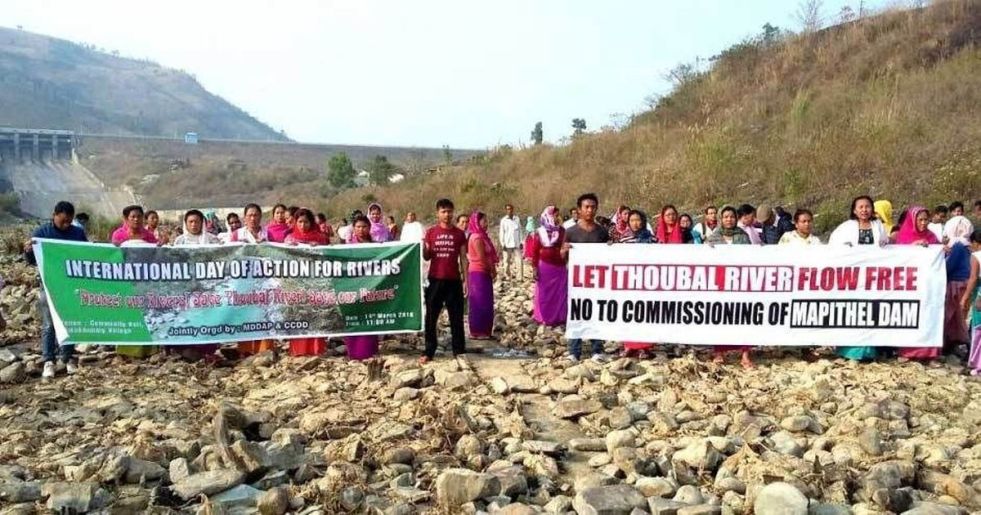
DRP: 19 Mar 2018 (PM Abandons Inauguration of Mapithel Dam in Manipur Following Protests)

In an important development in Manipur this week, PM Narendra Modi could not commission the controversial Mapithel dam due to local protest. As per, the official statement notifying The PM was  was supposed to launch is the Mapithel dam, part of the Thoubal Multipurpose Project.

As per CRA Manipur blog report, the forum of Mapithel dam affected “Joint Action Committee Against Forced Inauguration of Mapithel Dam had threatened a 48-hour shutdown to coincide with the dam’s scheduled inauguration by Modi. The committee withdrew its call late on March 14, reportedly after the Manipur government agreed to shelve the inauguration.

The action committee is primarily demanding compensation for the people displaced by the project as mandated by the Right to Fair Compensation and Transparency in Land Acquisition, Rehabilitation and Resettlement Act, 2013.

Apart from complaints of inadequate compensation, opposition to the commissioning of the dam itself has grown louder over the years. Local communities claim the project violates the Forest Conservation Act of 1980 and its new avatar, the Forest Rights Act of 2006.  https://cramanipur.wordpress.com/2018/03/16/as-local-communities-protest-manipur-government-cancels-plan-of-modi-inaugurating-mapithel-dam/

Continue reading “DRP: 19 Mar 2018 (PM Abandons Inauguration of Mapithel Dam in Manipur Following Protests)”
Dams · DRP News Bulletin

DRP: 05 Feb 2018 (J&K To Assess The Viability Of Big Hydro Pojects)

In a remarkable development, Jammu & Kashmir Govt is reviewing its Hydro policy to assess whether the Hydro Electric Power Projects (HEPs) are still viable. As per sources, this is for the first time that the Govt is discussing the viability of generating hydro power.

An empowered committee led by the Chief Secretary has started this discussion by calling for an “approach paper” that will give an overall picture of the hydropower industry in India. Top sources in the State Power Development Corporation (SPDC), a government-owned company, told Kashmir Reader that the empowered committee wants to lay a roadmap for power generation in the state. “It will reflect the vision of the government. It will give the picture of hydropower generation in India, its rates, market, demand and supply. It will also lay down a roadmap for large power projects,”

The approach paper will be part of a new hydropower policy which will be submitted before the same committee, and then before the cabinet for approval. The SPDC had submitted a hydro policy draft in April last year, which was returned to it in December. Sources said the approach paper has to be submitted in two months’ time.

At present, India has a surplus generation of hydropower, which has plummeted its rate. This has led to losses for SPDC as it invested in projects whose generation costs were high. The blunt example is that of the 450-MW Baglihar II. SPDC has failed to lure any buyer for more than a year as its selling cost of per unit of energy, Rs 4.4, is nearly Rs 2 higher than the market rate. The SPDC has finally managed to sell the power at about Rs 4 per unit to the Uttar Pradesh government but for one year only. The SPDC may have to struggle again next year if the state of UP does not continue the contract.

Another example is that of Nimuno Bezgo, and Chutak hydropower projects, which sell energy at Rs 13 per unit. The SPDC also buys power from Dulhasti project at Rs 7, when the available rates for power in the market is around Rs 2 and Rs 4. https://kashmirreader.com/2018/02/02/cs-led-panel-to-lay-roadmap-for-power-generation-in-jk/ (Kashmir Reader. 2 Feb. 2018)

As per another report, facing a growing demand for electricity and unable to tap its vast potential for generating hydroelectric power, the state government is looking to boost solar power generation. Given the long gestation period of hydel projects, it is unlikely the generation of hydroelectric power will expand significantly in the near future, said. Hence,  the focus on solar power. Indeed, when solar power potential exists, with lower installation and operation costs and impacts, why States continue after destructive, expensive hydro projects? https://scroll.in/article/866058/kashmir-can-generate-a-lot-more-hydel-electricity-than-it-requires-why-is-it-eyeing-solar-power (Scroll.In, 30 Jan. 2018)

There is one more interesting hydro power development in which the state cabinet of Bihar has approved closing 3 and cancelling the development of 2 others in addition to handing over of 8 hydropower projects to neighboring Jharkhand.

Continue reading “DRP: 05 Feb 2018 (J&K To Assess The Viability Of Big Hydro Pojects)”
Dams · DRP News Bulletin

DRP: 11 September 2017 (Why This Rally Won’t Help The Rivers?)

The news media is filled with this new kid on the block, trying to wake the nation about the need to save our rivers… amazing to see so many film stars, politicians, governments, and public personalities, many of them rather innocently joining the band wagon… some friends were pleading that see, he is able to take the message of rivers to so many people, including lakhs of children… let us try and see if there is something positive here… may be, may be this is just the entry point, but the guy and his team have bigger vision? May be we need to give him longer rope, be more charitable and not jump to negativity?

We have kept all this in mind while writing this.

We see nothing from the people who are leading the rally, or their websites or messages that they understand the real threats faced by and reasons for the state of our rivers, are ready to even list such causes or protest any further move to destroy our rivers. The website claims it is “a nationwide awareness campaign to revive our rivers”. Can missed call save our rivers?

Continue reading “DRP: 11 September 2017 (Why This Rally Won’t Help The Rivers?)”
Dams · DRP News Bulletin

DRP: 17 July 2017 (Northeast Continues To Experience Floods As Disaster Majorly due to Man-made Reasons) 

Since May 2017, several flood related incidents have taken place in the North East showing how our shortsightedness in understanding the rivers, how our thoughtless construction along the rivers in the name of flood control and how our careless operation of dams have converted floods into a disaster.

At the same time, there have been incidents raising suspicion over quality of construction of built and ongoing dams. Then the news of NHPC being accused of forging Gram Panchayats signs to build 520 MW Teesta IV dam is shocking revelation in itself. Contribution of such factors in worsening the floods is always underplayed. 

The countless landslides and Cyclone Mora (http://www.hindustantimes.com/india-news/cyclone-mora-reaches-northeast-many-houses-damaged-in-mizoram/story-UzcDuPOge0drAklftXW38L.html) have already left the region crippling, despite this there is no regular monitoring of flood situation and no timely warning being issued by States or Central Agencies about the rainfall and floods. All this is enough to prove that the ongoing flood devastation in North East has very much to do with the way we are destroying rivers with hydro projects, dams and embankments and disturbing the fragile environment of North East. These incidents also put question mark before govt agencies which are first pushing the destruction in the sensitive region and then lagging way behind in monitoring and issuing timely precautionary warnings.  

Continue reading “DRP: 17 July 2017 (Northeast Continues To Experience Floods As Disaster Majorly due to Man-made Reasons) “