DRP News Bulletin

DRP: 21 Jan 2019: NGT Asks For Audit of Pollution Control Regulation, But Fails on EIA

Two interesting orders from National Green Tribunal (NGT) marked important developments on water-environment issues this week. NGT asking for PERFORMANCE AUDIT of pollution Control Mechanism is indeed long overdue necessity, considering the complete, abject failure of the pollution control mechanism in India. The hopes of effective action, like in the past, however, were dashed since CPCB, which is PART OF THE PROBLEM has been asked to do the audit. An independent audit, in addition to one possibly by CAG may have helped.  https://www.thehindu.com/news/cities/Delhi/ngt-slams-state-pollution-bodies/article26008687.ece (17 Jan. 2019)

Whatever positive signs were available by this order were further dashed by another NGT order in which it declared that EIAs (Environmental Impact Assessment) reports are already taking climate change into account, while the tribunal dismissed a petition asking that all development activities be screened/ regulated keeping climate change in mind.

This is totally WRONG contention. Just to illustrate, SANDRP has been pointing out to the EAC, MoEF and the developers how the EIAs of dams and hydropower projects are ignoring the climate change related issues and impacts. In response the consultants and developers have responded, approved by the silent or spoken nods by the EAC and MoEF that these were not even part of their TORs! One only wishes NGT was most discerning before making such claims and would have gone through a few EIAs to see if at all EIAs are dealing with these issues with any rigour or credibility. https://www.business-standard.com/article/pti-stories/climate-change-already-covered-under-environment-impact-assessment-ngt-119011600897_1.html (16 Jan. 2019)

Continue reading “DRP: 21 Jan 2019: NGT Asks For Audit of Pollution Control Regulation, But Fails on EIA”
DRP News Bulletin

DRP: 14 Jan 2019: Will the campaign of 17-yr old Alappad Girl Wake us up to the perils of unsustainable sand mining?

The coastline between Chavara and Alappad in Kollam district of Kerala, has a decades-long story of people’s battle for survival against mining companies. This stretch in Kerala is where the extensive mineral beach sand mining has been happening since the 1960s. The abandoned buildings are the remains of people’s failed agitations and indefinite strikes. One by one the villages in the area are vanishing from the map of Kerala.

Continue reading “DRP: 14 Jan 2019: Will the campaign of 17-yr old Alappad Girl Wake us up to the perils of unsustainable sand mining?”
DRP News Bulletin

DRP: 24 Dec 2018: MoEF & WII’s Compromises for Hydro Interests

In a shocking revelation, Jay Mazoomaar in this Indian Express report exposes how Wildlife Institute of India not only accepted consultancies from hydropower companies, but also diluted the mandate for the studies for given by statutory bodies like NGT, NBWL and FAC, but also provided compromised reports catering to the interests of the hydropower developers, thus trying to clear the way for the two controversial mega hydropower projects, one each in Dibang and Lohit river basins in Arunachal Pradesh. https://indianexpress.com/article/north-east-india/arunachal-pradesh/wildlife-institute-all-for-hydel-projects-in-arunachal-pradeshs-tiger-zone-5499656/

In case of the 3097 MW Etalin project being developed by Jindal and Arunachal Pradesh govt, the IE report says: “the WII was asked by the Ministry (MoEF) to assess the feasibility of the plan that requires 1,166 hectares of forestland in the valley. The Ministry’s move followed a recommendation from its Forest Advisory Committee (FAC) to conduct an environment impact assessment study. Instead, the WII initiated a study to find how the project’s impact on wildlife can be minimised”. Thus instead of doing the mandated scientific impact assessment, the WII initiated a study to minimise the project’s impact.

Continue reading “DRP: 24 Dec 2018: MoEF & WII’s Compromises for Hydro Interests”
DRP News Bulletin

DRP: 3 Dec. 2018: Ken Betwa Link-Push to Dilute Forest Clearance Conditions

Ken Betwa river interlinking project is back to drawing board with Union water resources ministry approaching the ministry of environment and forest to relax conditions imposed as part of forest clearance accorded in May 2017 for diversion of forest in the Panna Tiger reserve (PTR).

Forest Advisory Committee (FAC) while according Stage-I clearance to the project had recommended that the project proponent and state govt should consider equivalent non-forest area (6,017 ha) adjoining to PTR from the revenue and private land and add to the PTR as a part of core/corridor (for tiger movement) with other areas or satellite core area. According to water resources ministry, they are unable to find land adjoining to PTR.

Will the forest department buckle under pressure to dilute the forest clearance conditions?  http://www.newindianexpress.com/thesundaystandard/2018/nov/25/first-river-linking-project-coming-undone-1902890.html  (25 Nov. 2018)

Continue reading “DRP: 3 Dec. 2018: Ken Betwa Link-Push to Dilute Forest Clearance Conditions”
Andhra Pradesh · Water Resources Information System

APWRIMS: Impressive Water Information System of Andhra Pradesh

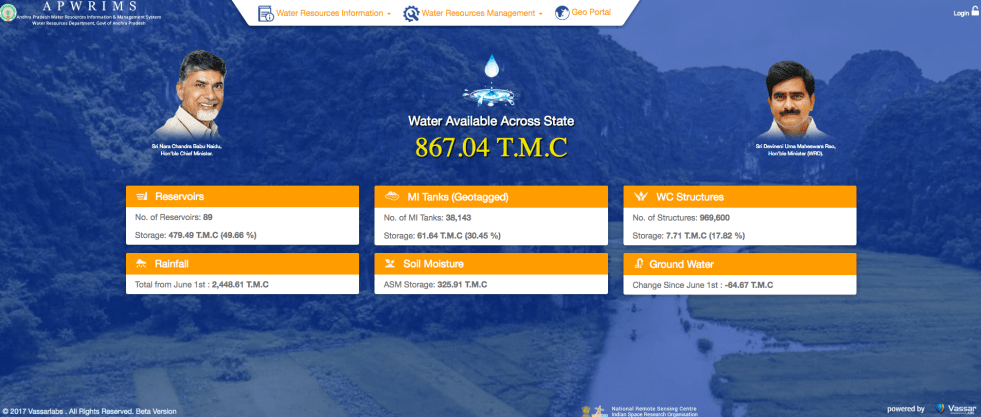
Andhra Pradesh Water Resources Information and Management System[i] is truly impressive water information system, possibly not available in any other state or even at national level, at any time in India. The comprehensiveness of the water information system is striking, as it not only includes reservoir water storages of Major and Medium Projects, but also storages in minor projects, minor tanks, water conservation structures (check dams, percolation tanks) but also groundwater and most importantly, soil moisture. These are collected in real time from diverse information sources including on ground measurements, satellite based assessments and also sent via mobile apps from diverse sources. And the information is put out in real time, along with number of analysis. The data are collated and analysed using tools from Vassar Labs, like Machine learning, Artificial Intelligence and big data. Continue reading “APWRIMS: Impressive Water Information System of Andhra Pradesh”

Dams

CWC Flood Forecasting: Anomalies between Website and SOP Document

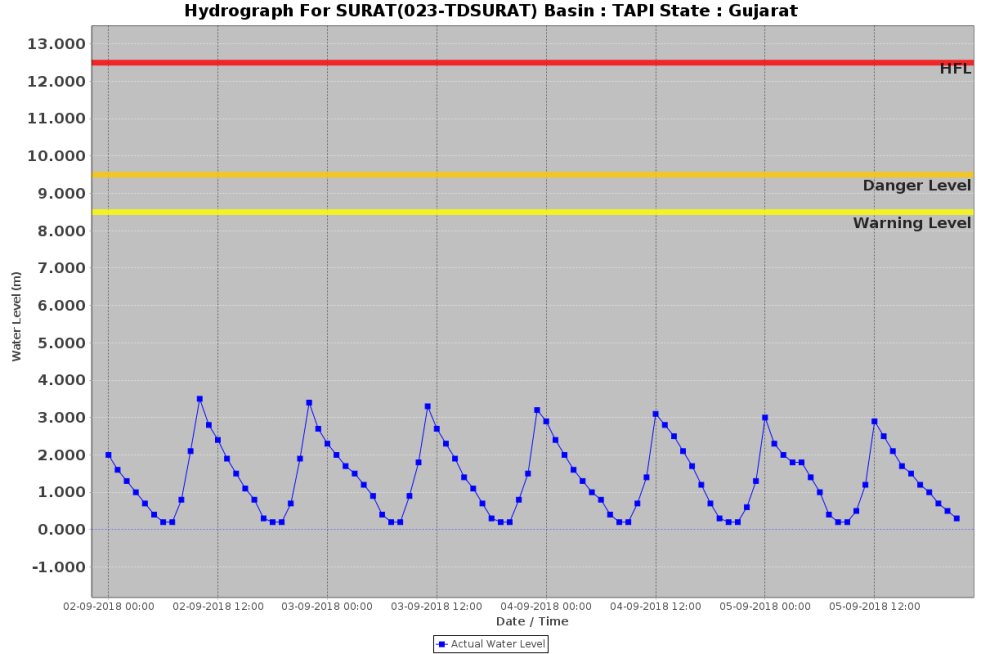
Central Water Commission (CWC) is the only agency in India doing flood forecasting, it becomes very important to understand what CWC does in this regard. The CWC flood forecasting website[i] is the main media through which CWC provides the flood forecasting. CWC has also published on its website, the document giving Standard Operating Procedure (SOP) for flood forecasting in 2018[ii]. The Home page of the CWC’s flood forecasting site says that CWC provides Level forecasting for 166 sites and Inflow forecasting for 60 sites. SOP document, however, gives these figures in Table 1, but in Table 2 (as also the full list given in Annexure 1.1 of SOP document), it gives state wise break up for 182 Level forecasting and 93 Inflow forecasting sites. So we can see anomalies in these two sources even about the number of forecasting sites.

Continue reading “CWC Flood Forecasting: Anomalies between Website and SOP Document”

Dams · Floods

Overview of CWC Flood Monitoring Sites 2018: INDIA

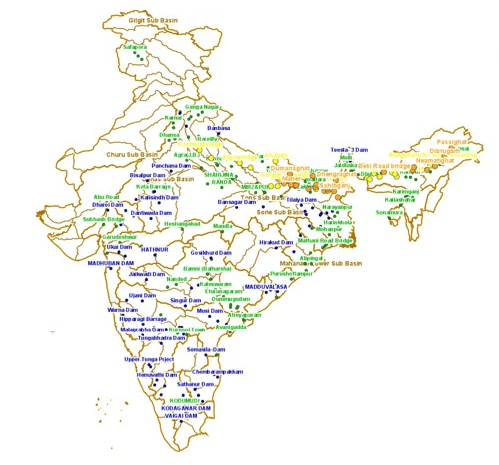
Central Water Commission is the only agency doing flood forecasting in India. As per CWC’s Flood Forecasting website[i] the Data Flow Map has information about 226 Flood Forecast Sites in the country comprising of 166 Level Forecast Sites and 60 Inflow Forecast Sites. It also monitors 700 Flood sites, information made available through List Based Exploration and Hydrograph View, but no flood forecasting is done for these sites.

In order to better understand the CWC’s flood monitoring and forecasting work, SANDRP has published report of CWC’s Level Forecast, Inflow Forecast and level monitoring sites in 5 zones of North India[ii], North East India[iii], East India[iv], South India[v] and West India[vi].  Through this report, we have presented all the data at one place with links to separate zone wise reports with detailed description.

Continue reading “Overview of CWC Flood Monitoring Sites 2018: INDIA”

Dams · Floods

Overview of CWC Flood Forecasting Sites 2018: WEST INDIA

Central Water Commission is the only agency doing flood forecasting in India. As per CWC’s Flood Forecasting website[i] the Data Flow Map has information about 226 Flood Forecast Sites in the country comprising of 166 Level Forecast Sites and 60 Inflow Forecast Sites. It also monitors 700 other sites, information is made available through List Based Exploration and Hydrograph View, but no flood forecasting is done for these sites.

In order to better understand the CWC’s flood monitoring and forecasting work, in this article, we have given an overview of CWC’s flood forecasting and monitoring sites in West India. It includes state wise list of CWC’s Level Forecasting, Inflow Forecasting and level monitoring sites in 5 States in West India. Similar report has been published for North India[ii] and North East India[iii] and East India[iv] and South India[v]. This is the last part in the series.  Continue reading “Overview of CWC Flood Forecasting Sites 2018: WEST INDIA”

Dams · DRP News Bulletin

DRP: 3 Sept 2018: CHINA HAS STARTED DECOMMISSIONING DAMS

In a mountain village in southwest China’s Sichuan province, authorities have demolished seven small dam projects this year along a river to clear illegal developments in a new nature reserve. The demolition is part of a nationwide programme to close hundreds of tiny and often ramshackle dams and turbines and bring order to China’s massive hydropower sector after years of unconstrained construction.

The dams sat on an unnamed tributary of the fierce and flood-prone Dadu river, which feeds into the Yangtze, Asia’s largest and longest river, where the government says the “irregular development” of thousands of small hydropower projects has wrecked the ecology. But green groups say the campaign will not necessarily save the environment because it will not affect big state hydropower stations, which they say have caused the most damage.

On the 48 km Zhougong, authorities have already demolished small projects built in nature reserves or encroaching upon new “ecological red lines” drawn up to shield a quarter of China’s territory from development.

The government says small dams have disrupted the habitats and breeding patterns of many rare species of fish, although green groups argue the damage wrought by bigger dams is more severe, with entire towns and ecosystems submerged in water, which they say increases the risk of earthquakes, landslides and even climate change.

Continue reading “DRP: 3 Sept 2018: CHINA HAS STARTED DECOMMISSIONING DAMS”
Dams · Floods

Overview of CWC Flood Forecasting Sites 2018: SOUTH INDIA

Central Water Commission is the only agency doing flood forecasting in India. As per CWC’s Flood Forecasting website[i] the Data Flow Map has information about 226 Flood Forecast Sites in the country comprising of 166 Level Forecast Sites and 60 Inflow Forecast Sites. It also monitors 700 Flood sites, information made available through List Based Exploration and Hydrograph View, but no flood forecasting is done for these sites.

In order to better understand the CWC’s flood monitoring and forecasting work, in this article, we have given an overview of CWC’s flood forecasting and monitoring sites in South India. It includes state wise list of CWC’s Level Forecast, Inflow Forecast and level monitoring sites in South India. Similar report has been published for North India[ii] and North East India[iii] and East India[iv]. 

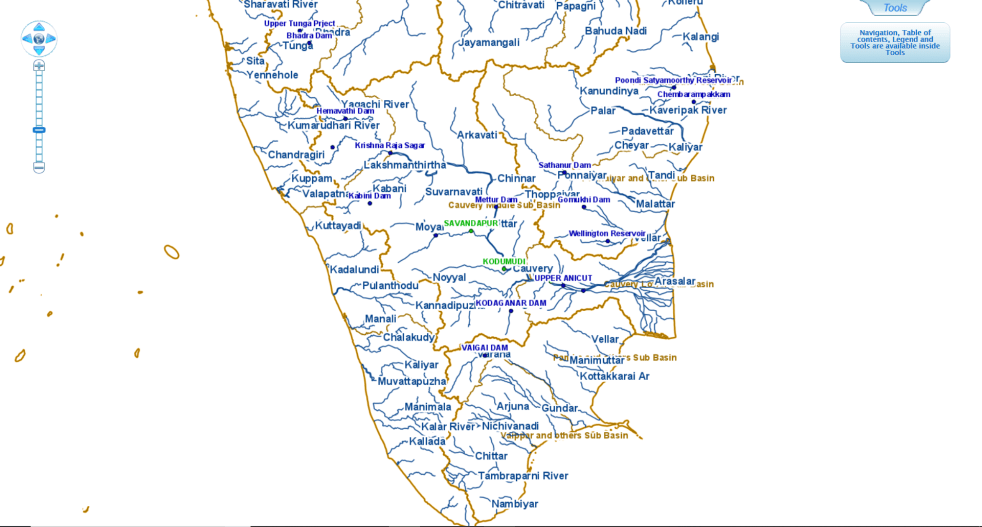
Tamil Nadu There are 3 Level Forecasting, 48 Level Monitoring and 14 Inflow Forecasting sites in Tamil Nadu State. Out of total 65 sites, 19 Level Monitoring and 2 Inflow Forecasting sites are inactive. MWL information is given only for 1 Inflow Forecasting site out of 14. IRRUKKANKUDI, Sathanur and Gomukhi sites are repeated with incomplete information. Out of 48, HFL figure and date is not provided for 25 Level Monitoring sites.

Continue reading “Overview of CWC Flood Forecasting Sites 2018: SOUTH INDIA”