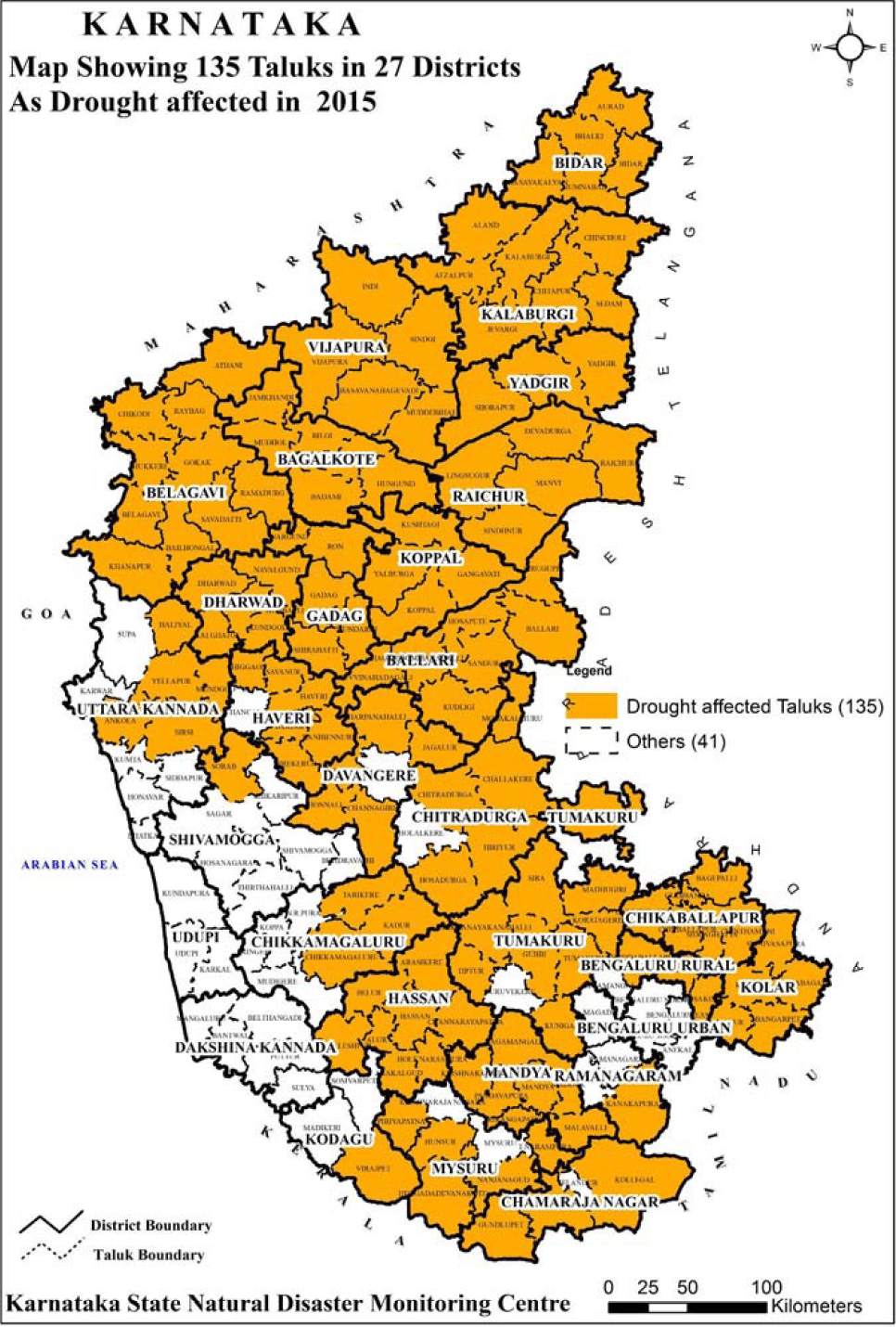
Karnataka is witnessing drought for the third successive year; rainfall has been deficient since 2012-13. Because of the rainfall deficit, reservoirs did not fill up completely. Coupled with the hot summer temperatures in March and April 2016, the stored water has now almost depleted. Groundwater, the saviour in times of failure of rainfall, has dipped severely because of years of reckless exploitation for irrigating water guzzling crops in semi arid soils. With even drinking water becoming scarce, agricultural activity has come to a standstill in the region. The drought in 2015 was preceded by unseasonal rains damaging the previous harvest. The monsoon deficit led to a dip in kharif output throughout the State in 2015. The drought spread even to the normally lush Cauvery basin prompting digging and deepening of borewells. While southern Karnataka received some heavy rains in November, districts in Northern Karnataka again saw failure of rains with some districts such as Kalaburagi, Koppal and Yadgir registering over 70% deficiency in rainfall. There has been a near complete failure of crops in Northern Karnataka, with both rabi and kharif crops being wiped out, even as area under sugarcane has gone up! The northern region, which also lags in development indices, is in the clutches of rural distress – over a thousand farmers have committed suicide. Mass migration to cities is being witnessed.
Tag: Drought
DRP: 25 APRIL 2016 (One Year After Nepal Earthquake, Has the World Learnt Any Lesson?)
On this day in 2015, the massive Nepal earthquake of 7.9 intensity (Richter scale) shook the scenic Himalayan Nation. The earthquake left a major trail of destruction affecting over 20 districts and killing over 9 thousand people. According to expert Dave Petley, Langtang rock and ice avalanche was the most dramatic and significant landslide, that killed the most individuals. The earthquake killed over 9000 people, with 255 still missing. The severity of the quake can be gauged from the fact that more than a third of the disaster related deaths in 2015 occurred in Nepal’s April 25 earthquake. The earthquake-induced flash floods, landslides and aftershocks also damaged up to 15 hydropower plants, which has not been still restored fully. Surprisingly despite the increasing number of disasters taking place across the globe, world only spends less than a fifth of the money on Disaster Risk Reduction Compared to Disaster management. Nepal will still take years from recovering socio-economic losses caused by the quake. But it is pertinent that in the wake of the quake and other disasters, human civilisation must learn its lesson. It’s true that development and disaster cannot be stopped but we must make our developmental decisions more informed, rule based and democratic so that it helps us deal better with disasters by decreasing their intensity and velocity and our short-sighted developmental choices do not get translated into a disaster itself. Continue reading “DRP: 25 APRIL 2016 (One Year After Nepal Earthquake, Has the World Learnt Any Lesson?)”
DRP: 18 April 2016 (Prior action & planning can reduce Drought impact: Solapur shows)
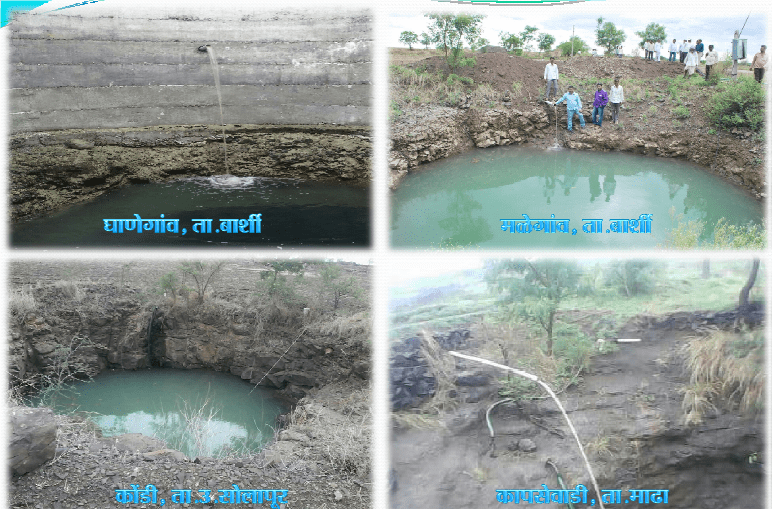
Union Water Resources Minister Uma Bharti in an interview tried to refute charges that the Centre reacted late to India’s drought crisis. Water minister makes strange statements that one cannot do any planning about drought & her govt is the first govt to provide water through tankers. However, Solapur, a chronically drought-hit district in Maharashtra was serviced with more than 200 tankers in 2013-14, even when the monsoon rainfall was better than this year. In this drought, there are only 16 tankers plying in Solapur. Drinking water sources have been secured, water from Ujani dam for and sugar cane has been disallowed. The district leads the way in Jal Yukta Shivar Program in the state, new avenues of Agricultural credit are opening, options to sugarcane are being developed, errant sugar factories are being fined for polluting drinking water sources. Will the Union Government accept its mistakes and make amends?
DRP: 11 April 2016 (Harsh Summer: In Search of Green Pastures)
With ponds and lakes drying up, cattle in Telangana are forced to travel long distances for fodder and water. Here, buffaloes are moving towards a water source near Medipalli in Adilabad district on 09 April.
Continue reading “DRP: 11 April 2016 (Harsh Summer: In Search of Green Pastures)”
DRP: 4 April 2016 (India Water Week shows absence of fresh thinking from water resources establishment)
SANDRP Comments India Water Week continues to show absence of any fresh thinking from water resources establishment The 4th India Water Week being organized by Union Ministry of Water Resources, River Development and Ganga Rejuvenation during April 4-8, 2016 in Delhi shows continued absence of any fresh thinking from water resources establishment.
The Information Brochure of the event says: “Ministry of Water Resources, RD & GR is to organize the India Water Week -2016 between April 4-8, 2016 to use it as a platform to elicit ideas and opinions from global level decision makers, politicians, researchers and entrepreneurs in the field of water resources for mutual benefit and goodwill… This is the fourth event of its kind with the theme “Water for all : Striving together” focusing on improving efficiencies of water use across all sectors… ”
DRP: 28 March 2016(Is India facing its worst-ever water crisis?)
Is India facing its worst-ever water crisis? On 11 March first time in 30 years history power generation at Farakka power plant in West Bengal was suspended for 10 days due to non-availability of water in Ganges. Nobody is sure why but the evidence about the declining water levels and waning health of the 2,500km long Ganges is mounting. Monsoon rains have been scanty for the second year in succession. The melting of snow in the Himalayas has been delayed. Water tables have also been declining in the Ganges basin due to the reckless extraction of groundwater. The 3-month-long summer is barely weeks away but water availability in India’s 91 reservoirs is at its lowest in a decade, with stocks at a paltry 29% of their total storage capacity, according to the Central Water Commission. Thousands of villagers in drought-hit region of Maharashtra depend on tankers for water & authorities in Latur district, fearing violence, have imposed prohibitory orders on gatherings of more than 5 people around storage tanks. Tens of thousands of farmers and livestock have moved to camps providing free fodder and water for animals in parched districts. The govt has asked local municipalities to stop supplying water to swimming pools. States like Punjab are squabbling over ownership of river waters. In water-scarce Orissa, farmers have reportedly breached embankments to save their crops. Realy the waning health of the sacred river underscores the rising crisis of water in India.
Continue reading “DRP: 28 March 2016(Is India facing its worst-ever water crisis?)”
DRP: 21 March 2016 (‘Towards Noyyal’ A people’s initiative to restore a river’s glory)
Tamil Nadu A people’s initiative to restore a river’s glory The Noyyal River Restoration Federation will launch ‘Noyyalai Nokki’ (Towards Noyyal), a people’s initiative to restore the Noyyal river system on 26 March. Social activist Anna Hazare will launch the project at Kooduthurai in Alandurai in Coimbatore district. The river originates in the Western Ghats and runs through the four districts to join the Cauvery at Noyyal village. Known as Jungle stream, in olden times as many as 34 streams used to feed water into it and the river would flow throughout the year with two or three annual flood spell. But now, just 4 or 5 streams feed the river. In many places, the river is encroached upon, sewage is let into it, or the river needs to be desilted. The river is all set to regain its glory with the ‘Noyyalai Nokki’ initiative. What is encouraging is the willingness of the public to be part of it. The project proposes to divide the river into segments of 500 metres for restoration and maintenance. Ownership groups will be formed for every 500 metres and it will consist of the local people, experts and patrons (divide-distribute-develop model).
DRP: 14 March 2016 (No Rain Dance, Only Dry Holy This Time: Pune District Administration)
Dam levels down, ‘rain dance’ for Holi dropped Pune district, where a water cut is in effect due to depleting water levels in the dams, will not have any kind of “rain dance” functions this Holi. As water reserved in the dams is to be used only for drinking purposes as per the district administration’s instructions, the collectorate has urged people to go for a “Dry Holi” this year and will ensure that there are no such functions during Holi. With dam levels coming down to as much as 23% of their capacity, the entertainment department of the collectorate will ensure that permissions are not given for events like the “rain dance” during the festival. Meanwhile, a BJP legislator in Mumbai has written to the Brihanmumbai Municipal Commissioner seeking a ban on “rain dance” functions in Mumbai in the metro during Holi. Ameet Satam, in a letter to the BMC, said that the civic body should ban rain dance and even asked the corporation to slap a fine of Rs 50,000 on those who indulge in waste of water.
DRP: 7 March 2016 (Sudden water discharge from Chamera-II hydro Project in Himachal killed 2 Air Force jawans)
Sudden water discharge from Chamera-II hydro project killed 2 IAF jawans In the evening of 05 March, 2 Indian Air Force (IAF) personnel posted at the Pathankot airbase were washed away by sudden rise in Ravi’s water level from Chamera-II hydro project in Chamba, Himachal Pradesh while 3 other personnel had a close shave. According to Sudesh Mokhta Deputy Commissioner Chamba the 5 IAF personnel on a weekend holiday trip were clicking pictures on the river bank at the time of the incident when the water of the river rose suddenly after discharge from upstream Chamera-II project. The incident happened around 6.30 pm and due to darkness, the search operation remained unsuccessful. It was only on 06 March that the bodies were fished out. Mokhta further stated that a magisterial probe has been ordered to ascertain if the NHPC authorities, which man the Chamera-II project, followed the guidelines laid down by the high court for the discharge of water. On 08 June 2014 also during a similar accident, 24 students from Hyderabad were killed by sudden discharge of water from Larji hydel project dam in Mandi district.

DRP: 29 Feb. 2016 (4 decades on, Siruvani dam displaced tribals wait for justice)
Kerala 4 decades on, Siruvani dam displaced tribals wait for justice During 1970s, of Muthikulam triblas of Siruvani hills in Kerala were forced to relocate themselves to Chingampara forests area. This was how a settlement constituted 24 Muduga tribes families facilitated the construction of the Siruvani dam, a major source of drinking water for Coimbatore city and its surrounding areas in Tamil Nadu. Four decades later, the Muduga tribe has volumes to talk about the breach of official promises. Their houses are in ruins and the tribal people have to walk about 3km to fetch water from the reservoir as the decades-old water supply mechanism stopped functioning years ago. Most of the children in the Chingampara colony do not attend school as the nearest school is about 20 km away. The old school at Muthikulam got submerged in the dam waters. Now the colony has only an Anganwadi. Rajan, a differently-abled member of colony reported that the new reservoir came up in the area from where our families had been forced to move out. The dam was commissioned in 1984, but our settlement remains neglected. The tribals are still awaiting justice even after four decades. Except for the once-in-a-week visit of a junior public health nurse, there is no health care facility for the people. Biju another affected stated that in 1971 we were promised pucca housing with water and power connections and toilets, besides compensation of Rs.10,000 but nothing happened. He felt that their rehabilitation was a mockery and they deserve a decent rehabilitation as compensation.
Continue reading “DRP: 29 Feb. 2016 (4 decades on, Siruvani dam displaced tribals wait for justice)”

