DRP News Bulletin

DRP 160123: Top Court appeals for EIAs for Urban Development: Welcome, but…

The Supreme Court of India, while disposing of a petition related Chandigarh, in its order on January 10, 2023 has said: “Before we part with this judgement, we observe that it is high time that the legislature, executive, and the policymakers at the centre and state levels take note of the damages to the environment on account of haphazard development and take a call to take necessary measures to ensure that the development does not damage the environment… We therefore appeal to the Legislature, the Executive and the Policy Makers at the Centre as well as at the State levels to make necessary provisions for carrying out Environmental Impact Assessment studies before permitting urban development.”

This is most welcome. And urgently required. That India’s urban development is happening at the cost of life sustaining environment resources including rivers, water bodies, forests, wetlands among others is well known. That the government sees all requirements of environmental scrutiny as road blocks is also well known. The consequences of this are clear for all concerned, not only in case of Bangalore as cited by the Supreme Court Bench, but also in case of Ahmedabad, Bhopal, Chennai, Delhi, Ernakulam, Faridabad, Gurugram, Hyderabad, Indore, Joshimath, Kolkata, Lucknow, Mumbai and so on. So is there a good chance that the apex court suggestion will be followed either in letter or in spirit? Unlikely. So what is clearly required is that the apex court emphatically directs the centre and states in this regard and follows it up with ensuring its implementation.

Continue reading “DRP 160123: Top Court appeals for EIAs for Urban Development: Welcome, but…”
DRP News Bulletin

DRP 090123: Atal Bhujal Yojana just chaff without any wheat?

According to this detailed report, possibly the first independent review of the Atal Bhujal Yojana, a 5-year program of the Union govt for management of groundwater, India’s water lifeline, with over half of the project period completed, seems bereft of the fundamental aspects that the scheme itself says are necessary for any sound foundation of the scheme. The review describes it as a dish full of chaff, without almost any kernels of wheat for some sound reasons. It says hardly 18% of allocated money has been spent on Gram Panchayat level community-led Water Security Plan. Only 4% of the planned Gram Panchayat level trainings have been held, with Gujarat and Haryana holding none. Only 27% of money allocated for Gram Panchayat level Hydrogeological monitoring network has been spent. The data gathering instruments that were required from the beginning of the program have not been installed in over half the planned locations. On Information, Education and Communication activities, only 16% of allocated amount is spent.

More detailed independent review of the program implementation will help, but from the available information so far, the signs do not look particularly promising. Is it due to ineptness or lack of intention? Only time will tell.

Continue reading “DRP 090123: Atal Bhujal Yojana just chaff without any wheat?”
DRP News Bulletin

DRP 020123: Looking Back to Look forward to 2023

(Feature Image:-River Ken inside Panna National Park from River Stories, Walking Across India-I by Siddharth Agarwal)

This is the first DRP bulletin of 2023 and we would like to begin on a positive note. But to remain grounded in reality we also need to look back at the events in 2022. We see a number of positives in 2022 and we hope that trend continues. The number of new dams and hydropower projects being started has remained on a declining trend. People and civil society has continued its protests against destructive projects and for more decentralised projects and governance.

Continue reading “DRP 020123: Looking Back to Look forward to 2023”
DRP News Bulletin

DRP 261222: People on roads against hydro projects that govt is pushing

(Joshimath residents staging protest against land sinking and damages to their homes demanding rehabilitation & halt in NTPC’s Tapovan Vishnugad HEP tunnel work on Dec. 24, 2022. Image source: Atul Sati, Joshimath)

People of at least four states are opposing hydropower projects that the central and state governments are pushing, ignoring all the ground realities. In Uttarakhand, the Joshimath residents are on roads to wake up the government that seems deaf to their protests due to their houses cracking and land subsiding due to the tunnels being blasted for hydropower projects and Char Dham highway being built ignoring the voices of not only the affected people, but also the experts.

In Arunachal Pradesh, people have been writing to the central govt authorities against the Etalin and Dibang projects being pushed in Dibang valley of Brahmaputra basin.

In Himachal Pradesh, the people of Kinnaur and Lahaul Spiti districts have made it an election issue the destructive hydropower projects being pushed there both by the state and central governments.

In Andhra Pradesh too people have been protesting against the pump storage projects being given permission in schedule tribe areas without their prior informed consent and ignoring the statutory requirements.

2022 is thus ending with people’s active protests across the country against destructive, disaster prone and unviable projects being pushed against their wishes and in violation of any proper consultations or even any credible impact assessments. In the escalating impacts of climate change, these projects are even more problematic as they not only worsen the adaptive capacity of people and invite more frequent, intense and spread of the disasters, but they also destroy the mitigation tools like forests and flowing rivers. This when all these projects are not even economically viable, and when better, cheaper options are available. It would be best if sooner the government listens to the people and stop pursuing such projects.

Continue reading “DRP 261222: People on roads against hydro projects that govt is pushing”
DRP News Bulletin

DRP 191222: Question marks over viability of pump hydro projects

(Feature Image: 1772 Mw PSHPs Spain. Photo courtesy of Iberdrola/ ENR)

The question marks over viability of huge number of pump storage hydro projects (PSHP) being pushed forward in India currently were flowing in the rivers for long. This week, Moody’s investors Service (MIS) seems to have strengthened this after it downgraded Greenko Energy Holdings’ corporate family rating. It may be noted that Greenko is the biggest investor in PSHPs in India from private sector and a major part of Greenko’s new investments are in PSHP.

This makes the implications of MIS’s downgrade all the more interesting. MIS has noted that PHSPs are capital intensive and each PHSP will generate cash flow only after at least 2-3 years of construction (in reality it can be much longer than 2-3 years, the operative phrase here is at least). It also noted that the additional debt to be raised from Greenko’s capital spending, coupled with a rising interest environment will put further pressure on “GEH’s already weak financial metrics” and that Greenko’s high financial leverage due to its substantial capital spending program will keep its financial metrics below its downgrade trigger “for an extended period of time”.

Continue reading “DRP 191222: Question marks over viability of pump hydro projects”
DRP News Bulletin

DRP 121222: Green Hydrogen from Hydropower is false solution

(Feature Image: Reservoir of Vyasi hydro project dam on Yamuna river in Dehradun. Credit: Varsha Singh/The Third Pole.)

A section of the hydro lobby has been trying to push hydropower in the name of producing green hydrogen as an alternative energy source. However, it has been known for a long time that this is a false solution. There cannot be green hydrogen when sourced from hydropower as not only hydropower projects have huge social and environmental footprint, they also have huge carbon footprint as the following article shows. It would be best to out rightly reject any such claim of green hydrogen when sourced from hydropower project.  

Continue reading “DRP 121222: Green Hydrogen from Hydropower is false solution”
DRP News Bulletin

DRP 260922: Need for new credible Polavaram backwater study

(Feature Image:- The construction of the Polavaram dam across the Godavari river has posed a big threat to the Pulasa fish, as its movement to the upstream of the river could be curtailed. HT PHOTO).

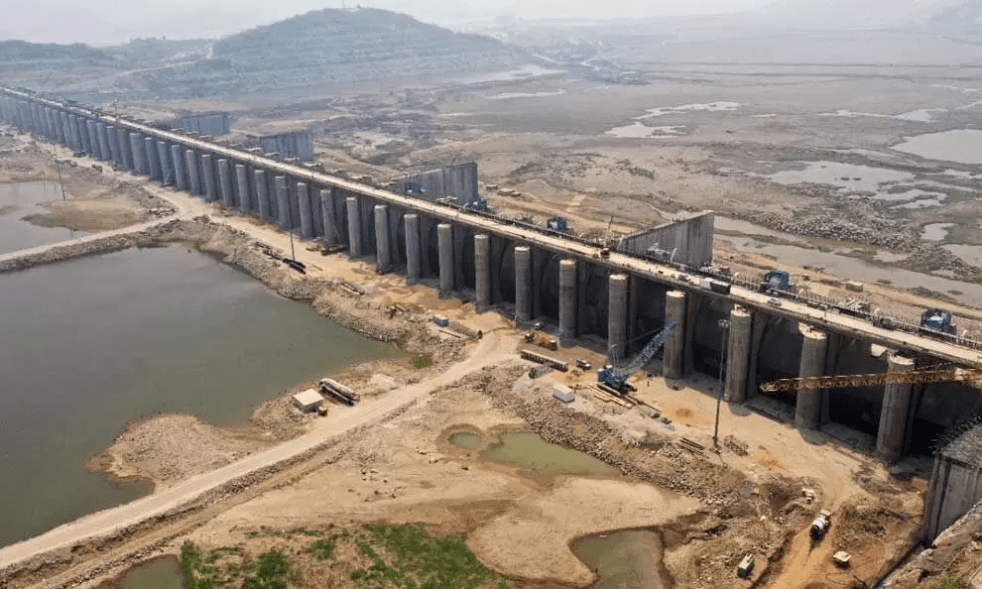
Telangana state has demanded fresh backwater study for the Polavaram dam based on a number of grounds including the higher spillway capacity and outdated river cross sections of 1990s used in the old study. The changing rainfall pattern and resultant changing river flow pattern, both due to changed rainfall and changed state of catchment area also should be a reason for such a fresh study. However, more importantly, the study needs to be done in a credible way involving independent experts, not just state or central govt officials or academics from govt run institutions. Moreover, the study and all the information related to it has to be completely and promptly in public domain as these studies are required for the affected people and affected area. Normally Central Water Commission does such studies and refuses to make it public. What is the use or reason for backwater study to be secret? Possibly CWC is not confident of the quality of the study and that is why it is very important to have experts in the study team who are known to take independent stand. It is useful not only for the states of Telangana, Odisha and Chhattisgarh, but also for the people of Andhra Pradesh too. And earlier this is done, better it will be for all concerned.

Continue reading DRP 260922: Need for new credible Polavaram backwater study
Dams · DRP News Bulletin

DRP 120922: Decisive judicial action dire necessity for wetlands

( Feature Image:- Satish Acharya’s illustration on Bengaluru floods: Whose land is it anyway? 07 Sept. 2022)

The wetlands reports tell us a lot, but the key point is that decisive judicial action is necessary if our wetlands are to have any future. The directions of the Tamil Nadu High Court to geo reference all wetlands of Tamil Nadu, including small (Less than 2.25 ha area) is good beginning, but the court will need to ensure continuous monitoring and ensure implementation. Because the past shows that the government and other stakeholders have collectively failed to take any decisive action to save our wetlands. The disastrous results are evident at so many places, this week it is most clear from the flooding of Bangalore, mainly due to encroachment of lakes, wetlands, water channels and their catchments.

Continue reading DRP 120922: Decisive judicial action dire necessity for wetlands
DRP News Bulletin

DRP 110722: Govt failure on cloudburst monitoring, forecasting, managing

(Feature Image: On July 8, a flash flood triggered by a cloudburst hit a camp near the Amarnath cave shrine in J&K’s Ganderbal district. The Indian Express)

Just in first few weeks of this South West Monsoon in India and particularly in last two weeks there have been numerous cloudburst incidents leading to large number of deaths and destruction of human and natural infrastructure. Most of the time, the government just calls these disasters cloud burst and points finger at climate change, implying its helplessness, but happy that they have rescued the affected people. In reality, a lot can be done in terms of monitoring, forecasting and managing cloudbursts that is clearly not happening and is not part of government’s disaster management plans or actions.

Firstly there are some known places where the flash floods from cloud burst could lead to disaster, they need to be identified and habitations near and at risk at such locations need to be mapped and monitored to minimize the risks. The locations next to streams are clearly such hazardous locations and how can there be camps located right next to such streams as happened during the recent Amarnath caves?

Continue reading “DRP 110722: Govt failure on cloudburst monitoring, forecasting, managing”
Disasters · Floods

Kerala and Uttarakhand floods in Oct 2021: Did the forewarnings help?

The October 2021 flood disasters in two ends of India, in Kerala and Uttarakhand have a lot common. Both happened after the end of normal dates of South West Monsoon 2021. In both cases it is repeat of earlier such disasters in respective states. In both cases, there were reports by expert reports warning about the disasters. In both cases the rainfall events were broadly along the lines warned by the climate scientists, but in both cases the state was ill prepared to cope with it. In both cases, inappropriate human interventions have worsened the disasters in major ways. And in both cases disaster management seems to be absent from ground. In both cases, more precise forecasts about the rainfall quantum and location would have helped. (Feature Image above is from The Hindustan Times, Oct 23, 2021)

Continue reading “Kerala and Uttarakhand floods in Oct 2021: Did the forewarnings help?”