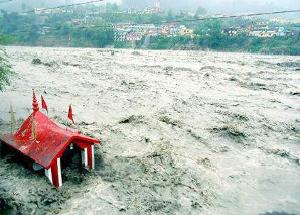
During Sept 4-6, 2014 Jammu and Kashmir in North India is facing one of the worst floods. NDTV[1] has reported that these are the worst floods in 60 years (The Times of India reported that this was worst flood of the state since independence based on number of casualties.). More than 160 people have died and some 2500 villages are affected (1615 in the valley, rest in Jammu), out of which 450 are completely submerged (390 in valley)[2]. Over 10 000 people are stranded across the state. The flood has affected almost all 10 districts in the Jammu region. J&K Chief Minister admitted that the rescuers have yet to reach the worst affected South Kashmir region. Jammu Srinagar Highway has remained blocked for over three days. Several rivers have been flowing above the danger mark and most parts of south Kashmir, including Pulwama, Anantnag and Kulgam districts have been submerged. Jhelum was flowing at 30.7 ft in South Kashmir, 7 ft above the danger mark. Chenab river was also flowing above the danger mark at several places.
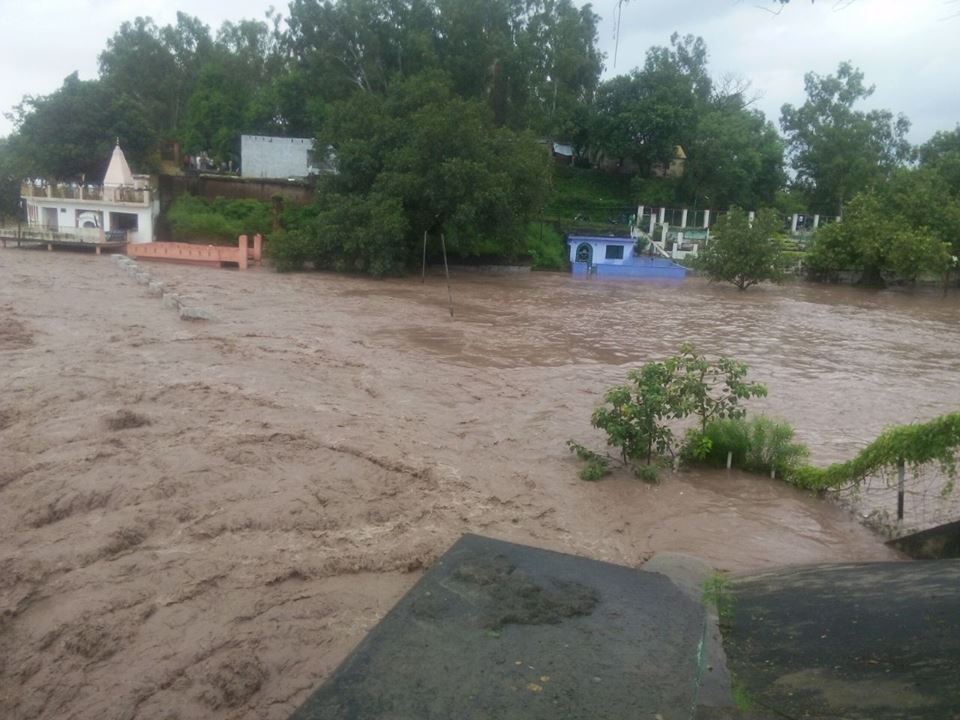
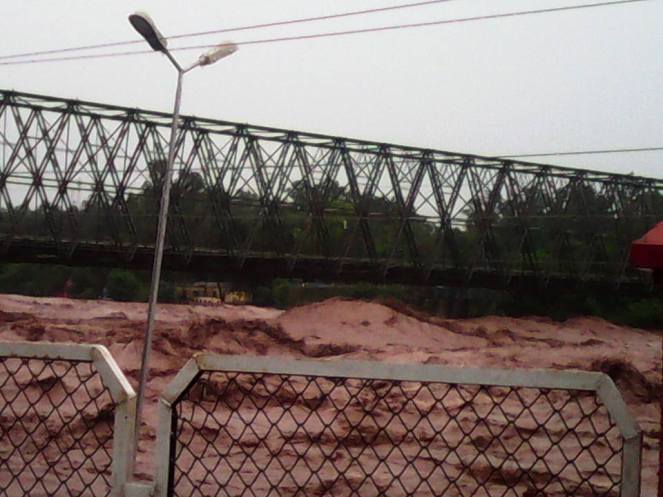
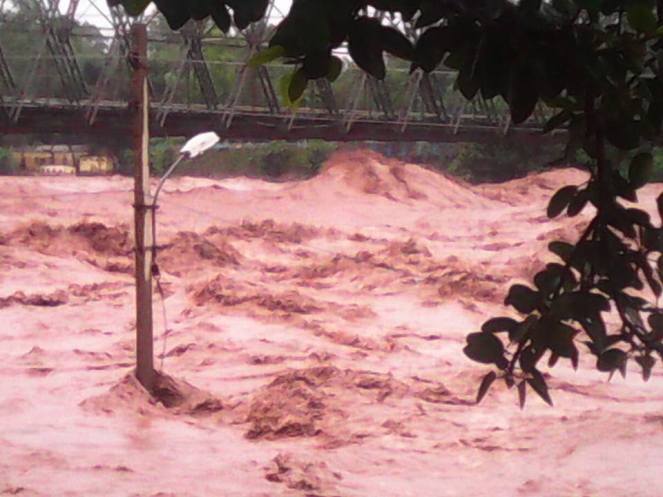
Authorities have declared the bridge over the Chenab in Akhnoor unsafe for traffic. Source: Vinay Saraf’s facebook post
Unprecedented floods Landslides triggered by heavy rainfall have damaged roads, dozens of bridges, buildings and crops. As many as 40 people went missing after a landslide in Thanamandi area of Rajouri district in Jammu region. Heavy rain in the catchment areas of Jhelum river has so far submerged more than 100 villages in the south Kashmir districts of Anantnag, Kulgam, Shopian, Pulwama, where the river was still rising, as well as the north Kashmir districts of Ganderbal, Srinagar and Badgam[3]. The flood has surpassed the 1992 memories and revived the 1959 flood memories[4].
Flood Forecast map of CWC has no sites to forecast floods in J & K
Vehicular traffic has been stopped on the Jammu-Pathankot highway due to incessant rain. Jammu is on red alert and Tawi bridge is also in danger.
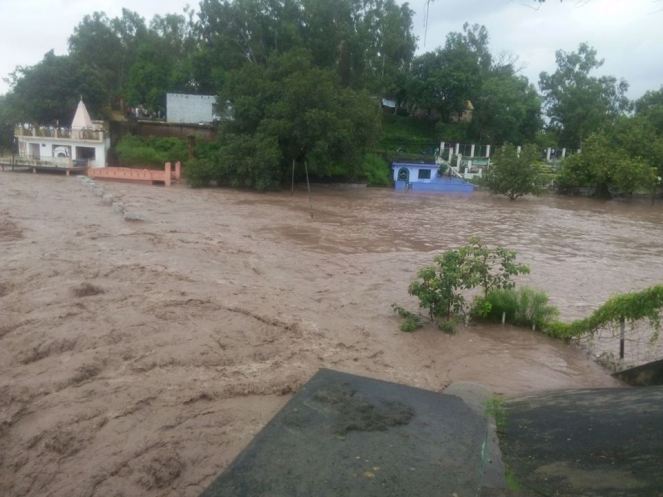
Flood image from Vinay Saraf’s Facebook post
State Finance Minister Abdul Rahim Rather said Chenab was flowing at 38 ft at Akhnoor which is four ft above the danger mark cumulatively discharging 2.75 lakh cusecs, a quantum of discharge which equals all other rivers of the state.
The situation is very grim indeed: “According to the Army, the situation in the state is as grim as it was in Uttarakhand last year.” Union Home Minister has visited the state and the prime minister has expressed grief.
VERY HEAVY Rainfall during Sept 3-6 The state received massive 250 mm of rainfall in just three days between Sept 3-4, out of its seasonal monsoon rainfall of 568 mm till Sept 6, 2014. Rainfall just on Sept 6 was 106 mm, which is unbelievable 3116% of the normal rainfall for that date for J&K.
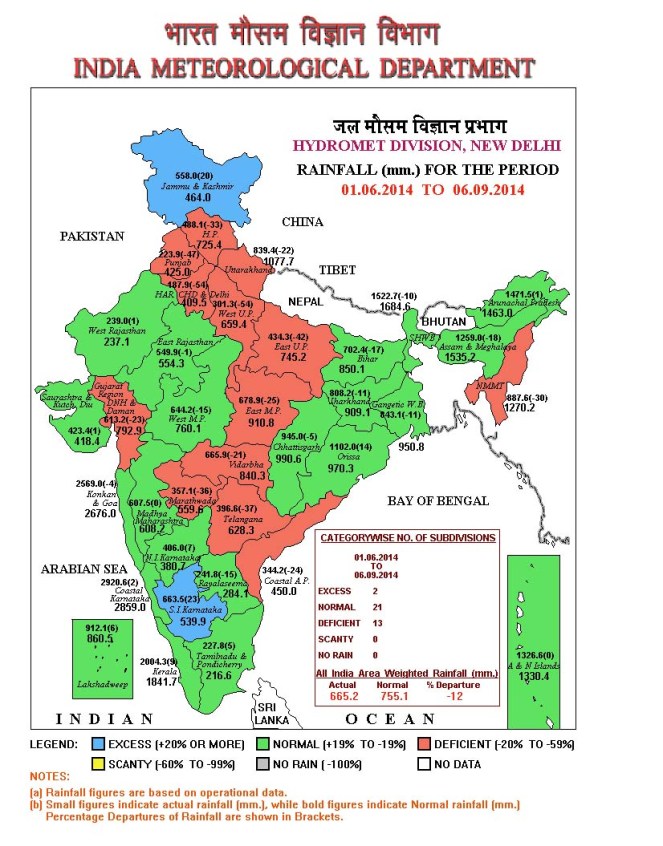
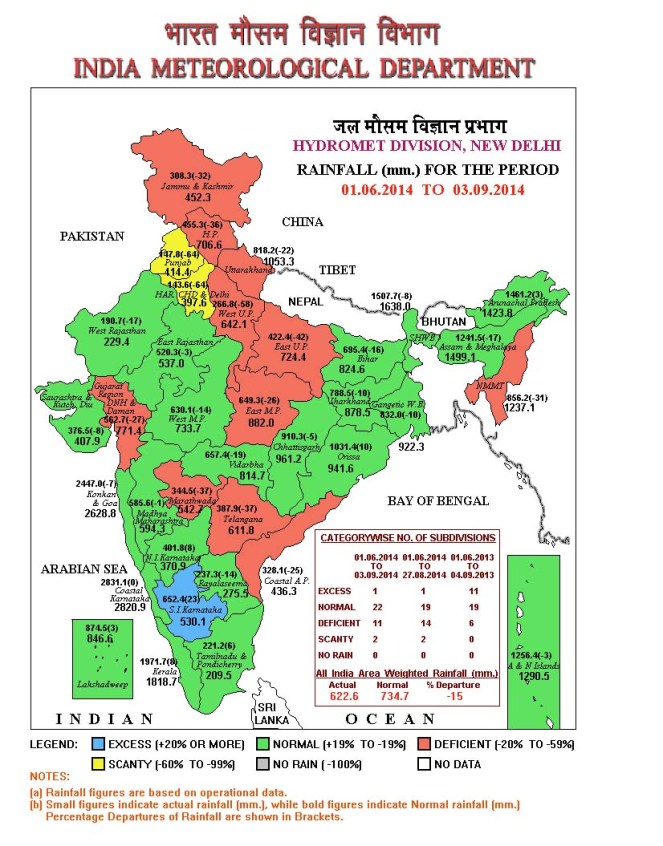
Rainfall Map from IMD showing that J&K received 558 mm rainfall till Sept 6, progressing to excess rainfall category in three days from deficit category on Sept 3, see the next map below
It can be seen from the season rainfall map see above of India Meteorology Department as on Sept 6, 2014 that J&K had received 558 mm rainfall till that date, progressing to Excess Rainfall category (blue colour code) from Deficit season rainfall of 308 mm as on Sept 3, 2014 (see IMD map below), in just three days.
IMD Map of Sept 3, 2014, showing J&K in deficit rainfall category (brown colour) with seasonal rainfall of 308 mm
CWC has no flood forecasts for J&K However, shockingly, India’s premier water resources body, Central Water Commission, responsible for flood forecasting and providing advisory to the states for tackling floods, has no flood forecast for any place in the state. The CWC’s flood forecast list[5] on Sept 6, 2014 has 18 level forecasts and 8 inflow forecasts, but NONE from J&K. CWC’s Flood forecast site has another option[6] that provides hydrographs for various rivers and location. Again for J&K it provides NO hydrographs. The options on CWC’s Flood Forecast site for list based selection[7] and map based selection[8] again has no information about Jammu & Kashmir.
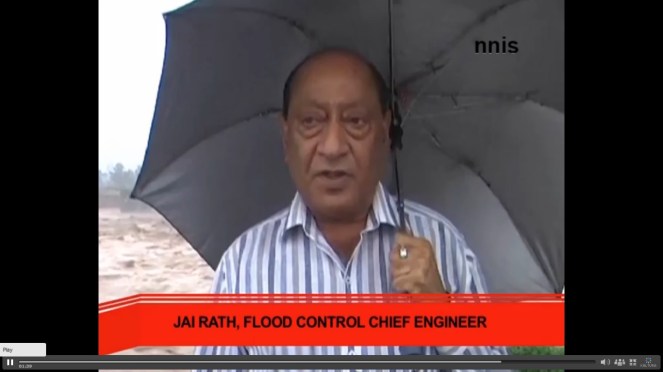
J&K Flood Control Chief Engineer called the situation Alarming. Photo Source – NNIS
This seems like shocking omission on the part of CWC, which functions under Union Ministry of Water Resources and reminds one that CWC completely failed to provide any flood forecast when Uttarakhand faced its worst floods in June 2013[9]. We hope CWC will urgently include the flood vulnerable sites of J&K in its flood forecasting and also explain to the people of J&K and rest of the country why these sites were not included so far.
Akhnoor flood image from Vinay Saraf’s Facebook post
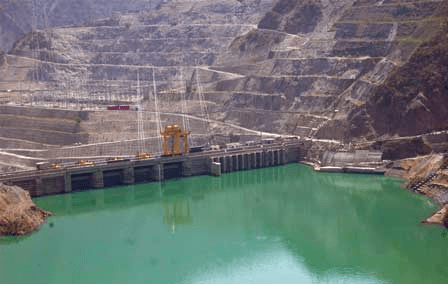
Mismanaged hydro projects increase the damage In this context, media has reported[10] that Dulhasti Hydropower project on Chenab river decided to open its flood gates DURING the worst flood period, which lead to further increase in flood levels in the downstream areas: “Release of water by NHPC dam is expected to increase the levels of the Chenab massively between Kishtwar and Ramban. Surged level can lead to submergence of the highway.” Such additional floods could have been avoided if the gates were kept opened in anticipation of floods. Such opening of gates during the floods can lead to catastrophic consequences for the downstream areas as happened in case of Srinagar Hydropower project in Uttarakhand in June 2013.
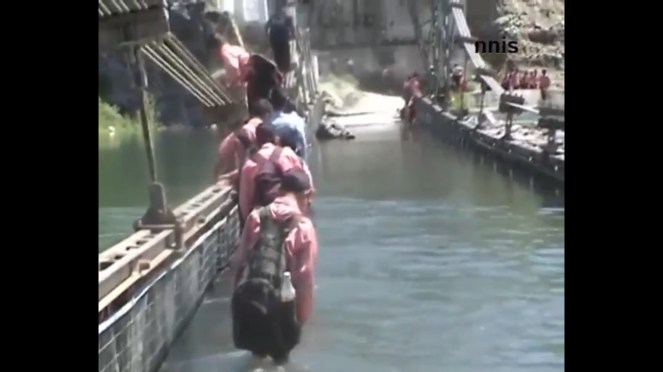
Kids crossing flooded bridge in flood hit J&K Photo Sources – NNIS
MoEF’s wrong decisions The Union Ministry of Environment and Forests have been clearing hydropower projects in the Chenab basin even without proper social and environment impact assessment as was evident in case of Sach Khas project most recently. As SANDRP pointed out in a submission to the Expert Appraisal Committee[11], the EIA and public hearing process of the Sach Khas HEP has been fundamentally inadequate and flawed and yet without even acknowledging the issues raised in this submission the EAC has recommended approval of the project. This is bound to be legally untenable decision. Such decisions by the EAC and MoEF are likely to add to the disaster potential in Chanab and other basins in J&K. There is also no cumulative impact assessment of such massive number of big hydropower projects any basins of J&K.
It is well known, as witnessed in case of Uttarakhand in 2013, that hydropower projects hugely add to the disaster potential of the vulnerable areas. We hope the J&K and central governments make this assessment on urgent basis and we hope the apex court does not have to intervene for such assessment as the Supreme Court had to do through its order of Aug 13, 2013 in case of Uttarakhand.
SANDRP
POST SCRIPT: This is one possible fall out of this, also flashed by several newspaper and following CWC questioned by media: http://www.cwc.nic.in/main/webpages/Flood%20Forecasting%20in%20uncovered%20Himalayan%20and%20interstate%20inflow%20forecasting%2011092014.pdf
Stumbled upon this on January 14, 2015. Hope the government will be now implementing this.
Large dams represent a gamut of ideas around the asocial and apolitical nature of water itself, i.e., ‘modern water’[1], expert control, and national space that are stitched together to yield hydraulic bureaucracies or hydrocracies. In the 20th century, the ‘hydraulic mission’ (See Molle et all 2009) was accepted across the globe and entrusted with hydrocracies which became synonymous with the project of ‘development’. These hydrocracies have left an indelible mark on national economies and geographies, constructing massive damming projects i.e. what India’s first Prime Minister called ‘temple[s] of modern India’. The effects of these projects have been a mixed bag. In India, these ideas about water and technology formed a template through which the hydrocracy—which took the form of the Central Water Commission (CWC)— conceived, discussed, and justified technological interventions. Rivers were described as natural features without history, ecology, and society, making a case for greater technological control.
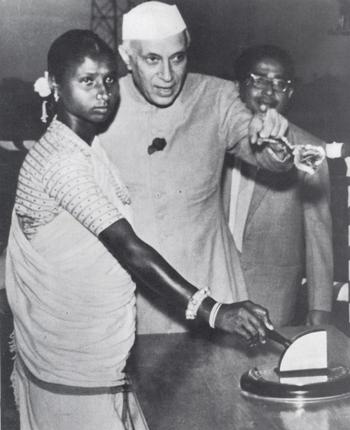
Santhal Tribal Lady Budhni inaugurating the power station at the Panchet dam in December 1959 photo Nehru memorial museum and library New Delhi Photo from: The Hindu
Using engineering voices from the Indian Journal of Power and River Valley Development (IJPRVD) and Government of India publications, I attempt to puncture the ‘tunnel vision’ of hydraulic development in India. Juxtaposing two contrasting narratives within the engineering community, the attempt is simply to bring out the spirited debate on large dams in post independence India- a fact lost in the din about which narrative won.
Except one engineer, M.Karantha who was the Chief Electrical Inspector of the erstwhile Madras Presidency, all the other engineers quoted in this post viz. A.Khosla, K.L. Vij, S.N.Gupta, Kanwar Sain etc were a part of the Central Water & Power Commission (CW&PC) before it became the Central Water Commission (CWC).[2]
Transforming Rivers into datasets Hydraulic manipulation has a long history in the Indian subcontinent. Hydraulic engineers in the 20th century recast modern irrigation as the logical conclusion of millennia long hydraulic manipulation practices- projecting irrigation, specifically dams and canals, as age-old components of the riverine landscape thus establishing continuity with the ‘unbroken’ tradition of hydraulic manipulation. This projection was selective: it did not acknowledge the colonial state’s role in establishing a radical break in hydraulic principle in the subcontinent by introducing perennial irrigation; barrages and weirs that effectively flattened a river’s variable flow. Instead, independence was projected as the watershed moment at which the millennia long project of hydraulic manipulation would reach fruition in the form of large dam projects.
Interestingly, engineers saw colonialism as helping bring modern science and technology to India; colonialism’s only limitation was ‘that it constituted an insult in that it denied that Indians could fully be partners in the enterprise of modernity’ (Klingensmith 2007: 233). Modernity in their eyes was an inevitable process, denied to India pre-independence. Modern science was a universal, emancipating category. According to S.N. Gupta: ‘[S]cientific, engineering and industrial research directed towards greater understanding and greater control of material surroundings is the keynote of the modern search for progress and power’ (Gupta 1970:3). The unfinished business of modernity, thus, was the complete control of nature, which could only be realized through the nation-state.
A System of Limits and Solutions One of the foremost challenges facing post independent India was food security. Narratives for water control underscore this challenge. There were carefully worded alarms about scarcity and impending catastrophe. Such warnings are found with striking regularity in the IJPRVDand the Silver Jubilee Souvenir of the CW&PC. For instance, S.N. Gupta asserted:
[T]he fateful year 1947- the year of India’s independence brought both responsibilities and opportunities. The country was faced with the basic question: Adequate production of food for the growing millions (S.N. Gupta 1970: 1).
The only way to meet this ever-increasing demand was to increase the area under cultivation by providing more water: The food production has to keep pace with the ever increasing requirements of population. The principal remedy for meeting this increased demand is to steadily extend irrigation facilities (Kanwar Sain 1959: 37a).
The answer was simply put: greater investment in developing water resources to ensure that the twin challenges of a rising population and looming food scarcity could be met effectively. Technology would provide solutions to tame nature for human needs.
There are two equally important elements in human progress. They are the development of spirit and character on the one hand, and the mastery of the physical world on the other… Without mastery over nature, our earth, as it stands would support but a small fraction of the present population… I submit that hunger and poverty are no longer beyond solution. The mastery over the physical world gives us the key to the problem. The most thickly populated regions on earth can be satisfactorily fed if the most effective known methods are applied. The technical possibilities of feeding the world will probably always run far ahead of the increase in population (Kanwar Sain 1957:1).This neo-Malthusian trap anticipated more than just technological problems and solutions. The rhetoric about looming scarcity and overpopulation served as a vantage point to drive home arguments for large multipurpose projects. This was an unprecedented move by Indian engineers in conceptualizing Indian rivers. Modeled on the TVA (Tennessee Valley Authority), these projects would render rivers into a ledger of flows and returns. As a complete system of inter-related projects, the aim was to ensure rivers would no longer ‘run waste to the sea’ (Khosla 1951:2). Basin-wide development therefore came to be premised on the scarcity trap. These visions of scarcity were axiomatic in two ways:
1) The ability of science and engineers to forewarn such a possibility due to the exact nature of their science and scientific method.
2) The need for planned development to ensure that fragile and unreliable natural resources could be yielded into reliable flows to provide consistent maximum returns.
Without large multi-purpose dam projects to control floods, manufacture electricity, provide water for irrigation, and utilize an ‘inexhaustible source of water supply in the form of rainfall’, all that water would go to waste (Khosla 1970a: 15). These projects would meet the pressing needs of the country:
[K]eeping in view the need of the country, priority has been accorded to projects likely to yield additional food at an early date. Large multi-purpose projects have been phased with a view to an early completion of their irrigation aspect (Dhir 1959: 57).
Indeed, as K.L. Vij stated while commenting on hydro-electric resources in India emphatically:
[E]ssentially the problem is simple, in that it resolves itself into an examination of the possibilities of utilizing “available water supplies” at the maximum possible head (Vij 1959: 64).
It was only through such a thorough examination of hydraulic heads that entire river basins could function as measures of water resources. As stocks of volumes, rivers held enormous possibilities, provided they were engineered holistically so as to ensure maximum returns.
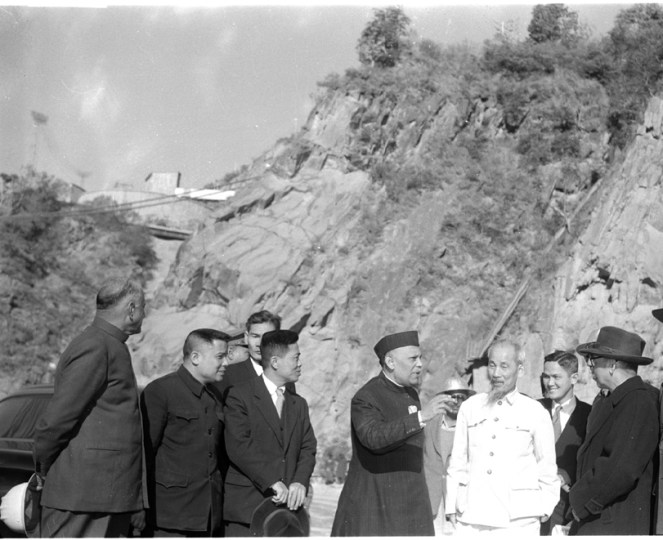
Dr Ho-Chi-Minh, president of the Democratic Republic of Vietnam and other party members photographed at the dam site during his visit to Bhakra dam on February 8 1958 Photo: photodivison.gov.in
Burgeoning Bureaucracy It’s [sic] (the CW&PC’s) development and march towards organizational expansion has been linked up with the development and planning of projects in the country since Independence and thus the stature of the Commission today is a barometer of the progress achieved by the country in the fields of irrigation and power (Jain 1970a: 21).
Kanwar Sain summed up the times emphatically: ‘[K]ey to the production of wealth is the Kilowatt. Underlying the country’s capacity to produce anything else is our capacity to produce power’ (Sain 1959: 37b. Emphasis added). There is a clear imperative to scale up through expert-led interventions. According to H.S. Desai,
[V]iewed purely from technical angle, and given all the goodwill that such cases deserve other angles, it is felt that engineers could and should have the last word on the development of the water resources of the country (Desai and Rao, 1970: 82).
Development, it might seem, could best achieved if driven by expert-led organizations like CW&PC. This championing of a burgeoning hydrocracy helped incubate and insulate it from overt political and social questions.
Holistic Planning for Basin-wide Development Planning water resource development required rearranging rivers into basin-units instead of geographies or people. Rivers as basin-units, like the larger nation state were comparable and amenable to technological solutions for resource optimization, and wired apolitically. Sain clearly charted out a course for the same:
[T]o make effective use of waters for irrigation, navigation, power and other allied purposes, it is necessary that a careful and unified development of the whole basin is planned irrespective of that number of States or Provincial boundaries that may be involved. It is only in this manner that optimum utilization of resources of the entire water-shed can be made and waste of any potential resources of the valley eliminated. If the entire basin is not developed as a unit there is the possibility of confusion arising when each State starts controlling the river from its own point of view (Sain 1959: 37b-c).
Some of the many voices include those of M.L. Sood, A.N. Khosla and S.K. Jain:
Practically all the river systems of the country run through more than one State. Their balanced development in the interest of navigation and other objects, e.g., irrigation, hydro-electric power and flood control, demands that the entire valley is treated as one unit irrespective of State boundaries (Sood 1959:52).
Modern technology for conservation and utilization of water resources is making rapid strides. With a unified and integrated approach to the development and utilization of surface and ground waters and to problems of agriculture and irrigation, this challenge (of looming resource crunch and a steady population rise) can be met (Khosla 1970a: 14).
It has been well recognized that river basin should be considered a single unit for development of water resources (Jain, 1970:12).
A basin-based approach across rivers was thus, the most efficient means to develop the nation’s water resources: ‘[T]he water and power resources of a region, basin and sub-basin and the transfer and interchange of both water and power between regions, basins and sub-basins in the overall interest of the country and regions concerned’(Khosla 1970a:12). These arguments combined to form the basis for a National Water Grid — an idea first proposed by Sir Arthur Cotton in the 19th century. Post Independence, the grid was seen as a means to ensure that the excesses of one river basin could replenish the deficiencies of another:
Large areas in Western, Central and Southern India have a very low rainfall while in the Northern and Eastern regions heavy monsoon rains cause extensive floods and large volumes of water flow waste to the sea. The National Water Grid has been conceived for remedying this imbalance to a certain extent by transferring waters from surplus regions to deficit areas by interlinking the various river basins so that transfer of water becomes possible (Rao 1979:104).
Rivers, thus, came to be re-conceptualized as units that could be rationally developed for maximum usage through multi-purpose projects. The natural world came to be arranged as a system of excesses and deficits that could be corrected with mathematical precision to yield steady, uniform returns. To the post-independence engineering mind, the National Water Grid was not a possibility but a certainty; the question was when it would become reality & not if it is desirable, viable or acceptable:
[T]hese policies will have to be implemented sooner or later for the survival and prosperity of our country (Rao 1979:100).
Driven by a burgeoning hydrocracy, the National Water Grid would render the riverine landscape entirely legible and amenable to complete development as well as provide impetus to power sector development, with reliable flows for hydropower generation. Tapped from source to mouth, river would cease to flow freely or at all. Instead, they would populate man made lakes; the tail of one reservoir would be the beginning of another hydro-project.
Rivers were thus reified and reconceptualized as prospective models that could be reproducible; a function of heads and cusecs. The development apparatus thus acquired ‘the character of calculability’ (Mitchell 2002:92) that mediated between material realities and the abstractions of science and politics. Numerical indicators came to speak for themselves and became tangible enough to mold facts. Rivers came to be organized in a linear fashion, as reproducible units across landscapes that were framed and solved technologically.
Marking the Elisions Despite their self-assuredness, these claims faced doubts, criticisms, opposition and questions. Engineers’ own admissions about the nature of hydrology are telling:
When the position regarding the resources of the country began to be reconsidered after the attainment of Independence in August 1947, it became apparent that there was very little data to enable an accurate estimate of the power potential to the country. Even selection of schemes for immediate detailed investigations had to be done on an ‘ad hoc’ basis (Vij 1959:64; emphasis original).
Indeed, according to the Five Member Review of the Sardar Sarovar Project by Patil et al, the CWC itself admitted:
Hydrology as a discipline is different from most of the engineering disciplines. Natural phenomena, with which hydrology is concerned, though have underlying physical processes, are complex and not amenable, to deterministic approach: They do not lend themselves to rigorous analysis not offer unique solutions as are possible in engineering mechanics [sic]. Since water resource development activity cannot be delayed for want of data of adequate quality and quantity, best judgement has to be resorted to. In the field of hydrology one has to devise methods to suit the data available and come out with solutions. Accepting a solution in turn needs judgement with due consideration to sociological, economic and political situations (Patil et al, 1994:7; emphasis added, see: www.ielrc.org/content/c9402.pdf).
Development plans preceded data, in lieu of which, projections and assumptions would have to do. Until 1958, when the erstwhile Ministry of Irrigation and Power (now the Ministry of Water Resources) set up a number of gauge and discharge observation stations on the Ganges and its tributaries to assess the flow, plans for river development were based on A.N. Khosla’s pioneering formula to calculate stream flows based on certain assumptions.
Voices of dissent constantly called for a more reflexive, inclusive, and engaged process of development. M.V. Karantha, the Chief Electrical Inspector of the erstwhile Madras Presidency was an early critic. In his article in the March 1952 issue of IJPRVD, he charged that his colleagues built for themselves and for Western observers rather than for India’s villagers. He observed that in India, like in other parts of Asia, ‘it has been the small tail of urban population that has been waging the body, the rural population’ (Karantha 1952: 11). In order to realise the true embodiments of democracy, he asked engineers to realise that engineers should utilise their education and training ‘not only for own self-advancement but also for the benefit of the common man if democracy is to be real and to survive’. According to Karantha, the common man is the single most important denominator for gauging the efficacy of engineering processes and technology. He said,
[I]f we Indian Engineers are to be praised for what we have done and what we are going to do for our country, obviously the praise has to be for what we have done and what we are going to do for these majority people, the common man (Karantha 1952:11).
Karantha championed the need for local solutions because, ‘[O]ur economic and industrial problems are peculiarly our own’ (Karantha 1952:16). He was particularly critical of western models that were prescriptively and sometimes uncritically imported to India:
[O]nly if we realise that in the field of technology the problem of India is indeed very different from that of the Western countries whose practice we have been blindly adopting. Ours is a country in which the population has now grown beyond any easily manageable limit. Even our annual increase of population is as much as that of the entire population of some of the smaller nations of Europe. Our resources though not bad are like the property of a middle class man which has got to be divided amongst his dozen children. There is too little to go around to all to enable us to act as if we are engineers living in America. We have no great outside markets for manufactured good from which we can enrich ourselves for us to act as if we were the rich British or Swiss engineers. It will be a tremendous task to increase our prosperity yearly even to the extent our population is increasing yearly. It is exceedingly stupid and suicidal for a poor man to imitate a rich man. For a similar reason, it is suicidal for us to imitate our poor country the methods which the rich and prosperous Western countries have adopted. We have no tangible proof whatsoever that we can ever catch up with them for very many decades to come (Karantha 1952: 18).
Karantha was extremely anxious about a centralized bureaucracy:
It seems to be that there is often, for people in our country, a fascination for collecting more power for themselves and to believe that others can never be trusted to do things so efficiently. But more the centralization the less the touch with local conditions which alone are capable of being turned to advantage by way of cheapness and quickness of action, so essential for our country. Engineers sitting far away do not find it easy to tackle endless local problem of varied types. So they insist on standardization, however costly it be. They have also better chances of salaries and promotion, the more the services are centralised. But it is the common man that finally pays for all the costliness, delays and misunderstanding of local problems. Nor is over-centralisation the way to train our people in democracy (Karantha 1952: 20).
In a more focused critique, engineer Ram Kishore examined the financial aspects of irrigation works, asking questions of transparency, efficiency etc. He remarked that:
A large number of irrigation works and other development projects are under consideration, investigation or construction in India. Some of them have been completed. Figures of actual cost in the case of completed projects, and of estimated cost in the case of other projects are usually available with ease, through often very late; but figures of anticipated net profits and other figures for the comparison of different projects are usually not available to the public. They are worked out in Government offices but are not usually published, apparently in order to avoid or reduce criticism.
All estimates and forecasts are in their very nature approximate and liable to prove more or less wrong, or incorrect when the project has been built and developed, more specially when the time of construction and development is long. We all make estimates and forecasts, and it is very important to do so, even if they prove a hundred percent out in the end; only we should try and make our estimates as correct as possible, and also invite suggestions and criticism. All printed literature about Government Projects should be made available to the public, sufficiently in advance of their being sanctioned so that non-government engineers, and others can offer suitable criticism. This is very important in a democratic country, even though it will to some extent increase work in Government offices. It will most probably do a great deal of good. In the absence of correct information criticism, where made, is usually based on wrong information and does more harm than good (Kishore 1952: 29-30).
At first glance, it might have seemed that the development process in post independence India was undeterred. In questioning the centralizing tendencies of the bureaucracy and calling for greater transparency and locality in the planning process, these brief but powerful early critiques point to the frictions in development. Without remarking on which side and why, these critiques offer a radical puncturing to the ‘tunnel vision’ of hydraulic engineers. As a critique coming from within the engineering community itself, they point to the fact that maybe development did not have as much of a buy in as the early heady narratives might have had us believe.
These couple of critical voices cited above were not the only critical voices present in those initial years after independence, there were many others. But these are given here as examples to point out that there were voices even from within engineering fraternity that were pointing that alternative development paths were available, and that the path taken was not the only option available to the society. In fact even Pandit Jawaharlal Nehru, in his speech before the annual meeting of CBIP in November 1958, talked about disease of gigantism plaguing Indian dam establishment (see page 6 of June 2006 issue of “Dams, Rivers & People”, see: https://sandrp.in/drp/June2006.pdf).
Why did Nehru not change the course after that speech is another question. The non-accountable culture that water engineering clan was allowed to indulge in is continuing to damage to this day. But that is another story.
Works cited:
Agnew, John. “The Territorial Trap: The Geographical Assumptions of International Relations Theory.” Review of International Political Economy 1, No. 1 (1994): 53–80.
Dhir, R.D. “Utilisation of Water Resources India.” Indian Journal of Power and River Valley Development 2, No. 6 (May 1952): 1-8.
—. “Water Resource Utilisation in India: A Brief Review.” Indian Journal of Power and River Valley Development 9, Numbers 6 & 7 (June- July 1959, CW&PC Special Number): 49-51.
Gupta, S.N. “Challenges of Seventies, Eighties ….and Central Water & Power Commission.” In Central Water & Power Commission (CWPC) Silver Jubilee Souvenir. New Delhi: Ministry of Irrigation and Power, Government of India, 1970.
—. “Challenges of Seventies, Eighties, And Central Water & Power Commission.” In Central Water & Power Commission (CWPC) Silver Jubilee Souvenir, 1-3. New Delhi: Ministry of Irrigation and Power, Government of India, 1970.
Hayath, M. “Power Development in India.” Indian Journal of Power and River Valley Development 9, Numbers 6&7 (June-July 1959, CW&PC Special Number): 39-39i.
Jain, S.K. “25 Years of CWPC- A Historical Review.” In Central Water & Power Commission (CWPC) Silver Jubilee Souvenir, 18-22. New Delhi: Ministry of Irrigation and Power, Government of India, 1970a.
—. “Problems in Irrigation Development in India.” In Central Water & Power Commission (CWPC) Silver Jubilee Souvenir, 180-183. New Delhi: Ministry of Irrigation and Power, Government of India, 1970b.
Karantha, M.V. “The Engineer and the Country.” Indian Journal of Power and River Valley Development 3, No. 4 ( March 1952): 11-22.
Khosla, Ajudhiya Nath. “Central Water and Power Commission: April 1945 to April 1970.” In Central Water & Power Commission (CWPC) Silver Jubilee Souvenir, 10-17. New Delhi: Ministry of Irrigation and Power, Government of India, 1970a.
—.“My Reminiscenes of The Central Water Commission.” 20, No. 3 (March 1970b, CW&PC Special Number): 107-111.
—. “Our Plans.” Indian Journal of Power and River Valley Development 1, No. 7 (1951): 1-4.
Kishore, Ram, “Financial Aspects of Irrigation Works,” Indian Journal of Power and River Valley Development 2, No. 5(April 1952), 29-30.
Klingensmith, Daniel. One Valley and a Thousand: Dams, Development and Nationalism. New Delhi: Oxford University Press, 2007.
Linton, Jamie. What is Water: The History of a Modern Abstraction. Vancouver, Toronto: University of British Columbia Press, 2010.
Molle, François, Peter P Mollinga, and Philippus Wester. “Hydraulic bureaucracies and the hydraulic mission: Flows of water, flows of power.” Water Alternatives 2, No. 3 (2009): 328‐349.
Patil, J., Vasant Gowarikar, Ramaswamy R Iyer, L. C. Jain, and V. C.Kulandaiswamy. “Report of the Five Member Group Set Up by the Ministry of Water Resources to Discuss Various Issues Relating to the Sardar Sarovar Project.” New Delhi, 21 April 1994.
Rao, Dr. K.L. Cusecs Candidate: Memoirs of an Engineer. New Delhi: Metropolitan Press, 1979.
Rao, G.V., and H.S. Desai. “Role of CW&PC in development of inter-state rivers.” In Central Water & Power Commission (CWPC) Silver Jubilee Souvenir, 80-82. New Delhi: Ministry of Irrigation and Power, Government of India, 1970.
Reisner, Marc. Cadillac Desert: The American West and its Disappearing Water. New York: Penguin, 1986.
Sain, Kanwar. “Administrative Organisations for Water Development Projects and Inter-State Rivers in India.” In Central Water & Power Commission (CWPC) Silver Jubilee Souvenir, 166-171. New Delhi: Ministry of Irrigaiton and Power, Government of India, 1970.
—. “Developing India’s Water and Power Resources.” Indian Journal of Power and River Valley Development 9, Numbers 6 & 7 (June-July 1959, CW&PC Special Number): 37-37b &37c.
—. “The Engineer in the Developing Community.” Indian Journal of Power and River Valley Development 7, No. 3 (March 1957): 1-7.
Scott, James. “High Modernist Social Engineering: The Case of the Tennessee Valley Authority.” In Experiencing the State, by Lloyd I Rudolph and John Kurt Jacobsen, 2006. New Delhi: Oxford University Press, 3-52.
Sood, M.L. “Inland Navigation in India.” Indian Journal of Power and River Valley Development 9, Nos. 6&7 (June-July 1959, CW&PC Special Number): 45-48 & 52.
Thakkar, Himanshu “Who takes decisions for large Dams? How? Why? Who profits? Who pays? Many questions, few answers” South Asia Network on Dams, Rivers & People, October 2005 (https://sandrp.in/dams/Pol_economy_dams.pdf)
Vij, K.L. “India’s Hydro-Electric Resources and Their Assessment.” Indian Journal of Power and River Valley Development 9, Numbers 6&7 (June-July 1959, CW&PC Special Number): 63-67.
END NOTES:
[1] Jamie Linton contends that the ‘modern idea of water as an objective, homogenous, ahistorical entity is complimented by its physical containment and isolation from people and reinforced by modern techniques of management that have enabled many of us to survive without having to think much about it’. He states that the twin processes of the formulation of water as a chemical formula, i.e. H2O and the development and dissemination of the concept of the hydrologic cycle represent an important contribution to the idea of abstract, modern water. In a philosophical investigation elaborating the fundamental incompatibility of modern water with people, Linton argues that despite being produced in relation to social practice, modern water is nevertheless taken to be entirely independent of social relations. Borrowing from Bruno Latour and Actor Network Theory, he claims that the ‘fictional’ independence of water from society is at the core of the ‘constitution of modern water’. This constitution of modern water holds together ‘only so long as the appearance can be sustained in hydrological and popular discourse’. See Jamie Linton, What is Water? A History of a Modern Abstraction (Kingston and Toronto: University of British Columbia Press 2010, p. 21and 175).
[2] The Central Water & Power Commission (CW&PC) was reconstituted as the Central Water Commission in 1974 & Central Electricity Authority. The CW&PC itself had a long gestation period and was a combination of a bunch of institutions that dealt with inland navigation, power generation, and hydraulic engineering.
[3] To read the story of Budhni Mejhan, see: http://www.thehindu.com/todays-paper/tp-opinion/recovering-budhni-mejhan-from-the-silted-landscape-of-modern-india/article3481766.ece
The much debated SIT Committee Report headed by Dr. Madhavrao Chitale was finally tabled in the State Assembly on the last day of the Assembly in the evening on the 11th June 2014, reading it one gets a feeling of déjà vu. Following the uproar due to unprecedented dam scam in 2012, GOM constituted Special Investigation Team (SIT) on the last day of the promise, on 31 December 2012. Members of the Special Investigation Team (SIT), chaired by Dr. Madhavrao Chitale include AKD Jadhav, retd. IRS official and also the past Chairperson of MWRRA, Dr. Krishna Lavekar, Retd. Agriculture Commissioner, GOM and Dr. V. M Ranade, Retd. Secy, Command Area Development, WRD, GOM.
The committee report was submitted in March 2014, after some extensions and was kept under wraps for past three months by the government possibly keeping the Loksabha elections in mind. Not that it mattered as Congress and NCP fared terribly in Maharashtra, winning just 6 of the 48 seats in Maharashtra, and the irrigation scam seems to have had a massive role in this. Now the government, especially NCP’s former and current water resources ministers Ajit Pawar and Sunil Tatkare are claiming that they have got a clean chit from the report, keeping the State Assembly elections in mind.
These claims will not help the political parties. On the other hand, they are likely to harm their political prospects.
But first let us look at some basic aspects of the report. Does it really give a clean chit to the political parties? Is it above shortcomings? Will it play an important role in overhauling dam-centric water management in Maharashtra?
TORs of SIT The TORs of the SIT, laid down by the Water Resources Department of the GOM were as follows:
Investigate irrigation potential created, actual irrigated area (pratyaksha sinchit kshetra) and water use for non-irrigation use. In the actual irrigated area, find the irrigated area by wells, farm ponds, water conservation department and water resource department
To ascertain if the revised administrative approvals given to projects by Irrigation Development Corporations (IDCs) are according to the existing rules and regulations.
Investigate the reasons for delay in completing projects
Investigate reasons behind change in scope from original administrative approval and increase in cost due to change in scope
Suggests measures to increase the usefulness of Lift Irrigation Schemes (LIS)
Suggest ways for quality enhancement in WRD
Suggest ways so that project is completed in said time span and costs
Suggest measures to increase irrigated area
If irregularity found in the inquiry, investigate it, fix responsibility and suggest suitable action
Are TORs inadequate? The Chairperson Dr. Chitale has reiterated over and over again, in face of requests and submissions from media, civil society, petitions filed in court (there are at this moment about 23 PILs (Public Interest Litigation) filed in Bombay High Court about irrigation projects between 2009-2013), that it was not a part of their mandate to look at the modus operandi of the corruption involved in the scam, in the process of calling tenders and accepting contracts. As per section 9.8 of SIT report, issues it has NOT looked at include: Misuse of clause 38 in tenders for addition of component in the main tender without re tendering, Sanctioning mobilization advances without appropriate justification, Manipulating estimates for accepting tenders, inclusion of unjustified and unrelated additional expenses and Dam Designs made by contractors. The Committee says that these irregularities are outside their TORs but there is ‘scope for doubt’ and the “government would need to investigate into this separately within the legal boundaries.” This is not true and the SIT should have gone into these issues, particularly when it has found ‘scope for doubt’ in these issues because per se the TORs are broad enough to include these.
The committee also says that going into these would have been difficult due to absence of man power, resources and time at the committee’s disposal. However, looking at the centrality of these issues in the Dam Scam, due to which the committee was set up in the first place, and the respect Dr. Chitale garners in the WRD (Water Resources Dept) and political circles, it would not have been impossible to get the TORs modified if at all necessary and very easy to get additional resources. But there is no evidence of the committee asking anything in this regard, indicating that this was not even attempted by the committee.
Apart from that, the committee could have addressed many of these issues being in their TORs as corruption, political-influence and contractor-led processes have affected nearly all the aspects covered in the TORs. Not looking at these issues has resulted in a situation where Dr. Chitale says one of the main reasons for cost escalation of projects has been rise in market prices. Now consider this: costs of Kondane dam increased from Rs 57 crores to Rs 614 cores in just six months, and market prices had nothing to do with this. There are several such examples, where cost escalations, time increase, technical problems had nothing to do with the issues looked at by the committee. The exclusion of political and corruption issues have affected the quality of conclusions and recommendations of the report.
The committee notes that it relaxed the TORs in accepting submissions from organizations and NGOs, keeping the bigger picture in mind. Strange to see that committee did not think of doing so in issues related to corruption and political links.
CONCLUSIONS OF SIT:
Some of the good conclusions:
Environmental and Forest Violations: The report says that there are 2 projects without EC (Environment Clearance) and 31 projects without FC (Forest Clearance) and which did not get FC for more than 5 years. Without clearance, work on some projects stopped midway or dragged on, resulting in a dead investment. If work was started only after permissions, these expenses could have been avoided and money instead could have been spent only on those projects with permissions. The SIT has recommended strict action against officials who floated tenders and issued work orders without these clearances, which is welcome.
It has also recommended action to be taken against officials responsible for starting working without acquisition of land for the project as well as canals. (9.3.2)
Initiating work without detailed design: Recommends action should be taken against the officials. (9.3.3)
Initiating work in the absence of finance: Committee recommends Strict action against IDC, Chief Auditor and Executive Director of the IDC (9.3.4.) which started work without requisite finances.
River plugging without creation of irrigation potential: There are around 23 projects where the river plugging (ghal bharni) was done but there was no irrigation potential created then or even two years later. Committee recommends strict action against officials.
Projects with serious faults, suspicious transactions: Committee recommends that projects with multiple flawed parameters should be checked by an independent committee and recommends action against Executive Director for the respective IDC. Such projects include: Ujani, Krishna Koyna LIS, Seena Medium Project, Bembla Project, Lower Painganga, Jigaon, Kurka Wadoda Project (TIDC), Sulawade, Bodhawad Praisar, Lower Tapi, Mukatinagar LIS, Manjra, Vishnupuri (Godavari Barrages), Brahmangaon LIS, Upper Godavari Project, Krishna Marathawada project
The committee also notes serious irregularities in the following projects: Dhamani (Kolhapur) Kukadi (Seena Tunnel), Jigaon (Buldana, Kondane (Thane) and Chanera (Thane) and recommends special attention and investigation into these projects.
But many conclusions are flawed, unacceptable and some are even illegal:
Irrigated area in the State: The report relies only on data collected by WRD. It also states that WRD collects seasonal field data. However, this is not true. The WRD currently has no system in place for admeasuring irrigated area. Irrigation Status Reports and Benchmarking reports are also not available for the past three years. Chitale Committees’ conclusions based on data from WRD are not reliable.
TOR 9: Investigation and fixing responsibility The committee holds the entire state machinery including the Planning and Finance Department for not providing enough checks and balances on the work of WRD and classifies most blunders as “systemic errors” (9.04). While fixing clear responsibilities of these sectors could have helped, sweeping generalizations and repeated conclusion of “systemic errors” ensure escape route to all offenders.
The punishments are classified into mild and strict punishments, but even strict punishment is limited to departmental inquiries. The committee has also taken the circuitous route of not naming the offenders, but alluding to their posts and duration. Even this is extremely vague. So while the committee refuses to look at most contentious issues, it also refuses to name offenders and also does not name political hand behind the decisions. It does not seem to be an investigation team in any way. Also, when fixing responsibility is a part of the TOR, the committee cannot shirk from the responsibility and state that it will not name offenders. This is a public issue and committee does not have the privilege of overriding the TORs for its idea of leniency.
The committee says that investigation into irregularities indicates that major driving force has been stress to reduce backlog, pressure from ‘local’ political leadership, centralized decision making in the IDCs and conscious ignorance of rules and social responsibility. This lenient generalization washes any responsibility from the political leadership of the state and the contractor-engineer nexus.
Section 10.9 of the report states that the blunders committed by decision makers were not intentional and were mostly ‘errors of judgment’.
MWRRA: Committee reports that 12 Projects are without MWRRA permission. Mild action is recommended against responsible Executive Director. (9.4) While the committee recommends action even against Finance and revenue departments, it does not mention any strict action against MWRRA, which, as pointed out by the CAG Report 13-14 cleared 189 projects during 2007-2013 though the State Water Resource Plan, based on which the projects were required to be cleared, was not prepared, violating the MWRRA Act (2005). Significantly, CAG mentions that: “Authority also failed to perform its role as a regulator as envisaged in the Maharashtra Water Resources Regulatory Authority Act, 2005.”
On functioning of IDCs The report states that in 2004, at a meeting of the governing council and IDC members, it was decided that the rights of giving Revised Administrative Approval (RAA) will be given to the Chairperson (WRD Minister). Only a few members of the governing council were present for this meeting. The SIT notes that while the IDCs should have been going towards decentralization, this was a regressive step towards centralization and concentration of power and authority, however, the committee does not suggest ANY action against the Chairman!
As per a 2003 GR (Government Resolution) regarding Krishna, Godavari and Vidarbha IDC, all rights to provide RAA were given to the Chairperson and Executive Director by the Governing Council of the IDCs, thus concentrating power (and also scope of corruption related to RAA hikes).
CAG Report (2013-14) says regular monthly meetings of the Governing Council of IDCs were not held, in violation of Maharashtra Irrigation Development Corporation Acts. The Chairman (WRD Minister) is directly responsible for this. But the SIT Report does not mention this!
Action Suggested with respect to Specific Projects:
GoseKhurd: There should be action against respective officials who did not visit the canal works due to which concretization was to be done again. The SIT does not suggest any departmental inquiry or anything new other than the recommendations of the Mendhegiri committee report.
Barrages on Godavari: Several question marks have been raised about these projects, their utility and safety. Kulkarni Committee appointed to look into irregularities has come up with strong measures against defaulting officials. But rather than upholding Kulkarni Committee’s recommendations, the SIT asks for constituting one more committee to look into the irregularities!
Illegal suggestion of SIT Shockingly the committee says: (Page 210) for Human Project Forest and Forest Clearance was incorporated in project tender and recommends “it would have been good if a separate tender was issued for this” This is very disturbing. The entire process of Forest Clearance happens through the State Government Forest Department and there is NO role for any other agent here. Any such role indicates violation of the Forest Conservation Act, and SIT recommends precisely such a violation!
Similarly, Environmental Appraisal is supposed to be an unbiased process looking at the social and environmental impact of projects. There is again no scope for tendering here. The SIT’s recommendations in this regard are illegal.
WHY THE PEOPLE OF MAHARASHTRA WILL REJECT THIS REPORT
After pursuing the 600 pager main report and its 32 pager Executive summary made by WRD[1], and keeping in mind all the other available information, one is left with little doubt that Chitale Committee has not only refused to unravel the truth, but has tried to protect political parties.
The unprecedented Dam scam in Maharashtra highlighted massive corruption in tendering process, a collusion of politicians contractors, engineers and bureaucrats, shockingly poor quality of work endangering lives of people in the downstream, a huge number of incomplete projects, nonexistent increase in irrigated area, etc. Some of the main whistle blowers of this scam included Anjali Damaniya of erstwhile IAC, organisations like Shramik Mukti Sangathana and SANDRP and most notable, Vijay Pandhare, who was then the serving Chief Engieer of META, WRD. Mr. Pandhare’s letters to Chief Minister, WRD Officials, his engagement with the media etc., was remarkable and helped people of Maharashtra in understanding the scope and impact of the scam. In the past too, reports from forthright officials like Kulkarni, Vadnere and Upase had exposes parts of the scam and raised public awareness. This is apart from the systemic problems of dam-based water management in Maharashtra on which many individuals and organisations like Lokabhimukh Pani Dhoran Manch, NAPM, etc have been working for many years.
Considering this, people of Maharashtra are not going to look kindly upon any vague report that gives escape route to corrupt politicians, engineers and bureaucrats, without seizing the opportunity available to it. Unfortunately Chitale Committee Report (referred to as Chitale report) does just that.
In fact, in the minds of people of Maharashtra who have followed this scam and listened to people in power insulting the plight of the common man in the absence of water (like Ajit Pawar’s remark about urinating in the dry dams or cutting water supply of villages that do not vote for NCP), the report has seriously discredited Dr. Madhavrao Chitale and the team of past bureaucrats themselves for:
not being clear and forthright about the main causes of the problems,
basing their data on the same WRD which has proved to be incorrect,
not seizing the historic opportunity available which could have altered the course of the Maharashtra irrigation through exemplary recommended actions,
not questioning the merits of mega irrigation projects which have been eating into Maharashtra’s public expenditure, concentrating water and power, impacting communities and ecosystems without benefits,
being shockingly protective of the political class that was at the driving seat of this scam at public expense, by ignoring proofs against political leaders and parties even when it was available to the committee,
by maintaining escape routes in the report through which political leaders can escape
mollycoddling most of the issues as ‘systemic failures’ when it was their responsibility to fix precise responsibility and there were specific known culprits and institutions,
making some suggestions which are in fact illegal.
The committee shows how protective it is of the status quo in irrigation department when it talks of possible negative impact of exemplary punishments (and even departmental inquiries!) on the morale of WRD officials and says that irregularities other than financial ones are due to systemic failures and a large scale investigation into these will affect the morale of the officials. What will really affect the morale of good officials in WRD is NOT fixing responsibility on the guilty, thus maintaining a poor public image of the entire department, while putting the burden of political decisions exclusively on WRD officials. This will foster the feeling that no one can touch the political class and hence, officials better toe the line. This is sending a completely wrong signal.
All Political Parties in it together: While members of BJP are saying that the SIT Report indicts some leaders like Ajit Pawar and Sunil Tatakare, these parties too are not stating upfront that there are serious flaws in the report & the projects, processes and systems the report was supposed to investigate and that neither the report, nor the flawed projects can be accepted. Neither do they raise the basic questions of the merits or lack of merits of having hundreds of irrigation projects without benefits at such huge expenses, and mostly unassessed social and environmental costs.
Nor do they talk about the real changes needed with the Water Resource Department, MWRRA (Maharashtra Water Resources Regulatory Authority), IDCs (Irrigation Development Corporations like the Konkan, Tapi, Kirshna Valley & Godavari basin) and related government machinery, to make them accountable, transparent and participatory.
The reasons for this are clear. The opposition parties are not untouched in this scam. Right now, they want to score political brownie points through the chaos while not aiming for any lasting changes or suggesting measures in the interest of people of Maharashtra. It should also be remembered that many of the current 600+ on-going irrigation projects under investigation were initiated at the time of Shiv Sena- BJP rule in the state.
The report protects political parties: While it has been shown by several reports, individuals and organisations that many decisions affecting projects were driven by financial and political interests, the report does not utter a word about political influence on WRD officials.
It should also be remembered Dr. Chitale, through his various roles as Chairman of Maharashtra Irrigation Commission, Secretary Water Resources for Government of Maharashtra & India, Secretary General of International Commission on Irrigation and Drainage, Chairperson of the Expert Appraisal Committee (EAC) of River Valley and Hydropower Projects MoEF[2] has been entirely pro dam in his approach. He has never questioned the basic need and merits of large dams, despite their poor performance, multiple safety issues, environmental and social impacts, hazy and unattained benefits, etc. His pro-dam attitude is very convenient for and coincides with government of Maharashtra’s push for large dam agenda: pushing dams at each and every possible location, without a thought about their performance and impacts. As a result, as pointed out by CAG report 2013, in June 2013, WRD has as many as 601 projects under execution with estimated balance cost of Rs 82,609.64 crore which is nine times the capital grant of the Water Resources Department for the year 2012-13.But the Chitale Committee Report does not say a word about this.
The report protects the Central Government In sanctioning, monitoring and financing irrigation projects in Maharashtra, there is a huge role for several arms of the Central Government, including Union Ministry of Water Resources, Central Water Commission, Planning Commission and Union Ministry of Environment and Forests. Thousands of crores of money comes from the Center to this state each year. The scam could go on unhindered also due to the failure of these agencies. For example, large irrigation projects are funded through Accelerated Irrigation Benefits Programme that is supposed to be monitored by CWC and Planning Commission. The Planning Commission is supposed to release first installment only after projects have all the clearances and every next installment only after previous installment has been used as per required norms and necessary results achieved. The SIT should have looked into the role of these agencies and their failures, but by not doing so, SIT has again favoured status quo and protected these bodies.
Dr Chitale, Ignorance of law is not a valid legal defense In the most crucial section of the report, dealing with fixing responsibility in grating Revised Administrative Approvals (RAAs), the report says that the Irrigation Development Corporation (IDC) does not have the right to sanction RAA and the Managing Director and CAFO (Audit and Finance Officer) of the IDC did not bring this to the notice of the IDC and hence the responsibility lies with them. In addition it says that: “Permission of Finance Department is needed for issuing RAA and it seems improbable that the GOM does not know this”. This clearly implies that although the committee knows that Chairperson of the IDC knows this, being a part of the GOM, it is not ready to say so, shifting the responsibility on the officials.
In the very next point on action suggested, however, the report says: “In cases where expense made exceed approval, the Executive Director of IDC did not have power to grant RAA. CAFO and Executive Director of IDC are responsible for not bringing this fact to the attention of the Governing Council. If they had brought this to the notice of the governing council of the IDC, then responsibility comes to members and Chairperson. GOM should take appropriate decision in this regard.”
This is the only place where the SIT mentions the Chairperson of the IDC (Water Resources Minister) in the entire report!
This is possibly the most dishonest part of the report. The committee implies that WRD Minister of the State not knowing the norms of WRD is fine, and the responsibility for minister’s ignorance should lie with the officials. But, ignorance of laws and orders is not an excuse for violating laws. It is clear that SIT should have firmly indicted the WRD Ministers and recommended strong action against them. The SIT has done nothing of this sort and has transferred the responsibility on the WRD officials, also keeping a clever escape route for the politicians. Sunil Tatkare is already exploiting this escape route. (Interview)
This is shocking, blatant and unacceptable.
RECOMMENDATIONS OF SIT The Chitale Committee has made following recommendations, translated by SANDRP from original Marathi:
1. Through Remote Sensing (RS) find the actual siltation of major, medium and some minor projects
2. Cities and industries should treat their sewage and effluents to 100% level to reduce non-irrigation water demand
3. Water charges should be levied on wells in command which have not been handed over to WUAs
4. Performance evaluation of minor irrigation projects and recommendations for betterment
5. In cases where perennial crops like sugarcane are taken on major projects and canals their area should ascertained by RS and water charges levied accordingly.
6. Revenue and Agriculture Department is causing extreme delay in collating irrigated area. This needs to be looked into urgently.
7. In depth assessment of why water use is less in Konkan, Amravati and Marathwada and undertake works accordingly
8. Study through MERI: why has carrying capacity of canals decreased?
9. Do not declare irrigation potential created unless distribution systems are in place and ascertained
10. Proper account of irrigated area should be kept with the Agriculture Commissioner
11. Any fraudulent use of non-irrigation water should be checked and detailed audit published every year
12. Methods of collecting data for Economic Survey Report should be improved.
13. Data in benchmarking report should be collated at project level and not Division level as it is done now.
14. The actual cost of projects (original cost + escalation) should be considered as Administrative Approval cost and if cost of the project exceeds 12% of this only then it should be considered for Revised Administrative Approval (RAA) according to CWC guidelines
15. In RAA while finding the benefit ratio, the expenses should be modified as per the escalation
16. WRD needs to have its own code of conduct and rulebook
17. LIS Projects should have a separate rate list, separate from the contractor
18. The WRD should publish escalation rates based on rates every year
19. Construction work should be audited at various stages.
20. After the project construction has been completed, the project should be handed to the management division, WUAs, distributaries work should be done asap (As soon as possible)
21. Some period before and after the project should be designated as project related time
22. Before clearing any further LIS, it should be checked whether it has complete financial support and its electricity expenses should also be considered
23. Separate maintenance fund for pumps, rising mains and other LIS equipment should be considered
24. Rather than giving water to PA’s through LIS, smaller WUAs should be formed and water should be given through smaller LIS
25. Manual for LIS needs to be developed which includes all aspects of LIS management, implementation and command area development
26. Quality control parameters for WRD Department are now out of date and new ones should be developed
27. Damaged and dysfunctional equipment on states dams should be immediately made functional and it should be seen if any changes in these are needed
28. A committee should be formed under MERI to implement and manage the recommendation of the Dam Safety Organization
29. Special training session on Colgrout masonry should be organized by META and only the certified employees should be used for overlooking related works.
30. Proper management of projects as per methods like PERT or CPM should be undertaken at Project formulation stage. Activity time considered should be from the start of initial work to the initiation of irrigation from the project
31. Limits of the five year plan should also be laid on project
32. Work on large projects needs to be broken down in smaller pieces and projects with irrigation potential higher than 1 lakh ha should be termed as Mega projects.
33. Investment made for non-irrigation use should be clearly indicated as such
34. Irrigation potential of the project should be adjusted as per the water used for non-irrigation uses. Requisite area should be reduced from irrigation potential of the project. Not doing so bloats the irrigation potential created.
35. A separate cell should be set up for coordinating mandatory clearances in IDCs (Irrigation Development Corporations)
36. Help should be taken from Social scientists, NGOS etc in rehabilitation, water distribution and WUA formation
37. Completion report of the project should be prepared in which the responsible officer writes the history of the project and looks at future. A separate cell for this need to be created
38. Separate set up for Project related survey and this should have responsibility of awareness creation in beneficiaries.
39. All IDCS should have separate rules as they have separate regional needs.
40. To achieve the scope and participation of IDCS, noted non-government representatives heading financial institutions/ orgnaistiaons, MLAs and MPs etc should be deputed. There should be a quorum for IDC decision making meetings.
41. Steps should be taken to make IDCs self-sufficient through things like fisheries sale, water charges for HEPs, the water charges should be deposited with the IDCs. This will encourage the IDCs
42. High tech and region specific irrigation methods should be used like drip, sprinkles, piped supply, cropping pattern and volumetric water supply norms.
Suggestions Offered: Can they improve the current situation? While some suggestions of the SIT are indeed good, they still continue with the same status quo, doing tinkering here and there. When there was a need for substantive increase in transparency, accountability, independent oversight and participation in WRD, the suggestions largely remain at the superficial level. They follow the same system that was so easily manipulated by the officials as well as politicians, while blacking out the affected communities as well as local stakeholders from the decision making processes.
As it was pointed out by several groups (Example: Manch, NAPM, SANDRP, experts like Pradeep Purandare) at the time of appointing the committee, there were several fundamental flaws in the appointment of the members, the TORs of the Committees, the powers it had to take any meaningful action against the guilty. It was clear from the outset, and also vindicated by the report that the SIT committee Report under Dr. Chitale mainly protects the political masters.
However, after witnessing and sometimes even bearing the burden of the irrigation scam and political interference in water management,the people of Maharashtra know how deep the roots of this scam go. They also understand that any report which the political parties use as an escape route is not credible. To that effect, the SIT Committee Report under the chairpersonship of Dr. Chitale will not help the political parties. Ye jo Public hai, ye sab jaanti hai…
[1] Exe Summary by WRD and not the SIT committee. Strangely committee report does not have an executive summary
[2] The EAC under the chairpersonship of Dr. Chitale gave environmental clearance to 2000 MW Lower Subansiri Project in Arunachal in 2002, which has been stalled for more than 2 years now for the want of comprehensive studies. When the EAC sanctioned the project, it was designed to release 6 cumec water for nearly 20 hours and suddenly 2000 cumeces for 2-4 hours to generate electricity, which would have disastrous impacts on downstream Assam. The environmental clearance and approval to this project caused a huge uproar and protests in downstream Assam and these are still continuing.
It is close to a year after the worst ever Himalayan flood disaster that Uttarakhand or possibly the entire Indian Himalayas experienced in June 2013[1]. While there is no doubt that the trigger for this disaster was the untimely and unseasonal rain, the way in which this rain translated into a massive disaster had a lot to do with how we have been treating the Himalayas in recent years and today. It’s a pity that we still do not have a comprehensive report of this biggest tragedy to tell us what happened during this period, who played what role and what lessons we can learn from this experience.
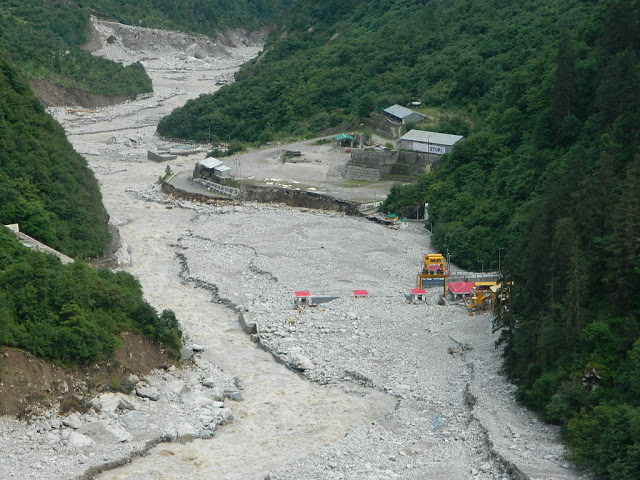
Floods in Uttarakhand Courtesy: Times of India
One of the relatively positive steps in the aftermath of the disaster came from the Supreme Court of India, when on Aug 13, 2013, a bench of the apex court directed Union Ministry of Environment and Forests (MoEF)[2] to set up a committee to investigate into the role of under-construction and completed hydropower projects. One would have expected our regulatory system to automatically initiate such investigations, which alas is not the case. Knowing this, some us wrote to MoEF on July 20, 2013[3], to exactly do such an investigation, but again MoEF played deaf and blind to such letters.
5 MW Motigad Project in Pithorgarh District destroyed by the floods. Photo: Emmanuel Theophilus, Himal Prakriti
The committee report, signed by 11 members[5], makes it clear that construction and operation of hydropower projects played a significant role in the disaster. The committee has made detailed recommendations, which includes recommendation to drop at least 23 hydropower projects, to change parameters of some others. The committee also recommended how the post disaster rehabilitation should happen, today we have no policy or regulation about it. While the Supreme Court of India is looking into the recommendations of the committee, the MoEF, instead of setting up a credible body to ensure timely and proper implementation of recommendations of the committee has asked the Court to appoint another committee on the flimsy ground that CWC-CEA have submitted a separate report advocating more hydropower projects! The functioning of the MoEF continues to strengthen the impression that it is working like a lobby for projects rather than an independent environmental regulator. We hope the apex court see through this.
Boulders devouring the Vishnuprayag Project. 26th June 2013 Photo: Matu jan Sangathan
Let us turn our attention to hydropower projects in Himalayas[6]. Indian Himalayas (Himachal Pradesh, Uttarakhand[7], Jammu & Kashmir, Sikkim, Arunachal Pradesh and rest of North East) already has operating large hydropower capacity of 17561 MW. This capacity has leaped by 68% in last decade, the growth rate of National Hydro capacity was much lower at 40%. If you look at Central Electricity Authority’s (CEA is Government of India’s premier technical organisation in power sector) list of under construction hydropower projects in India, you will find that 90% of projects and 95% of under construction capacity is from the Himalayan region. Already 14210 MW hydropower capacity is under construction. In fact CEA has now planned to add unbelievable 65000 MW capacity in 10 years (2017 to 2027) between 13th and 14th Five Year Plans.
Meanwhile, the Expert Appraisal Committee of Union Ministry of Environment and Forests on River Valley Projects has been clearing projects at a break-neck speed with almost zero rejection rate. Between April 2007 and Dec 2013[8], this committee recommended final environment clearance to 18030.5 MW capacity, most of which has not entered the implementation stage. Moreover, this committee has recommended 1st stage Environment clearance (what is technically called Terms of Reference Clearance) for a capacity of unimaginable 57702 MW in the same period. This is indicative of the onslaught of hydropower projects which we are likely to see in the coming years. Here again an overwhelming majority of these cleared projects are in Himalayan region.
Agitation Against Lower Subansiri Dam in Assam Source: SANDRP
What does all this mean for the Himalayas, the people, the rivers, the forests, the biodiversity rich area? We have not even fully studied the biodiversity of the area. The Himalayas is also very landslide prone, flood prone, geologically fragile and seismically active area. It is also the water tower of much of India (& Asia). We could be putting that water security also at risk, increasing the flood risks for the plains. The Uttarakhand disaster and changing climate have added new unknowns to this equation.
We all know how poor are our project-specific and river basin-wise cumulative social and environmental impact assessments. We know how compromised and flawed our appraisals and regulations are. We know how non-existent is our compliance system. The increasing judicial interventions are indicators of these failures. But court orders cannot replace institutions or make our governance more democratic or accountable. The polity needs to fundamentally change, and we are still far away from that change.
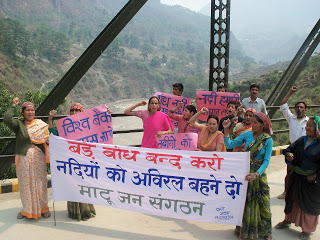
Peoples protests against Large dams on Ganga. Photo: Matu Jansangathan
The government that is likely to take over post 2014 parliamentary elections has an opportunity to start afresh, but available indicators do not provide such hope. While UPA’s failure is visible in what happened before, during and after the Uttarakhand disaster, the main political opposition that is predicted to take over has not shown any different approach. In fact NDA’s prime ministerial candidate has said that North East India is the heaven for hydropower development. He seems to have no idea about the brewing anger over such projects in Assam and other North Eastern states. That anger is manifest most clearly in the fact that India’s largest capacity under-construction hydropower project, namely the 2000 MW Lower Subansiri HEP has remained stalled for the last 29 months after spending over Rs 5000 crores. The NDA’s PM candidate also has Inter Linking of Rivers (ILR) on agenda. Perhaps we have forgotten as to why the NDA lost the 2004 Parliamentary elections. The arrogant and mindless pursuit of projects like ILR and launching of 50 000 MW hydropower campaign by the then NDA government had played a role in sowing the seeds of people’s anger with that government.
In this context we also need to understand what benefits these hydropower projects are actually providing, as against what the promises and propaganda are telling us. In fact our analysis shows that the benefits are far below the claims and impacts and costs are far higher than the projections. The disaster shows that hydropower projects are also at huge risk in these regions. Due to the June 2013 flood disaster large no of hydropower projects were damaged and generation from the large hydro projects alone dropped by 3730 million units. In monetary terms this would mean just the generation loss at Rs 1119 crores assuming conservative tariff of Rs 3 per unit. The loss in subsequent year and from small hydro would be additional.
It is nobody’s case that no hydropower projects be built in Himalayas or that no roads, townships, tourism and other infrastructure be built in the Himalayan states. But we need to study the impact of these massive interventions (along with all other available options in a participatory way) in what is already a hugely vulnerable area, made worse by what we have done so far in these regions and what climate change is threatening to unleash. In such a situation, such onslaught of hydropower projects on Himalayas is likely to be an invitation to even greater disasters across the Himalayas. Himalayas cannot sustain this onslaught.
It is in this context, that the ongoing Supreme Court case on Uttarakhand provides a glimmer of hope. It is not just hydropower projects or other infrastructure projects in Uttarakhand, or for that matter in other Himalayan states that will need to take guidance from the outcome of this case, but it could provide guidance for all kinds of interventions all across Indian Himalayas. Our Himalayan neighbors can also learn from this process. Let us end on that hopeful note here!
At least 49 large[1] hydropower projects are under construction in India today, with a cumulative capacity of 15006 MW[2]. As per the latest bulletin from Central Electricity Authority[3], “Status of Hydro Electric Projects under Execution for 12th Plan & beyond (Excluding projects above[4] 25 MW)” dated March 31, 2014, 35 of these projects (9934 MW) are expected to be commissioned in 12th Five Year Plan[5] and remaining 14 with installed capacity of 5072 MW would provide benefit beyond 12th Plan.
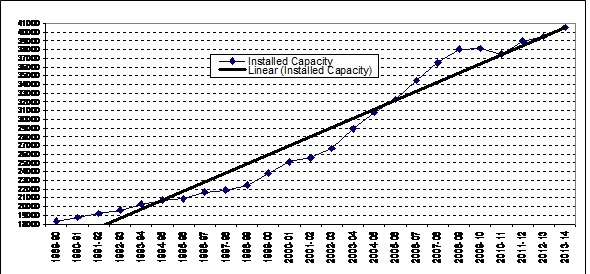
Considering that 1534 MW capacity has already been added in first two years of ongoing 12th Five Year Plan (during 2012-13 and 2013-14), CEA projections means that India hopes to add massive 11468 MW capacity during the current five year plan. This will be higher than capacity added in any other five year plan and 254% of the capacity addition during the last, 11th Five Year Plan (2007-12) when India added 4514 MW. The graph below shows how steeply our hydropower installed capacity is going up over the last 25 years.
Rapidly Increasing installed capacity of Large Hydropower Projects in India
The proponent of even more accelerated hydro capacity addition misleadingly talk about the need for having 40% of installed grid capacity as hydro.
In line with this, the CEA came out with plans to add 65000 MW in 13th Five Year Plan (2017-2022: 30 000 MW) and 14th Five Year Plan (2022-2027: 35 000 MW). (see http://www.energylineindia.com/ of May 6, 2014)
There is no science behind this advocacy. It is basically a suggestion possibly based on the general assumption that peaking demand is 40% higher than base-load demand. Hence if we have 40% installed capacity from hydro in the grid, this can take care of total demand optimally. However, this is based on assumption that hydro capacity is indeed used for peaking. This assumption is completely wrong in India, with no agency monitoring or even reporting how much of the hydro generation currently provide peaking power. Without such optimum use of current hydro capacity, where is the case for 60:40 grid capacity ratio for hydro? It goes without saying that when hydro projects are used for peaking power, there are additional social and environmental impacts in the downstream and upstream. These need to assessed and those who suffer are compensated.
On similar lines, one can answer the advocacy for claim that hydro is clean, green, renewable and cheap source of power or that run of the river or small hydropower projects are more environmentally benign. However, this blog is not attempting to answer all such fallacies here, it needs a separate blog.
While this is happening, the Expert Appraisal Committee of Union Ministry of Environment and Forests on River Valley Projects has been clearing projects at break a neck speed with almost zero rejection rate. Between April 2007 and Dec 2013, this committee recommended environment clearance to 18030.5 MW capacity, most of which has not entered the implementation stage. Moreover, this committee has recommended 1st Environment clearance (what is technically called Terms of Reference Clearance) for a capacity of unimaginable 57702 MW in the same period. This is indicative of the onslaught of hydropower projects which we are likely to see in the coming years.
Figure 1 TORs (First Stage EC) and EC recommended by EAC between April 2007 – December 2013
Table: Sector-wise & plan-wise number of & capacity of under construction HEPs
Sector
During 12th FYP
After 12th Plan
Total
No of Projects
Installed capacity, MW
No of Projects
Installed capacity, MW
No of Projects
Installed capacity, MW
Central
11[6]
5312
3
2615
14
7927
State
12
1506
3
736
15
2242
Pvt
12
3116
8
1721
20
4837
Total
35
9934
14
5072
49
15006
Among the three sectors, the largest number of under construction projects (20) are from private sector. However, among all sectors of under construction projects, central sector projects have the highest installed capacity (7927 or 53% of under construction capacity of 15006 MW).
Figure 2 Sectorwise ownership of under-construction HEPs in Numbers
Vulnerable Himalayas are the target In the second table the state-wise and sector-wise break of numbers and capacity of under construction HEPs has been given. Himachal Pradesh has the highest number and highest installed capacity projects among all states. That state also has the highest installed capacity (8139 MW or over a fifth of operating HEP capacity at national level) of large operating hydropower projects. Sikkim, however, has the highest number and capacity of private sector hydropower projects under construction. In fact, half of the total national-level private sector projects which are under construction are in that tiny state. Their installed capacity is more than half the installed capacity of all the private sector hydropower projects under construction at national level. Ironically, the state also has the highest biodiversity in the country.
Figure 3 Installed Capacity of under construction HEPs, sector-wise ownership, in MW
Himachal Pradesh and Uttarakhand also have 5 and 3 private sector HEPs under construction respectively. The 5 Himalayan states of Jammu & Kashmir (J&K), Himachal Pradesh, Uttarakhand, Sikkim and Arunachal Pradesh between them have 38 of the 49 under construction hydropower projects with total capacity of 13550 MW or over 90% of under construction capacity. In addition, the projects of Mizoram, Meghalaya, W Bengal (Teesta L Dam IV) and Punjab (Shahpur Kandi on Ravi River) are also in Himalayan zone.
Table: State-wise & sector-wise number and capacity of under-construction HEPs
State
Central Sector
State Sector
Private Sector
Total
No of projects
Installed Capacity, MW
No of projects
Installed Capacity, MW
No of projects
Installed Capacity, MW
No of projects
Installed Capacity, MW
J&K
1
330
1
450
1
850
3
1630
Himachal P
4
2532
6
956
5
460
15
3948
Uttarakhand
4
2135
–
–
3
505
7
2640
Sikkim
–
–
–
–
10
2622
10
2622
Arunachal P
3
2710
–
–
–
–
3
2710
Mizoram
1
60
–
–
–
–
1
60
Meghalaya
–
–
1
40
–
–
1
40
W Bengal
1
160
–
–
–
–
1
160
Punjab
–
–
1
206
–
–
1
206
Madhya Pr
–
–
–
–
1
400
1
400
Maharashtra
–
–
1
80
–
–
1
80
Andhra Pr
–
–
3
410
–
–
3
410
Kerala
–
–
2
100
–
–
2
100
Total
14
7927
15
2242
20
4837
49
15006
Figure 4 State-wise and sector-wise number of HEPs under constructionFigure 5 State-wise installed capacity of under construciotn HEPs
Diminishing Returns This blind rush for hydropower projects (which have serious and irreversible impacts on social and ecological systems) is difficult to understand and justify considering their poor generation performance, rising costs and availability of better options. To illustrate, in the graph below we can see how power generation per unit (MW) installed capacity has been steadily reducing over the last two decades. From 1993-94 to the latest year of 2013-14, there has been a huge drop of 16.5%.
Diminishing power generation from India’s Hydropower Projects over the last two decades
Yawning gap between promised and actual generation of Hydro Projects Another way to look at performance of hydropower projects would be to compare the projected (as promised in Techno Economic Clearance) and actual generation (both at 90% dependability) of electricity by HEPs. This assessment shows that about 89% of India’s operating hydropower projects are generating at below the promised levels. Shockingly, half of under performing projects are generating at below 50% of promised generation levels.
How much Peaking Power are we generating? A third way to assess the hydropower generation is in terms of peaking power, a USP[7] of hydropower projects. However, no figures are available as to how much of the generation from hydropower projects are happening during peaking hours. No agency in India is even monitoring this or reporting this: including CEA, Central or State Electricity Regulatory Authority, National, Regional or State Load Dispatch Centers, Union or state Power Ministries or individual operators. In short, there is no case for justifying more hydro in the name of providing peaking power if we are neither monitoring nor optimizing hydropower generation during peaking hours. One expected CEA to do this job, but it seems they are busy lobbying for hydropower projects rather than functioning as India’s premier Technical Power sector agency.
Invitation to disaster? The consequences of such massive capacity addition are and will continue to be disastrous for the rivers, forests, biodiversity and people. The Uttarakhand disaster of June 2013 has shown the vulnerability of hydropower projects in Himalayas, as well as their impacts. The disaster and independent reports[8] also show how the construction and operation of these projects have contributed to compounding the proportion of the disaster. Climate Change is accentuating this situation and will continue to do so with increasing intensity as per the IPCC reports.
Role of HEPs in Uttarakhand disaster: CEA and CWC in denial mode This analysis of under construction hydropower projects as reported in the latest CEA bulletin shows that Himalayas is the target for overwhelming majority of hydropower projects being taken up India (& neighbouring countries like Bhutan, Nepal, Pakistan and Tibet). The Uttarakhand disaster showed how hydropower projects are increasing the existing vulnerabilities and disaster potential of the Himalayan region in times of natural calamities. An independent committee appointed by MoEF following Supreme Court orders of Aug 13, 2013 pointed out the role of hydropower projects in Uttarakhad disaster of June 2013.
It should be highlighted here that multiple hydropower projects should invite cumulative impact assessment. As Supreme Court order of Aug 13, 2013 highlighted, such cumulative impact assessment need to be done in a credible way and not the way AHEC of IITR did for the Bhagirathi-Alaknanda basin.
Strangely, instead of accepting this reality and taking this into account in decision making processes, Central Water Commission and Central Electricity Authority are in a denial mode! They collectively submitted a completely unscientific and unfounded report to Union Environment & Forests Ministry, advocating for hydropower projects rather than assessing their role in disaster, which was the mandate given by Supreme Court of India to MoEF. The CEA is clearly jeopardizing whatever credibility it has in joining hands with CWC. It would be better for both the agencies to accept and wake up to these realities.
Else, such onslaught of hydropower projects on Himalayas is likely to be an invitation to further disasters all across the Himalayas. All our decision makers and all others concerned need to take note of this urgently.
[4] In reality, this should be “below”, we have italicized the word since the error is in the original.
[5] Ending on March 31, 2017
[6] CEA projects that out of 2000 MW installed capacity of Lower Subansiri HEP in Arunachal Pradesh, 1000 MW will be commissioned in 12th Plan and the rest of 1000 MW thereafter.
Drop 23 projects, do cumulative assessments & improve governance
In a significant development on role of hydropower projects in Uttarakhand flood disaster of June 2013, the Expert Body (EB) headed by Dr Ravi Chopra has recommended that at least 23 hydropower projects should be dropped, that hydropower projects played significant role in the Uttarakhand disaster and that there is urgent need to improve the environment governance of hydropower projects. The Report “Assessment of Environmental Degradation and Impact of Hydroelectric Projects During The June 2013 Disaster in Uttarakhand” dated April 2014 has been submitted to the Union Ministry of Environment and Forests on April 16, 2014 and was made public following hearing in the Supreme Court on April 28, 2014. The committee was appointed by a reluctant Union Ministry of Environment and Forests (MoEF) in October 2013, following the Supreme Court’s suo motto order of August 13 2013.
Damaged Vishnuprayag Dam in Uttarakhand floods of June 2013: Source: MATU Jansangathan
Uttarakhand floods of June 2013[1],[2]: The committee report endorses the stand taken in a letter[3] that was written to MoEF on July 20, 2013, endorsed by over 20 individuals and groups including from Uttarakhand on the role of existing and under construction hydropower projects in the Uttarakhand floods of June 2013. MoEF did not take any action on this letter, but it was Supreme Court order next month that pushed MoEF to take necessary action.
SC order of Aug 13, 2013[4]: On Aug 13, 2013, while disposing off the petition on Srinagar HEP in Uttarakhand, the Supreme Court, suo motto, made an order that asked, MoEF and Uttarakhand governments not to provide any further clearances to any more hydropower projects anywhere in Uttarakhand till further orders. Both MoEF and Uttarakhand governments have been violating this order. However, one of the fall outs of this order was formulation of Expert Body appointed by MoEF more than two months latter, through an order on Oct 15, 2013, whose report now is available in public domain.
Limited TOR[5]: The Supreme Court order of Aug 13, 2013 pertained to whole of Uttarakhand, as was the disaster of June 2013. However, the MoEF order and subsequently CWC tried to restrict the field of work of the committee to Alaknanda and Bhagirathi sub basins rather than whole of Uttarakhand.
Problematic constitution: The constitution of the Expert body was also problematic from a number of aspects. There was clear conflict of interest with respect to some of the members like Dr BP Das, former member and Vice Chair of the MoEF’s Expert Appraisal Committee on River Valley Projects, as explained below. The committee also included chairman of Central Water Commission and Central Electricity Authority, which unfortunately act like lobbies for hydropower projects. These persons were in the committee to bring in respective expertise, but in stead used their presence in the committee to discredit evidence which suggested clear role of hydropower projects, some members also advocated for more hydropower projects, in stead of adhering to the mandate given by the Supreme Court, thus raising the issue of contempt of court.
In what follows we have given some useful recommendations and conclusions of the EB, followed by some weak recommendations and conclusions of the EB report, based on a quick reading of the report (we got the over 200 page report only on April 29, 2014), following by some remarks on role of vice chair, CWC, CEA, MoEF and our conclusion.
Map of Mandakini Valley, epicenter of Uttarakhand floods of June 2013 (Source: EB report)
On 24 projects recommended to be dropped by WII “After considerable discussions and analysis, the Expert Body concluded that of the 24 proposed Hydropower Projects (HEPs) that Wildlife Institute of India (WII) recommended for Review, 23 HEPs would have significant irreversible impacts on biodiversity values.”
“The EB recommends that for the 23 proposed HEPs out of the 24 identified by WII (other than the Kotli Bhel 1A project) that would have irreversible impacts on the biodiversity of Alaknanda and Bhagirathi Basins, the HEPs that fall in any of the following conditions should not be approved for construction.
(a) Proposed HEPs that fall inside wildlife Protected Areas such National Parks and Wildlife Sanctuaries
(b) Proposed HEPs that fall within the Gangotri Eco-sensitive Zone
(c) Proposed HEPs that fall above 2,500m that encompass critical wildlife habitats, high biological diversity, movement corridors, and fragile in nature due to unpredictable glacial and paraglacial activities.
(d) Proposed HEPs that fall within 10 km from the boundary of Protected Areas and have not obtained clearance from the National Board for Wildlife.”
It would have been in fitness of things if EB had exclusively asked for stoppage of work on all these 23 projects with immediate effect.
On Kotli Bhel 1A The EB has, we believe, erroneously concluded, over ruling the conclusion of WII and expert review initiated by EB, “that the Kotli Bhel 1A project might not significantly worsen the condition of the river Bhagirathi between Koteshwar and Devprayag – already part of a highly fragmented zone”. However, EB has asked for “due modifications to its design and operations so that an adequate stretch of the river downstream of the Koteshwar dam just above KB-IA can be maintained in a free flowing state”. This means the project work should stop and it should reapply for clearances after doing the suggested modifications in credible way.
Restoration: “The river bed profiles at Phata-Byung, Singoli-Bhatwari, Vishnuprayag and Srinagar HEPs have changed significantly. This requires a fresh analysis of the project hydrology and redesigning them if necessary.
All projects must undertake river restoration works after prior clearance from MoEF. It was noticed that project developers were engaged in projects’ restoration only. MoEF needs to conduct a formal review of the environmental damages at all the HEPs in Uttarakhand and prepare guidelines for restoration. Till then none of the projects should begin power production.”
HEPs above 2 MW need EC “All projects > 2 MW, shall require prior Environmental Clearances (EC) from MoEF”.
“A multidisciplinary expert body should be constituted with members of proven expertise and experience to review every year the progress/performance of each HEP and its compliance with the sanction conditions. This body will also review the technicalities of disaster preparedness before each monsoon season and examine the impact of monsoon storm and floods on the performance of all the project components. The environmental health of the river will be a critical area for comprehensive examination.”
No projects above winter snow line “Learning from the June 2013 event, the EB believes that the enhanced sediment availability from and in paraglacial zones could be a serious problem for the longevity of the existing, under construction and proposed HEPs in Uttarakhand. Therefore the EB recommends that the terrain above the MCT in general and above the winter snow line in particular (~2200-2500 m) should be kept free from hydropower interventions in Uttarakhand.”
SIA should be carried out for all river systems in Uttarakhand “The WII study has already identified 24 proposed HEPs in the Alaknanda and Bhagirathi basins as likely to cause irreversible impacts. But comprehensive research studies of other basins in Uttarakhand are lacking at this stage… Strategic Environmental Assessment (SEA) be carried out in other major river basins of Uttarakhand such as the Yamuna and Kali basins.”
Distance between projects in a cascade “Scientific studies by subject experts should be conducted for establishing baseline data on river parameters, diversity and populations of floral and faunal species in different rivers of Uttarakhand at different elevation zones. Such studies should be used for deciding upon the minimum distances between two consecutive HEPs. Until such scientific studies are completed, no new HEPs (in S&I stage) should be cleared on the rivers of Uttarakhand within a distance that may later be revoked. Minimum distances for projects in the clearance stage should be significantly revised upward from the current consideration of 1 km.”
SANDRP Map of Bumper to Bumper hydropower projects in Alaknanda basin in Uttarakhand
National Himalayan Policy “Since the Himalaya are our vital source of growth and abundance, a National Himalayan Policy needs to be urgently created and implemented.”
“Therefore, the EB strongly recommends that a detailed study of the impacts of hydropower projects in terms of deforestation/tunneling/ blasting/reservoir formation on the hydrogeology of the area should be carried out.”
A study on the role of large artificial reservoirs on local climate change and precipitation patterns with special reference to the Tehri dam reservoir.”
Sediment transportation studies “Recent studies have highlighted serious concern about the Indian deltas, which are shrinking due to changes in river courses. The Ganga-Brahmaputra delta is also noted in this category. This seems to be a major issue in near future therefore we recommend that the studies should be carried out regarding the impacts on sediment transportation due to projects existing on Himalayan rivers.”
Cultural impacts of HEPs “Therefore EB recommends that the Ministry of Culture along with the local representatives and spiritual leaders should undertake a comprehensive study of the cultural impacts of HEPs in the spiritually rich state of Uttarakhand.”
“The river bed profiles at Phata-Byung, Singoli-Bhatwari, Vishnuprayag and Srinagar HEPs have changed significantly. This requires a fresh analysis of the project hydrology and redesigning them if necessary.”
“River Regulation Zone (R.R.Z.) guidelines should be issued immediately by the Ministry of Environment & Forests and should be executed accordingly.”
Muck Management: “The existing practices of muck management are inadequate to protect the terrain and the people from an eventuality like the June 2013 flood. Therefore, a serious revisit is required towards evolving technically better and ecologically sustainable methods for muck disposal and rehabilitation in Uttarakhand.”
Environmental Flows: “Till such time as a decision is taken on the EFlows recommendations of the IITs-consortium, the EB recommends EFlows of 50% during the lean season and 30% during the remaining non-monsoon months. Sustaining the integrity of Uttarakhand’s rivers and their eco-systems is not negotiable.”
Eco-Sensitive Zones: “It is recommended that legislation be enacted to (i) protect small but significant rivers (as done in Himachal Pradesh and also recommended by the IMG for Uttarakhand) as pristine rivers and (ii) designate Eco-Sensitive Zones for all rivers of Uttarakhand.”
Community based CA and CAT “Community-based CA and CAT plan execution must be done by the State Forest Department within the construction period of the project.” This is to be monitored by a committee that includes two representatives from local communities, a renowned environmentalist, among others.
Forests and Biodiversity Conservation: “Community based CAT programmes have to be systemically implemented for ensuring sustenance of the plantations. This requires training of forest officials to work with the communities through their Van Panchayats.”
“It was brought to the notice of the EB that clearances to start work had been granted recently to the Lakhwar (300 MW) and Vyasi (120 MW) projects. This is in violation of the spirit of the Hon’ble Supreme Court’s order of August 13, 2013. It is also noticed that these projects were approved more than 25 years ago. Consequently they do not have any EIA/EMP/DMP studies that are mandatory today. Without conducting cumulative impact assessments and disaster management studies of the Yamuna and Kali basins no such projects should be allowed at the risk of fragile ecology, biodiversity and lives of people living in and around the project sites.”[6]
SOME WEAK RECOMMENDATIONS OF EB
“The EB recommends that MoEF strengthens its personnel and procedures for post-sanction monitoring of environmental conditionalities. The MoEF should develop a programme for research studies by reputed organizations on the impacts of HEPs on river water quality (and flows). Pre-construction and post operation long term impacts monitoring studies are required.”
Geology & Social Issues: “Given the massive scale of construction of HEPs in Uttarakhand it may be worthwhile to set up a formal institution or mechanism for investigating and redressing complaints about damages to social infrastructure. The functioning of such an institution can be funded by a small cess imposed on the developers. It is also suggested that to minimize complaints of bias, investigations should be carried out by joint committees of subject experts and the community.”
Disaster Management: “Disaster preparedness is critical because all of Uttarakhand lies either in seismic Zone IV or V. These areas are most vulnerable to strong earthquakes. Disaster Management Plans (DMPs) are critical parts of EIA Reports. They need to be carefully reviewed and approved by local communities in the probable zone of influence.”
“It is necessary to establish an independent authority which may commission EIA Reports…”
CONCLUSIONS OF EB:
On Role of Dams in Uttarakhand disaster:
In Chapter 3 (p 10) chairman of EB notes, “Thus THDC’s inundation analysis results could
not be substantiated by the ground survey in Haridwar city.”
“In September 2010, to retain flood inflows in the face of water levels rising beyond the permitted FRL the (Tehri) dam authorities had to seek the permission of the Supreme Court. It led to inundation of the upstream town of Chinyalisaur and later after draw down fresh landslide zones were created around the reservoir rim.”
“Geo-chemical analysis of sediment samples taken from various locations along the river stretch in Srinagar, however, indicated a significant contribution — varying from 47% near the barrage to about 23% much further downstream (Fig. 3.19, pg 101, Main Report) — from muck eroded from muck disposal sites 6 and 9 located on the concave right bank and consequently experienced an intense current of the order of 7m/sec.
This raises a question that if there was heavy to very heavy rainfall from the glacial reaches of the Alaknanda valley, leading to numerous landslides along the banks, then why was massive damage observed only downstream of the Vishnuprayag and Srinagar HEPs? A detailed investigation is warranted in order to arrive at a scientifically viable explanation.”
“Otters appear to be nearing extinction in the Ganga, Alaknanda sub-basins.”
It is good to see that the EB has effectively rejected the critique of the WII report presented by Dr. Sabyasachi Dasgupta, HNB Garhwal University and consultant to UJVNL, following an independent review of the WII report by Prof. Brij Gopal, an eminent ecological scientist who had worked extensively on river ecosystems. Prof Brij Gopal, while finding some limitations in WII methodology, concluded: “he agreed with WII’s findings that the 24 proposed hydropower projects would impact the biodiversity of Alaknanda and Bhagirathi basins significantly. Based on his own analysis, Prof Gopal recommended that several more projects be dropped.”
SOME WEAK CONCLUSIONS:
“A ground survey of the inundation analysis carried out by THDC on the basis of which it claimed to have saved Haridwar from drowning raised doubts about the accuracy of the computer generated inundation maps. It is therefore not clear how much of Haridwar would have been affected if the Tehri dam had not been there. The problem at Haridwar, as at other towns and habitations along river banks, is that there has been wide spread encroachment and construction inside the river’s regime. Therefore it is imperative to set up river regulation zones where encroachments are forbidden. (Unscientific sand mining on river beds adds to the problem.)”
“There is some doubt about whether the Vishnuprayag project authorities were able to properly manage the opening and closing of the gates.”
Role of Dr B P Das: Dr B P Das has for close to a decade been member or vice chair or officiating chair of the Expert Appraisal Committee of MoEF on River Valley project and has in the process been involved in appraising and deciding on clearances for a no of projects and their impacts in Uttarakhand. Hence he was not likely to be in a position to take an independent view on Uttarakhand hydropower projects as there was a conflict of interest involved with respect to his earlier decisions. His biased views were also known through his article in The Hindu earlier. This got reflected in the alternate view on page 27 of chapter 3 and page 16-17 of Chapter 4 of the report authored by Dr Das. In Chapter 3 box, Dr Das’s abiding faith in the project developer could be seen. In Chapter 4 box Dr Das himself mentions that EAC has yet to take a view on WII report, but the he himself is a responsible party for EAC not having taken a view on WII report.
Role of CWC, CEA chairpersons: CWC (Central Water Commission, India’s premier technical body on water resources development under Union Ministry of Water Resources) and CEA (Central Electricity Authority, India’s premier technical body on power sector are largely known to act as lobbies for hydropower projects, in stead of the independent technical and regulatory body that they are expected to work as. In view of that, inclusion of chairperson of CWC and CEA in this committee was wrong step on the part of MoEF. We learn from a letter written by two eminent members of the committee, namely Dr Shekhar Pathak and Dr Hemant Dhyani on March 27, 2014, that indeed the chairpersons of CWC and CEA did not really participate in the way they were required to, and rather functioned in violation of the Supreme Court order.
Scanned version of last part of the letter of 27.03.2014 from Dr Shekhar Pathak and Dr Hemant Dhyani, members of EB
Role of MoEF: One had expected that the EB would take a critical view of the functioning of the MoEF around HEPs and contribution of MoEF’s failures in increasing the disaster proportions. Unfortunately we are disappointed in this. Possibly, with the committee having been appointed by MoEF and member secretary of the committee being MoEF official this was a difficult ask. However, not being able to take a critical stand on the role of MoEF (and other institutions like CWC, CEA, state environment department, state disaster management department etc) imposes a limitation on the EB report and provides a free reign to guilty party. The consequences of this became apparent when on April 28, 2014, during the Supreme Court hearing, we are told, the MoEF presented erroneous picture that there are two reports of the committee, one by 10 members(wrongly called activists) another by Vice Chair B P Das, with CWC and CEA chair persons, when at best the note from these three persons can be considered dissent note, that too in violation of SC orders. We hope the Supreme Court will take strong view of this misleading picture presented by MoEF and reprimand the responsible officials to ensure that this does not happen again.
View of the Committee working through its minutes
Minutes of the 2nd, 3rd and 4th meeting are available on the MoEF, Lucknow regional office website. Perusal of the minutes shed light of the functioning of the committee, and the biases of some specific members. Some highlights from the minutes:
THDC, Tehri and Muck Disposal Sites: Site visit reports of various members, including Dr. Amit Gupta, Dy Director of MoEF presented that THDC is managing active and non active muck disposal sites ‘poorly’. The sites do not have proper retaining wall, slop or plantations.
THDC hid drift tunnel of Koteshwar dam: Member Hemant Dhyani exposed that THDC officials did not accept the presence of a huge drift tunnel of Koteshwar Project near Payal Gaon, which was suffering from severe subsidence. Only when the local people, including the tunnel construction workers insisted that there is a tunnel that the THDC officials accept this fact!
In the 3rd meeting, the Chief Secretary of Uttarakhand told the committee that projects with EC or FC should not be closed or stopped. Note here that this suggestion is unacceptable when the SC itself has asked the committee to investigate the role of projects in the flood damages.
To top this, Additional Chief Secretary unilaterally asserted that HEP did not have any role in the mishap. He emphasised every Environmental CLearance needs an EIA. This indicates his poor knowledge about the quality of EIAs which has been accepted by most experts.
He further stressed that a umber of FC cases were peding before the MoEF. Moef official YK Singh Chauhan rebutted this claim.
In the 4th Meeting, Dr. B.P. Das, Co Chair of the committee categorized June event as a rare natural calamity and attributed the losses only to road construction ( Incidentally, many roads are being built for hydel projects, and do not even allow access to local communities.)
Dr. Ravi Chopra, Chairperson highlighted the poor data management of THDC. He highlighted that THDC could not provide HFL data, rainfall data, inlet level from Maneri Bhali II and outlet level sought by the committee members.
Conclusion: In spite of certain weaknesses, most of the recommendations of the committee need to be immediately implemented and till they are implemented in letter and spirit, the Supreme Court should order a status quo on any further hydropower projects. The EB headed by Dr Ravi Chopra should be congratulated for this report in spite of difficult circumstances under which the committee operated.
Þ We also hope the Supreme Court would ask MoEF to order stoppage of work on Lakhwar and Vyasi projects that has been started recently, violating the Supreme Court order in letter and spirit, and also as pointed out by the EB.
Þ The work on 24 hydropower projects that was part of explicit TOR of the committee should be ordered to stop immediately. The EB should have made this explicit recommendation, but even if they have not done that, it is implicit in its recommendation.
Þ The Supreme Court should ask MoEF to provide a time bound action plan on implementation of the various recommendations of the EB. The SC an also possibly appoint EB (minus Dr Das, CWC and CEA persons) to oversee the implementation of the action plan and continue to provide independent feedback on adequacy of such implementation.
Þ The Lessons from Uttarakhand are relevant for all Himalayan states of India from Kashmir to all the North East states and we hope Supreme Court to ask the follow up committee to ensure that these lessons are taken note of and necessary steps flowing there from are implemented in these Himalayan states. These will also provide guidance to our Himalayan neighbouring countries.
Þ The failure of environmental governance is one of the clearest stark message from this episode and we hope MoEF will put its house in order in this respect, revamping its entire environmental governance.
[7] Reuters report on this issue: http://in.reuters.com/article/2014/04/29/india-flood-idINL6N0NL0VC20140429
[8] The section “View of the Committee working through its minutes” has been put together by SANDRP colleague Parineeta Dandekar. I am also thankful to her for other useful suggestions from her.
Sardar Sarovar Dam Stilling basin damaged: No repairs for 3 years:
No meeting of Dam Safety Panel for 30 months:
WHY IS GUJARAT NEGLECTING SAFETY OF ITS LIFELINE?
Sardar Sarovar Dam: (Photo by SANDRP)
Gujarat government, Gujarat politicians and their supporters never tire of telling the world that the Sardar Sarovar Dam (SSD) on Narmada River is their lifeline. Shockingly, perusal of recent official documents obtained under RTI indicate that Government of Gujarat (GOG) and its Sardar Sarovar Narmada Nigam Limited (SSNNL) are least bothered about the issues of the very safety of the SSD.
The only technical body that is supposed to be in charge of safety of the dam, namely Dam Safety Panel (DSP), has remained non existent for years together while the official reports show that the structures like stilling basin that are a part of the dam have suffered such serious damage that the Sardar Sarovar Construction Advisory Committee (SSCAC) and its Permanent Standing Committee (PSC) have repeatedly asked for attention. First they asked for urgent attention then immediate attention, then attention before monsoon to the repair, but still, there has been no response for a long time from GOG or SSNNL.
Shockingly, India’s premier technical body on water resources, Central Water Commission (CWC), was not taking interest in this issue ostensibly since they were not represented on DSP!
Who can say Sardar Sarovar Project is really Gujarat’s lifeline and that Gujarat government is bothered about the lifeline?
CHRONOLOGY OF EVENTS RELATED TO DAMAGE AT SSP DAM: In what follows, we have given the blow by blow chronology of events related to the damage to SSP Dam, all information taken from official documents obtained under RTI.
May 2011 The minutes of 101st meeting of PSC notes, “He (Representative of GOG) further informed that a team of nine officials from National Institute of Oceanography, Goa carried out inspection under water of stilling basin of SSP dam during 3rd May to 15th May 2011 and it was found that there is no damage except some erosion of size 3-5 cm at some places, which is not a serious problem.” Please note the description of what NIO found, as reported by GOG here and let us see how this description and implications change from “there is no damage except…” and “not a serious problem”.
It is this report of NIO that had discovered the damage to the SSP dam stilling basins and other underground parts, the damage must have happened during 2010 monsoon or earlier, and till March 2014 and as we write this, there is no confirmation of the repairs.
SSP Stilling Basin damaged in 1995 Photo: Frontline
June 8, 2011: 101st meeting of PSC notes: “The committee noted the progress of works and directed GOG to include the reports of National Institute of Oceanography, Goa in their quarterly progress report and also to take up remedial measures for the shortfalls indicated therein.” So PSC first asks for just necessary reports and remedial measures.
Feb 10, 2012: The minutes of the 102nd meeting of PSC notes: “Chairman suggested tat the observation of NIO may be taken seriously”. It calls for urgent steps for remedial actions on the recommendations of the NIO report and meeting of Dam Safety Panel at an early date in view of NIO report. If what NIO found was “no damage” and “not a serious problem”, as GOG reported to the 101st PSC meeting, why did PSC ask for URGENT meeting of DSP?
Moreover, the minutes of the meeting note: “The committee directed GOG to initiate urgent steps for remedial actions on the recommendations of NIO report.” The NIO report found, among other damages, “two big cavities noticed along with many minor ones” in Bay 5 and “RT[1] wall cavity at the bottom, where a small area which found disturbed, needs attention.” Damages were also reported from Bay 1, 2, 3 & 4 and divide wall and basin floor had cavities in all the bays, more in Bay 4 & 5.
March 16, 2012: The minutes of 79th meeting of SSCAC note: “… the NIO found minor cavities, loose pieces of concrete and broken iron rod pieces on the floor.” This description shows much more serious damage than what GOG reported to 101st meeting of PSC in June 2011. The Minutes of the 79th meeting of SSCAC go on to say: “SSCAC took on record the above fact and endorsed the decision of PSC for convening the meeting of Dam Safety Panel as early as possible and address the issue.”
So NIO finds damage in May 2011, but there is no meeting of DSP till March 2012. Then PSC (Feb 2012) and SSCAC (March 2012) recommend URGENT meeting of DSP. Note that PSC and SSCAC took nine and ten months respectively to recommend URGENT meeting of DSP. And yet, there is still no meeting of DSP for another 20 months!
Aug 23, 2012: The minutes of the 104th meeting of the PSC says: “it was decided that DSP meeting may be called up immediately and underwater inspection should be carried out after monsoon whenever high magnitude flood occurs.” Note the word “immediately”, since GOG had not responded to earlier URGENT recommendation. GOG still shows no urgency.
The GOG response, on reading of minutes of the 104th meeting of PSC appears most casual: “For conducting above mentioned DSP meeting, Shri Y K Murthy, Chairman DSP panel is being contacted to get the date convenient to him. However, meeting is getting delayed as Shri Y K Murthy is not keeping good health.” Shri Murthy, it may be noted, is close to 92 years old by now… and the meeting of DSP, immediately required since over two years, is not possible since this 90+ year old person is unable to give dates! In the meantime, as the minutes of the 104th meeting notes, two flood seasons (2011 & 2012) have passed and 2012 monsoon saw water level reach record level (till than) of 129.2 m on Sept 7, 2012 and dam overflowed for more than 50 days.
Oct and Dec 2012: Considering the seriousness of the situation at SSP, SSCAC wrote letters to SSNNL on Oct 25, 2012 (Ltr no SSC/PB/PSC-104/2012/3112) and Dec 7, 2012 (Ltr no SSC/PB/PSC-105/2012/3553) asking for the status of the action by GOG on recommendation of the 104th meeting of PSC that DSP meeting be called immediately. The GOG does not bother to respond to the letters. Could SSCAC, a statutory body chaired by Union Water Resources Secretary & set up under NWDT award have done better than just writing letters, when safety of country’s costliest dam?
Feb 20, 2013: On the agenda of urgent repair of SSP dam stilling basin and meeting of DSP, the minutes of 105th meeting of PSC record: “Representative of Gujarat informed the Committee about the sad demise of Dr Y K Murthy, Chairman of DSP and so DSP has become defunct. To get expert advise it is proposed that BOC constituted for Canal work can also act as DSP for Dam. Accordingly, they referred the matter to BOC[2].” PSC asked GOG to send a proposal about BOC for Canals being given the task of DSP and reminded: “The remedial action needs to be completed before the monsoon of 2013.” The remedial action did not happen before the monsoon of 2013 or before the end of year 2013 either. Nor did the meeting of DSP happened till Nov 2013, after the end of Monsoon 2013.
March 25, 2013: The minutes of the 80th meeting of SSCAC notes that there is still no progress. On the GOG proposal of entrusting the DSP work to BOC for canals, SSCAC reminds GOG that “as per CWC guidelines for the safety of the project, the constitution of DSP is must.” Nothing happens till the monsoon is well underway, even the constitution of the DSP does not happen till July 2013. This means that for over 30 months after NIO discovers damaged dam, there is not even a meeting of the DSP, leave aside any remedial action.
July 6, 2013: SSNNL reconstitutes DSP under chairmanship of Shri R Jayaseelan (he is also the chairman of Board of Consultants of SSNNL), a former CWC chairman. DSP was originally constituted through GOG resolution of 20.2.1986. The DSP constituted on July 1, 2010 was supposed to be functioning till June 30, 2013 with extended term and was chaired by Dr Y K Murthy. Born in Oct 1920, Dr Murthy was already 90 when the DSP chaired by him got this extended term. Dr Murthy too was chairman of CWC during 1977-78[3].
Aug 18, 2013: The GOG remains most casual on the subject of DSP meeting, as reported in the minutes of the 106th meeting of PSC: “GOG representative informed that meeting of DSP will be convened within this month as per the availability/ convenience of the Chairman, DSP”. The dam safety has to wait, of course, till the chairman finds time for the meeting.
Aug 29, 2013: A letter from SSNNL to Gujarat Engineering Research Institute explains possible reason for damage to stilling basin: “Due to uncontrolled flow passing over the spillway, hydraulic conditions which have not been considered in the design of spillway basin have developed. This has caused damage/ erosion in the stilling basin area… in the floor of stilling basin, junction of stilling basin floor and divide wall/ right training wall.” SSNNL must know these conditions are existing since 2006 when dam reached present level of 121.92 m and should have taken necessary measures, but not only they do not take any, but even after NIO report shows the damage in May 2011, they don’t take any action on it for over 30 months before calling DSP meeting and even longer to start repair work.
Nov 25-26, 2013: The 48th meeting of Dam Safety Panel (at last) happens. Its first agenda is: “Repairing of Concrete Panels of different bays of stilling basin of Sardar Sarovar Dam.” In the meantime, letter dated Nov 20, 2013 from Chief Engr (Dam and Vadodara), SSNNL to secretary SSCAC says: “Regarding safety measures for Stilling Basin, memorandum is prepared for repairing of Stilling Basin and submitted to the DSP for heir guidance by the Superintending Engr, N P Designs (Dams & Power House) circle, Vadodara.. DSP meeting will be called as per the convenience of the DSP members.” So 30 months after NIO discovered damaged dam stilling basin, SSNNL has prepared memorandum for repair and six days before scheduled DSP meeting, they feign ignorance about the date of the meeting!
Dec 18, 2013: The minutes of the 107th meeting of PSC says: “The Committee directed GOG to give top priority for repair of stilling basin before coming monsoon and keep ready the embedded parts required for at least one working season.”
The minutes also note what GOG reported about the DSP meeting on Nov 25-26, 2013: “It has been suggested that dewatering of bay No 4 & 5 shall be carried out at first instance & then inspection of damaged portion will be done by the DSP members. After inspection by DSP members, remedial measures will be suggested… Representatives of GOG informed the Committee that the procedure for carrying out above works will be started after receiving the final report of 48th Dam Safety Panel Report.” Dam repairs are still waiting for the DSP report, dewatering and inspection by DSP members!
March 28, 2014: Agenda note of the 81st meeting of the SSCAC throw light on lack of interest by CWC in this whole affair: “… it was observed that there was no participation from CWC in DSP and on enquiry it was learnt that they did not give this priority as they are neither invitee nor member in the DSP.” The key words are that CWC “did not give” dam safety of SSP priority!
Conclusion It is clear from the above sequence of events that serious damage was found in the stilling basin[4] of Sardar Sarovar Dam by NIO in May 2011. Till March 2014 (34 months after damage was discovered) and till as we write this, there is still no news that the damage has been repaired, even as the monsoon of 2014 is about six weeks away. In fact it took Gujarat government 30 months just to organize the dam safety meeting. That too after pushing and prodding from several meetings of Permanent Standing Committee of SSCAC and also meetings and letters from statutory SSCAC itself. This for the costliest dam of India. A dam about which the Gujarat government and Gujarat politicians never tire of telling the world that it is Gujarat’s lifeline.
Sardar Sarovar Dam with milestone showing 2 km distance (Photo: SANDRP)
Why did the central government (Please note that SSCAC is a body under Union Water Resources Ministry and is chaired by Secretary, Union Ministry of Water Resources) not do anything beyond writing letters and changing words from necessary to urgent to immediate and yet not doing anything when none of these words were heeded to?
Why did the premier water resources agency of India, CWC, not bother to do anything about this situation and did not take interest in Dam Safety Panel? Can CWC even be entrusted with the task of dam safety?
Why did SSNNL employ a person as old as 90 years to head an important body like Dam Safety Panel? Why did it take no action even as the chairperson reported sick then passed away dead ? Why did it wait for the chairperson’s term to be over before appointing a new Panel, again headed by a former CWC chief?
Is the Dam Safety Panel of Sardar Sarovar Dam a retirement perk for CWC chiefs? If Gujarat government cannot take necessary steps for the safety of Sardar Sarovar Dam, its claimed lifeline, then is this Government capable of taking any serious responsibility? Will the officers responsible for this state of affairs both in Gujarat and the Centre be identified and held accountable?
There are too many questions like these for which there seem to be no easy answers.
[4] A depression just downstream of the dam, deep enough and so structured as to reduce the velocity or turbulence of the flow and also channelise the downstream flow. The stilling basin is in fact integral part of the dam and without a safe stilling basin, a safe would not exist since an eroded and damaged still basin can expose the foundation of the dam to damage.
Why is Tehri filled up with half the monsoon still to come?
The Tehri dam reservoir on Bhagirathi river in Uttarkashi district in Uttarakhand is filled upto 818.4 m as on August 5, 2013, as per the latest available information on Northern Region Load dispatch Centre (http://nrldc.org/). With permitted full reservoir level of 820 m[1], the FRL is just 1.6 m above current level. At current rate, the water level in the Tehri dam may reach FRL in less than a week. The question is why is Tehri dam being filled up when almost half the monsoon is still to come? And when going by the trend so far, the monsoon is likely to continue to bring surplus rains? Now the Tehri dam is posing a huge, grave and real risk for the downstream areas in Uttarakhand and UP as the monsoon rains continue in all its fury.
In last 35 days since July 1 (level 780.05 m), the water level in the dam has gone up by 38.35 m. In last four days since Aug 1, the level has gone up by 7.85 m. On every single day since July 1, Tehri has been releasing less water than it has been receiving, which means the dam is hoarding water (a detailed list of reservoir level, inflow and usage at Tehri dam from July 1 to August 6 is given in the annexure below). On at least 22 days since July 1, the dam has used less than the optimum quantity of water it can use, that is 572 cubic meters/ sec. The Tehri dam generated 657.65 million units of power during July 2013, which is below the optimum it can generate (744 MU) and also less than what it generated for example in Aug 2011 and Sept 2010. As a direct consequence, while less power was generated, more water was accumulated behind the dam and now the dam is posing a risk to the downstream areas.
Safety issues at Koteshwar Dam: Vigilance enquiry on It may be recalled that in September 2010 similar mismanagement at the Tehri dam led to huge and avoidable floods (for details see page 20 of Aug Sept 2010 issue of Dams, Rivers & People: https://sandrp.in/drp/DRP_Aug_Sept_2010.pdf) in the downstream Uttarakhand and UP. Thus the highest ever flood level of 296.3 m at Haridwar was reached on Sept 19, 2010 (see http://www.india-water.com/ffs/static_info.asp?Id=24). In fact in Sept 2010, the downstream Koteshwar dam of THDC also suffered severe damages due to this mismanagement and now it is unable to take larger flows from upstream Tehri dam. The weak civil works of Koteshwar dam is also now facing vigilance enquiry as per the Aug 4, 2013 report from http://www.energylineindia.com/. The report said, “Vigilance department had expressed its concerns regarding the civil works and works relating to diversion plug, which are extremely susceptible to rains and are vulnerable to lead to major impact on the dam safety… The stalemate at THDC’s 400 MW Koteshwar Dam and Power House (KDPH) has seen work come to a halt in the event of non completion of emergency works for the project.”
97.5 m high Koteshwar Dam is located 20 km downstream of Tehri dam (photo: hydroworld.com)
AIPEF misleading Power Ministry? It is reported[2] that All India Power Engineers Federation has written to the Union Power Ministry, expressing concern that spillage from Tehri dam will pose risk of flooding of the downstream Koteshwar project. This concern also seems to suggest that Koteshwar dam is not strong enough to take the higher water releases from Tehri that may be required. The Matu Jansangthan[3] has also raised concern about safety of the Koteshwar dam and its impacts. The request in the letter that THDC be allowed to increase the water storage to 830 m is anyway misleading since it is not in the hands of Power Ministry.
Uttarakhand waiting for new disaster? It seems from this situation that unless urgent steps are taken, Uttarakhand may be in for a new disaster pretty soon. It is strange that while this situation was developing over the last month a number of agencies that should have taken advance notice and action have been sitting quietly.
Þ Central Water CommissionIndia’s highest technical body on water resources is supposed to provide rule curve for safe operation of all dams. It seems CWC has not issued any such safe rule curve for Tehri or the rule curve issued by it is unsafe like it is in many other dams.
Þ Uttarakhand and Uttar Pradesh government In case of the flood disaster that will happen in the downstream area because of the wrong operation of the Tehri dam, it is the people, lands, property and environment of the Uttarakhand and Uttar Pradesh governments that will be affected. But Uttarakhand or the Uttar Pradesh seems to have taken no action. Uttar Pradesh government is also partner with THDC in the project.
Þ National Disaster Management Authority NDMA should be concerned about this impending manmade disaster and should have taken action, but seems to have done nothing.
Þ Union Ministry of Water Resources The Ministry is supposed to be concerned about the safety of all dams in India, but has clearly failed to do anything about Tehri or Koteshwar.
THDC, Uttarakhand Chief Minister, Central Water Commission among others have been making a lot of false claims about Tehri dam having saved Uttarakhand during the Uttarakhand flood disaster during June 15-17, 2013. Our analysis[4] showed that this is clearly false claim and also warned that Tehri could turn out to be a source of disaster in the remaining part of current monsoon. That situation now has clearly developed and requires urgent intervention. We hope all concerned authorities will urgently intervene and ensure that no such disaster happens.
[1] In ongoing Supreme Court case, THDC does not have permission to take water level behind the dam above 820 m due to lack of progress in rehabilitation. On Aug 27, 2010, THDC was given a one time temporary permission to take water level to 830 m only as an “emergency measure”. Now THDC is seeking SC permission to take the water level to 835 m from the current permissible 820 m, but that is unlikely to be agreed by the Uttarakhand government considering the state of rehabilitation. The case is likely to come up before the Supreme Court in Sept 2013, as per Matu Jansangthan, which is fighting the case.
Reservoir level, inflow and usage (outflow) at Tehri dam during July 1, 2013 to Aug 6, 2013
Date
Reservoir Level (meter)
Inflow (cumecs)
Usage (cumecs)
01-07-2013
780.05
603.78
462
02-07-2013
780.05
603.78
462
03-07-2013
781.1
554.73
540
04-07-2013
781.1
599.4
538
05-07-2013
781.6
545.81
536
06-07-2013
781.9
680.47
537
07-07-2013
781.9
680.47
537
08-07-2013
781.9
680.47
537
09-07-2013
781.9
680.47
537
10-07-2013
786.6
760.77
540
11-07-2013
787.1
785.2
645
12-07-2013
787.45
633.13
546
13-07-2013
788.45
804.66
546
14-07-2013
NA
749
549
15-07-2013
790.1
798.15
551
16-07-2013
790.1
798.15
551
17-07-2013
790.1
798.15
551
18-07-2013
793.8
910.51
546
19-07-2013
793.8
910.51
546
20-07-2013
796.35
855
475
21-07-2013
799.3
855
236
22-07-2013
800
810.53
459
23-07-2013
802.3
917
541
24-07-2013
802.3
917
541
25-07-2013
804.15
946.5
574
26-07-2013
808.5
1471.92
572
27-07-2013
809.7
972.44
564
28-07-2013
810.50
792.25
569
29-07-2013
810.50
792.25
569
30-07-2013
810.50
792.25
569
31-07-2013
810.50
792.25
569
01-08-2013
810.50
792.25
569
02-08-2013
810.55
730.41
572
03-08-2013
814.70
629.43
573
04-08-2013
816.15
617.8
572
05-08-2013
817.15
NA
NA
06-08-2013
818.4
NA
566
Effective Full Reservoir Level of THDC – 820 meter, NA – Not Available. The dates mentioned here are reporting dates, the levels and flow figures are for the previous day. Source: http://nrldc.org/
Draft National Policy Guidelines for Water Sharing[1]: Comments[2]
Copied below are the Comments sent by SANDRP to the Union Ministry of Water Resources in response to MWR’s invitation to send comments by July 31, 2013.
1. What is the value added by these Draft National Policy Guidelines on Water Sharing? What is the immediate reason for bring out these guidelines? The guidelines do not make this clear. This becomes particularly important as under constitution, water is a state subject and among states there is increasing suspicion that centre is trying to take over the rights of deciding about the water resources. If that is the case, as it seems (see comments below), than the guidelines also seem to violate the constitutional provisions.
2. The guidelines use the word “National Interest” at least four times, without explaining who will decide this and how. This is likely to raise suspicions among the states. This is particularly true with provisions like that in section 4.6 (c) saying, “The quantum of water exported from the surplus basin in overall national interest will not be counted as water available for sharing in that basin.” This seems to give unfettered rights to the centre to decide about inter basin transfer of water citing “national interest”.
3. If the Union Ministry of water resources is going to decide what is in National Interest than it is likely to invite risk of ridiculous and risky propositions. For example, the ministry some years ago came out with a scheme of National Projects, but most of the projects under this scheme did not have statutory clearances, or were unviable or were controversial and involved unresolved interstate issues. Thus use of such terms without clear definition and clear checks and balances is not likely to be acceptable.
4. It is pertinent to note that conflicts over river waters, whether inter-country or intra-country, invariably seem to arise only in the context of large projects. So long as the river is flowing freely without any such big projects, there is no cause for any conflict between the upper and lower riparians. As soon as any riparian State plans an intervention (dam or barrage or other diversion structure), anxiety in other riparians is triggered, and a potential for conflict arises. It would appear that large projects tend to become the foci of conflicts. This is essentially because (a) they tend to drastically alter geography and hydrological regimes, and (b) they involve issues of control, power and political relations, social justice and equity. The best course to avoid conflicts is to refrain from such interventions as far as possible, keep them minimal, give advance notice of an intended intervention to all the other riparians, provide full information, take the concerns and consent of the lower riparian into account, and refrain from causing ‘substantial harm’ or ‘significant injury’ to the lower riparian. This point has not been covered in the guidelines.
5. On similar lines, the guidelines basically take a macro view and do not seem to have a place for micro, local, bottom up process or democratic perspective.
6. The sharing should be only of what is available for sharing after the ecological functions of the river (in all its manifestation and catchments) are ensured. These would include the sustaining of wildlife, aquatic life and vegetation; the maintenance of the river regime and the capacity of the river to cope with pollution and regenerate itself; the maintenance of the micro climate; the support of the lives and livelihoods of people dependent on the river on both sides of the political or administrative border; the recharging of aquifers; the preservation of wetlands; the protection of the health of the estuary; and so on. This does not find mention in the guidelines.
7. Its very important to note here that groundwater is increasingly the main source of water for all sources and more and more areas. This is likely to remain the situation whether we like it or not. Under the circumstances, sustenance of rivers flowing all round the year with freshwater as one of the most important groundwater recharge mechanism is also important, both at intrastate as well as interstate level. This aspect should have found a key place in these guidelines.
8. An inter-State river is not a sequence of Statewise segments, it is one continuous flow, one integral whole as a hydrological/ecological system. Allocating so much of its waters to State A, so much to State B, etc, involves a segmentation – a chopping up – of the river. The ideal course would be a joint, agreed, integrated, holistic, harmonious use of its waters by all the basin States coming together. Any statement of sharing principles should begin with this recognition.
9. If a sharing becomes necessary, equitable sharing for beneficial uses must of course be the governing principle, and the Ministry’s draft says this in section 4.3.
The word ‘apportionment’ is best avoided because it suggests an imposition by a judicial or other agency. As mutual agreement is also possible, the word ‘sharing’ seems better. As contending States often argue on the basis of other principles such as ‘territorial sovereignty’ (the Harmon doctrine) or ‘prior use’ or ‘prescriptive rights’, the National Statement of Principles should not merely lay down the principle of equitable sharing but specifically rule out other principles such as those referred to above. Three, it is not enough to say ‘equitable sharing’; the words ‘for beneficial and justifiable uses’ must be added, because the sharing is not for non-use or waste.
The term ‘equitable sharing’ immediately leads to the question of what constitutes ‘equity’, and the draft has something to say about this. The Helsinki Rules enumerate a large number of criteria and leave the actual applicable criteria and the relative weights to be attached to each criterion to be determined in accordance with the circumstances of each case. These are missing here.
Thus, it is not clear how this equitable sharing will be applied and how it will get change with other principles like prior use, high economic value use, etc come in the picture. This principle has always been there, and in spite of such principles, in Maharashtra, a state with largest number of big dams, 70% of irrigation water gets used up by 2% land under sugarcane. Similarly while parts of Krishna basin is highly drought prone, over 3 billion cubic meters of water get transferred from that basin to the high rainfall area of Konkan while the downstream areas in the Krishna basin is severely drought prone. This is also applicable at interstate level as is clear from the reservoir filling methods applicable in all basins, where the upstream dams will release water only when they are full and till than downstream areas wont get any water, irrespective of if the downstream areas are in the same state or another one. So in absence of clearly defined publicly accountable mechanism to implement this principle, it is of little value.
10. Incidentally, one of the criteria, namely the ‘contribution’ of each BasinState, is a bit dicey. Can that fact give unfettered rights over that water to that state? If not what will limit those rights? This is because, the State that receives the precipitation also needs downstream state to provide drainage; it follows that by virtue of providing that crucial drainage the lower State also acquires a certain right over those waters. This factor is not mentioned here.
11. The upper riparian tends to assume a primacy of rights, and in any case has control over the waters, putting the lower riparian at a disadvantage. The upper riparian often talks in terms of ‘giving’ water to the lower riparian or ‘sparing’ water for the lower riparian. It is necessary for the Statement of Principles to make it clear that there is no hierarchy of rights; that all co-riparians have equal use-rights over the waters of the inter-State river; that the lower riparian has a right to the waters. If there is a hierarchy, than the hierarchy should be made clear and also how that hierarchy is going to be ensured in real situation.
12. One of the key issues that a statement of principles must deal with is the problem of sharing in a low-flow year. This is clearly recognised in the India-Bangladesh Ganges Water-Sharing Treaty 1996. However, the draft guidelines do not make this clear.
13. The upper riparian, in using the waters, must not cause ‘substantial harm’ (Helsinki language) or ‘significant injury’ (UN convention language) to the lower riparian. (The India-Bangladesh Ganges Treaty contains a ‘no harm to either party’ clause.) The draft guidelines must include this.
14. Under the law as it stands at present, the parties to an adjudication under the ISWD Act are the State Governments. A more inclusive approach seems desirable so as to allow water-users (agriculture, industry, citizens, etc), as well as those likely to be affected by the projects in dispute, to be heard in the adjudication process.
15. Data of all kinds needed for the purposes these guidelines (e.g. section 6.1.1) shall be freely shared by the States concerned and put in the public domain for the information of all without any restrictions on the grounds of confidentiality or secrecy.
16. Section 4.3 mentions that storage of rainwater shall not qualify as direct use of rainwater. However, there are many techniques that require local storage of rainwater and such local storage should not disqualify from being considered as direct user of rainwater. This may be modified to say that storage of water beyond a certain quantity at one place (say 1 million cubic meter) may not qualify as direct use of rainwater.
17. The guidelines are only pertaining to interstate water sharing. However, any such (non binding) guidelines should also include provisions for intra-state, inter-sectoral water sharing.
18. Section 4.8 is problematic as it does not define what “existing use” is. Is the use of water by fish, plants and nature “existing use”? Does it count? It seems the existing use is entirely anthropocentric, but in case of an ecologically embedded entity like water this may be seriously problematic. Secondly, it seems to recognise use only when done through projects approved through due process. But there is a lot of informal use of water (e.g. by tribals) that is beyond the project-generated use. Does it count? Thirdly it makes a strange distinction of preplanned use. Do we have well documented and well recognised pre plan uses of water? Fourthly, the use of phrase “Every effort shall be made to protect the existing utilization” creates serious doubts as it gives an escape route that nothing is sacrosanct.
19. Section 4.9.1 also raises serious suspicions since it says even where an existing interstate agreement has approval of all the basin states, it may still not be good enough before “national interests”. This is bound to raise suspicion of all the states.
20. Section 4.10.2 is also likely to raise suspicions as it reads: “In the process of water sharing/distribution, in consultation with the co-basin States, the Centre would take care of the water sharing/distributions required in the national interest… Any State affected adversely due to such sharing/distribution would be adequately compensated by alternative means.” This seems to give rights to centre that so far belongs to the state. As far as the interests of the ecology and environmental flows are concerned, centre has the powers under Environment Protection Act, 1986 and do not have to resort to such seemingly extra constitutional guidelines.
21. The presence of section 4.12 on interlinking further raises the suspicion that this whole effort is geared towards pushing such projects. This should have had no place in these guidelines.
22. In section 5.1b there should have been explicit mention of groundwater use and climate change implications on water use and availability.
23. In section 5.4b(i) it is not clear what is the basis for review after 40 years.
24. The whole guidelines have no place for people, and also has no value for transparency, accountability or participatory processes.
25. Conclusion This exercise may be redone with more open ended terms of reference and holistic way of considering water in nature and with greater faith in the people and democratic processes.
The Ministry should not rush through this. It should give more time for feedback, take up extensive consultation and make the draft available in regional languages.
Another evidence of MoWR working like a big dam lobby?
It is well known that India’s water resources ministry in India and its offices like the CWC and NWDA work more like a big dam lobbies, now increasingly working for the private sector business organisations, rather than the communities that they are supposed to serve. If an additional proof was needed, it has become available in the form, content, inclusion and exclusion of the concerned groups in its India Water Week being organised at Vigyan Bhawan in Delhi during April 8-12, 2013.
Ministry of Water Resources, Govt of India, along with organisations likes Central Water Commission, Central Ground Water Board, National Water Development Agency, some related ministries of Govt of India are collectively organising India Water Week during April 8-12. Sponsors of the week long show include some state dam and irrigation organisations to private sector business organisations like L&T and Jain Irrigation and also hydro power company from neighbouring country like the Punatsanchu Hydropower Authority of Bhutan. The theme of this year’s event is: “Efficient Water Management: Challenges and Opportunities”.
The official website (http://www.indiawaterweek.in/) says about the event, “Ministry of Water Resources, Government of India have established a key annual policy and technology showcase event… The event is targeted at International and National audience comprising of policy planners and technologists involved with water resources management in all key sectors of economy”.
Further elaborate statement (http://www.indiawaterweek.in/html/aboutus.html) says something different, “the Ministry of Water Resources, Government of India have made a comprehensive plan for creating a unique platform for deliberating the issues involving all stakeholders including decision makers, politicians, researchers and entrepreneurs of water resources not only from Indian arena but also from International avenues”. So all stakeholders involved in India water sector are supposed to be participating in this. However, we see no sign of any scope for the most important stakeholders: farmers, women, tribals, fisherfolk or even critical voices from civil society. The organiser claims to have made efforts “for effective civil society involvement too in the consultative processes of India Water Week 2013”. We have not noticed any, but that must be our fault.
The registration fee: Who can afford? The fee is nominal: only Rs 8000/- per participant. Needless to add, the stakeholders have to make their own travelling and staying arrangements, not included in this registration fees. 99% of Indians cannot afford such fees, but we guess its not for them. The trouble, however, is that this is happening at public expense by the government of India agencies, in the name of people of India, most of whom cannot even participate it it.
The programme page of the official site (http://www.indiawaterweek.in/html/programme.html) opens with a telling statement: “Keeping in view the priorities of the Government of India towards making optimal usage of all the available water resources”. So, very interestingly, whatever the organisers are doing, is not only on behalf of water resources ministry and its subordinate offices, but the entire Government of India.
Commodification of Water That the event organisers equate water resources with water is apparent when they say: “the water resources are a single entity, which are shared by all the above sectors out of a common pool of utilizable water”. They simple do not seem to understand that water is an ecological good, embedded in the ecological entities and when water is taken out, it has consequences.
Enlightening definition of wide consultations What the Ministry understands by wide consultations is abundantly clarified by them. The Programme page says: “The theme for the event has been decided after wide consultations amongst the national and international level stakeholders and workers in the field. You can view the deliberations here.” When you click to view the deliberations, it takes you to: http://www.indiawaterweek.in/pdf/programme1.pdf. This page contains minutes of the meeting held on April 30, 2012, chaired by the Central Water Commission Chairman. It actually includes the list of 15 participants, and no prize of guessing that all, each one of them happen to be government officers! It is thus quite enlightening to know what is the meaning of wide consultations. Obviously those mortals who are not government officials have no place in the consultations.
National Water Policy It is learnt from the statements of the Union Water Resources Minister Harish Rawat that he will launch the new National Water Policy from the inaugural function on April 8, 2013. Here it should be noted that people of India have yet to see the final version of the new NWP, but those who pay the registration fees, will be first to see it! More importantly, it may be recalled that majority of the states that participated in the National Water Resources Council meeting held on Dec 29, 2012 opposed the policy. If one were to go by the latest draft available on MWR website (see: http://mowr.gov.in/writereaddata/linkimages/DraftNWP2012_English9353289094.pdf), the new policy is likely to advocate treated water as an “economic good”, encourage private sector to be service provider in public private participation mode and largely support business as usual practices rather than learn any lessons from past experiences. For more detailed comments on the new NWP draft, see: https://sandrp.in/wtrsect/Letter_to_NWRC_on_New_National_Water_Policy_Dec2012.pdf.
Buyer Seller meet for Dam Rehabilitation and Improvement Project There is an interesting session in the event with above sub title. DRIP is a World Bank funded programme managed by CWC for rehabilitation of some 243 dams that are more than 50 years old. The official programme website says, the objective of the event is to facilitate state dam agencies to get “exposure to state of the art technologies and solutions”. Its bit of a mystery what is going to be bought and sold, since even contours of the DRP programme are not in public domain. We hope, it is not about buying and selling of the old dams, as seems to be the case from the title of the session.
Hydropower A quick look at the detailed programme (see: http://www.indiawaterweek.in/html/event_plan.html) shows that the event will have four sessions on hydropower: 1. Water Availability and issues in development of hydro / thermal power 2. Hydro Power Green Power 3. Hydro Power Generation – Impact on Environment 4. Accelerated Development of Hydropower. The formulation, description and available names of moderators of these sessions clearly show how the MWR is acting like a big dam lobby.
For example, the page on first session (see: http://www.indiawaterweek.in/pdf/IWW-2013-IB2_30.pdf) does not talk about water availability issues at all, but about the huge untapped hydropower potential, like any lobbyist would do. The moderator is Mr A B Pandya, who is known to be proponent of big dams.
For the second session on Hydro Power Green Power (see: http://www.indiawaterweek.in/pdf/IWW-2013-IB2_49.pdf) the very title says that it is going to play the usual pro hydro jingle. Not surprisingly, the moderator is Mr Dasho Chhewang Rinzin from Bhutan’s Druk Green Power Corporation Limited. The session description includes, “Environmental Impacts of Hydro Projects need to assessed in proper keeping in view all aspects”. While former environment minister Jairam Ramesh, Assam Power Minister and many others are on record to have said that almost all EIAs in India are mostly dis-honest, cut and past jobs, to expect Managing Director of Bhutan corporation to moderate such a session is clearly inappropriate decision. It is open secret that Bhutan, in spite of its slogan of Gross Happiness Index, gives scant regard for social or environment issues of hydropower projects. Only where you can do that, can you get away with calling Hydro Power as Green Power.
For the Third Session on Accelerated Development of Hydro Power, (see: http://www.indiawaterweek.in/pdf/IWW-2013-IB2_42.pdf), the session is, to be moderated by the Chairman of Central Electricity Authority, which has been sanctioning every hydropower project that comes its way, without even fulfilling its duty under Section 8(2) of India Electricity Act 2003, which asks CEA to evaluate the impact of the projects on basin wide context.
For the fourth session on Impact of Hydro Power on Environment (see: http://www.indiawaterweek.in/pdf/IWW-2013-IB2_15.pdf), the description actually talks only about positive impacts of hydropower on environment! Even about negative impacts, it says, “These impacts, however, may not necessarily be characterised as negative impacts”. The description actually shows how ostrich like the organisers are: “there is no universally accepted methodology for monitoring the downstream, reservoir or upstream ecological responses of the river systems”. They would not even like to acknowledge the existence of the report of the World Commission on Dams.
Session on Environment Flows It is indeed welcome to see the session titled: “Case for setting aside gains for environment flow”, though the title should be talking about gains from and not for environment flows. More worryingly, the organisers could not find anyone more credible than former Power Sector Shri Anil Razdan to moderate this session. Mr Razdan clearly has no environmental credentials and is rather known for his advocacy for more hydropower projects. This shows how insincere the organisers are on such vital issues.
There is only one more session on “Water Management and Sustainable Ecosystem” where there is likely to be some discussion on Ecosystem (see: http://www.indiawaterweek.in/pdf/IWW-2013-IB2_28.pdf). The session is to be moderated by Ms Sui Coates, Chief, WSH UNICEF. Good to see some representative of fairer gender at last. We hope UNICEF will in future speak up when dams destroy rivers, forests, biodiversity and livelihoods in future, which they have not done in the past, even though they are active in India.
In Conclusion: No-Water-weeks in India’s Drought Prone areas Even as the mandarins of water resource establishment host this multi crore water week, very large parts of India, including parts of Maharashtra, Gujarat, Karnataka, Tamil Nadu and Kerala are facing drought and crores are people are suffering no-water-week, week after week. The organisers of India Water Week have clearly scant regard for these crores of unfortunate people. They may in fact join in chorus with Maharashtra Deputy Chief Minister Ajit Pawar (see: http://www.ndtv.com/article/india/ajit-pawar-apologises-for-shocking-remark-if-no-water-in-dam-do-we-urinate-in-it-351163) in mocking at these people. It would however be useful to remind them that Maharashtra is the state of India that has the highest number of big dams, more than a third of India’s big dams are in that state, and yet that state is claimed to be suffering drought worse than the 1972 drought, when the rainfall is much higher than the 1972 drought in most drought affected districts (for details see: https://sandrp.wordpress.com/2013/03/30/how-is-2012-13-maharashtra-drought-worse-than-the-one-in-1972/) and when the states has built close to thousand big dams in these 40 years. Big dams are not going to be solutions of India’s Water Future, they are actually going to create more problems and we need to find real solutions, beginning with some honest review of past experiences, which is what such event should start from. But the organisers of India Water Week seem in no mood for any such exercise.