River Health · Rivers

Demystifying River Health-1

Guest Blog by Manoj Misra

We humans know it when we are unwell, but when and how would we know that a river is ‘unwell’?

This article is in two parts. Part I attempts a new name and Part II suggests a way forward. It is more in nature of loud thinking and is an expression of a personal discomfort with a ‘missing’ terminology with respect to ‘streams’ against few parallels including that with humans and the latter’s unscientific propensity to view a stream as being little more than a carrier of utilizable water.

This is primarily to stir ‘thinking’ and ‘debate’. Comments are most welcome. Terms ‘river’ and ‘stream’ have been used here interchangeably.

Continue reading “Demystifying River Health-1”
Rivers · Rivers and Culture · Rivers in Literature

O Majhi Re, Apna Kinara Nadiya ki Dhaara Hai!

Rivers & Love are magical, transcendental. One has always been fascinated by the old love songs from Hindi films, some of the lyrics actually include rivers. The normal word used for river in Hindi is Nadi, but there is another beautiful word used for rivers in Hindi: Dhaara.

Once I heard a song that used both the words Nadi and Dhaara in the same line: “Tu Dhaar hai Nadiyaa ki, mai tera Kinaara hu”. That was fantastic. I have since been trying to find other instances where both these words Nadi and Dhaara are used in the same song. I ended up finding quite a few songs in the end! And believe me, each discovery gave so much joy. I soon realized that the words Kinara & Majhi also get used in most such songs. Sounds natural, how can Kinara be far away from Nadi! And only a Majhi can take you from Nadi Majh Dhaara to Kinara!! Continue reading “O Majhi Re, Apna Kinara Nadiya ki Dhaara Hai!”

Rivers

River Stories, Walking Across India – I

Guest Blog by Siddharth Agarwal

In the years 2018 and 2019, I spent months walking East across India with Paul Salopek on the Out of Eden Walk[i]. His trail started in the Great Rift Valley of Ethiopia in East Africa, roughly following the path of the early human migration out of Africa and across the globe.

The India trail of the Out of Eden Walk started from the India-Pakistan border at Wagah, Punjab. It then moved East through the Indus Basin, followed by the basins of West flowing desert rivers like Luni, then a large chunk through the southern Gangetic plains in Central India before crossing over to the Brahmaputra basin close to Siliguri in West Bengal. The crossover to Myanmar happened at Moreh in Manipur, also incidentally very close to the basin boundary of Brahmaputra and Irrawady. He entered India in March 2018, and crossed over to Myanmar in July 2019. Continue reading “River Stories, Walking Across India – I”

Maharashtra · Rivers

Beyond technological failure: Examining the role of religious organisations in water conservation

Guest Blog by Sachin Tiwale

Introduction 

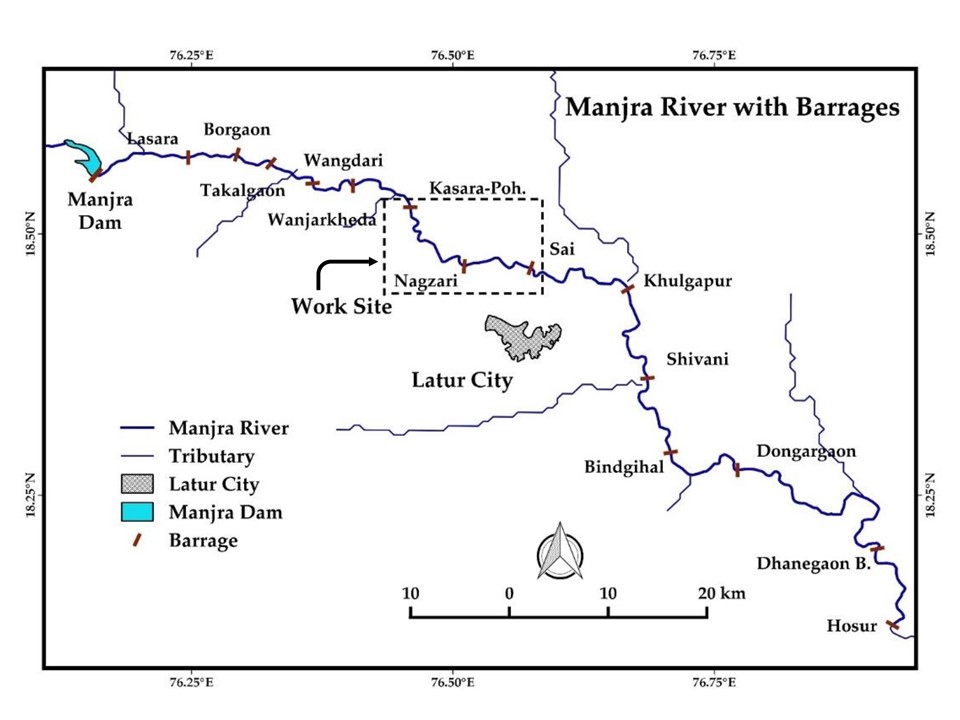
In summer of 2016, after witnessing two consecutive droughts, Art of Living (AoL) along with RSS Jankalyan Samiti, (RSS-JS) initiated Manjra River Rejuvenation program with the involvement of local leaders and residents. As a part of this program, the Manjra River channel was deepened and widened to create additional storage to meet the drinking water demand of parched Latur city of Marathwada, Maharashtra. During implementation, the leading organisations AoL and RSS-JS proclaimed rejuvenation project as a permanent measure resolving the crisis by creating storage of 18 million cubic metre (MCM) enough to meet Latur city’s water demand (Ghadyalpatil  2016; Thomas 2016). With a promise of supplying piped water every alternate day, they collected around Rs. 70 million from the people[1]. However, as described below, even after completion of massive excavation damaging river ecology, this project failed miserably. It could not even supply one drop of water to the citizens of Latur. Surprisingly, this failure is never revealed or discussed and on the contrary, the project was celebrated as a success (Samvada, 2016). Continue reading “Beyond technological failure: Examining the role of religious organisations in water conservation”

Dams · Rivers

Travelling through Ramganga and Nayaar Rivers Basin

Fed by Dudhatoli forest range, the Ramganga West and Nayaar East and West in Uttarakhand are perennial rivers of immense scenic beauty amid emerging and looming threats. This photo blogs highlights some of the charms and concerns of these non-glacial rivers of the Ganga Basin.

Continue reading “Travelling through Ramganga and Nayaar Rivers Basin”

Arunachal Pradesh · brahmaputra · Hydropower

Open letter to MoEF & River Valley EAC: Review Recommendation to grant EC to Etalin HEP

The MoEF’s Expert Appraisal Committee (EAC) on River Valley Projects in its meeting in January 2017 recommended Environmental Clearance (EC) to the controversial 3097 MW Etalin Hydropower project in Dibang River Valley in Arunachal Pradesh. However, since the stage I forest clearance to Etalin HEP has not yet been accorded, the EC letter has not yet been issued. Hence there is an opportunity to stop EC to the project till the EAC reviews its decision.

It may be noted that Forest Advisory Committee (FAC) in its meeting on April 23, 2020, has decided in the context of Etalin Project: “As this is a large sized project in the Himalayas, inputs of IA (Impact Assessment) Division of the Ministry on whether environmental impacts of the proposed project and mitigating measures have been considered, will be obtained.” This provides an opportunity for the MoEF to direct the IA Division and EAC to review its decision to recommend EC to the Etalin Project.

Continue reading “Open letter to MoEF & River Valley EAC: Review Recommendation to grant EC to Etalin HEP”

Rivers · Sand Mining

Why indiscriminate river bed mining is wrong, dangerous and unethical

Guest Blog by Manoj Misra

Uttarakhand government is reportedly keen on taking up widespread river bed mining to generate around Rs 750 crore as revenue during 2020-21. More states anxious to recover revenues lost to ‘lockdowns’ due to COVID19 pandemic might also follow suit. Such indiscriminate actions would be unnatural, wrong, dangerous and even unethical.     Continue reading “Why indiscriminate river bed mining is wrong, dangerous and unethical”

Bihar · Rivers

Bringing Life back to Champa River

Guest Blog by Dr. Ruchi Shree (TMBU, Bhagalpur)

Is it merely a coincidence that I am writing this last segment of my three-part writing on Champa river when due to ongoing lockdown amid unprecedented COVID-19 pandemic, the rivers not only all over India but worldwide are said to have become cleaner. Many scholars and environmentalists are calling it a ‘boon in disguise’ and asking us to take it as an opportunity to re-engage with human being’s relationship with the surrounding nature. To quickly recap what I have already said in my previous writings that rivers are more than merely water-bodies and each river has not one but many stories around it. These stories are about how did they come into existence to what are their specific features and many more. (Photo above: Live History)

Continue reading “Bringing Life back to Champa River”

Bihar · Rivers

Champa’s Angpradesh to Champa Nala of Bhagalpur

                                                                                       Guest Blog by Dr. Ruchi Shree (TMBU, Bhagalpur)

The title of this paper is influenced by Anupam Mishra’s writing ‘Yamuna ki Dilli’[i] which narrates the significance of river for a city and how the equation between the two keeps changing along the passage of time. As mentioned in the previous part of the story, my writing is an attempt to explore the history of Bhagalpur around its one water body named Champa river. Continue reading “Champa’s Angpradesh to Champa Nala of Bhagalpur”

Dams · Rivers

Cleaner rivers in lockdown: Lessons we can learn

Within a week of 21-day long lockdown in India that started at midnight on March 24, 2020, several reports in print, electronic and social media have been doing rounds showing remarkable improvements in water quality in many rivers in the country. Most of these are on the basis of naked eye observations in the form of pictures and videos by people.

Some of the reports quote pollution control boards’ officials and experts with some analytical data. People generally believe that the shutting down of industrial units has led to reduction in discharge of industrial effluents in the rivers, breathing fresh life in pollution laden streams. It’s right that there is halt in industrial belts and there is less industrial pollution reaching the rivers. However there are other factors contributing to the change in the scenario. 

Continue reading “Cleaner rivers in lockdown: Lessons we can learn”