Gujarat · Narmada

Why is media missing the real Gujarat story: Gujarat Satya Samachar!  

It seems large parts of mainstream national media have gone underground these days. If you view most of the English and some Hindi news channels or most of the English and Hindi newspapers, you suddenly find proliferation of reports favouring Mr Narendra Modi and BJP. The repeated highlighting of the doctored pre poll analysis, without attempt at in-depth analysis or investigation into the credentials of the agencies doing such predictions is only one troublesome part. But even in reporting of the news, there is a clearly discernable pro-BJP tendency and an attempt to black out or under report or mis-report the news surrounding BJP’s rivals, particularly the news around Aam Admi Party (AAP). This was most evident in reporting of AAP’s trip to Gujarat in first week of March 2014.

There will be no doubt to any objective viewer that AAP’s trip punctured the well-crafted balloon of Gujarat’s development image. To many Gujaratis like me, this was not such a big breaking news. But strangely, the media that is supposed to report realities in an objective manner, should have been happy reporting this significant development. Arvind Kejriwal’s hour long speech in Ahmedabad at a hugely attended meeting should have been reported extensively in the media. Strangely, large parts of the mainstream media (both print and electronic) almost blacked this out.

This no doubt reflected poorly on the media that has been accepting the claims of Modi and BJP as gospel truths, since an independent media should have exposed the reality of these claims on its own through trips like the one AAP members did. The speech in Ahmedabad on March 8, 2014 was a good opportunity for the media to correct their own failure. In stead of using that opportunity, by not reporting or under reporting or mis-reporting, the media has further discredited itself.

It reminds one of an episode in Gujarat not long ago. “One morning some years ago, Gujarat’s residents found a newspaper on their doorsteps. They hadn’t subscribed to it, and it carried a vaguely familiar masthead. It was called Gujarat Satya Samachar, to make it resemble the state’s largest circulated newspaper, Gujarat Samachar. It was produced by Gujarat’s information department (a portfolio held by chief minister Narendra Modi) and contained reports of the state government’s achievements”, wrote former Divya Bhaskar (Gujarati edition of paper from Bhaskar group) editor Aakar Patel in his column in Mint on March 1, 2014.

The reason Gujarat government resorted to Gujarat Satya Samachar was “belief was that the local media was either suppressing stories about government successes or was critical of Modi to the point of antagonism”. The Gujarat Satya Samachar did not run much beyond a couple of issues, since Gujarati media quickly fell in line, the way government wanted. In fact, this episode should not give a misleading picture that Gujarati media was depicting the reality of Gujarat’s development before the government resorted to Gujarat Satya Samachar. Far from it.

While traveling through various parts of Gujarat, I have seen frustration of the aam Gujarati about the way the state is ruled over the last decade and more. Repeatedly, common people on the street have told me, during my numerous trip in the state, about corruption, break down of the regular basic facilities like schooling (everyone seems to have to go for tuitions and tuition classes, “then what are the schools for?” as one frustrated autorikshaw wala told me) or electricity or water and pro-big-industries bias of the state establishment. Intellectuals and independent observers have talked about the huge gap between claims of the Gujarat government and reality for long.

Ahmedabad is supposed to be shining with Sabaramati river front development, but if you go a dozen kilometers upstream or downstream you realize that this is just for the benefit of the real estate developers of the city. The state of the river elsewhere is as bad as Yamuna in Delhi. Even the water you see in Sabarmati flows in it through a fraud.  This water is from Narmada project and not a drop from it was planned or allocated for Ahmedabad city or Sabarmati River.  The project was proposed and justified for drought prone areas of Kutch, Saurashtra and North Gujarat. They are not getting this water, in stead farmers of Saurashtra are fighting FIRs and cases for using Narmada water! Farmers everywhere are feeling discriminated when the state government favours big industries at their expense and without transparency or due justice or their participation. The tribal belt is not only neglected, it is facing prospects of more and more displacement and deforestation in the name of dams, river linking projects and industrial zones and corridors.

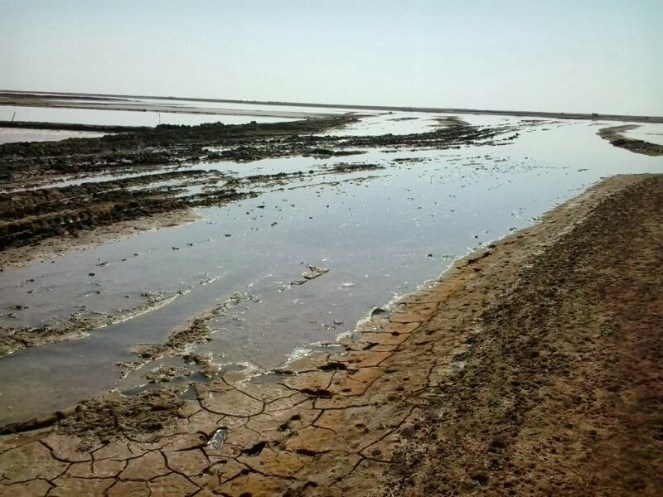
Narmada Waters flowing unused in the Rann of Kutch, harming the eocsystem and saltpan workers livelihoods Photo: Counterview.net
Narmada Waters flowing unused in the Rann of Kutch, harming the ecosystem and saltpan workers livelihoods Photo: Counterview.net

While traveling through the tribal areas near Sardar Sarovar dam, Savitaben Tadvi of Indravarna village told us about the repression they are facing while peacefully opposing the Garudeshwar dam on Narmada river, which has neither any valid approval nor any impact assessment or consent from the affected villages in the upstream or downstream. Lakhan Musafir of Umarva village took us to the washed out portion below the Sardar Sarovar dam, including the viewers park, about which there is so little information in public domain. Rohit Prajapati of Paryavaran Suraksha Samiti, showing the proposed site of the statue of Unity, publicized as world’s highest statue, just downstream of the Sardar Sarovar Dam, said how the foundation stone was laid on Oct 31, 2013 by arresting the peacefully opposing tribals, but that project neither has any impact assessment, nor any of the statutorily required approvals. As Nandini Oza, after traveling for over a thousand kilometers in Gujarat recently said, “You can actually smell development at Vapi, Ankaleshwar!”

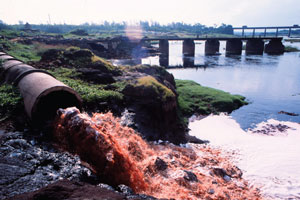
Pollution of Damanganga at Vapi Photo: Tehelka
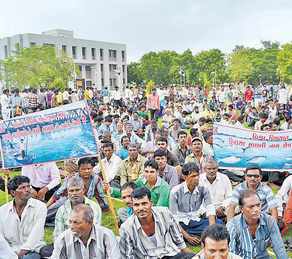
Protest against the Bhadbhut Barrage also on Narmada Photo: Counterview.net

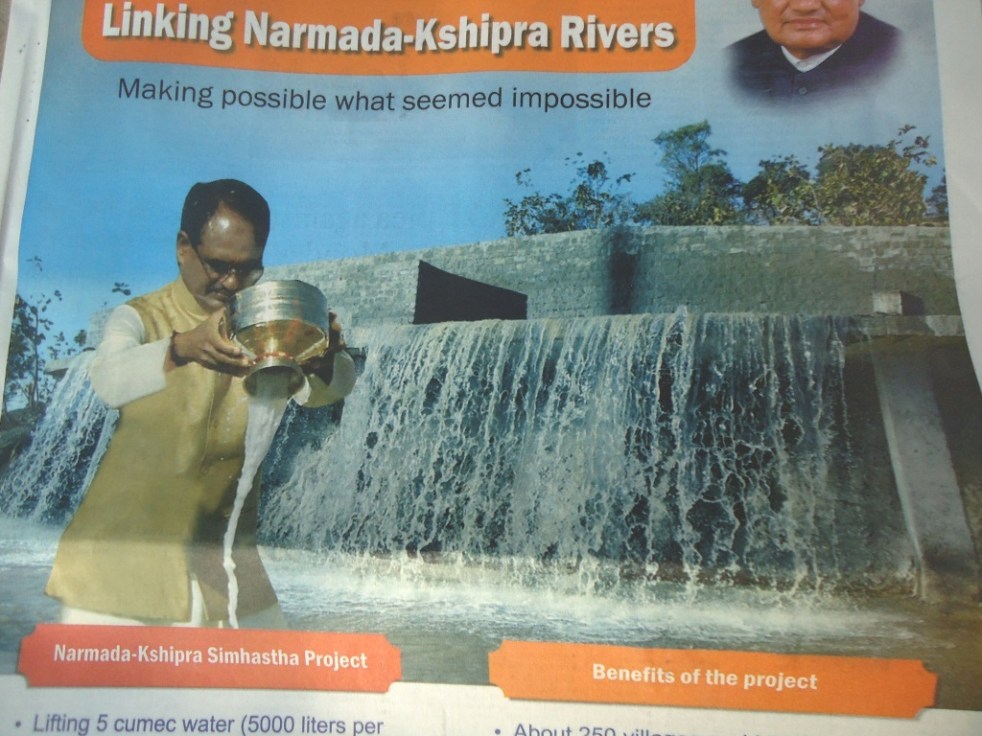
BJP’s prime ministerial candidate Narendra Modi, who as a chief minister, resorted to Gujarat Satya Samachar to show slightly critical Gujarati media its place and succeeded in arm-twisting them, has been resorting to less than Satya in his electioneering. Just to illustrate, during his trip to North East, he did not mention his support for either large hydro projects or inter linking of rivers, which are facing huge opposition in Assam, Arunachal Pradesh and other states. But during his speech in following week on February 26, 2014 in Madhya Pradesh, he talked about the North East region being “heaven for hydro power generation”. In that same state of Madhya Pradesh, his party chief Minister flashed full page advertisements (at public expense) for three straight days about Narmada Kshipra link as harbinger of the ILR dream of former prime Minister Atal Behari Vajpayee. In reality it is just a pipeline water supply project with questionable viability and justifiability, without even impact assessment or participation of the people of the Narmada or Malwa region. There is already opposition to the project from among the farmers of the Narmada Valley.

There are others who have taken an objective view of Gujarat story. Revealing research by two professors of British Columbia, Canada about GUJARAT GROWTH VS DEVELOPMENT recently[1] showed: “This is a perplexing picture of development. Gujarat has done so much better in terms of growth and so much worse in terms of development than other states. Why has the fast growth not translated into meaningful development? Finally, it is the grassroot-level institutions that run schools, health clinics, bring water and sanitation to households, and bring the fruits of growth to the multitudes. Could it be that the centralised model of governance that works well for big investment projects does not work as well for grassroot institutions? Or, is this high growth with low development model indicative of the priorities of the government of Gujarat? Or is it something else altogether? It would be good to know the answer.”

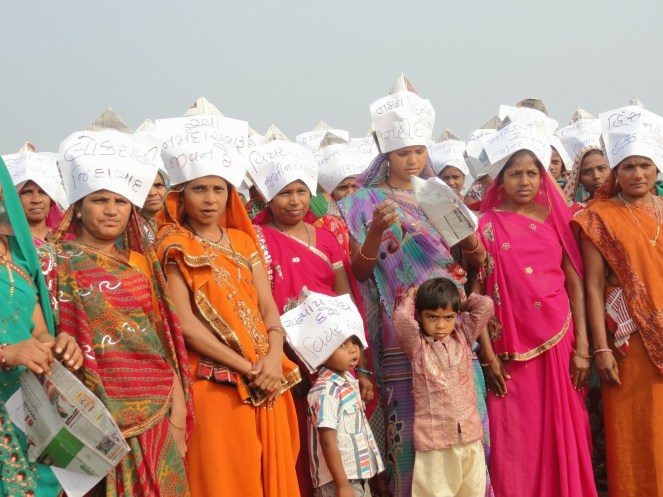
Protest against the illegal Garudeshwar Weir Photo: Counterview.net

The trouble is, large part of mainstream media has mostly blacked out all this critical news.  This situation is no doubt very bad for Indian democracy. As a senior journalist from financial paper told me, whenever there is extraordinarily positive report about any company or party, first question that arises is, how much has the reporter been paid to write such a story! Media should be wary of at least such a perception.

Himanshu Thakkar, SANDRP


END NOTES:


[1] http://indianexpress.com/article/opinion/columns/gujarats-growth-for-growths-sake/99/


[2] An edited version of this article was published in April 2014 at: http://www.civilsocietyonline.com/pages/Details.aspx?509

[3] Also published at: http://www.hotnhitnews.com/Real-Gujarat-An-Underreported-Story-By-Himanshu-Thakkar-HotnHitNews-13702042014.htm

Some other relevant links:

[4] http://www.thehindu.com/news/national/other-states/in-gujarat-tribal-people-get-a-raw-deal/article5873973.ece

[5] VERY INTERESTING Column by AAKAR PATEL, calling Modi a TYRANT, who hates democracy and revers only the dead: http://www.livemint.com/Leisure/NP7LlgqacegDU1PoTm3HKI/The-oneman-armys-forward-march.html

[6] How Modi’s government has treated RTI acitivists: http://www.firstpost.com/politics/narendra-modis-gujarat-model-has-no-space-for-rti-activists-1214009.html

[7] Why the growth fundamentalist THE ECONOMIST refused to back Modi: “But for now he should be judged on his record—which is that of a man who is still associated with sectarian hatred. There is nothing modern, honest or fair about that. India deserves better.” See: http://www.economist.com/news/leaders/21600106-he-will-probably-become-indias-next-prime-minister-does-not-mean-he-should-be-can-anyone?fb_action_ids=10202394265351839&fb_action_types=og.likes&fb_ref=scn%2Ffb_ec%2Fcan_anyone_stop_narendra_modi_

[8] http://indiatogether.org/could-modi-be-a-development-disaster-government by Ashish Kothri

[9] http://www.ndtv.com/elections/article/election-news/blog-gujarat-s-development-pre-dates-modi-considerably-505647?pfrom=home-topstories by Reetika Khera, Development Economist at IIT Delhi

[10] http://www.hindustantimes.com/india-news/gujarat-one-of-the-most-water-starved-states-in-india-un-report/article1-1205787.aspx

[11] BJP’s PM candidate Modi showing his true colours: Opposes even RTI: http://indianexpress.com/article/india/politics/in-karnataka-modi-targets-upas-aadhaar-rti/

[12] http://www.hindustantimes.com/elections2014/state-of-the-states/gujarat-s-pride-wilting-it-s-also-land-of-failing-crops-and-dying-men/article1-1206339.aspx

[13] “Hemantkumar Shah, an economics professor at Gujarat University, has challenged Modi’s claim of dramatic economic growth. He said data reveals the state’s economic and human development parameters worsened under Modi.” http://timesofindia.indiatimes.com/City/Mumbai/Growth-declined-poverty-increased-in-Gujarat-under-Modi-Guj-varsity-prof-claims-in-book/articleshow/33463710.cms

[14] “CAG reports and data on economic and social development from various sources make it evident that the much-touted “Gujarat model” of development is non-inclusive, socially divisive and highly ineffective in key areas.”

By ATUL SOOD and KALAIYARASAN A.” Gujarat Model: Fiction and Facts: Frontline Cover Story, April 4, 2014: http://www.frontline.in/cover-story/fiction-and-facts/article5795324.ece?ref=sliderNews (needs registration to get full story)

[15] http://themadeconomy.blogspot.in/2013/08/Facts-behind-Modi-and-Gujarat-Model.html

[16] “To sum up, the “Gujarat model” story, recently embellished for the elections, is misleading in at least three ways. First, it exaggerates Gujarat’s development achievements. Second, it fails to recognise that many of these achievements have little to do with Narendra Modi. Third, it casually attributes these achievements to private enterprise and economic growth. All this is without going into murkier aspects of Gujarat’s experience, such as environmental destruction or state repression.” From Hindu article by Jean Dreze, See: http://www.thehindu.com/opinion/op-ed/the-gujarat-muddle/article5896998.ece

[17] Another warning from eminent people against voting for Narendra Modi for Prime Minister: http://www.theguardian.com/commentisfree/2014/apr/10/if-modi-elected-india-future-gujarat

[18] Is Modi’s fabled Gujarat model lawful and accountable? http://www.firstpost.com/politics/is-modis-fabled-gujarat-model-lawful-and-accountable-1491885.html

Arunachal Pradesh · Assam · brahmaputra · Embankments · Ministry of Water Resources

Analysis MoWR’s Advisory Committee’s Decisions for Northeast – January 2009 to Dec 2013

This is analysis of the decisions of the Advisory Committee in the Union Ministry of Water Resources for consideration of techno-economic viability of Irrigation, Flood Control and Multi Purpose Project Proposals (TAC in short) for North East India[1] from 95th meeting of January 2009 to 122nd meeting held in December 2013. In our last analysis of TAC minutes we have covered the decision taken for NE states from July 2011 to December 2013 which  is available at – https://sandrp.wordpress.com/2014/03/19/lack-of-transparency-and-accountability-remains-the-norm-of-functioning-for-mowrs-advisory-committee/. In this analysis, we have covered the same for an extended period. In these five years TAC has accepted project proposals worth of 5515.46 crores. In calculating the total cost of the projects considered we have considered only the projects whose proposals were given clearance by TAC. In these five years, some of the projects also made two appearances with revised costs. In such cases the higher revised cost has been taken into consideration, e.g. Khuga Multipurpose Project and Dolaithabi Barrage Project, both located in Manipur were accepted by the committee in its 100th meeting (held on 9th October 2009) with revised cost of Rs 381.28 crore and 251.52 crore respectively. In the 115th meeting (held on 24th July 2012) of the TAC, these two projects were considered again where the cost for Khuga Project was Rs. 433.91 cr and for Dolaithabi Project it was Rs. 360.05 Cr. The same is the case for the Thoubal Multipurpose Project which appeared in 101st and 115th meeting of the TAC.

Within these five years, TAC has given financial clearance to 26 flood and erosion control projects and majority of these projects are from Assam. The committee gave the clearance to 6 irrigation projects, 3 barrage projects and 3 multipurpose projects.[2] The committee also gave clearance to a strom water drainage improvement project below Greenfield Airport at Pakyong in Sikkim within this period.

In this period, largest no of considered (25) and approved (20) projects were from Assam. Assam also has the maximum cost of projects among all states (Rs. 2631.99 Cr). Highest number of projects were considered (16) and approved (14) in the year 2009, with total cost of Rs 2321 Crores, which too was highest among all the years.

As found in our previous analysis, in the last five year from 2009 to 2013 TAC has not rejected a single project. Five projects had been deferred but were approved in the subsequent meetings within the same period. In the 108th meeting (held on 4th January 2011), the TAC did not discuss two projects on the Brahmaputra river stating “It was observed that the flood control and anti erosion scheme of Brahmaputra Board are implemented through Central Fund, which do not require investment clearance from the Planning Commission. Therefore, these schemes need not be put up to the Advisory Committee. However, the technical aspect of such project may be looked into by Central Water Commission as per past practice.”  But both these projects were reconsidered in the 110th meeting of TAC (held on 20th July 2011) and were cleared by the committee.

So this seems like a rubber stamping committee, clearing everything that comes to it. Reading of the minutes of the meetings also reveals that there are hardly any critical questions asked on merits of the questions for the massive delay and cost escalations that most of the projects suffer. Nor is there an discussion about the performance of the projects.

As we noted earlier, this committee functions in most non transparent, non participatory and unaccountable way. Neither the minutes nor the agenda notes of the meetings are in public domain. Following our letters along with TAC analysis in April 2011, addressed to Planning Commission, Union Ministry of Water Resources, Central Water Commission and members of the National Advisory Council, for the first time, TAC minutes were put up on CWC website (see: http://www.cwc.gov.in/main/webpages/TAC%20minutes.html). However, the last uploaded minutes were for the 115th meeting held in July 2012, after which minutes have stopped being uploaded. Secondly, some of the links are not working and all the files are unnecessarily large PDF files since only scanned pages of the minutes are put up, in place of the PDFs of normal word files, which would be of much smaller size. The TAC also has no independent, non government members, all the members are government officials. As we wrote to MoWR and Planning Commission in April 2011 and again in March 2014, there is urgent need for TAC to have  such members so that they provide objective perspective about the projects that come up before TAC.

The importance of functioning of this committee cannot be over emphasised. As we  wrote  in our letter to MoWR and Planning Commission, TAC “considers dozens of such projects with huge economic, social, environmental and other implications for the country in every one of its meetings. All of these projects are supposed to be public purpose projects, and are taken up using public resources. The Planning Commission accords investment clearance to the projects only after the TAC clearance. This Committee’s decisions are perhaps the ones which impact on India as a whole the most – as they relate to land and water – which are the basic life sustaining and livelihood providing resources for the people.”

It is high time that first effective steps are taken to ensure that the functioning of this committee becomes more transparent, participatory and accountable.

State-wise list of projects cleared by TAC

State No of Projects Considered No of projects approved Total cost of the projects
Arunachal Pradesh 4 4 106.6
Assam 25 20 2631.99
Manipur 10 10 2268.99
Meghalaya 1 1 5.63
Sikkim 1 1 48.55
Tripura 6 6 453.7

Note: No projects from Mizoram and Nagaland have come to TAC in this 5 years period.

Year-wise List of Projects Cleared by TAC

Year No of Projects Considered No of projects approved Total cost of the projects
2009 16 14 2321
2010 5 5 663.67
2011 12 9 497.33
2012 5 5 2208.81
2013 9 9 1439.45

Meeting-wise List Projects Cleared by TAC January 2009 to December 2013

Sl. No Meeting no Date of meeting No of projects considered No projects approved No of projects deferred No of projects rejected Total cost of the accepted projects, Rs Crore
95th 20.01.2009 4 3 1 0 196.07
96th 16.02.2009 2 2 0 0 168.14
100th 09.10.2009 6 5 1 0 264.73
101st 30.11.2009 4 4 0 0 77.26
102nd 28.01.2010 1 1 0 0 59.91
103rd 11.03.2010 1 1 0 0 302.22
106th 16.09.2010 3 3 0 0 301.54
108th 04.01.2011 2 0 2 0 0
109th 04.03.2011 3 3 0 0 70.13
110th 20.07.2011 5 4 1 0 211.56
111th 17.08.2011 1 1 0 0 167.09
112th 14.09.2011 1 1 0 0 48.55
115th 24.07.2012 5 5 0 0 2208.81
117th 21.03.2013 1 1 0 0 155.87
118th 30.07.2013 2 2 0 0 467.38
119th 29.08.2013 2 2 0 0 601.67
120th 13.09.2013 1 1 0 0 42.96
121st 08.10.2013 2 2 0 0 146.01
122nd 20.12.2013 1 1 0 0 25.56
Total   47 42 5 0 5515.46

95th meeting (20.01.2009): Accepted TOTAL – Rs 196.07 crores (revised costs have been taken into consideration)

SN Project Dist/ State Appr. year River/ Basin Original (revised) Cost-CrRs Decision
1 Protection of Sialmari Area Morigaon/ AS 2002 B’putra 14.29 (25.73) Accepted
2 Protection of Bhojaikhati, Doligaon and Ulubari AS 2002 B’putra 14.52 (27.92) Accepted
3 Protection of Majuli Island Ph II-III AS New B’putra 116.02 Deferred the proposal with suggestion to prepare the cost at current prices.
4 Raising & strengthening Dyke from from Sissikalghar to Tekeliphuta including closing of breach by retirement and anti erosion measures AS New B’putra 142.42 Accepted

96th meeting (16.02.2009): Accepted Total – Rs 168.14 crores

SN Project Dist/ State Appr. year River/ Basin Original (revised) Cost-CrRs Decision
1 Flood protection of Majuli Island Ph-II & III AS New B’putra 115.03 Accepted
2 Restoration of Dibang & Lohit rivers to their original courses at Dholla Hattiguli AS New B’putra 23.32(53.11) Accepted partially & suggested that proposal of coffer dam, pilot channel, etc. may be put up to the Standing Committee for expert opinion

100th meeting (09.10.2009): Accepted: TOTAL – Rs 897.53 crores

SN Project Dist/ State Appr. year River/ Basin L of Dam Original (revised) Cost-CrRs Benefit Irri CCA Annual Irrigation Decision
1 Borolia Irrigation Project AS 1980 Brahmaputra 92 m 6.775 (135.93) 9717 15,000 Ha Deferred due to non-submission of State Finance Concurrence
2 Khuga Multipurpose (Major- Revised) Manipur 1980 Khuga/ Imphal 230 m 15 (381.28) 9575 14,755 Ha Accepted
3 Dolaithabi Barrage Project (Med Revised) Manipur 1992 Iril/ Manipur 79 m 18.86 (251.52) 5,500 7,545 Ha
4 Gumti Irrigation Project (Revised) Tripura 1979 Gumti 96 m 5.88 (83.01) 4,486 9,800 ha Accepted
5 Khowai Irrigation Project (Revised) Tripura 1980 Khowai 96 m 7.10 (83.01) 4,515 9,320 Ha Accepted
6 Manu Irrigation Project Tripura 1981 Manu 82 m 8.18 (98.71) 4,198 7,600 Ha Accepted

101st meeting (30.11.2009): Accepted TOTAL – Rs 1059.26 crores

SN Project State Appr. year River/ Basin L of Dam Original (revised) Cost-CrRs Benefit Irri CCA/ flood prot. Annual Irrigation Decision
1 Raising & strengthening to Puthimari embankment Assam New B’putra NA 30.23 15000 Ha NA Accepted
2 Anti Erosion measures to protect left B’putra Dyke Assam New B’putra NA 27.97 5000 Ha NA Accepted
3 Protection of Gakhirkhitee and its adjoining areas Assam New B’putra NA 19.06 20,000 Ha NA Accepted
4 Thoubal Multipurpose Project (revised) Manipur 1980 Thoubal/ Imphal 1074 m 47.25 (982) 21,862 ha 33,449 Ha Accepted

102nd meeting (28.01.2010): Accepted TOTAL – Rs 59.91 crores

SN Project Dist/ State Appr. year River/ Basin Original Cost-CrRs Benefit-flood protsn Decision
1 Emergent measures for protection of Rohmoria in Dibrugarh Dist Assam New Brahmaputra 59.91 18,000 Ha Accepted

103rd meeting (11.03.2010): Accepted: TOTAL Cost of approved projects: Rs 302.22 crores

Project Dist/ State Appr. year River/ Basin L of Dam Original (revised) Cost-CrRs CCA (Ha) Annual Irrigation (Ha) Decision
Champamati Irrigation Project Chirag/AS 1980 Champamati/B’putra 258.5 m 15.32 (309.22) 17,414 24,994 Accepted

106th meeting (16.09.2010): Accepted TOTAL – Rs 301.54 crores

SN Project Dist/ State Appr. year River/ Basin Original (revised) Cost-CrRs Decision
1 Raising & strengthening of tributary dyke on both banks of Kopili River Assam New Kopilli/ B’putra 110.72 Accepted
2 Assam Integrated Flood River Bank Erosion Risk Management Project Dibrugarh/ Assam New Brahmaputra 61.33 Accepted
3 Assam Integrated Flood River Bank Erosion Risk Management Project Palasbari/ Assam New Brahmaputra 129.49 Accepted

108th meeting (04.01.2011): Accepted TOTAL- Rs 0

SN Project Dist/ State Appr. year River/ Basin Original (revised) Cost-CrRs Decision
1 Restoration of Dibang & Lohit rivers to their original courses at Dholla Hattiguli AS New Brahmaputra 23.32(53.11) The technical aspect pf this type of project may be looked in to by CWC as per past Practices.
2 Protection of Majuli Island from flood & erosion, Ph II-III AS New Brahmaputra 116.02 The technical aspect pf this type of project may be looked in to by CWC as per past Practices.

109th meeting (04.03.2011): Accepted TOTAL – Rs 70.13crores

SN Project Dist/ State Appr. year River/ Basin Original (revised) Cost-CrRs Decision
1 Anti Erosion & Flood Protection work in Dikrong Basin Arunachal Pradesh New Dikrong 23.68 Accepted
2 Anti Erosion & Flood Protection work in Bhareli sub Basin Arunachal Pradesh New Bhareli 16.81 Accepted
3 Anti Erosion & Flood Protection work in Siyom Basin Arunachal Pradesh New Siyom 29.64 Accepted

110th meeting (20.07.2011): Accepted: TOTAL: Rs 211.56 crores

Sl No Project Dist/State Appr. year basin original cost (Rs. Cr) decision
1 Anti Erosion & Flood protection in Tawangchu basin ArP New Tawangchu 36.47 Accepted
2 Protection of Majuli from Flood & Erosion Ph II & III Assam 2011 Brahmaputra 115.03 Accepted
3 Restoration of rivers Dibang and Lohit to their original courses at Dholla Hatighuli Assam 2011 Brahmaputra 54.43 Accepted
4 Protection of Balat village from flood and erosion of river Umngi in W Khasi hill district West Khasi hill/Meghalaya New Brahmaputra 5.63 Accepted

111th meeting (17.08.2011): Accepted: TOTAL: Rs 167.09 crores

Project Dist/State Appr. year basin original cost decision
Protection of Biswanath Panpur including areas of upstream Silamari and Far downstream Bhumuraguri to Borgaon Sonitpur/Assam New Brahmaputra Rs 167.09 Cr Accepted

112th meeting (14.09.2011): Accepted: TOTAL: Rs 48.55 crores

Sl No Project Dist/ State Appr. year original cost (Rs. Cr) decision
1 Improvement of Strom Water Drainage below Greenfield Airport at Pakyong Sikkim  New 48.55 Accepted

115th meeting (24.07.2012): Accepted: TOTAL: Rs 2208.81 crores

Sl No Project Dist/State Appr. year basin original cost (Rs. Cr) decision
1 Thoubal Multipurpose project Manipur 1980 Brahmaputra 1387.85 Accepted
2 Khuga Multipurpose project Manipur 1980 Brahmaputra 433.91 Accepted
3 Dolathabi Barrage Project Manipur 1992 Brahmaputra 360.05 Accepted
4 ERM of Imphal Barrage Project Manipur New Brahmaputra 16.8 Accepted
5 ERM of Sekmai Barrage Project Manipur New Brahmaputra 10.2 Accepted


117th meeting (21.03.2013): Accepted: TOTAL: Rs 155.87 crores

Sl No Project Dist/ State Appr. year basin Ht / L of Dam/Embnk. original cost (Rs. Cr) Benefit flood prot. (Ha) decision
Protection of Sissi-Tekeliphuta dyke from erosion – Lotasur to Tekeliphuta Assam New Brahmaputra 153 km 155.87 10117 Accepted

1188h meeting (30.07.2013): Accepted: TOTAL: Rs 467.38 crores

Sl No Project Dist/ State Appr. year River/ basin original cost (Rs. Cr) Benefit flood prot. (Ha) decision
Flood management of Dikrong and river training works on both banks embankment Lakhimpur/ Assam New Dikrong/ Brahmaputra 105.96 9998 Accepted
Flood management of Ranganadi and river training works on both bank embankments Lakhimpur/ Assam  New Ranganadi/ Brahmaputra 361.42  21056 Accepted

119th meeting (29.08.2013): Accepted: TOTAL: Rs 601.67 crores

Sl No Project Dist/ State Appr. year River/ basin original cost (Rs. Cr) annual irrigation decision
Dhansiri Irrigation project Assam 1975 Dhansiri/ B’putra 567.05 Accepted
ERM of Singda multipurpose project Manipur  New Brahmaputra 34.62 3000 Accepted


120th meeting (29.08.2013): Accepted: TOTAL: Rs 42.96 crores

Project Dist/State River original cost (Rs. Cr) decision
Anti erosion work along river Haora from Champakpur to Baldakhal W Tripura Haora 42.96 Accepted

121st meeting (08.10.2013): Accepted: TOTAL: Rs 146.01 crores

Sl No Project Dist/ State River original cost (Rs. Cr) Benefit flood prot. (Ha) decision
Anti erosion work along river Gumti from Dlak Samatal Para to Durgapur under Amarpur, Udaipur & Sonamura subdivision S & West Tripura Gumti 54.99 2209 Accepted
Anti erosion work along river Khowaii from Netajinagar to Banglahour under Telimura subdivision and from south L. N. Pur to Paharmura bridge under Khowai subvision West Tripura Khowaii 91.02  4256 Accepted

122nd meeting (20.12.2013): Accepted: TOTAL: Rs 25.56 crores

Sl No Project Dist/State River original cost (Rs. Cr) decision
Loktak Lift Irrigation Project Manipur 25.56 Accepted

 Parag Jyoti Saikia and Himanshu Thakkar

————————————–

[1]While this article only contains the details of the North East India Projects considered in TAC for the five years, we hope to soon provide details of the projects considered by TAC from all over India.

[2] Sicne Khuga Multipurpose, Thoubal Multipurpose and Dolaithabi barrage project, all from Manipur appears twice in this period, they have calculated only for once here.

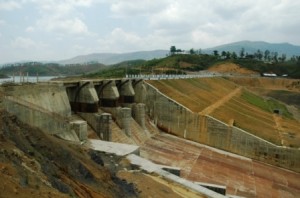
[3] Feature image – Khuga Mutipurpose project. Image courtesy – http://manipuronline.com/

Arunachal Pradesh · Assam · brahmaputra · Embankments · Ministry of Water Resources · Sikkim

Lack of Transparency and Accountability Remains the Norm of Functioning for MoWR’s Advisory Committee

The Advisory Committee in the Union Ministry of Water Resources (MoWR) for consideration of techno-economic viability of Irrigation, Flood Control and Multi Purpose Project Proposals (TAC in short) is a very important committee. It accords the financial clearance for any irrigation, flood control and multipurpose project. TAC is supposed to discuss the techno-economic viability of projects as per the resolution published in the Union of India Gazette Notification No. 12/5/86-P-II dated Nov 27, 1987. This committee came into being replacing a similar committee that existed earlier in the planning commission. Even now, the guidelines for functioning of the committee are issued by the Planning Commission.

The Gazette notification cited above also said, “The committee may also invite representatives of any other Government organizations, scientific body of experts in the relevant fields to participate in its deliberations.” This seems like a window to appoint credible, independent, non-government persons in the committee, but this window does not seem to have been used. Among the functions of the committee listed in this notification include, “The functions of the Committee will be to examine projects proposed by State Governments, Central Government or other organizations and satisfy itself that the schemes have been prepared after adequate investigations” and “the need of environment conservation and proper rehabilitation of project-affected persons have been taken into account.” However, our perusal of the functioning of the TAC shows that TAC has failed to fulfill both these mandates.

As noted in the Guidelines for Submission, Appraisal and Clearance of Irrigation and Multipurpose Projects, 2010 available on the CWC website (see: http://www.cwc.nic.in/main/webpages/publications.html), “The project proposal, thereafter, is put up to the Advisory Committee for clearance, which is, by and large, like single window clearance.” The importance of such a single window clearance becomes all the more important. The guidelines further note, “On the basis of examination conducted by the Advisory Committee, decision on techno-economic viability of the projects is taken in the meeting of this Committee. The projects found acceptable by the Advisory Committee shall be recommended for investment clearance by the Planning Commission and inclusion in the Five Year Plan/Annual Plan.” This shows how important is the role of the TAC in judging techno-economic viability of projects and also from the point of view of prudent planning.

No Transparency, independent participation or accountability of TAC Considering the above, there is strong case for clearly defined norms for transparency, participation and accountability in (1) functioning of TAC; (2) The screening process of the projects at initial stages that also happen under these guidelines in the Central Water Commission, based on which approval for DPR preparation is given.

In view of the significance of TAC, this is SANDRP’s third analysis of the decisions taken in TAC meetings. The present analysis covers decisions taken for North East India from 110th to 122nd TAC meeting. In the two previous analysis done by SANDRP, TAC meeting decisions taken from 95th meeting to 109th meeting has been covered. Here it is important to note that lack of transparency has been observed right from the agenda and minutes of the TAC meetings. The agenda and minutes of the TAC meetings should be uploaded on CWC website but CWC website has minutes only till the 115th meeting held on 24th July 2012 and the website has been last updated on 31/08/2012.

In this analysis we have covered 13 TAC meetings held from July 2011 to December 2013. In these 13 meeting, 21 projects from 6 northeastern states have been considered. But out of the 13 meetings held, projects from northeast were considered only in 10 meetings. TAC has accepted the proposals for projects with a total cost of rupees 4075.46 crore. Majority of the projects were given clearance at the first time of consideration. Thus, on an average TAC  had cleared projects worth of 407.55 crores from the North East in each of these 10 meetings. Number of the projects considered by TAC in each meeting along with their total cost is given below. A state-wise and a project-wise list is also provided.

Total Cost of Projects Cleared by TAC July 2012 to December 2013

Sl No Meeting no Date of meeting No of projects considered from NE No projects approved No of projects deferred No of projects rejected Total cost of the accepted projects, Rs Crore
1 110th 20-07-11 5 4 1 0 211.56
2 111th 17-08-11 1 1 0 0 167.09
3 112th 14-09-11 1 1 0 0 48.55
4 115th 24-07-12 5 5 0 0 2208.81
5 117th 21-03-13 1 1 0 0 155.87
6 118th 30-07-13 2 2 0 0 467.38
7 119th 29-08-13 2 2 0 0 601.67
8 120th 13-09-13 1 1 0 0 42.96
9 121st 08-10-13 2 2 0 0 146.01
10 122nd 20-12-13 1 1 0 0 25.56
  Total     20     4075.46

State-wise list of projects cleared by TAC

Sl. No State No of projects approved Total cost of the approved projects, Rs Crore
1 Arunachal 1 36.47
2 Assam 7 1526.85
3 Manipur 7 2268.99
4 Meghalaya 1 5.63
5 Sikkim 1 48.55
6 Tripura 3 188.97

Note: No projects from Mizoram and Nagaland have come to TAC in this 30 month period.

Some observations regarding TAC meetings

1. Zero Rejections The TAC did not reject a single project. There was only one project which was deferred in the 110th meeting but it was approved in the next meeting. Rest of the new projects were were approved in the very first meeting of their consideration.

2. Lack of information The TAC minutes provide little information about projects. Specially in case of newer projects, detailed discussions should have happened. The minutes of TAC meetings do not give much of an idea about size, location, benefits of a particular project. In the project- wise list provided towards the end of this analysis, we have provided limited information available in the minutes. Some of the noteworthy missing information is listed below:

– In the 115th meeting, 5 projects from Manipur were considered. Out of these five projects, 2 were multipurpose projects and 3 were barrage projects. Surprisingly, there was no information about where these projects are located, on which river, what the size of these projects. None of the minutes mentioned about whom these projects will actually benefit. Only two projects mentioned about increase in annually irrigated land but no more detail was provided.

– In the 118th meeting, construction of embankments on both banks of river Ranganadi for flood management and river training was considered. But the cost of the project was on the higher side compared to the embankment construction work to be done on the river Dikrong, considered in the same meeting. This cost escalation may be due to the difference in the length of the projects. But this cannot be confirmed since minutes do not mention the length of the proposed embankments.

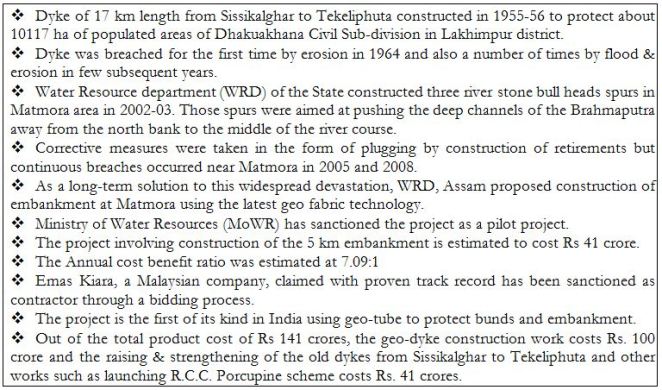
India's First Geo-tube embankment in Matmora in Dhakuakhana sub-division of Lakhimpur district in Assam.  Photo: Parag Jyoti Saikia
India’s First Geo-tube embankment in Matmora in Dhakuakhana sub-division of Lakhimpur district in Assam. Photo: Parag Jyoti Saikia

But the increased costs may also be due to the use of Geo bag technology for construction of Ranganadi embankments. Use of Geo-bag technology is a costly affair but nothing has been mentioned about the use of this technology in the minutes of 118th meeting. This is stated in the annexure (Annex VI as mentioned in the document) of the meeting. Interestingly this annexure too has been mentioned only as a corrigendum.

3. No Detailed Discussion on Projects Considered This was very evident in the two previous analysis done by SANDRP and situation remains the same this time as well. In case of all the projects, including the ones considered for the first time, there was no detailed information or any detailed discussion. There is no discussion on technical viability of the project. Reading through the minutes gives an impression that approval for any project considered by TAC is fait accompli. There is no discussion about whether the project is a desirable project, if there are other options available, if this is the best option and so on. Under the mandate given to it, TAC is supposed to discuss all these issues. TAC accepted projects proposals with huge cost and time overruns but little enquiry has been made why such escalation happened.

Dhansiri irrigation project This is a glaring example of cost escalation. The project was discussed in the 119th meeting on 29.08.2013 for consideration of cost of Rs 567.05 crores. But, it was surprising to find that original cost of the project in 1975 was Rs 15.83 crores as according to the information available in Assam State Irrigation Department website.[1] The same website states that project started in 1975 and supposed to be completed 35 years later in 2010. In the TAC meeting a new time schedule of March 2015 was stated. The cost of the project has increased by 35.82 times over a period of 40 years but the advisory committee accepts proposal without much scrutiny or enquiry. There was no detailed assessment of the reasons for time and cost over runs (there is no question of delay due to clearances or agitations here) or whether this project which will take 40 years just to complete will be viable or not. On the contrary, the planning commission representatives said, “the benefit cost ratio of the project was 1.2 and any further escalation in cost would result in the project becoming techno-economic unviable.”

The TAC should have done a detailed assessment why the project took so long time to complete. But it seemed to be contended with the rational that the project authorities provided which was that due land acquisition and law and order problem the project has not been completed. But in the meantime minutes of the meeting also showed that that major components of the project are in advanced stages of construction with 93% of barrage work, 99% of the canal works and about 83% of works in the distribution system were reported to have been completed. There has been no detailed assessment in to any of these aspects.

Imphal Barrage project In this project, the cost of the project mentioned in the minutes of the 115th meeting contradicted with the cost provided in the annexure. The cost of Extension, Renovation and Modernization (ERM) of the Imphal barrage project as mentioned in the minutes is Rs 16.80 crores. But a letter from the Under Secretary, Govt. of Manipur to the Chief Engineer of Irrigation and Flood Control Department, Manipur dated 21.07.2012 stated the cost of the project as 23.41 crores. This reflects the lack of serious discussion over projects in TAC. It is also surprising that TAC, being the committee which gives the techno economic clearance to projects, does not have clarity about even the cost of the project.

4. No Discussion over Social, Environmental and Other impacts of the Projects The projects cleared by TAC have serious social, environmental and other impacts but the committee never discussed these impacts. TAC does not at all take into account the impacts a project would have on the environment.

In the 118th meeting (30.07.2013), while considering the proposal for flood management of Dikrong along with river training works on both banks, the minutes stated “Effectiveness of existing embankments of river Dikrong has been deteriorating due to lack of repair, siltation of river bed and consequential change in river behaviour, change in flow pattern due to release of Ranga Nadi hydel project etc.” But this is one of the rare instances when TAC mentioned about the environmental impacts on embankments. But rather than asking for more details on these impacts or to see whether embankment would really be a viable option or not, the TAC accepted the proposal. On the other hand nowhere the committee discussed what impacts an embankment has on river bed, siltation or downstream stretches of a river.

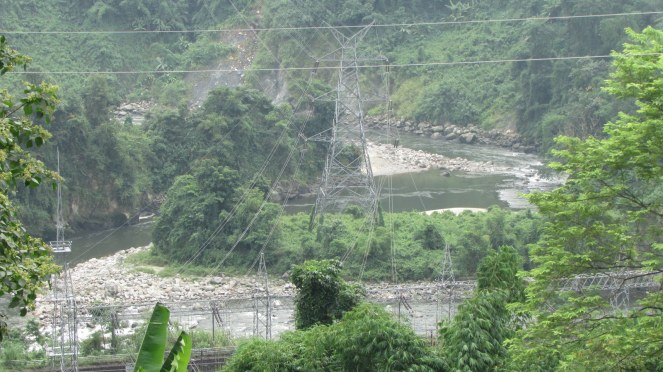
Dikrong Power Station at Hoz where water from Ranganadi HEP is released in Dikrong. Photo: Parag Jyoti Saikia
Dikrong Power Station at Hoz where water from Ranganadi HEP is released in Dikrong/Pare. Photo: Parag Jyoti Saikia
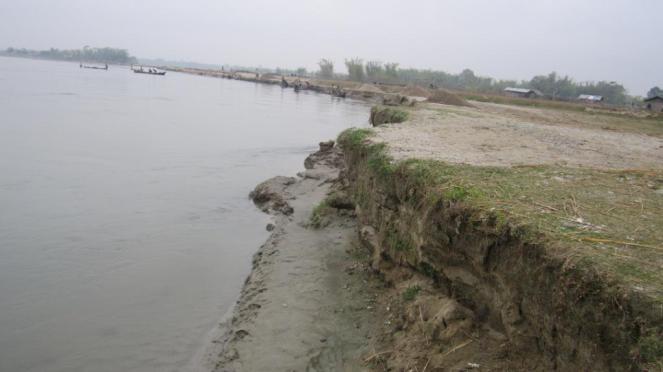
Dikrong at Dikronghat in Lakhimpur district of Assam where it erodes rapidly. The impacts of change is water flow is clearly visible. Due to release of water in upstream water at night covers the lower portion of the bank. This photo was taken around 8am in the morning when the water receded. The lower bank portion was wet in the morning. According to the local the water further recedes by the evening and again increases at night. Photo: Parag Jyoti Saikia
River Dikrong at Dikronghat in Lakhimpur district of Assam where it erodes rapidly. The impacts of change is water flow is clearly visible. Due to release of water in upstream water at night covers the lower portion of the bank. This photo was taken around 8am in the morning when the water receded. The lower bank portion was wet in the morning. According to the local the water further recedes by the evening and again increases at night. Photo: Parag Jyoti Saikia

It is also important to note here TAC also does not take into consideration impacts of the hydropower projects on the embankments in the downstream of the river. In the above mentioned case, the increased costs of Dikrong embankment should have been charged on the Ranga Nadi HEP, but there is no discussion on this. The Pare hydropower project (110 MW) in Papumpare district of Arunachal Pradesh is currently under construction on Dikong / PareRiver. Moreover there are at least 10 hydropower projects at various stages in the combined Ranganadi-Dikrong basin in Arunachal Pradesh, including one operating, three TOR approvals given and five additional MoA signed (in addition to a proposed project). There is no provision to assess the impacts of these projects on the embankments downstream of DikrongRiver in Assam. In fact there is no provision for any impact assessment study for embankments even though studies show the disastrous impacts of embankments on environment, floods and on the lives of the people living close to the river.

5. Clearing Same Embankment Projects over Years In terms of embankments, it is observed that the TAC had cleared same projects over the years. Not emphasizing on the environmental impacts of embankment projects is one of the major reasons for this. In the 117th TAC meeting held on 21.03.2013 the proposal for “Protection of Brahmaputra dyke from Sissikalghar to Tekeliphuta at different reaches from Lotasur to Tekeliphuta from the erosion of river Brahmaputra Assam” was considered. The estimated cost of the project was Rs 155.87 crore. But on the same embankment, a project titled “Raising and Strengthening to Brahmaputra dyke from Sissikalghar to Tekeliphuta including closing of breach by retirement and anti-erosion measures (to protect Majuli and Dhakukhana areas against flood devastation by the Brahmaputra, Lakhimpur district, Assam) was accepted in the 95th TAC meeting held on 20.01.2009. The estimated cost of the earlier project was 142.42 crore.

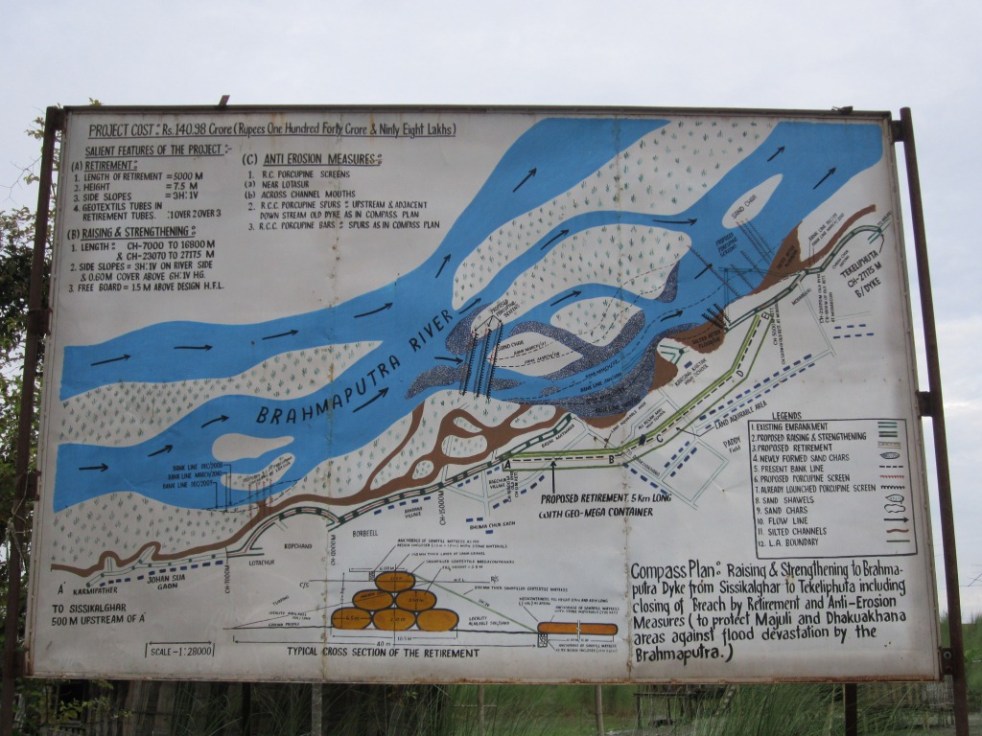
A Hoarding on the way to Geo-tube embankment in Matmora, describing the project.  Photo: Parag Jyoti Saikia
A Hoarding on the way to Geo-tube embankment in Matmora, describing the project.
Photo: Parag Jyoti Saikia

The minutes of the 117th meeting, about the previous scheme said that it “was taken up primarily for closure of breach in the then existing embankment including raising of embankment around the breach area only.” But the minutes of the 95th TAC meeting had said something totally different about the project. The minutes stated that project proposal envisaged – (i) Raising and strengthening of embankment for a length of 13.9 km, (ii) Construction of retirement bund with geo-textile tubes of length 5000 m. This shows how the discussion on the Brahmaputra dyke Sissikalghar to Tekeliphuta is 117th meeting is completely misleading. TAC does on even take into account its previous meeting discussions before clearing a project. This possibly gives a hint of a scam.

The Brahmaputra dyke from Sissikalghar to Tekeliphuta has a long history of facing severe erosions. The first geo-tube embankment was constructed on this dyke in Dec 2010. Crores have been spent for the protection of this embankment. But even after that the Dhakukhana sub-division always remained in the headlines during the flood season in Assam. There is need for area specific detailed study assessing the impact on and of the embankment, but little has been done in this regard. Besides, the Bogibeel Bridge, the fourth one on the BrahmaputraRiver, is coming up in the upstream of this embankment. Construction of this bridge would make this dyke even more prone to erosion since the length of this bridge will be 4.94 km, shrinking the wide river to great extent. In a personal visit to the area, one of the government officials informed that as a result of this “funneling action”, the force of water will increase and it will directly hit the embankment leading to more erosion. But TAC has never dealt with these issues in its meetings but cleared all the proposals that it considered.
Short History Brahmaputra Dyke from Sissikalghae to Tekeliphuta[2]

box text

6. There is no independent, critical voice in the meetings. The agenda, proceedings, or decisions of the meetings are not even in public domain.
7. There is no mechanism to hold the TAC accountable for any wrong decisions taken.
8. The TAC is clearly not fulfilling the mandate given to it in the guidelines for TAC meetings. The guidelines themselves need revision from several points.
9. There is no attempt to assess the justifiability of the kinds of projects that are being accepted and if they are indeed delivering the promised benefits.

Parag Jyoti Saikia (meandering1800@gmail.com)

Project-wise Detailed List of TAC decisions

110th meeting (20.07.2011): Accepted: TOTAL: Rs 211.56 crores

Sl No Project Dist/State Appr. year basin original cost (Rs. Cr) decision
1 Anti Erosion & Flood protection work Arunachal Pradesh New Tawangchu 36.47 Accepted
2 Protection of Majuli from Flood and Erosion Phase II & III Assam 2011 Brahmaputra 115.03 Accepted
3 Restoration fo rivers Dibang and Lohit to their original courses at Dholla Hatighuli Assam 2011 Brahmaputra 54.43 Accepted
4 Protection of Balat village from flood and erosion of river Umngi in West Khasi hill district West Khasi hill/Meghalaya  New Brahmaputra 5.63 Accepted

111th meeting (17.08.2011): Accepted: TOTAL: Rs 167.09 crores

Sl No Project Dist/State Appr. year basin original cost (Rs. Cr) decision
1 Protection of Biswanath Panpur including areas of upstream Silamari and Far downstream Bhumuraguri to Borgaon against erosion of the river Brahmaputra Sonitpur/Assam  New Brahmaputra 167.09 Accepted

112th meeting (14.09.2011): Accepted: TOTAL: Rs 48.55 crores

Sl No Project Dist/ State Appr. year original cost (Rs. Cr) decision
1 Improvement of Strom Water Drainage below GreenfieldAirport at Pakyong Sikkim  New 48.55 Accepted

115th meeting (24.07.2012): Accepted: TOTAL: Rs 2208.81 crores

Sl No Project Dist/State Appr. year basin original cost (Rs. Cr) decision
1 Thoubal Multipurpose project Manipur 1980 Brahmaputra 1387.85 Accepted
2 Khuga Multipurpose project Manipur 1980 Brahmaputra 433.91 Accepted
3 Dolathabi Barrage Project Manipur 1992 Brahmaputra 360.05 Accepted
4 ERM of Imphal Barrage Project Manipur New Brahmaputra 16.8 Accepted
5 ERM of Sekmai Barrage Project Manipur  New Brahmaputra 10.2 Accepted

117th meeting (21.03.2013): Accepted: TOTAL: Rs 623.25 crores

Sl No Project Dist/ State Appr. year basin Ht / L of Dam/Embnk. original cost (Rs. Cr) Benefit flood prot. (Ha) decision
1 Protecion of Sissi-Tekeliphuta dyke from erosion – Lotasur to Tekeliphuta Assam New Brahmaputra 153 km 155.87 10117 Accepted

1188h meeting (30.07.2013): Accepted: TOTAL: Rs 623.25 crores

Sl No Project Dist/ State Appr. year River/ basin original cost (Rs. Cr) Benefit flood prot. (Ha) decision
1 Flood management of Dikrong and river training works on both banks embankment Lakhimpur/ Assam New Dikrong/ Brahmaputra 105.96 9998 Accepted
2 Flood management of Ranganadi and river training works on both bank embankments Lakhimpur/ Assam  New Ranganadi/ Brahmaputra 361.42  21056 Accepted

119th meeting (29.08.2013): Accepted: TOTAL: Rs 601.67 crores

Sl No Project Dist/ State Appr. year River/ basin original cost (Rs. Cr) annual irrigation decision
1 Dhansiri Irrigation project Assam 1975 Dhansiri/ B’putra 567.05 Accepted
2 ERM of Singda multipurpose project Manipur  New Brahmaputra 34.62 3000 Accepted

120th meeting (29.08.2013): Accepted: TOTAL: Rs 42.96 crores

Sl No Project Dist/State River original cost (Rs. Cr) decision
1 Anti erosion work along river Haora from Champakpur to Baldakhal West Tripura Haora 42.96 Accepted

121st meeting (08.10.2013): Accepted: TOTAL: Rs 146.01 crores

Sl No Project Dist/ State River original cost (Rs. Cr) Benefit flood prot. (Ha) decision
1 Anti erosion work along river Gumti from Dlak Samatal Para to Durgapur under Amarpur, Udaipur & Sonamura subdivision S & West Tripura Gumti 54.99 2209 Accepted
2 Anti erosion work along river Khowaii from Netajinagar to Banglahour under Telimura subdivision and from south L. N. Pur to Paharmura bridge under Khowai subvision West Tripura Khowaii 91.02  4256 Accepted

122nd meeting (20.12.2013): Accepted: TOTAL: Rs 25.56 crores

Sl No Project Dist/State River original cost (Rs. Cr) decision
1 Loktak Lift Irrigation Project Manipur 25.56 Accepted

[2] From the brochure published by WRD, Assam at the time of commissioning the geo-tube embankment in Matmora

Expert Appraisal Committee · Karnataka

Tragedy of Errors : Environmental governance and the Sonthi Lift Irrigation Scheme

That small-time EIA agents and private project proponents put up sham EIAs and project justifications is not really news. People, from erstwhile Environment Minister Jairam Ramesh to Prof. Madhav Gadgil, have spoken famous lines about this issue.

But what if respected government agencies and departments too join this band wagon of fraud?

In the 69th meeting of the Expert Appraisal Committee of the MoEF[i], officials of Karnataka Bhagya Jal Nigam Limited and WAPCOS (Water and Power Consultancy, under the Ministry of Water Resources) earnestly discussed the ‘proposed’ Sonthi Lift Irrigation Scheme, which ‘envisages’ a non-submersible barrage ( dam) across the Bhima River in Gulbarga, Karnataka. The barrage and project would submerge over 1400 hectares of land and affect nearly 3000 people.

As per EIA Notification 2006, the project had applied for first stage environmental clearance (Terms of reference clearance) in which the EAC is supposed to appraise the viability of the proposal holistically, assess the pre-feasibility report (PFR) and Form I submitted by the project proponent and, if all these are found satisfactory, recommend specific Terms of Reference for carrying out Environment Impact Assessment (EIA) and Public Hearing of the project. On completing these, the project comes back to the EAC for Environmental clearance. Based on the EIA and public hearing, EAC decides on recommends Environmental clearance (EC). EC is issued by the MoEF and only after this can the actual project work start.

This forms the backbone of the Environmental clearance process of the country, upheld by the EIA Notification 2006 and Environment (Protection) Act 1986.

Now comes the intriguing and sad part.

The Pre-feasibility report of the project, presumably done by WAPCOS, talked about Sonthi Lift Irrigation scheme, which ‘envisages construction of Sonthi barrage, its ‘proposed’ submergence and people who ‘may be affected’. Form I by the proponent talked about “967 structures which will have to be cleared in submergence village for the project”. Note here that WAPCOS is no small time EIA Agency, it is a part of the Ministry of Water Resources, Government of India.[ii]

The reality is that the Sonthi barrage with vertical gates, which the Executive Engineers and WAPCOS were ‘proposing’, already stands across the Bhima River near Sonthi village. While work on the barrage is complete, work on canals is also complete in some stretches and progressing in some. Contracts for this Lift Irrigation scheme, which was discussed for TORs in 2013, were issued by the Karnataka Government as early as 2005!

Completed Sonthi Barrage Photo: KBJNL http://www.kbjnl.com/Comp-CZ1-Sonthi-BCBAR-Bhima

And the status of the Sonthi LIS is not a secret either.

In fact, the Karnataka Bhagya Jal Nigam Limited website itself sports a picture of this barrage and states that: “Sonthi Barrage, with a capacity of 4 TMC is already completed!” (http://www.kbjnl.com/Ongo-CZ1-Sonthi-LIS)

The website states:

Location:

Across River Bhima near Sonthi Village of Shahapur Taluk.
Utilisation 4.00 TMC
Components Bridge cum Barrage across River Bhima.
Head Work – 1 No.
Main Canal – 23 Km, Branch Canal – 16 Km
Yargol Minor Canal – 10 Km & Distry. Network.
Command Area 16,000 Ha.
Status of work

Sonthi Bridge cum Barrage completed.
Head work in progress

The barrage completed with all 37 gates of the barrage fixed, work on the canals of the Lift Irrigation scheme is also progressing water is stored and work on feeder canal is completed, branch canals on going fast and completed in some stretches. According to KBJNL, Civil work of barrage & Erection of all 37 vertical gates completed and water stored at Barrage. Construction of Feeder Canal work is completed. Works of Sonthi LIS Main Canal Km 0.00 to 5.00 including Aqueduct, Sonthi Branch canal Km 0.00 to 7.00, Distry. No.1 Km 0.00 to 15 & Yargol Minor Canal works are in progress.” (http://www.kbjnl.com/Progress-Report)

CAG’s report

Ironically, not only is the scheme complete, but CAG had punched holes in the contracting of this LIS back in 2011.( http://agkar.cag.gov.in/docs/ARPSU%202013-Eng.pdf ) According to CAG Report, No. 4, Commercial of 2011, Karnataka, modifications of converting a submersible bridge into a lift irrigation scheme have happened on the barrage and Sonthi barrage has already been modified into a Lift Irrigation Scheme. CAG has recorded irregularities in awarding contracts for this extended work also to the same contractor, without proper tendering process. CAG proves that contracts for converting the submersible barrage into a non-submersible barrage and Lift Irrigation Scheme were given as early as 2005, nearly a decade before the project came for first stage environmental clearance!

According to teh CAG report: After award of the work (June 2003) the Company (Karnataka Bhagya Jal nigam Limited) decided (December 2003) to construct a non-submersible bridge on a request from the Minister for Minor Irrigation (October 2003). This resulted in increase in quantity by more than 125 per cent of tendered quantities. The same contractor was entrusted (Nov 2004) with the additional works necessitated due to change over to non-submersible bridge at the cost of Rs  7.85 crore.”

“On the directions of the Government (Dec 2005) Sonthi bridge- cum-barrage was modified to include lift irrigation scheme also. Construction of steel embedment works for vertical gates and the associated additional civil works at the cost of Rs 30.15 crore were also entrusted to the same contractor.”

Media reports also support this change into a Lift Irrigation scheme way back in 2005 ““The Government has increased the scope of the Sannati barrage ( which is the same as Sonthi barrage, as the place is called Sonthi as well as Sannati) and converted it into a lift irrigation scheme to utilise 4 tmcft of water to irrigate more than 17,000 hectares. Mr. Singh laid the foundation stone for the redesigned Sannati lift irrigation project on June 16 2005”

Karnataka Bhagya Jal Nigram Limited or WAPCOS however, did not share this advanced status of the work with the MoEF and went on talking of the ‘proposed’ barrage in the EAC meeting.

69th EAC Meeting: SANDRP sent a submission to the EAC ahead of the 69th meeting in which the project was considered, exposing this state of affairs. Following this, the 69th minutes of the EAC note: “It was informed to the project proponent  that a complaint/representation against the project from SANDRP has been received. As per the complaint, construction work for the project has already been started.  In that case, this is a violation of Environmental Protection Act, 1986. The project proponent was given a copy of the complaint and was asked to give a detailed response. The EAC also advised MoEF to write to State Government on the violation and take necessary action/ settle in accordance with provisions of prevalent office memorandum on such violation.  The proposal may be placed before EAC only after this issue is resolved.”(Emphasis added)

Public Hearing of an existing Project?!

Despite these clear instructions by the EAC we are shocked to see that Karnataka State Pollution Control Board has announced on its website that Environmental Public hearing of the Sonthi Lift Irrigation Scheme will be held in Sonthi village on the 23rd March 2014! (http://kspcb.kar.nic.in/pubhear.html)

The announcement is also accompanied by Executive Summary of EIA report and a complete EIA report. This EIA will not stand legal scrutiny as this is done without TORs from the MoEF. The Kannada version of the EIA report also bears the name of WAPCOS.

Shockingly, both the Executive Summary and the EIA paint a fraudulent picture that the project has received TOR clearance in the 69th EAC meeting, when we saw above that this is categorically incorrect.

The EIA report states: “The Terms of Reference (TOR) for the EIA study were approved by MoEF. A copy of the approved Terms of Reference for the CEIA study is enclosed as Annexure-I.”

The EIA Executive Summary states: “Annexure III: TOR Clearance, 69th Meeting Minutes.”Annexure III consists of the 69th Minutes and has shockingly removed the parts of the minutes which unequivocally state that TORs have been rejected.

(It has removed: “The proposal may be placed before EAC only after this issue is resolved”)

These consciously misleading statements are completely unexpected and unacceptable from the Karnataka Bhagya Jal Nigam Limited as well as WAPCOS.

COPY PASTE EIA!

The travesty does not end here. The EIA report by WAPCOS is a confusing document. Though it is meant for Sonthi LIS, Karnataka,large parts of the report mention Kundalia major multipurpose project from Madhya Pradesh!

For a lift Irrigation Scheme, without any drinking water supply angle, the reader is told: “The proposed Kundalia Major Multipurpose project will provide 20 Mm3 Improvement in agriculture production of water every year to meet drinking water requirements. This will serve a population of 1.35 million, who will be served with low fluoride levels. Thus, Rajgarh district, which is categorized as fluoride affected, will be immensely benefitted due to the project.” (Page 10.6)

This repeats with unerring regularity at various places like 10-4, 10-6, 10-8, Table 2.2 (Cost required for Kundalia Project), 9.1 (Prediction of impacts!), many places at 9.7, etc.

The EIA further extolls the benefits of Kundalia Multipurpose Project in an EIA document of Sonthi Lift Irrigation Scheme!

In fact the EIA of Kundalia was also done by WAPCOS.

SANDRP and a number of organisations have pointed out the severe issues with WAPCOS’s EIAs, basin studies, cumulative impact assessments tudies, etc. Even Forest Advisory Committee of the MoEF has passed strictures on WAPCOS. But it seems that WAPCOS is insulated against these errors, which severely affect communities and ecosystems.

Complete reading of the EIA report highlights:

  • Wrong figures of affected population: EIA Report (10-2) states that 2861 people will lose their lands and 1760 people would lose homesteads. Same page states that 2004 people would lose lands. Topping this, section 13.3 states that in total only 942 people would be affected! (From 852 families, so this is assuming 1.1 persons per family!!). Its interesting to see that the agency could not get the numbers right even for a project which is already existing.
  • Wrong impoundment figures: Chapter 5 of Hydrology states: The Sonthi Lift Irrigation Scheme envisages construction of a barrage across Bhima River near Sonthi village in Chittapur taluka, Gulbarga district, in Karnataka to impound 4 TMC of water including a dead storage of 0.265 TMC. Chapter 2 Project Description states: Sonthi Lift Irrigation Scheme envisages construction of a Barrage across Bhima River to impound 2.89 TMC of water including a dead storage of 0.265 TMC!
  • Cost: Page2-13 gives cost at 502 crores. Page 2-14 gives it at 600 crores.
  • Gross irrigated area and Culturable command are the same at 16800 hectares. Irrigation intensity should thus be 100%, its shown as 105%!
  • Rehabilitation: Although the barrage is built and is storing water, rehabilitation of the affected population still not done.

This is only indicative list of the cut and paste instances, inconsistencies and contradictions in the EIA.

 All in all, it is clear that Public hearing for Sonthi Project should not be held on the grounds of:

1. Absence of TOR from MoEF due to violations

2. Violation of Laws

3. Cut Paste EIA Report

4. Serious issues with the quality of the EIA Report

We urge KSPCB to cancel this public hearing immediately and take action against KBJNL and WAPCOS for making wrong statements of TOR clearance given by EAC when, EAC has not given any such clearance. Not doing so will implicate KSPCB in these illegal activities.

The case of Sonthi LIS is critical as it negates nearly all aspects of the environmental governance surrounding dams in this country. It has violated EIA Notification 2006, EPA 1986, it has conducted a sham EIA study without TORs, the EIA is a copy paste document and we do not even know the status of the displaced population. The question here is not about 16000 hectares of irrigation. If the project had undergone honest and transparent environmental appraisal, it would not have affected the irrigated area. The question is how serious are we in implementing, upholding and respecting laws protecting people and environmental and our entire environmental governance system.

SANDRP has sent submissions to the EAC, MoEF as well as the KSPCB to cancel this sham of a public hearing for an existing project. Our eyes are now at the KSPCB and MoEF to see what action do they take against a project which undermines rules laid down by the MoEF and the laws of the land.

-Parineeta Dandekar, SANDRP

parineeta.dandekar@gmail.com


Climate Change · Maharashtra

Maharashtra farmers face impacts of hailstorms and State’s “Inaction” Plan on Climate Change

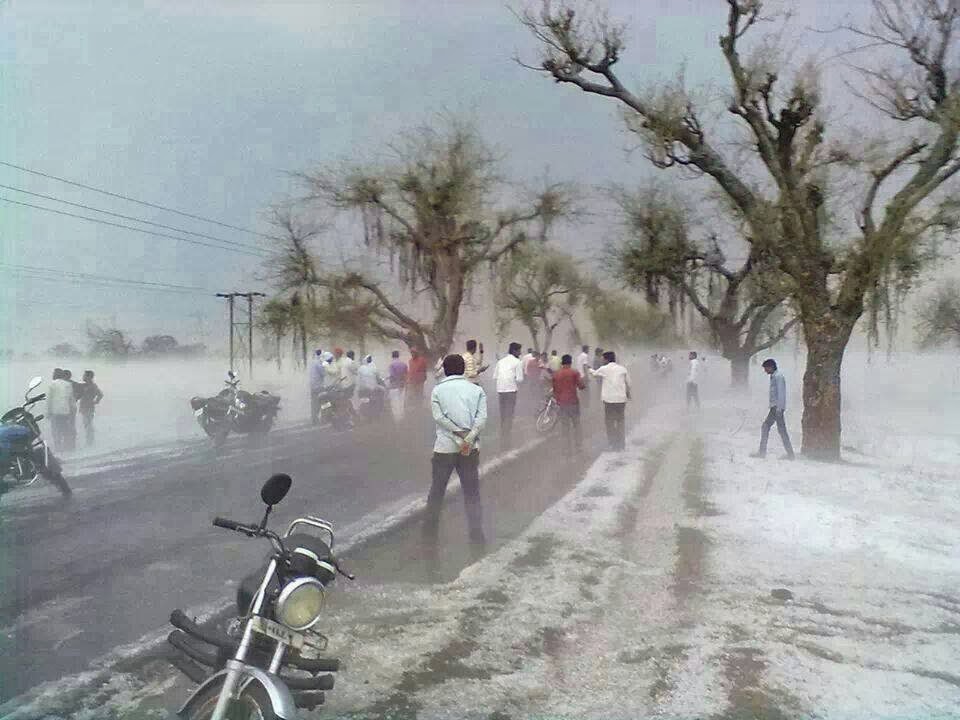
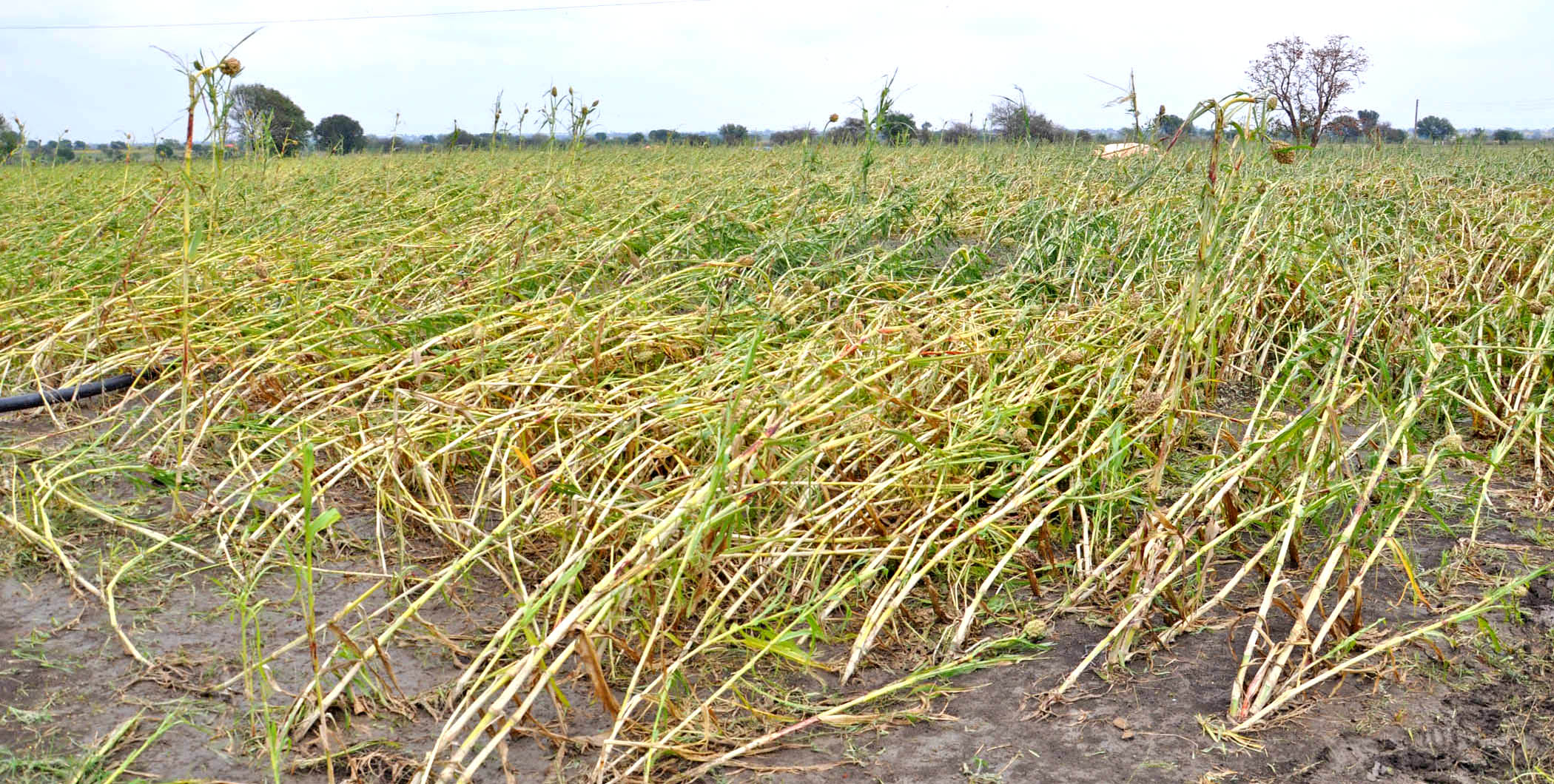
Marathwada, Vidarbha, Northern Maharashtra and parts of Western Maharashtra are reeling under unprecedented hail storms and unseasonal rainfall. Hailstorms in end of February 2014, initially thought of as a one-off phenomenon, continue to batter places like Solapur for nearly two weeks now, absolutely destroying the farmer. Rabi crops like Wheat, Harbhara, Cotton, Jowar, summer onion are lost, horticultural crops like Papaya, sweet lime, grapes are battered and orchards which took years to grow are ridden to the ground. For many farmers the tragedy is unbearable as majority of crops were about to be harvested. Turmeric was drying in the sun, grapes were waiting to be graded, wheat was harvested and lying in the fields.

Hail in drought-prone Baramati. Photo from : eSakal

According to a preliminary estimate and news reports, crops over 12 lakh hectares have been severely affected, thousands of livestock, animals and birds have succumbed to injuries and diseases, which threaten to spread. Around 21 people have lost their lives to the disaster.[1]

Grapes destroyed. Photo from : Loksatta
Destruction in Latur Photo from: Dainik Ekmat
Hailstorms Photo from : eSakal

The hailstorms developed as a response to hot, damp air from Bay of Bengal as well as Arabian Sea, rising and meeting the cold air coming south from the Himalayas, which led to formation of huge hail. This, though, is a very preliminary understanding of the phenomenon and hopefully, a clearer picture will arise in some time.

According to news reports, Madha Taluka in Solapur alone received 208 mm rainfall, Kurduwadi received 154.1 mm rainfall and Pandharpur received 63.95 mm rainfall in a single day[2].

SANDRP compared this rainfall with the 1901-2002 district wise rainfall dataset of IMD available at India Water Portal. 208 mm rainfall in Madha in March 2014 is 771.79% higher than the highest recorded monthly district rainfall for Solapur District for the entire month of March in the 100 years between 1901-2002! The highest total recorded rainfall of March for the district was 26.95 mm in 1915 [3]. Similarly, 65 mm rainfall received by Ausa Taluka in Latur[4] is 146 % higher than the highest 100 year recorded March rainfall of the district in 1944. Similar is the case with Parbhani, Akola, Wardha, etc.

While district rainfall masks extreme spikes due to averaging and also due to the distribution and location of rain gauges, this is truly unprecedented.

But is it also truly unexpected?

Is Climate Change an unknown phenomenon to us? IPCC[5] has predicted that in peninsular India, rainfall patterns will become more and more erratic, with a possible decrease in overall rainfall, but an increase in extreme weather events. What we are witnessing is certainly an extreme weather event.

That climate change is happening and that the reasons are anthropological is beyond debate[6]. Unfortunately, Climate change, its scientific status, its impacts, adaptation and mitigation strategies to cope with the changing climate do not enter discussions in functioning of Maharashtra government with any seriousness. Being a fuzzy, global phenomenon, linking climate change to singular events is difficult, though climate scientists are unanimous that there is footprint of climate change in each such extreme weather event.

The complexity of this issue does not allow us to brush the issue under the carpet. In the recent floods of United Kingdom, the issue of climate change was debated and led to serious discussions between researchers, climate scientists, politicians and policymakers and it seems that it will lead to an action plan.[7],[8]

Significantly, there are studies that claim that Marathwada and other regions of Maharashtra are vulnerable to Climate Change. In a 2012 paper by ICRISAT “Vulnerability to Climate Change: Adaptation Strategies and Layers of Resilience” (2009-2012) by Naveen Singh et al, which was highlighted in the latest edition of Adhunik Kisan, a Marathi magazine on agriculture, the authors have warned that Semi-Arid Tropics (SAT) in Maharashtra (as also the country) are specifically vulnerable to Climate Change. Their analysis of Maharashtra has shown that Marathwada and parts of Vidarbha are particularly vulnerable to climate change challenges, which include increase in the incidence of extreme weather events. Vulnerability index depends not only on the changing climate, but also on the vulnerability of the communities in the region: Despite hundreds of dams, agriculture in Marathwada region is mostly rain-fed, miniscule area which is irrigated appropriates all the water and grows sugarcane: a crop fundamentally unsuitable for a drought prone region, making the lesser endowed communities more and more vulnerable to challenges posed by climate changes or even small natural oscillations in the weather. This was seen very starkly in 2012-13 drought, when the region had highest area under sugarcane in Maharashtra, but several villages did not have water for drinking and dams became pawns at the hands of politicians-cum-sugar kings of the region.[9]

The ICRISAT Paper says, “In the SAT region, [10]Rainfall variability over the years is the major cause of yield uncertainty and makes rain-fed agriculture one of the risky enterprises in SAT India.

In SAT region of Maharashtra, long-term climatic analysis undertaken by ICRISAT shows “an average rise of 0.02°C per year in annual temperature in the last 40 years. In addition, the mean surface air temperature is projected to rise by 1.7-2.0°C by 2030 and 3.4-4.5°C by 2080 from the 1960-1990 . According to simulation studies, there can be productivity losses from 5% to 18% from 2030 to 2080 if no effective mitigation measures are undertaken. Differential degree of drought together with unpredictable rainfall variability has become common. This situation makes it difficult for the farmer to take pre-emptive decisions, resulting in crop and economic loss. Everyone is affected by this sudden change in weather. However, the extent of damage caused will be dependent upon each one’s ability to cope with the deleterious effects. The evidence, although incomplete, is indicative of major changes in the climatic conditions at macro levels. However, this masks the situation and variance at the local level. Greater vulnerability at the local levels implies greater pressure at the state and national level governance systems to respond to prevent the spillover effects such as urban migration, socio-political instability and conflicts, national poverty indicators, increased demands on disaster response systems, depletion of food and fodder production, etc.” However, there is no mention of increasing coping capacity of the vulnerable and compensating those who lose and demanding that those who are responsible (High consumption sections of the world and India) pay for these impacts in this long list.

According to an undated report ‘Climate change in Maharashtra’[11] brought out by Met Office (Hadley Centre, UK), TERI and Government of Maharashtra:

  • “Increased temperatures and altered seasonal precipitation patterns (both quontum and timing) could affect the hydrological systems and agricultural productivity.
  • Increased risk of severe weather events may have a      devastating impact on agriculture, water resources, forestry and the well-being of the population.
  • TERI states that due to changing climate, Sugarcane yield in Maharashtra could go down by 30%

 When all this is known, what is Maharashtra’s response to these predictions and the looming challenge of Climate change?

 The National Action Plan on Climate Change was made public in June 2008 amidst huge fan fare by PM Manmohan Singh.[12] It was mandated that states will come up with State Action Plans for Climate Change by 31st March 2011. These State Action Plans would outline the vulnerability of the state as whole as well as specific regions and specific communities in the state to Climate change and recommend a strong adaptation and mitigation plan for overcoming these challenges. Till date (11th March 2014), SAPCCs of 12 states have been submitted to the MoEF. [13]

Maharashtra Cabinet had reportedly approved a State Action Plan for Climate change prepared by its environment department on Aug 20, 2009[14], however, the Maharashtra’s Action Plan is not finalized till date. When enquired about the status of this plan, the Director in Environment Department, Government of Maharashtra told SANDRP that they had contracted the plan to TERI and TERI has not completed the task till date.

Given the gravity of the issue, the State Action Plan for Climate Change is supposed to be overseen by a High Powered Committee, whose Chairperson is the Chief Minister, with participation from ministers of Urban Development, Public Works, Transport, Agriculture, Water resource, Revenue & Forest, Energy, industry, Food, Civil Supplies & Consumer Protection Department and Education Department.[15] The agenda and minutes of meetings of this High Powered Group should have been in public domain, but none are.

A formal contract was signed between Government of Maharashtra and TERI in March 2010 and TERI was supposed to submit a complete report in two years, i.e., by March 2011. However, Maharashtra still does not have a state action plan, indicating its lack of seriousness about Climate Change and vulnerable communities.[16]

As Maharashtra continues to be battered by hailstorms, rainfall and winds, it is not useful to get into discussions of whether this is due to climate change or not. The challenges right now is to devise strategy that will help the most vulnerable sections of Maharashtra: its farmers, more than 85% of whom practice rain fed agriculture. It is time not only to seriously revamp the nearly non-existent disaster management systems, but also the weather prediction and crop insurance systems. To build resilience of farming communities, reliance cannot be put on monoculture like sugarcane which does not allow even protective irrigation to a large proportion of farmers outside the sugarcane belt.

After closely spaced events like Mumbai floods in July 2005, Phyan cyclone in 2009, 2012-13 drought, erratic monsoon rainfall and current hailstorms, Maharashtra cannot afford to drag its feet on addressing climate change challenges, organizations like WOTR are specifically working on strengthening capacities of local communities to adapt to challenges thrown by Climate change[17]. Let us hope that at least State Action Plan on Climate change is finalized, not only by the experts from far away, but with full participation of the people of Maharashtra. Similar rain induced damages are also being witnessed in the North India and scientists fear that the coming monsoon may suffer due to El Nino effect. (http://timesofindia.indiatimes.com/business/india-business/Fears-of-El-Nino-on-rise-may-spell-woes-for-the-economy/articleshow/31824485.cms)

In the meantime, the least that the government of Maharashtra and also the Union Government can do is to compensate the affected farmers irrespective of red tapes and Codes of conduct.

High-end consumers and polluters of India and abroad contribute to climate change, which ironically hits the poorest sections  of the society harder. This gives an added urgency to address these linked issues.

Parineeta Dandekar, parineeta.dandekar@gmail.com


[1] Sakal (Marathi) Newspaper, 11 March 2014

[10] The semi-arid tropics (SAT) region is characterized by highly variable, low-to-medium rainfall and poor soils, further characterized by lack of irrigation. In general, the historical average annual rainfall in the SAT is below 700 mm. In agricultural policy terms, this region is considered to be a less favored area (LFA) (ICRISAT)

[17] http://www.wotr.org/climate-change-adaptation

http://www.wotr.org/audio_visuals_english/does-it-ever-rain-time

[18] VERY TRAGIC story of how hailstorms have hit poor farmers in Marathawada in Maharashtra: http://www.livemint.com/Specials/jkcra6zQqMShlFJjzmvXeN/Death-and-despair-in-hailstormhit-Marathwada.html

[19] Maharashtra State Action Plan on Climate change: Farmers Suffer, State and consultant TERI unaffected https://sandrp.wordpress.com/wp-admin/post.php?post=2529&action=edit

Maharashtra

Vijay Pandhare’s letter to Dr. Chitale: “Please fix responsibility of the irregularities”

It has been reported that the Special Investigation Team under the Chairpersonship of Dr. Madhavrao Chitale has submitted its 1300+ pages report on the Dam Scam and practically no increase in irrigated area in Maharashtra, to the Chief Minister.

Dr. Chitale has reportedly said that no political person has been named in the report, supposedly because it was not the mandate of his committee. In his words: “There was no question of mentioning the name of any minister or bureaucrat for the wrongdoings in irrigation sector as it was not permissible under the given guidelines. At the very beginning, it was made clear that findings will be very impersonal. The objective of the committee was never to engage in fault finding of any individual (politicians or bureaucrats) but rather larger concerns related to the systemic lapses that resulted in the cost overruns and allowed manipulation of rules,” 

This, though expected from Dr. Chitale, is entirely incorrect as the TORs to the SIT by the GOM, dated 31st Dec 2012 clearly mention 2.9: “If irregularity is found in investigations, the committee will fix responsibility and suggest further action.” in addition, the systemic lapses that have occured in Maharshtra have been sytematically abetted by many for personal gains. Not even attempting to fix the responsibility,is akin to giving a clean chit to the strong perpetrators.

The SIT report is not in the open domain as yet, but if it has indeed shied away from specifically naming guilty politicians, bureaucrats and engineers, then it is hugely problematic. The links between politicians, bureaucrats and engineers have been made clear by a number of whistle blowers of the irrigation scam at grave personal risks. The SIT had all the resources, the mandate, the time and the opportunity to investigate charges and radically influence Maharashtra’s irrigation sector. But right from the beginning, the SIT refused to look into matters of corruption, clearly indicating that it will not ‘dirty its hands’ and will go with the status quo, which suited the ruling government. Supporting Status Quo at such important juncture comes at a huge social cost. SIT’s composition as well as its stand was challenged by many, including SANDRP. (SANDRPs Press Release, Piece by Pradeep Purandare, New Reports, Pani Dhoran Manch PR)

One of the most significant whistle blowers of the Dam Scam, Vijay Pandhare, who was then the Chief Engineer of Irrigation Dept had written a scathing letter to Dr. Chitale in March 2013, when Chitale refused to investigate any evidence given by leader of opposition Vinod Tawde about corruption in the Irrigation sector.

This letter ( obtained and translated from Marathi into English by SANDRP) indicates Pandhare’s impassioned appeal to Dr. Chitale to investigate charges and fix responsibility as per the mandate of the committee.  Pandhare in fact says that: “If the SIT is going to be escapist about the issue of corruption, then it is better that you resign, listening to your inner voice, because such escapism would not be in the interest of the state.” He produces many evidences of wrong doings in the WRD. The scale of the problem described in the letter is staggering. We look forward to how these matters have been treated by the SIT Report.

Parineeta Dandekar, SANDRP

VIJAY PANDHARE WRITES TO DR. MADHAV CHITALE, MARCH 2013

 From: 

Vijay Balawant Pandhare

Chief Engineer,

Maharashtra Engineering Research Institute, Nashik, and

Member, State Technical Advisory Committee,

Nashik- 422004


Dt- 16th March 2013

To,

Shri. Madhavrav Chitale,

Chairman,

Special Investigation Team,

WALMI, Aurangabad

Subject- About inquiry into technical and financial discrepancies in Water Resources Department of Maharashtra


Respected Sir,

Regarding the subject sited above, it is learned through news reports of 6th March 2013 and through the broadcasts of Marathi news channels that, you have wrote to the Leader of Opposition Mr. Vinod Tawade stating your committee is not empowered to inquire officers and political representatives.[1]

In fact, while determining the mandate of your committee TORs explicitly mention “fixing the responsibility against any discrepancy and suggesting suitable action against it”.[2] The government has clearly mentioned in your mandate that “fix the responsibility against the discrepancy”. So, your stand that the Special Investigation Team (SIT) doesn’t have any investigating power is against this mandate. It is like Lord Ram deciding that he will not attack the evil spirit or will not oppose it. If you are not going to unmask these corrupt spirits through the special investigation team, would we have the moral right to seek respite from Lord Ram? Moderate and honest people like you are required to lead the bandwagon against such corrupt people and dishonest mentality. Such an opportunity is created because of the constitution of SIT. We believe that you would capitalize on it. ( Emphasis added, throughout the letter) The anarchy created in Water Resources Department is because of the non-functional office-bearers. If the officers would have been alert and selfless, such a catastrophic situation would have never come, however, it has been difficult in our times to see good officers rising through the ranks. It seems that picture would be very gloomy from here on. Therefore, it is your first responsibility to identify people who are responsible for such a situation, those who have created discrepancies and fix the responsibilities. After outlining the mandate, the state government has thrown a ball in your (SIT) court. Therefore, it will not be acceptable to adopt a stand which turns a blind eye towards all of these malpractices. The government has nowhere said that the committee has not investigative powers. The very name of the committee itself is a “Special”. Isn’t it contradictory to take up such a stand when the committee itself is called “Special Investigation Team” then? On the other hand, the committee should ask for complaints from all the people and investigate them all. But your stand seems to be something else altogether. Please don’t continue with that. (Emphasis added). There is no prohibition on any committee for accepting complaints from the people and collecting sufficient information pertaining to the investigation. If the committees like Vadnere, Kolwale, Mendhegiri etc. can determine the responsibilities on the defaulters, why can’t the SIT under Mr. Chitale?[3]

Earlier officers never took a firm stand against such malpractices which eventually culminated to degradation of Irrigation department. The responsibility of improving the situation has been entrusted with your team, otherwise, history will never forgive us. If the committee is going to be escapist about the issue of corruption, then it is better that you resign , listening to your inner voice, because such escapism would not be in the interest of the state. I can understand (although don’t justify) the attitude of political representatives about the scam, but honorable people like you need to take a strong stand to make the department disciplined. Im sure that escaping from this duty and saying that Pseical investigation team does not have the power to investigate is not something that your conscience would agree with. Despite that, your statement regarding Tawade’s letteris a clear indication that the team would shy away from such investigation. To improve the situation in Irrigation department, some surgical measures should be taken otherwise the financial crisis of the state would persist in the foreseeable future. I want to remind you that around 14-15 years back we personally met in Aurangabad and I had told you how pathetic and corrupt the administration has become. That time too, you had said that the political representatives have taken charge of everything and you were resigned in saying that it’s difficult to change the situation. But now the destiny has entrusted you with the responsibility to end these malpractices. We request you to please carry it out with the help of Mr. Ranade. It would be very unfortunate for Maharashtra if you are not going to fix the responsibilities against the observed malpractices, something which is clearly in the mandate of your team. If the projects are not getting completed even after 25-30 years, isn’t it a serious blunder by the policy makers? Shouldn’t we fix the responsibility ? Is it not sinful to float tenders, make payments against inflated costs, financially weaken the state and push people into drought situations? If you’re not going to prevent such practices, then who will? I was extremely surprised to learn about your stand. If you really want to serve for the betterment of Maharashtra, then taking a strong stand against such practices so that nobody would dare to tread this path is very much expected from you. If we all decide, then we will have “Ram-rajya” in our country. But if we are moving away from Lord Ram’s ideals, we have no turn to him for the help. (Emphasis added)

I’m enlisting the discrepancies that I observed while working in Water Resources Department. Kindly investigate them and fix the responsibilities against the defaulters so that nobody would ever dare to indulge in such practices.

Discrepancy No. 1-

Without investigating or envisaging properly, irrigation development corporations have approved budgets with inflated costs and have granted tenders at higher price to the contractors. This has resulted in wastage of billions of rupees of public funds. We request you to thoroughly investigate all the discrepancies and fix the responsibilities. So that, no political representative or contractor or engineer would ever indulge into it.  If no inquiry is conducted, these people would keep looting the state as well as nation with boosted confidence. That’s why the honest and selfless people should try to prevent such malpractices otherwise it is beyond doubt that our coming generations, our nation and the democracy will have a dark future.

For example, please note the projects in Tapi Irrigation Development Corporation-

  1. A.      Sulwade Lift Irrigation Scheme (Cost ₹ 2100 Cr)
  2. B.      Bodwad Lift Irrigation Scheme ( Cost ₹ 2200 Cr)
  3. C.      Prakasha-Burai Lift Irrigation Scheme (Cost ₹ 700 Cr)
  4. D.      Varangaon-talwel Lift Irrigation Scheme
  5. E.       Padmalay Lift Irrigation Scheme
  6. F.       Kurha-vadoda Lift Irrigation Scheme

Like these, thousands of tenders have been awarded. It is requested to permanently stop such cases.

Discrepancy No. 2

The projects that have been approved by respective development corporations have always witnessed increase in their scopes. You can find many such projects. White paper enlists such modifications under each scheme. Such modifications/ increments have been approved without giving proper thought to their impacts and hence these projects are bound to fail. Because, the projects which have been approved at inflated costs get less funds allocations and eventually results in the projects remaining incomplete for more than three decades and there is no way these projects would be complete in next 30 years either. Therefore, the officers and politicians who approved such changes should be held responsible for these discrepancies.

Discrepancy No.3-

The way in which each development corporation has cited their cost break-up would stun anyone. It is clear that the interests and the benefits of the contractors have been secured by employing multiple tricks. It has been a very common trend in Konkan and Vidarbh Irrigation Development Corporations. Other corporations are not an exception either. The episode of the inflated costs paid against the steel pipes in Jigaon Project Lift Irrigation Scheme is indeed well-known. Vidarbh Irrigation Development Corporation itself has cancelled ₹ 2900 Cr tenders because those were based on such inflated costs. We request the SIT to investigate such discrepancies in the budget of the said projects. To prevent such incidences from happening again, such incidences should be thoroughly investigated and defaulters must be brought to the book. Please investigate the cost sheets of following items-

  1. 1.       Hearting and casing items
  2. 2.       Pitching items
  3. 3.       Rising main and steel pipe items in lift irrigation schemes
  4. 4.       Radial gate fabrication rates
  5. 5.       Dewatering items, excessive dewatering
  6. 6.       Concrete and masonry items

The SIT should also probe the various reasons cited for increasing the costs.

Discrepancy No-4

There have been humongous discrepancies in the “C” grade tenders. In most of the cases, despite being “C” level tender, “EIRL”s of hundreds of thousands of rupees have been passed and even the claims have been settled too. Therefore, it is necessary to investigate all the EIRLs and claims against them from all the development corporations. The SIT should ask for information in a tabular form about all the EIRLs and respective settled claims from all the irrigation development corporations, and probe the serious cases. Otherwise there would be no check on such malpractices.  For example, I’m referring to the Nardawe project EIRL here. Despite being a “C” tender, KIDC (Kokan irrigation Development Corporation) has granted EIRLs worth ₹ 30-40 Cr. Moreover, it has also settled the claims for machinery idle charges without taking due permission from the state government. Due to less availability of funds, the contractors have made it a trend to show that their machinery have been idle on paper and have been receiving the idling charges. Big projects have been approved with administrative approvals and now idling charges are being paid citing the unavailability/ insufficiency of funds. Projects are incomplete for years because of unavailability of funds and according to price escalation clause of the tenders, hundreds of thousands of crores are being paid to the contractors. The situation is so grim that the actual expense incurred on work is marginal and that on price the escalation is multifold. For example, let’s see the Sulwade Lift Irrigation Scheme of Tapi Irrigation Development Corporation. Work order was granted 14 years ago. Because of unavailability of funds, ₹ 15 Cr have been spent on the actual work. However, during the same period, the price escalation has been of ₹ 700 Cr! There are many such projects which have not begun in last 14 years. The responsibilities of such agonizing planning must be fixed on responsible people.

Discrepancy No. 5-

The earthen dams which are being constructed under B-1 tender, exhibit “excessive” cross-sections while the works under “C” tender have “under-sized” cross sections. Engineers from Central Design Organisation:  MERI must have had a hand in this. This is commonly known but nobody talks about it. The best example of how these engineers from the mentioned organizations have given wrong design is of Radial gates. The variations made for the same sized radial gates are worth visiting. The radial gates size of Gosi-khurd, Shelgaon barrage, and Lower Tapti projects are same. In fact, their weights should have been more or less identical. But, their weightages have been absolutely irrational. Weightage of Lower Tapti is 208 MT/Gate but that of Gosikhurd has 159 MT/ gate weightage. This one example is sufficient. The weight of steel has been increased by around 1000 folds. To stop such things, SIT should give special emphasis on such practices and prevent their repetition.  Against this backdrop, Konkan, Krishna valley, Tapti, Godavari and Vidarbha Irrigation Development Corporations should be thoroughly investigated. Nardawe project of KIDC has two Cut of trench (COT). Such technical irregularities have been followed which must be stopped. The investigation of Balganga project would yield many shocking cases. It would be interesting to check how much cement grouting and expenses have been incurred to stop the leakage of Bhatsa project.

Discrepancy No.6.-

There have been numerous attempts in Maharashtra to raise the height of the dam wall. The existing dams do not get completely filled in the first place. Despite that, the department has consented to raise the dam wall height in hundreds of dams. Raising height has always been an expensive affair which has resulted in increased expenses. It has been a norm with Maharashtra’s Irrigation Department that anybody would ask for raising the height and the department would float the tender.  Considering the availability of funds with the state, contemplative policy makers would not have indulged in such things. But the unwise leadership has encouraged such attempts and dealt a permanent damage to all of us. It is clear that receiving cuts (percentages) against floating tenders has been a common norm here. If you would enlist the projects which witnessed such height raising, the SIT would understand the irregularities.

Discrepancy No. 7-

Many high cost and unviable projects have been undertaken/ are proposed to be undertaken under the name of increasing irrigation. When there has been no feasibility on the site, is there a case for floating high cost budget? While we have shortage of funds, such expensive affairs would not have been advisable. But some political representatives and engineers have made us bankrupt. I’m enlisting few projects here, the SIT should probe into them-

  1. 1.       Manjarpada Project Phase 1, Nashik
  2. 2.       Nerdhamne Project- Akola
  3. 3.       Shahapur Project- Akola
  4. 4.       Waghadi Project- Amaravati
  5. 5.       Chandrabhaga Project- Amaravati
  6. 6.       Kawatha Project- Amaravati

Despite the financial crunch in the state, nobody has bothered to talk sense into the cost estimates. How could we ever adopt the projects worth ₹ 15, 10, 5, 4, 3, and 2 thousand crores? The SIT must probe into this. It shows the prevalent mentality of satisfying political agendas from public funds and siphoning it off as much as possible. It is our responsibility to uproot such mentalities. Otherwise the democracy will not survive. We will see selfish anarchy rising in our country. We have come a long way from selfless leaders like Gandhi- Nehru to our current tender-floater leadership.

Discrepancy No-8

There is an urgent need to probe the tunnel works being done in Krishna river valley. There have been many tunneling works undertaken in Krishna valley without any rational basis. If one checks the rate analysis of all the excavation work, the rates would appear to have been inflated. There have been many big tunnels undertaken instead of small ones. It is a common practice to float the tender with small sized tunnels and increasing the size of the tunnel later on. SIT should probe into the works undertaken for all the tunnels so that such mistakes won’t be repeated. If the team would investigate the tunnel works in Manjarpada-1 project, such practices would be unmasked.

Discrepancy No.-9

Many projects have been granted water availability certificates from the जलविज्ञान कार्यालय (Hydrology Project) of the government as a special case, which are violations of law. The SIT should make a list of all such cases and probe them to avoid repetitions. Despite the lack of water, projects are undertaken and then they never fill up for years together. Painaganga valley has seen several such examples and still, the water availability certificates have been granted 1.5 times more than the actual water availability on ground. We request you to investigate them all.

Discrepancy No 10-

There has been no master plan for any of the irrigation development corporation approved at the government level. In absence of approved master plan, the projects have been pushed forward. We would not have been in such an unfortunate situation if the state government would have prepared a master plan and then adopted the projects accordingly. Policy makers and secretary level bureaucrats are responsible for not approving such a master plan. There is a need to fix the responsibility of this irregularity and the government must plan its irrigation-related works according to a master plan. But some political leaders don’t let this happen because they want to earn unfair profits out of it. Kindly suggest a measure which would permanently do away with this malpractice.

Discrepancy No 11-

There has been an unfortunate trend in Maharashtra of showing a new project as a part of old project on the papers and floating the tenders without taking administrative approval. Hundreds of projects have been undertaken in such a fashion. SIT should ask for the information from all the development corporations and fix the responsibility of respective irregularity. 12 barrages of Godavari, Manjarpada 1 project could be cited for example. Therefore, we request you to suggest a permanent solution against this malpractice.

Discrepancy No. 12-

It is such a shame that the projects are not being completed for 20-40 years. It reflects our poor thinking and planning. We need to put a cap on the budgets of the projects. The planning should be such that any project must be completed within 5 years. We should stop the costs of projects running as high as ₹ 5, 10, 15 thousand crores. If the political leaders from the areas of Takari, Mhaisal, Tembhu lift irrigation schemes have not been able to complete these projects despite being in power, when would the projects of other areas be completed? The team must contemplate on this and create a work discipline in Maharashtra. Kindly fix the responsibility for taking so many lift irrigation schemes when not even 1% of the 300 schemes undertaken by the irrigation department are operational. Kindly suggest the measures for future so as to prevent the wastage of public funds.

Discrepancy No. 13-

There have been many irregularities in Mechanical department (यांत्रिकी विभाग) of Water Resources Department. Vigilance cell has received many complaints. Executive engineer, vigilance team, Pune has submitted the report to the government saying there have been humungous irregularities in the Mechanical wing. I request to inquire into it so that there would be a discipline within the mechanical wing. Nobody is paying attention to irregularities in that division.

Discrepancy No. 14-

There has been no provision for technical audit in the department. Therefore, there has never been a verification of technical matters. To prohibit people from indulging in technically flawed work, it is requested to start a technical audit on the basis of AG. Therefore, there would be check on technically flawed decisions. All planning has collapsed because of the wrong estimates.

Discrepancy No 15-

Currently the state government doesn’t supply the cement for the project works, contractors buy it on their own. Therefore, the department has lost control on cement usage. There has been a tremendous corruption in cement related matters. The main reason behind stopping the supply of cement has been that the contractors find it difficult of sell the cement after the work is done. However, no irrigation development corporation has ever undertaken the thorough check up of delivery challan and excise gate passes as per the tender conditions. Therefore, there is a huge corruption in cement usage. SIT can easily prove it. There would be a shocking revelation- and it should come out- if once checks the used cement, verified delivery challans and gate passes. Every engineer knows it but they prefer to keep quiet. But, SIT should probe this and fix the responsibilities. 23 km long lining of Gosikhurd Left Bank Canal has been completely taken out because of the poor quality. The reports of executive engineers of Maharashtra Engineering Research Institute (MERI), exposing the poor quality of work done in Lower Tapi and Tarali have been suppressed. Please at least stop this corruption by supplying cement to contractors. People would be grateful to you if you could do that.

Discrepancy No. 16-

There have been too many irregularities in the irrigation department under the name of Arbitration. A closer look at all the cases of arbitration would surface these irregularities and malpractices. Especially in Marathwada, Pune, Konkan divisions and more so, in Koyana project, the corruption has been many folds. The arbitration has been the best example of how the officials indulge in corruption instead of taking the decisions in the best interest of the country. Therefore, there is a need to re-audit all the arbitration cases. Please suggest strong measures to prevent such things from happening again.

Discrepancy No. 17-

Right now, the IPI circles are almost equal to none in the water resources department. Therefore, the contractors themselves prepare the budget estimates. They prepare the estimates as they please, get them approved using political pressures and siphon off the public funds. That’s a norm! This has to stop immediately and the department must newly create IPI circles in each regional department. Isn’t it obvious to the government? To the political representatives? But they all have deliberately made those mistakes. I request to find the defaulters in those cases.

Discrepancy No 18-

Earlier the state also used to provide steel to the contractors. But now contractors themselves buy the steel. Like cement, the department has lost its control on steel usage and the risk of re-rolling steel being used in the work has increased. This is indeed serious. Therefore, it is requested that the steel should be supplied under Schedule-A like before. People who have taken such wrong decisions must be identified along with their faults.

Discrepancy No. 19-

I also request you to probe into all the steel gate fabrication works done by contractors for the rates of fabrication. In Jigaon Lift Irrigation Scheme, the fabrication rates- like the steel pipe rates- have been divorced from reality. If you would check the gates on Tapi, you can realize how the costs have been inflated. If all the irrigation development corporations are asked to submit the steel fabrication rates, irregularities of crores of rupees would be exposed.

Discrepancy No 20-

There has been a tremendous corruption in all the corporations under the clause 38 and claims. Therefore, it is requested that all the clause 38 and claims cases of all the corporations be investigated. One would be surprised by the subsequent revelation of how the costs and respective works are inflated. It is worth investigating how the officers and politicians have joined hands to commit “mistakes”. Engineers know the kind of pressure and tensions faced by the good officers who were opposing these decisions. Everybody knows how the people opposing it were insulted. These incidences are common in KIDC and so also in other corporations. Those should be investigated.

Discrepancy No. 21-

Cost of many items has been inflated beyond comprehension in all the corporations. It would be really an eye-opener exercise to check how the revised administrative approvals have been granted year-wise. For example, if you would compare the earlier tenders with the budget estimates in the Tapi Irrigation Development Corporation, you would easily find the irregularities. They have been happening all over. The rates have been inflated tremendously. Comparing the rate analysis method that was adopted before 1980 and the one in effect now would prove it. By use of machines, the rates should have actually gone down but they have been raised by deploying various tricks. Investigating in such cost escalation and finding the defaulters is the need of the hour so that nobody would ever dare to indulge in such malpractices.

Discrepancy No 22-

The tenders have been awarded with high costs across all the corporations. If the true competitive bidding would have taken place, the tenders would have been awarded with 25-30% lesser rates and the works would have also been done because the rates of the rate index were higher as well. Instead of that the tenders are awarded with the higher percentage. Everyone knows how the tenders are floated at the government level. SIT should probe into all the tenders which have been awarded above percentage. The 3 large bridges which were built by Tapti Irrigation Development Corporation in the submergence area are higher than the current rate index by 60%, 70% and 80%. This is a serious irregularity. Probing into such high cost tenders awarded by all the corporations would yield the serious corruption in public expenditure. That’s why ₹ 2900 Cr tenders had to be cancelled in one go. Such a shame!

The costs of barrages built on Godavari, are raised by constructing a large dam without any reason. This is a shameful waste of money when there has been a financial crisis. Everybody has fallen prey to such hideous plans. All of these actions should be investigated into and the defaulters must be brought to the book.

Discrepancy No. 23-

Some of the irregularities have been brought to your notice. Apart from these, it is requested to you to suggest strong measures to prevent ground level and foundation level scams. Please assign at least three people to cross check such activities. It saddens me to think how much state is losing in all of such scams. But everyone seems to have become insensitive. Those who oppose it are transferred. Politicians don’t even know about technical sins. We need to stop all such mismanagement and misuse of power. The crimes pertaining to such adjustments would be exposed by checking the earlier Cement delivery chalan and gate passes of RA-bills.

Discrepancy No 24-

All the corporations have been routinely floating the tenders for a project based on the designs of other project and later on escalating the costs by several folds based actual design. It is requested that such information be collected from all the corporations and identifying the responsible people so that these irregularities would never occur.

Discrepancy No 25-

The high cost tenders are floated just to siphon off public funds. What can you call this practice- of preparing a budget estimate with hundreds of thousand crores, awarding the tender, spending around ₹ 10-15 Cr only in the beginning against the advance, and then for next 14 years, the project doesn’t get any money while the cost of the project rises from ₹ 600 Cr to ₹ 2100 Cr!

Do you think these projects would ever be complete? The worst cases in this regards are Sulwadi, Jamphal Lift Irrigation Scheme, Prakasha-Burai Lift Irrigation schemes etc. The tenders of hundreds of thousands of rupees of the projects on which less than 25 % of funds have been spent must be cancelled with immediate effect. Instead, the works costing less than ₹ 100 Cr should be undertaken otherwise the state would never come out of the financial crunch.

Discrepancy No 26-

There needs to be a thorough investigation into Takari, Tembhu, Mhaisal Lift Irrigation Schemes. Despite spending crores of rupees in last 25 years, the farmers are not getting water. The responsible people must be unmasked after thorough investigation. The machinery installed 20-25 years ago has its days numbered. Isn’t the expenditure totally wasted? What is the use of the projects which can’t even irrigate 10-15 % of the promised irrigated area? It is requested that kindly compile the information from respective departments and probe into them. Please suggest strict measures about Lift Irrigation Schemes as well. (It is also requested that please investigate Krishna Marathwada Lift Irrigation Schemes, Khuntefal storage lake, Kurha- Vadoda Lift Irrigation Schemes as well).

Discrepancy No 27-

Granting the advance money while there is no provision in the tender has also been one of the unfortunate norms. It is requested to collect the information from the respective corporations and identify the defaulters. For example- Five lift irrigation schemes of the Tapi Irrigation Development Corporation.

Discrepancy No. 28-

All the irrigation development corporations have indulged in floating and awarding the tenders without legitimate surveys and optimum designs. I request you to seek the information on all such cases and find the defaulters. All the “C” Tenders awarded in the state fall under this irregularity. Therefore, please fix the responsibility of such “C” Tenders after conducting due investigations, especially in case of “C” tenders awarded under Krishna valley, Tapti and Kokan irrigation development corporation.

Discrepancy No. 29-

We have many projects in Maharashtra which have violated the I. S. Code norms and received approvals. 12 barrages on Godavari are the best examples of such violations. I would not be surprised if sooner or later these barrages would create some or the other kind of problem. Not taking flood design into account as per I. S. Code, especially in case of river like Godavari, is a serious blunder. I request you to investigate all such cases from respective corporations and fix the responsibilities.

Discrepancy No 30-

All the corporations have been floating and awarding the tenders without completing land-acquisition and rehabilitation of the affected families and obviously projects keep lagging for years together in absence of such important formalities. It is requested to find the responsible people and fix their responsibility

Discrepancy No 31-

It’s an open secret why the files are sent back to cabinet minister for “Liability Sanction” after completing all the due procedures of awarding the tender. The truth would come out if the data-wise investigations are carried in all such cases of liability sanction. Such kind of hegemony never takes place in any of the states in India. Please look into the matter and suggest preventive measures.

Discrepancy No 32-

In most of the estimates about the projects of Konkan and Vidarbha, though the excavation works have been done with the help of machinery, lift schemes are proposed in the rate analysis. So also in cases of pit filling works done using the machinery of hearting. Please summon the respective corporations over such irregularities, ask for the detailed reports and fix the responsibilities on defaulters.

Discrepancy No 33-

The budgets and estimates prepared by all the corporations are never checked/ cross-checked properly and are directly submitted to the state technical advisory committee. All the irrigation development corporations have been indulging into this. Nobody has so far been suspended no matter how many blunders the person committed. So, everyone has become fearless of law and the politicians have become god fathers of such corrupt people. Kindly investigate into all such matters and find the defaulters so that such activities would stop.

I’ve highlighted some of the major irregularities happening in the department. I request the SIT to come out with the measures which would prevent repetition of such things. It is further requested to take away powers to transfer the officers from politicians. The situation would be much different if the politicians are kept out of these transfer mechanisms.

Also, there should be no involvement of politicians as far as tender processes are concerned. The unfathomable corruption in tender processes would stop only if the politicians are kept at bay. Kindly recommend robust measures for that.

Lastly, I beg you for recommending the government to move away from constructing large dams, big canals, huge lift schemes, and budgets spanning over millions of rupees etc. otherwise the situation would never improve.

There is a need to revisit the fundamentals of irrigation schemes and adopt small dams, water conservation measures like Shirpur patterns etc. Large dams should be taken up only in exceptional cases. The situation seems pretty grim considering the large dams, canals, and distribution networks that we have undertaken in last 50 years. We need to check if the area which was supposed to be irrigated, has really been benefited. There is no point in digging wells for the purpose of percolation either. What has happened to the commitment that we had made in the beginning? Its review would prove that our total irrigation efficiency doesn’t even exceed 15%. So please review and revisit our irrigation policies. The state would have had much better irrigation had the Shirpur of such small, appropriate technology patterns had been adopted. Unfortunately the state has suffered the most because of the people with insatiable greed for power and money- be it engineers, or politicians or contractors. The political leaders have stripped the state of all its possessions. Therefore, I beg you to drastically change the irrigation policy. I pray to the ultimate creator that you would change the situation for the betterment of Maharashtra.

It does not matter if the team would need an extension, or if an additional investigation team would be composed, but, please create an order in the state.

Yours,

Vijay Pandhare

Chief Engineer META and

Member, State Technical Advisory Committee

Nashik 4

Attached:

Letter dates 20.02.12 ( 9 pages)

Letter dated 5.5.12 (15 Pages)

Letter dated 12.10.12 ( 4 pages)

Copy to:

Hon. Governor, GOM, Mumbai for appropriate instructions

Hon. Chief Minister, GOM, Mumbai for appropriate instructions

Hon. Chief. Secy, GOM, Mumbia for appropriate action

Hon. Principal Secy, Irrigation Department, GOM, Mumbai

Shri. V. M. Ranade, Retd. Secy and Member, SIT

Translated from Marathi to English by Damodar Pujari


[2] From SANDRP: TORs of SIT , GOM, 31 December 2012, Point No. 2.9 States: If irregularity found in the investigation, it should be investigated, responsibility should be fixed and action to be taken should be suggested.

[3] We have shifted the placing to this para

Arunachal Pradesh · Expert Appraisal Committee

Hydromania in Arunachal Pradesh: Massive 1850 MW Dam Planned Without Any Basic Data, Not even Water Flow Data…

‘MoU Virus’ was the term used by former environment minister Jairam Ramesh in May 2008 to describe the speed at which the Memorandum of Understanding or MoUs for hydropower projects were signed by Arunachal Pradesh government. Five years after that virus attack, the ill-effects are clearly visible. The construction of Lower Subansiri hydropower project has been stopped for 26 months now. Environment and Forest clearances are yet to be accorded to 3000 MW Dibang Multipurpose dam, even though the foundation stone for this dam was laid by none other than the Prime Minister Dr. Manmohan Singh on 31st January 2008. Lower Siang hydropower project public hearing was vehemently opposed by people. But learning no lesson from these, the government of Arunachal Pradesh and the center is going ahead with its gigantic plan to make Arunachal Pradesh the ‘future powerhouse’ of the country. In doing so scientific studies and ground realities have been blatantly neglected.

Oju hydropower project in the Subansiri river basin with a proposed installed capacity of 1850 MW is the latest example of the hydromania, which has gripped the government of Arunachal Pradesh and the center. Oju HEP is the upper most project proposed on the Subansiri river in the Upper Subansiri district with a catchment area of 9827 sq. km. up to the dam site. The project was considered for Terms of Reference (TOR) or first stage of environmental clearance by the Expert Appraisal Committee on River Valley and Hydroelectric projects (EAC) in its 72nd meeting held on 20th and 21st February this year. But there is little information available about the actual situation of the project area.  Before going any further, consider the following situations –

Any scientific study is yet to be done at the dam site. Water flow data which is a prerequisite for construction of a hydropower dam is not available for the proposed dam site. No gauge and discharge measurement site at the project site or anywhere in the catchment of the dam.

The project area is totally under forest cover. It holds rich biodiversity which is yet to be explored.

* There is no road to reach the project area. The distance between the dam site of Oju hydropower project and Limeking town, the last point of motarable road is 60 km. From Daporijo, the headquarters of Upper Subansiri district, the dam site is 210 km away. 

Tentative Road Network to Project Site Source: Oju PFR
Tentative Road Network to Project Site
Source: Oju PFR

A small hydropower project is proposed to be constructed in a nearby stream in order to fulfill the electricity requirement during the construction of the project.  

SNC-Lavalin, the consultants hired for preparation of detailed project report, is known to be one of most corrupt engineering firms in the world.

All the situations mentioned above are drawn from the project documents submitted to MoEF. It was shocking to find that without any environmental baseline assessment, the Pre Feasibility Report and Form I made all kinds of sweeping assertions. This hydromania is leading to nothing but ignorant, unscientific and corrupt decision making. 

SANDRP after reviewing the project documents, made a detailed submission to EAC on February 13th pointing out the critical issues related with Oju HEP. We asked the EAC not to consider the project for TOR clearance. We also demanded that the project proponent should  be  asked  to  get  at  least  five  years’  daily  water  flow, gauge, rainfall and sediment data at the project site before applying for TOR clearance. The critical issues mentioned in SANDRP’s submission on Oju HEP to EAC are listed below.

Critical Issues of Oju HEP

No More Projects Should be Cleared in Subansiri basin before Completion of Basin Study From 20007 to 2013, four projects in Subansiri basin has been considered by EAC along with one sub-basin study. All the four projects have been given TOR clearance. Subansiri Upper HEP has been given TOR extension on 6th June 2013. The total installed capacity of these projects are 4960 MW. It is also important to note that 2000 MW Lower Subansiri project is in under construction phase. This implies that nearly 6960 MW of capacity has already been given clearance by EAC without any cumulative impacts assessment study of Subansiri basin being completed through a participatory process. This capacity is in addition to the small hydropower projects in the basin.

The Subansiri sub-basin study was discussed for the first time in 68th EAC meeting in 2013. In that meeting the EAC had stated that “optimal number and locations of HEPs and similar projects to be planned in the basin conforming strictly to ecological and environmental sustainability is to be clearly delineated.” This can only be known once the basin study is completed.

In this situation, no more projects in Subansiri basin should be given any clearance till the cumulative study is being completed. Besides, the EAC must take into account the fact that cumulative impact assessment study of the basin is major demand of the organizations whose agitation has stopped the construction work of Lower Subansiri with the support of the people of Assam. Therefore it is very essential that a through and detailed cumulative impact assessment study is done for Subansiri in participation with all the people of the basin. Without this, clearances given to projects would face the same fate as the Lower Subansiri project is now facing: Work stopped for 26 months till now.

A list of projects cleared by EAC in Subansiri basin is given below.

Sl. No Project State Sub-Basin Ins Cap Status Meeting date Total Area Req. ha Forest Land, ha
1. Subansiri Lower AP Subansiri 2000 Under construction EC on 16-07-03 4111 4039.9
2. Subansiri Middle AP Kamla 1600 TOR Approved 25-09-10 3180 1333
3. Nalo HEP AP Subansiri 360 TOR Approved 11-12-11 662.94
4. Naba AP Subansiri 1000 TOR Approved 03-05-13 658
5. Subansiri Upper AP Subansiri 2000 TOR Ext Granted 06-06-13 3155 2170

Premature application Reading the PFR and Form I on the EAC website shows that project has come rather prematurely for TOR clearance. There is no gauge and discharge measurement site at the project site or anywhere in the catchment, the nearest site is at Upper Subansiri dam site with catchment area about 50% higher than that of Oju HEP. Even for this site, the flow measurement observations are available only for 6 years. How can optimum parameters of a massive project with 1850 MW capacity be formulated without any flow measurements, which is the most important parameter for hydropower project. Even now the flow measurements do not seem to have begun. There are no roads to the project area. It should be remembered that this is a virgin site, and there have been no environmental baseline assessments and yet the PFR and Form I are making all kind of sweeping assertions. The PP should be asked to get back with such an application only after they have at least five years of observation data of water flow and other parameters. That the application is premature is also apparent from the drastic changes the project capacity has gone through so far, as described in PFR. 

Oju HEP's nearest gauge is located in Menga, also the site for Subansiri Upper HEP. But there are four hydropower projects planned between Oju and Subansiri Upper.  Source: Form I of Oju HEP
Oju HEP’s nearest gauge station is located at Menga which the site for Subansiri Upper HEP. But there are four hydropower projects planned between Oju and Subansiri Upper. Source: Form I of Oju HEP

This premature-ness of the proposal is further confirmed when we see contradictory figures in the submitted documents about basic project parameters. For example dam height is given as 110 m (sec 8) at one place and 115 m at another place. Live Storage capacity is given as 2.065 MCM at some place, 3.3 MCM elsewhere (e.g. sec 4.4 of PFR). Power intake design discharge is given as 327.4 cumecs at some places and 333.39 cumecs elsewhere (e.g. sec 2.2 of Form 1).

Proposal in contradiction with Cumulative Impact Assessment This proposal before EAC for a 1850 MW Oju project is in contradiction with what is given in the Cumulative Impact Assessment (CIA) commissioned by the CWC and which was discussed in the 68th meeting of  EAC. The CIA says (see para 3 of Ex Summary) that there are two Oju projects: “Oju – I (1925 MW), Oju – II (2580 MW)”. However, the proposal now before the EAC is one project with capacity lower than any single project! However, Table on page 15 of CIA says Oju I has 700 MW and Oju II has 1000 MW capacity! The CIA says the submergence area of Oju I is 72.3 ha, though the proposal now before EAC for the same dam says the dam has submergence area of 42.3 ha! CIA says design flood is 10500 cumecs for Oju I (same dam as Oju now before EAC), but the proposal before EAC says PMF is much lower at 5983. This shocking series of numbers show that both the reports of Oju project before EAC and the CIA are misleading and do not seem to know what they are talking about. This is not an exhaustive list of contradictions, there are many more, this is only for illustration. 

Map of Subansiri RIver Basin  Source: https://sandrp.in/basin_maps/Subansiri_River_Basin.pdf
Map of Subansiri RIver Basin
Source: https://sandrp.in/basin_maps/Subansiri_River_Basin.pdf

Proposal different than allotment The PP was allotted two separate projects Oju I and II by Arunachal Pradesh government, but they have decided to club the two, but there is no agreement between Arunachal Pradesh and PP for the new parameters in the project proposed before EAC. Without such an agreement, EAC consideration of the project would be vacuous.

Huge Land Requirement The Form I of Oju project states that the area which will come under submergence due to the formation of the reservoir excluding the river bed is 34.3 ha. Including the river bed the total submergence is 43.2 ha. But the total land requirement is 760 ha implying that the required for dam, water conductor system, power house and other project appurtenances is about 727 ha. It is not clear why 760 ha of land is required for the project when reservoir submergence is 43.2 ha.

Contradictory figures about Land Requirement The Form I in the table providing basin information about the project states that “The total land to be acquired for the project is 760 ha.” But the PFR in section 12.2 in page 15 states “It is estimated that about 790 Ha of land would be required for development of the Project.” This shows that the project proponent is not clear about the land requirement for the project. 

Threat to Huge Forest area The construction of Oju HEP will be a threat to a huge forest area. Page 17 the Form I states “…760 ha of land with forest cover is to be acquired for the project. Forest cover is also observed within the project as well as area within 15 km from the project site.” But the PFR does not specify how much forest area will be actually diverted. 

River Subansiri flowing through its lush green valley

Installed Capacity is more than 1850 MW The installed capacity of Oju project is more than 1850 MW since a dam toe power house of 28 MW is also planned. This makes the total installed capacity in 1878 MW. The documents in most of the places mentioned installed capacity of the project as 1850 MW. The EAC therefore should ask the project proponent to apply for fresh TOR clearance with renewed installed capacity.

Oju Project Proponent aims to Construct Three Projects in the Name of One: Small Hydro project to Power the Construction Work The EAC should take a note that project proponent of Oju, is aiming to construct three hydro power projects in the name of one. We have already mentioned about the first two. Now in section 10.7 of page 10-7, the PFR documents states “The power requirement for construction activities is estimated to about 25.0 MVA taking into consideration the capacity of electric driven equipments which are to work during the construction period and lighting. The possibility of constructing small hydro power plants on streams in the vicinity of the project would also be explored at DPR stage.”

The Form I also mentioned about small HEP in page 10 -“The estimated peak requirement of power is about 25MW required for construction activity of major works such as tunnels, adits, barrage area and power house complex. Construction power requirement is proposed to be met by DG Sets/Small HEP.” Full details including impact assessment of this small HEP should be included in the TOR.

Stretch of Free Flowing River between Two Projects on Subansiri It is not clear how much flowing river stretch is available between Oju and downstream Nare HEP. According to the minimalist norms followed by EAC the free flowing stretch between two projects should be minimum one kilometer. But the PFR of Oju HEP have not clearly mentioned this distance anywhere. The Cascade development figure given in the PFR says that the elevation difference between TWL of Oju (1300 m) and FRL of Nare (1280 m) is just 20 m. If we look at the average slop at the site, this translates to about half a km. The PP should be asked to change the parameters to increase this to more than a km at least.

It is also important to specify this distance between two projects because of the cumulative impacts of the project. The Siang basin study in its recent version, which will be discussed in the same 72nd EAC meeting has asked to change the FRL and TWL of some of the projects because they have not kept minimum distance of one kilometer between projects. The basin study report in section 12.1.3 stated “…..it is recommended that FRL of three projects viz. Tato II, Naying and Siyom Middle should be slightly reduced so that free flowing river stretches of 1 Km can be maintained between FRL and TWL of these four projects in cascade.”

Therefore Oju HEP PFR should clearly mention the distance between its TWL and FRL of the downstream project. EAC also should make this compulsory for all the projects in other river basins.

Form I and PFR contradictory about the Generating Units The Form I of Oju HEP in page 20 states that the installed capacity of 1850 MW will be generated through eight units of 231.25 MW each. But PFR on the other hand, in section 9 of page 8 states “The underground powerhouse, housing eight units of 225 MW each, is proposed on the right bank of the river Subansiri.” It is surprising to find such contradictions in the Form I and PFR of Oju project.

The PFR in page 13 again states “As mentioned earlier, project’s installed capacity has been fixed at 1850 MW and correspondingly, eight generating units of 231.25 MW, each, are proposed in the powerhouse.”

Huge Diversion of the River The Oju HEP will divert a huge length of the river. Page 1 of the PFR states, “The dam site is located at about 60 km upstream of Limeking and powerhouse site is located at about 40 km upstream of Limeking on the right bank of Subansiri river.” This implies that the river has been diverted for 20 km between the dam site and the power house (The head race length is 14.82 km). . This is a huge diversion of the river Subansiri which will have disastrous impacts on the health and ecosystem of the river. But neither the Form I nor the PFR provide what is the length of the river to be diverted for the project.

Subansiri carries significant amount of sediment The PFR report of Oju project in section 7.5.2 states “Since Subansiri River is expected to carry some amount of sediment during monsoons, effective management of sediment removal from the reservoir should be ensured.” Stating that the river carries some sediment is not correct since this river system is known for high sedimentation due to its location in the young Himalayan mountain range.

Reference to this can be found in the January-March, 2003 issue Ecologist Asia (page 12) which was focused on dams in northeast “The catchments of the Brahmaputra and its tributaries show significantly high rates of basin denudation especially after the great earthquake of 1950. The catchments of the Subansiri, Jia Bharali and the Manas along with the Dihang (Siang) are estimated to have experienced an average denudation of 73-157 cm./1000 years over just 24 years (1955-79). The increasing amounts of sediment and water yields downstream indicate an increase in sediment yield by a whopping 240% accompanied by an equally significant rise of nearly 120% in water yield during the period 1971-1979 between Tsela D’Zong (China) and Ranaghat (India).
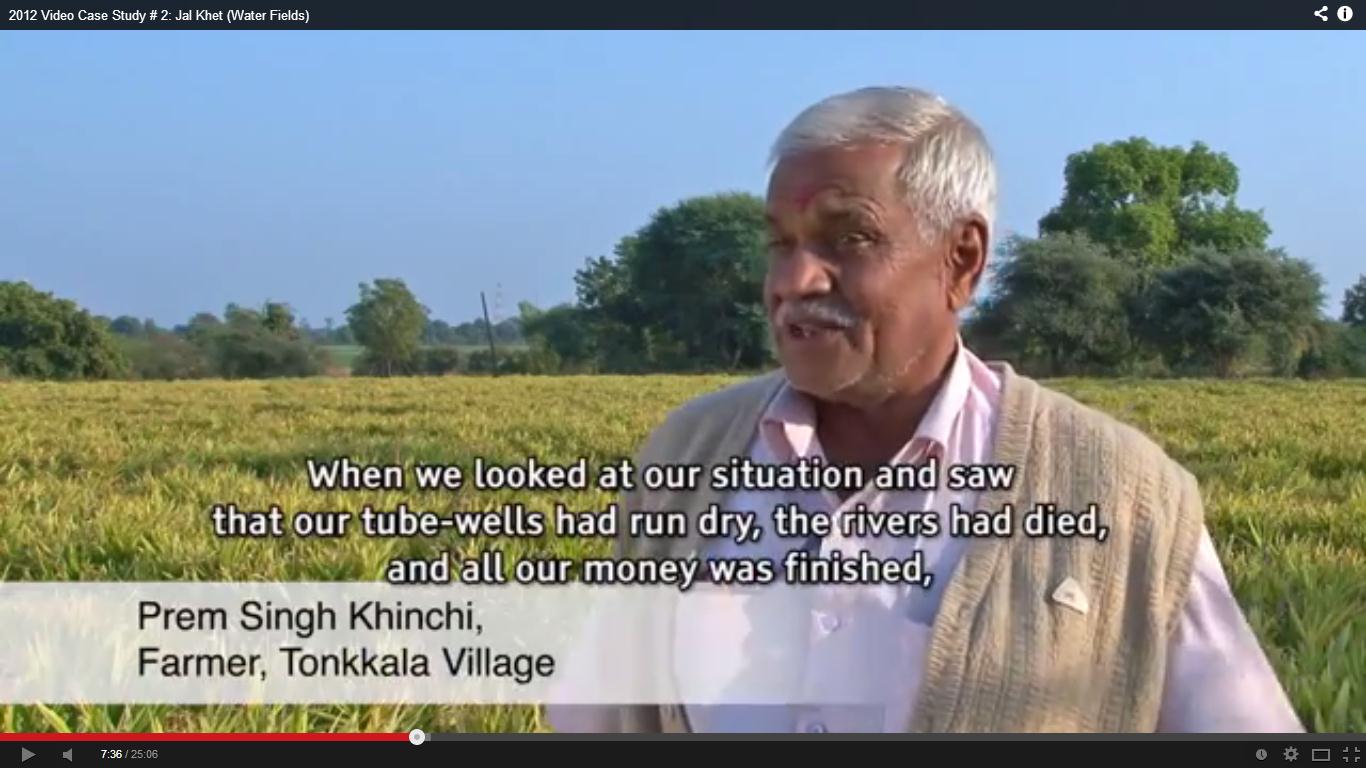
Therefore first the sediment flow should be properly assessed.

Detailed and Thorough Options Assessment A detailed and through options assessment should be done for Oju project. There can be several other cost effective options for power generation in this area and options assessment should look into all such options. The options assessment should also look at whether the local people or the state needs such a huge capacity hydropower project.

It is important here to note that successful sub-megawatt capacity hydropower projects (Less than 1 MW) are currently under operation in Anjaw district of Arunachal Pradesh. (see – Anjaw shines in hydro power sector).

The TOR for the project does not include the following key aspects:

1. Issues related to cumulative impact assessment due to various components of the project and various projects in the basin.

2. The disaster vulnerability of the area on various aspects like landslides, earthquakes, floods, etc and how these will change with changing climate and how the project will change the disaster vulnerability of the area. There should be a separate chapter in EIA on this.

3. The project should do actual environment flow assessment and not just take the EAC norms as given. There should be separate chapter in EIA on this. The statement in Form 1 section 1.24 “Environmental Flows as per MOEF norms shall be released” is thus clearly premature and unwarranted. Eflows should be on daily changing basis and not seasonal averages.

4. Full Downstream social and environmental Impact Assessment

5. Impacts Peaking Power Operations

6. Assessment of impact of reservoir operation and mechanism to achieve transparent, accountable reservoir operation.

7. Impacts of Silt Management operations at various points of time and space.

8. Impacts of Tunneling and Blasting

9. Impacts of Mining of materials for the project.

10. Impacts of Backwater Effects of the reservoir in flood season

11. Impacts of Climate Change on dam

12. Impacts of the project on the adaptation capacity of the people in view of changing climate

13. Impact of peaking operation of the project on downstream areas and communities

No de-sanding chambers proposed in Silt Laden River The PFR in section 7.5.2 in page 7-5 states that “In this regard, it may be noted that no de-sanding chambers are proposed in the project in view of a relatively high dam with reservoir extending to almost 3.13 km.” Keeping no provision of de-sanding or de-silting chamber in the dam could have serious impacts on reservoir operations.

Form 1 undertaking not signed Page 2 of Form 1 is supposed to be an undertaking about the accuracy of information in Form 1, but there is no name, place or date for the signatory, all places are blank.

Poor reputation of consultants The PP has hired SNC Lavalin as consultant for DPR. However, SNC Lavalin has poor reputation in their country of origin (Canada[1]), globally[2] and even in Indian state of Kerala[3]. How dependable would the work of such an agency be is a big question mark.

Parag Jyoti Saikia (with inputs from Himanshu Thakkar)


[1] Out of  over 250 companies on World Bank’s current black listed from bidding on its global projects under its fraud and corruption policy, 115 are from SNC Lavalin and its affiliates, see: http://business.financialpost.com/2013/09/18/canada-now-dominates-world-bank-corruption-list-thanks-to-snc-lavalin/

[2] See: http://www.huffingtonpost.ca/daniel-tencer/snc-lavalin_b_4110591.html, the company has been banned by the World Bank due to corruption issues: “SNC-Lavalin, the engineering giant based out of Montreal that has now pretty much become a national (and international) embarrassment.” Its CEO has been arrested more than once for corruption charges.

[3] See: http://en.wikipedia.org/wiki/SNC_Lavalin_scandal, there was a CBI inquiry in relation to hydropower projects related work and several politicians have been charge sheeted.

Mumbai · Narmada · Western Ghats

Crisis in India’s Urban Water Sector

More than 50 people including tribal groups, social activists, water experts, ecologists and wildlife experts, academics came together for a brainstorming workshop about Dams coming up for Mumbai Region. The meeting was organized by South Asia Network on Dams, Rivers and People, Shramik Mukti Sangathana, and Jalbiradari.

Meeting on Dams round Mumbai Photo: SANDRP
Seetaram Shelar of YUVA at Meeting on Dams round Mumbai Photo: SANDRP

About 12 dams are planned or are under construction to satisfy the increasing thirst of the Mumbai Metropolitan Region (MMR). All of these dams fall in eco-sensitive region of the Western Ghats. They will together submerge more than 22,000 hectares of land, including nearly 7000 hectares of forests, lakhs of trees and more than 750 hectares of Tansa Sanctuary. They will affect a minimum of 100,000 tribals who depend on the forests and their ancestral lands for livelihoods. These dams include Kalu, Shai, Balganga, Susari, Khargihill, Bhugad, Pinjal, Gargai, Middle Vaitarna, Barvi and Poshir, among others. These are in addition to the dams already constructed for MMR water supply.

Tribals and other affected groups of Thane and Raigad region have been strongly opposing these projects. Most people in Mumbai seem unaware of their struggles or impacts of these projects.

Most of these dams are escaping the social and environmental impact assessments and management plans, environment clearance requirements, environmental monitoring or public consultations due to blunders in environmental impact assessment notification of Sept 2006, which excludes domestic and industrial water supply projects from environmental clearance process. It signifies the environmental illiteracy of the officials and ministers at the Union Ministry of Environment and Forests. In spite of repeated letters, and acknowledging that this makes no sense, they have refused to change it.

Local protest against Pinjal Dam near Jawhar which can submereg 11 villages and 2000 hectares fo forests Photo: SANDRP
Local protest against Pinjal Dam near Jawhar which can submereg 11 villages and 2000 hectares of forests Photo: SANDRP

MMR has not done any sort of options assessment before pushing these projects and cursory review show that many options exist. At the city or Region level, there is no shortfall in water supply currently and the existing problems are due to inequitable, non-transparent, non-participatory and wasteful water governance in MMR. Municipal corporations under the MMR which are pushing new dams do not treat even 15% of their sewage. Bhiwandi Nizampur & Vasai Virar Corp do not treat ANY of their sewage. The Mumbai Region has no estimate of its rainwater harvesting potential, and there is little effective action in this direction despite high rainfall. Water supply and distribution losses are over 30%. Local water sources like rivers, lakes and wells are being destroyed by pollution and encroachments. There is no interest in democratizing governance of MMR water sector.

The meeting resolution urged the MMR region to address these issues first, which would lead to sustainable water supply to the city and suburbs. Konkan Irrigation Department which is constructing most of these projects has violated several laws related to tribal and forest rights, environment, forests and resettlement and has been mostly favoring a single contractor, illegally.

The meeting also strongly urged the MMRDA, MCGM, Municipal Corporations of MMR, Maharashtra government, Union Ministry of environment and forests, Maharashtra Forest Department, National Board of Wildlife and all others concerned to ensure that following steps are taken up urgently and in a credible way:

Þ     Undertake thorough options assessment for Mumbai’s (and also for other cities of MMR) water needs which includes groundwater recharge and sustainable use, protect and use local water sources, rainwater harvesting, sewage treatment and reuse, plug leakages, improve water supply efficiency, take up systematic demand side management measures etc.;

Þ     Undertake Environmental and Social impact assessments for all the dams coming up for Mumbai Region;

Þ     Take immediate action against KIDC for violating multiple laws while bulldozing ahead with projects and MMRDA for funding projects in the absence of clearances;

Þ     Respect people’s protests and Gram Sabha resolutions against displacement, deforestation and their refusal to give permission for these projects;

Þ     Take strong penal action against the officers and the contractors who have displaced Adivasis illegally;

Þ     Not resume any work or planning for any project before the above is done, stop work on projects in the meantime;

Þ     Change the EIA notification to ensure that all large dams are included for environment clearance, public hearings and EIA requirements;

Þ     Immediately institute a credible Cumulative Impact Assessment of the projects already constructed and advanced in implementation;

Þ     Institutionalize decentralized, democratic governance of water sector in MMR from bottom to top.

Forests in the Western Ghats are Mumbai’s and MMR’s lungs. They are the watersheds of rivers and water sources like Tansa and Bhatsa and naturally purify Mumbai’s & MMR’s drinking water. Rich tribal culture of Thane and Raigad is a shared heritage of Mumbai and we have no right to displace the tribals or destroy their livelihoods. This destruction in Mumbai’s backyard must be stopped.

Submergence of Gargai Dam Photo: SANDRP

However, Mumbai and MMR are not the only urban areas guilty of destroying the environment, forests, biodiversity and livelihoods of lakhs of poor people. Delhi, already having more per capita water than European cities like Paris, Amsterdam or Bonn, is asking for Renuka, Lakhwar and Kishau dams in upstream Yamuna basin, while destroying the YamunaRiver for all downstream areas. Ahmedabad is using water from the Sardar Sarovar Narmada dam that was meant for the people of Kutch and Saurashtra and which has led to displacement of over two lakh people. Jaipur is taking water from Bisalpur dam. Farmers for whom it was made are not getting the water and some lost their lives in police firing, while demanding that water. Massive diversion of Nethrawathi water is proposed for Bangalore and other areas, destroying the pristine Western Ghats forests. 3 farmers died in police firing near Pune when a huge farmers rally was protesting against diversion of water from Pawna Dam to the Corporation of Pimpri-Chinchwad.

Headwaters of Netravathi and Gundia threatened by Yettinahole Diversion Photo: Parineeta Dandekar, SANDRP

As Planning Commission member Dr Mihir Shah recently wrote, the 12th Five Year Plan proposes paradigm shift in Urban sector sector: “Each city must consider, as the first source of supply, its local waterbodies. Therefore, cities must only get funds for water projects, when they have accounted for the water supply from local waterbodies and have protected these waterbodies and their catchments. This precondition will force protection and build the infrastructure, which will supply locally and then take back sewage also locally.”

The trouble with this urban water sector reform agenda is that close to two years into the 12th Plan, we still do not see it being implemented anywhere. We do not see any roadmap for its implementation. And yet the UPA government continues to fund solutions catering to only long distance supply-side measures like big dam projects for urban areas under the Jawaharlal Nehru National Urban Renewal Mission. In fact, of the first Rs 60 000 crores sanctioned for JNNURM, about 70% was for urban water sector, but do we see any progress in democratisation or even improvement of Urban Water Governance?

The hope lies with clean, transparent and participatory governance. Let us hope we see some change in this direction.

Himanshu Thakkar (ht.sandrp@gmail.com), Parineeta Dandekar (parineeta.dandekar@gmail.com), SANDRP

A slightly edited version of this has appeared in Civil Society http://www.civilsocietyonline.com/pages/Details.aspx?480

Sikkim

Mockery of ESAs in Sikkim: When Governments Collude to Violate Laws

In a clever move initiated by the MOEF and assisted by Arunachal Pradesh Government, aimed at bypassing the need of the compulsory clearance from the National Board of Wildlife (NBWL), the Environment Ministry has slashed the protective zone around the hill State’s national parks and sanctuaries from the existing 10 km radius to an insignificant 25-meters in most cases (200 mts is for a very small stretch of Khanchengdzonga National Park).

This shocking move underlines Union Minister Veerappa Moily’s penchant for hydropower projects as he has chosen to override the report of the National Board of Wildlife, a constituent of the MOEF, in a bid to let at least six hydropower projects operating in Sikkim in gross violation of the NBWL clearance and orders of the Hon’ble Supreme Court of India. In October 2013, SANDRP’s published a blog titled “Hydro Power Projects Violating SC order in the Greenest State of India” on the report by NBWL members and its significance.  Sikkim_nbw_blog_26 feb 14

The notification has drawn tremendous ire of environmentalists and social activists from Sikkim, opposing major dams. “We have been demanding earmarking of the ‘eco-sensitive zone’ up to 10 kilometers radius from the protected areas under Supreme Court order, if the government itself ridicules NBWL’s warning report, manipulates its own laws, what can a citizen of democratic India say?”, said Tseten Tashi Bhutia, convener Sikkim Bhutia Lepcha Apex Committee (SIBLAC), which is fighting a legal battle against the Tashiding project in Sikkim High Court.“We strongly protest this notification of the MOEF and would respond officially as per the protocol, they can’t bulldoze their vested interest, damaging our fragile environment. Already a lot of damage has been done, we might take appropriate legal recourse after consultations, if the notification is not altered or withdrawn”, added Bhutia, speaking exclusively to this correspondent.

Projects within 10 kms boundary of Protected Areas in Sikkim From NBWL SC Members Report

SIBLAC along with another apolitical group Save Sikkim on September 28th, 2013 filed FIRs against Shiga Energy Private Ltd, developer of the 97 MW Tashiding hydro power project for alleged cheating, distortion of facts and violation of environmental norms and the SC order. This is in addition to an ongoing PIL at the Sikkim High Court. The proposed site is about 5 Km away from the buffer zone of the Khangchendzonga Biosphere Reserve, the project also falls within 10 Kms from the Fambongla Wildlife Sanctuary, as such; NBWL clearance needs to be obtained.

Several attempts by this correspondent, to contact the PCCF –cum-Secretary of the Forest and Wildlife Department of Sikkim Mr. Arvind Kumar to get the Sikkim government‘s official version on the controversy, remained unanswered. Under the orders of the Supreme Court(in the Goa foundation case of 2006), any project falling within 10 km radius of a national park or a wildlife sanctuary has to be endorsed by the standing committee of the NBWL unless a different site-specific protection ring is declared for each of these national parks and sanctuaries.

The members of the standing committee of the board had earlier submitted a report in August 2013, to the Ministry warning that at least six dams in the State were coming up without the mandatory clearance and Sikkim faced a Goa-like situation with rampant and illegal development of these dams likely to cause devastation just as unlawful mining had done in the coastal State.

 Construction of the Teesta III project at Chungthang on the edge of  Khangchendzonga National Park proceeding without SC-NBWL clearances. Note the  extensive forest cover and large landslides at the construction site.  From: SC NBWL Members Report
Construction of the Teesta III project at Chungthang on the edge of
Khangchendzonga National Park proceeding without SC-NBWL clearances. Note the
extensive forest cover and large landslides at the construction site. From: SC NBWL Members Report

The report had said that the proposed Teesta V, and the ongoing Teesta III, DikChu, Panan, and the Tashiding hydroelectric projects were coming up without the statutory NBWL clearance.

Other hydropower projects of Sikkim that are being considered by the MoEF for clearances, and are operating in abeyance of the NBWL clearance, and are also close to the protected areas include: 63 MW Rolep HEP on Rangpo river in East Sikkim (5-6 km from Pangolakha and Kyongnosla WLS), 126 MW Ralong HEP (4.05 km from Kangchendzonga Biosphere Reserve and 1.8 km from Maenam Wildlife Sanctuary), 96 MW Chakung Chu HEP in North Sikkim (1.8 km from Kangchendzonga Biosphere Reserve), 71 MW Sada Mangder, 40 MW Suntaley Tar HEP, within 10 kms from Pangolakha Sanctuary) and 60 MW Rangit III.

Shockingly, the Ministry has now come up with a way to bypass the wildlife board by sticking to the apex court orders merely technically but not in real terms. The court order has said the 10 km protective zone (technically called the Ecosensitive Zone) would be enforced unless the Centre and the State government notified a different perimeter based on scientific assessment. The MOEF has discreetly put out draft notification to reduce these protective zones around four sanctuaries and Sikkim’s lone national park from the existing 10 km to a negligible 25-200 metres, to be effective from April 2014.

Protests against dams in sacred Dzongu region, which is excluded from the ESA Notifications Photo: http://savedzongu.wordpress.com/background/

The ministry of environment and forest sought public opinion on this move within 60 days so that the ministry can look into suggestions and complaints, if any, relating to extent of the eco-sensitive zone during the period. The proposed ban under the order will come into force after expiry of the 60-day deadline.

“Moves like this makes one wonder as to what would become the fate of the law abiding citizens of this country; when the government elected by the people are resorting to such blatant violations of the existing laws of the land, and are circumventing them to serve vested interests, it is a shame at the least”, reacted Affected Citizens of Teesta(ACT) president Tseten Lepcha, while speaking to this correspondent exclusively. The ACT had created a stir by sitting on a relay-hunger strike during 2005-6, for over a year protesting against the onslaught of numerous hydropower projects operating in Sikkim in blatant violation of all laws. We will take up the issue officially, reiterated Lepcha.

“In a letter dated April 13th 2011, the then Sikkim additional principal chief conservator of forests- cum the chief wild life warden, Mr. N T Bhutia had written to the DG Forests MOEF, reiterating the states’s commitment to announce the 6 ESZ around sanctuaries and the lone NP in Sikkim. That it would comply with the MOEF dictated revision of the perimeter of the ESZ, as is now evident was not mentioned. An RTI query to this effect is pending with the forest department.”

Soumik Dutta (duttauni@gmail.com)

Inputs from SANDRP:
This shameful attempt at regularisation is a complete mockery of Wildlife Clearance as well as  ESA zonation process. The Draft notifications do not elucidate upon any justifications behind the extent of ESA or the process through which this was arrived at. This is clearly unacceptable and will not stand legal scrutiny

This shameful regularisation indicates that the MoEF is shielding the guilty projects which have violated EPA (1986) and WPA (1972), colluding with these projects, furthering environmental and cultural destruction in Sikkim.

This is entirely shocking and unacceptable. We urge the MoEF to:
• Take back these draft notifications and take strict action against Government of Sikkim and projects which have violated SC orders
• Disclose the process through which ESA for Sikkim was arrived at.
• Disclose the justification used behind specific buffer zones around specific protected areas
• Ensure that violators of the past will in any case be penalised.

Following the SC Orders and considering that:
• Sikkim is the most species-rich state in India.
• Sikkim falls in geologically fragile and seismically active zone
• Communities of Sikkim have strong cultural and religious bonds with forests and region like Dzongu which is surrounding Khangchengdzonga BR,

MoEF should recommend that Sikkim undertakes a participatory process to identify ESA regions around PAs.
Not only should the local population have a say in area of the ESA, but also activities allowed in the PA. Unless such a participatory process is devised, Sikkim should respect SC Orders of 10 kms buffer zone of ESA around PAs.

Excerpts from NBWL member Report, August 2013:

“…based on an examination of available information on legal compliances required for the above projects in the Teesta basin, we conclude that, with the notable exception of the Teesta IV project (which has currently approached the Standing Committee of the NBWL for clearance), none of the other projects listed above appear to have sought/obtained this compulsory SC-NBWL clearance, as mandated by the Honourable Supreme Court in the Goa Foundation vs. Union of India case of December 2006.

While we are fully aware that there are many more proposed/ongoing hydroelectric projects situated within the Supreme Court mandated 10-km eco-sensitive zone of wildlife sanctuaries and national parks in Sikkim, we have not been able to ascertain whether Supreme Court stipulations in their regard are being followed, or being violated, and if latter be the case, the MoEF should take due cognizance of the same urgently.

We further recommend that the Standing Committee direct the MoEF to write to the Government of Sikkim asking them to immediately investigate and submit a detailed report listing hydroelectric projects in Sikkim that are being constructed prima facie in violation of Honourable Supreme Court’s order of 12/2006. Based on the list provided by the Government of Sikkim, if it is indeed ascertained that the projects are proceeding in violation of the said Supreme Court ruling, we further recommend that the MoEF initiate action by asking the State Government to suspend ongoing work on those projects immediately and to direct user agencies to formally seek clearance for these projects from the Standing Committee of the National Board for Wildlife.” (Emphasis added)

“Independently, we recommend that the MoEF and the Government of Sikkim thoroughly investigate the circumstances under which the seemingly widespread bypassing of Supreme Court orders in the construction of dams within the 10-km eco-sensitive zone of Sikkim has taken place, fix responsibility for the transgressions and violations, and punish the guilty.” (Emphasis added)

“Finally, we base our recommendations by drawing a parallel between hydroelectric dams in the eco-sensitive zones of Sikkim and iron ore mines in the eco-sensitive zones of Goa. The coastal state, which is just half the size of Sikkim, had heavily pivoted its economy on iron ore mines, just as Sikkim has done with hydroelectric power. The landmark Justice Shah Commission Report observed in the case of iron ore mining in Goa that, “approvals have been granted in many cases… in the eco-sensitive zones without placing the project proposals before the Standing Committee of the National Board for Wildlife (p 190)”. The report went on to say that, “all mining activities should be stopped with immediate effect including transportation of ore for all mining leases where there is no approval or clearance of the Standing Committee of the NBWL and are falling with 10 km of eco-sensitive buffer zone (p 191)” We believe that much of the Summary and Recommendations section of Justice Shah’s report (pp. 189-200) is extremely relevant to the case of the hydroelectric dams in Sikkim, and request that any committee constituted to examine hydroelectric dams in the eco-sensitive areas of Sikkim, pay close attention to this report.” (Emphasis added)

Madhya Pradesh

Hype vs Reality of Narmada Kshipra Pipeline Project

Bahut kathin hai dagar chunav ki; kyo bhar lau pipe-link se ye mataki….

Hype vs Reality of Narmada Kshipra Pipeline Project

The Narmada Kshipra Simhastha Project is to be dedicated to the people of Malwa by former deputy Prime Minister L K Advani on Feb 25, 2014. Significantly, it is happening in absence of BJP’s Prime Ministerial candidate Narendra Modi.

The full page advertisement (going on daily during Feb 23-25, 2014 at huge public expense) and the hype that is being created by the Madhya Pradesh’s BJP government around pumping of around 5000 litres of Narmada water per second from a small Sisalia tank through 47 km long pipeline involving four stage pumping and releasing in the bed of dry KshipraRiver needs to be put in correct perspective. Madhya Pradesh government calls it river linking that too “the first-ever river linking project of the country” (see Madhya Pradesh Govt press release dated: Jan 9, 2013[1]).  Such claims are not only a fraudulent presentation, possibly aimed to create a hype in view of the upcoming elections, but are factually wrong in many ways. In MP itself, Indore and Bhopal [both outside Narmada basin] have been getting water from Narmada river through such pipeline schemes for many years, Indore is now getting water through third phase of the scheme). More importantly, the project will not be able to deliver most of the benefits it claims. 

Dewas district collector Umakant Umarao explaining in Jal Khet film how RWH is the best option for the region and showed this on ground

The hype The Madhya Pradesh government claims this is “Making possible what seemed impossible”. It is not clear since when has pumping 5 cumecs water through piple-line become impossible in India. It is claimed to be “Realizing the dream of former Prime Minister Shri Atal Bihari Bajpeyi” (wrong spellings in the official MP govt advertisements). It is not clear when did Mr Vajpayee say that it was his dream to achieve pumping of some water through 47 km long pipeline. The project achievement, the advertisement claims: “First phase of restoring Malwa’s legendary prosperity successful”. This claim actually takes the cake and much more! What happened to Malwa’s legendary prosperity? Did they need piped water from another basin for that? How can such a limited quantity of water from another basin at huge cost achieve that? 

Some over-enthusiastic MP government officials are claiming (see press statement dated Nov 27, 2012) that this project will also link Narmada with Ganga and some water from the project will go right upto Allahabad! It is just god’s grace that they did not claim it will also help Bangladesh in achieving greater food production!

A farmer of Malwa describing the problem and solution, the result can be seen in the background, from film Jal Khet

The reality But first let us understand what this project is about. The water that will be pumped from Sisalia tank will reach there from NarmadaRiver: through one of the right bank canals of Omkareshwar dam. So the path of the water will be: Narmada river – Omkareshwar dam – common water carrier canal – right bank canal – Rising main of Omkareshwar project Phase IV – Sisalia tank – pump station (PS)-1 – Rising Main (RS pipe) 1 – BP Tank 1 – Gravity Main (GM) 1 – PS-2 – RM-2 – PS 3 – RM 3 – BPT 2 – GM 2 – PS 4 – RM 4 – tank – (Ujjaini village) Kshipra river. Secondly, how much of the water that is released from the dam will reach the consumers? There are no assessment of this in public domain, but considering the long path of the water even after reaching the Kshipra riverbed and considering huge evaporation losses and seepages into the dry riverbed and aquifers below, only a small fraction, less than a quarter of the water pumped, would reach the consumers.

The project claims it will provide drinking water to Dewas and Ujjain cities, over 250 villages along Kshipra river, supply water to Ujjain, Dewas and Pithampur and also recharge groundwater! Showing true intentions, agreements have already been signed with Delhi Mumbai Industrial Corridor for providing 90 MLD (or 25% of the 362 MLD water to be pumped in this scheme) water from this project to Pitampur industrial area in Malwa at the rate of Rs 26 per KL. That will leave very little water for other claimed objectives. Who will get how much water is a matter of assessments which are not in public domain. Moreover, in absence of credible  wastewater treatment system and governance in place, more water for industry would mean more untreated industrial effluents into the Kshipra river, worsening the problems for the river and the people. (See: http://www.patrika.com/news/narmada-shipra-river-link-to-pithampur-sanctioned-by-dmic/958548http://daily.bhaskar.com/article/MP-IND-special-purpose-vehicle-proposed-for-rs-200-cr-pithampur-water-supply-plan-4236793-NOR.html

)

An engineer explains that ponds in Malwa would certainly fill up even at 400 mm rainfall, from film Jal Khet

Unaffordable cost of water Thirdly, this pipeline project involves pumping through 47 km long pipes that would raise the elevation of water by about 348 m from Sisliya (228 m) to Ujjaini (576 m) through pipelines of 1.8 m diameter. This involves use of at least 27.5 MW of power. The power bill of this project would be Rs 118.92 crores per year as per the MP Govt Public Relations Officer (PRO), power cost would be Rs 9 per KL for the pumping of 362 MLD (Million Liters per day). Even if 35% (very optimistic assessment) of the water were to reach the consumers, just the power cost of the raw water reaching the consumer would come to Rs 24 per KL (kiloliter). If we add the cost of maintenance, replacement cost, staff costs for the Narmada Kshipra Pipe Project (NKPP) and also the cost of treatment, distribution of the water to the consumers, the cost of the water that would reach consumer will multiply, would surely go much above Rs 50 per KL. Compare this to the water rate of Rs 5-10 per KL that average urban consumer in India is paying. Which of the rural or even urban consumer is going pay this kind of water bill? Here it may be added that the Rs 432 crores of the project cost is not even included in this water rate. More importantly, do we need this project for drinking water needs of Malwa? Such high head pumping schemes have proved unviable elsewhere too.

It maybe added here that Kshipra river is today in highly polluted state[2]. About 4 lakh liters of polluted water is entering the Kshipra river from Dewas city and industries, affecting villages of Ujjain, Dewas and Indore, and also Hirli dam and even groundwater. The Madhya Pradesh government has completely failed to ensure that such illegal dumping of polluted water is stopped. Now pouring this pipeline water to the polluted Kshipra water would only mean more quantity of polluted water. 

4500 ponds constructed in just four years, storing 100 MCM water, more water than what Narmada Kshipra pipeline will bring here at much higher expenses: Jal Khet film

Inappropriate use of Omkareshwar Project’s water and funds The administrative approval for the project dated Oct 19, 2012 says the cost of the project will be taken from Omkareshwar Project Unit II (Canals). Now this raises many questions. Firstly, it is clearly wrong to include the cost of the NKPP in the Omkareshwar canal cost. Secondly, this component was not included in the Omkareshwar project as approved by the Union Ministry of Environment and Forests, Central Water Commission or the Planning Commission. Adding this component to the Omkareshwar project would change the scope of the project and which should entail a fresh clearance from all these authorities. Thirdly, the Omkareshwar project canals get significant funding from Union of India under AIBP (Accelerated Irrigation Benefits Programme) and using that project money for such completely new component is clearly wrong, also from audit and accounts point of view. We are sure CAG will take due note of this and disallow such practices. 

Similarly, diversion of water from Omkareshwar canal has angered the farmers and they have filed an Interlocutory Application in Indore bench of Madhya Pradesh High Court, asking for stay on inauguration of the project. While the HC has not provided a stay, it has remarked that command area of the project cannot be changed. As Rehmat of Manthan Adhyayan Kendra said, these projects are also creating new conflicts, which also happened in case of Veda dam in NarmadaValley. More conflicts are likely to come up in future.

A farmer in film Jal Khet explains how Malwa villages could prosper without the Narmada waters

No Impact Assessments, no participatory process There has been no social or environmental impact assessment for this project at any stage. The project also escaped need for environmental clearance using the loophole (which has been questioned for years now) that drinking water projects do not need environmental clearances and hence environmental or social impact assessment or management plans or monitoring or public consultations. In fact, since the project was funded from Omkareshwar project fund, use of that loophole itself is fraudulent. From the statements of the Madhya Pradesh Chief Minister Shri Shivraj Singh Chouhan, and former deputy Prime Minister L K Advani and others, they seemed quite sure about the project being beneficial. Why then they did not have any participatory processes and impact assessments? Incidentally, Mr Advani laid the foundation stone for the project on Nov 29, 2012, strangely at Ujjaini, where no significant work of the project was to happen, leave aside starting of the work where normally, foundation is laid! Did the project have inappropriate foundation? 

A screenshot from film Jal Khet showing a rainwater harvesting structure in a village in Dewas district in Malwa

That the project had adverse impacts was apparent even from Govt of MP Press statement of March 21, 2013, which said: “Families who are growing water melons for generations at Kshipra river’s originating point[3] Sisliya reservoir urged Shri Agrawal to give them assistance since they will no more be able to grow water melons due to all-weather filling of Sisliya reservoir due to the project and their livelihood will be affected. Shri Agrawal assured to consider these families’ demands sympathetically.” It is not clear, what decision, Mr K L Agrawal, then chairman of NVDA, took about these and other affected people, it has not been brought out in public domain. There was also forest land affected in construction of the pipeline. There will also be issue of huge energy footprint and hence carbon foot-print of this water. These are only a few of the environmental issues related to the project. 

The farm pond movement also led to reduction in electricity consumption, reducing carbon footprint, but the govt scheme is actually going to increase it manifold!

The project was in fact approval through a hurried process without any involvement of either the people of the NarmadaValley or the people of the Malwa. The introductory note[4] of Govt of Madhya Pradesh’s Narmada Valley Development Authority claims: “The Malwa region of M.P. had been reeling under acute water scarcity since about 3 decades. The ground water was plummeting at fast pace and experts had opined that if such conditions prevails, the whole Malwa region shall transform into a desert. The life line of M.P.-Narmada was the only option to feed the water to Malwa…” Similarly, MP Information Department Press Release[5] says: “…the Chief Minister concluded that the crisis can be solved only through Narmada water.” Amazing claims, since there are areas within Malwa that are even today have no water shortage, as can be seen from the screenshots from the film on water harvesting work done in Malwa. However, more importantly, is there anything to substantiate this standard “only option” theory? Why did the government not have a participatory process for arriving at such a conclusion? Also, if Malwa was once prosperous, without needing water from outside, why has it come to this stage now? Why not tackle those reasons? Why did Kshipra, a perennial, sada nira River became, seasonal, polluted River?

As Planning Commission member Dr Mihir Shah recently wrote, the 12th Five Year Plan proposes paradigm shift in Urban sector sector: “Each city must consider, as the first source of supply, its local waterbodies. Therefore, cities must only get funds for water projects, when they have accounted for the water supply from local waterbodies and have protected these waterbodies and their catchments. This precondition will force protection and build the infrastructure, which will supply locally and then take back sewage also locally.” The NKPP clearly violates this norm.

The chief minister, through full page advts is now projecting himself as Bhagirath, but the Malwa communities already got it from UN in 2012, from film Jal Khet

Story of proven alternative: Jal Khet However, this conclusion of There Is No Alternative (TINA for short) is typical phrase used by authorities to shut down any questions or debate. There are many Options for the Malwa region, but to see something that has been proven by the people of Malwa on ground, see a 25 minute film Jal Khet by Anjali Nayar[6], done for the International Water Management Institute, the film synopsis says: “In this awe-inspiring tale of innovation and courage, watch how the district administration joined forces with the villagers to bring water to this arid land. Soon the entire district would come under the throes of change in a massive effort to resolve its own problems, and many other fascinating and unforeseen changes would be discovered to have accrued. The perseverance of these people is a testimony to the enormous human capacity for resourcefulness and resilience.” Note that the district administration and the state were involved in this effort! Even the United Nations recognised this Bhagirath Krishak Abhiyan as best practice of water conservation for food security, as recently as in 2012. There should be no doubt that there are better alternatives than the Narmada Kshipra pipeline project.

The Bhagirath Krishak Abhiyan work was simple: create farm ponds in Dewas district villages in Malwa that will harvest rainwater and provide source for groundwater recharge, irrigation and drinking water. The scheme started on a slow note, but has picked up over the years and has led to construction of over 4500 ponds, recharging groundwater, increasing water and food security and making the people so confident that they say they will never have water shortage. The biodiversity in the area has increased, with lots of birds and some wild animals too coming to the area. While there could be some questions about the claims of the district collector and other government officials, there is little doubt that if such works are implemented with honesty and participation, they can bring significant change.

People started celebrating birthdays of talab and death ceremony of the tubewells in Malwa, from film Jal khet, but MP govt seems hell bent on imposing the pumps on the people

Is this Interlinking of Rivers? Is this part of ILR? The whole hype bringing in Vajpayee dreams etc seems designed to imply that the NKPP is part of the controversial and discredited interlinking of Rivers proposal. This is clearly far fetched and a major stretch on the credulity of all concerned, considering the scale, manner and cost of the ILR compared to a water pipeline project like NKPP. While it does involve transfer of some water from one basin to another for drinking water and the NKPP, like the ILR itself is of seriously doubtful justification, optimality, desirability and sustainability, there can be no comparison of NKPP with the ILR. Moreover, in ILR scheme of things, Kshipra, being part of Ganga basin, is surplus basin, and Narmada, claimed to be a deficit basin, is supposed to get water from Par and Tapi rivers! It seems we are seeing a case of Ulti Ganga here too, compared to ILR! 

Watch the confidence of the people: No drinking water shortage EVER! (Jal Khet film)

But than MP is not new to working at cross purposes with the ILR project. It already did that in case of Mohanpura[7] and Kundalia major irrigation projects in Chambal basin in recent months. Both projects are part of PKC (Parbati-Kalisindh-Chambal, one of the five prioritized links of ILR) link of the ILR project, but MP is going ahead with the projects independently, jeopardizing the ILR link. And the Central Water Commission is in fact supporting MP in these machinations. 

Model of sangam tirth from NVDA website

Next phase of Narmada Malwa link? The Madhya Pradesh government is saying that the NKPP is only phase 1 of a larger programme. In next phases, they hope to transfer water from NarmadaRiver to other tributaries of ChambalRiver like the Kali Sindh, Parbati and Gambhir. Those phases will involve much bigger transfer, much bigger impacts, costs and implications. However, the MP govt on Sept 27, 2013, gave in principle approval to full Narmada Malwa link at the cost of Rs 2375 crores and asked the NVDA to prepare Detailed Project Reports for these phases. The next phase is making impossible sounding claims of achieving irrigation to 17 lakh ha, drinking water to 3000 villages and 75 towns, in addition to water for industries! 

The whole farm pond movement has led to change in heart of some govt officials, from Jal Khet filmThe whole farm pond movement has led to change in heart of some govt officials, from Jal Khet film

No information is available as to how much water is to be transferred (earlier estimates said 3 Million Acre Feet of water is to be transferred, requiring over 550 MW of power), in what manner and with what impacts. MP govt is clearly most undemocratic, non transparent and non participatory. There is an interesting clause in the administrative in principle approval, however. It says the project operation and maintenance expenses must be recovered from the farmers! Rehmat of Manthan Adhyayan Kendra based in Badwani suspects this is because the project is part of the application to the World Bank. Going by the first phase costs, the O&M (Operation and Maintenance) costs of next phase are going to be only higher! But farmers have no clue what they are going to be asked to pay! In no state of India are the farmers charged to completely recover the O and M expenses. In this project, it would clearly be impossible, considering the much larger O&M costs of this project compared to standard gravity fed canals. Is this than a ploy to create a water source of urban and industrial areas? 

Photo from NVDA, showing part of the pipeline

However, besides requiring the statutory impact assessments and clearances, the next phase will also have serious inter state implications for the downstream Gujarat state (even NKPP will transfer 158 MCM of water). Gujarat sees NarmadaRiver and the Sardar Sarovar Project on it as its lifeline. The large no of projects that MP is building and planning to build on Narmada[8] is going to have serious implications for Gujarat. With hydrological basis of the Narmada Water Disputes Tribunal, on basis of which Sardar Sarovar has been designed, already in doubt, Gujarat would be wary of this. Now with these Madhya Pradesh plans of transferring water outside the basin, Gujarat would be very worried! And so would Modi! But as recent Madhya Pradesh decisions have shown[9], Madhya Pradesh is least bothered about downstream states. 

Another screenshot from Jal Khet showing why the govt official changed his views

In fact, while the discredited ILR is included in Modi’s Lok Sabha elections agenda, he seems to be missing from the scene at this major ILR moment (Modi also completely forgot about it during his trip to North East, it seems, but that is another story!). May be, Gujarat’s worries at Madhya Pradesh schemes are somewhere a reason for this? It is clear, to paraphrase the words of famous qawalli of yester-years (with apologies to poet Sahir Ludhianwi), Bahut kathin hai dagar panghat ki… Full page advertisements at public expenses, making unfounded claims about river linking are much easier!

Himanshu Thakkar, SANDRP [We would like to acknowledge the useful comments provided by Shripad Dharmadhikary and Rehmat from Manthan Adhyayan Kendra and Parineeta Dandekar from SANDRP on an earlier draft of this note.]

Annexure 1:

Time line of Kshipra Narmada Pipeline Project

April 8, 2007     A global call floated by NVDA to invite EoI for selecting a consultant for DPR

Aug 8 2012        The approval of project was given by the CM, to be completed in one year

Aug 27, 2012    Tenders invited

Oct 12 2012      Official sanction for Rs. 432 Crore was accorded

Oct 19 2012      Approval letter issued

Nov 5, 2012      Contracts signed (not clear who are the contractors)

Nov 29 2012      Mr. L K Advani laid the foundation stone

Feb 25 2014      Project to be dedicated to the nation after time over run of 25%

END NOTES:


[2] 4 lakh litre chemical water being released to Kshipra 4 lakh litre chemical water being released to Kshipra 

[3] Govt of MP press statement here was clearly wrong, Sisliya is not where Kshripa river originates.