PS: Also see: http://phoenixuttarakhand.blogspot.in/2013/12/short-film-on-uttarakhand-disaster.html
Author: SANDRP
Uttarakhand Flood Ravage and the Dams: short film – English
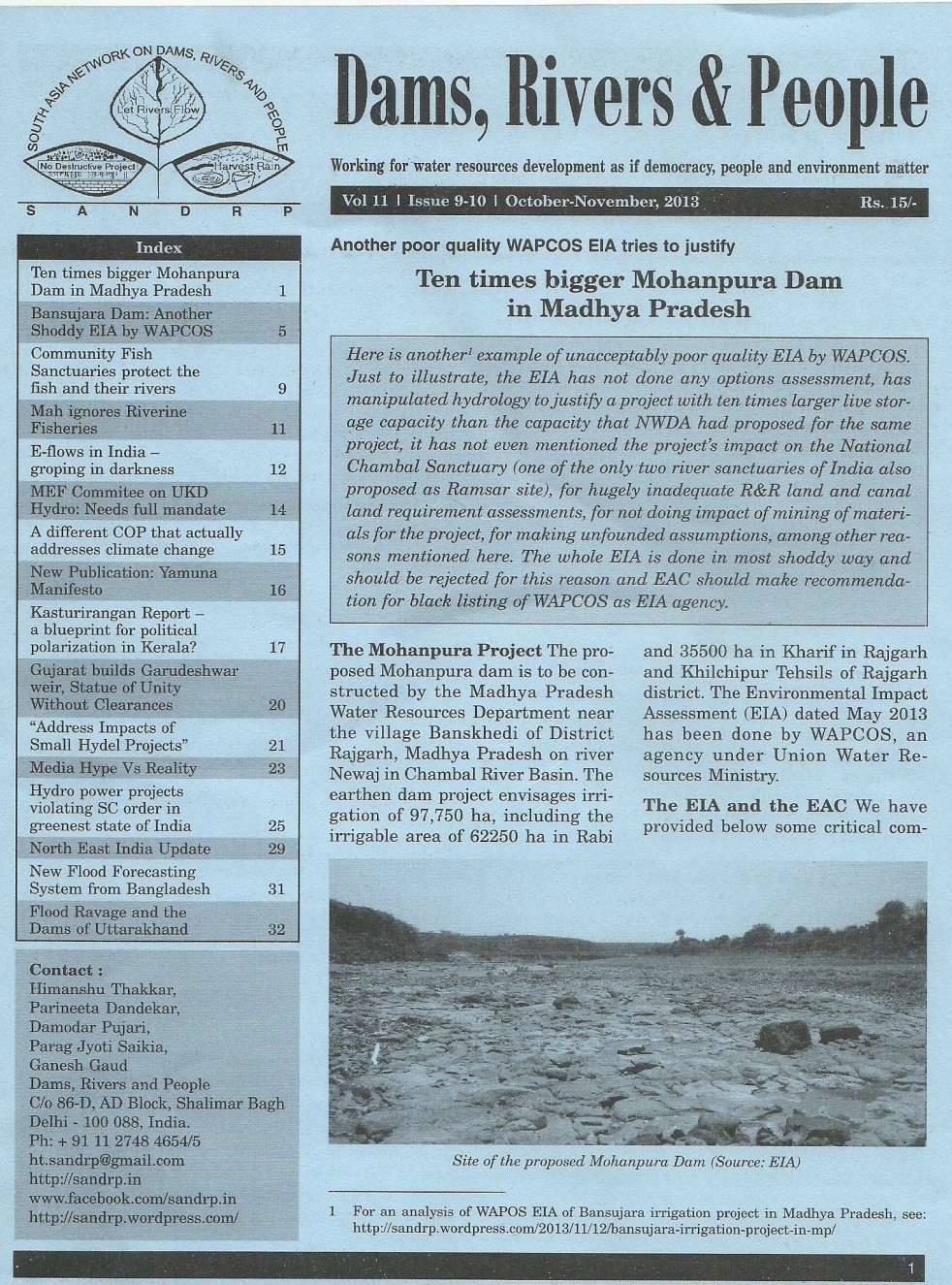
Dams, Rivers & People – October-November, 2013 Vol 11, Issue 9-10
The October – November, 2013 edition of SANDRP’s magazine ‘Dams, River and People‘ is now available online. This is the 9-10th issue of magazine in its 11th volume. Like its previous issues, this issue too is packed with indepth analysis of matters concerning dams, river as well as larger environment. The contents magazine are mentioned in the list below. The magazine in pdf format is available here — https://sandrp.in/DRP_Oct_Nov_2013.pdf. Several of the articles are also available in SANDRP’s blog and they can be viewed just by clicking on the name in the list. Enjoy reading.
| Contents | Page No |
|---|---|
| Ten Times Bigger Mohanpura Dam in Madhya Pradesh | 1 |
| Bansujara Dam: Another Shoddy EIA by WAPCOS | 5 |
| Community Fish Sanctuaries protect the fish and their rivers | 9 |
| Mah ignores Riverine Fisheries | 11 |
| E-flows in India – groping in darkness | 12 |
| MEF Committee on UKD Hydro: Need full mandate | 14 |
| A different COP that actually addresses climate change | 15 |
| New Publication: Yamuna Manifesto | 16 |
| Kasturirangan Report – a blueprint for political polarization in Kerala? | 17 |
| Gujrat builds Garudeshwar weir, Statue of Unity Without Clearances | 20 |
| “Address Impacts of Small Hydel Projects” | 21 |
| Media Hype Vs Reality | 23 |
| Hydro power projects violating SC order in greenest state of India | 25 |
| North East India Update | 29 |
| New Flood Forecasting System from Bangladesh | 31 |
| SANDRP’s Short Film on “Flood Ravage and the Dams of Uttarakhand” | 32 |

Another Hydro fraud: Two small projects on paper, one large project on site
24.75 MW Mouneswar + 24.75 MW Basavanna ‘Small’ Hydel Projects = One large HEP
According to the Ministry of New and Renewable Energy (MNRE), hydel projects between 2-25 MW are classified as Small Hydel Projects (SHPs). These projects are exempt from Environmental Clearance, impact assessment, public consultation or any monitoring from the Ministry of Environment and Forests (MoEF), receive subsidies from the MNRE and apply for Carbon Credits from United Nations Framework Convention on Climate Change (UNFCCC).
Though the concept of encouraging small hydel projects as sources of decentralized energy, also supplying off grid power seem welcome, the happenings on ground are vastly different. As these projects are excluded from environmental governance, there are several examples of fraudulent Small Hydro projects, which exploit the lax governance mechanism to hoodwink all concerned.[i]
One such recurring fraud is showing two separate projects on paper, in order to avoid environmental scrutiny and avail subsidies meant for SHPs, while building one single big dam on site, clubbing the two projects. Projects like Perla and Shemburi by Greenco in Mangalore or Maruthi Gen projects in Sakaleshpur (http://www.dnaindia.com/bangalore/report-maruti-power-gen-s-hydel-project-an-environmental-disaster-1617237), all in Karnataka Western Ghats, are two example of this fraud.
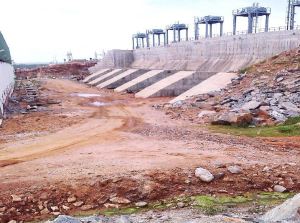
One more case has now come to light, this one from Gulberga district in north Karnataka when I visited the project area recently. Although called by two different names, 24.75 MW Mouneswar Small Hydel Project and 24.75 MW Basavanna Hydro Project are operating from a single dam/diversion weir across the KrishnaRiver, just downstream Narayanpur Dam. As such, the project should be considered as a single 49.50 MW hydel project and should undergo immediate environmental, social and legal scrutiny and further assessment. We tried to conatct the officials of the company several times for questions related to the projects, but we got no response.
The Projects:
24.75 MW Mouneswar and 24.75 MW Basavanna SHEPs are built across river Krishna in Benchagaddi village of Shorpur taluk of Gulberga district in Karnataka.
The projects have also applied for Carbon credits under the United National Framework Convention on Climate Change (UNFCCC). Basavanna Hydro Project has been registered as a Clean Development Mechanasim (CDM) project with the UNFCCC on 28th December 2012 and its crediting period has been fixed as 1st March 2013 to 28th February 2023[ii]. 24.75 MW Mouneswar SHP has applied for registration[iii]. SANDRP has sent comments against registration of this project.[iv]
Shockingly, both projects have requested separate registrations, hiding the fact that both will be using the same dam, the same intake/power canal and the same tail race canal.
Project design documents (PDDs) submitted to United Nations Framework Convention on Climate Change Executive Board (UNFCCC – EB) mention the same coordinates as the project location:
Latitude- 16°19’52 “N
Longitude- 76°33’48” E
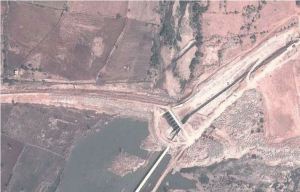
PDDs of both the projects do not even mention the other project, clearly misleading the UNFCCC. Not only do the PDDs show same coordinates, the lengths of the intake canals are exactly the same at 2771 meters, so are the RCC conduits and penstocks, because we are talking of the same project!
Carbon Credits are supposed to be provided to projects only when they prove beyond doubt that they will be economically unfeasible without such support. However, in this case the expenses of dam, power canal, and tail race tunnel is shared and hence the costs will be lowered, the Internal Rate of Return (IRR) of the projects will be higher than what is quoted in the PDDs and they will be profitable even without additional ‘pocketable’ finance from the UNFCCC in the name of Clean Development! (IRR claimed in the PDD is 9.14% for Mouneswar SHP and 11.38% for Basvanna SHP.)

Same Proponent, different names
Interestingly, project proponents of both the projects are shown to be different in respective PDDs. For Mouneswar Small Hydel Project it is Lakshmi Jalavidyut Limited and that for Basavanna Hydro Project it is Krishna Hydro Energy Limited. However, the registered office of both these firms is the same! This address also belongs to Penna Cements, Hyderabad, which is a player in Mini hydel projects in Karantaka. Penna Cements and its subsidiary Pioneer Genco already operate two SHPs, each of 24.75 MW capacity across Cauvery in Karnataka.
From the ground
When SANDRP visited the project sites, the officials were hostile to any entry in the premises or even near the site.

The dam/ diversion weir built by the projects is inside the KrishnaRiver bed and diverts the water through a power canal which runs approximately 3 kms downstream. The power canal takes most of the water from the river rendering the river dry in lean season.
Farmers told power canal as irrigation canal:
When I talked with the farmers in the downstream, they told me that they were under the impression that this canal is meant for irrigation, like Narayanpur Dam canals in the upstream (about 26 km). However, Benchagaddi village which is situated next to the tail race canal of the project not allowed to take even its drinking water from the canal.
There have been strong protests from the villages to this project as the diversion has dried the river bed and more than 300 irrigation pumps of villages like Bechagaddi, Hosur and Yedalabhavi used for irrigating paddy are now useless. Karanataka Bhagya Jal Nigam had also taken serious exception to the projects and had ordered a stop work notice.[v] (It subsequently issued an NOC, without providing any resolution to the issues raised by it earlier.)
The Benchagaddi village which is right next to the power canal experiences power cuts lasting 18-20 hours daily. Around 40 farmers from this village lost their lands for the canal. Rates of compensation given were Rs 25-85 thousand per acre.
Shockingly fraudulent Local Stakeholder Consultations!
The projects have claimed to have organised ‘Local Stakeholder Consultations’ about the CDM mechanism, which is mandatory when applying for CDM credits. PDD claims that Mouneswar project organised stakeholder consultations on 21st December 2011 and Basavanna project organized it on 26th September 2011.
Now see this, both PDDs mentions exactly the same people asking exactly the same questions with exactly the same answers being given!! It is absolutely clear that these meetings and these reports are fake. Amazingly, UNFCCC could not see through this clear fraud.
Local Development through Small Hydels?
As per the villagers, affected families were promised a job in the power plant although none of them received any jobs there. Even the JCB and truck operators are from other states. Security guards too aren’t from the same village.

Unaddressed impacts of Submergence:
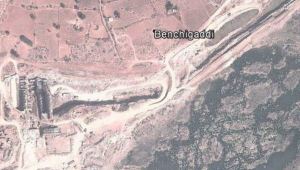
In Geddamari village near the diversion weir, around 15-20 families lost their lands for construction of the dam. Bill collector (Talathi) of the village told SANDRP that around 50 acres of land was SUBMERGED due to dam (diversion weir) construction. He further added that farmers whose lands were submerged, have not received the compensation as yet. They have been talking with the company and have been verbally promised some compensation, though nothing on paper. Problems in this village too are like Benchagaddi village. Limited drinking water, disturbed power supply etc.
Applicable for Environmental Clearance:
As the projects use a single dam and are a single project of 49.50 MW and they qualify for a full environmental clearance process, including an EIA, public hearing, and Environmental appraisal by the state or central EAC and an Environmental Management Plan. However, the projects have illegally escaped all this.
Executive Engineer of Krishna Bhagya Jal Nigam (KBJN) – controlling state authority in case of Krishna River- confirmed, “Both the projects are operating using the same weir .The power houses of two projects are housed behind the same diversion weir. There are three 8.25 MW turbines for each of the projects situated downstream of the same diversion weir.”
According to the Executive Engineer, KBJN has granted NOCs to both the projects and that both of them being fully operational for last 6-8 months. When SANDRP visited the project site, the HEPs were found to be fully operational.
Conclusion:
24.75 MW Mouneswara and 24.75 Basvanna Projects are operating from the same diversion weir, use the same intake canal and same tail race. They are in fact one single project which has fraudulently shown itself as two separate projects. The proponent and the consultants have hidden this fact from the UNFCCC, the MoEF, the MNRE, KREDL, State Pollution Control Board and State Environmental Department. The Local Stakeholder Reports of the projects are a sham. Submergence impacts are still unaddressed.
These issues need to be addressed urgently by all concerned including the MoEF, the Karnataka Government, UNFCCC, MNRE and KREDL. Such frauds are giving a bad name to the all these institutes.
-Damodar Pujari (damodar.sandrp@gmail.com) with inputs from Parineeta Dandekar
River Yamuna through the Prism of Political Manifestos in Delhi
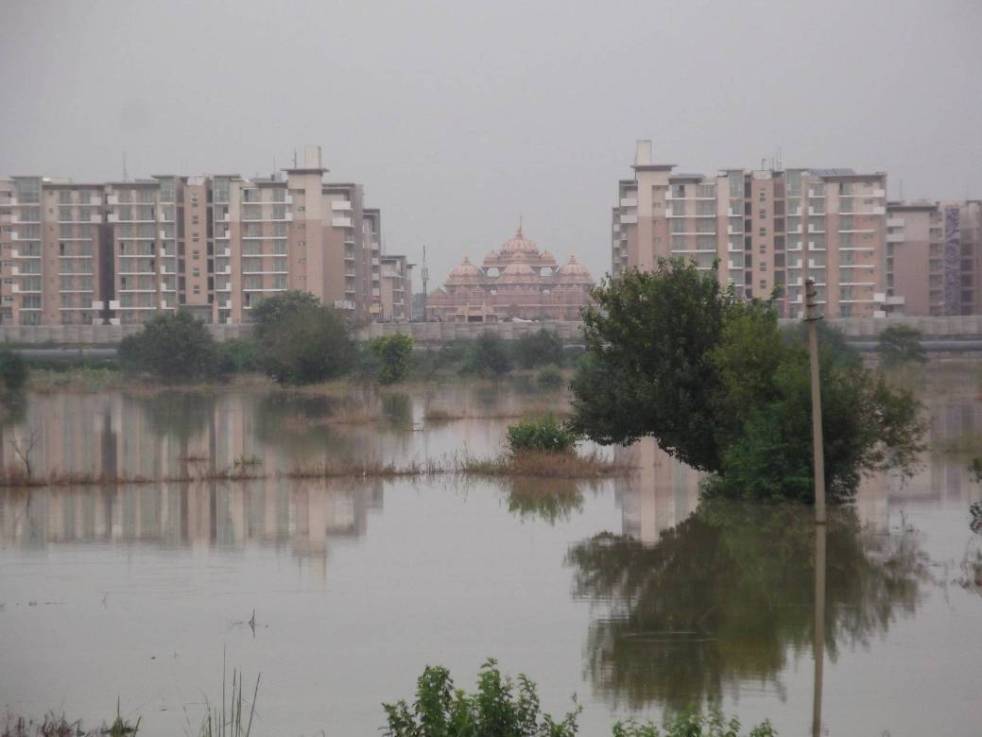
Deteriorating health over the decades of river Yamuna in Delhi is a perfect example of an abject governance failure. All grandiose plans to restore the river to its past glory have been in vain. Yamuna Action Plans (YAP) implemented since 1993 with a consolidated spent of around Rs 1500 crores have succeeded (sic) in only taking the river closer to its demise in the city-state.
Continue reading “River Yamuna through the Prism of Political Manifestos in Delhi”
Kasturirangan Report – a blueprint for political polarization in Kerala?
Guest Post by Dr. Latha Anantha, River Research Centre, Kerala
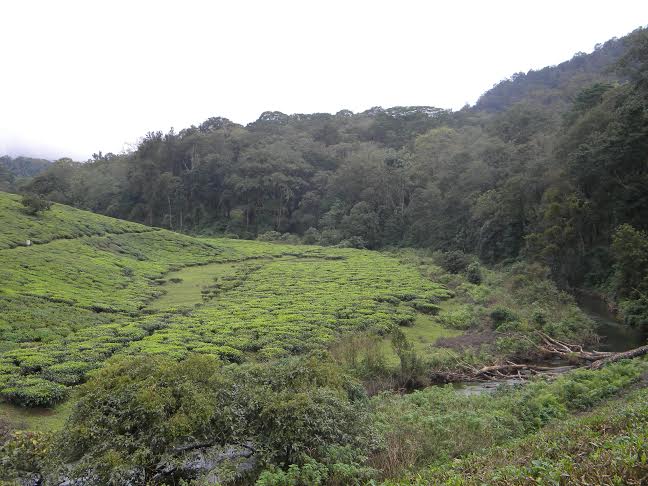
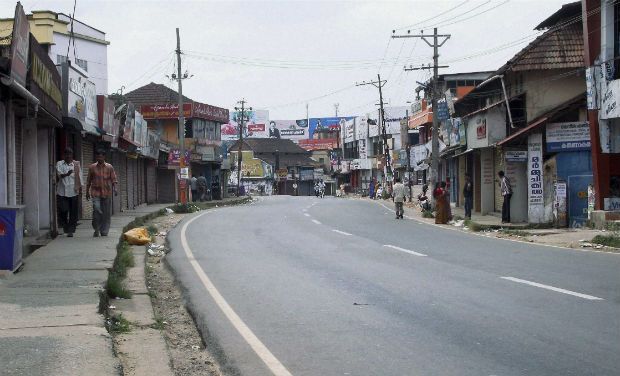
Possibly for the first time in the history of Kerala, a hartal led by the unlikely combination of a powerful section of the Church and the Left Democratic Front has rejected both the Western Ghats Panel Report (WGEEP) and the High Level Working Group Report (HLWG) claiming it as anti farmer. On November 18, 2013, the LDF and its supporters called for a state wide bandh which brought normal life to a standstill. Thousands of protestors took to streets, mainly from Idukki and Wayanad Districts. Events that are unfolding in Kerala hold significance for the entire country. Firstly it reveals the extent to which forces are trying to decide the fate of a common natural heritage like the Western Ghats through short sighted political means. Secondly it reveals the lack of democratic process by which the people of a region as diverse and ecologically significant as the Western Ghats are not taken into confidence by the Governments while introducing a new governance process. Thirdly the Western Ghats and the two reports on it has become the oven hot political weapon in an election year for Kerala.
Violent responses
The incidents of violence and destruction of public property started off with the issuance of directions by the MoEF on the 13th November 2013 under Section 5 of the Environmental Protection Act 1986. Kannur and Kozhikode districts witnessed widespread violence on the 15th November. Forest offices, government vehicles and public transport buses were set fire by the angry mob in several places in North Kerala[1]. The High Range Protection Council led by the Roman Catholic Church organised a 48-hour road blockade under the banner ‘occupy the streets’ at Kattapana the district headquarters in Idukki district on the 18th ad 19th of November. In fact the Wayanad MP Sri M. I Shanawas called on Mrs Sonia Gandhi in New Delhi along with Bishop Remigius Inchananiyel of Tharamassary Diocese, patron of the resistance group spearheading the campaign in north Kerala, to convey the anxieties of the people.[2] Not a day has passed since 14th November, 2013 when the discussions over the two reports have not taken over the prime time news hour in the television channels of Kerala. The debate continues.
Why the hue and cry?
The MoEF directions and the subsequent Office Memorandum (OM) dated 16th November both reiterate that the MoEF has accepted the High Level Working Group report on Western Ghats, headed by Dr. Kasturirangan ‘in principle’. It also explicitly means that the MoEF has rejected the Western Ghats Expert Ecology Panel Report under the chairpersonship of Prof. Madhav Gadgil, though the OM makes absolutely no mention of the WGEEP Report!

Atleast 123 villages in Kerala will fall within the ESA (natural landscape). The category of development activities banned in the ESAs are restricted to mining, quarrying and sand mining, thermal power plants, red category industries, building and construction projects of 20,000 sq.m and above.
The watered down HLWG report and the OM does not contain any clause which would force the farmers of Idukki and Wayanad districts out of their land as alleged by the agitators. Clearly farmers would not resort to hooliganism of the kind which was perpetuated in Kozhikode and Kannur. Presently, the sand mining and quarrying lobby hold the largest political clout in Kerala with many political leaders and legislators alleged to be having direct share and ownership over the large granite quarries operating in the heart of the Western Ghats districts. More and more farmers in the mountains are selling their land to quarry contractors. Now this is something which can become difficult if the restrictions are imposed. As somebody was remarking in a bus my friend was traveling in, ‘if mining stops, the JCBs will have to be sold at the price of scrap metal, that is the issue”!
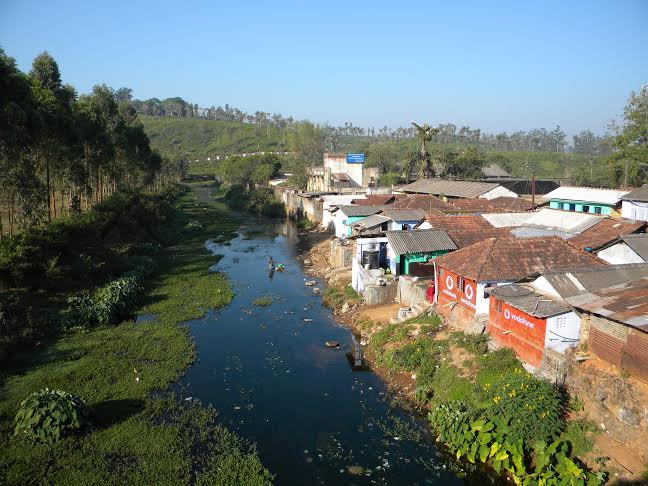
By this time a large section of population including the ruling party legislators in Kerala openly admit that the Kasturirangan panel report is a watered down version of the Gadgil panel report and is not going to bring in much changes in status quo conservation. Meanwhile, the clause (viii – d) on banning township and area development projects with an area of 50 ha and above and / or with a built up area of 1, 50 000 sq.m. shockingly reveals further dilution. The MoEF has gone against the ‘in principle’ acceptance by inserting this recommendation which was not included in both the reports! HLWG report has categorically stated that no more new townships and settlement areas will be allowed in the Western Ghats. This new insertion by the MoEF opens up the space for mining and quarrying in the name of township development within ESA areas diluting the concept and spirit of ESA. Meanwhile many ecologically sensitive areas have been left out of the HLWG report which will be opened up for mining and other development.
Baseless rumours are being spread over how the report will affect the high range population! Allegations are now reaching ridiculous levels include, ‘The hidden agenda is to convert all the ESAs into forest area in a stage by stage manner; tiger cubs are being introduced into the forest to evict the people; no more new houses will be allowed once the ESAs are declared; no more monoculture plantations in the Western Ghats; all houses in ESAs have to be painted green and lights have to be switched off by 8 pm; so on and so forth are the interpretations led by the church and the political fronts. The people living in the plains are being warned that they will have to bear the onslaught when lakhs of evicted farmers from the high ranges will settle in the plains! To top it all, the revenue department officials are warning people against land registration or land transfer citing that until further directions are given, no land transaction can be carried out in ESA villages!
There are misleading attempts to show that Ecologically Fragile Lands Act EFL Act (2005) and ESA are the same. The EFL Act is a state Act to provide for the vesting in the Government of ecologically fragile lands in the State of Kerala and for the management of such lands with a view to maintain ecological balance and conserving the bio-diversity. Ecologically fragile land denotes any forest land or any portion thereof held by any person and lying contiguous to or encircled by a reserved forest or a forest or any other forest land owned by the government and predominantly supporting natural vegetation. This Act allows the Government to vest such a land from the owner and make it part of the Reserve Forest. It also gives power to the government to evict any person occupying the notified land. The ESA meanwhile comes under the purview of the central Environment Protection Act 1986. It does not entail any eviction or vesting of land by the government or the Forest Department. There is no eviction of farmers entailed in either the WGEEP or the HLWG report. Any news about evictions is politically motivated and baseless.
The concerns and anxieties of the local communities who have made the mountains their home since three generations when a new regulation is being ushered in cannot be ruled out. The distressing state of the Western Ghats calls for stringent protection measures as well. ESA under the EPA (1986) is the best option available wherein conservation can be ensured without displacing people. Meanwhile the other states seem not too perturbed by the decision of the MoEF to accept the Kasturirangan Report. The high population density in Kerala Western Ghats plus the vested interests of the quarrying lobby and the church (which holds large tracts of land in the mountains) could be attributed as the reason for this uproar.
Reparative Measures
The Government of Kerala has meanwhile taken a guarded stance with respect to the Kasturirangan report instead of totally rejecting it. They have assured the people no decisions will be taken in haste. However, the GoK reacted late by stating that they will translate the notification when it is out and hold discussions in each of the ESA panchayaths. In response to the first OM issued on 19th October, 2013 (which was surprisingly cancelled by the MoEF and replaced by the OM on 16thNovember, 2013), the Kerala Government constituted a three member expert committee headed by the Kerala State Biodiversity Board (KSBB) Chairman to seek opinions from farmers’ organisations, environmentalists and people’s representatives from the regions that will be affected once the Kasturirangan report is implemented. The state also plans to circulate the HLWG report’s Malayalam version to all the 123 villages[3]. Round the clock help lines have been opened by the Kerala Forest Research Institute (KFRI) and KSBB to clarify the doubts of the public. Chief Minister Ommen Chandy has decided to convene an all party meeting to seek opinion from the various political units of the state. The Kerala Pradesh Congress Committee (KPCC) has also constituted a five member committee to seek opinions through district level hearings.
Lapses in democratic processes come with a cost. If the Government had taken the pains to interpret the WGEEP report way back in 2011 when it was published and undergo the above processes, so much politically created antagonism towards the WGEEP report, the destruction of public property and loss of 900 crores to the public exchequer by an uncalled for bandh could have been avoided[4]. The LDF too could have organized discussions and debates on the two reports instead of rejecting both the reports.
Consciousness for the Western Ghats is growing
What was the need to constitute the HLWG by the MoEF? New ideas and governance mechanism takes time to sink in the public mind and the development sectors that are used to work in silos. The MoEF bowed to the pressure from different lobbies and went ahead with the new panel without giving time to the state governments or the people to understand the WGEEP report. And not surprisingly the HLWG panel digressed from its ToR and came out with a status quo report. Hence the pro Athirappilly project lobby is happy with the HLWG report. While the WGEEP report had totally rejected the Athirappilly project, the HLWG has given space to the Government to revaluate the project and take it up with the MoEF if needed.
Is the Western Ghats Ecology Expert Report (WGEEP) sent for a burial? The MoEF seems to have done so. But many in Kerala where the maximum opposition to both the reports came in, think otherwise. The dots are growing into a network of like-minded groups and individuals who believe the Gadgil report should be accepted and not the HLWG. There is increasing realization that the WGEEP report has mooted a completely new system of governance based on ecological limits and carrying capacity of a region, democratic decentralization and a futuristic perspective of inter-generational equity. While recommending sanctions and regulations, the process is intrinsically democratic where discussions and decisions about the wise use of natural resources have to be made by the local communities. Not surprisingly even the media discussions start with the HLWG report and end up supporting the WGEEP report! There is still scope for the public to demand with the MoEF that the WGEEP report be implemented after correcting the grey areas. The rest of the Western Ghats states need to take cue from the happenings in Kerala and start a process of democratic discussion with the ESA village communities and different development sectors to avoid future problems that may crop up. The conflicts and riots have reinforced the conviction that it is time to start a peoples’ movement once again to save the Western Ghats!
Dr. Latha Anantha (latha.anantha9@gmail.com)
OTHER SANDRP BLOGS ON WESTERN GHAT REPORTS:
2. https://sandrp.wordpress.com/2013/05/18/prof-madhav-gadgil-writes-to-dr-kasturirangan/
[1] http://www.thehindu.com/news/national/central-direction-on-western-ghats-report-sparks-protest-in-kerala/article5354418.ece
[2] Read more at: http://indiatoday.intoday.in/story/western-ghats-kasturirangan-report-oommen-chandy-kerala-cm-protests-kozhikode/1/325158.html

Rajasthan Remains Silent As Madhya Pradesh Goes Ahead with Dam Projects in Interstate Chambal Basin
It seems Rajasthan state is ignored and is silent as Madhya Pradesh is going ahead with massive water resources development projects in interstate ChambalRiver basin. Some of these projects were even part of the interstate projects discussed for several years between the two states and now Madhya Pradesh is going ahead with them unilaterally. Mohanpura and Kundaliya projects were also part of the ParbatiKalisindh ChambalRiver link, one of the priority links of Union Government, but now MP is going ahead with them without any consultation with Rajathan or Government. In response to SANDRP questions, Madhya Pradesh responded, as recorded in the minutes of 68th meeting of EAC held in Sept 2013, “It was clarified that the NWDA scheme has not been accepted by the M.P. Government and is not likely to be implemented in the near future. The M. P. Government wants immediate implementation of Mohanpura Project”.

Not only that, the MP has ten times increased the size of the projects, which will have huge, unassessed downstream impacts on people, river and environment. The interstate National Chambal Sanctuary (NCS) will also be seriously adversely affected, but the downstream Rajasthan seems neither consulted nor concerned.

Source: SANDRP partners
Below we have given some information about some of the projects that have come up for clearance before the Union Ministry of Environment and Forests’ Expert Appraisal Committee on River Valley Projects (the meeting number and date of meetings are given) over the last couple of years. All of these projects are in Chambal basin in Madhya Pradesh and are being taken up without consent of or consultation with state or people of Rajasthan.
|
Mohanpura Major Irrigation Project |
|||
| Dist/ State | Rajgarh / Madhya Pradesh | ||
| River/ Basin | Newaj | ||
| Proposal | TOR | ||
| Developer | Water Resource Department, Bhopal, Govt of Madhya Pradesh | ||
| Height of Dam (m) | 47.90 | ||
| Drinking water supply | 20 MCM | ||
| Industrial Water Supply | 60 MCM | ||
| CCA (Ha) | 65,000 | ||
| Submergence area (Ha) | 7051 | ||
| Area required (Ha) | NA | ||
| Villages affected | 36 (1800 families) (10,240 persons) | ||
| ForestLand | NO | ||
|
Decision |
|||
| 52nd Meeting (16-17.09.2011) | Decided that some additional information may be submitted | ||
| 53rd Meeting (11-12.11.2011) | No effective discussion on the parameters of the project could be made and it was decided that the project shall be discussed again along with the information submitted by the M.P. Govt. | ||
| 54th Meeting (26-27.12.2011) | Recommended scoping clearance and TORs with the same comments and observations made for Kundaliya Project. | ||
This Mohanpura project (for more information on this, see: https://sandrp.wordpress.com/2013/11/15/mohanpura-dam-in-madhya-pradesh/) have been under discussed in the EAC now for full environment clearance and does not include any reference to Rajasthan, interstate aspects, downstream impacts, or impact on Chambal River of National Chambal Sanctuary. Some details in this respect are given below.
Much bigger Mohanpura Reservoir proposed compared to the PKC proposal It is clear from the perusal of the Feasibility Report of the PKC link given on the NWDA website that the project now proposed by the Govt of Madhya Pradesh is much bigger and an unviable scheme. The Gross and live storage of the NWDA scheme is 140 MCM and 52.5 MCM, where as the proposal now has gross storage of 616.27 MCM and live storage of 539.42 MCM, which means the live storage proposed now is more than ten times the live storage proposed in NWDA scheme. In fact the NWDA scheme had the proposal to transfer 464 MCM from the Patanpur Dam to the Mohanpura dam and yet, under the Mohanpura live storage capacity proposed under NWDA scheme was much smaller.

Interstate aspects ignored The project is coming up on an interstate river basin and will have clear implications for the downstream state of Rajasthan, but there is no mention of this in the EIA. Several meetings have also happened between Madhya Pradesh and Rajasthan about the PKC link mentioned above. The Government of India has prioritized this link, but by taking up this project unilaterally without consent of Rajasthan or Centre (Ministry of Water Resources) the Madhya Pradesh government is violating the interstate and federal norms. The EIA does not even mention any of these issues.
|
Kundaliya Major Irrigation Project |
||
| Dist/ State | Rajgarh and Shajapur Districts/ Madhya Pradesh | |
| River/ Basin | Kalisindh | |
| Proposal | TOR | |
| Developer | Water Resource Department, Bhopal, Govt of Madhya Pradesh | |
| Height of Dam (m) | 44.50 | |
| Drinking water supply | 18 MCM | |
| Industrial Water Supply | 84 MCM | |
| Diversion | 1037 cumecs of LakhundarRiver to river Kalisindh | |
| Live storage capacity | 495.20 MCM | |
| CCA (Ha) | 58040 | |
| Catchment Area (sq km) | 4900 | |
| Submergence area (Ha) | 7476 | |
| Villages affected | 56 (8630 persons) | |
| Forest land | 680 ha | |
|
Decision |
||
| 52nd Meeting (16-17.09.2011) | Desired some more info. | |
| 53rd Meeting (11-12.11.2011) | It was decided that the project shall be discussed again along with the information submitted by the M.P. Govt. The Committee felt that considerable area of forest land is to be submerged in the project (680 ha). The forest maps provided as a part of additional information lack clarity. | |
| 54th Meeting (26-27.12.2011) | Recommended scoping clearance and TORs with some suggestions/comments. | |
|
Kalisindh Major irrigation project |
||
| Dist/ State | Sajapur/ Madhya Pradesh | |
| River/ Basin | Kalisindh | |
| Proposal | TOR | |
| Developer | Water Resources Department, Govt of Madhya Pradesh | |
| CCA | 49023 | |
| Submergence area (Ha) | 4239 | |
| Area Req (Ha) | 4919 | |
| Village affected | 15 (2384 PAFs) | |
|
Decision |
||
| 61st Meeting (12-13.10.2012) | Sought some additional information. | |
| 62nd Meeting (23-24.11.2012) | Recommended clearance for pre-construction activities and TOR with some additional TORs. | |
It is high time Rajasthan government and people wake up to this reality of upstream developments and write to Madhya Pradesh, Union Ministry of Environment and Forests and also Union Water Resources Ministry against these developments.
Himanshu Thakkar (ht.sandrp@gmail.com)

Community Fish Sanctuaries: Protecting the fish….and their rivers
21 November 2013: World Fisheries Day
A small bus load of pilgrims descended at Walen Kondh and bought the usual Prasad from a shack by the river. They crossed a suspension bridge over a deep gorge of Kal Nadi and went to the derelict temple of Vardayini Mata on the other bank.

Then a few girls among them did something unusual. Instead of offering the Prasad at the temple, they came to the ridge of the gorge and clapped a few times, peering into the river below. In a matter of seconds, there was frantic thrashing in the waters as a huge school of endangered Mahseer fish congregated swiftly. The devotees then threw in fistfuls of puffed rice to hundreds of Mahseer below. For the devotees, these fish are sacred: the children of Varadayini Mata.
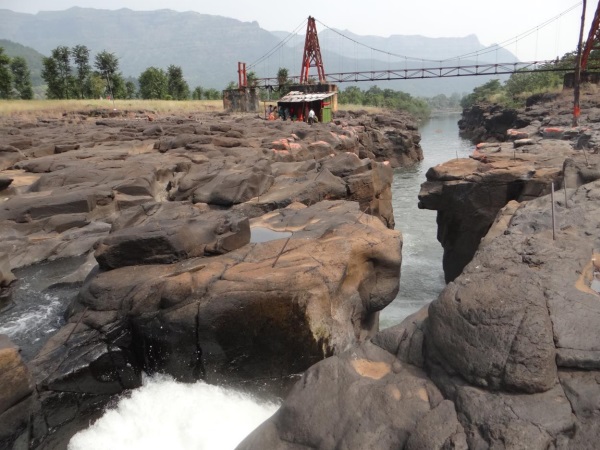
Walen Kondh in Mahad Taluka of Raigad District in the Western Ghats of Maharashtra is one of the several critical community fish sanctuaries of India that protect the Mahseer fish. These sanctuaries have been successful in conserving not only the fish, but also stretches of rivers through their unique actions which find no support from the establishment and limited recognition from the conservation community.

Deccan Mahseer (Tor Khudree) is classified as an endangered specie by IUCN[i]. It does not feature in the schedule of species protected under the Wildlife Protection Act (1972) which is not a surprise as the Act represents freshwater diversity very poorly. However, many researchers, fisher folk and anglers have recorded that Tor Khudree and associated Mahseer species (Tor tor, Tor putitora, etc) which were once plentiful in rivers across Western Ghats, peninsular and central India, HimalayanRivers as well as floodplains, has now reduced drastically.
One of the major reasons behind the collapse of fish species like Mahseer is dam construction. Mahseer species migrate in the upstream to smaller streams for spawning (breeding). They need a flood pulse to undertake this migration. While other factors like pollution, overfishing, etc. have contributed to the decline, the multiple impacts of dams in terms of blocking migration paths, reduction of water levels in the downstream, submergence of pools in the upstream, changes in natural hydrograph and flood pulses, changes in sedimentation, etc., have been the primary reasons behind this collapse. (SANDRP’s report on Impact of Dams on Fisheries: sandrp.in/dams/Impacts_of_Dams_on_Riverine_Fisheries_in_India_ParineetaDandekar_Sept2012.pdf)
Fall of Mahseer has affected the ecology, local livelihoods, angling and recreational fishing in the rivers. While Hoshangabad on the banks of Narmada recorded 5-6 tonnes of Mahseer landings every year, it has been nearly wiped out from these places now[ii]. Mahseer used to form the majority of catch in these parts and has been severely affected by reservoirs like Tawa, Bargi, Sardar Sarovar and other Naramada projects. However, hardly any efforts are being made to reverse this situation. According to Shashank Ogale, who set up and managed Mahseer hatcheries in Tata Dams for more than 20 years, there are next to none functional Mahseer hatcheries in the country. This is despite the fact that dam proponents show an expense of crores of rupees to set up hatcheries as a part of their Environment Management Plan. After granting clearances, which are also based on these EMPs, MoEF does not bother to monitor the functioning and efficiency of these hatcheries or the impacts of dams on fish diversity and fisheries[iii].
In such a scenario, community conserved fish sanctuaries which are scattered across the country are playing a very important role in conserving various species of Mahseer as well as stretches of rivers. Unfortunately, most of these sanctuaries get no protection by the State Governments, Forest Departments or the Ministry of Environment and Forests. This is at a time when freshwater diversity is declining at the fastest rate globally[iv]. Ministry of Environment and Forests has done precious little in conserving or protecting riverine diversity, fisheries or rivers from the onslaught of dams. These sanctuaries keep getting submerged, dried up or fragmented by newly planned dams and State Fisheries Departments don’t bat an eyelid before giving a no-objection certificate (NOC) to projects which will spell doom for these sanctuaries.
Renole Pujari from Walen Kondh tells me that they have received no support or protection from the government to conserve Walen Kondh Sanctuary, however the community sanctions are so strong that not only is fishing banned across 2 kilometers from this stretch, but people are not even allowed to get down to the water, near these fish. He only hopes that this stretch of Kal nadi[v] is not destroyed by dams and chemical pollution like the neighboring Savitri River which flows through the chemical MIDC at Mahad. Fish kills are a regular feature of Savitri River.[vi]
In Maharashtra, Tilase is one more such small village in Wada Taluka of Thane district which protects Mahseer fish in Vaitarna River. The stretch is downstream of Upper Vaitarna Dam which supplies water to Mumbai. Local youths told me that fish kills occur here when water releases from Upper Vaitarna decrease. Downstream this stretch, Middle Vaitarna Dam has now come up and the sanctuary is now sandwiched between the two projects. Social sanctions here are so strict that a net cannot be put in the waters, even to check the species. Fish Sanctuaries also existed in Alandi and at Pandharpur along teh Bhima, but have been wiped out. In Vidarbha, several Dev dohs (Sacred Pools) exist in Rivers like Adan, Kathani, Wainganga, etc., where fishing is banned.

Accoridng to Rajendra Kerkar, Goa too has community conserved fish sanctuaries protecting the Mahseer at ‘Pistyachi Kon’ nesteled between Bhimgad and Mhadei Sanctuaries. It receives no protection.
In Orissa, along the Mahanadi on the banks of the leaning temple of Huma exists the Huma Mahseer Sanctuary. On the banks is a stone statue of a lady cutting a Mahseer fish. Legend goes that the one who fishes in this stretch will meet the same fate, like King Midas! Hirakud Dam has already affected this sanctuary and the proposed Lower Suktel Dam will make things worse.

Karnataka possible has the highest number of community fish sanctuaries in the Western Ghats. Nakur Gaya and Yenekkal fish sanctuaries exist on the banks of Kumardhara in Dakshin Kannada. In Yenekal, local gram panchayat has built a small weir with wooden gates for maintaining water levels for the fish. The weir is so small that the fish can migrate over it in the monsoons. Both these sanctuaries are threatened by the numerous mini hydel projects coming across the region, especially the 24.75 MW Kukke Mini Hydel Project near Hosmata[vii]. Fisheries Department however has given an NOC to this and many other mini hydels coming across the region without even attempting to study their impacts on Mahseer and other fish.

200 MW Gundia Hydel project will also affect the entire hydrograph of Kumaradhara-Gundia rivers. Here. The EIA done by KPCL (Karnataka Power Corporation Limited) says that there are no rare and endangered fish in the area. 5 new fish have been discovered in the region just in the past one year!

Karappura Fish Sanctuary in Mysore was submerged by the Kabini reservoir while the Shimoga Agrahara Sanctuary collapsed due to dwindling water levels which resulted after construction of Tunga Anicut 12 kilometers upstream from here.[viii]

Uttarakhand and Himachal Pradesh too have temple fish sanctuaries, notably the Baijanath Temple complex on the banks on River Gomti in Uttarakhand conserves Golden Mahseer (Tor putitora) and supports a small fish sanctuary on its banks. Many isolated fish sanctuaries are also reported from the Ramganaga and Kosi area near Corbett. However, it is also reported that now these sites are used by anglers and the temples receive revenue in return. In Jogindernagar, a town in Mandi distirct of Himachal Pradesh, lies a lake known as Machchiyal, fed by River Uhl. This lake is supposed to be the abode of Machendru Devta, the Fish God. Fish are fed and worshipped here regularly and fishing is strictly prohibited in the lake. Machchiyal supports a large population of the Himalayan Mahseer. There is a Temple of Machendru Devta on the lake bank with ancient idols of fish-god.
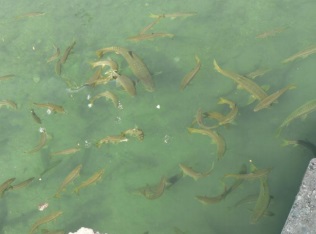
In the remote Tawang in Aruncahal Pradesh in the North East corner of India flows a beautiful river Nyamjangchu. Buddhist Monpas rever the river as well as the fish in Nyamjangchu. Fish in the Nyamjangchu are not hunted. The river is threatened by the proposed 780 MW Nyamjangchu Hydel project which will divert or submerge nearly the entire length of this river flowing through India. Even premier research institutes like CIFRI (Central Inland Fisheries Research Institute) have done a shoddy study and supported the project and have not raised the issue of impact of this dam on fish diversity.[ix]
On the occasion of World Fisheries Day 2013, we urge to the MoEF to document the existing sanctuaries and grant immediate protection to all the existing fish sanctuaries in the country, protecting them from the onslaught of dams and other pressures. We had sent a similar submission to the moEF which was endorsed by several Fisheries Scientists and activists across the country in 2012, we’ve received no response from the MoEF on it till date (https://sandrp.in/rivers/MoEF_EAC_Submission_Fisheries_Nov2012.pdf, sandrp.in/rivers/World_Fisheries_Day_PR_Nov2012.pdf).
These sanctuaries stand testimony to the fact that community conservation is one of the most sustainable and effective ways of protecting ecosystems. The sanctuaries and their keepers deserve respect and recognition.
– Parineeta Dandekar ( parineeta.dandekar@gmail.com)
________________________
Additional Information:
1. IISC Bangalore has developed an excellent data base on the status of fish sanctuaries in Western Ghats. This needs more updation. http://www.ces.iisc.ernet.in/biodiversity/sahyadri_enews/newsletter/issue11/hotspot/fish/
2. International Ron Temple Fish Sancatuaries: http://www.internationalrivers.org/resources/india%E2%80%99s-community-fish-sanctuaries-protect-wild-fish-and-rivers-1641
[iii] sandrp.in/dams/Impacts_of_Dams_on_Riverine_Fisheries_in_India_ParineetaDandekar_Sept2012.pdf
[viii] Shyama Bhat Kolari, Development and management of Freshwater Fish Sanctuaries in India, 2005
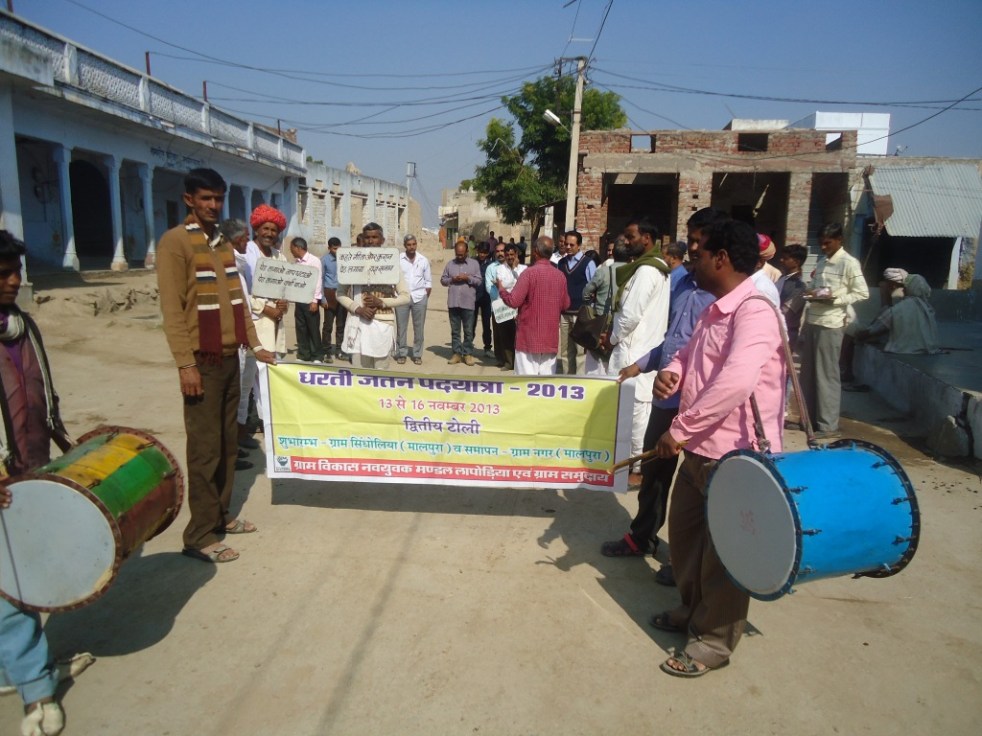
27th Dharati Jatan Annual Festival Honoured Eco-warriors: A Different Conference of Parties that Actually Addresses Climate Change
It was certainly a Conference of Party (COP) of sorts. Those present included farmers, women, academics, media persons, delegates from other states (Gujarat, Madhya Pradesh, Uttar Pradesh, Delhi), Non Government Organisations and elected representatives. It also happens to be an annual event that has been going on for 27 years. It was certainly celebrating the work that actually helped mitigation and adaptation in changing climate in both drought and flood related possibilities. It was also happening on the same dates as the COP 19 was going on far away in Warsaw, Poland.

It was an honour for me to be present at Nagar village in Malpura block in Tonk district in Rajasthan at the 27th annual Dharati Jatan conference where the Pad Yatra from two different streams that culminated. Five eco warriors were honoured at this meeting with a certificate, silver medal, shawl and other ceremonial gifts. They were being honoured for their work related to tree plantation, soil and water conservation and protection of grazing land.
As speakers at the conference on November 16, 2013 narrated, this annual festival is a remarkable achievement by the Gram Vikas Nav Yuvak Mandal at Laporiya in Dudu block in Jaipur district, led by Laxman Singh, now famous for his grazing land protection through the unique chauka system.

Experience of the marchers The leaders of two streams of marchers presented their experience. Rameshbhai Saini, leader of the first stream that marched through the 15 villages of Dudu block (Jaipur district) also mentioned the difficulties people are facing. For example, he mentioned how Phulsagar, one of the tanks in Laporia is encroached and communities’ efforts to remove the encroachment did not succeed as the encroacher had the support of the Rajasthan minister Babulal Nagaur who is also the member of the Legislative assembly from the local area.
Ramjilalji, the leader of the second stream that walked through Malpura block villages (Tonk district) starting from Sindolia village, also said that encroachments on tanks are increasing under political support and when volunteers try to remove such encroachments to save the water bodies, they are faced with court cases. He also said that the state government is laying long distance pipelines and building cement containers to bring the water from mega dam Bisalpur to the villages in the area. He very pertinently asked, will we allow our water harvesting culture to be destroyed since now we have this piped water supply? Reflecting unconvincingly on this dilemma, the letter from state government’s principle secretary Purushottam Agarwal (he was supposed to come for the function, but had to travel elsewhere due to some family emergency and hence sent a letter) suggested that the pipelines are only for drinking water and tanks that the GVNML has helped build are for irrigation and other purposes. The fact is that the state government made no effort to consult the people before coming up with the pipeline scheme. Kesarbhai, active in Mahoba district in Uttar Pradesh described the Apna Talab Abhiyaan through which already 70 talabs (tanks built with earthen bunds) have been built in less than a year.
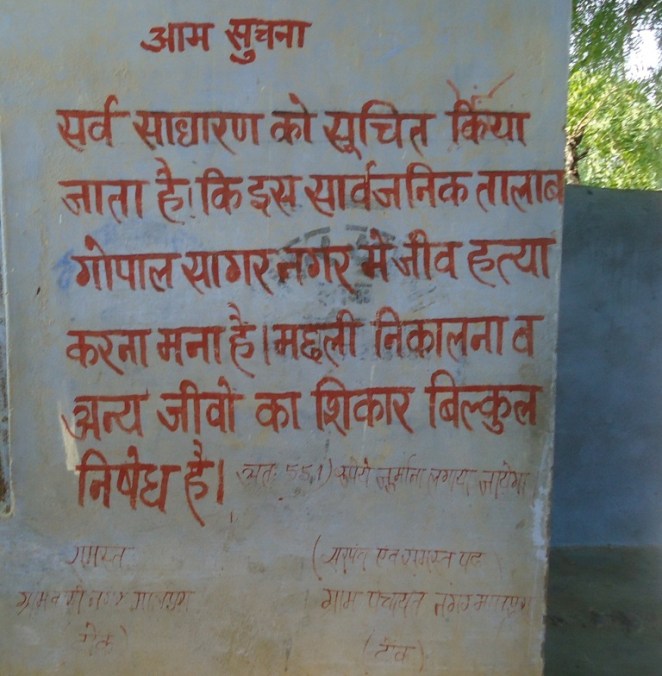
Participants from other states Pankaj Shrivastava from Mahoba appreciated that communities in GVNML area have system of imposing fines when anyone is caught polluting the lakes (as reflected in the wall writing in the photo below at the Nagar village tank).
He also said that the communities in their area is trying to clean up Kiratsagar lake in Mahoba through a focused campaign since Oct 5, 2013. Mavjibhai from Vivekanand Research & Training Institute, Bhuj (Kutch in Gujarat) said that they plan to take up implementation of chauka system in 55 villages along the 60 km long Rukmawati river in their area.
The Awards The five awards presented on this occasion were indeed very well deserved ones. The managing committee of Akodiya village (Dist Ajmer) was recognised for the tradition of collective management of common property resources including grazing land and water harvesting systems.

Rajjak Sheikh of village Tikel (Block Dudu in Jaipur district) was honoured for planting long living trees like peepal, Banyan, neem and other local varieties along the tank embankment over the last five years through his own efforts. He also got the fisheries contract given for the village tank canceled and got some of the hunters caught at his own personal risk.

Next, Shravanlal Jaat, a shepherd of village Kalyanpura (Dudu, Jaipur) was given the Dhudhad Ratan prize for consistently planting large number of trees in grazing land and along the village tank with his own personal effort and expenses for more than five years and also taking care of the planted trees.

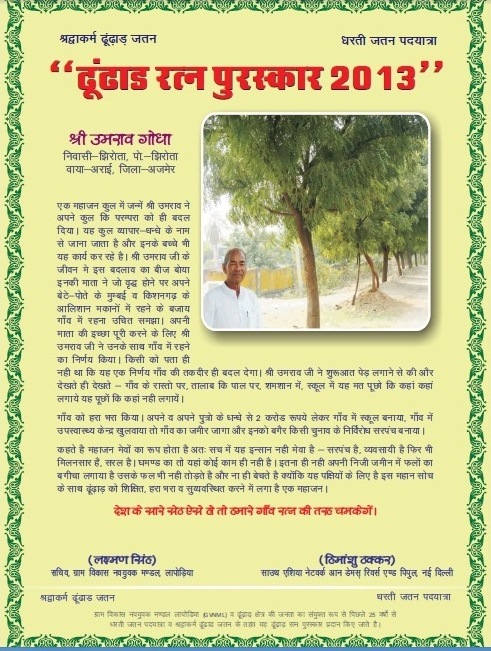
Efforts of Umrao Godha, a relatively rich man of village Jhirota in Ajmer district were recognised for transforming the village with institutions like school, health centre and also for planting and taking care of large number of villages. Enthused villagers elected him as village head.
Khivsingh Rajput, an old man of Bikhraniya Kalan village from relatively far off Nagaur district (Marwad area) was also honoured for his 20 year old campaign in the village to plant long living Banyan and other trees in very dry area. He also inspired people to donate money and collected Rs 5 lakhs to deepen, renovate and strengthen the village tank.

Relevance for climate change The work of GVNML in the region is remarkable in many respects. The water conservation work helps recharge the groundwater and this water is then available in years of deficit rainfall, the frequency of which is bound to increasing in warming climate. Similarly, the whole area has created such a remarkable water conservation system that even when rainfall is excessive, this area will not face any floods since the water will be stored and only slowly released. The soil here has increased carbon content which also helps hold the moisture much longer, thus helping overcome the dry spells which has also increased in recent years. Thus it is clear that the that is underway over the last over three decades under GVNML has huge implications in the climate change context. The COP 19 talks at Warsaw remains deadlocked, waiting for some façade to emerge to show progress, this different COP 27 at Nagar shows so much progress is possible when the communities are at the helm of the affairs. It is doubtful though that the lessons from COP 27 at Nagar will have any impact on COP 19 at far away Warsaw.
Himanshu Thakkar (ht.sandrp@gmail.com)
Story of a free-flowing stretch of Kali River in Karnataka
River Kali, before it enters Dandeli in Karnataka is a breathtaking sight..
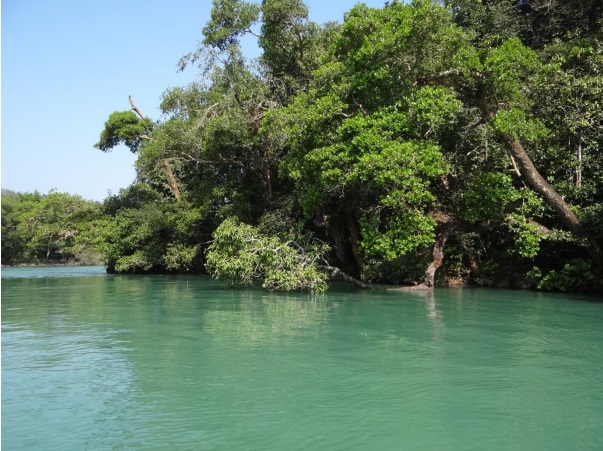
Its waters are emerald green, flowing steadily. Its banks are thickly forested with a continuous canopy. Endemic species like Malabar Giant Squirrel, Malabar Pied Hornbills, Malabar Gray Hornbills are a common sight here. Down the river, a monitor lizard is stretched across a branch, low over the waters. Fishing eagles and several kinds of Kingfishers look for fish. Fisher folk hover along the banks in beautiful coracles, laying hooks in the riparian vegetation.
During our visit to the Kali, my six-year-old swam in the river and could not believe that the river back in his home-town was once as clear as this!
It’s hard to imagine that it was a touch-and-go for this stretch of Kali…
If it were not for some brave, timely advocacy and strong local action, most of this stretch would have been submerged. Rest of the river would have been diverted through a tunnel or silenced in a steady pool of a reservoir: the way many Indian rivers are silenced. There would have been no river, no riparian forests and possibly no swimming.

Dams on Kali: Kali has seen far too much damming. According to Kali Bachao Andolan, a network of organizations working to protect Kali River, more than 5 dams across the river have already submerged 32,000 acres of forests in the Western Ghats. According to Karnataka Power Corporation website, “The west flowing Kalinadi has its origin at an elevation of 900 m, near the DiggiVillage in the Western Ghats of Karnataka. Its 180-km long journey ends at the Arabian Sea near Karwar.”
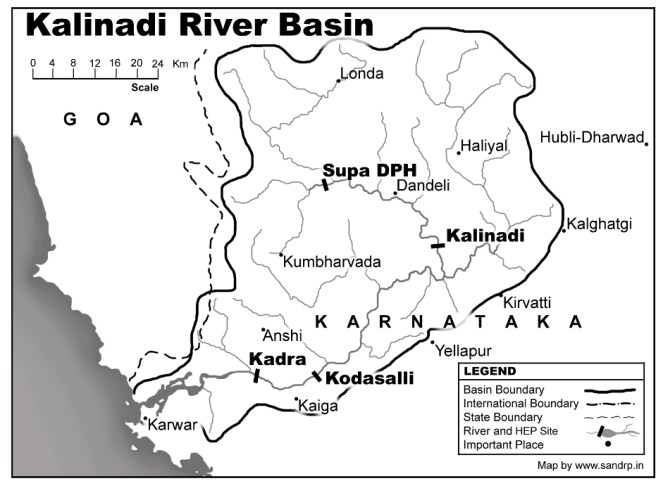
After its origin, it’s dammed at Supa in Joida Taluk of the Uttara Kannada District. The submergence of Supa Dam is a site to behold. Stretching endlessly like an ocean, this dam submerged more than 24 villages and hundreds of hectares of forests. One of the dam evictees, an old, frail man now tells me, “Even now in summers, when the waters recede, I can see my village and my temple. We try to go there some times. I can see all my past life there, for a brief period, before it all goes under water again”.
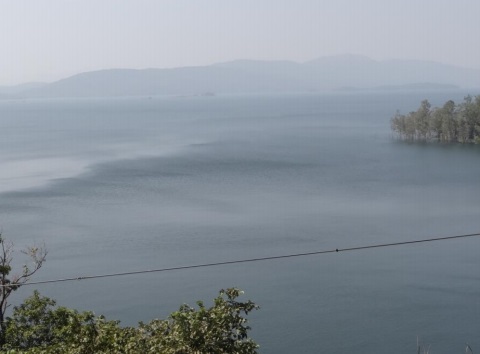

Downstream the 101 m-high Supa Dam (100 MW), the river flows down through Dandeli town, taking huge pollution from West Coast Paper Mills on the way. From here it is dammed at Bomanhalli Pick up Dam, from where it is diverted to Nagazhari Powerhouse (870 MW), then to Kodasalli Dam and powerhouse (120 MW) and then at Kadra Dam and powerhouse (150 MW). If we look at the flow chart of Kali Nadi Dams, the river seems to be flowing from one reservoir into the next, with nearly no free flowing river stretch between two dams. Its main tributaries Kaneri and Tatihalla have been dammed too.[1] The power generation performance of Kali dams for the last 27 years is shown in the graph above.
There is a stretch downstream the Supa dam to Bomanhalli Pick up dam, where the Kali still flows. This again is controlled flow, regulated by the Supa Dam. But this is the precise stretch which was also targeted to be dammed in 2000’s. An 18 MW project by Murudeshwar Power Corporation Limited (MPCL) was proposed to come up at Mavlangi village downstream Supa Dam. According to Kali Bachao Andolan, it would have meant submergence of 210 hectares of land, including 70 hectares of forest land, next to the Dandeli Sanctuary. Kali Bachao Andolan, including Parisar Samrakshana Samiti, Sirsi and Environment Support Group (ESG), Bangalore, highlighted that Uttar Kannada District only needed 17 MW electricity (in 2000) while it was producing more than 1200 MW electricity and one more dam at a huge social and ecological costs cannot be justified. More importantly, ESG exposed that the Rapid EIA (Environment Impact Assessment) report done by reputed consultancy Ernst and Young for the proponent, was in fact a copy-paste of a different EIA, done by a different agency for a different river! A strong campaign was built around this, which garnered public and media support.
In 2006, the Forest Advisory Committee of the MoEF rejected Forest Clearance for this project. The project was also strongly opposed internally within the Karnataka Government by the Department of Tourism. Surprisingly, MoEF did not book the EIA agent (Ernst and Young) or the proponent (MPCL) for submitting an entirely false report! Even more shockingly, this EIA was later done by TERI (The Energy Research Institute), which also completed the study in one month and came up with a dubious report based on secondary data. However, strong opposition from local groups, ESG, and even within Karnataka Government resulted in rejection of the proposal by a number of authorities, including the Department of Industries and Collectorate of Uttar Kannada. Since then, the project has tried to raise its head again, only to be opposed strongly.[2]

Around 10 years down the line, what does this small stretch of free flowing river mean?
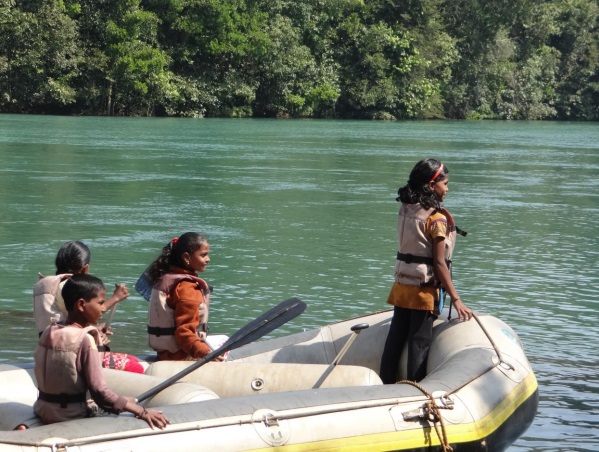
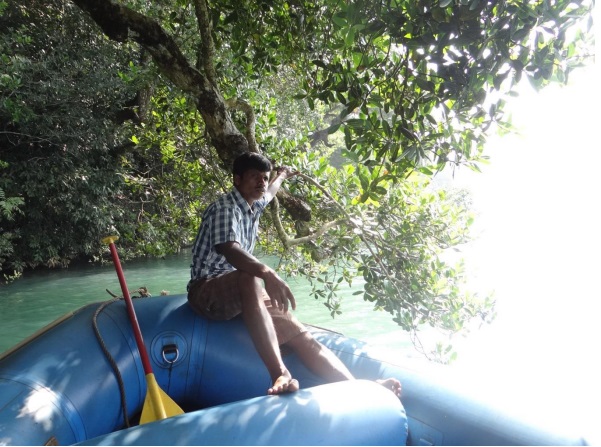
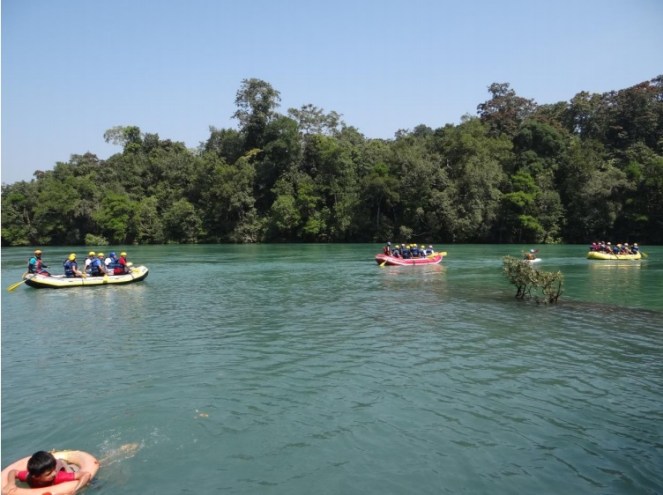
I traveled in Uttara Kannada as a tourist in November 2013. A thriving tourism industry now exists on the banks of Kali and the river is now world-renowned as one of the best rivers for white-water rafting in India. There is boating, canoeing, kayaking, swimming, fishing along this stretch of the river. Pools and islands in the river provide perfect habitats for various species as well as for naturalists and bird watchers. The range of recreational activities that take place along the river are endless. Fishermen still lay their nets across this stretch and catch some fish (though I was told that fish greatly reduced after Supa Dam was commissioned in 1985). Along the banks of the river in this stretch, a thick riparian forest flourishes, providing habitat and corridor to several species.
But more importantly, this tiny stretch is a reminder of how this great river once was. A humbling reminder.
According to Lal, now a boatman and guide from Dandeli, the river stretch which could have been dammed, now provides tourism related employment to around 1000 people from around the region. The region supports around 8 resorts and several homestays. It has created multiple employment opportunities for locals like naturalists, guides, white-water trainers, etc. Some of the locals are descendants of the Supa Dam evictees. One of them says, “The relocated colony of Supa evictees is called Ramnagara, actually it is Vanvasanagara. If it were not for the tourism, I would have migrated to Goa or Belgaon. We saw the fate of Supa dam displaced and would not allow one more dam, no matter how small or big, to affect us again.”
The struggle against 18 MW mini hydel has been significant in a number of ways. EIA and public hearing for the project were the two events where protests were recorded. It was through these platforms that the extent of the impacts of the projects was known and could be opposed. However, after this, a newer version of EIA Notification was adopted in Sept 2006 which excludes hydel projects below 25 MW from its ambit! This has been a ecologically senseless move as projects which have severe impacts on the ecology do not even need a public hearing and an EIA now! We, and several experts and organizations, have raised this point a number of times with the MoEF, but MoEF is yet to respond.
One more strong point of the struggle was a more than 20-year-old order by Karnataka government categorically stating that since the Kali river is so heavily dammed (five major dams on this short 186 kilometre long river, destroying most of its forests and displacing thousands of tribal and forest dwelling communities), no more dams, big or small, shall be allowed further across this river. This has been a very significant order.
Even today, when more and more bumper to bumper dams in the Himalayas and Western Ghats are killing our rivers, our Ministry of Environment and Forests does not have a clear guideline for protecting certain stretches of rivers from dams or declaring them as no-dam stretches. There exists no such order protecting over-dammed, collapsing rivers.The only report which actually recommended that 24 dams in the Upper Ganga basin should be dropped due to their impact on ecosystems, has not been complied with by the MoEF. Dams are coming up in cascades, without leaving any free-flowing riverine stretch between two projects. Nothing is being done about this. The MoEF’s Expert Appraisal Committee on River Valley Projects now has a weak norm of leaving a bare kilometer of flowing river between projects. But this norm too gets twisted and violated.
Avay Shukla committee appointed by Himachal Pradesh High Court recommended that projects should have at least 5 kilometers of free flowing river between them. But MoEF does not seem to support this. In fact, a flowing river seems to have no value in our governance system.
However, as the Kali experience shows, a flowing river is good for ecology and is good for the people too.
Let us take this opportunity to thank the Kali Bachao Andolan and the local communities for protecting the last remaining free flowing stretch of Kali… so that we can catch a glimpse of how a free-flowing river looks like!
– Parineeta Dandekar