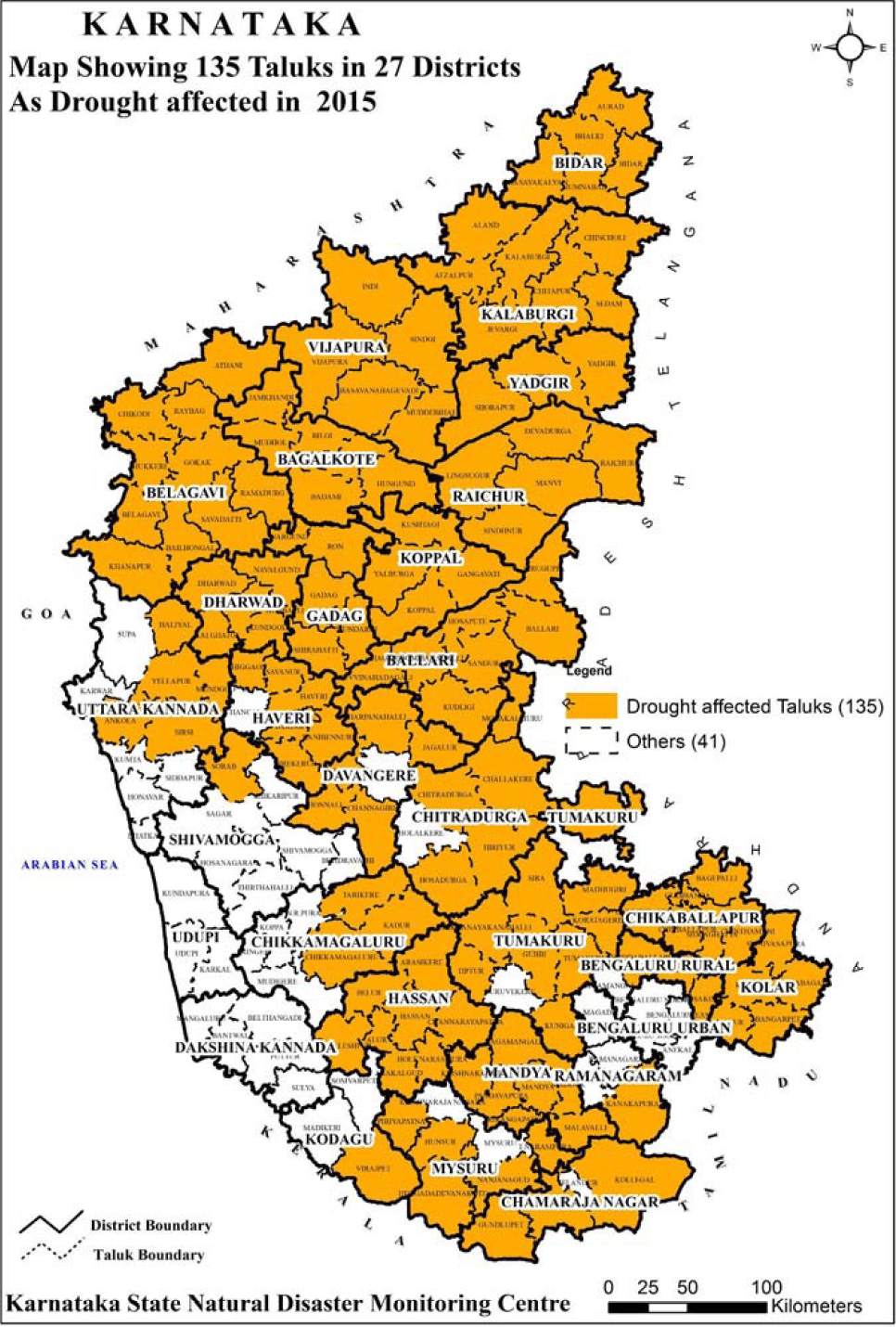
Karnataka is witnessing drought for the third successive year; rainfall has been deficient since 2012-13. Because of the rainfall deficit, reservoirs did not fill up completely. Coupled with the hot summer temperatures in March and April 2016, the stored water has now almost depleted. Groundwater, the saviour in times of failure of rainfall, has dipped severely because of years of reckless exploitation for irrigating water guzzling crops in semi arid soils. With even drinking water becoming scarce, agricultural activity has come to a standstill in the region. The drought in 2015 was preceded by unseasonal rains damaging the previous harvest. The monsoon deficit led to a dip in kharif output throughout the State in 2015. The drought spread even to the normally lush Cauvery basin prompting digging and deepening of borewells. While southern Karnataka received some heavy rains in November, districts in Northern Karnataka again saw failure of rains with some districts such as Kalaburagi, Koppal and Yadgir registering over 70% deficiency in rainfall. There has been a near complete failure of crops in Northern Karnataka, with both rabi and kharif crops being wiped out, even as area under sugarcane has gone up! The northern region, which also lags in development indices, is in the clutches of rural distress – over a thousand farmers have committed suicide. Mass migration to cities is being witnessed.
Author: SANDRP
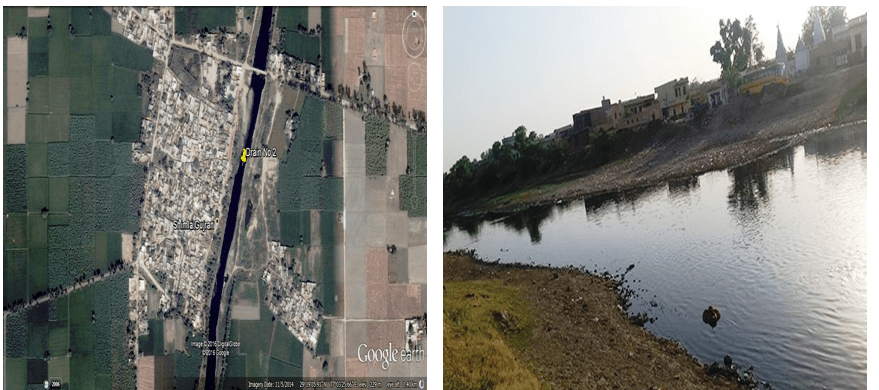
Shimla Gujran in Yamuna basin: Journey from a flourishing village to a living hell
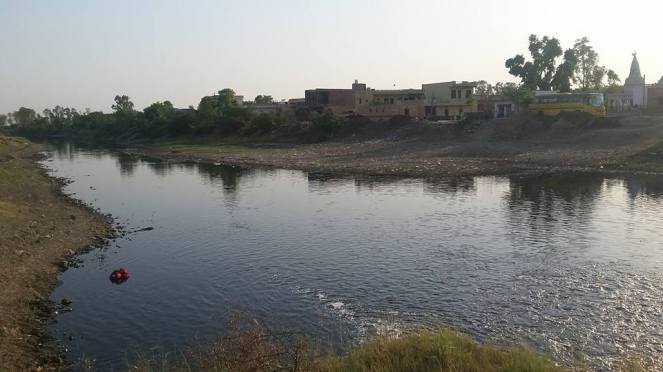
Shimla Gujran village on the other side of DN-2 (Photo by Vikas Sharma, village doctor who had to fix an air tight aluminimum framed glass door at his clinic to avoid to deadly stench)
The news of ammonia laden pollution entering Delhi’s water supply via Yamuna River has become more of a routine. The periodical nuisance forces closure of Delhi Jal Board (DJB) water treatment plants for few days, leading in disruption of water supply to lakhs of people. But as usual, within couple of days things fall back to normalcy until the cycle strike back.
The source of pollution remains undisclosed with only hint that the origin presumably a drain carrying pollutants from Haryana sneaks into river somewhere upstream of Delhi. Much is not talked or heard about the mystic drain and the problem largely remains unfixed. Haunted time and again Delhi Government has now installed one Ammonia-Neutralizers and planning to buy more as a remedial measures.
DRP: 2 May 2016 (Patoda: How a village in drought hit Maharashtra achieved water independence)
Patoda: How a village in drought hit State turned water self-reliant At a time when almost every village in drought-hit Marathwada is facing acute water scarcity tiny Patoda, on the fringes of water-starved Aurangabad city, is offering valuable lesson in water management conservation and harvesting. Though it is surrounded by arid villages but Patoda’s residents regard water as more precious than money. They follow strict rules about usage and strictly carry the water audits. Water meters are installed in every households and entire village recycles each drop of waste water it generates. Today no rain water flows out of the village. Percolation has recharged the aquifers and the water table has risen. So effective is its water conservation model that Patoda has now become a model for the rest of Marathwada and has won 22 state & national awards. But it did not happened over nights. In fact it is a result of over 10 years joint efforts done by villagers.

Submission to Mihir Shah Committee For Restructuring of CWC & CGWB
It is proposed that the current CWC and CGWB should be reconstituted along following lines. Encouraged by communication from the committee and MoWR that the suggestions need not be limited by the TORs since TORs are also extendable, I have proposed a new institutional structure that is different than the current one. A brief outline of this was presented at the 6th meeting of Mihir Shah headed committee on Jan 11, 2016, it is elaborated here further. Continue reading “Submission to Mihir Shah Committee For Restructuring of CWC & CGWB”

Bihar Floods of 1987- V – District Khagaria
Above: Cover photo and map from NIDM report of Bihar floods 2007
Guest Blog by: Dr. Dinesh Kumar Mishra
Khagaria faced the first round of floods starting 8th July this year when the floodwaters of the Kosi, the Kareh and the Bagmati had engulfed large number of villages in the district. The Ganga and the Burhi Gandak was relatively quiet at this time despite heavy rainfall locally. It took towards the end of July that the flood level of the rivers started rising alarmingly and the Kazijaan embankment on the Burhi Gandak breached on the 2nd August in Alauli block of the district. The flood water emanating out of the gap created thus engulfed the Panchayats of Raun, Sahasi, Budhaura, Mujauna, Bhikhari Ghat, Shumbha and Burhawa Haripur. The road connecting Alauli to Khagaria was submerged in flood water and its connection with Khagaria was snapped. There was an untimely flood in the Kosi and all the Panchayats of the Beldaur block came under a sheet of water. The blocks of Chautham, Parbatta and Gogri were still spared by floods as the Ganga was maintaining its low profile. So far only 14 Panchayats of Alauli, 5 Panchayats of Chautham, 13 Panchayats of Gogri, 11 Panchayats of Beldaur, 3 Panchayats of Khagaria and only one Panchayat of Kosi was flooded. Relief programs were started in this district on the 4th August but its coverage was meager according to the local people. Rise in the levels of the Badla-Karachin embankment on the Kareh and Badla- Nagarpara embankment on the Kosi/Bagmati was causing concern among the local people. Continue reading “Bihar Floods of 1987- V – District Khagaria”
Bihar Floods in 1987 – IV – Sitamarhi
Above: Cover photo and map from NIDM report of Bihar floods 2007
Guest Blog by Dr. Dinesh Kumar Mishra
Till the end of the third week of July, rains in Sitamarhi were normal and whatever flood that normal water could cause was there in the district. But when it stared raining in the fourth week of July then just within three days, on the 27th July, the Bagmati overtopped the Muzaffarpur-Sitamarhi Road at three places and the road communication between the two towns was snapped. The road communication, however, was quickly restored on the 31st July. On the 28th July, the Bagmati breached its right embankment near Belwa Ghat in a length of 400 meters. A flood regulator was being constructed here for the past many years to divert part of the river flow (50,000 cusecs)and make it rejoin the river downstream thus delaying this portion of the flow by 16 hours when it rejoined the mainstream. Engineers hoped that by so doing they will be able to control the floods of the river to a great extent. The under construction regulator used to get washed away every year during the rains and this was not a new thing that it was damaged this year also. Water coming out of the damaged regulator submerged the villages on the western bank of the river. The rains of the past 4-5 days were enough to flood hundreds of villages in the blocks of Bairgania, Majorganj, Shivhar, Tariyani, Piprahi, Belsand and Runni-Saidpur of Sitamarhi and Katra and Aurai of Muzaffarpur district. The river water had entered the Sub-divisional HQ of Shivhar on the right bank and on the left bank in the block HQ of Belsand and the thana there through the gaps left in the embankment for constructing sluice gates in future.. The water of the Bagmati had entered every house of Sugia, Katsari, Sugia Bazar, Shahpur, Pokharbhinda, and Bisahi etc and it was flowing one and half feet above the Sitamarhi-Muzaffarpur road near Kataunjha where the river crosses this road that was closed for the vehicular traffic. There was a simultaneous flood in the rivers of the Adhawara Group and a causeway connecting the villages Chilara and Parchhaiyan was washed away. This meant that the road connection between Sitamarhi and Sonbarsa block was also lost. The rail line between Sitamarhi and Darbhanga was overtopped at many places and the train services were suspended between the two stations. Continue reading “Bihar Floods in 1987 – IV – Sitamarhi”
Bihar Floods in 1987 – III – West Champaran
Above: Cover photo and map from NIDM report of Bihar floods 2007
Guest blog by: Dr. Dinesh Kumar Mishra
West Champaran district of Bihar is located in the Northwestern corner of the state and is surrounded by the Gandak and the Burhi Gandak along with their tributaries. Two of its blocks, Madhubani and Thakaraha, are located on the western bank of the Gandak and are adjacent to the Deoria district of Uttar Pradesh. There used to be a rail line connection between Chhitauni Ghat of Uttar Pradesh and Bagaha in Bihar. A bridge connecting these two towns was washed away during the floods in 1924 and the British Government did not restore this bridge as the train service was coming handy for the freedom fighters to travel to UP and vice versa. This bridge and the rail service were restored a few years ago. The administration of these two blocks (these are split into four now) is run from Padarauna in UP during the flood season as the blocks get thoroughly disconnected from Bihar. To prevent the westward movement of the Gandak and embankment named Pipra-Piparasi Ghat embankment (PP Embankment) was constructed in 1960s as the river has a tendency to shift towards the west and there is a constant pressure of the river on this embankment during the rainy season. At times, the safety of this embankment is threatened and there is long history of its breaches and the engineers of the Irrigation Department face a tough time maintaining the embankment. When the rail bridge was not there on the Gandak one had to go to Madhubani and Thakaraha by crossing the Ganga via Chhapra, Siwan and Gopalganj. Continue reading “Bihar Floods in 1987 – III – West Champaran”
DRP: 25 APRIL 2016 (One Year After Nepal Earthquake, Has the World Learnt Any Lesson?)
On this day in 2015, the massive Nepal earthquake of 7.9 intensity (Richter scale) shook the scenic Himalayan Nation. The earthquake left a major trail of destruction affecting over 20 districts and killing over 9 thousand people. According to expert Dave Petley, Langtang rock and ice avalanche was the most dramatic and significant landslide, that killed the most individuals. The earthquake killed over 9000 people, with 255 still missing. The severity of the quake can be gauged from the fact that more than a third of the disaster related deaths in 2015 occurred in Nepal’s April 25 earthquake. The earthquake-induced flash floods, landslides and aftershocks also damaged up to 15 hydropower plants, which has not been still restored fully. Surprisingly despite the increasing number of disasters taking place across the globe, world only spends less than a fifth of the money on Disaster Risk Reduction Compared to Disaster management. Nepal will still take years from recovering socio-economic losses caused by the quake. But it is pertinent that in the wake of the quake and other disasters, human civilisation must learn its lesson. It’s true that development and disaster cannot be stopped but we must make our developmental decisions more informed, rule based and democratic so that it helps us deal better with disasters by decreasing their intensity and velocity and our short-sighted developmental choices do not get translated into a disaster itself. Continue reading “DRP: 25 APRIL 2016 (One Year After Nepal Earthquake, Has the World Learnt Any Lesson?)”

Latur Drinking Water Crisis highlights absence of Water Allocation Policy and Management
Above: The dried up Manjara Dam near Latur. Photo: Vivek Bendre, The Hindu
On the 16th of January 2016, when Latur City in the heart of Marathwada was receiving drinking water once in 15 days and when plans of bringing water from Ujani Dam, about 300 kms away were being mulled upon, I was standing on the wall of the Lower Terna Reservoir in Osmanabad, about 40 kms from Latur. The dam has been at dead storage for the past 3 years. There are a string of jackwells inside the dam, to take water to rural drinking water supply schemes in Osmanabad and Latur for Nilanga, Killari and recently Ausa in Latur and Makani and Omerga in Osmanabad. Water Filtration System which is supposed to supply drinking water to 14 villages in Osmanabad lies defunct for years, even as the Revenue Minister inaugurated a brand new system for Latur City. Villages supposed to receive water from the dead stock stay thirsty. This is also the same Lower Terna Dam from where water is being taken for the Latur city in tankers now. Continue reading “Latur Drinking Water Crisis highlights absence of Water Allocation Policy and Management”
DRP: 18 April 2016 (Prior action & planning can reduce Drought impact: Solapur shows)
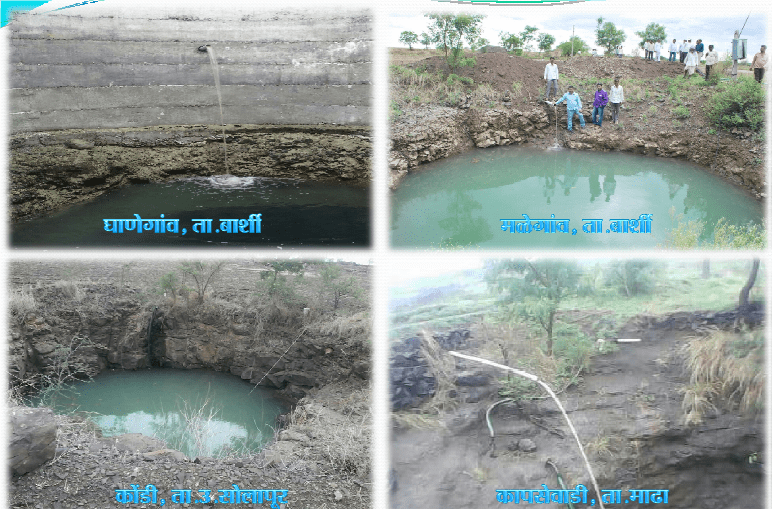
Union Water Resources Minister Uma Bharti in an interview tried to refute charges that the Centre reacted late to India’s drought crisis. Water minister makes strange statements that one cannot do any planning about drought & her govt is the first govt to provide water through tankers. However, Solapur, a chronically drought-hit district in Maharashtra was serviced with more than 200 tankers in 2013-14, even when the monsoon rainfall was better than this year. In this drought, there are only 16 tankers plying in Solapur. Drinking water sources have been secured, water from Ujani dam for and sugar cane has been disallowed. The district leads the way in Jal Yukta Shivar Program in the state, new avenues of Agricultural credit are opening, options to sugarcane are being developed, errant sugar factories are being fined for polluting drinking water sources. Will the Union Government accept its mistakes and make amends?
 SANDRP