
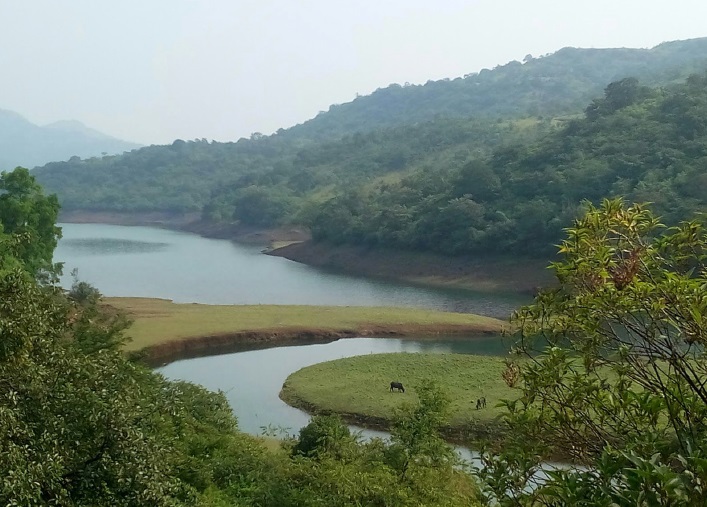
Above: Mandovi River in Goa just before Mapusa, Photo by Author in Feb 2016
GUEST BLOG by: Chicu Lokgariwar
Dear Mr. Rajendra Singh
Your support for the diversion of the Mhadei River to the Malaprabha before it enters Goa is well known. I understand it is your belief that it will benefit ‘commoners’[i] in the Malaprabha river basin while not having any adverse downstream impact on the Mhadei. While a ‘commoner’ citizen is entitled to have his/her opinion based on a curated portion of the facts, you, Mr. Singh, do not have that luxury.
As a Magsaysay, Stockholm Water Prize awardee, as an individual who has adopted the title of ‘waterman of India’, it is obligatory for you to consider all the facts, to weigh the issues at stake in an unbiased manner, and finally, to commit no injustice. And that is why I do find some comments made by you to the press problematic in their bias. Please allow me to put forth my objections to these statements.
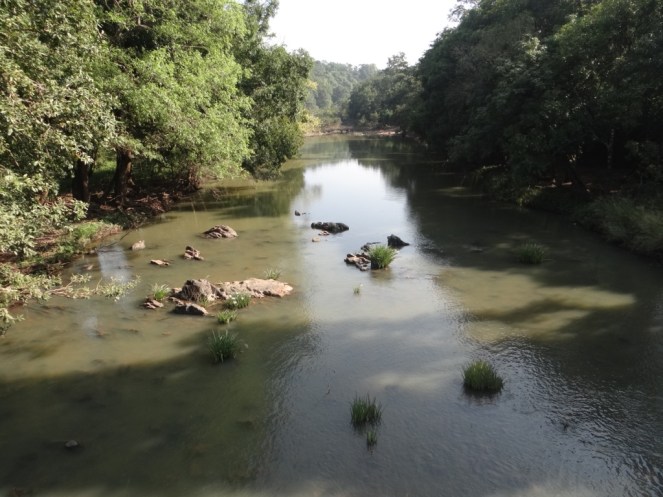
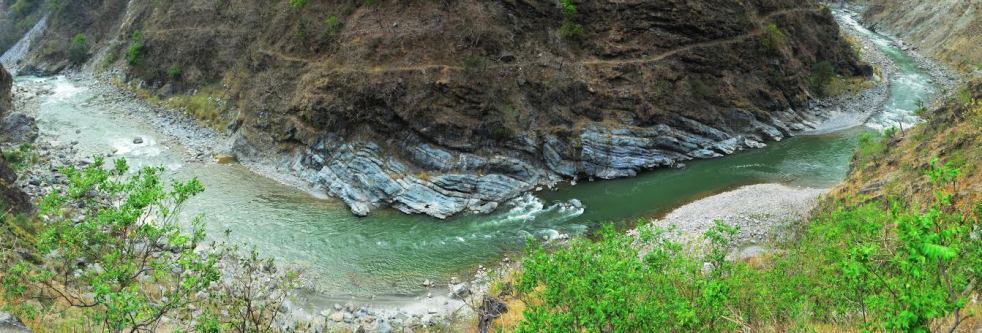
Malprabha River on the Eastern Flank (Photo by Parineeta Dandekar)
You have gone on record[ii] that it is your belief that ‘This diversion from River Mhadei to River Malprabha would not cause any environmental damage’.
The discharge of the Mhadei, when measured near its mouth in the non-monsoon season is 285 MCM/year (8.07 TMC); and its total annual discharge is 3447 MCM/year (97.6 TMC). Karnataka, as per its original plan made in 2002, aims to divert 214 MCM/year (7.56 TMC). A study[iii] of the water retaining structures then planned by Karnataka on the tributaries of the Mhadei indicates that these six will retain 21% of the annual monsoon rainfall and 22% of the baseflow during non-monsoon season for the entire basin.
But things are even worse than that study would have us believe. According to A N S Nadkarni, Advocate General of Goa,”Karnataka now wants to divert 24 TMC of water from the basin”.
I fail to conceive of any circumstances in which this extensive withdrawal ‘would not cause any environmental damage’. This is especially true of the Mhadei. The Mhadei sanctuary was formed in 1999, and hosts one of the most lush and verdant pockets of the Western Ghats Biodiversity Hotspot. Mr. Rajendra Kerkar informs us that infrastructure for the diversion islocated in the reserve forest area. Nirmal Kulkarni, Chair of the Mhadei Research Centre[iv], has stated in an interview, “This region is sustained and supported by the Haltar nullah, Kalsa-Bandura nullah and their tributaries, along with the Mhadei river and its tributaries. Any diversion of water going to a wildlife sanctuary or forest is not permissible by India’s wildlife laws”[v]. This area will receive a denuded river incapable of supporting the rich riparian ecosystem that now exists. This is true not only in terms of a decreased quantity of water, but also due to a loss in the nutrients brought by the sediments which will now be impounded by the diversion related structures.
An issue unique to coastal rivers is that of tidal ingress. Currently, some 56 kilometers of the Mhadei’s 87 kilometer length is in the saline zone. A decrease in the baseflow of the river will have two consequences. It will increase the salinity of estuarine waters and will increase the area that is presently saline. Either will have catastrophic consequences on the people, wildlife and plants that presently depend on this river.
Increase in the salt content of coastal and estuarine waters can decrease the nutrients available[vi], lead to major mortalities of several species[vii], possibly destroying fish populations[viii]. Increase in the length of the saline zone will decrease the area available for freshwater organisms and lead to a decrease in their numbers.
I will include humans in this list of the victims of environmental damage due to increased salinity. The Mhadei, just above its saline zone, supports most of Goa’s rich Khazan lands. Besides these, several fisherfolk depend on it for their livelihood. And finally, the Mandovi supplies drinking water to 43% of Goa’s population.

Above: Image of The Hindu clipping of March 26, 2016 carrying Rajendra Singh ji’s interview
- In an interview with The Hindu of the 26thof March 2016[ix], you said that ‘(Karnataka) should come out clear on a policy that will enable it to harness every drop of water available in its territories’. Further, you have also stated that ‘Karnataka would not have faced scarcity if it had stopped the western flow of water four decades ago’.
Mr. Singh, you are an advocate of healthy flowing rivers. You have, in the past, opposed the inter-linking of rivers. Why do you consider the Mhadei-Malaprabha diversion to be an exception?
This diversion certainly does not come under the concept of ‘catch every drop’ or any other water harvesting principle. As Adv. Nadkarni stated, Goa has no objection if Karnataka wishes to utilise the water within the basin. The issue is that the state wishes to divert water out of the basin into another one. Harnessing ‘every drop of water’ available within political boundaries is a notoriously dangerous and oppressive principle. While India has the good fortune to be the upstream neighbour in the case of most of our rivers, we too would protest if Nepal, Bhutan or China were to follow the principle you are advocating.
While there is a perceived scarcity of water in Karnataka (though the intensity is being debated[x]), scarcity cannot be negated by robbing other rivers. The solution has to evolve within the basin.
Mr. Vijay Kulkarni, president of the Kalasa Banduri campaign that is advocating the diversion, has informed us that water from the Mhadei will be used to supply the needs of irrigation in Bagalkote, Gadag, Dharwad and Belguam. The rainfall in these districts ranges between 579 to 772 mm[xi]. Admittedly, this is less than that of coastal regions, but is comparable to Alwar. All four districts grow sugarcane, cotton, and sunflower. These are crops with high water needs, their requirements being approximately 1500-2500mm (cane), 700-1300mm (cotton), and 600-1000mm (sunflower)[xii]. In addition, there is an abysmal lack of interest in rainwater harvesting or water recharge. Of the four districts, only Belagavi can boast of one water harvesting/recharge structure constructed to the knowledge of the CGWB. Karnataka has not proved to be a wise user of its own water resources. Goa is not perfect by any means. It faces problems of pollution of its waters and environmental degradation just as other states do. But that does not give us the right to rob the Mhadei of its water.
- As you know, Karnataka has gone ahead and constructed most of the structures required for this diversion without any of the clearances in place, including environment clearance, forest clearance, wildlife clearance, Options assessment, CWC clearance, conducting social and environment impact assessment and public consultations, among others. Most of these are staturoy requirements. In your statements it would have been useful if you had also raised the issue of these violations, since besides being statutory requirements, these are basic steps necessry before any prudent decision making.
Now that the issue is before the tribunal, any such diversion cannot take place without the tribunal decision. In fact, we hope you also raise your voice that the tribunal should also hear the people and civil society, besides the states, since states have most often failed to fairly represent the real interests of most of the poorer and weak sections of society and also environment.
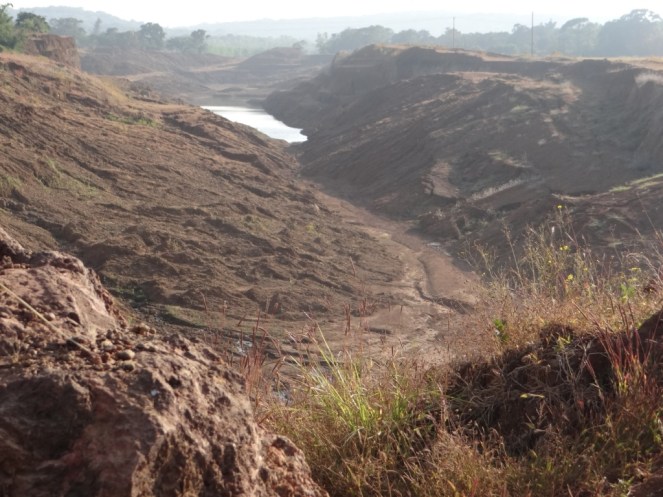
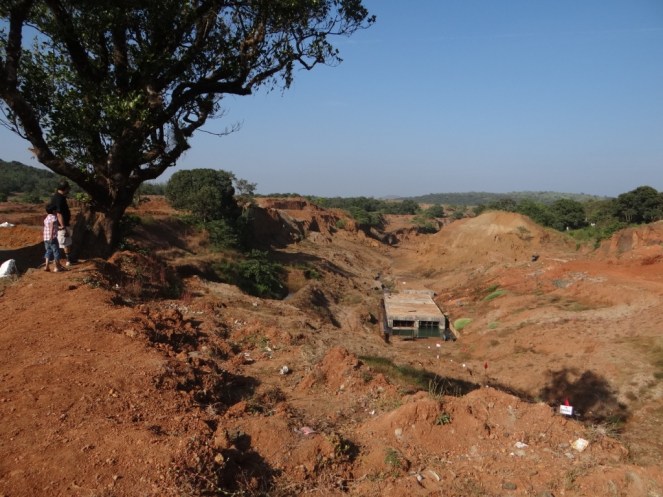
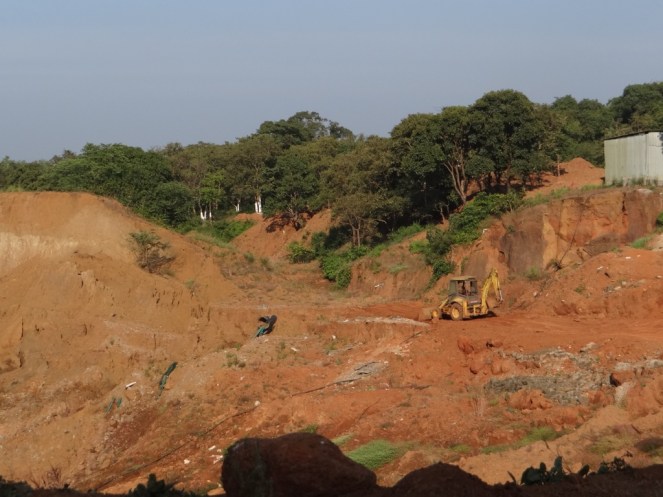

Work on diversion done by Karnataka without clearances (All four photos by Parineeta Dandekar)
IN CONCLUSION As Mr. Rajendra Kerkar suggests[xiii], rainwater harvesting, selection of appropriate crops and irrigation technologies, and demand management are the key to quenching Karnataka’s thirst. Interestingly, these are the very principles that you mentioned when you spoke of your work in Alwar. At that time you said of these,’I believe this is the way to save the environment and bring prosperity to farmers in Indian villages.’
What was true then is true today. In your own words[xiv] Mr. Singh, your first foray into leadership and water began in November 1985 when ‘carrying a spade and basket and accompanied by Nathi Bhalai of Gopalpura village, we started building a dyke in the hot sun’. Those principles, of working with people, and arriving jointly at a sustainable solution to their needs, of protecting the earth’s resources, is what we expect of you. Not advocating environmentally and socially unsound inter-linking of rivers.
No exceptions.
Chicu Lokgariwar (chicu.l@gmail.com)
END NOTES:
[i] http://www.thehindu.com/news/national/karnataka/now-it-is-for-the-tribunal-to-suggest-a-way-out-of-mahadayi-row-rajendra-singh/article8398449.ece
[ii] http://www.goanews.com/news_disp.php?newsid=6917&catid=169
[iii] http://shodhganga.inflibnet.ac.in/handle/10603/7539
[iv] http://mhadeiresearchcenter.org/about/the-team/nirmal-kulkarni/
[v] http://timesofindia.indiatimes.com/city/goa/Diversion-of-Mhadei-waters-will-mean-irreversible-damage/articleshow/48703312.cms
[vi] Qasim, S. Z., P. M. A. Bhattathiri, and V. P. Devassy. “The influence of salinity on the rate of photosynthesis and abundance of some tropical phytoplankton.” Marine biology 12.3 (1972): 200-206., http://link.springer.com/article/10.1007/BF00346767
[vii] Gibson, R. N., Margaret Barnes, and R. J. A. Atkinson. “Impact of changes in flow of freshwater on estuarine and open coastal habitats and the associated organisms.” Oceanography and Marine Biology, An Annual Review, Volume 40: An Annual Review 40 (2003): 233.
[viii] Drinkwater, Kenneth F., and Kenneth T. Frank. “Effects of river regulation and diversion on marine fish and invertebrates.” Aquatic Conservation: Marine and Freshwater Ecosystems 4.2 (1994): 135-151. http://swrcb2.swrcb.ca.gov/waterrights/water_issues/programs/bay_delta/deltaflow/docs/exhibits/swrcb/swrcb_drinkwater1994.pdf
[ix] http://www.thehindu.com/news/national/karnataka/now-it-is-for-the-tribunal-to-suggest-a-way-out-of-mahadayi-row-rajendra-singh/article8398449.ece
[x] http://timesofindia.indiatimes.com/city/goa/Ktaka-seeks-7tmc-ft-of-Mhadei-water/articleshow/50155740.cms
[xi] Central Ground Water Board District Profiles, http://cgwb.gov.in/index.html
[xii] http://www.fao.org/nr/water/cropinfo.html
[xiii] http://www.indiawaterportal.org/articles/one-river-two-names-and-14-year-long-dispute
[xiv] http://environmentportal.in/files/Rajendra%20Singh.pdf



 SANDRP