
काल दि. २३ ऑगस्ट २०१६ रोजी महाराष्ट्र-तेलंगण आंतरराज्य मंडळाच्या आज झालेल्या पहिल्याच बैठकीत तुमडीहेटी, मेडिगट्टा आणि चनाखा-कोर्टा बॅरेज या तीन बॅरेजचे काम सुरू करण्यासाठी दोन्ही राज्यांदरम्यान करार करण्यात आले. कमालीची गोपनीयता पाळत केल्या गेलेल्या या कराराबद्दलची अत्यंत मोघम टिप्पणी प्रसार माध्यमांना पाठविण्यात आली. तुमडीहेटी, मेडिगट्टा आणि चनाखा-कोर्टा बॅरेजमुळे महाराष्ट्र राज्यातील यवतमाळ, चंद्रपूर आणि गडचिरोली जिल्ह्यातील 30 हजार हेक्टर जमीन सिंचनाखाली येणार असून उपसा सिंचन योजनांना बारमाही शाश्वत पाण्याचा स्त्रोत उपलब्ध होणार आहे असे या टिप्पणीत नमूद केले आहे. तसेच या प्रकल्पामुळे महाराष्ट्रातील एकही गाव, गावठाण बुडणार नाही, नदीकाठच्या गावांना पुराचा धोका नाही व हे प्रकल्प दोन्ही राज्यासाठी फायदेशीर ठरणारे असून उपसा सिंचन योजनांना बाराही महिने पाणी मिळणार आहे असा दावा करत या भागातील नागरीकांनी या प्रकल्पांना विरोध करु नये असे आवाहनही महाराष्ट्राच्या मुख्यमंत्र्यांनी त्यांनी केले. Continue reading “महाराष्ट्र-तेलंगण आंतरराज्यीय करार: जनतेच्या मुलभूत हक्कांचे व देशाच्या पर्यावरणीय कायद्यांचे उल्लंघन”
Author: SANDRP
दो बाॅधों की कहानीः क्या बिहार की अप्रत्याशित बाढ़ एक टाली जा सकने वाली मानव जनित त्रासदी है?
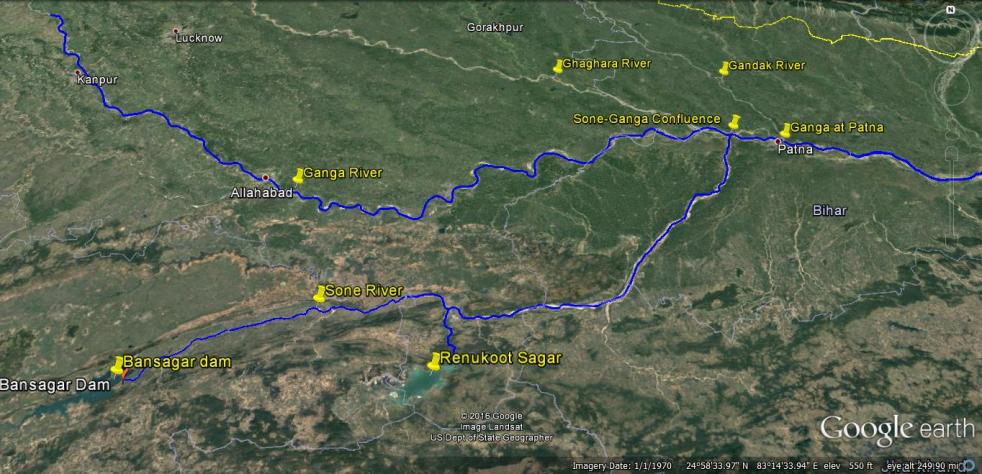
बाणसागर बाॅध, सोन नदी, गंगा नदी और पटना को दर्शाता मानचित्र
21 अगस्त 2016 की सुबह, गंगा नदी का जलस्तर लगातार बढ़ते हुए, पटना में 50.43 मीटर पर पहुॅच गया। जिससे पटना में गंगा नदी अपने पहले के उच्चतम बाढ़स्तर 50.27 मीटर से 16 सैंटीमीटर ऊपर बह रही थी। 22 अगस्त 2016 तक पानी का जलस्तर गंगा नदी के किनारे तीन अन्य स्थानों पर उच्चतम बाढ़स्तर को पार कर गया। जिसका विवरण निम्न हैः-
स्थान 22.08.2016 को उच्चतम बाढ़स्तर पुराना उच्चतम बाढ़स्तर
बलिया उत्तरप्रदेश 60.30 मीटर 60.25 मीटर (14 सितंबर 2003)
हाथीदाह, बिहार 43.17 मीटर 43.15 मीटर (07 अगस्त 1971)
भागलपुर बिहार 34.55 मीटर 34.50 मीटर (05 सितंबर 2013)
इस तरह से हम देखते हैं कि पटना में उच्चतम बाढ़ का रिकार्ड तोडने के बाद, अब यह बाढ़ गंगा नदी के किनारे बसे बिहार और उत्तरप्रदेश के अन्य इलाकों में पहुॅच रही है। यहाॅ यह बात उल्लेखनीय है कि बिहार में अब तक वर्षा औसत से 14 प्रतिशत कम हुई है। सवाल यह उठता है कि इसके बावजूद गंगा में रिकार्ड तोडने वाली बाढ़ क्यों आयी?
A tale of two dams: Is Bihar’s unprecedented flood an avoidable man-made disaster?
Above: Map Showing the location of Bansagar Dam, Sone River, Ganga River and Patna
Water level of Ganga at Patna reached 50.43 m on Aug 21, 2016 morning with still showing rising trend. This level was already 16 cm higher than the highest ever recorded flood level (HFL) of Ganga at Patna of 50.27 m. By Aug 22, 2016, at three more sites along Ganga, the water level had already breached the highest recorded levels: Balia in Uttar Pradesh (Ganga Water level at 60.3 m, higher than the HFL of 60.25 m recorded on Sept 14, 2003), Hathidah in Bihar (Ganga water level at 43.17 m, higher than the HFL of 43.15 m recorded on Aug 7, 1971, that is 45 years back) and Bhagalpur in Bihar (Ganga water level at 34.55 m, higher than HFL of 34.5 m recorded on Sept 3, 2013). This means that the highest flood level that started at Patna is now travelling both upstream and downstream along Ganga.
Several districts of Bihar along Ganga are facing floods, with at least 10 lakh people affected and about 2 lakh people displaced. On Aug 21 alone, NDRF teams have rescued over 5300 people from Didarganj, Bakhtiyarpur, Danapur Chhapra, Vaishali and Maner. At least ten lakh people have been affected in Bihar, two lakh have been displaced and scores have been killed. It seems more like and annual natural calamity.
But that is not the case, if we look closely. Available information shows that the unprecedented floods that we are now seeing in Ganga in Bihar and UP are largely due to contribution of two dams: Bansagar Dam along Sone river in Madhya Pradesh in the upstream and Farakka Dam (misleadingly called a Barrage) on the Ganga river in West Bengal. If Bansagar Dam was operated in optimum way, than it need not have released over ten lakh cusecs of water. As pointed out by Bihar government, the high floods brought by Ganga in Patna are majorly due to the high flow contributed by Sone river upstream of Patna. Continue reading “A tale of two dams: Is Bihar’s unprecedented flood an avoidable man-made disaster?”

Proposed Maharashtra Telangana Inter-state Water sharing Agreement of Aug 23, 2016: In complete violation of people’s rights & environmental laws of India
Maharashtra & Telangana governments, it has been announced, will be signing a pact for three irrigation projects to be constructed on River Godavari. Under the agreement, the two states would take up Tummidihatti, Medigadda (Kaleswaram) and Chanaka–Korata projects. Chief Minister of Telangana K Chandrasekhar Rao has reportedly said that “this would herald a new era in the relations between the two states and would be a standing example of how the states can resolve inter-state disputes without the Centre’s intervention.”[i]
This pact which has been looked at as ‘historical victory’ for Telangana for convincing the neighbouring states is in fact one of the most blatant and outright violations of India’s environmental laws. Tummidihetti Project & Medigadda Project featured in the agreement have long history of gross irregularities and violations exposed by several apex agencies as well as media. SANDRP has visited these project sites multiple times, studied and written extensively about the projects and also repeatedly sent submissions to Chief Minister of Maharashtra pointing out the violations. The agreement is also being signed, keeping the affected people and also people in the Godavari river basin in two states completely in the dark. Some of the links for these articles are given at the end of this article. Continue reading “Proposed Maharashtra Telangana Inter-state Water sharing Agreement of Aug 23, 2016: In complete violation of people’s rights & environmental laws of India”

DRP: 22 August 2016 (NGT failed its mandate by allowing AOL event)
Op-Ed NGT failed its mandate by allowing AOL event This is such an amazing editorial on the issue of destruction of floodplain by Art of Living, whose behaviour is brazen, but predictable, it says! So amazingly forthright, it says “ Far more unfortunate, however, is the manner in which the NGT appears to have conducted itself in this affair. It is a sad commentary on the state of environmental governance n the country that its premier green body”, NGT, “ has to prevaricate on its earlier order”. It concludes. NGT failed to protect such an ecologically sensitive area. It is deeply disturbing that the country’s apex environmental tribunal allowed itself to be pressured and intimidated. Salutes to the Author of this forthright editorial! Meanwhile, the committee of experts, appointed by Green has found that the “entire floodplain area used for the main event site” has been “completely destroyed” causing “invisible loss of biodiversity” that “may never be able to return”. In its 45 page report, submitted to the NGT on July 28, the seven-member panel, said “the entire floodplain area used for the main event site, i.e. between the DND flyover and Barapullah drain (on the right bank of river Yamuna) has been completely destroyed, completely destroyed not simply destroyed. The ground is now totally levelled, compacted and hardened, totally devoid of water bodies or depressions, and almost completely devoid of any vegetation (except a few large cattails at the base of of the DND flyover)”. On the contrary AOL alleged that NGT appointed committee is biased, unscientific and lacks credibility.
Continue reading “DRP: 22 August 2016 (NGT failed its mandate by allowing AOL event)”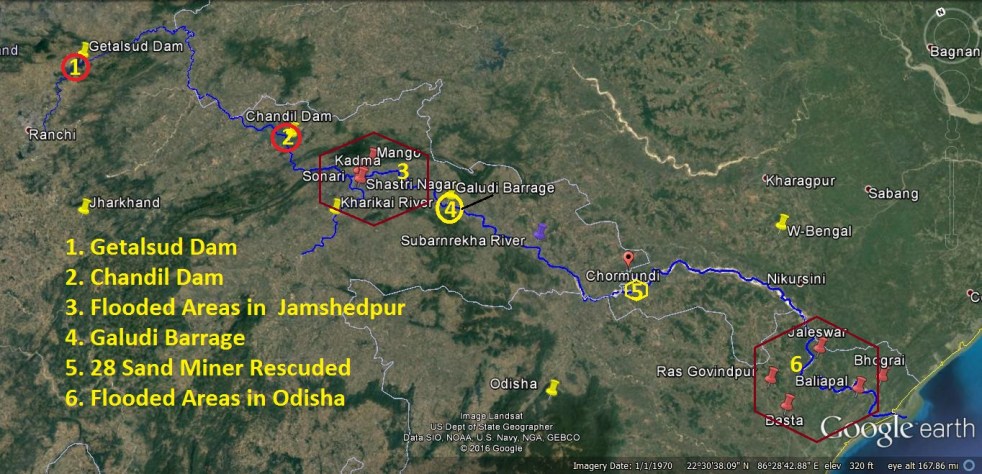
Was Not Sudden Flood In Subarnrekha Jharkhand Avoidable?
Following heavy rainfall, on August 17, 2016, Chandil dam, Jharkhand released huge amount of water in Subarnrekha River. As a result there was sudden surge of waters in Subarnrekah River causing worrisome situation in Jamshedpur town and in areas further downstream along the river in West Bengal and Odisha States.
Superficially the incident may appear a natural incident. But analysis of available information indicates that the flood impact could have possibly been reduced or avoided.
The incident:- On August 17 and 18, 2016, the ongoing South West Monsoon brought heavy rainfall in Jharkhand. The evenly distributed showers were measured as 80 mm across the State with Jamshedpur town located on the bank of Subarnrekha River recording maximum rainfall of 270 mm in 24 hours.
Continue reading “Was Not Sudden Flood In Subarnrekha Jharkhand Avoidable?”

Happy? Birthday? Narmada Bachao Andolan – Salutes to a 31-year-old movement
Above: 8-column front page top photo of Yatra carried by THE INDEPENDENT in Dec 1990
“अब तो है तुमसे हर खुशी अपनी, तुम पे मरना है ज़िंदगी अपनी..”
"फिर चाहे जो भी कहे हमको ज़माना, कोई बनाये बातें चाहे अब जितनी"
Several times Ive felt that these lines from famous hindi song[i] from film Abhimaan sum up the feelings of many activists like me.. Majrooh Sultanpuri’s lyrics came to mind again as I thought of writing about the Narmada Bachao Andolan on Aug 16, 2016, after all it was completing 31 years! Continue reading “Happy? Birthday? Narmada Bachao Andolan – Salutes to a 31-year-old movement”

DRP: 16 Aug 2016 (When shall We Start Respecting Our Rivers & Provide Space to Them)
In absence of clear and strict laws to define the rivers zone and demarcate flood plains, our rivers are increasingly becoming subject to exploitation. When the river spaces of our National River Ganga & Yamuna River which flow through National Capital are not well protected, then the plight of other rivers across country can be understood.
This week, there are two news reports which again are highlighting this cause. Interestingly in both cases, legal fight is going on in green tribunal which indirectly deals with the issue though with no success so far. In fist case, NGT has directed Govt. of Uttarakhand to demarcate floodplains of Ganga river from its origin in Gomukh till Roorkee, a 65-km long stretch in the state. The tribunal has posted the matter for the next hearing on Oct 20 and asked the state government to submit its compliance report by then. The bench also sought a report on the total number of hotels on the 65-km stretch from the govt. The green panel allowed the state govt to take the help of Roorkee-based National Institute of Hydrology for identification of flood plains. Construction on flood plains and inside river zones is a sure invitation to disaster such as Kedar Nath Floods in 2013 when human made infrastructures erected very much inside river zones were raised down like sand dunes by enraged rivers. It is sad and even more worrisome that we have learnt nothing from such events.
In second incident Govt. of Uttar Pradesh has drawn green tribunal’s ire over constructions in floodplains. The apex court for environmental issues, expressed its dissatisfaction over the manner in which State Govt filed its report on the distance of various real estate projects from the Yamuna flood plain zone in the city. Coming down heavily in the state govt and various Agra authorities, Agra Development Authority (ADA) & irrigation department, it stated that “authorities were expected to act fairly and judicially while complying with its directions.” The tribunal appointed registrar general Mukesh Kumar Gupta as local commissioner and asked him to file a correct position of flood plains and the distances of the various projects. Meanwhile, ADA has been asked to produce the original records before the tribunal on the next date of hearing, Aug 19.
Floods & floodplains are integral part of a river eco-system. Both has essential role to play in smooth functioning of multiple ecological processes that takes place throughout the journey of a river. It is abused of floodplains that our cities are facing flood threats. It is surprising to see how govts have so far failed in protection of flood plain.
With incidents of excess rainfall, cloud burst & land slides happening at increased frequency, it is time to define our river zone and flood plain clearly in the own interest of human being.
Continue reading “DRP: 16 Aug 2016 (When shall We Start Respecting Our Rivers & Provide Space to Them)”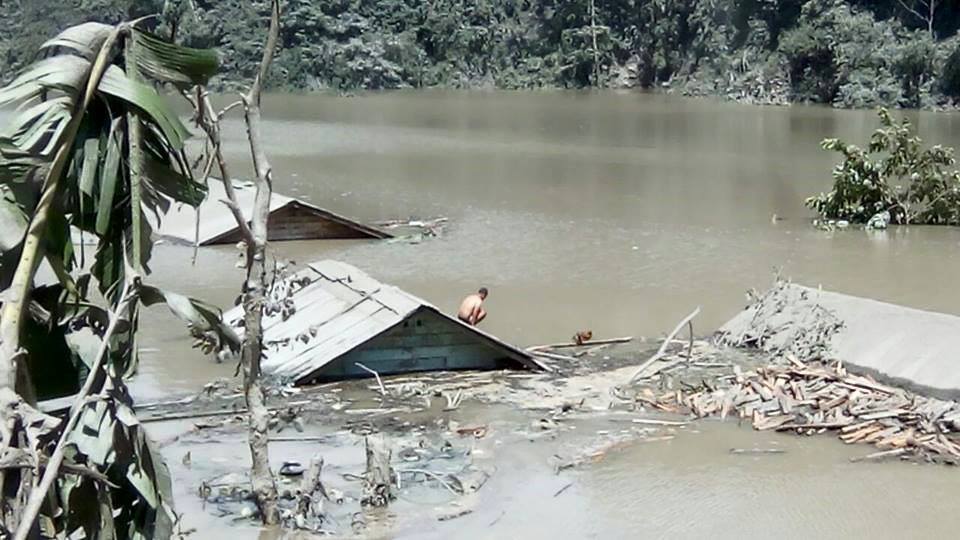
TEESTA LANDSLIDE DAM IN DZONGU: RIVER OVERFLOWS OVER DAM BUT RISK CONTINUE
Above: Submerged houses in reservoir behind landslide dam. Photo from Darjeeling Chronicle
The Kanaka River is flowing over the dam that was created on Aug 13, 2016, it is confirmed now, but the risk of the dam failure and disaster downstream continues. In the meanwhile, the upstream villages, cut off due to road damaged and bridge submerged, are facing serious problems.[i] Continue reading “TEESTA LANDSLIDE DAM IN DZONGU: RIVER OVERFLOWS OVER DAM BUT RISK CONTINUE”
LANDSLIDE DAM BLOCKS TEESTA TRIBUTARY IN NORTH SIKKIM: MAJOR RISK TO TEESTA RIVER BANK COMMUNITIES
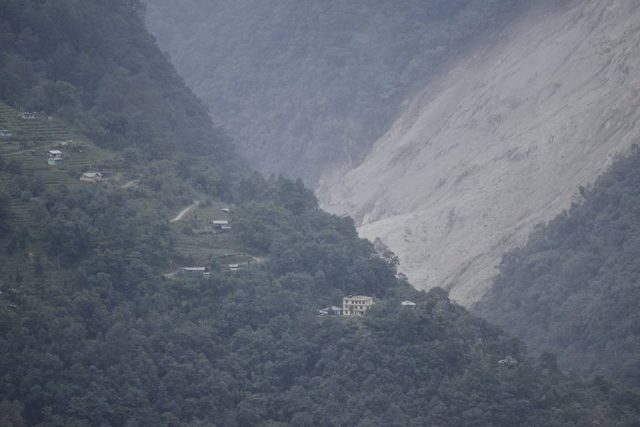
(Above: Lower part of the Dzongu Landslide, Photo from Save the Hills)
According to a number of reports[i], at around 1230 hours on Aug 13, 2016, a massive landslide completely blocked the flow of Kanaka (Rongyoung) River near Mentam village in Dzongu region in North Sikkim. A hillock called “So Bhir” came crashing down, it is reported. The Landslide dam is about 50 m high, about 45 m wide, the landslide top point is about 900 m above the river. Darjeeling Chronicle reports, the river downstream is totally dry as the water has started collecting behind the landslide dam (that situation seems to have changed on 14th Aug morning around 830 am). Continue reading “LANDSLIDE DAM BLOCKS TEESTA TRIBUTARY IN NORTH SIKKIM: MAJOR RISK TO TEESTA RIVER BANK COMMUNITIES”

