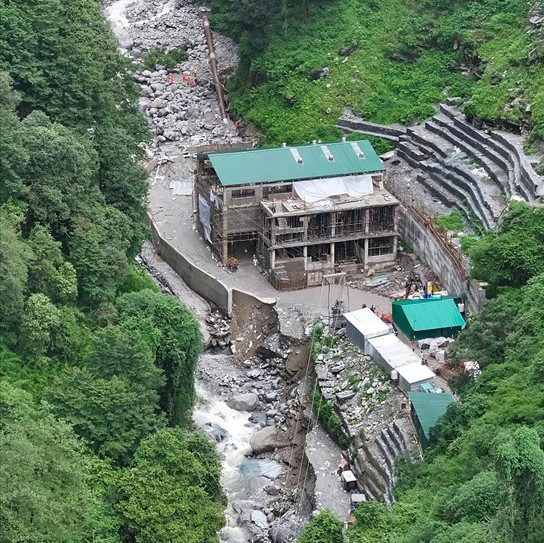
(Feature Image: Priyadarshini Small HEP on Manuni khad in Kangra, Himachal Pradesh damaged after flash flood in June 2025. At least 8 workers of the project were also killed in the disaster. Image Source: Gems of Himachal, post on X.)
The impression being given through the following PIB Press Release dated March 18 2026 that this scheme cleared by the Union Cabinet to promote small hydropower projects will promote environment friendly and socio-economically beneficial projects in North East and other hilly areas is incorrect and misleading.
Current policies require no environment, social or disaster impact assessments of such projects. Current policies also do not require any credible public consultation process or their free, prior and informed consent. The projects invariably have significant social and environment impacts, all suffered by the local communities, as numerous research, also available on SANDRP website show.
So the local communities will suffer all the adverse impacts by projects that will imposed on them without their consent. The profits will go to the private companies investing in such projects and electricity will go to the grid. How will the local people benefit? If we are serious about ensuring that such projects indeed help the environment and local communities, the least we can do is to change these policies to make it legally mandatory to ensure there is credible process to achieve free, prior and informed consent of the local communities.
Union Govt approves Rs 2584.6 Cr for Small Hydro in next five years The Union Cabinet has approved the ‘Small Hydro Power (SHP) Development Scheme for the period FY 2026-27 to FY 2030-31’ with an outlay of Rs.2584.60 crore for installation of Small Hydro Power (SHP) Projects of an approximate capacity of 1500 MW.
In North Eastern States and in districts with international border, central financial assistance to the tune of Rs. 3.6 crore per MW or 30% of the project cost, whichever is lower with an upper limit of Rs. 30 crore per project will be available. In other states Rs. 2.4 crore per MW or 20% of project cost, whichever is lower with a cap of Rs. 20 crore per project would be available. An amount of Rs. 2,532 crore has been earmarked for such projects. This is likely to bring in Rs. 15,000 crore of investment in the small hydro sector. The scheme will also incentivise the states to prepare the detailed project report for about 200 projects to create a pipeline of small hydro projects in future. An amount of Rs.30 crore has been kept to support state and central government agencies to prepare such DPR. The scheme will support 51 lakh person days of employment during the project construction and will also enable employment in maintenance and operation of these SHPs for 40-60 years.
HYDRO POWER PROJECTS
March 2026: Landslide at Pakul Dul HEP in Jammu & Kashmir One worker has been killed; one went missing while two others sustained minor injuries following a landslide at the head race tunnel (HRT) site of Pakal Dul Hydro Electric Power (HEP) Project near Drangdhuran village in Dachan tehsil under Kishtwar district of Jammu & Kashmir as per available reports.
The incident occurred amid heavy rains in the area during intervening night of March 15-16, 2026. The four workers were carrying out loading activities at Drangdhuran (Dangduru) the dam site of the project when they were hit by rocks and boulders originating from uphill. Two workers including a poclain operator were buried under tons of debris while two others managed to save their lives with minor injuries.
HP HC case in irregularities in 20 MW Rora Khadd HEP Himachal Pradesh High Court has taken suo moto cognizance of the alleged irregularities in the 20 MW Rora Khadd HEP in Yula village in Kinnaur district, following media reports. A division bench headed by the Chief Justice has issued notices to HP govt and others following issues raised by people of Yula village in the media, including indiscriminate blasting and illegal dumping of debris. HC has asked detailed status report after ground visit by the officials by the next date of hearing on May 4.
Expert reports critical of Sharavathy PSP The Karnataka High Court, earlier this month, directed the State government to stop work in the forest area for the Sharavathi Pumped Storage Hydroelectric Project, until further orders. A group of environmentalists had moved the Court, challenging the State Wildlife Board’s approval for the proposed project in the Sharavathi Lion-Tailed Macaque Wildlife Sanctuary which is part of the Western Ghats, and a biodiversity hotspot. The Court’s order boosted the morale of the environmentalists, who have been opposing the project since it was proposed in 2017.
HC halts on-ground work for Sharavathi PSP The Karnataka High Court March 10 directed that no work or activities related to the Sharavathi Pumped Storage Project (Sharavathi PSP) and Kalkatte Bridge construction be carried out in the forest without the court’s permission. A Division Bench passed the interim order while hearing a PIL praying for quashing the decision dated January 28, 2025, taken during the 19th meeting of the Karnataka State Wildlife Board when the project was approved. It also prayed to quash the in-principle recommendation granted in the 84th meeting of the standing committee of the National Board for Wildlife held on June 26, 2025. The plea also asked to declare that all the activities in any sanctuary that run contrary to the embargo laid out in Section 29 of the Wildlife (Protection) Act, 1972, are prohibited.
Sharavathi PSP: The cost of energy transition The KPCL aims to generate 2,000 MW through this project to meet peak-hour energy demands, which can touch 18,000 MW daily. The project has been defended on the grounds that the Central Electricity Authority has recommended a transition to clean energy, targeting 50% non-fossil fuel capacity by 2030. Th the cost of the project which was estimated to be around ₹4,800 crore in 2017, has gone up to nearly ₹10,240 crore.
The Karnataka State Wildlife Board gave its approval for the project in January 2025, with certain conditions. Initially, the KPCL had estimated that more than 16,000 trees were to be cut for the project. The board suggested that it be reduced to 7,000 to 8,000 trees.
Salal Dam sediment issue This article by Devendra Kumar Sharma – Former Chairman, Bhakra Beas Management Board on March 20 2026 explains how the dam reservoir is now 97% full of sediment.
The 690 MW Salal Hydroelectric Project on the River Chenab (two phases commissioned in 1987 and 1995) was conceived in 1920, with construction starting in 1970. The project consists of a rock-fill and a concrete dam. It has a unique combination of a 113-metre high, 487-metre long concrete gravity dam and a 118-metre high, 630-metrelong rockfill dam. The top elevation of the dam is 495.9 metres(1627 feet). The maximum water level of the reservoir is 494.08 metres(1621 feet) and full reservoir level is 487.68 metres(1600 feet). Overflow spillways have been provided near to top of the dam having a crest elevation of 478.68 metres (1,570 feet).
As per original design six under-sluice spillways were provided at an elevation of 416.05 metres (1,365 feet) to allow for hydraulic sluicing of the sediments. This design of having a provision of under-sluices for hydraulic sluicing of the sediments was as per the international practice of sediment management in any dam. However, based on objections from Pakistan, India was forced to plug the under-sluice gates which today has resulted in catastrophe consequences for this project. When the under-sluice gates were plugged, the dam lost its ability to ‘flush’ the river’s heavy silt load. Instead of water, the reservoir began filling with sediments (clay, sand and boulders). Within a few years, the ‘dead storage’, the area below the intake structure, was completely filled with sediments. Plugging of the under-sluices has resulted in filling almost the entire 284 million cubic meter (MCM) storage capacity of the reservoir with sediments within a few years after its commissioning in the year 1987.
As of today, more than 97% capacity of the reservoir has been filled up with sediments.
BBMB Dehar power plant crisis deepens The Dehar Power Plant of the Bhakra Beas Management Board (BBMB), a key 990 MW hydroelectric project, has plunged into a major operational crisis with all its six generating units currently non-functional, resulting in complete stoppage of power generation since early March 2026. This has intensified concerns in Punjab, which has flagged massive generation losses and alleged gross mismanagement of the Beas-Sutlej Link (BSL) Project.
Officials say the project is now operating far below its potential, with generation witnessing a continuous decline over the past three years. Punjab authorities have highlighted that since 2022, power output has been steadily falling due to technical faults, silt accumulation and repeated shutdowns, leading to substantial loss of valuable peaking power.
A major factor behind the declining generation is the persistent silt problem in the BSL system. Excessive silt ingress, particularly after 2022, has led to erosion of turbine components, reduced efficiency and frequent breakdowns. The issue has also sparked controversy, with Punjab alleging inadequate silt management and delayed maintenance by BBMB.
New hydropower plants to be set up in J&K In an interview to a national newspaper, Union Power Minister said the construction has resumed on three to four projects that were earlier stalled while additional projects are being planned, and site identification is under way. Authorities are now examining potential sites for more plants as part of plans to increase power generation in J&K, he added.
The Union Power Minister said the Government is also studying the possibility of diverting water from Jammu and Kashmir toward Punjab and further to Rajasthan, Haryana, Uttar Pradesh and Delhi through canals or tunnels. He added that there are also proposals to divert water towards Punjab and further to Rajasthan, Haryana, UP and Delhi through canals or tunnels.
SIFFYW accuses GoAP of using ‘false means’ to get signatures for SUMP PFR Rejecting the pre-feasibility report (PFR) activities for the proposed Siang Upper Multipurpose Project (SUMP) in Upper Siang district, the Siang Indigenous Farmers Forum Youth Wing (SIFFYW) on March 18 accused the government of using “false and fraud means” to get signatures from villagers. “What is happening in the Siang valley is very sad to see. The administration officers and our representatives are using false and fraud means to get signatures,” SIFFYW spokesperson Katon Moyong said.
Addressing mediapersons at the Arunachal Press Club, Moyong, who is an environmental engineer, challenged the legitimacy of the project’s approval process by arguing that the state is projecting “selective consent” from a few individuals as broad community backing. He maintained that “even a single village lacks the authority to alienate community land without wider consensus,”emphasising that land ownership in the region remains deeply governed by customary practices, rather than individual transactions.
Allegations against NHPC The All Nyishi Youth Association (ANYA) has flagged alleged administrative irregularities at the NHPC Ltd’s Itanagar regional office. It has raised concerns over the transfer of local employees, shortage of staff, and the alleged neglect of safeguards for Scheduled Tribe communities. The association has alleged that several non-engineering employees, including local women, have been transferred from the Itanagar office to remote project sites. This has led the association to question the necessity of such transfers, noting that these roles are primarily administrative and are usually confined to regional offices. It has also pointed to a reduction in manpower at the Itanagar office compared to other NHPC regional offices.
Subansiri Lower HEP NHPC on March 21 declared the commercial operation of the third unit of Subansiri Lower Hydroelectric Project adding 250 MW to the National Grid. With this milestone, the project has achieved a total operational capacity of 750 MW out of its planned 2000 MW (8×250 MW).
DAMS
Ken Betwa Project: Patwari caught taking bribe from displaced tribal woman A patwari, Rahul Agrawal, was caught taking a ₹50,000 bribe in Chhatarpur by the Madhya Pradesh Lokayukta Police from Sagar. He allegedly demanded ₹1.50 lakh from a woman to release ₹12.50 lakh compensation linked to the Ken-Betwa Link Project. The accused, Rahul Agrawal, was arrested from the collectorate premises while allegedly accepting the bribe from 43-year-old Shagunti Bai Saur from Neguwan village in the Kishangarh area whose village is affected by the Ken-Betwa Link Project. A case has been registered against the accused under the Prevention of Corruption Act, and further investigation is underway.
Parliamentary Panel flags under utilisation of funds in ILR The Parliamentary standing committee on water resources in their report has expressed concern over the underutilisation of funds under the Interlinking of Rivers in 2025-26. The fund allocation at the Budget Estimates (BE) stage was ₹2,400 crore, which was revised to ₹1,808.29 crore at the Revised Estimates (RE) stage, while the actual expenditure till December 31, 2025, stood at ₹453.16 crore.
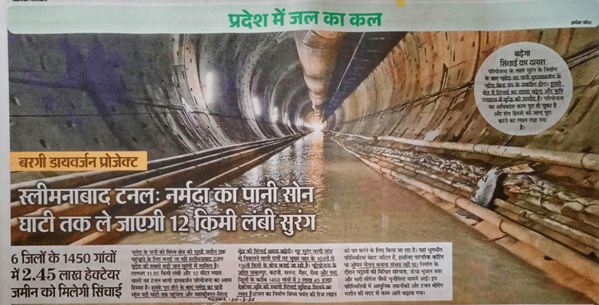
Bargi Diversion Project under construction The 11.95 km long and 10 m dia Slimanabad tunnel to connect Narmada and Sone basins across Vindhya range is under construction. It is aimed at achieving irrigation in 2.45 lakh ha in 1450 villages of six districts including Panna, Jabalpur, Katni, Satna, Mehar, Rewa. It will thus transfer water from Narmada (considered a deficit basin in Inter Linking of Rivers Scheme) to Ganga (supposed to be a surplus basin). Reminds one of what Anupamji would call Ulti Ganga! What impacts it will have on the Narmda downstream areas is a question.
Relevant decisions of MoEF’s Forest Advisory Committee meeting held on Feb 27 2026
1. Diversion of 107.596 ha forest land for 600 MW Upper Indravati Pumped Storage Project in Kalahandi dist in Odisha: APPROVED
2. Diversion of 520.66 ha forest land for 1800 MW PANARI STANDALONE PUMPED STORAGE PROJECT in (308.96 ha under Satna Forest Division, Satna district and 211.70 ha under North Panna Forest Division, Panna district) on Baghain river in MP: More Info Sought.
3. Diversion of 6.62 ha of forest land for Marshall Small Hydel Power Project in Rewa dist in MP: APPROVED
4. Diversion of 111.03 ha of forest land for Yettinahole Project in Tumkur Division in Karnataka: APPROVED.
5. Diversion of 49.85 ha of forest land for Jagmadwa Minor Tank in Kawardha division in Chhattisgarh: More info sought.
6. Diversion of 261.53 ha forest land for SJVN’s Attunli Hydro Electric Project in Arunachal Pradesh: More info sought.
Relevant agenda of MoEF’s Forest Advisory Committee meeting to be held on March 24 2026 1. DIVERSION OF 77.17 HA (ORIGINALLY PROPOSED AREA WAS 50.17 HA.) FOR EXPANSION OF ALREADY DIVERTED PROPOSAL FOR ESTABLISHMENT OF INTEGRATED RENEWABLE ENERGY PROJECT, PINNAPURAM OF GREENKO ENERGIES PVT., LTD., HYDERABAD- SUBMISSION OF ADDITIONAL INFORMATION
2. Diversion OF 197.27 HA. OF RESERVED FOREST FOR KIRTHAI- II HEP (820 MW) ON CHENAB RIVER IN DISTRICT- KISHTWAR IN JAMMU & KASHMIR
3. Diversion OF 740.1592 HA FOREST LAND FOR DAM AND MICRO IRRIGATION SYSTEM UNDER MUNJARI MAJOR IRRIGATION PROJECT IN SHEOPUR DISTRICT OF MADHYA PRADESH
4. DIVERSION OF 160.783 HA. FOREST LAND (3.626 HA PRIVATE FOREST AND 157.157 HA RESERVED FOREST) FOR SHIRAWTA OFF STREAM OPEN LOOP PUMPED STORAGE PROJECT (1800 MW) AT VILLAGE KHANDASHI, RAKASWADI, THORAN, JAMBHAVALI, TAL. MAVAL, DIST. PUNE IN MAHARASHTRA BY M/S TATA POWER COMPANY LTD
1. Seshachalam Pumped Storage Project (600 MW) in 137.44 Ha at Village Adaram, Anjuru, Anjuru Reserved Forest And Kondaturu, Sub Dist K. V. B. Puram, Dist Tirupati, Andhra Pradesh by Venika Jal Vidyuth LLP – Terms of Reference
2. Chitawad Barrage Major Irrigation Project (CCA: 65000 Ha) in 4120.67 Ha at Village Thikriya, Alot, Amri, etc, Sub Dist Mahidpur, Nagda, Ghatiya and Tarana, Dist Ujjain, Madhya Pradesh – Terms of Reference
3. Integrated Anandapur Barrage Project (CCA: 60,000 Ha) in Keonjhar dist, Odisha – Amendment in Environmental Clearance
4. Niare Hydroelectric Project (from 870 MW to 909 MW) in (from 429.585 ha to 175.05 Ha) at Village Niare, Upper Subansiri District, Arunachal Pradesh by Andra Power Private Limited – Amendment in Terms of Reference
5. Dikchu HydroPower Project (from 96 MW to 110 MW) in 55.5329 Ha (existing) at Village Nampong, Rongong, Samdong and Sangtok etc., Sub Dist Gangtok and Mangan, Dist: East Dist and North Dist, Sikkim by Sneha Kinetic Power Projects Pvt Ltd – Terms of Reference
6. Aruna Kolamb Open Loop Pumped Storage Project (1200 MW) in 383.09 Ha at Village Gothane, Kolamb, Kolik and Varchiwadi (N.V.), Subdist Panhala & Rajapur, Dist Kolhapur and Ratnagiri, Mah by THDC India Ltd – Terms of Reference
7. Sukhnai Closed Loop Pumped Storage Project (1000 MW) in 277 Ha at Village Nadi Kathari, Babura Raghunath Singh, Chandragarh, Devhat, etc Sub Dist Lalganj, Dist Mirzapur, Uttar Pradesh by Hinduja Renewables Energy Pvt Ltd – Terms of Reference
8. Chhadgada Closed Loop Pumped Storage project (900 MW) in 292.4Ha at Village Chhargarh, Deoghat, Devhat & Katra, Sub-dist Koraon & Lalganj, Dist Prayagraj & Mirzapur, Uttar Pradesh by GSC PSP Uttar Pvt Ltd – Terms of References
DAM FLOODS
Punjab MP in Parliament: BBMB mismanaged dam operations bringing dam floods The Shiromani Akali Dal (SAD) leader and Bathinda MP Harsimrat Kaur Badal on March 18, 2026, while participating in a discussion in Parliament on agriculture demands alleged “mismanagement of the situation during the floods by the Bhakra Beas Management Board (BBMB).” She said as Punjab did not have a member in BBMB, “the board failed to read the situation correctly and water was released from the Bhakra dam without due planning, compounding the situation during the floods last year”.
INTER STATE WATER DISPUTES
Punjab demands Rs 1.44 lakh crore from Rajasthan for Gang Canal Water use since 1960 Punjab chief minister Bhagwant Mann on March 18 said his government will seek royalty from Rajasthan for supplying it Gang Canal water, claiming that an unpaid amount of Rs 1.44 lakh crore has accumulated since 1960 under an old arrangement dating back to a 1920 tripartite agreement involving former Bikaner state and former Bahawalpur state (Bahawalpur is now in Pakistan). Rajasthan is currently getting 18000 cusecs water through the Rajasthan feeder. Punjab has already written to Rajasthan for this and will also approach centre.
IRRIGATION
Canal irrigation surged from 26.5% in 2022 to 78%: Punjab CM Bhagwant Mann on March 17 said groundwater table has improved in the state following increased supply of canal water for irrigation. “Our efforts have significantly reduced dependence on groundwater. In a Gurdaspur village, groundwater extraction has come down from 61.48 per cent to around 31 per cent. We aim to further increase utilisation of surface water and reduce stress on groundwater resources,” Mann said, while giving account of the performance of the Water Resources Department in the past four years.
He claimed that the AAP government ensured water supply to fields equivalent to the Bhakra canal by unlocking 10,000 cusecs from seasonal rivers and reviving a collapsing canal network. Mann said Rs 6,700 crore had been spent on canal lining, modernisation and strengthening of infrastructure from April 2022 till now. “Punjab has a total canal irrigation potential of around 75.90 lakh acres, but until March 2022, only 20.89 lakh acres, 26.5 per cent, were actually receiving canal water. We have increased this coverage to nearly 58 lakh acres, taking utilisation to around 78 per cent,” said the CM.
URBAN RIVERS
PMC officer to recommend cancelling tree felling docket A hearing on Friday about a docket issued by the Pune Municipal Corporation (PMC) regarding the felling of 689 trees for the Riverfront Development (RFD) between Wakad Bypass and Sangvi Bridge ended with a small victory for the residents and environmental activists of the city who had objected. The Tree Officer Vijay Naykal said that he was adjourning the hearing and would recommend that the docket be cancelled. Naykal also said that he would bring a notice, about the legalities of advertising the docket in newspapers, issued by activist Rekha Joshi to the attention of his seniors.
Residents oppose felling of 689 trees Residents and environmental activists have raised objections to the proposed felling of 689 trees for a stretch of the PMC’s RFD project between Wakad Bypass and Sangvi Bridge. The civic body issued a public notice regarding the proposed tree cutting on March 2, inviting objections from citizens. The objection period ended on March 14.
Kadamvakvasti Gram Sabha passes resolution to tackle garbage crisis Amid the ongoing student agitation against garbage dumping in the Mula-Mutha riverbed near the MIT Art, Design and Technology University campus, the Kadamvakvasti gram panchayat on March 14 passed a resolution to address the issue of waste management and proposed setting up of a solid waste treatment project.
Amid the growing agitation, Haveli block development officer (BDO) Shekhar Shelar on March 13 issued a letter to the Lonikand and Kadamvakvasti gram panchayats regarding the solid waste management issue. He said that “improper garbage management in these peri-urban villages had created serious sanitation and health concerns, and emphasised the need for coordination between local agencies and gram panchayats to find a sustainable solution”.
Rising pollution in Mula Mutha While thousands of crores are being poured into the RFD project to build “dead concrete walls,” the reality on the ground—just downstream of Pune is a devastating environmental disaster. The water of the Mula-Mutha is now a toxic cocktail of green stench and thick white foam. Surrounding it are “oceans” of garbage that stretch as far as the eye can see. Is decorating the banks with concrete and cutting down thousands of trees the solution we need, or are we just masking a deeper crisis? It’s time to demand a focus on the health of the river, not just the aesthetics.
Spatial dynamics of microplastics in Mula- Mutha River This study highlights the crucial role of sediment texture in influencing the concentration and retention of microplastic particles, with a pronounced presence in fine to medium-grained sediment matrices in river basins based on the example of the Pune Metropolitan Region as part of the Mutha river sub-basins.
The findings imply that a significant proportion of plastic products are breaking down into smaller particles, increasing the distribution rate over a larger surface area. The risk assessment of microplastic contamination is marked by a high to very high Microplastic Hazard Index (MHI) indicating substantial pollution, emphasizing the severity of microplastic presence.
Musi Project Gets ₹1,500 Cr The Telangana Budget has allocated ₹1,500 crore for Chief Minister A. Revanth Reddy’s flagship Musi Riverfront Development project, which aims to revive the river. The works related to the rejuvenation of the river will be taken up by Musi River Front Development Corporation Limited (MRDCL). Half of the project funding will come from the Asian Development Bank (ADB), while the state government and the central government will bear 25 per cent of the project expense each. The current allocation of ₹1,500 crore made in the Budget 2026-27 is part of the state government’s 25 per cent share.
Musi RFD: Heated debate in assembly A heated discussion took place in the Telangana Assembly on March 18 over the Musi River rejuvenation project, with sharp exchanges between the ruling Congress and opposition BRS members. While the BRS clarified that it is not against the project, it accused the government of corruption and lack of transparency. The ruling side, however, maintained that the project is aimed at improving people’s lives and accused the opposition of obstructing development.
Expert panel flags critical gaps in Vishwamitri rejuvenation efforts A high-level expert committee constituted by the Gujarat State Human Rights Commission (GSHRC) has issued a stark warning regarding the ongoing efforts to rejuvenate the Vishwamitri River, stating that without a fundamental shift toward holistic, ecosystem-centric planning, the vision of mitigating floods and restoring the river will remain unattainable.
In its fourth and most comprehensive report submitted to GSHRC, the Vishwamitri Committee detailed significant progress in data collection and physical works but highlighted alarming gaps in execution, governance, and ecological sensitivity, particularly concerning the river’s flagship mugger crocodile population.
RIVERS
2026: Books, Films, Discussions on State of Indian Rivers This overview puts together brief information on top five books, films, discussions, reports, and cultural stories published during previous year to present a comprehensive view on the state of rivers in India. The compilation emphasizes how rivers are deeply intertwined with ecology, society, politics and culture while highlighting the growing crises they face due to pollution, dams, urbanization and climate change. Through research, storytelling and lived experiences, the collection questions current policies and development models, stressing on the need for sustainable management, stronger accountability and recognition of rivers as living systems essential to human and ecological well-being.
First world map shows impact of the tidal pulse in coastal rivers A research team led by TUM has conducted the first global evaluation, based on high-resolution satellite data, and presented it in an interactive map. The map closes a major gap in global data on river tides. Even long-term development can be observed with the map. As sea levels change with advancing climate change, high-risk flood zones will also shift. The available data enables to record these changes globally and provides a valuable basis for adaptation through protective measures.
The researchers evaluated data from over 3,000 rivers worldwide. This compiles the most comprehensive database of the tidal pulse in coastal rivers to date. The results show that over 175,000 kilometers of coastal rivers worldwide are significantly influenced by the tide. The data can also be used to show how many kilometers the tidal pulse travels along a river. In the Amazon, for example, this occurs up to 892 kilometers upstream from the river’s mouth at the ocean.
Progress on Polluted River Stretches and Sewage Management The 21st Meeting of the Central Monitoring Committee (CMC) on river rejuvenation was held on March 02 under the chairpersonship of Shri V. L. Kantha Rao, Secretary, Ministry of Jal Shakti. The Committee reviewed the latest status of polluted river stretches based on the CPCB’s 2025 report and examined the progress made by States in implementing approved Action Plans.
The Chair underlined that sustainable improvement in river water quality depends not only on the creation of infrastructure but on its effective utilisation, regulatory compliance, and timely project execution. Priority areas highlighted included bridging sewage treatment gaps, improving performance of existing Sewage Treatment Plants (STPs), expediting ongoing and tendered STP projects & associated works on developing sewage networks, strengthening industrial pollution control, scaling up reuse of treated wastewater, and accelerating floodplain demarcation. The Secretary also directed the States to enable real-time monitoring to enhance transparency and accountability in pollution control effort.
Satluj: 7 stretches non-complying on BOD concentration in Punjab: Report The Central Pollution Control Board (CPCB) has acknowledged the degradation of five major rivers — Satluj, Beas, Ravi, Jhelum, and Chenab — in a recent affidavit submitted to the NGT. The report highlighted non-compliance with water quality standards. For the Satluj, 10 of 16 locations monitored failed to meet the quality standards. Seven of these sites were in Punjab and rest of the three in Himachal Pradesh. The report also identified the stretch near the Budda Nullah in Ludhiana as the most heavily polluted section of the river. The Ravi was monitored at 13 points, with two being flagged as non-compliant. One of the points was in Punjab and the other in Jammu & Kashmir. Out of 41 locations monitored for the Beas, four failed the standards, with two each in Punjab and Himachal Pradesh.
Ganga: ‘Dry testing of STP at Kedar concludes, facility operationally ready’ The Rudraprayag district administration informed the NGT that the construction of a STP at Kedarnath has been completed, and the facility is operationally ready. In an affidavit submitted to the tribunal for the hearing on Friday, officials said that dry testing of the plant has been successfully conducted, confirming its functional readiness ahead of the upcoming yatra season. District magistrate Prateek Jain, in his report, said, “Household sewage connections are currently being linked to the main network. Along the Mandakini river stretch, sewerage pipelines have been laid over approximately 400 metres. The sewerage line from the bridge area to the STP, covering around 585 metres, has also been completed.” “Along the Saraswati river alignment, pipelines have been laid adjoining already constructed buildings over a stretch of about 170 metres, and newly built public infrastructure has been connected to the main sewerage line,” he mentioned in the report.
Yamuna: Rivers national assets, need to be protected: SC Concerned over reports of untreated effluents flowing from Delhi, Noida and Ghaziabad into the Yamuna, the Supreme Court on Thursday appointed senior advocate K Parmeshwar as amicus curiae to help frame a comprehensive treatment plan before discharge. A bench of justices Manoj Mishra and Manmohan was hearing civil appeals filed by the Noida Authority and the Delhi Jal Board. The appeals challenge a 2022 order of the NGT imposing Rs 150 crore as environmental compensation for failing to prevent sewage inflow into the Kondli canal, which ultimately drains into the Yamuna.
The court directed the Central Pollution Control Board (CPCB) to identify all relevant authorities involved in addressing the issue and to help frame a coordinated response. It also ordered that the State of Haryana be added as a party and asked to submit a report detailing steps taken to prevent effluent discharge into the Yamuna or its tributaries. Referring to the tribunal’s findings, the bench noted that the issue concerns pollution in an irrigation canal in Noida that feeds into the Yamuna and eventually the Ganga, highlighting the failure of authorities in Delhi, Ghaziabad and Noida to contain the problem. Given the interlinked nature of these regions, the court observed, untreated waste from multiple jurisdictions can easily enter shared water systems. The matter will next be heard on April 29.
SC asks UP for timeline on clearing land for Khoda STP The Supreme Court on Feb. 24 directed the Uttar Pradesh government to ensure that land earmarked for a STP in Khoda, Ghaziabad,is cleared of encroachments and that a clear timeline for the project is submitted to the court. The bench comprising Justice Manoj Misra and Justice Manmohan said in its order: “We had earlier directed (on Dec 3, 2025), the State to file an affidavit indicating the time schedule within which the STP would be set up by Uttar Pradesh Jal Nigam. However, the affidavit filed is completely lacking on the aforesaid aspect.”
During the hearing on February 24, the court noted that the state government had filed an affidavit dated February 23, 2026, complying with earlier directions issued on December 3, 2025, and February 4, 2026. According to the affidavit, the executive officer of Khoda Nagar Palika Parishad transferred 16,000 sqm of land to the UP Jal Nigam (urban) for the STP’s construction.
SC to hear appeal against Rs 150 crore fine on Noida, DJB Supreme Court will on Feb. 17 hear a plea by Noida Authority and Delhi Jal Board challenging NGT’s Rs 150-crore environmental compensation over alleged sewage discharge into the Kondli irrigation canal. This will be the third listing since Jan 21 that the apex court took up the matter for hearing, but had to adjourn it as the state govt’s counsel sought more time. After the hearing last month, the case was listed again on Feb 4.
The case took over from an NGT judgment from Aug 2022 in connection with an application filed by environmentalist Abhisht Kusum Gupta. After the tribunal imposed the Rs 150-crore environmental compensation on Noida Authority and DJB, they moved SC against the order. While the Authority faces a penalty of Rs 100 crore, DJB has been asked to pay Rs 50 crore. The apex court, while staying NGT’s direction, asked Noida to comply with the tribunal’s directives set up functional STPs to arrest the flow of untreated water into the Kondli canal.
On Dec 3 last year, SC asked CPCB to draw fresh samples from all eight STPs and the wetlands within two weeks, get them analysed and file a fresh report. It noted that the earlier material was unclear and may not have reflected ground reality because samples were collected on Oct 15, 2025, during an extended rainy season and high flows. During the Jan 21 hearing, CPCB placed a fresh report before the court, but the state govt counsel sought time to respond. The matter was listed again on Feb 4, when the counsel was not ready and the hearing was adjourned again.
DJB ties up with IIT-Roorkee to assess rising water requirements The govt has commissioned a study by the Indian Institute of Technology, Roorkee to assess the water requirement of the city to renegotiate the 1994 Yamuna water sharing agreement between North Indian states, said officials in March 17.
According to the DJB, the per capita water requirement in Delhi is approximately 272 liters per day (LPCD)—a figure that stands higher than that of other major metropolitan cities. Currently, Delhi’s population hovers around 25,000,000. Based on this calculation, the daily water supply in Delhi ought to be in the vicinity of 1,300 million gallons per day (MGD). However, the actual supply stands at 1,000 MGD. Consequently, the city faces a significant water deficit, amounting to a shortage of approximately 22–23%.
“By 2031, the demand for water is projected to rise to around 1,746 MGD. To meet both current and future water requirements, Delhi intends to present a fresh demand for water during the upcoming negotiations on the Yamuna water-sharing agreement, which is scheduled to take place over the next year,” another official said.
Building in Floodplain? NGT Seeks Response This matter has been registered based on a letter petition dated Aug 13, 2025, filed by Rohit Tyagi, a resident of Wazirabad village. The petition alleges that construction work for a multi-story building is being undertaken in the Majnu Ka Tila area by encroaching upon the river’s floodplain. According to the petition, the site in question falls within a designated ‘Green Belt’ area and is classified under the ‘O’ Zone as per the Delhi Master Plan 2021. Construction is not permitted at this location. The Registry has been directed to issue notices to the respondents. Next hearing on April 20, 2026.
5km-long flood wall to save vulnerable areas A nearly 5km-long flood wall from Majnu Ka Tila to Kashmere Gate along the Yamuna has been planned to prevent flooding of vulnerable areas in north Delhi during heavy monsoon spells. The project, with a sanctioned estimate of around Rs 50 crore, seeks to create a protective barrier along Ring Road to stop floodwater from entering nearby low-lying city areas and causing widespread damage. After receiving administrative approval, it was cleared by Yamuna Standing Committee in Feb.
DPCC finds deficiencies at Okhla CETP A day after a video of untreated wastewater being discharged from the Okhla common effluent treatment plant (CETP) into a drain was widely shared on social media, the Delhi Pollution Control Committee (DPCC) inspected the facility and found several operational deficiencies, including choked bar screens, floating sludge, and non-functional filtration units. Although the committee did not find any discharge of polluted water during its initial inspection, it said in a post on X that the samples have been sent for laboratory analysis. It added that regulatory action, including the imposition of environmental compensation, will be taken if violations are found.
Earth Warriors, on March 16 wrote a letter to the DPCC and CM Rekha Gupta, urging them to take action against the textile industries that have allegedly contributed to the toxic pink froth noticed in the Yamuna river.
4 effluent treatment plants failed to meet norms in Feb The DPCC’s monthly assessment of the CETPs in Delhi’s industrial areas has found that four of the total 13 plants failed to meet the water treatment standards for the month of February, while reports for two others were not available. This comes even as the Delhi government has initiated the administrative takeover of the Okhla CETP after an inspection found multiple operational deficiencies at the facility.
Of the 28 approved industrial areas in the national capital, only 17 are connected to the 13 CETPs that collect and treat industrial wastewater to meet environmental standards. The remaining areas, as well as 26 unplanned industrial areas, dispose of their waste into stormwater drains, which eventually flow into the Yamuna River, significantly contributing to its pollution.
Bhim Singh Rawat, SANDRP, said that industrial effluents are far more toxic for the river health as compared to sewage as they also destroy the self cleaning capacity and ecosystem of the river and Delhi has completely failed to tackle this governance issue.
Pink froth in river Environmental experts believe that the pink colour may be caused by untreated wastewater from illegal dyeing, textile, or colouring industries operating near the river. Yamuna activist Bhim Singh Rawat from the SANDRP said that although there is no detailed study yet confirming the exact cause, industrial effluents containing dyes could be responsible for the unusual colour. He pointed out that similar incidents of froth were reported earlier in 2016 and 2023 in other parts of the Yamuna in Delhi, showing that the problem has existed for years.
₹6.2-cr tender for 2 VIP boats The Delhi govt is procuring two high-end boats with air-conditioned cabins at a total cost of around ₹6.2 crore for VIP inspections of the Yamuna, according to a tender notice issued by the government’s irrigation and flood control (I&FC) dept.
The tender notice, dated March 12, specifies that the government will procure two “air-conditioned boats with enclosed cabin for VVIPs/VIPs,” each priced at approximately ₹3.10 crore ( ₹3,10,16,254). The bidding process is scheduled to conclude by March 19, with procurement expected to take an additional five months once the supplier is finalised, shows the tender document.
A day after HT report, the office of the Irrigation and Flood Control (I&FC) minister Parvesh Verma on March 18 said that the minister has “sought a detailed inquiry into the tender and the circumstances under which it was issued”. On being asked whether the ₹6.2 crore tender is being cancelled, the minister’s office said that while the tender is not being cancelled, its conditions will be changed to ensure that “procurement of boats will be strictly need-based.”
Govt sources said that irrigation and flood control minister Parvesh Verma has now sought an inquiry into the previously issued tenders and the circumstances under which they were issued. Sources said that the department has been told that any procurement of boats will strictly be need-based and limited to essential functions of the department, such as surveillance, pollution monitoring and other similar operational requirements.
Take action on polluting units Minister Parvesh Verma on March 18 directed DPCC officials to intensify monitoring and take immediate action against any source polluting the Yamuna, including illegal discharge points. “Any source found contributing to pollution will face strict action. Our focus is clear. There will be no compromise,” he said. Verma on Tuesday conducted a joint inspection at Kalindi Kunj and nearby areas, following the appearance of froth on the river.
He also reviewed the performance and upgrade of STPs and CETPs. Officials from DJB and other departments were instructed to accelerate work and ensure that treatment systems operate at full capacity. Officials said the total STP capacity is being enhanced to 1500 MGD. Decentralised sewage treatment plants (DSTPs) are being developed in key areas, while in-situ treatment at major drains is being done too.
Blue ‘chemical cocktail’ in a Noida Residents of Gali 7 in Noida’s Mamura encountered a surreal sight in the locality’s drains this week: dark blue water spilling onto the roads, filling potholes, and disrupting daily life. The reason? A small dyeing factory in the village lanes that has been discharging untreated water for the last two days. Residents told ThePrint the water has been overflowing because of a sanitation workers’ strike for the past four days. The workers generally clean the drains and flush out the dyed water.
One such video was posted on Instagram by Earth Warrior, an organisation that works on cleaning the Yamuna. In it, Pankaj Kumar, founder of Earth Warrior, collects the blue liquid in a plastic cup. The caption said the “toxic blue water” was untreated wastewater from illegal small-scale dyeing units running from homes and backyards in Mamura. Several such units operate in the area. One of them, residents said, is barely 50 metres from a large puddle that has formed on Gali 7.
Zero DO at Hindon stretches: Survey An ongoing five-day research survey of the Hindon river has raised serious concerns about water quality, with preliminary tests showing zero DO levels at several locations, rendering the water “uninhabitable” for most aquatic life. Field teams conducted on-site assessments of parameters such as pH, TDS and DO, while additional samples have been sent for detailed laboratory analysis.
The survey, being conducted from March 15 to 19 as part of the Hindon River research expedition, involves participants travelling along the river and engaging with local communities, public representatives and civil society. Meetings are being held to discuss pollution, water conservation and local concerns.
RIVERS BIODIVERSITY
Crab found displaying both male and female biological traits A tiny crab displaying both male and female biological traits on the same body has been discovered in the Western Ghats. Discovered from the forests of the Silent Valley National Park, this freshwater crab belongs to the species Vela carli and is both male and female at the same time. The dual-sex condition was observed in three crabs found in tree holes in Silent Valley.
Vela carli is an endemic freshwater crab found only in the forests and streams of the Central Western Ghats. The study documents the first instance of gynandromorphy (a rare condition in which individuals exhibit both male and female characteristics) in Vela carli. This phenomenon is rare in crustaceans and has never before been reported in the freshwater crab family Gecarcinucidae, according to the researchers.
SAND MINING
गुजरात के मछुआरा समाज ने की नर्मदा में अवैध खनन की शिकायत समस्त भरूच जिला मछीमार समाज के अध्यक्ष कमलेश एस मढीवाला ने यह पत्र 22 मार्च 2026 को विश्व जल दिवस के दिन भेजा है। पत्र में उन्होंने लिखा है कि गुजरात राज्य के वडोदरा, नर्मदा और भरूच जिलों में लोटे की नावों-बार्जाें में ड्रेजिंग मशीनों का प्रयोग करके पानी के रास्तों में पाइप लाइनें डालकर नर्मदा नदी से गैर कानूनी रेत खनन किया जा रहा है। उन्होंने यह पत्र पूर्व में राज्य सरकार के प्राधिकारियों व विभागों को लिखे गए पत्र व प्राप्त जवाब के आधार पर लिखा है। मढीवाला इस संबंध में गुजरात मैरीटाइम बोर्ड के समक्ष पूर्व में पत्र लिख कर अपनी शिकायत रख चुके हैं।
मढीवाला ने पत्र में लिखा है कि गुजरात में नर्मदा के प्रवाह वाले तीनों जिलों में रेत खनन माफिया ने गैर कानूनी तरीके से 15 से 20 पक्की पुलिया का निर्माण का लिया है, जिससे नर्मदा का स्वाभाविक प्रवाह प्रभावित हुआ है। मढीवाला ने अपने पत्र में इस बात पर चिंता जतायी है कि कई इलाके में नर्मदा का प्रवाह कम हो गया है और तल सूख गया है। वहीं, नर्मदा नदी के किनारे निजी व सरकारी जमीन का कटाव साल-दर-साल बढ रहा है। उन्होंने यह भी कहा है कि ऐसी कार्रवाइयों से नर्मदा नदी की पारिस्थितिकी बिगड़ रही है और राज्य की इस जीवन रेखा पर बुरा असर हो रहा है।
SC to hold officials vicariously liable for wildlife destruction due to illegal sand mining in Chambal Sanctuary The Supreme Court on March 20 expressed an intention to hold officials of the states of Rajasthan, Madhya Pradesh and Uttar Pradesh vicariously liable for destruction of wildlife habitats in the National Chambal Sanctuary area due to their “lethargy and inaction” in preventing illegal sand mining.
Kerala HC Judge Calls Own Judgment ‘Per Incuriam’; Says Illegal Sand Mining Attracts Both Sand Act Offences And Theft Under BNS. Justice Kauser Edappagath observed that his earlier ruling on sand mining was per incuriam and clarified that illegal sand mining could attract theft charges under the BNS in addition to offences under the Sand Act.
Goa: NGT further prohibits sand mining till next month The NGT has extended the ban on sand mining activities in Goa’s rivers until Jan 28, 2026, following a challenge by the Goa River Sand Protection Network against 12 environment clearances granted by the state authorities. The extension came after the Goa Coastal Zone Management Authority requested additional time to respond during a Dec 8 hearing.
Odisha: MoEFCC directs strict action on illegal sand mining in 15 days The Ministry of Environment, Forest and Climate Change (MoEFCC) has issued instruction to the state government agencies to take visible action within 15 days to arrest illegal sand mining and smuggling from Subarnarekha river in Balasore district.
With complaints lodged by residents of 15 villages which have borne the brunt of the illegal mining, a virtual hearing was held on March 20 by MoEFCC secretary Tanmay Kumar where deputy director Rajeev Ranjan, joint director Krishnendu Mandal, director (mines) Kahnucharan Dhir, member secretary of Odisha State Pollution Control Board Manoj Nair and village representative Chandan Kumar Manna participated. The villagers had previously complained that illegal sand mining and smuggling from Subarnarekha river in Jaleswar block has spiraled out of control of the administration.
ED uncovers sand mining mafia’s fronts in Ganjam Enforcement Directorate (ED), investigating illegal sand mining in Ganjam district, has found that the mining mafia procured licences in the names of poor people, mostly betel leaf shopkeepers, sweet and vegetable vendors, using them as fronts for carrying out extensive unauthorised operations. These leaseholders lacked financial capacity to run a business that demanded substantial investment and were unaware of the legal consequences of violating mining regulations, officers said.
WETLANDS, LAKES, WATER BODIES
Unraveling Sundarbans’ erosion: how machine learning maps climate change impacts This study aims to improve the accuracy of shoreline change models by incorporating novel techniques like island-based filtering and shoreline extraction. Findings reveal southern islands eroding faster, while northern and western regions gain land through accretion. Machine learning tools, including random forest and gradient boosting models, highlighted that regional factor, like sea proximity, are key drivers of erosion, while accretion follows nonlinear trends. The study also established optimal thresholds for when linear models work best. These insights pave the way for better coastal management strategies, helping protect vulnerable ecosystems and communities from the growing threats of climate change and shoreline retreat.
The Lake Water Quality Products (LWQP) from the Copernicus Land Monitoring Service enable consistent, large-scale observation of inland waters, reducing reliance on in situ monitoring. They provide key water quality parameters, including turbidity, trophic state, and surface reflectance. These together support the assessment of water clarity, biological productivity, and optical properties. The LWQP also provide observations every 10 days, made available in near real-time, at 100 m spatial resolution for a wide range of medium and large lakes.
WATER OPTIONS
WWD 2026: Collective Groundwater Conservation Efforts in India On the occasion of World Water Day (WWD) 2026, themed around water and gender, this overview highlights ten stories of collective efforts by communities, experts, and government agencies to conserve groundwater from across India. These examples show how decentralized actions such as reviving wells, recharging aquifers, harvesting rainwater and managing surface water bodies offer simple yet effective alternatives to large-scale infrastructure projects to address the water scarcity.
Bringing a Lake Back to Life This is a story of Venkateshpura Lake – a neighbourhood lake tucked away in north Bengaluru. As the city grew around it, the lake gradually lost its ecological health, eventually slipping into stagnation and decline. Until a group of concerned citizens chose to bring it back to life – not only for the lake’s future, but for their own well-being. Their story of collective action offers important signposts for any community seeking to rejuvenate a lake.
Grassroots hero revives Bihar’s rivers, wetlands Ajay Sahay is a program officer in Bihar’s rural works department. He is associated with VB-G RAM G Act, 2025, and has received over 400 awards for his work in restoring ponds and rivers. Currently, he is supervising the revival of Manika Mun, a wetland in Muzaffarpur. Later this month, he will travel to Bengaluru as a jury member for the Jal Yoddha programme, which honours grassroots water warriors. His work with water began later, after joining the government service around 2008. While travelling, he noticed rivers that had vanished or been diverted by influential people after they changed course.
GROUNDWATER
Punjab HC questions power misuse for Groundwater The division bench of Chief Justice Sheel Nagu & Justice Sanjiv Berry, hearing a petition filed by Balraj Singh Sandhu, a resident of Patti in Tarn Taran district, through advocate Gurnoor Singh Sandhu, challenging the supply of 24-hr free and unmetered electricity to many agricultural consumers in violation of state policy asked, “How can you extract more groundwater than what is available?” They were hearing a PIL on March 17 2026.
The court was told that despite a policy restricting free power supply to about eight hours during the paddy season, around 300 agricultural connections in Patti subdivision alone were allegedly drawing electricity round the clock. The figure emerged from a reply furnished by the Punjab State Power Corporation Limited (PSPCL) to an RTI application filed by the petitioner. The petitioner pointed out that PSPCL itself had admitted it was unable to disconnect these connections due to opposition from farmers and consumers. The petitioner further argued that the issue was not confined to one subdivision but extended across Punjab, where similar connections had been granted to selected consumers. He contended that this selective and unregulated supply was in direct contrast to the state’s notified policy and was accelerating groundwater depletion. It directed the Central Groundwater Board, arrayed as a respondent, to file a detailed reply, including any recommendations on curbing excessive groundwater exploitation in the state.
House panel expresses concern over the rising level of groundwater contamination A parliamentary panel on water resources has expressed concern over the rising level of groundwater contamination and recommended that the govt make all out efforts towards mitigation in the most affected regions by using latest technologies, including AI/Machine Learning and best global practices. The panel, which submitted its report this week, also took note of heavy metal contamination, including uranium, lead and nitrate, detected in Delhi’s groundwater, and the serious health risks which it may pose. It referred to instances of contamination flagged by the Central Ground Water Board (CGWB) in its annual report in Nov 2025.
Rajasthan: 70% units overexploited despite record rain The Central Ground Water Board’s Annual Report for 2024–25, based on data from June 2024 to March 2025, shows that 214 of Rajasthan’s 302 assessed groundwater units are overexploited, where extraction far exceeds recharge. Only 37 units, or 12.25%, remain in the safe category, while 21 are semi-critical and 27 critical, showing little improvement from the previous year and reinforcing a worsening trend.
The scale of the crisis stands out because it has persisted despite unusually high rainfall. Rajasthan recorded 678.4 mm of rain between June and September 2024, or 156% of its long-period average, making it one of the wettest seasons in recent years. August alone saw the second-highest monthly rainfall in the state’s recorded history. Even so, groundwater levels have not recovered.
The mismatch is stark at the district level. Dausa, which received the highest rainfall in the state at around 1,409.4 mm in 2024, has all five of its groundwater blocks — Lalsot, Dausa, Bandikui, Sikrai and Mahuwa — classified as overexploited. Sawai Madhopur, the second-highest rainfall district with about 1,285 mm, has four of its six blocks in the overexploited category. The figures point to a deeper problem: heavy rainfall is not translating into groundwater recharge, exposing structural weaknesses in water use and management.
According to the report, nearly 85% of groundwater in Rajasthan is used for agriculture, compared with 14% for domestic use and 1% for industry. The state’s heavy dependence on groundwater for irrigation, especially for water-intensive crops such as wheat, paddy, oilseeds, pulses and sugarcane, is accelerating depletion in areas not naturally suited to such cropping patterns.
Erode: Contaminated ground water, dying farms In the Perundurai region, residents say decades of industrial activity in the State Industries Promotion Corporation of Tamil Nadu estate have contaminated groundwater, ponds and lakes, forcing communities to abandon traditional farming and depend on distant water sources. In Eludhingalpatti village, a well that once sustained residents now stands shut, bearing a warning that the water is unfit for consumption.
India’s groundwater crisis is deeper than we imagined India’s groundwater crisis has been building for decades. It is now being documented with a precision that was not possible before. Satellites overhead are reading the ground we walk on to the millimetre, and a national monitoring network samples thousands of wells season by season. The data is making the scale of this problem impossible to ignore, holding up the mirror for us each year, prompting us to act or see the future defined by arid farms, parched mouths, and drying taps.
URBAN LAKES, WETLANDS
The State’s 15-Year Battle against the Wetland at Kanjurmarg, Mumbai Wetlands are complex ecosystems that are nature’s most efficient climate sequestration technology. We treat these ecosystems as wastelands, and Kanjurmarg in Mumbai is a case in point. A thriving coastal wetland has been locked in a 15-year legal battle to bury it under garbage. Mangroves, in particular, are known to store up to four times more carbon than most terrestrial forests. While governments speak the language of carbon sinks and climate targets, they dump on the very ground that makes these commitments possible.
Flamingos yet to arrive at Navi Mumbai wetlands Flamingos were reportedly yet to arrive at Navi Mumbai wetlands as the season kicks off, with the environment activists pointing out at alleged toxic water conditions. The climate activists have raised alarms over a ‘wetland emergency’ in Navi Mumbai, after water tests revealed toxic conditions in three key flamingo habitats, reported the PTI. The DPS, NRI, and T S Chanakya lakes at Nerul serve as satellite wetlands for the Thane Creek Flamingo Sanctuary (TCFS), a Ramsar site, and are crucial for migratory flamingos.
Climate activists are demanding swift action to restore tidal flow, improve water quality, and enforce environmental protections to save Navi Mumbai’s wetlands. With flamingos failing to arrive and toxic waters threatening local biodiversity, the situation is being framed as a public health and ecological emergency.
TC plans underground sewer to protect Madambakkam lake The total length of the sewer network will be 267 km, and it will serve a total of 37,540 buildings in Chitlapakkam, Sembakkam and Madambakkam. As per the document submitted by the Tambaram corporation to the NGT, the proposed STP has an installed capacity of 35 MLD in Pazhathottam. “The STP will be sufficient for the next 50 years with possible upgrades and additional capacity within the STP,” the civic body said. The state government issued an order sanctioning the project in Feb. 2026 and the works are expected to be completed in 2 years from the date of issue of the work order.
Wetland system to handle excess sewage at Jakkur Lake What used to enter Jakkur Lake as untreated sewage, turning parts of the water black, foul-smelling, and unfit for aquatic life, is now being cleaned through a wetland system, designed to treat excess wastewater that existing infrastructure cannot handle. The change was made as the lake, despite having a STP, continued to receive ‘additional’ untreated sewage, especially through one of the three inlets — the northern inlet. With no immediate scope to expand the STP, North Corporation Commissioner Pommala Sunil Kumar told The Hindu that they have diverted this excess sewage into a wetland that treats the water in stages.
URBAN WATER
SC reserves judgment ‘Industry’ Definition In BWSSB case A bench headed by Chief Justice of India Surya Kant and comprising Justices BV Nagarathna, PS Narasimha, Dipankar Datta, Ujjal Bhuyan, Satish Chandra Sharma, Joymalya Bagchi, Alok Aradhe and Vipul M Pancholi heard on the limited issue of whether the Bangalore Water Supply judgment was rightly decided. The Constitution Bench is examining whether the broad interpretation of “industry” adopted in the 1978 judgment authored by Justice VR Krishna Iyer requires reconsideration.
BWSSB anticipated a flood, but there is only a trickle While the Bangalore Water Supply and Sewerage Board (BWSSB), through Cauvery stage 6 is planning to bring another 500 MLD of Cauvery water to the city, it is still struggling to get people to get water connections under Cauvery stage V, completed 18 months ago. While BWSSB was initially expecting at least 3.5 lakh connections across 110 villages added to BBMP limits in 2008, the board has received applications only from close to 1.2 lakh residents so far.
BWSSB claims that development of the newly added areas was not on expected lines. So, the board has now revised the expected number of connections to 1.8 lakh. Considering the revised estimate, only close to 70% of the people have come forward to get connections under stage 5. According to BWSSB sources, many residents of areas serviced by Cauvery stage V are used to borewell water and hence are not keen to get new tap connections.
Bengaluru re-imagined Bengaluru’s water woes are not new but, this letter to the city by a hardcore Bengalurean and water expert, is a tender recount of its water network with an appeal to look beyond lakes’ restoration. From connecting lake channels, situating bird sanctuaries in lake islands, recharging the wells and underground aquifers across the city to supporting the traditional well-digging community of Mannu Vaddars, and ensuring water-secure homes to a water-secure city, the letter is a Call to Action. (S. Vishwanath)
Clean air and water in Thrissur Drawing a circle from Thrissur to Chennai, Mumbai, and back to Thrissur, this multi-city letter weighs in to reminisce what used to make them ‘home’ earlier, and what has changed over the decades and what has not. It then re-imagines, in the years ahead, Thrissur and Chennai as the former urbanises and the latter joins the megacity bandwagon, touching upon their wetlands and water shortages, among other aspects. (S. Gopikrishna Warrier)
Let’s transform Kolkata In its bid to ‘develop’ into a modern metropolis, the city’s everyday rhythms are fading. Kolkata must hold on to its essence – embrace of all people, streets as expressions of protests, neighbourhood addas and baithaks all a testimony to its harmony and cultural diversity. Its rivers, ponds and lakes cry for help, its non-partisan collectives need strength, and, this letter appeals, that it must adopt the feminist lens to make a care-based city for all because it is, the — not a City of Joy. A fighting city, not a dying city. (Srestha Chatterjee)
Sundargarh town stares at drinking water crisis Amid rising temperatures and declining water level in the Ib river, Sundargarh town is staring at a potential drinking water crisis during the summer. The river’s water level dropped significantly in January, severely affecting piped water supply managed by WATCO. The situation was temporarily stabilised through dredging of the riverbed to enhance water retention.
Guwahati flyovers into waterlogging risks Experts highlight how integrating rainwater harvesting could reduce urban flooding, recharge groundwater, and improve infrastructure planning in Guwahati.
City Protests for environment, water issues in India: MUMBAI Across Mumbai and Thane, individuals and groups have been coming together to resist ecological damage by the authorities in the name of development. Undeterred by governments and the courts, they have been fighting in Mumbai, Thane, Navi Mumbai against projects like the Versova-Bhayandar coastal road extension, opening eco-sensitive zones of the Sanjay Gandhi National Park, the Internal Ring Metro project and more. What kind of a city do we want, is the question protesters ask, a multi-crore question that sees no answers coming from those in power.
GOA Goans, who have seen their fields and orchards turned into commercial areas, came out in hordes to protest the amendment Section 39A to the Town and Country Planning Act. It allowed for easier land conversion of paddy fields, orchards and no-development zones to commercial use. Protesters used city spaces from Azad Maidan, streets and pavements to government offices and outside ministers’ homes to push for its cancellation.
Dehradun In the past few years, Dehradun went from being a salubrious hill city to having summer temperatures above 40 degrees Celsius, floods and landslides. Thousands of trees were felled for massive infrastructure projects. Locals call this large-scale devastation of nature ‘green slaughter’. Environmentalists Ravi Chopra and Anoop Nautiyal from Dehradun speak about the people’s movements in this once dreamy destination.
Open Letter to Uttarakhand CM Dehradun, the capital of Uttarakhand, is grappling with waste management – a crisis visible in every overflowing drain, every littered riverbank, and every hillside stained with plastic. As the Solid Waste Management Rules, 2026, comes into effect from April 1, and the Char Dham season soon begins, Anoop Nautiyal, a concerned citizen who lives in Dehradun, writes an open letter to the Chief Minister of Uttarakhand with five concrete, actionable points to make the city cleaner and the authorities accountable.
Delhi water supply disrupted after pipeline damage halts plant Water supply to several parts of central, north and south Delhi is likely to be disrupted for at least three days after a damaged pipeline knocked the crucial Chandrawal water treatment plant out of action, the Delhi Jal Board (DJB) said on March 22. The shortages, expected to ease only by March 24, will be the first major supply disruption this season and come just days before summer sets in, when the Capital struggles to keep all its taps running.
A damaged pipeline flooded the pump house at the Chandrawal water treatment plant in Civil Lines, officials said, adding that the flooding damaged electrical motors and panels. Some parts may require significant repairs. “The electrical motors and panels will need to be dried completely and damaged parts will require significant repair,” said the official, who asked not to be named.
A similar snag hit the Chandrawal plant during the 2023 floods. The three plants located along the river at Okhla, Wazirabad and Chandrawal were closed when the Yamuna’s waters surged to a record 208.66m on July 13, 2023. The water entered the pump houses and it took four days to repair and dry the machinery at Chandrawal. Chandrawal is Delhi’s oldest water treatment plant, with its first unit set up in 1935 and its second in 1955.
DJB operates nine water treatment plants: Chandrawal, Wazirabad, Haiderpur, Okhla, Nangloi, Bawana, Dwarka, Sonia Vihar and Bhaigirathi. A new 105mgd plant is being built at Chandrawal and is likely to be fully operational towards the end of the monsoon season, HT had earlier reported. The new facility will cater to 2.2 million consumers in north and central Delhi.
Dwarka WTP: Groundwater, diversions could supply new plant The new 50 MGD (million gallons per day) water treatment plant (WTP) in south-west Delhi’s Dwarka is now ready, and the Delhi Jal Board (DJB) is planning a series of diversions, coupled with groundwater extraction through tube wells, to source raw water for the facility, officials said. However, they added, the plant’s operationalisation now hinges on a nod from the NGT panel for extracting ground water against the objections raised by Haryana.
A senior DJB official said the plant in Sector 16 will benefit Dwarka sub-city and surrounding areas. “Our raw water supply from Haryana and Uttar Pradesh is limited. To secure additional water to run the second unit at Dwarka, around 30MGD of raw water — sourced from the Haiderpur-Munak Canal and currently supplied to three other treatment plants — will be partially diverted to the new plant,” the official said.
Water bottle prices rise as input costs surge Prices of packaged drinking water have begun to rise across parts of Tamil Nadu, including Tiruchi, as manufacturers grapple with increasing input costs and disruptions in the supply of commercial LPG. Industry participants said the cost of PET (polyethylene terephthalate), a petroleum-derived raw material used to make bottles, has increased in recent weeks, along with packaging inputs such as caps and shrink-wrap. Much of the raw material is sourced from hubs such as Chennai, Puducherry and Mumbai, where availability has become inconsistent amid rising logistics costs.
JJM/ RURAL WATER SUPPLY
Lack of sustainable water sources can thwart JJM: Parliamentary Panel A parliamentary committee has said that the objectives of the Jal Shakti Ministry’s flagship ₹8.69-lakh-crore Jal Jeevan Mission — that aims to provide consistent and potable water supply to all rural households — will remain “unfulfilled” if sustainable sources of water supply are not found: “…the objective of providing water for the next 25-30 years under JJM will remain unfulfilled due to lack of source sustainability”. This comes after an official in the Department of Drinking Water and Sanitation of Jal Shakti Ministry told the committee that despite taps under the scheme having been installed at many places, there was an “…issue of water availability due to shortage of sources” and that in some places “…water sources were being exhausted within a year or two”.
Punjab’s tap claims watered down: Audit The Comptroller and Auditor General (CAG) report, tabled in the legislative assembly on Monday, found that the state govt’s claim of universal tap access under the ‘Jal Jeevan Mission’ (JJM) was inflated artificially by 11.2 lakh households. These residents, according to the audit, have been forced to arrange their own water supplies despite official figures categorising them as “covered”.
The report paints a dire picture of environmental mismanagement, noting that 78% of the state is now “over-exploited” for groundwater, even as authorities continue to prioritise unsustainable bore-well schemes over surface water alternatives.
A CAG report reveals Punjab has India’s highest groundwater extraction, with 18 of 23 districts over-exploited and widespread contamination (arsenic, nitrates, etc.), largely due to agriculture. The state also underutilized Jal Jeevan Mission funds, falsely reported 100% tap water coverage, and faces a severe shortage of water testing labs.
The making of ₹960 cr Rajasthan JJM scam Retired IAS officer Subodh Agarwal is the subject of a multi-state manhunt for his alleged role in a Rs 960-crore Jal Jeevan Mission scam in Rajasthan. Two firms reportedly used forged certificates and paid bribes to officials, including former minister Mahesh Joshi, to secure water supply contracts. Multiple agencies are investigating the widespread corruption.
A special court hearing Anti-Corruption Bureau (ACB) cases March 13 issued arrest warrants against retired IAS officer Subodh Agarwal and three others in connection with the alleged Jal Jeevan Mission (JJM) scam. The other three accused were Jeetendra Sharma, Sanjeev Gupta and Mukesh Goyal. Investigators said Agarwal evaded authorities for several weeks as the probe into the alleged irregularities under the JJM intensified. CCTV footage gathered from several cities was examined to trace his movements and identify possible associates helping him elude capture.
Just few days before his retirement, the state government gives permission to ACB to investigate Subodh Agarwal in JJM case. The agency allowed Agarwal retire from his post and then suddenly raided his premises in February only to find Agarwal missing. Since then the IAS is on run and ACB is on his trail.
WATER
Haryana, Punjab water samples show high contamination: Govt data New data shared in Parliament this week reveal high level of contamination in drinking water samples in Haryana and Punjab over the past five years. Records from the Ministry of Jal Shakti show that Haryana tested 3,35,334 water samples during this period, of which 20,334 were found bacteriologically contaminated and 5,691 chemically contaminated. Punjab tested 2,05,053 samples, of which 5,109 showed chemical contamination and 389 were bacteriologically contaminated.
Himachal Pradesh tested 11,78,436 samples, the highest among Indian states, with 110 found chemically contaminated and 163 showing bacteriological contamination. Nationally, too, the problem is significant. Of the 3,27,52,723 samples tested for quality over five years, 14,51,009 showed chemical contamination and another 11,74,266 were bacteriologically contaminated, taking the overall contamination rate to over 8 per cent.
Karnataka mandates weekly reviews to tackle rural drinking water shortage The Karnataka government has intensified efforts to address drinking water shortages in rural areas during the summer, with coordinated measures aimed at ensuring timely intervention and effective management, said Priyank Kharge, Minister for Rural Development and Panchayat Raj, and Information Technology & Biotechnology.
As part of the measures, all zilla panchayat Chief Executive Officers (CEOs) have been directed to hold mandatory review meetings with Panchayat Development Officers (PDOs) on the second and fourth Mondays for the next three months to assess ground-level realities. In addition, district authorities will conduct press briefings on the second and fourth Tuesdays to keep the public informed about actions taken, according to a release on March 20.
MONSOON
Winter 2026 Rainfall In the 2026 Winter Season (January 1 2026 to February 28 2026), as per India Meteorological Department, India received 60% below Normal Rainfall (it was 47% below normal in winter 2025, 33% below normal in winter 2024, it was 45% below normal in winter 2023, 44% above normal rainfall in winter 2022 and 32% below normal rainfall in winter 2021. In five of the last six years since 2021, winter rainfall has been 32% or more below normal. 2026 is the fourth consecutive year when India has seen deficit winter rainfall, with deficit being above 44% in all these four years.
India to witness below monsoon rains El Niño can occur every two to seven years. During El Nino India has experienced reduced monsoon rainfall. El Niño has occurred 14 times since 1980. Nine of these times, monsoon rainfall was below normal. The temperature difference in the Pacific Ocean can lead to a decrease in the strength of monsoon winds. Meanwhile, despite the El Niño in 1997, India normal monsoon season.
Rainfall was 46 per cent below normal in 2010, 28 per cent below in 2011, 70 per cent below in 2016 and 71 per cent below in 2018. The deficit remained significant in recent years — 70 per cent in 2021, 38 per cent in 2023, 42 per cent in 2024 and 26 per cent in 2025. By January 2026, rainfall was already 11 per cent below normal. Since 2010, January has recorded below-normal rainfall in 11 years, directly affecting snowfall patterns and the stability of winter, shows long-term weather data.
FLOOD MANAGEMENT
Telangana to set up nodal agency for floodplain Zoning The Telangana Minister for Irrigation and Civil Supplies N. Uttam Kumar Reddy said that a dedicated nodal agency will be constituted for Flood Plain Zoning in Telangana, and the first river stretches for demarcation – along with mapping of vulnerable pockets – will be identified before the upcoming monsoon.
DISASTERS
Funds released for 5 states A High-Level Committee (HLC), under the Chairmanship of Union Home Minister and Minister of Cooperation Shri Amit Shah, has approved Rs. 1,912.99 crore of additional Central assistance to Andhra Pradesh, Chhattisgarh, Gujarat, Himachal Pradesh, Nagaland and UT of Jammu & Kashmir affected by flood, flash flood, cloudburst, cyclone ‘Montha’ landslides during year 2025.
This Central assistance has been provided from the National Disaster Response Fund (NDRF), subject to an adjustment of 50% of the opening balance for the year available in the State Disaster Response Fund (SDRF). Out of the total amount of Rs. 1,912.99 crore, Rs 341.48 crore has been approved for Andhra Pradesh, Rs. 15.70 crore for Chhattisgarh, Rs. 778.67 crore for Gujarat, Rs. 288.39 crore for Himachal Pradesh, Rs. 158.41 crore for Nagaland and Rs. 330.34 crore for UT of Jammu & Kashmir.
This additional assistance is over and above the funds released by the Centre to the States in the State Disaster Response Fund (SDRF), already placed at the disposal of the States. During the financial year 2025-26, the Central Government has released Rs. 20,735.20 crore to 28 States under SDRF and Rs. 3,628.18 crore under NDRF to 21 States. Additionally, Rs. 5,373.20 crore from the State Disaster Mitigation Fund (SDMF) to 23 States and Rs. 1,189.56 crore from National Disaster Mitigation Fund (NDMF) to 21 States has also been released.
ENVIRONMENT GOVERNANCE
Environmental manifesto for Kerala Assembly elections On March 11, 2026, a coalition of Kerala’s environmental organisations released ‘From Forest to Sea: People’s Environmental Charter’ and handed it to the leadership of all major political parties in the state. Released on the eve of the April 2026 assembly elections, it is designed as a set of commitments that parties can adopt before the elections and be held accountable for afterwards. It has genuine strengths that deserve recognition. It also carries certain limitations that are worth naming.
The charter is organised around the idea that Kerala’s ecological systems form a single connected landscape running from the forests of the Western Ghats through midland hills, agricultural land, wetlands and rivers to the coast. Disturbances in any part of this system affect the whole. Upstream deforestation intensifies downstream floods. Floodplain encroachment amplifies coastal erosion. Wetland loss reduces a city’s capacity to absorb flood water. The Charter argues that governing this landscape requires not sectoral programmes operating in isolation but integrated governance across the entire continuum.
This framework is translated into proposals across eleven sectors including agriculture, forests, water, coastal ecosystems, infrastructure, mining, urban ecology, waste management, tourism and energy. For each sector the Charter offers both a situational assessment and specific commitments formatted for direct adoption by political parties. These range from structural proposals such as river basin governance and agroecological transition to specific ones such as Ecological Service Payments of at least Rs 2,500 per acre per year for wetland-conserving paddy farmers, mandatory 200-metre buffer zones for quarry blasting near residential settlements, and abandonment of the proposed coastal highway.
The governance architecture proposed is equally detailed. A Kerala Climate Action and Resilience Mission with cross-sectoral authority is the centrepiece, supported by approximately fifteen new missions and councils covering wetlands, river basins, coastal resilience and urban ecology. This is complemented by proposals for ecology-tagged budgeting, ecological fiscal transfers to local governments, and a Kerala Climate Rehabilitation Act modelled on the land acquisition law that would give climate-displaced communities enforceable rights.
Ecological sacrifice at the altar of frontier development As India expands its infrastructure footprint from the Nicobar Islands to the eastern Himalayas, the critical question is not whether development should proceed, but how its ecological costs are spatially distributed and politically justified.
NGT can’t order encroachment removal: SC The Supreme Court has observed that the National Green Tribunal lacks jurisdiction to order the removal of an alleged encroachment, which was raised in violation of the Municipal Laws. A bench of Justices PS Narasimha and Alok Aradhe set aside the Delhi NGT decision, which had ordered the removal of a Temple, which was illegally constructed on the land shown as open space/Park in Sector – 16A, Vasundhara, Dist Ghaziabad.
The bench faulted the NGT’s exercise of its power under Section 14 of the NGT Act, 2010, which authorizes the Tribunal to adjudicate upon the question of law relating to the environment in respect of statutes specified in Schedule I, such as the Air Act, Water Act, Forest Act, Environment Protection Act, etc. The bench held that the issue of removing an unauthorized construction on open land falls within the domain of applicable municipal laws and does not raise any environmental question. Accordingly, it ruled that the NGT erred in directing the removal of the alleged unauthorized structure/temple, as the encroachment was in violation of municipal laws and not of the statutes specified under Schedule I of the NGT Act.
Madras HC junks ecologically sensitive land allotment order The Madras High Court recently quashed a Tamil Nadu govt order that allotted ecologically sensitive sand dune land as an alternative site to a school, observing that the decision was illegal and contrary to public interest.
Justice D Bharatha Chakravarthy passed the order on February 25 while hearing a writ petition filed by St. Joseph’s Matriculation Higher Secondary School in Cuddalore and observed that sand dunes are ecologically sensitive areas that serve as natural buffers against storms and support biodiversity. The court quoted French-Canadian astrophysicist Hubert Reeves who said: “Man is the most insane species. He worships an invisible God and destroys a visible Nature. Unaware that this Nature he’s destroying is this God he’s worshipping”.
Sewer deaths: No end to manual scavenging in India The abominable practice of manual scavenging continues to be a blot on India’s conscience. Over 620 sanitation workers have died cleaning sewers and septic tanks across the country since 2017, as per data tabled by the Union government in the Lok Sabha earlier this week. The numbers are stark, the lapses are starker. While 539 families reportedly received full compensation, 52 did not get even a penny. Financial aid for the kin of deceased workers is not charity; it is a legal and moral obligation. When even this baseline response falters, it lays bare systemic apathy, which can be detrimental to a nation aspiring to become Viksit (developed) by 2047.
CLIMATE CRISIS
Documentation of Climate Change by Govt of India According to information provided by the Union Minister of State for Earth Sciences, Science and Technology in Parliament on March 19 2026, the Government has comprehensively documented changes in the weather cycle due to climate change in the Ministry of Earth Sciences (MoES) report titled “Assessment of Climate Change over the Indian Region”. The report is available at https://link.springer.com/book/10.1007/978-981-15-4327-2. The report documents that the surface air temperature over India has risen by about 0.7°C during 1901–2018, accompanied by an increase in atmospheric moisture content. The sea surface temperatures in the tropical Indian Ocean increased by about 1°C during 1951–2015.
The MoES report noted that the sea level in the Indian Ocean was observed to be rising at a rate of about 1.7 mm/year during the last century (1900–2000) and even more rapidly in the north Indian Ocean at the rate of about 3.3 mm/year since 1993-2015. An assessment based on gridded satellite altimeter records (1993-2020) for a few selected locations along the Indian coast shows sea level rising by 4.59 +/- 0.19 mm/year in Mumbai.
The India Meteorological Department (IMD) has released a web-based “Climate Hazard & Vulnerability Atlas of India” prepared for the 13 most hazardous meteorological events, which cause extensive damage and economic, human, and animal losses. The same can be accessed at https://imdpune.gov.in/hazardatlas/abouthazard.html. Further, IMD also studied changing rainfall patterns in the country and extremes in the recent 30 years at different spatial scales (States and Districts). A total of 29 reports on “Observed Rainfall Variability and Changes” for various States/UTs were published and are publicly available.
Unseasonal snowfall could enhance Ladakh’s water crisis In the past, heavy snow arrived between December and February and stayed long enough to recharge underground water and keep springs flowing through summer. Now the pattern has changed. Late snow is experienced more frequently in numerous regions and often does not last due to the period it arrives in. Rising temperatures make it melt right away, leaving the ground dry when farmers and families need water most. The shift is hitting daily life hard. Less snow means weaker groundwater and drying springs that villages depend on for drinking and irrigating fields. Additionally, glaciers are shrinking too, raising the risk of sudden floods later.
THE WORLD
Kaveh Madani named 2026 Stockholm Water Prize Laureate Professor Kaveh Madani, Research Professor of the City College of New York and the Director of the United Nations University Institute for Water, Envrionment and Health (UNU-INWEH) was named 2026 Stockholm Water Prize Laureate for his “his unique combination of ground-breaking research on water resources management with policy, diplomacy and global outreach, often under personal risk and political complexity”. In a special ceremony at the UNESCO Headquarters in Paris to mark World Water Day, Professor Kaveh Madani, was named the 2026 Stockholm Water Prize recipient, to be officially presented by H.M. King Carl XVI Gustaf of Sweden in August 2026, during World Water Week in Stockholm.
SANDRP
Also see: DRP 16 March 2026 & DRP 09 March 2026
Follow us on: www.facebook.com/sandrp.in; https://twitter.com/Indian_Rivers

 SANDRP
Looks like any critical comment made on government policies are barred from being posted.
LikeLike
Our comment is critical!
LikeLike