
(Feature Image: Work going on Polavaram Project at Polavaram in West Godavari. DC Image: Narayana Rao, Dec. 2020)
The sequence of events over the last two decades that ended this week with white paper on Polavaram project being released by the newly elected Andhra Pradesh govt underlines urgent need for an independent assessment of the multi-state Polavaram Project on Godavari River in Andhra Pradesh.
The story of the project similar to, though a bit longer than that of the ill-fated Kaleshwaram Project of the neighbor Telugu speaking state of Telangana. Both are ill-conceived, expensive, high impact projects on same Godavari River, both taken forward without sufficient studies and implemented without sufficient checks and balances.
In both cases, the inadequacies of the functioning of the Central Water Commission as premier technical body of India on water resources has been starkly exposed. So, a truly independent review of the project will also hopefully provide insights and recommendations into functioning of CWC as a body tasked with many different aspects of water resources development in India, including sanctioning, monitoring and compliance functions, in all of which, the CWC seems to have failed in projects, Polavaram and Kaleshwaram.
The independent review will also hopefully provide a least cost path forward for the project, to limit the losses and completion as soon as possible with full and clear impact assessment across party states and social justice to all concerned.
Polavaram Project CM releases white paper According to the White Paper on Polavaram Project brought out by AP CM Naidu, which was aimed at making the project status public, about 72 percent of the civil works were completed by May 2019, the end of Naidu’s previous five-year term as chief minister of bifurcated Andhra Pradesh. “From May 2019 to May 2024, the progress is only 3.84 percent. Practically, no work was carried out during this period on both Right Main and Left Main Canals. The works pertaining to the distributary network under main canals are not yet commenced and even DPR is not finalised. Under Land Acquisition (LA) and Rehabilitation & Resettlement (R&R) also, the progress is meagre 3.89 percent in this period,” the white paper read.
– While Rs 16,493 crore were spent on the project till May 2019, “there was a drastic decrease in budgetary support to Polavaram by the AP government during 2019-24”, the TDP government said. The spending in the last five years was Rs 4,167.53 crore. According to the white paper, there has also been no tangible action regarding the resolution of disputes with Odisha, Chhattisgarh and Telangana, and other issues like getting the approval for the second Revised Cost Estimate (at 2017-18 Price Level).
– In addition, the lapses also resulted in deep scours in the foundation area in the entire base width of the main dam. Measures to be taken to overcome these bottlenecks have also not been finalised. “As a result, it is now not possible to commence any work pertaining to the main dams,” Naidu said.
– The YSRCP government, between May 2019 and November 2021, failed to take necessary action to plug the two gaps left in the upstream cofferdam, the TDP government claimed.
– “Had appropriate timely action been taken to plug the two gaps, the calamity of deep scouring of the riverbed both on the upstream and downstream of D-wall and damage of D-wall, partially completed downstream cofferdam, including its cutoff wall, would not have occurred and the project would have been completed by this time,” the white paper read. Due to this lapse, the original topography/terrain of the river bed in the entire base width of the main Earth Cum Rock Fill (ECRF) dams in Gap-I and Gap-II was disturbed with deep scours. Filling the scours with sand resulted in different foundation soils underneath the base width of the main ECRF dams (Gap–I and Gap–II) requiring extensive stabilisation/remedial measures causing both time and cost overrun, according to it.
– An IIT-Hyderabad report from November 2021 said major reasons for delays in completion of the project were inadequate construction and contract management, contractor changes, lack of strategic planning and coordination, frequent design changes/deviations, legal issues and non-compliance of directions/recommendations of the established monitoring mechanisms by the executing agency. “The drastic decline in the growth of the expenditure in 2019-20 is attributed to the delay in the progress of the work associated with the change in the executing agency and re-tendering process. Similarly, the decline in the subsequent years is due to the COVID-19 pandemic,” read the report.
– The two gaps in the upstream cofferdam were plugged in non-flood season from November 2020 to June 2021. In spite of this, a working area could not be provided to rectify the diaphragm wall or start any activity on the ECRF dam as the downstream cofferdam was not in place, it claimed. The downstream cofferdam was completed in February 2023. Thereafter, in the flood season from June 2023 to November 2023, it was observed that there was excess seepage from both upstream cofferdam & downstream cofferdam. Hence, working areas could not be provided for taking up the D-Wall rectification and work at the ECRF dam. So far, the excess seepage was not arrested. Due to high velocity flow in the 2020 flood season, the existing river bed in the upstream portion of ECRF dam (Gap I) alignment was washed away. This led to the base of ECRF dam (Gap I) resting on two different substrata (the original river bed strata and other filled up strata). Hence, additional treatment measures are required to fix the issue. The task has not yet been taken up as the design and treatment measures are not finalised. Rs 12,157 crore is the likely cost of completion of the balance work of Polavaram Phase I. https://theprint.in/politics/calling-jagan-a-curse-andhra-pradesh-cm-naidu-releases-white-paper-on-stalled-polavaram-project/2153269/ (29 June 2024)
Global experts to sssess damage During four days from June 30, international experts and several agencies will inspect various components of the Polavaram project and assess the extent of damage. The international experts roped in for the purpose are David B. Paul and Gian Franco Di Cicco of US, and Richard Donnelly and Sean Hinchberger from Canada. Accompanied by officials of the water resources department, they will inspect upstream cofferdam, the riverbed, grouting, stability and seepage on June 30 morning. Union ministry of Jal Shakti has already issued an order approving involvement of the four international experts for examining the Polavaram project on behalf of the Polavaram Project Authority. https://www.deccanchronicle.com/southern-states/andhra-pradesh/global-experts-to-assess-damage-at-polavaram-from-today-1308724 (29 June 2024)
Expert team to provide solutions The Polavaram project is currently stalled, and a group of global specialists has been assembled to deal with lingering problems. Four specialists from the United States and Canada will assess the hydraulic structures, civil engineering, security, and administration of the dam. They will be at Polavaram from June 27 to July 5 in order to assess the condition and provide a report to the Polavaram project Authority. These specialists will come to the project once every three months till it is finished. David B. Paul (USA), richard Donnelly (Canada), Gias Franco de Cisco (USA), and seas Hinsberger (Canada) are the visiting specialists.
– With over 35 years of expertise in dam security and administration, David B. Paul is a senior consultant for an international dam security organisation. With more than 30 years of expertise, richard Donnelly is a specialist in hydraulic construction and water management in the field of civil engineering. Gias Franco de Cisco has over 28 years of expertise in dam building, structural engineering, and maintenance. He works with Advanced Structural Solutions as a Chief Engineer. With more than 25 years of expertise, seas Hinsberger is skilled in irrigation management and geotechnical engineering.
– The Polavaram project is now being held up by considerable seepage in the top cofferdam. Chemical grouting and routine piezometer-based seepage monitoring have been advised by experts. The project will be examined by the current professional team and provide suitable solutions. The main dam’s diaphragm wall sustained damage during the 2020 floods. Whether it has to be fixed or rebuilt will be decided by the team. With this team’s assistance, the govt hopes to expedite the project. https://www.indiaherald.com/Breaking/Read/994722492/Polavaram-Project-Back-on-Track (25 June 2024)
Project cost to go up steeply due to time lag The previous cost estimates for Polavaram project were of Rs 55,548 crore, based on the 2017-2018 price level. The components of the project like diaphragm wall, cofferdams both upstream and downstream, the earth-cum-rock-fill dam Gap-1 and 2, the caved-in guide bund at spillway etc had been damaged. https://www.deccanchronicle.com/southern-states/andhra-pradesh/polavaram-project-cost-to-go-up-steeply-due-to-time-lagcm-says-it-would-take-four-years-to-complete-the-project-901048 (26 June 2024)
Hopes drowned in uncertainty Compensation promised to over 1 lakh families displaced by Polavaram project has remained elusive for over a decade, thanks to political and bureaucratic hurdles. Now, CM N. Chandrababu Naidu’s apprehensions about the project’s near-term completion has caused widespread disappointment among those affected. As the project progresses at a sluggish pace, displaced families share their angst with G.V.R. Subba Rao. https://www.thehindu.com/news/national/telangana/polavaram-irrigation-project-hopes-drowned-in-uncertainty/article68314005.ece (21 June 2024)
HYDRO POWER PROJECTS
Arunachal Pradesh No Breach at Subansiri HEP, powerhouse safe, says NHPC According to statement by AN Mohammed, NHPC consultant, there is no breach in under construction Subansiri project, contrary to media reports on June 25. He claimed that the breach was of a temporary dyke constructed for Tail Race Tunnel, the dyke was expected to be breached in monsoon. https://nenow.in/north-east-news/arunachal-pradesh/arunachal-no-breach-at-subansiri-hydroelectric-project-powerhouse-safe-says-nhpc.html (25 June 2024)
Remain alert for onset of monsoon: DC Pare Hydro Project (PHP) head of operations Sania Ngurang spoke on strategic use of dams to control and mitigate flood risks during monsoon season through regulated water release, storage capacity management, flood buffer zones and hydrological monitoring and forecasting. “The residents living downstream of Pare dam needs to stay informed and updated from official channels regarding water release. This could significantly reduce impact of floods,” Ngurang said and urged all to stay alert and follow guidelines issued by the authorities.
– PHP DGM (Tech) Taba Gagung informed about warning system for opening dam gates for controlled release of water in response to any critical situation caused by unprecedented monsoon rains. Informing about automated warning systems, sirens, early warning systems, public addressing systems, signage, advertisements and WhatsApp group are being used to disseminate information about opening dam gates,” Ngurang urged the people not to venture near the river when warning alerts are sounded.
– “Whenever water is to be released from the dam radial gates, sirens are blown three times; 30 minutes ahead of releasing the water. These sirens are blown all along the downstream of the river banks at different locations by siren operators. At present sirens have been installed at Jampa dam site, Sopo Mount Cliff Resort, power house at Sopo, Chiputa, Mani, Midpu, Khola Camp, Doimukh, Togdo and Saturday Market, Doimukh,” Gagung added. https://arunachalobserver.org/2024/06/28/remain-alert-for-onset-of-monsoon-dc/ (28 June 2024)
In Papum Pare district, a cloudburst in Sagalee triggered the Pare Hydropower Project (PHEP) to release a huge amount of water, and the district administration has cautioned the public against venturing near the water bodies. PHEP Assistant General Manager (Technical) Taba Gagung Tebw appealed to the residents downstream of the project to be vigilant and not venture near the riverbanks for fishing in the next few days.
“A cloudburst occurred at around 3:30 am on Monday (July 01) near Sagalee, leading to heavy rainfall in the entire Pare River catchment area and flooding of all the tributaries of the Pare River,” he said, adding that “discharge from the Pare River dam may increase in the coming days due to heavy rainfall in the catchment area of the river.” The Pare River catchment area comprises streams and nallahs in Leporiang, Sagalee, Nimte, Laptap, Tashi, Kheel, Toru and Mepsoro. The swollen Pare River has also flooded the compound of the government girls’ residential school in Sarkha Happa. https://arunachaltimes.in/index.php/2024/07/02/rains-wreak-havoc-in-arunachal/ (02 July 2024)
“A record 1334.00 Cumecs of water has been discharged from the Pare Dam at 8:00am of Monday (July 01), which is the highest since 2014. In 2023 the highest water discharge from the dam was recorded at 688.00 Cumecs on 21.06.2023. The discharge from the Pare river dam may increase in coming days due to heavy rainfall in the catchment area of the river,” Gagung added while appealing the public to be alert and abide by the safety guidelines issued by the District Administration. https://arunachal24.in/arunachal-cloud-burst-at-sagalee-triggers-pare-hydro-project-to-release-huge-amount-of-water/ (01 July 2024)
Sikkim North Bengal is paying the price for last year’s floods “When the river came down from Sikkim to West Bengal and entered Teesta Low Dam III, most of the debris got deposited in that reservoir,” Himanshu Thakkar, who is the coordinator of the South Asia Network on Dams, Rivers and People. As a result, even before the monsoon arrived, the water level of Teesta was alarming, he said. “It had climbed close to the road. So, all the signs were very much there,” Thakkar said. The administration and NHPC authorities should have opened the dam gates so that the debris could have flown further downstream, Thakkar said. “And where it cannot flow down, the NHPC should have dredged the reservoir,” he said. “That would have helped reduce the accumulated silt and the water level. They obviously didn’t do that, and that’s why there is a much higher water level upstream from the dam.” https://scroll.in/article/1069832/this-monsoon-north-bengal-is-paying-the-price-for-last-years-sikkim-floods (27 June 2024)
West Bengal Govt prepares to dredge Teesta amid flood-like situation Following the catastrophic flash floods in Sikkim in October 2023, the Teesta changed its course and deposited excessive silt in the river basin. Authorities suspected that like last year, several river spurs have been broken this year as well by the current surge in the Teesta’s water levels. The Irrigation department was also engaged in the repair of dams damaged by the swollen Teesta, including in Milanpally, Bakali and Changmari. The repairs for the Ghazaldoba dam were initiated on Thursday (June 20).
-On Thursday (June 20), the waters of the Teesta had crossed the danger mark and eroded and submerged major parts of National Highway 10, a critical roadway that connects Sikkim to the plains in north Bengal. The local administration also detected multiple cracks along the side of the highway and took steps to ensure vehicles did not ply over the damaged areas.
-Meanwhile, flood-like situations along the banks of the Teesta, especially in Melli, Teesta Bazar and 28th Mile in Kalimpong, have alarmed locals and authorities alike. Authorities had earlier evacuated multiple homes along the currently submerged banks of the Teesta and relocated residents to safer areas. Additionally, traffic plying between Sikkim and places in north Bengal like Kalimpong, Darjeeling and Siliguri were also affected due to the recent landslides in Sikkim as well as diversions due to damages caused by the Teesta. https://www.thehindu.com/news/national/west-bengal/west-bengal-prepares-to-dredge-teesta-riverbed-amid-flood-like-situation/article68320882.ece (22 June 2024)
Uttarakhand टीएचडीसी झील के गेट बंद होने और नदी के बढ़ते प्रभाव से टिहरी झील में लगातार पानी की बढ़ोतरी हो रही है। वहीं, टिहरी झील के वर्तमान वाटर लेवल की बात की जाए तो जलस्तर बढ़कर 766.71 मीटर तक पहुंच गया है। वहीं, पिछले साल की बात करें तो टिहरी झील का जलस्तर 741 आरएल मीटर था। https://hindi.news24online.com/state/up-uk/asias-largest-tehri-dam-latest-update-uttarakhand-news-khatling-glacier-rising-temperature-water-level-rise-dangerous-warning-bhagirathi-river-mountain-tdhc/764214/ (26 June 2024)
टिहरी बांध में पहली जून से 15 जुलाई तक बिजली का उत्पादन बंद रह सकता है। क्योंकि टिहरी हाइड्रो डेवलपमेंट कारपोरेशन (टीएचडीसी) को पंप स्टोरेज प्लांट (पीएसपी) के अंतिम चरण का काम करना है। यह काम पहली जून से प्रस्तावित है। इसके लिए टीएचडीसी प्रबंधन ने केंद्र सरकार से टिहरी बांध से पानी न छोड़े जाने की अनुमति मांगी है। हालांकि अभी अनुमति मिली नहीं है। टिहरी बांध झील से पानी न छोड़े जाने की अनुमति मिलने पर भागीरथी नदी में भी जलस्तर काफी कम हो जाएगा। हालांकि टीएचडीसी प्रबंधन का कहना है कि इस दौरान एक अन्य सुरंग से सिर्फ पांच क्यूमेक्स पानी भागीरथी नदी में छोड़ा जाएगा जिससे गंगा की अविरल धारा बनी रहे। https://www.jagran.com/uttarakhand/tehri-garhwal-electricity-production-may-remain-closed-for-45-days-in-tehri-dam-23718767.html (16 May 2024)
-टिहरी डैम और कोटेश्वर डैम मिलाकर 2400 मेगावाट बिजली के उत्पादन के लिए पीएसपी (पंप स्टोरेज प्लांट) का कार्य अंतिम चरण में है जिससे 1 हजार मेगावाट बिजली का उत्पादन होगा. पीएसपी (पंप स्टोरेज प्लांट)का कार्य अंतिम चरण में है और इसको पूरा बनाने के लिए टिहरी डैम और कोटेश्वर डैम से बिजली का उत्पादन एक महीने के लिए बंद हो जाएगा. इसके लिए हाई पावर अथॉरिटी से अनुमति ले ली गई है. पंप स्टोरेज प्लांट का कार्य एक महीने के अंदर पूरा करने का टारगेट रखा गया है. एक महीने बिजली का उत्पादन बंद रहेगा तो उस दौरान टिहरी डैम से कोटेश्वर डैम के बीच नदी का प्रवाह बंद रहेगा, मात्र गंगा की अविरल धारा बहती रहेगी. https://www.abplive.com/states/up-uk/uttarakhand-news-tehri-dam-project-phase-3-work-in-progress-will-be-no-electricity-production-ann-2697780 (24 May 2024)
Ladakh Ramky Infra bags ₹131 cr contract for power projects Ramky Infrastructure Limited has secured two contracts totalling Rs 131.19 crore from PowerGrid Energy Services Limited to enhance the power distribution infrastructure in Ladakh. The first contract, valued at Rs 107.39 crore, and the second, at Rs 23.80 crore, are aimed at the supply and installation of plant services respectively, in the Leh and Kargil districts of the Union Territory of Ladakh, sources said. https://www.greaterkashmir.com/business/ramky-infra-bags-contract-worth-rs-131-crore-for-ladakh-power-projects/ (30 June 2024)
MoEF Agenda of EAC meeting to be held on June 27 2024:
1. Maa Ratangarh Multipurpose Project erstwhile Sindh (Seondha) Barrage project (CCA: 78,484 ha and 9 MW) in 3337.63 Ha near village Dangdiroli, Tehsil Seondha, District Datia, Madhya Pradesh FOR EC
2. Pedakota Pumped Storage Project (1800 MW), in 202.11 ha at Village Dayarti, Tehsil Ananthagiri, District, Alluri Sitharama Raju, Andhra Pradesh by Adani Green Energy Ltd: For TOR
3. Musakhand Pumped Storage Project (600 MW), in 344.609 ha at Village Janipur, Malhar, Munsakand etc, Sub District Chakia, District Chandauli, Uttar Pradesh by Acme Cleantech Solutions Pvt Ltd: For TOR amendment.
4. Kamala Hydro Electric Project (1720 MW), in 4001.67 ha at Village Amperi, Baktap, Rabam etc, Sub District Kamporijo Circle, Dist Kamle, Arunachal Pradesh by NHPC: For TOR
5. Khadakwasala Fursungi Tunnel Project Substitute to New Mutha Right Bank Canal KM 1 to Km 34 in 23.8364 Ha at Village Akole, Rui etc, Sub-dist Indapur, Haveli, Pune City, etc , Dist Pune, MAH: For TOR.
6. Naying Hydro Electric Project of 1000 MW (4×250 MW) on river Siyom, in 470.8 ha at Village Yapik, Hone, Lipo, Row and etc, Sub Dist Payum Circle and tato, Dist Shi Yomi & Siang, Arunachal Pradesh by NEEPCO: For TOR
7. Kalai II Hydro Electric Project of 1200 MW in 1100 Ha at Village Kamdi, Tehsil Hawai Town, Dist Anjaw, Arunachal Pradesh by THDC: for TOR https://parivesh.nic.in/utildoc/67797680_1719215508493.pdf (June 2024)
Relevant agenda FAC meeting to be held on July 4 2024:
– Proposal for use of 211.8 ha of forest land for Dugar Hydro project in HP. (https://forestsclearance.nic.in/Online_Status.aspx?cat_id=FP/HP/HYD/123533/2021)
– Proposal FOR USE OF 6.2255 HA. OF FOREST LAND FOR EXTRACTION OF SAND, STONE AND BAJRI FROM YAMUNA RIVER, IN PAONTA SAHIB FOREST DIVISION, DIST SIRMOUR IN HIMACHAL PRADESH; more such proposals from Uttarakhand.
– DIVERSION OF 315.74 HA FOREST LAND FOR RENOVATION OF ASOLAMENDHA IRRIGATION PROJECT IN SAOLI, MUL AND POMBHURNA TALUKAS OF CHANDRAPUR DISTRICT IN MAH
– Proposal FOR NON-FORESTRY USE OF 263.5406 HA. FOREST LAND FOR SAMBARKUND IRRIGATION PROJECT AT VIL MAHAN, TALUKA ALIBAG, DIST RAIGAD IN MAH https://forestsclearance.nic.in/AgendaDetail.aspx?id=303%21dis1 (Jun 2024)
Relevant decisions of the FAC meeting held on June 7 2024:
– Proposal for non-forestry use of 1.7674 ha. of forest land for mining lease for extraction of Sand, Stone and Bajri in Son Khad Part-III at Kalsawai, in Dist Mandi, HP: Stage-I approval for the proposal, shall be considered provided that the State Gov submit the following:
1. Valid Letter of Intent obtained from competent authority.
2. The State Government shall identify middle of the riverbed, demarcate safety zone and submit the revised KML file.
– Proposal for nonforestry use of 0.7984 ha of forest land for extraction of sand, stone and bajri in Son Khad Part-II at Kalswai, VillageTrambla, P.O. Longni, Tehsil Dharampur, District Mandi HP: Same decision as above.
– Proposal for diversion of 349.00 ha forest land for Sangatha (AER) Medium Irrigation Project in Shivpuri Dist of MP: Approved https://forestsclearance.nic.in/writereaddata/FAC_Minutes/61124121712121MoMPARIVESH10.pdf
DAMS
Kaleshwaram Project Probe panel’s term extended by 2 months The government on Saturday (June 29) extended the term of the Justice Pinaki Chandra Ghose-led commission of inquiry into allegations of irregularities in construction of barrages at Sundilla, Annaram and Medigadda as part of the KLIS by two months. As per the original orders, the term of the commission was to end on June 30. Saturday’s (June 29) orders said the term will now end on August 31.
During its previous sittings, the commission had said that those who met with it must submit affidavits by June 28. With the commission yet to hold more hearings, Justice Ghose had previously said that the inquiry will require more time for completing its work, preparation of its report to submit to the government. Justice Ghose is expected to resume the commission’s work from July 5. In the next phase, the commission could summon those involved in the decision-making process with respect to planning and executing the Kaleshwaram project, of which the three barrages are key structures. https://www.deccanchronicle.com/southern-states/telangana/kaleshwaram-probe-panels-term-extended-1308705 (29 June 2024)
50 irrigation officials submit affidavits to Ghose Commission The Judicial Commission probing the alleged lapses in the construction of KLIS will conduct public hearing soon. The Commission, led by former SC judge, Justice Pinaki Chandra Ghose, had a thorough interaction with the officials and agencies associated with the construction of the project barrages. Earlier, the engineers, who deposed before the commission, were asked to submit their comments and responses in the form of affidavits. As many as 50 of them have submitted their affidavits to the Commission on June 26. https://telanganatoday.com/kaleshwaram-50-irrigation-officials-submit-affidavits-to-justice-ghose-commission (28 June 2024)
Future buried in sands of time There are reports of agencies involved in the repairs and flood protection measures of Kaleshwarm Project, as recommended by the NDSA, struggling to bring up core samples from under the foundations of the Sundilla, Annaram, and Medigadda barrages. “It is the Godavari. It is full of sand. And as the drilling for the cores is going on, subsidence of the material is being encountered, resulting in imperfect core samples which might not really be of much help in finding remedial measures for protecting the barrages,” a source familiar with the developments has said. Just what exactly the nature of the river bed might mean for the safety of the barrages — whether short term or long-term — is uncertain, the source added.
– But the new difficulties arising out of the difficulty in acquiring proper core samples, has raised further questions on just how much of a study went into designing the barrages and shortcuts, if any, were taken because of the rush the previous BRS led government was in to complete construction of the barrages. There have been allegations earlier that even during the construction stage, an adequate number of core samples were not collected. And those being extracted now, at least many of them, may not be of much use when it comes to measures to strengthen the foundations of the barrages, it is learnt. https://www.deccanchronicle.com/southern-states/telangana-klis-future-buried-in-sands-of-time-901258 (27 June 2024)
Officials pensive as flows at Medigadda rise Most of the flood protection measures recommended by the National Dam Safety Authority (NDSA) have been completed, with the exception of further strengthening of downstream concrete blocks, a task expected to be finished within two or three days.
-In anticipation of higher flows at Medigadda, it is understood that the irrigation department has recommended reinforcing the cement concrete blocks at the barrage with gabion walling (a method using strong wire mesh to hold blocks together). This measure aims to prevent a recurrence of past incidents where blocks were washed away during heavy floods, leading to seepage from under the foundation and partial sinking of Block 7, causing significant damage to the barrage.
-Officials have indicated that the Medigadda barrage is currently in a state of free flow, with all its gates open as per NDSA recommendations. They further stated that as long as the combined flow from the Godavari and Pranahita rivers remains below 20,000 cusecs, no further issues are expected at the barrage. https://www.deccanchronicle.com/news/officials-pensive-as-flows-at-medigadda-rise-900726 (25 June 2024)
Kerala Govt plan to build nine new dams including at Mullaperiyar Kerala Minister Roshy Augustine informed the Assembly that the government has plans to construct nine new dams, including one at Mullaperiyar. The government has also started construction of flood control dams in Periyar, Chalakudy, Chaliyar, Pampa-Achankovil and Meenachil river basins for flood control. The minister informed that in order to effectively utilize the 3 TMC water allocated to Kerala from the Pambar river basin, three dams namely Pattissery Dam included in the Chengal River Project, Lower Chatta Munnar Dam included in the Thalayar River Project and Ottamaram Dam included in the Vattavada Project are planned to be constructed in the Pambar sub-basin. A study has been conducted to construct a dam across the Siruvani River at Attappadi-Chittoor to utilize 2. https://keralakaumudi.com/en/news/news.php?id=1331941&u=water-for-tamil-nadu-and-safety-for-kerala-plan-to-build-nine-new-dams-including-at-mullaperiyar (25 June 2024)
Karnataka Farmers reiterate opposition to trial blasts near KRS dam The efforts of the authorities to carry out trial blasts had been blocked thrice by farmers’ outfits, including KRRS. The last attempt was in March this year when a team of experts from Central Institute of Mining and Fuel Research (CIMFR) arrived in Mandya to prepare the ground for trial blasts in the vicinity of KRS reservoir. The round-table meeting of farmers’ outfits was held in Mandya on June 29 in the wake of reports that CNNL and Mandya district administration were bracing to carry out trial blasts by citing their commitment to the High Court of Karnataka. Farmers from Mandya, Mysuru, Ramanagara, Chamarajanagar, Tumakuru and Hassan districts participated in the round-table meeting, and opposed the trial blasts in unison.
While the High Court of Karnataka had banned all mining and allied activities in a radius of 20 km from KRS reservoir in view of the threat to the safety of the dam, the government had given a commitment to the court to carry out trial blasts to assess the impact of blasts during mining on the safety of the reservoir, Mr. Nagendra said. CNNL and the Mandya district administration had come forward to carry out trial blasts after mining licence-holders filed a writ petition in the High Court questioning the ban on mining activities within a radius of 20 km of KRS reservoir.
Suspecting that the government, succumbing to the mining lobby, was planning to carry out trial blasts to build a case that the blasts do not pose a threat to the reservoir, the KRRS sought a permanent ban on mining activities in a radius of 20 km from KRS reservoir. Pointing out that KRS is the life-line of not only farmers, but the entire human and animal population in the Cauvery region, Mr. Nagendra said farmers had made clear their opposition (to the trial blasts) during a meeting convened by the Mandya district administration seeking their co-operation to carry out the trial blasts. https://www.thehindu.com/news/national/karnataka/farmers-reiterate-opposition-to-trial-blasts-near-krs-dam-suspect-karnataka-government-of-pandering-to-interests-of-mining-lobby/article68354605.ece (01 July 2024)
Bhakra Dam HC orders penal action against illegal muck dumping High Court has ordered the initiation of penal action against illegal muck dumping in the Govind Sagar Lake noting the blatant violation of environmental laws by the State Authorities. Taking a serious view of environmental violations, the Bench commanded the State Authorities to initiate all possible steps to clear the muck from the shores of Govind Sagar Lake, its tributaries, forest, and public lands.
-The Bench stated that the aspect of depletion of natural resources and its impact on the environment could not be ignored, and therefore, the violations of law with impunity on account of the failure on the part of authorities to enforce needed to be viewed seriously. Consequently, the Court passed an interim order directing the authorities to “initiate penal action against the violators, who have dumped the muck illegally in Govind Sagar Lake or its tributaries/rivulets/khuds or on other forest or public lands and to take such action to its logical conclusion as expeditiously as possible and in any case not later than six months hereafter.” Accordingly, the High Court listed the matter for hearing on July 1st 2024. https://www.verdictum.in/court-updates/high-courts/himachal-pradesh-high-court-madan-lal-v-state-of-hp-blatant-violation-environmental-laws-state-authorities-illegal-muck-dumping-1540861 (20 June 2024)
Tehri Dam संयुक्त विशेषज्ञ समिति ने लिया बांध प्रभावित क्षेत्र का जायजा टिहरी बांध के जलाशय बनने के बाद कई गांव भूस्खलन की जद में आ गए थे। झील का जलस्तर घटने-बढ़ने से यह समस्या लगातार बढ़ती जा रही है, जिसके बाद शासन ने सर्वे आफ इंडिया, जीएसआई, वन, खनिज, मृदा, आईआईटी रुड़की, उत्तराखंड अंतरिक्ष उपयोग केंद्र, पुनर्वास निदेशालय और टीएचडीसी इंडिया की एक संयुक्त टीम गठित कर प्रभावित क्षेत्रों का भ्रमण और मूल्यांकन करने के निर्देश दिए हैं। पुनर्वास विभाग के अधिशासी अभियंता धीरेंद्र सिंह नेगी ने बताया कि एक्सपर्ट कमेटी ने बीते बुधवार और बृहस्पतिवार को प्रभावित क्षेत्रों का भ्रमण किया। बुधवार को नंदगांव में वीरेंद्र दत्त नौटियाल, पिपोला-ढुंग के 13 आवासीय भवनों और पिलखी में राम प्रसाद नौटियाल के भवन का निरीक्षण किया गया। झील के कारण परिसंपत्तियों को कितना नुकसान हुआ है। https://www.amarujala.com/uttarakhand/tehri/joint-expert-committee-took-stock-of-the-dam-affected-area-tehri-news-c-50-1-sdrn1016-107510-2024-06-27 (27 June 2024)
Hirakud Dam Tainted waters of Tilia put life in peril The dread of Tilia residents is compounded by the breach that occurred last December at an OPGC-run ash dyke at Banharpali, located 11 km from Tilia panchayat. The breach in the ash pond polluted the Hirakud Reservoir and 420 acres of farmland.
– “The ash ponds are right next to the reservoir… This area has been allotted for farming to those displaced by Hirakud Dam… If they make ash ponds in remote areas sans water sources or farmlands, it is a different thing. Otherwise, it is bound to leak and mix in water bodies and enter farmlands. We had protested when the IB plant construction began [the plant is operational since 1996],” Gopinath Majhi (67), a member of Hirakud Budi Anchal Sangram Samiti (a collective of displaced people) & Jharsuguda resident said. https://101reporters.com/article/environment/Tainted_waters_of_Tilia_put_life_in_peril (27 Jun 2024)
INTERLINKING OF RIVERS
PKC Linking MP & Rajasthan sign MoU for joint river linking project Madhya Pradesh and Rajasthan governments on Sunday signed an agreement for the implementation of the Rs 72,000 crore Parbati-Kalisindh-Chambal river linking project. A Memorandum of Understanding (MoU) was signed in the presence of Rajasthan chief minister Bhajanlal Sharma and his Madhya Pradesh counterpart Mohan Yadav in Bhopal.
This link project proposes to provide drinking and industrial water in 13 districts of eastern Rajasthan, Malwa and Chambal regions of Madhya Pradesh apart from providing irrigation in a minimum 2.8 lakh hectare area each in both the states including supplementation of route tanks in the states.The link project will help utilise the available water resources of the Chambal basin optimally and economically. “Following this agreement, drinking water and irrigation facilities can be expanded in 13 districts of Madhya Pradesh including Morena, Gwalior, Sheopur, and Rajgarh. Every drop of water will be used in Rajasthan and Madhya Pradesh, which will write a new chapter in the development of both states,” Yadav said. https://timesofindia.indiatimes.com/city/bhopal/mp-and-rajasthan-sign-mou-for-joint-river-linking-project/articleshow/111389707.cms (01 July 2024)
INTERSTATE WATER DISPUTES
Mahanadi Water Sharing Dispute Way forward to protect river, resolve water disputes -Three quick suggestions for the ‘triple-engine sarkar’. First: Form a Mahanadi Civilization Coordination Committee – taking citizens from all sectors from both the states – and work with them on a peace and conservation framework for the real progress of the river and the civilisation. Second: Do a cumulative environmental impact assessment of all the ‘development’ activities, including dams, barrages, mining, industries, power plants, deforestation, urbanisation, and all such actions that are dependent on the Mahanadi system for water and other needs. And third: Formulate a ‘green transition’ plan with learnings from the above assessment and help of all Mahanadi citizens through the above committee.
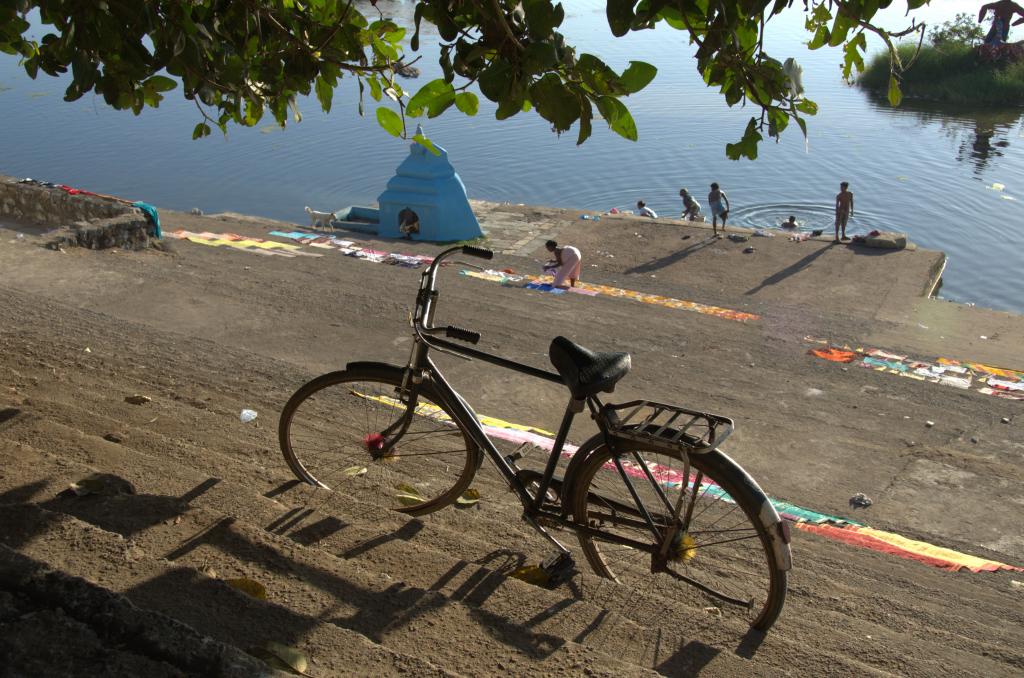
-And do this even as the tribunal continues its assessments. Cooperation in a federal structure is very much possible beyond legal mechanisms, if there is strong will power. Let the law take its own course but let the river and its citizens be given the freedom to flow and progress in a cooperation framework. (Ranjan Panda) https://www.downtoearth.org.in/blog/governance/mahanadi-got-a-triple-engine-sarkar-now-what–96688 (14 June 2024)
Cauvery Water Sharing Dispute CWMA asks Karnataka, Tamil Nadu to save water for drinking purposes -The Cauvery Water Management Authority (CWMA) on Tuesday (June 25) directed both Karnataka and Tamil Nadu to save water in the Cauvery basin reservoirs, with priority to utilise for drinking water purposes and environmental flow due to uncertainty of South West Monsoon. The CWMA, which reviewed the hydrological situation in the Cauvery basin area, emphasised the need to protect flora and fauna in the river basin area. https://www.deccanherald.com/…/cwma-asks-k-taka-tn-to (26 June 2024)
Punjab Farmers calls to scrap all previous decisions on rivers Representatives of various farmer organisations affiliated to the Sanyukt Kisan Morcha held a debate on the issue of river water disputes and continuous depletion of groundwater in Punjab. They also discussed solutions to the problems in Chandigarh on Saturday (June 23). Senior advocate Rajwinder Singh Bains, IAS officer Kahan Singh Pannu (retd), principal agronomist Ajmer Singh Brar and Rajesh Vashisht, technical adviser to the Punjab Water Regulatory Development Authority, held an in-depth discussion the subjects.
The farmers also passed resolutions stating water was the state subject under entry 17 of the state list and the Centre had no right to pass executive orders and make decisions about river waters. As per the riparian principle, Punjab is the owner of the river water and this right should be restored. All previous accords and awards about river water disputes should be scrapped, they resolved. Sections 78, 79 and 80 of the Punjab Reorganisation Act should also be scrapped as there is no interstate dispute of river water, they added. The present assessment of available water should be made, and if it is found to be surplus, Punjab should have the right to give it to any other state on making a contract on payment, added the farm bodies. https://timesofindia.indiatimes.com/city/chandigarh/calls-to-scrap-previous-decisions-on-punjabs-groundwater-and-rivers/articleshow/111198893.cms (23 June 2024)
IRRIGATION
Andhra Pradesh Pattiseema LIP water release to rise By 2019, Pattiseema lift irrigation scheme of Andhra Pradesh provided 305.07 TMCs of water, irrigating about 4 lakh acres in the Krishna Rayalaseema and combined West Godavari districts. However, during the YCP regime, water distribution from Pattiseema significantly reduced, with 4.5424 TMCs released from June 2020 to November 2024, 1.6417 TMCs in 2021, and 58.7421 TMCs in 2023. This scarcity left farmers of the 4 lakh acres disappointed. Now farmers are hoping the scheme will provide more water. Currently Godavari water level is at 13.28 m. Once water level reached 14 m, there is possibility of water release. https://www.m9.news/politics/pattiseema-to-finally-become-operational/ (26 June 2024)
Telangana Trial run of Sita Rama LIP’s pumphouse successful The trial-run of the first pump of Sita Rama Lift Irrigation Project has been tested successfully in the erstwhile Khammam district on Wednesday (June 26) night. The Godavari waters were lifted and delivered into the delivery cistern at the pumphouse constructed in BG Kothur village of Aswapuram mandal in Bhadradri-Kothagudem district. The project has been constructed with the objective of irrigating a new ayacut of 1.57 lakh acres in Khammam district, 1.62 lakh acres in Bhadradri Kothagudem district, 9,000 acres in Mahabubabad district, besides stabilising the exiting ayacut of 2.48 lakh acres under the Nagarjunasagar left canal, Wyra and Lankasagar projects. https://www.siasat.com/trial-run-of-sita-rama-lift-irrigation-projects-pumphouse-successful-3051920/ (27 June 2024)
Punjab Tail-end farmers grapple with severe water shortage At Janisar village located at the tail-end of Muktsar distributary, farmers Major Singh, Baldev Singh and Malkit Singh say: “The state government has spent nearly Rs 60 lakh on laying a pipeline to our village in December last year. However, we have not got canal water after winter. The underground water is brackish, which can’t be used for irrigation or human consumption. On paper, we are now getting canal water supply. However, the flow of water is insufficient and the depth is less than an inch in the channel. The fact is we are still dependent on a nearby drain and on lifting water using tractors at our own expense. Senior officers, sitting in their air-conditioned offices, are merely issuing statements to the media. The situation on the ground is entirely different.” https://www.tribuneindia.com/news/punjab/tail-end-farmers-grapple-with-severe-water-shortage-634991 (29 June 2024)
Water scarcity increases dependence on tubewells Balkar Singh is anxiously waiting for power supply to run the tubewell for irrigating his paddy fields in Bhalo Patti village. It is ironic that a water-channel from Baserke Rajbaha, the canal minor from Buchar to Bhalo Patti — one of the several channels of the Upper Bari Doab Canal (UBDC) which brings water from the Ravi river — is just across the 8-ft wide unpaved road. But either it runs dry or the water level and speed are insufficient for irrigation.
A drive on the 20 km ‘kuccha’ road alongside the canal minor reveals that Balkar is not an exception. There are over a hundred tubewells like his, in close proximity to the water channel in Punjab, also known as a land of five rivers. It paints an ironic picture that despite the channels, the tubewells have to be operated, worsening the already depleted underground water. There are 79,409 tubewells in Tarn Taran district alone.
Though after government intervention this year the water in this channel has reached its ‘tail’ but due to low level, it is of no use. In fact, it has reached this far because most of the farmers are not using it as they continue to draw water from tubewells. The absence of canal water for irrigation has also caused havoc to the groundwater table. Even the farmers are forced to go for deeper and deeper borewells to draw water. A section of the farmers feels that free power for tubewells coupled with the decision to waive water cess had proven fatal for the canal irrigation system. “While the first made the farmers lethargic, the second left the government with no money to care for the upkeep of the canal system,” summed up Parshotam Singh, another farmer. https://www.tribuneindia.com/news/punjab/water-scarcity-increases-dependence-on-tubewells-635255 (23 June 2024)
Upset over insufficient supply of canal water, Abohar farmers block highway Bhartiya Kisan Union Rajewal members blocked the Abohar-Sriganganagar highway today in protest against shortage of canal water and the rotational system adopted by the Water Resources Department for water supply. On Friday (June 28) as well, traffic remained suspended from 10 am to 4 pm due to blockade on this highway by Sanyukt Kisan Morcha against transit loss in Gang Canal. Announcing that the protest will continue until their demands are met, farmers staged a dharna at Gidderanwali toll plaza and blocked the road. Due to the protest, long queues of vehicles were formed although the protesters allowed the ambulances to pass through. https://www.tribuneindia.com/news/punjab/upset-over-insufficient-supply-of-canal-water-abohar-farmers-block-highway-635316 (30 June 2024)
URBAN RIVERS
SANDRP Blog Asan Rivers Struggling to Survive in Dehradun In recent years, the National Highway Authority of India (NHAI) has approved two highway projects which have potential to irreversibly damage the watersheds of Asan rivers.

https://sandrp.in/2024/06/25/photo-blog-ii-asan-rivers-struggling-to-survive-in-dehradun/ (25 June 2024)
Tawi; Jammu Tawi RFD raises concerns Bhushan Parimoo, a geologist and environmentalist in Jammu, expresses his concerns while speaking to SANDRP (South Asia Network on Dams, Rivers and People), an Environmental website: “Tawi is a potable water source for the city and a lifeline for areas all along its 177 km course. However, the river has been facing a decline in flow due to catchment degradation and shrinkage in glacier areas feeding the river. The river needs watershed protection and revival instead of being turned into a lake, which goes against the very nature of how a river functions. “On RFD, Parimoo says, “The RFD work has even removed boulders from the riverbed, which worked as a natural flood defence mechanism. Sewage drains are still polluting the river, and green banks are being concretised for commercial and real estate activities. If there is flood destruction, it’s not the fault of the river but the humans.” https://www.thequint.com/my-report/jammu-tawi-river-front-development-will-disturb-the-ecology-of-the-region#9 (26 June 2024)
Pune ‘Will we be able to live on earth?’ HC raps govt over flooding Bombay high court on June 26 2024 questioned whether the earth will be habitable at the rate at which natural water bodies are receding. The court was hearing a PIL regarding flooding of Pune due to faulty demarcation of floodlines on the banks of Mula Mutha river. The PIL by architect Sarang Yarwadkar said erroneous floodline maps wrongly shifting the floodlines to the centre of the river upto 80 m were included in 2017 development plan. Consequently, the prohibitive zone was converted to a developable zone. The incorrect maps were retained as excluded portions in the final sanctioned DP.
– The judges noted that there is fault in the preparation of floodlines of Pune city in the 2016 map, a deviation from the 2011 flood lines and that has receded the flood carrying capacity. “This is what happened in Uttarakhand,” the CJ said. Senior advocate Gayatri Singh and advocate Ronita Bector, for Yarwadkar, said construction is going on inside the floodlines. “This is a clear example of not the apathy of state govt, the corporation officials and all responsible, but a deliberate attempt to reduce the flood carrying capacity,” the CJ said.
– On Dec 6, 2023, the HC had directed the irrigation department to conduct a study of the demarcation of floodlines. The judges noted that the Jan 2 study report mentioned that while preparing floodlines, various factors were not considered. It suggested that a comprehensive review be conducted. The judges directed the report to be placed before the additional chief secretary/principal secretary of Water Resources Department who shall form a five-member supervisory committee of experts to formulate a plan for conducting the review. He shall also co-opt experts from external agencies. The committee will fix a timeline for completion of review. The judges directed the committee to be formed within two weeks. https://timesofindia.indiatimes.com/city/mumbai/will-we-be-able-to-live-on-earth-hc-raps-govt-over-pune-flooding/articleshow/111298371.cms (27 June 2024)
HC orders comprehensive review of flood line demarcation The high court bench of Chief Justice Devendra Kumar Upadhyaya and Justice Amit Borkar emphasized the importance of precise flood line demarcation, particularly in urban areas like Pune. Allowing development in flood zones reduces the flood-carrying capacity of water channels, exacerbating flood risks. Proper demarcation is crucial to mitigate these risks and ensure the safety and habitability of urban areas.
-To address these issues, the court has ordered the formation of a five-member Supervisory Committee. This committee will be headed by the Additional Chief Secretary of the Department of Water Resources Development and will include experts from related departments and external agencies of national repute.
-The committee is tasked with formulating a plan for a comprehensive review of flood line demarcation in Pune, preparing a blueprint for the review, and determining the necessary human resources. The court has set a timeline for the committee’s formation and the completion of the review:
1. The committee must be formed within two weeks.
2. A blueprint for the review must be finalized within four weeks thereafter.
3. A high-ranking officer, nominated by the Additional Chief Secretary, will file an affidavit detailing the steps taken to comply with the court’s directions
-The PIL petition is scheduled for the next hearing on August 14, 2024. By then, the State Government is expected to file an affidavit detailing compliance with the court’s orders. This affidavit must be served in advance to the petitioners’ counsel and the Pune Municipal Corporation’s counsel. https://www.punekarnews.in/bombay-high-court-orders-comprehensive-review-of-flood-line-demarcation-in-pune-supervisory-committee-formed/ (26 June 2024)
Indrayani; Pune Toxic foam in river raises alarms The Indrayani River holds significant religious importance, especially during the Sant Dnyaneshwar Maharaj Palkhi Procession. Lakhs of pilgrims are expected to bathe in the river and use its water for drinking. However, the presence of toxic foam poses severe health risks, potentially causing diseases among the devotees. This recurring issue has led to repeated complaints to the Maharashtra Pollution Control Board, but effective action remains elusive.
-Despite the religious and cultural significance of the Indrayani River, pollution has been a constant issue. The chemicals released from nearby industries have severely degraded the water quality. Activists and citizens are now questioning the responsiveness of the Pollution Control Board, the Alandi Municipal Council, and the local administration in addressing this critical issue. https://www.mypunepulse.com/toxic-foam-on-indrayani-river-raises-alarms-ahead-of-ashadhi-wari-palkhi/#google_vignette (23 June 2024)
Kukrail; Lucknow Ponds along river to be revived As part of the plan to rejuvenate the 28-km-long Kukrail river, around 22 ponds surrounding it will be recharged apart from the beautification and revival of Sautal Lake in Asti village – the point of Kukrail river’s origin. Encroachments from nearby areas will also have to be removed, and the LMC will lead efforts to raze encroachments around Scorpio Club. Besides, illegal dairies on Kursi Road, around 550 unauthorised houses in Abrar Nagar and approximately 250 unauthorised structures in Pant Nagar will be removed to clear the Kukrail riverbed, said authorities.
-To ensure continuous supply of water to the river, ponds will be built to revive the river’s water sources within the forest area. In rural areas, the rural development department and the LDA are working to revive water sources and bodies. The UP Jal Nigam (urban) has proposed releasing water into the river from a 40 MLD STP. Additionally, the irrigation department will provide approximately 5 to 15 cusecs of water from the Sharda Nagar escape channel. https://www.hindustantimes.com/cities/lucknow-news/ponds-along-kukrail-river-sautal-lake-to-be-revived-101719513086691.html (28 June 2024)
Chandigarh A tale of luxury homes on a flood-prone riverbank Despite severe flooding last year that left the housing belt near the Kaushalya dam cut off from the mainland for four months, demand for property in this area remains high. Residents had to take a lengthy detour through villages to reach the mainland, but this has not deterred buyers. Major developers are promoting “pristine living” and an “elite club crafted by untouched nature,” attracting buyers willing to pay crores for houses and flats.
-This rapidly developing area in the “foothills of the Shivaliks,” adjacent to the Panchkula-Kalka highway, has become highly sought after by elites, including retired defense personnel, judges, doctors, and advocates. However, residents who have lived here for some time have a different story to tell.
-Lt General KJ Singh (retd), who resides in the DLF Valley Panchkula near the Kaushalya dam, summed up the residents’ situation with this poem: “Rehta Kaushaya- Ghaggar paar… Pehle Builder ne liya pocket maar… Phir, Sarkaar ne diya nakkar. Sehta baadh, gandagi ki maar. Chahe Tadi-paar, lekin himmat mat haar…” Singh recited this poem at a recent residents’ event.
-PEC Director Professor Baldev Setia stated that “any construction obstructing the river’s right of way should be avoided.” “About ten years ago, I had seen this area around the Kaushalya dam. With so much activity in and around the area, it is likely to change soil and slope characteristics. When floods occur, releasing water from upstream can cause erosion. Such activity should be avoided,” he said.
-A retired chief engineer with the Irrigation Department told The Indian Express that “the housing near the banks of the river needs a relook.” The retired engineer also noted that the damage from the last floods should have been exemplary enough. The engineer emphasized that “the floodplain of a river basically serves as a cushion to mitigate the impact of the river’s velocity. When you carry out construction activity in this floodplain, you narrow the area where water has to gush through, restricting the flow. https://indianexpress.com/article/cities/chandigarh/luxury-homes-flood-prone-riverbank-9416779/ (26 June 2024)
In Amravati enclave, a dream turns into a nightmare During floods last year, residents of Amravati Enclave the first 118-acre township across the Kaushalya belt claim that not only did the lifts of certain towers fill with water, but at night, they had to rush to park their vehicles at a height as water entered and accumulated in the parking lots. The rains not only scare the residents regarding connectivity to the mainland but also cause them to fear cracks in their houses.
-Last year, residents were alarmed when not only were their houses flooded, but a part of the main highway adjacent to the small bridge also caved in due to the rains. The repair work is still ongoing, even after a year. The residents also alleged that, as per the plan, a government school was to be constructed on a five-acre site, most of which now falls in a riverbed.
-Residents alleged that river protection works have not been carried out in certain places and that the retaining wall hasn’t been built, which would protect their houses during heavy rains. “We know how we spend sleepless nights when it rains heavily for more than a few minutes,” Col Rangi said. https://indianexpress.com/article/cities/chandigarh/amravati-enclave-panchkula-flooding-amenities-connectivity-9420585/ (28 June 2024)
Musi; Hyderabad Bids to assess structural stability of 17 bridges submitted Four consultants have submitted bids to assess the condition and structural stability of 17 bridges on the Musi River within the Outer Ring Road (ORR). The Musi Riverfront Development Corporation Limited (MRDCL) will oversee the rehabilitation and strengthening of these bridges through necessary surveys and preparation of Detailed Project Reports (DPR).
Most of the bridges on the Musi River were constructed several decades ago, necessitating a check on their structural stability. The state government’s Musi Riverfront Development Project aims to rejuvenate the 55-km polluted stretch of the Musi River, reviving its ecosystem, and promoting economic growth through suitable riverfront development. https://www.newindianexpress.com/cities/hyderabad/2024/Jun/30/telangana-four-consultants-submit-bids-to-assess-condition-structural-stability-of-17-bridges (30 June 2024)
RIVERS
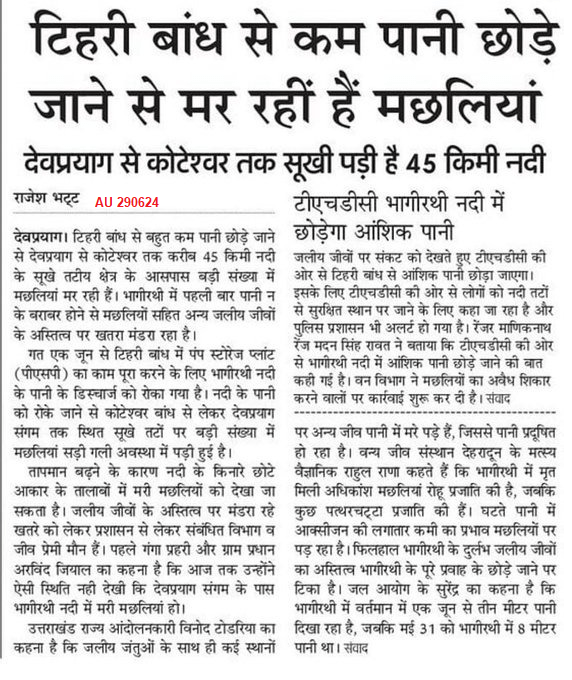
GANGA Uttarakhand -Installation work of a Pump Storage Project at Tehri dam has left 42km stretch of Bhagirathi the main stream of national river Ganga flowless for over a month resulting in adverse impacts on fresh water aquatic species. (Amar Ujala 29.06.2024)
Varanasi Water falls to alarming levels exposing riverbed The Ganga water level at Varanasi has receded to alarming levels, exposing the riverbed at several ghats. The water has dropped below the lowest step of at least six ghats, including Chet Singh Ghat, Asi Ghat, Lalita Ghat and Rajendra Prasad Ghat. Senior officials of Jal Kal expressed concern over the decreasing water level of the Ganga on June 25. In view of the Ganga water level dropping to 57.60 metres (189 ft) in Varanasi, Jalkal general manager Vijay Narayan Maurya wrote a letter to Ganga Barrage officials in Kanpur, requesting them to release water. If the water level had fallen below 186 feet (56.69 metres), there would have been a threat of water supply disruption. However, rain has come, and the water level has risen to 57.66 m on June 26 and 57.74 m on June 27 at 8 am. https://www.hindustantimes.com/cities/others/ganga-water-falls-to-alarming-levels-in-varanasi-exposing-riverbed-101719500547377.html (27 June 2024)
Bihar This (Bhaskar June 26 2024) report says that since the construction of too narrow Katauza Railway Bridge on Bagmati river in North Bihar, the main stream of Bagmati river has dried up at Kharka in Runisaidpur (close to Benpur of Aurai) and so far Rs 28 Cr has been spent in last five years to bring the flow back to main stream, but without success.

The water is now flowing in two streams, closer to either embankment, creating risk of breaching of the embankment. Bihar Water Resources Dept is now ready to spend Rs 2.71 Cr this year for this.
Bridge Thakurganj Sinks, Sixth In 10 Days Another bridge in Bihar went out of commission today, making it the sixth in 10 days. The bridge in Thakurganj block sunk by a feet on June 30 the water level of the Bund river increased following heavy rains. The surface of the bridge cracked, making it too risky to use. The bridge, located in Khoshi Dangi village of Patharia panchayat, was built in 2007-2008 from the MP fund of the then MP Md Tasleemuddin of Thakurganj. But today, it could not withstand the pressure of water. This bridge connects areas under three to four panchayats and if it collapses completely, it would affect around 60,000 people. https://www.ndtv.com/india-news/bridge-in-bihars-thakurganj-sinks-sixth-in-20-days-6004473 (30 June 2024)
Five bridges collapsed in 11 days This latest incident highlights ongoing issues of negligence and corruption in bridge construction in Bihar. Over the past 11 days, four other bridges have collapsed, raising serious questions about construction standards and oversight. https://www.indiatoday.in/india/story/five-bridges-collapsed-in-bihar-madhubani-jhanjharpur-2559814-2024-06-28 (28 June 2024)
Another bridge collapses, this time in Kishanganj A portion of a 13-year-old bridge collapsed in Kishanganj on Wednesday (June 26) evening, cutting off 40,000 people in dozens of villages from the mainland. This is the fourth such incident in Bihar in the past one week.
-The 70-metre-long and 12-metre-wide bridge, built under the Mukhyamantri Gram Sadak Yojana in 2011 at a cost of ₹25 lakh, caved in due to the force of floodwaters triggered by incessant rainfall.
-“Due to torrential rains in the catchment areas of Nepal, the Mariya River got flooded and one portion of the bridge gave way,” the Circle officer (CO) Ashish Kumar said. “The bridge was already in need of repairs and the department concerned has already been intimated.” https://www.hindustantimes.com/cities/patna-news/another-bridge-collapses-in-bihar-this-time-in-kishanganj-101719483018412.html (27 June 2024)
Jharkhand Underconstruction bridge girder collapses Girder of a bridge under construction over Arga river at Bhelwaghati in Giridih district, around 235km from Ranchi on Bihar border, collapsed late Saturday (June 29) night owing to incessant rain. Residents said water level in the river rose significantly after heavy rainfall on Saturday (June 29) and strong currents resulted in the girder breaking apart. Also, a pillar bent in the downpour. The falling girder’s loud noise alarmed residents nearby. https://timesofindia.indiatimes.com/city/ranchi/underconstruction-bridge-girder-collapses-in-jharkhand-during-rain/articleshow/111391989.cms (01 July 2024)
YAMUNA Delhi Excessive silt brings Palla floodplain project to halt According to this report, DJB plan of expanding the pilot from 26 acres to 1000 acres at Palla to hold excess Yamuna flood waters for subsequent use is facing hurdles in terms of silt accumulation. The issue will be taken to NGT. https://timesofindia.indiatimes.com/city/delhi/excessive-silt-brings-palla-floodplain-project-to-halt/articleshow/111297442.cms (27 June 2024)
Focus on Hathnikund-Okhla Barrage stretch for floodplain demarcation Delhi Pollution Control Committee (DPCC) has presented its findings to NGT regarding the demarcation of floodplain in Delhi to prevent future flooding incidents. The report was submitted in response to an earlier NGT directive, which was based on a Times of India article titled, “Why Flooding Has Forced DDA’s Master Plan Rethink”, published in Aug 2023.
In a submission by DPCC, a high-level committee was convened in May to address this matter. During the meeting, NMCG, a member of the committee, disclosed that MoJS had established a separate committee to conduct a comprehensive joint flood management study of Yamuna. DPCC, in a report dated June 26, said “a meeting of the high-level committee (HLC) was held on 07.05.2024 under the chairmanship of chief secretary, govt of NCT of Delhi… executive director, NMCG, one of the members of HLC, informed the committee that ministry of jal shakti had constituted a committee for a joint flood management study of the river Yamuna for its reach between Hathnikund and Okhla Barrage in which principal secretary, irrigation & flood control department (I&FCD) is a member from GNCTD.” The report further stated regarding the SOP for demarcation of the floodplain that I&FCD had identified the flood of 2011 as 1 in 25 frequency event. https://timesofindia.indiatimes.com/city/delhi/focus-on-hathnikund-okhla-barrage-stretch-for-floodplain-demarcation/articleshow/111388763.cms (01 July 2024)
New STPs to use UV treatment Water will be subjected to ultraviolet treatment at some STP to control faecal coliform level and, thus, reduce pollution in the Yamuna. Though only the STP at Kapashera is equipped with UV technology, water is currently being treated for faecal coliform in 15 other STPs too. TOI had earlier reported that over 75% of the city’s STPs were failing to reduce faecal coliform level, a major marker of pollution in the river water. This was because most of the STPs had no technology for bacterial disinfection through either chlorination, UV treatment or ozonation, despite an order to the effect by the NGT.
According to Delhi Jal Board officials, the goal is to upgrade 28 of the 39 STPs by September. These upgrades will bring the STPs in line with the standards accepted by NGT, including reducing faecal coliform level to below 230 units. Another official said that of 15 currently compliant STPs, the one at Kapashera was using UV treatment while the others employed chlorination and other processes. Nine others are undergoing augmentation at present and four are having trials. https://timesofindia.indiatimes.com/city/delhi/clean-yamuna-new-stps-to-use-uv-treatment/articleshow/111241907.cms (25 June 2024)
RIVERS BIODIVERSITY
Tamil Nadu Rare moth ‘rediscovered’ in Nilgiris after 132 years At a first glance, Chiretolpis erubescens, a rare moth endemic to the Western Ghats could be considered unremarkable. However, a more nuanced study of the species would remind us of how little is known about the health and continued existence of “lesser-known species” that were recorded to have inhabited the Nilgiri Biosphere Reserve (NBR), and largely been forgotten since. The species, which was “rediscovered” after 132 years, was photographed for the first time by researchers Samson Arockianathan; N. Moinudheen; A. Abhinesh; R. Mahesh; and N. Sadiq Ali. Their record was recently published in the Journal of the Bombay Natural History Society titled Rediscovery of Chiretolpis erubescens, A rare moth species in Nilgiris, Tamil Nadu. https://www.thehindu.com/news/cities/Coimbatore/rare-moth-endemic-to-western-ghats-rediscovered-in-nilgiris-after-132-years/article68351651.ece (30 June 2024)
FISH, FISHERIES, FISHERFOLKS
West Bengal Boat races set to enthral rural Bengal “Boat races usually begin in the middle of the rainy season and they continue till September, sometimes till October, even November in some places. That way, boat race in Bengal held on a far greater scale in Kerala, where it is held only during the Onam festival with only one kind of boat participating,” said anthropologist Swarup Bhattacharyya, who has been documenting Bengal boats for nearly three decades now. He has been making scientific models of the boats for the past few years to preserve them for posterity.
– Mr. Bhattacharyya held an exhibition in Kolkata of his boat models sometime ago and his most recent creation is a model of Sorengi, one of the traditional racing boats of Bengal. “Unlike in Kerala, here four to five kinds of traditional boats are used for the races; that way we are ahead of them, but unfortunately, we are not as famous. Even people in Kolkata are hardly aware of the boat races of Bengal,” he said. According to Mr. Bhattacharyya, boat race — called nouka baich in Bengal — is essentially a part of Southeast Asian culture and is most common in countries such as China, Vietnam, Cambodia, and, of course, Bengal, including Bangladesh as well as West Bengal. Sorengi, whose model he crafted most recently, is of Bangladeshi origin. “Someone requested me to make this model, but I also made it for another purpose: to tell people, through social media, that such a beautiful boat is used for our boat races. Sorengi is about 90 ft long, the front is narrow and the rear is like the tail of a fish — a shining example of how boats imitate nature. This boat is an essential part of Bengali culture,” he said.
– Other boats that are commonly used for races in Bengal include the Chhip, Kaile Bachhhari, Chande Bachhari, Chitoi and Sorpi. “Not only that, in Nadia I have seen people using earthen pot as a boat. I have also seen plantain raft being used in a Sundarban village,” said Mr. Bhattacharyya, who is currently working on a model of Chhip, among the most popular race boats. Boat races in Bengal are no longer a male bastion. The recent years have seen the participation of women too. “I was always fascinated by boats. Each time we crossed the river, going from one town to another, I always felt this urge to be at the helm. Then one day, while in college, my netball coach asked me if I would like to join a boat race association, and that’s how it began for me, about eight years ago,” said Unnati Mondal, 32, of Koikhali village in Nadia. https://www.thehindu.com/news/cities/kolkata/with-onset-of-monsoon-boat-races-set-to-enthral-rural-bengal/article68344541.ece/amp/ (29 June 2024)
Kerala Private company booked for polluting Periyar river near Kochi A case has been registered against a private company for allegedly polluting Periyar river near Kochi weeks after protests by environmental activists and locals against the alleged illegal discharge of chemical effluents into the waterbody, which posed a threat to the biodeiversity in it. According to sources, the authorities and activists have been patrolling the industrial area along the banks of Periyar for some time. When the colour of the river turned black early this week, they carried out a search and found that the company’s waste deposit was the reason. https://www.telegraphindia.com/india/kerala-private-company-booked-for-polluting-periyar-river-near-kochi/cid/2030388 (29 June 2024)
Hyderabad 10 tonnes of dead fish found floating in Chitkul tank Much to the distress of locals and fishermen, nearly 10 tonnes of fish were found floating in the Chitkul tank in Patancheru on Wednesday (June 26) evening, suspected to be the result of discharge of industrial effluents in the water body. Estimating the cost of the dead fish at over 1 crore, the fishermen said more than 100 families in Chitkul village depend on this tank for their livelihood. “Recently, eight lakh fish fingerlings were released in the Chitkul tank for cultivation. If we do it again now, it will need another 20 lakh fingerlings and the culture season will be over by the time these fish are ready for fishing,” explained N Ramaiah, another fisherman. https://timesofindia.indiatimes.com/city/hyderabad/10-tonnes-of-dead-fish-found-in-chitkul-tank-locals-blame-effluents/articleshow/111325119.cms (28 June 2024)
Bengaluru Cattle wash waste blamed for Hesaraghatta fish kill A month after the fish kill incident at Hesaraghatta lake, the Karnataka State Pollution Control Board (KSPCB) has issued a notice to the Frozen Semen Collection Centre. Authorities have provided an undertaking to prevent sewage leaks into the lake. In late May, thousands of small fish were discovered dead near the bamboo forest on the lake’s eastern side. During inspection on May 21, KSPCB officials found that the dead fish had originated from a pond at the semen collection centre belonging to the Animal Husbandry Department.
Another official said treatment of the waste water was necessary as stormwater from the ponds, located upstream, drains into the Hesaraghatta lake. He said the sewage from washing of the cattle sheds gets collected in a large pond, which overflows into the neighbouring low-lying areas, including the other ponds and the drain that carries storm water to the lake. “While it was not clear whether fish were being bred in the adjacent ponds with clear water, it was evident that the sewage from the centre would overflow and drain into the lake. We have received a response, which will be forwarded to the headquarters for further action,” he said. The official noted that preventing the contamination of the lake, which once supplied drinking water to Bengaluru, was important to protect the birds and animals that thrive in the grassland. https://www.deccanherald.com/india/karnataka/bengaluru/cattle-wash-waste-blamed-for-hesaraghatta-fish-kill-pollution-board-authorities-promise-action-3085718 (29 June 2024)
SAND MINING
SANDRP Blog May-June 2024: Sand Mafias Mowed Three Policemen to Death These horrific incidents have put the spot light on brazenness and violent nature of operations by sand mafias in these states.
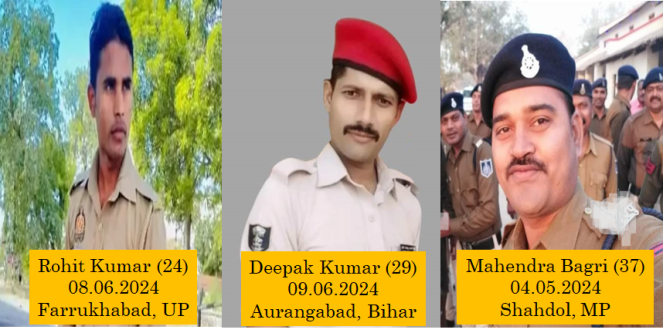
The respective govts in State and at Centre have been miserable in ensuring compliance to norms and deter the increasing violent attacks by sand mafia. Sadly, innocent people and government officials continue to pay the price of governments abject failure with their lives. https://sandrp.in/2024/06/30/may-june-2024-sand-mafias-mowed-three-policemen-to-death/ (30 June 2024)
Odisha Officials narrowly escape attack by mining mafia Tension prevailed in Bada Bisol area under Kaptipada sub-division in Mayurbhanj district on Saturday (June 29) after sand mining mafia attempted to attack two mining officers who had imposed fines for the illegal transportation of sand from the Sono river. Though the two officers narrowly escaped the attack, a group of local residents protested against the mafia and urged the officers to take stringent action to curb illegal sand transportation that causes revenue loss to the government every year. https://www.newindianexpress.com/states/odisha/2024/Jun/30/officials-narrowly-escape-attack-by-mining-mafia-in-odisha (30 June 2024)
Uttar Pradesh GB Nagar admin cracks down on illegal crushing work on floodplains A joint team of Gautam Budh Nagar administration, irrigation department, UP Pollution Control Board, and district police launched inspections in the wee hours of Monday (June 24) and cracked whip on illegal stone crushing operators in the Yamuna floodplains, officials said.
District magistrate (Gautam Budh Nagar) Manish Kumar Verma said, “Inspections were conducted and the mobile units setup in the floodplains of Yamuna, falling under Basantpur and Asgarpur areas were sealed. A major portion was occupied by the operators illegally who were indulging in activities of crushing of stones through machineries, boulders and C&D (construction and demolition) waste.” As per the information from the pollution control board officials, the exercise is prohibited and results in air pollution.
The sub-divisional magistrates (SDMs) have been directed to identify the violators and landowners who have given land on rent for such operations while ensuring the area remains sealed. Additionally, the ground water department has also been asked to carry out survey of illegal borewells in the area and impose penalty on the violators. https://www.hindustantimes.com/cities/noida-news/gb-nagar-administration-cracks-down-on-illegal-crushing-work-on-yamuna-floodplains-101719255817443.html (25 June 2024)
Karnataka Spurt in illegal sand mining cases, rivers ravaged Illegal sand mining cases in north Karnataka, which have devastated rivers, have gone up from 4,402 in 2022-23 to 5,441 in 2023-24. The state government has reported that fines collected during this period have also increased by 40 per cent, from Rs 8 crore to Rs 11.11 crore. “Illegal miners are transporting twice the permissible limit of sand from Channur, Gonal and several villages of Vadagera taluk in Yadgir district in trucks, destroying roads. Officials have become mute spectators as the tippers pass by RTO offices and police stations. There has been no action even after I complained,” says K B Manikareddy, a resident of Kurakunda in Vadagera taluk.
Raichur-based activist Hanumanth Bhangi, who has been fighting illegal sand mining in the region for years, claims he has been receiving threats for filing public interest litigations against the illegal trade. “Excessive sand mining has led to depletion of groundwater levels and environmental degradation. Machines are being used for sand mining despite guidelines allowing only manual extraction,” he explains.
The acute staff shortage has crippled the mines and the geology department. As the existing staff and police personnel were deployed for election duty, illegal activities had spiked. “We are patrolling every night with tahsildar, PWD and police officials and have shifted around 750 tonnes of illegally stored sand adjacent to the river in Afzalpur taluk,” says Somashekhar M, deputy director of the Kalaburagi mines and geology department. “With only two geologists, we can’t keep a watch on illegal sand mining in all taluks,” he adds. https://www.deccanherald.com/india/karnataka/spurt-in-illegal-sand-mining-cases-n-k-taka-rivers-ravaged-3079316 (25 June 2024)
Pavoor Uliya Kudru shrinking due to illegal sand mining Pavoor Uliya Kudru, a small riverine island located in the middle of the Netravati River between Pavoor and Adyar, is shrinking due to illegal sand mining. Local residents have raised concerns that despite repeated complaints, the district administration and police department have failed to take any action. Responding to the locals’ plea, the Catholic Sabha Mangalore Pradesh, along with a coalition of like-minded organizations, visited Uliya Kudru on Monday (June 24) to inspect the affected site. They called for immediate intervention by the district administration to halt the sand mining, warning that a legal battle would be inevitable if no action is taken.
Once spanning approximately 80 acres and extending 2 kilometers, the island has now shrunk to 40 acres and its length reduced to just 1 kilometer due to years of relentless sand mining. Local authorities fear that a major flood could wash away the entire island. Previously, District Collector A. B. Ibrahim had issued an order prohibiting sand mining within a 1- kilometer radius around the island and had destroyed the sand pits. However, Bennett, a local resident, told Udayavani that the order was no longer enforced, leaving the island vulnerable. Despite multiple efforts to resist sand mining, locals feel overpowered by the money and muscle power of the sand extractors.
Pavoor Uliya Kudru, part of the Mangalore Assembly Constituency, lies between the Thumbe and Harekala dams in the Netravati River. The island, once home to over 50 families, now has only 35 families with about 130 residents, 99% of whom are Christians. They rely on agriculture and external jobs for their livelihood, with boats being their primary means of transportation to the mainland.
Despite the construction of the Harekala Dam, which has kept the river level high even in summer, their longstanding demand for a bridge between Kudru and Adyar remains unmet. A temporary bridge built by the residents in the summer was reportedly damaged by sand smugglers a few years ago. Roy Castellino, PRO of the Mangalore Diocese, accused various departments of colluding to drive the residents off the island through sand mining. He expressed hope that the traffickers would eventually face repercussions for their actions. https://www.udayavani.com/english-news/illegal-sand-mining-reduces-pavoor-uliya-kudru-by-half-locals-demand-justice (25 June 2024)
The mining and geology department’s recent clarification regarding allegations of illegal sand mining in Pavoor Uliya has ignited significant outrage on social media. Activists and concerned citizens have expressed their dissatisfaction and disbelief over the department’s statements, accusing it of downplaying the severity of the situation.
Journalist Stany Bela, who first brought the issue to light, criticized the department’s press release, suggesting it reflects the influence of the sand mafia over the mining and geology department. Bela also claimed he is prepared to release a detailed historical account of the alleged illegal sand mining activities. This statement from Bela adds weight to the activists’ accusations, highlighting the need for transparency and accountability from the authorities.
The public outcry on social media underscores the demand for a thorough investigation and honest communication regarding the situation in Pavoor Uliya. Activists and the public continue to pressure authorities to take decisive action to address and resolve the issue of illegal sand mining. https://www.daijiworld.com/news/newsDisplay?newsID=1203027 (27 June 2024)
Tamil Nadu ED: Proceeds from sand mining used to pay excavator loans The Enforcement Directorate (ED)’s investigation into the money trail of the alleged Rs 4,730 crore river sand mining scam has indicated that a portion of the cash from the sale of sand was routed through multiple accounts to one primary account, which was used for repaying monthly dues for loans taken to buy excavators. ED had provisionally attached 209 of these machines worth Rs 128.34 crore in the case. These excavators were deployed for the illegal mining of sand, which ED has pegged at 23.6 lakh units in excess of what was permitted by the state government. https://www.newindianexpress.com/cities/chennai/2024/Jun/29/ed-proceeds-from-sand-mining-used-to-pay-excavator-loans (29 June 2024)
WETLANDS, LAKES, WATER BODIES
Telangana Efforts on to secure Ramsar wetland tag for Manjeera WS While a team of experts from the Ramsar Convention on Wetlands was expected to visit Telangana on July 11 and 12, the Forest department was preparing to send a proposal to the Ramsar Convention shortly. The Manjeera wetland site was spread over 20 square kilometres from Manjeera Dam and Singur dam, both built across river Manjeera in Sangareddy district 20 km apart. It had six islands where most of the bird species were found. https://telanganatoday.com/efforts-on-to-secure-ramsar-wetland-tag-for-manjeera-wildlife-sanctuary (24 June 2024)
Kerala More officers for wetland reclamation regularisation The revenue department will assign more officers to process applications for regularising reclamation of old wetlands and paddy fields. In a statement on Thursday (June 27), the department said the strength of officers will be increased from the present 27 to 71 from July 1. Taluk-based processing will be adopted, the statement said.
The statement said as per the Kerala Conservation of Paddy Land and Wetland Act, 2008, only revenue divisional officers (RDOs) can approve regularisation applications and subsequent category change of land in revenue records. The current strength of 27 officers has created a huge backlog of applications, and to resolve this, the assembly enacted an amendment to enhance the number of officers, said the statement. https://www.newindianexpress.com/states/kerala/2024/Jun/28/more-officers-for-wetland-reclamation-regularisation-in-kerala (28 June 2024)
Uttarakhand Aquatic insects choke as heavy metals poison Asan wetlandThis paper titled ‘The impact of heavy metal concentrations on aquatic insect populations in the Asan Wetland of Dehradun, Uttarakhand’ published in Nature Scientific Reports discusses the findings of a study that looked at the impact of heavy metal pollution on the distribution and biodiversity of aquatic insects in the Asan Wetland of Dehradun, Uttarakhand. The research used data collected from three sites within the Asan Wetland in Dehradun, Uttarakhand. https://www.indiawaterportal.org/articles/aquatic-insects-choke-heavy-metals-poison-asan-wetland (23 June 2024)
WATER OPTIONS
CSE Country’s lakes and ponds CSE releases new book, ‘Back from the Brink: Rejuvenating India’s lakes, ponds and tanks – a compendium of success stories’, at a national symposium. Survey covers around 250 revived waterbodies from nine states and Union territories from across the country; assesses the role played by 27 programmes and schemes in reviving these waterbodies. https://www.cseindia.org/as-india-reels-under-a-water-crisis-a-cse-survey-unveils-some-good-news-the-country-s-lakes-and-ponds-are-on-a-revival-route-12249 (26 June 2024)
The study found Odisha met the target by restoring and constructing more than 75 Amrit Sarovars in each of its 30 districts. While Uttar Pradesh topped the list with 16,909 water bodies, at least 2,367 water bodies were developed in Odisha against the target of 2,250. Other states that have completed their targets are Maharashtra, Madhya Pradesh, Karnataka, Chhattisgarh and Andhra Pradesh. One of the reasons for Odisha achieving the high rate of completion was mainly due to an existing local scheme ‘Mo Pokhari’ to revive water bodies. https://www.newindianexpress.com/states/odisha/2024/Jun/28/odisha-among-top-seven-states-in-water-body-revival-efforts (28 June 2024)
Delhi Lakes project is helping recharge GW Govt’s plan to use treated water to rejuvenate lakes has worked, to increase groundwater level, particularly in SW Delhi. https://timesofindia.indiatimes.com/city/delhi/delhi-govts-successful-lakes-project-helps-recharge-groundwater/articleshow/111298154.cms (27 June 2024)
The Delhi government’s lake revival project, based on recycling treated wastewater, has been successful in southwest Delhi, where the groundwater table has increased by up to 6 metres in the last three years, a new study by the CSE has found. The study, which looked at successful lake rejuvenation models across the country, found the groundwater table had increased by around 6 metres at Pappankalan, by around 4 metres at Nilothi and by 3 metres and at Najafgarh through the artificial lakes created there by the government in 2021. https://www.hindustantimes.com/cities/delhi-news/groundwater-table-rose-by-3m-in-nilothi-najafgarh-report-on-delhi-lakes-101719424683662.html (27 June 2024)
Bengaluru ‘55% treated water used productively’ A study has found that in Bangalore 35% of treated water is used for agriculture, landscaping and habitat restoration, and another 20% for construction, commercial, and industrial needs. As per the study, carried out by the Bengaluru-based Well Labs, 45% of treated water is released into waterbodies where it gets mixed with untreated water. Comparing Bengaluru with other parts of the world in wastewater management and effective utilisation of sewage treatment plants, the report highlighted, “A few countries such as Australia, Spain, Israel, Japan, and Singapore have set themselves the target of meeting between 10% and 60% of their total water needs by reusing wastewater after treatment.” The study pointed out that Australia leads with over 50% reuse of treated water for agricultural purposes.
– “The total installed capacity of STPs in Bengaluru is around 1,523 MLD. However, only around 1,239 MLD is actually treated. Out of this, more than 570 MLD is believed to be reused largely outside of Bengaluru for agricultural purposes,” Shreya Nath, managing partner, Urban Water Programme, Well Labs, added. “A majority of IT parks in the city are reusing treated water for air conditioning purposes, where the cool water they get is STP-treated,” Syed Khaja of KSPCB said while adding that these numbers are likely to become better. What holds the key for Bengaluru is the untapped source of treated water from 3,000 decentralised treatment plants. “Most of these plants are located in apartment complexes and their total installed capacity is about 615 MLD of sewage a day. These places can reuse the treated water on their premises or at nearby construction sites or industries. The actual treatment lags and is estimated to be around 250 MLD. Calculations suggest that the current reuse of treated wastewater from decentralized sources is roughly 47 MLD,” Khaja said. https://timesofindia.indiatimes.com/city/bengaluru/bengaluru-leads-in-reusing-treated-water-for-agriculture-and-industry/articleshow/111325663.cms (28 June 2024)
Karnataka Campus catchments bringing change Great to see that in Dakshin Kannada, students are increasingly involved in rainwater harvesting, recharging groundwater in their schools, colleges and communities. https://www.deccanherald.com/india/karnataka/campus-catchments-bringing-change-3082149 (27 June 2024)
Tamil Nadu Delta farmers cultivating indigenous rice varieties -Farmers in the ‘rice bowl’ of south India, the Cauvery delta, are reviving traditional ways of farming and shifting to more resilient traditional rice varieties, inspired by initiatives such as the ‘Save our Rice’ campaign. Of the 186,000 acres planted with traditional paddy varieties in Tamil Nadu, the Cauvery delta covers 42,000 acres. https://www.downtoearth.org.in/blog/agriculture/cauvery-delta-farmers-are-gaining-resilience-by-cultivating-indigenous-rice-varieties-96873 (26 June 2024)
GROUNDWATER
Himachal Pradesh HC questions PCB over plan to check GW pollution in Baddi The High Court has asked the State Pollution Control Board (PCB) what action it proposes to take to deal with the alarming groundwater pollution in the Baddi-Barotiwala industrial area. A Division Bench comprising Chief Justice MS Ramachandra Rao and Justice Satyen Vaidya passed the order after perusing the report of the IIT-Mandi regarding groundwater pollution in the Baddi-Barotwala industrial belt.
The counsel for the state government placed on record the report of the IIT-Mandi indicating the level of groundwater pollution detected at Baddi at depths between 30 metres and 80 meters below the ground. The report further reveals that there are traces of heavy metals and geogenic uranium in the groundwater originating from both natural and industrial sources and warns of serious consequences to human health on account of the presence of carcinogenic chemicals in the aquifer due to contamination. The court listed the matter for hearing on July 16. https://www.tribuneindia.com/news/himachal/high-court-questions-pcb-over-plan-to-check-underground-water-pollution-in-baddi-635334 (30 June 2024)
URBAN LAKES, WETLANDS
Vizag Rapid urbanisation takes toll on Mangroves Over the past several decades, Visakhapatnam has experienced rapid urbanisation and industrialisation, leading to a significant reduction in its mangrove stretches. Once extensive, these vital ecosystems have been reduced to a few small patches and are now threatened by ongoing development. This loss is concerning given the crucial role mangroves play in protecting shorelines from erosion and providing habitat for diverse wildlife.
-The Meghadri Gedda, a rain-fed drain flowing into the Bay of Bengal near Visakhapatnam harbour, once supported a vibrant mangrove ecosystem. These mangroves extended from the Naval Dockyard to the Meghadri Gedda reservoir behind Visakhapatnam International Airport but are now reduced to a small, endangered patch, increasingly threatened by construction debris. https://www.newindianexpress.com/states/andhra-pradesh/2024/Jun/25/rapid-urbanisation-takes-toll-on-mangroves-in-vizag (25 June 2024)
Chennai Debris watch at Perumbakkam wetland The recent fire at the Perumbakkam wetland caught many eyeballs, underlining its vulnerability. But there is an insidious danger that does not easily show up on the radar. It takes some effort to identify this danger, and even more to address it. For years, debris from infrastructure work on Perumbakkam Main Road has slipped into the wetland. Accumulation of concrete debris in the wetland detracts from its essential character. Besides, due to infrastructural work including road-relaying, the restraining wall of the wetland has sunk, making it easy for concrete debris dumped along the wall to tip over and fall into the wetland. Metro rail construction is in full swing on the road, and concrete debris is generated regularly. And one finds mounds of concrete debris near the wall, causing concern. https://www.thehindu.com/news/cities/chennai/debris-watch-at-perumbakkam-wetland/article68299475.ece (17 June 2024)
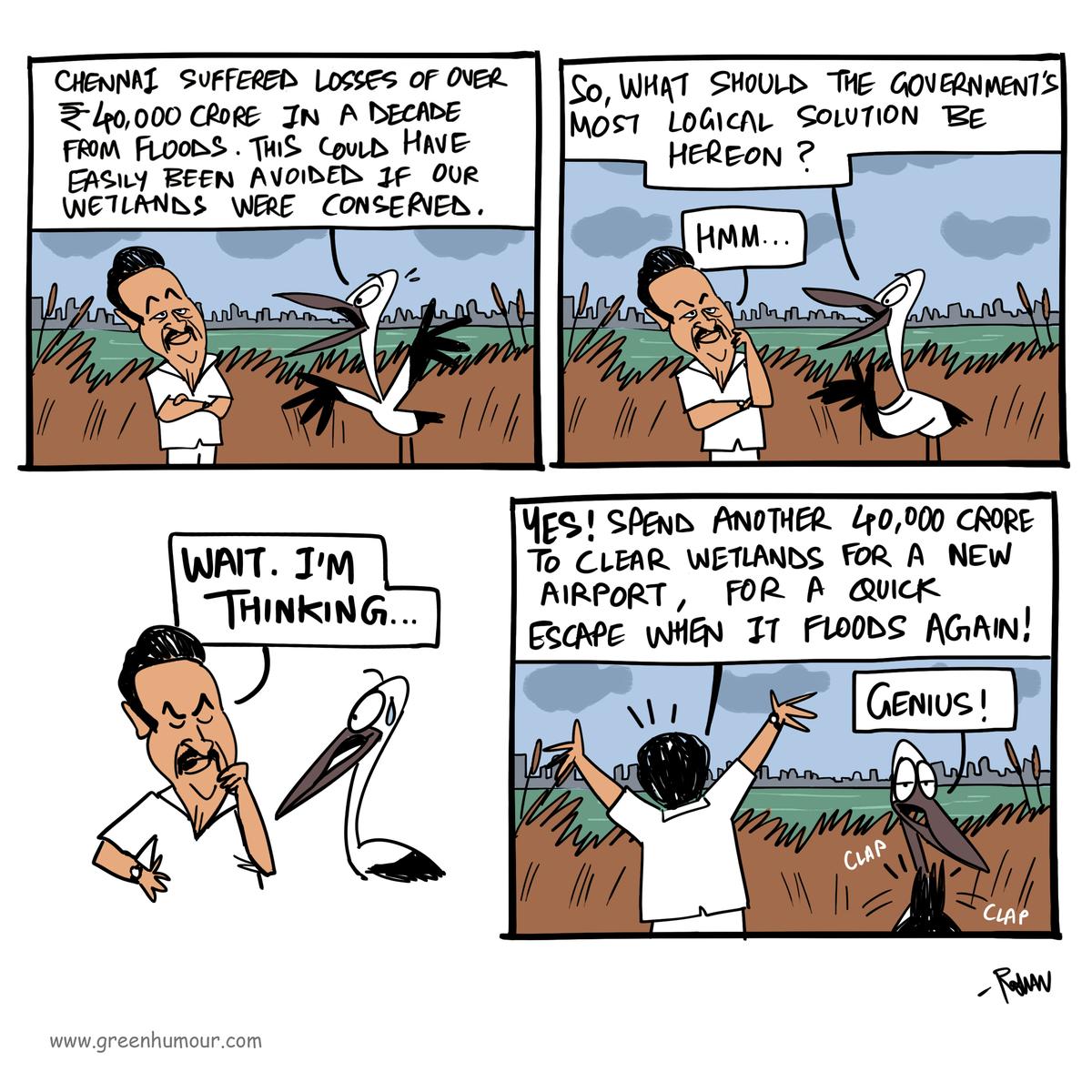
Rohan Chakravarty on Chennai’s wetlands and the Parandur airport project. https://www.thehindu.com/sci-tech/energy-and-environment/green-humour-cartoon-rohan-chakravarty-chennai-flood-governement-funds-aiport/article68331118.ece (29 June 2024)
URBAN WATER
Kolkata Poor pay for the water supply of the rich Kolkata, a city traditionally rich in water resources, is now supplying 5.5 million litres of water daily through tankers despite producing sufficient water for its residents, according to sources within the Kolkata Municipal Corporation (KMC). The situation in the city, built on a deltaic topography with the Hooghly River nearby, hints at high wastage and distributional failures.
Kolkata produces 479 million gallons daily (MGD), or 2,180 million litres daily (MLD), including about 182 MLD of groundwater. Of this, around 1,700 MLD is designated for domestic use. Considering the city’s estimated 5 million population, the requirement is approximately 750 MLD. Even accounting for the additional 5 million people who frequent the city daily, the produced water should suffice, noted a senior civic official, acknowledging that high wastage and distributional failures are the main culprits.
While the rich draw groundwater in addition to receiving pipeline supply, the poor primarily depend on public sources like standposts and tubewells. “Most water is seized by the city’s middle and upper classes, commercial establishments, and the floating population. The government’s policy of not charging for water means the poor effectively subsidise the wealthy,” said an expert.
“Our surveys revealed that poor slum residents are willing to pay a minimal water tax if the supply’s quantity and quality are assured, but the rich in areas like Alipore completely oppose it,” said a KMC expert. https://www.downtoearth.org.in/news/water/tanker-economy-revealed-in-hydrologically-rich-kolkata-the-poor-pay-for-the-water-supply-of-the-rich-96910 (28 June 2024)
Bengaluru Nexus between water mafia and politicians On the condition of anonymity, a tanker fleet owner who specialises in water transportation revealed several secrets to this author, claiming that the city’s water supply ward level engineers have their own clique, which determines who will invest in a tanker and how many trips he can make in a season.
-“The officials themselves are connected to the ward’s corporator, higher officials and top political leaders. Each tanker costs around Rs 50-55 lakh. The owners are in debt to banks, and if there is no water shortage, they will not receive income and will be unable to service the bank debt. This is why they must participate in the ‘artificial water scarcity economy’ in Bengaluru,” the tanker fleet owner said.
-A BWSSB official, who is unwilling to compromise on Bengaluru’s water security, told this author on condition of anonymity that he had attended meetings between political leaders and the tanker mafia, as well as BWSSB and BBMP officials in charge of water supply.
-“These meetings are a sham; behind the scenes, the tanker mafia is given free rein to control the water supply officials in various wards in order to cut off water. The persons operating the valves of the pipelines are instructed to either release water once every three days or open only 30 per cent of the valve, which will just trickle water into the taps, not enough to fill up the underground sumps and overhead tanks,” the official said. With no other options, the residents are forced to summon the tankers.
-According to the activists, the water tanker mafia is one of many lobbies that work closely with political parties. “You help us with the elections, and we will get back your investment in the summer,” appears to be the secret pact.
-“How is it that the tanker operators get water while the Bengaluru Water Supply and Sewerage Board (BWSSB) does not, despite being a government organisation? Despite owning the pipelines, rivers, reservoirs, tanks, lakes, and all water bodies, the BWSSB is unable to supply water to the citizens, while the tanker operators can. Do they manufacture water?” asked Asha Jyothi, a concerned citizen in Koramangala, Bengaluru. https://www.downtoearth.org.in/news/water/tanker-economy-revealed-nexus-between-water-mafia-and-politicians-controls-supply-in-bengaluru-96843 (24 June 2024)
Ghaziabad High rise residents suffer as level dips further A failed pumping set has led to many high rise inhabitants queuing up for water tankers. In Crossings Republik of Ghaziabad, all the societies are dependent on groundwater as the agencies have failed to provide water supply.
“The authorities have sealed the pumping sets of societies and are providing groundwater from their pumping sets. This is doing the same thing but officially. We have been waiting for Ganga water supply for over a decade but no one takes any interest in providing us with basic amenities. The high rise residents are just a vote bank”, said Abhishek Kumar, president, New Era Flat Owners Welfare Association.
Ujjwal Mishra, president, Federation of Crossings Republik Apartment Owners Association, said “The societies have to re-bore for water as the groundwater is depleting at an alarming pace. We have rain water harvesting, but in the absence of any water supply from the government, we have been forced to draw groundwater since last decade. The re-boring was done four years back when the submersible pump was at 200 feet, now its at 300 feet and this summer, water supply is feeble”, Mishra added. https://www.indiatoday.in/india/story/dependent-on-groundwater-ncr-high-rise-residents-suffer-as-level-dips-further-2558135-2024-06-26 (26 June 2024)
Delhi Tanker mafia profiting from govt borewells—pipes Flourshing illegal water tanker business in Sangam Vihar, Okhala and Dwarka in Delhi: Private tanker operators are seizing control of govt-authorised borewells, diverting water from pipes, and illegally drilling into the ground. They are selling government water that would otherwise be freely available to residents, all while environmentalists raise alarms about Delhi’s rapidly depleting groundwater levels.
“The tanker mafia business operates at multiple levels. They receive support from politicians, police, and lower-ranking officials in the Jal Board,” alleged Puneet Singhal, a social and environmental activist working with the people of Sangam Vihar. He added that in return, these influential people sponsor election campaigns and bribe officials to look the other way. https://theprint.in/ground-reports/delhi-water-tanker-mafia-jal-board-borewells-pipes-profits-politics/2149003/ (27 June 2024)
Residents battle scarcity amidst tanker mafia monopoly While residents of Sangam Vihar struggle to meet their water needs, the private tanker mafia in the area thrives due to a monopoly. During peak demand, the tanker operators raised prices by 200 to 300 per cent. A 2,000-litre tanker that costs Rs 600-700 in February-March costs around Rs 1,800 to 2,000 this summer.
-According to sources who asked to remain anonymous, these tanker mafias have connections to every political party. When power shifts, they switch sides and continue operating through collusion. Furthermore, the tanker mafias run a number of illegal borewells in Sangam Vihar and the Deoli area, which supply water to Sangam Vihar and a large portion of the surrounding area. https://www.downtoearth.org.in/news/water/tanker-economy-revealed-in-delhi-sangam-vihar-residents-battle-scarcity-amidst-tanker-mafia-monopoly-96870 (26 June 2024)
Gurugram 200 societies suffer at the hands of tanker mafia Tanker mafia has allegedly damaged water pipeline of a residential society — Emaar Imperial Gardens, Sector 102, Gurugram — as its members failed to pay them “protection money”. The incident highlights the plight of residents amid the growing menace of tanker mafia in New Gurugram. It is learnt that people living in around 200 residential societies located along the Dwarka Expressway were being forced to pay “protection money” to the water mafia or buy tankers from them at exorbitant prices.
-Many residential societies in the city had been dependent on water tankers to meet their daily requirements for around a decade.
When Gurugram Metropolitan Development Authority (GMDA) expanded its water supply network, these tanker providers went out of business. So, they began asking residents for money to ensure the “safety of the pipelines in the area”.
-Residents of multiple societies said they had written to the GMDA to file a police complaint in this matter, but the GMDA has not filed any complaint in this regard, highlighting that the society’s pipeline was the responsibility of the developer and not the GMDA. https://www.tribuneindia.com/news/haryana/200-societies-along-dwarka-e-way-suffer-at-the-hands-of-tanker-mafia-634420 (27 June 2024)
Water mafia is holding residents to ransom Around 200 residential societies located along the Dwarka Expressway are being forced to pay “protection money” to the water mafia, residents alleged, after the water pipeline leading to a high-rise in Sector 102 was damaged and supply disrupted as residents refused to pay ₹50,000 to a group that sought the money to ensure “safety of the pipeline”.
-“This is happening frequently and a complaint was already lodged with the Dhankot police station, but to no effect. These miscreants or local goons have been demanding protection money from us, which we refused. The RWA has spent around ₹10 lakh in the past three months on pipeline (repairs) and buying potable water through tankers. On Tuesday morning, we engaged a contractor to put soil on the new pipelines to prevent sabotage,” said Sunil Sareen, the deputy convener of Dwarka Expressway Gurugram Development Association (DXP-GDA) and a former RWA president of the Emaar Imperial Gardens society.
-Sources in the GMDA acknowledged that the water mafia was behind the crisis, damaging infrastructure and then charging residents exorbitant sums for water tankers and packaged water. https://www.hindustantimes.com/cities/gurugram-news/water-mafia-sabotages-water-pipeline-on-dwarka-expressway-after-residents-refuse-to-pay-protection-money-101719339448248.html (26 June 2024)
NTPC team visits Bandhwari landfill, to set up waste-to-charcoal plant soon A three-member team from the National Thermal Power Corporation (NTPC), Delhi, visited the Bandhwari landfill on Saturday to inspect the site and assess requirements as work on the facility is set to begin on July 10, officials aware of the matter said. The corporation had earlier initiated discussions with NTPC Vidyut Vyapar Nigam Ltd (NVVNL) regarding the utilisation of refuse-derived fuel (RDF) and solid waste for producing green coal, which is essential for thermal plants, in March and their team had visited in April, officials said. https://www.hindustantimes.com/cities/others/ntpc-team-visits-bandhwari-landfill-to-set-up-waste-to-charcoal-plant-soon-101719682396382.html (30 June 2024)
Chandigarh 2,267 notices, 365 challans for water wastage The city Municipal Corporation has issued 2,267 notices and 365 challans during its two-and-a-half-month water-conservation drive from April 15 to June 30. The teams found a total of 2,632 cases water wastage during this period. The MC teams had conducted a round-the-clock challaning exercise in the city to identify and address instances of water wastage. The civic body disconnected nine water connections of offenders. https://www.tribuneindia.com/news/chandigarh/2-267-notices-365-challans-for-water-wastage-635601 (01 July 2024)
WATER POLLUTION
Maharashtra 93 fall ill after drinking contaminated water 93 people suffered from stomach infections after consuming contaminated water from a well in Nanded district on June 26 and 27, according to officials. The affected village, Mugaon Tanda has 107 houses with a population of 440, as per the officials. 93 villagers sought medical assistance at a nearby health facility, complaining of stomach pain and diarrhea, as reported by Balaji Shinde, the district health officer. “We conducted a survey and the possible source of infection was a well from where water is supplied to the villagers. The well has been sealed and water from a nearby filter plant is being made available to the villagers,” he said. https://timesofindia.indiatimes.com/city/kolhapur/93-persons-fall-ill-after-consuming-contaminated-water-in-maharashtra-village/articleshow/111393435.cms (01 July 2024)
JJM/ RURAL WATER SUPPLY
MoJS ‘New project’ to fix water deficit Union Jal Shakti Minister C.R. Paatil said at a public event on Monday (June 24) that the government was conceiving a “new project” to ensure that rural households, which were provided taps under the ambitious Jal Jeevan Mission but had not yet been able to avail water, would soon be provided potable water. https://www.thehindu.com/news/national/jal-shakti-ministry-conceives-new-project-to-fix-water-deficit-in-flagship-jal-jeevan-mission/article68332529.ece (26 June 2024)
उत्तर प्रदेश गंगाजल परियोजना से बनी पानी की टंकी धराशाई, दो की मौत,10 से अधिक घायल मथुरा में बीएसए इंजीनियरिंग कॉलेज के पास कृष्ण विहार कॉलोनी के पार्क में स्थित 2.5 लाख लीटर की क्षमता की पानी की टंकी रविवार (June 30) शाम 6 बजे करीब भरभराकर गिर गई। हादसे में दो महिलाओं की मौत हुई है, 10 से अधिक लोग घायल है। मलबे में अन्य कई लोगों के दबे होने की संभावना है। देर रात तक घटनास्थल पर रेस्क्यू कार्य जारी रहा। दो साल पहले गंगाजल परियोजना के तहत बनी इस टंकी में लीकेज के कारण पिलर कमजोर होने से इसके गिरने की बात सामने आई है। डीएम-एसएसपी मौके पर पहुंचे। सीएम ने इस घटना की रिपोर्ट तलब की है। डीएम ने बताया कि आदेश की उच्चस्तरीय कमेटी जांच करेगी। https://www.amarujala.com/uttar-pradesh/mathura/overhead-tank-collapsed-who-built-under-ganga-water-project-in-mathura-2024-06-30 (30 June 2024)
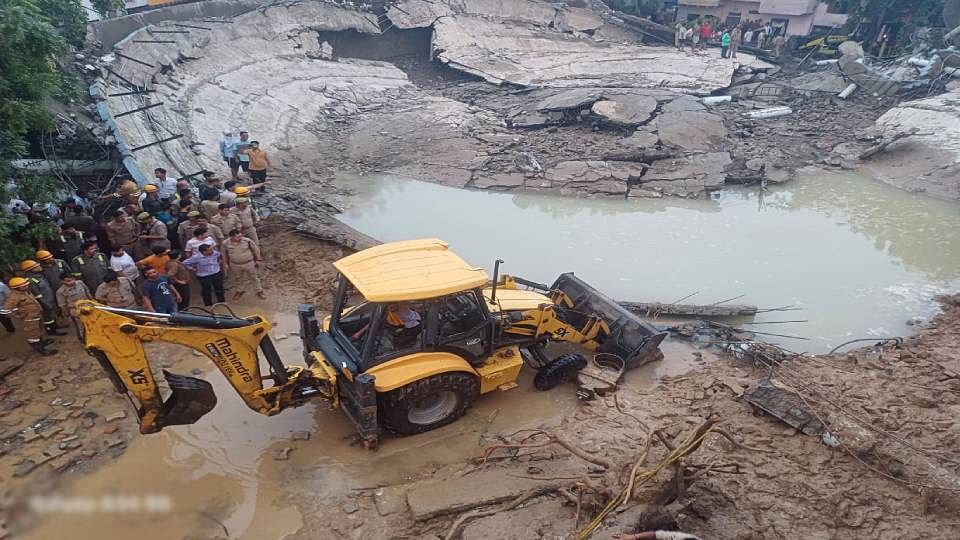
The casualties are likely to rise as some people, including children, got buried under the debris of the 2.5 lakh litre tank, the officials said, adding some nearby houses also came under the rubble. The DM said the construction of the water tank was completed in 2021 and its collapse in just three years will be investigated. He also said the tank was built by the Jal Nigam at a cost of Rs 6 crore under the Gangajal Drinking Water Project. https://www.newindianexpress.com/nation/2024/Jun/30/2-killed-12-injured-as-water-tank-collapses-in-ups-mathura (30 June 2024)
MONSOON 2024
EDIT Learning to live with shifts in monsoon So far, Monsoon’s performance is in keeping with the trend of below-normal rainfall in June, proper onset only in July, and prolonged, heavy rainfall in September. While the exact causes remain unclear, one explanation for the shift in monsoon patterns is delayed western disturbances and Arctic Sea Ice melting as a result of the climate crisis. What is clear is that the country should prepare for the new character of the weather system, which brings with it erratic rainfall distribution, an increasing number of dry days, and abnormally high night temperatures. A dry June hurts the kharif crop, heavy rainfall days in July hurts vegetable output, and the season continuing well beyond September means a delay in the rabi crop. Nine years since 2008 have seen below-normal rain in June.
– The climate crisis calls for focus on devising policies that can deal with these threats adequately and puts the onus on even local governments to ensure proper implementation. https://www.hindustantimes.com/editorials/learning-to-live-with-shifts-in-monsoon-101719331042163.html (25 June 2024)
Study Shrinking Arctic ice behind high summer rainfall in India According to this (Bhaskar June 26 2024) report new research suggests that is inverse relation between status of ice in middle Arctic in March to May and rainfall in India in June in North East, South and Centre. If the ice melts, there is heavy rainfall and if it accumulates, there is deficit. Similarly, there is some relation with North Pole Barent Kara Sea ice situation and rainfall in NW India. These are conclusions of research for the period June 1979 to Sept 2021 by scientists of National Polar and Ocean Research Centre in Goa. This can help better forecast of monsoon rain pattern.

– This is third consecutive year when June rainfall is below normal. Six times in last ten years, when once the rainfall was normal and thrice it was above normal. https://www.newindianexpress.com/nation/2024/Jun/27/research-reveals-shrinking-arctic-ice-behind-high-summer-rainfall-in-india (27 June 2024)
Report Data points to monsoon pattern shift Scientists say India should prepare for the monsoon’s new character, which is changing when rain falls, where it falls, and with what intensity. https://www.hindustantimes.com/india-news/temp-spike-more-dry-days-data-points-to-monsoon-pattern-shift-101719259181680.html (25 June 2024)
Extreme heat and erratic rain affect flower production Erratic rain and extreme heat are impacting the floriculture industry, which stands as the second-largest producer of flowers globally. In addition, consumers making the move to artificial flowers is not only affecting vendors’ livelihood, but also raises the question of the environmental cost of recycling. Flower vendors are having to reduce the number of flowers they procure to sell or lower the sale price as the lifespan of flowers is also affected by extreme weather conditions. https://india.mongabay.com/2024/06/extreme-heat-and-erratic-rain-affect-flower-production-and-livelihood-of-vendors/ (26 June 2024)
The sky people Adding to weather power are independent weather forecasters operating separately from the IMD. But their work often complements the IMD’s efforts. They predict weather by using a variety of tools and techniques, including high-resolution regional climate models, statistical and dynamic weather prediction models, high-performance computing for hyperlocal predictions, and advanced weather models like GFS, ECMWF and CMC. They also bank on online platforms such as Windy.com, the Global Flood Awareness System, satellite images, and Doppler radar data. They then choose a specific geographical area and time frame for their forecast or historical analysis, besides employing high and low-pressure systems to understand general patterns.
By building custom platforms and engaging directly with their audience, they are growing their own community, which might be harder to achieve if they were part of a large institution. Their credibility stems from consistently accurate and timely forecasts that demonstrate real-world impact in real time. Their stories highlight the broader narrative of how indie forecasters are bridging the gap between official meteorological predictions and the real-time, localised needs of the population. Unlike the IMD, which provides updates at scheduled times and follows strict protocols to avoid causing public panic, independent local forecasters can make announcements whenever they like. https://www.newindianexpress.com/magazine/2024/Jun/29/the-sky-people (30 June 2024)
FLOOD 2024
Karnataka Water in Tunga reservoir reaches maximum level The water level in Tunga reservoir at Gajanur near Shivamogga reached its maximum level (FRL OF 588.24 m) on June 27 with inflows of 6766 cusecs, forcing the dam authorities to open the crest gates. THE MONSOON HAS JUST BEGUN. https://www.thehindu.com/news/national/karnataka/water-level-in-tunga-reservoir-at-gajanur-reaches-the-maximum-level/article68340263.ece (27 June 2024)
Ladakh 5 soldiers killed, tank swept away by Shyok river Confirming the loss of lives the Army on Saturday (June 29) said that the incident took place on 28 Jun 2024 night, while deinducting from a military training activity. Indian Army’s Fire and Fury Corps elaborated, in a social media message that “an army tank got struck in the Shyok River, near Saser Brangsa, Eastern Ladakh due to sudden increase in the water level.”In response, “Rescue teams rushed to the location, however, due to high current and water levels, the rescue mission didn’t succeed and the tank crew lost their lives,” added the Corps. https://www.newindianexpress.com/nation/2024/Jun/29/five-soldiers-killed-t-72-tank-swept-away-by-shyok-river-during-military-training-in-ladakh (30 June 2024)
Tamil Nadu Terming flood relief grossly inadequate, govt seeks Rs 3,000 cr State Finance Minister Thangam Thennarasu on Saturday (June 23) termed the Rs 276 crore allocated by the Union government for the recent floods in the State as grossly inadequate and urged it to immediately allocate Rs 3,000 crore to Tamil Nadu in the upcoming budget to undertake necessary restoration works. “The releases from the National Disaster Relief Fund are legitimate dues to the states and I implore the Union government to release adequate funds to disaster-affected states. I request the Union government to allocate a sum of Rs 3,000 crore to Tamil Nadu to undertake necessary restoration works in the upcoming budget,” Thennarasu submitted.
Referring to the two detailed memoranda submitted by the State outlining the extent and magnitude of disasters and seeking a disaster relief of around Rs 37,906 crore, Thennarasu referred to the Rs 276 crore released by the Centre and said, “Given the magnitude of the disasters and the colossal damage caused to the infrastructure and livelihoods of people, this compensation is grossly inadequate and is a grave injustice to Tamil Nadu.” https://www.dtnext.in/news/tamilnadu/flood-relief-grossly-inadequate-says-tamil-nadu-seeks-rs-3000-crore-for-restoration-work-791473 (23 June 2024)
Assam Experts left confused over HM’s idea However, the idea of Union Home Minister Amit Shah that digging ponds across the northeast would somehow mitigate floods has not been met with approval from experts, who are struggling to understand the rationale behind the idea.
Mirza Zulfiqur Rahman, an independent researcher based in Guwahati, who completed his PhD on Sino-Indian transboundary water interactions in the Brahmaputra river basin, raised concerns over the plan to construct artificial ponds to mitigate flooding and boost agriculture and tourism. Rahman emphasized the need to address the destruction of existing wetlands before embarking on new projects. https://www.eastmojo.com/news/2024/06/26/dig-ponds-to-fight-floods-experts-left-confused-over-amit-shahs-idea/ (26 June 2024)
Pune 5 of family swept away near Bhushi dam The bodies of a 36-year-old woman and two girls, aged 13 and 8, were found in the backwater of Bhushi Dam in Lonavala on Sunday (June 30). A search is ongoing for a nine-year-old boy and a four-year-old girl. The five family members were washed away on Sunday (June 30) afternoon due to a sudden rise in water levels at the popular tourist destination. Continuous rain over the last few days caused a sudden increase in the water flow at the waterfall where the family had stopped. Ten people got trapped in the water flow. Five managed to escape, but five were swept away in the strong current. The incident occurred at 1:30 p.m., when the Ansari family visited Bhushi Dam. https://www.indiatoday.in/india/story/woman-girl-drown-waterfall-bhushi-dam-lonavala-3-children-missing-2560416-2024-06-30 (30 June 2024)
HFL BREACH
Assam After three decades, river Brahmaputra at Neamatighat site in Jorhat district is forecasted to breach its HFL by 18:00 hour on June 30. The present flood level is 87.28 meter at 11:00 hour on 30.06.2024 which is just 0.09 meter below the HFL 87.37 meter dated 11.07.1991. It crossed HFL between 1400 and 1500 hrs on June 30 and was still in rising trend as we write this at 1200 on July 1.
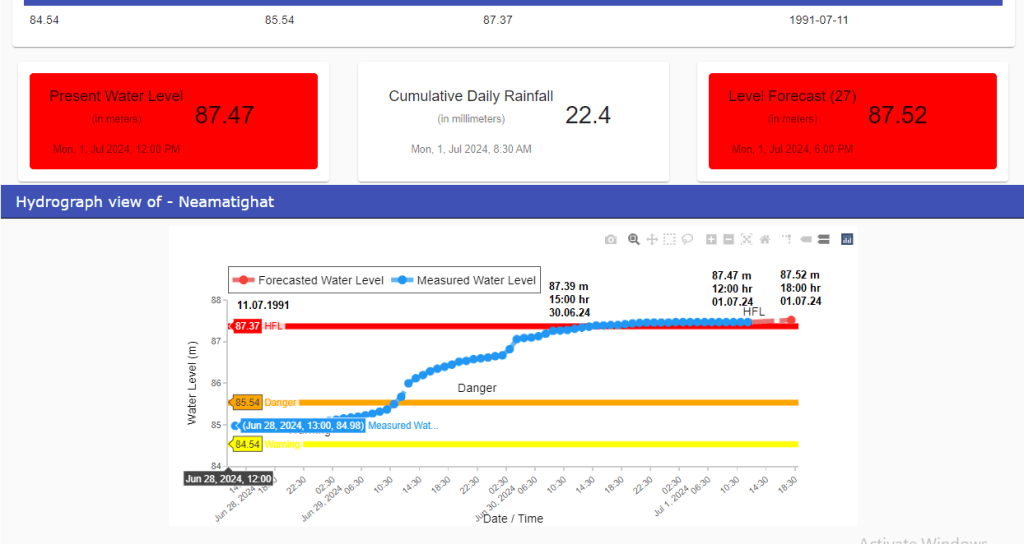
River Brahmaputra at Polaguri site in Marigaon district has crossed old HFL 58.53 meter dated 31.08.2021 at 08:00 hour on 01.07.2024. The river continues to be in extreme flood situation with present flood level at 58.73 meter at 12:00 hour on 01.07.2024.
River Jiabharali at NT Road Crossing site in Sonitpur district has touched HFL 78.5 m dated 26.07.2007 at 06:00 hour on 01.07.2024 and started declining. Present flood level is 78.48 meter at 11:00 hour on 01.07.2024 and is forecasted to decline further at 78.4 meter at 15:00 hour on 01.07.2024.
Rivers in Brahmaputra basin is in severe flood situation at about 8 sites including Tezpur in Sonitpur district and Buridehing river at Margharita site in Tinsukhiya district.
URBAN FLOODS
Delhi From extreme heat to rivers on roads in just 24 hours Just weeks after enduring one of its hottest periods in history, the Indian capital experienced a deluge, receiving a staggering 228.1 mm of rainfall within a span of 24 hours. This amount surpasses Delhi’s average rainfall for the entire month of June, transforming relief from the heat into widespread disruption.
-As per the IMD the torrential downpour marked a 266 per cent departure from the norm for this time of year. Areas surrounding the Delhi airport alone received 148.5 mm of rain in just three hours on Friday (June 28), exceeding the total rainfall recorded in June of the previous year (101.7 mm). The Safdarjung Observatory, Delhi’s main weather station, registered 228.1 mm of rain in the 24 hours ending at 8:30 am on Friday (June 28). This amount is more than three times the average June rainfall of 74.1 mm and marks the highest June rainfall in at least 16 years. https://economictimes.indiatimes.com/news/india/how-indias-capital-went-from-extreme-heat-to-heavy-floods/articleshow/111336100.cms (28 June 2024)
Highest rain for June since 1936 -Delhi recorded 228.1mm of rainfall in a 24-hour period between 8:30 am on Thursday (June 27) and Friday (June 28), at Safdarjung weather station the IMD said, stating 148.5mm out of this came in just a three-hour window between 2:30am and 5:30am. This is likely to be the wettest single-day spell of rain for June in the capital since 1936, when Delhi recorded 235.5mm, IMD data showed. “The all-time record for rainfall in a single day in June for Delhi is 235.5mm, which was recorded on June 28, 1936. We are checking 24-hour rainfall records for every year since then to see whether this is the second-highest spell after that,” said an IMD official on Friday (June 28). https://www.hindustantimes.com/cities/delhi-news/delhi-receives-228-1mm-of-rainfall-in-24hrs-likely-to-be-highest-for-june-since-1936-101719556056994.html (28 June 2024) However, the IMD reported rainfall for 48 hours ending at 0830 am on June 28 or June 29 did not cross even 200 mm for any of the nine Delhi districts.
Rain breaks 88-year-old record According to the Meteorological Department, Delhi received 228 mm of rainfall from 8:30 am on June 27 to 8:30 am on June 28, marking the highest 24-hour rainfall in June since 1936, when 235.5 mm of rain was recorded. https://www.ndtv.com/delhi-news/delhi-ncr-submerges-as-torrential-rain-breaks-88-year-old-record-5987793 (28 June 2024)
Heavy rainfall instances in Delhi in recent years.

Surgeries put off at AIIMS & LNJP At least 50% of the surgeries at AIIMS were cancelled due to waterlogging in the basements of the trauma centre and Cardiothoracic Neurosciences Centre (CNC), where electric panels are located. Many parking areas also got flooded.
-AIIMS’ National Centre for Ageing (NCA), which was inaugurated in Dec 2023 by Union health minister, got flooded and rainwater seeped into the room where the CT scan machine was kept. The traffic movement in the tunnel connecting the trauma centre to the main AIIMS building was also disrupted, forcing patients to be transported by the main road. The tunnel was inaccessible till the evening.
-Some operation theatres even experienced minor water seepage. The power supply was disrupted in many areas, including wards and OPDs. The basement of the CNC building was flooded with knee-deep water, rendering three elevators inoperable. According to a notice issued by the acting head of the neurosurgery department, its OTs were non-functional due to the breakdown of the airconditioning system and water seepage from the walls. Several patients were sent to either Safdarjung or other govt hospitals, said officials.
-Several surgeries were also postponed at Lok Nayak Hospital due to the delayed arrival of the surgical and anaesthesia teams. According to the hospital, at least five surgeries, two of which were major, had to be cancelled. The area leading to the emergency department at RML Hospital also got flooded, resulting in difficulties for patients and their companions attempting to access the medical facility. According to doctors, the water receded in two hours. https://timesofindia.indiatimes.com/city/delhi/rain-disrupts-medical-services-at-aiims-and-lnjp-due-to-heavy-rainfall/articleshow/111351481.cms (29 June 2024)
No lessons learnt from ’23; ITO drain floods again The deluge in areas surrounding ITO, Connaught Place and Tilak Marg, on Friday (July 28) morning was a grim reminder of the historic July 2023 floods in the city which submerged large swathes of arterial stretches in key areas surrounding New Delhi, throwing normal life out of gear for nearly a week and displacing around 28,000 people.
Officials from the Public Works Department (PWD) said that most of the water from across parts of ITO goes into drain number 12, maintained by the Municipal Corporation of Delhi (MCD). “Our team visited the drain on Thursday (July 270 and found that work seemed to have just started, and most of the desilting and cleaning was still not done. MCD had earlier claimed that desilting was complete. We have written to the MCD to get the work done at the earliest. Due to the silt deposited in the drain, there is a high probability of backflow of water into the PWD drain which may cause waterlogging in the Supreme Court campus and Mathura Road,” said a PWD official. https://www.hindustantimes.com/cities/delhi-news/no-lessons-learnt-from-23-ito-drain-floods-new-delhi-again-101719599029375.html (29 June 2024)
Delhi Water Minister Atishi conducted an inspection at the Chandrawal water treatment plant on Sunday. Heavy rain on Friday (June 28) damaged the plant’s motors, and the minister assured that the supply would be restored promptly. In a post on X, the minister cited waterlogging due to unexpected rain as the cause of the damage. https://indianexpress.com/article/cities/delhi/delhi-minister-atishi-inspects-flood-damaged-chandrawal-water-treatment-plant-9424376/ (30 June 2024)
Infamous flooded underpasses make a comeback -Capital’s Minto Bridge underpass, the Pragati Maidan and Mathura Road tunnels, Tilak Bridge railway underpass near ITO, Azad Market, Zakhira, Azadpur and Chatta Rail (behind Red Fort) underpasses in north Delhi, Mehram Nagar underpass leading to Terminal 3 of Delhi airport, and Ashok Nagar underpass in east Delhi were also inundated, with several vehicles being submerged in the flooded areas. https://www.hindustantimes.com/cities/delhi-news/infamous-flooded-underpasses-make-a-comeback-in-delhi-man-drowns-in-azadpur-101719598910444.html (29 June 2024)
The Pragati Maidan tunnel which had been closed on June 28 due to waterlogging following last week’s heavy rain in Delhi reopened for the public on Monday (July 01). https://www.indiatvnews.com/delhi/pragati-maidan-tunnel-reopens-for-public-after-three-day-closure-due-to-waterlogging-in-delhi-rains-latest-updates-2024-07-01-939681 (01 July 2024)
City does not drain water efficiently -The long-term data at high frequency – for an hour or three hours – is not publicly available. IMD’s intensity categories for 24-hour rainfall do not suggest an increase in the intensity of rain in Delhi. While total annual rain decreased by 25% in the 2011-2020 decade compared to LPA, rain of “rather heavy” or higher intensity (rain of 35.5mm or more in 24 hours) decreased by 64%. On the other hand, moderate rain (7.6-35.5mm in 24 hours) decreased by 7%. It is only rain of even lower intensity (all classified as different types of light rain) that increased by 6% https://www.hindustantimes.com/cities/delhi-news/yamunas-water-level-suggests-delhi-does-not-drain-water-efficiently-101719598969953.html (29 June 2024)
Death toll rises to 11 -The heavy overnight rains unleashed fury over the residents of the national capital as at least 11 lives in total were lost in separate incidents, including the death of four kids aged between eight to ten years. https://www.newindianexpress.com/nation/2024/Jun/29/delhi-rains-death-toll-rises-to-11-bodies-of-4-kids-recovered-from-flooded-areas (30 June 2024)
Environment min blames plastic waste -Union Environment Minister Bhupender Yadav attributed the waterlogging in Delhi following torrential rains on Friday (June 28) morning to drains being clogged with plastic waste and criticised the Delhi government for its inaction despite multiple reminders. https://www.business-standard.com/politics/delhi-rain-chaos-environment-min-blames-plastic-waste-slams-state-govt-124062800474_1.html (28 June 2024) However, key question is, what has the Union MoEF done about restricting the production of such plastics in the country.
Rains sink lawyer chambers in NCR -After hours spent in draining the water out – which required both the assistance of the Municipal Corporation of Delhi (MCD) assistance and of private pumps that were frantically purchased – they were shocked to walk into an entirely ruined office. All the furniture and reference books were floating across the lobby, bookshelves rain-sacked, computer screens and laptops broken, and files completely destroyed. The extent of the damage was such that false ceilings and lights embedded on them had come down in their entirety. Everything was destroyed, with nothing capable of being salvaged. https://www.barandbench.com/columns/delhi-rains-sink-lawyer-chambers-in-ncr (29 June 2024)
Waterlogging, traffic snarls add to chaos The heavy rainfall spell in Delhi on June 28 causing water logging and urban flooding in several areas have again exposed the poor maintenance of existing drainage system which is further disrepected even damaged by growing infrastructure projects. Unabated tree felling, absence of RWH facilities and concretization of surface area has only worsened the scenario. Sadely five people lost their lives due to rain related incidents and flooding. https://www.business-standard.com/india-news/heavy-rains-pound-delhi-5-dead-waterlogging-traffic-snarls-add-to-chaos-124062801357_1.html (29 June 2024)
Gurugram Rainwater floods homes, roads At least 20 spots across the city witnessed severe waterlogging, forcing residents to remain indoors during the first half of the day. Heavy rainfall on Friday (June 28) morning caused significant traffic jams across Gurugram, which were managed to be cleared out within an hour, said officials. According to the weather department, the city received 30mm of rainfall, while Sohna recorded 80mm, leading to waterlogging on several stretches of National Highway (NH-48). https://www.hindustantimes.com/cities/gurugram-news/rainwater-floods-homes-roads-in-gurugram-101719600529996.html (28 June 2024)
Ayodhya City struggles with waterlogging, damaged roads Just six months after the grand inauguration of the Ram Janmabhoomi Temple in Ayodhya, heavy rainfall in the temple city has exposed the city’s infrastructural vulnerabilities and raised concerns about the new temple’s structural integrity. The downpour turned the city’s existing issues worse, leading to widespread damage.
-Rampath, an important road, suffered damage despite recent repairs near Vidya Mandir School. The rain caused further chaos, with a tree falling inside the Basic Education Officer’s office and widespread waterlogging affecting public offices like the Public Welfare Department and District Veterinary Hospital in the area. The second consecutive day of rainfall saw water seeping into houses, shops and offices, leading to huge financial losses for residents in areas like Police Lines and Reedganj-Gulabbari. of Ayodhya. https://www.news9live.com/india/6-months-after-ayodhya-temple-concertation-city-struggles-with-waterlogging-damaged-roads-2593248 (26 June 2024)
Haridwar Vehicles swept away in Sukhi river Heavy rain hit Haridwar on Saturday (June 29) afternoon, causing the Sukhi river to flood and wash away numerous parked cars. The rainwater also entered homes and flooded major roads in the town. Normally dry, the Sukhi riverbed is often used as a parking area. However, the sudden flood carried cars away into the river, which flows into the Ganga nearby. https://www.hindustantimes.com/india-news/watch-heavy-rain-in-haridwar-swells-dry-sukhi-river-vehicles-swept-away-101719671345803.html (29 June 2024)
CLOUD BURSTS
Arunachal Pradesh Cloudburst fear sparks panic in Itanagar In a matter of minutes, the serene sky at Itanagar turned spooky and rained hard, triggering a series of landslides, a deluge of the streets, and a “cloudburst” panic among the residents. The India Meteorological Department (IMD), however, termed it an “extremely heavy fall”, and not a cloudburst, which resulted in 3.75 cm of rainfall in a little more than two hours from 10.30 am to 11.45 am.
-“Since the entire rainfall of 3.75 cm took place within a short interval at Itanagar and a similar amount of water flowing from higher hills to the state capital, when summed together, caused a flood-like situation and more damage,” explained K N Mohan, the head of the regional meteorological centre of the IMD. https://timesofindia.indiatimes.com/city/itanagar/cloudburst-fear-sparks-panic-in-itanagar-no-of-assams-flood-hit-down-to-2-lakh/articleshow/111237813.cms (24 June 2024)
Himachal Pradesh सोलन में बादल फटा, ट्रक-कार मलबे में फंसे सोलन जिले के कुनिहार-नालागढ़ मार्ग पर स्थित गंबरपुल पर बादल फटने से एक ढाबा ढह गया। इससे कुछ वाहन भी इसकी चपेट में आए हैं। गनीमत रही कि जब बादल फटा तो ढाबे में कोई नहीं था, नहीं तो नुकसान ज्यादा हो सकता था। इसमें गंबरपुल पूरी तरह से मिट्टी से भर गया है। मौके पर एसडीएम अर्की भी पहुंच गए हैं। सड़क पर बड़ी-बड़ी चट्टानें आ गई हैं, जिन्हें हटाने का काम चल रहा है।
DISASTERS
Uttarakhand Govt to study risk posed by 13 glacial lakes There are 13 dangerous glacial lakes in Uttarakhand. These will be visited in July by two teams including experts from Wadia Institute and MoEF. (The Hindu, Bhaskar 280624) https://www.thehindu.com/sci-tech/energy-and-environment/uttarakhand-will-study-glacial-lakes-to-avoid-outburst-scenarios/article68340516.ece (28 June 2024)
An avalanche struck Gandhi Sarovar in Kedarnath, on Sunday, 30 June. There have been no reports of casualties or property damage so far. https://www.livemint.com/news/india/uttarakhand-news-avalanche-occurs-over-gandhi-sarovar-in-kedarnath-watch-11719739993889.html (30 June 2024)
Jammu & Kashmir Team formed to assess GLOF threat Chief Secretary Atal Dulloo on Monday (June 24) directed the department of Disaster Management to form a team of experts, including glaciologists, to conduct expeditions to these lakes and provide practical recommendations based on ground reality. The team will assess the lakes and install Early Warning Systems, Auto Weather Stations, and collect data to develop a comprehensive mitigation plan against GLOF, said an official communique from the Information department.
A detailed project worth Rs 30 crore has been submitted to the National Disaster Management Authority (NDMA) for funding, it read. https://www.greaterkashmir.com/governance/need-to-prevent-glacial-lake-outburst-floods-in-jk-chief-secretary/ (24 June 2024)
Himachal Pradesh NHAI to construct 68 tunnels The National Highways Authority of India (NHAI) is constructing 68 tunnels in the state. Covering a distance of 85.1 kilometres, these tunnels, once completed, will shorten travelling time by 12.5 hours by reducing a distance of 126 km. “Eleven tunnels have been completed, while 27 are under-construction and a detailed project report for the remaining 30 is being prepared,” said Abdul Basit, Regional Officer, NHAI, Shimla, at a conference of the Tunnel Association of India in Shimla yesterday (June 27). https://www.tribuneindia.com/news/himachal/nhai-to-construct-68-tunnels-in-himachal-634990#goog_rewarded (29 June 2024) Unfortunately, NHAI has poor track record in terms of assessing the adverse impacts of such tunnels and ensuring prudent decision making, monitoring, compliance and accountability in such projects.
LANDSLIDES
Jammu & Kashmir Land subsidence hits Srinagar, 6 houses develop cracks The six houses in Khwajapura Surteng, in old Srinagar (Kashmir) city’s Rainawari area, began developing cracks on the walls and floors on June 17, with some structures also tilting, after some portions of the land began to sink last week. The residents have been moved to a safer location and the administration have set up an expert committee to look into land subsidence. The committee comprises experts from University (of Kashmir) and National Institute of Technology, Srinagar, besides those from geology and mining, roads and buildings and the district administration.
– A research paper on ‘mining induced subsidence’ in 2021 by a group led by Bikram Singh Bali, from the department of Earth Sciences at the University of Kashmir, said Surteng has a history of land subsidence. It said that the surface change phenomenon was restricted to a small area, which had a history of “extensive underground mining related to pottery industry” for decades. “Major sub-surface observations made were underground cavities, room and pillar mining structures and voids. In addition to the sub-surface structures caused by the mining in the historical past, the surface deformations were observed in the form of cracks developed in the construction,” the paper abstract said. https://www.hindustantimes.com/india-news/land-subsidence-hits-srinagar-6-houses-develop-cracks-101719341913019.html (26 June 2024)
Himachal Pradesh Landslide damages vehicles in Shimla Eight vehicles in Shimla were damaged as concrete-rock debris slid from the hill and landed on the parked vehicles at Malyana area. No one was hurt in the incident, the police said. Roads were blocked and traffic came to a standstill following landslides in Kullu and Kinnaur districts. A small bridge at Indora in Kangra was washed away in the rain, they added.
-Local residents in Shimla claimed that it was a man-made landslide caused by choked drainage. “Yesterday night, Shimla received the first monsoon rain. Minor landslides were expected. At Malyana, the landslide was a man-made tragedy. People have choked the drainage with dumping garbage, concrete waste in the drainage. Moreover, a sewage pipeline was also broken at the Housing Board Colony (HBC) at Malyana. We have sent the rescue workers along with a JCB machine on the spot,” Shimla Mayor Surinder Chauhan told The Indian Express. https://indianexpress.com/article/cities/chandigarh/shimla-under-heavy-rain-alert-landslips-block-roads-in-kullu-kinnaur-districts-9420283/ (28 June 2024)
Report Eastern Ghats debuts in new landslide susceptibility map A new landslide map of India classifies 4.75% of the country as highly susceptible to landslides. Landslide-prone zones in the Eastern Ghats, which were previously unreported in government data, have been identified on a map for the first time. Experts say they believe such data could significantly improve landslide management in India, frequently ravaged by landslides and other extreme weather events. https://india.mongabay.com/2024/06/eastern-ghats-debuts-in-new-landslide-susceptibility-map/ (26 June 2024)
DROUGHT
Report How droughts & worsening soil health can increase carbon emissions Researchers have identified a feedback loop between drought, soil desiccation and carbon dioxide emissions that can accelerate climate change effects. Due to droughts and soil surface cracking, the carbon in soil is oxidised and emitted as carbon dioxide, further increasing temperatures. This feedback loop requires further interdisciplinary research to understand the interplays between droughts and greenhouse gas emissions. Soil health plays a crucial role in climate mitigation and must be prioritised for agricultural and climate-related outcomes. https://india.mongabay.com/2024/06/how-droughts-and-worsening-soil-health-can-increase-carbon-emissions/ (24 June 2024)
ENERGY OPTIONS
Punjab Few takers for solar power as free electricity flows Government decision to give free power to agriculture sector and 300 units of free power to domestic consumers have led to a fall in number of domestic consumers going in for solar power generation on their rooftops.
-There are also no takers for the solar power generation for running the agriculture pumpsets since power to the farm sector is also free. Nearly 24 per cent of the total power generated is consumed by 14 lakh agriculture pumpset consumers and they use power during the day, which are the peak load hours.
-With domestic consumers getting 300 units of free power every month, or 600 units in a billing cycle, they are unwilling to make an investment of Rs 1.5-Rs 2 lakh for installing the on grid rooftop solar (RTS) system, ever since the free power to domestic consumers was started in July 2022.
-Data available with The Tribune shows that the number of domestic consumers opting for the RTS grew by 14,978 between 2019 and 2022 (when the free power scheme began). The generation capacity then was 107.31 MW. Between March 2022-2024, only 7,508 consumers opted for solar power and the generation capacity reached 159.10 MW. https://www.tribuneindia.com/news/punjab/few-takers-for-solar-power-as-free-electricity-flows-633831 (25 June 2024)
ENVIRONMENT GOVERNANCE
Delhi DDA tells SC it can’t find records of LG’s site visit prior to tree felling -“We have issued contempt to your vice chairman. That doesn’t mean we are sending him to jail but mark it, he has to come with clean hands and inform it very clearly to us as to who directed him for felling of trees. If he does so, he will be doing great service to the environment. If the highest authority has done something, he has to disclose this. This is a remedial measure we have to take for protecting the environment. He has to come with clean hands. There cannot be any cover-up even if something has been done by the highest authority,” Justice Oka observed. The Court granted the DDA Vice Chairman one more week to comply with the directions in the order passed on June 24. https://www.barandbench.com/news/dda-tells-supreme-court-cant-find-records-delhi-lgs-site-visit-prior-tree-felling (26 June 2024)
LG’s role in tree felling under SC scanner -“Such brazen damage to environment cannot be ignored by courts. 1,100 trees have been felled. It is such a serious matter and you are taking it so casually. If statutory authorities do not perform their functions, courts will have to give a clear message to authorities that environment cannot be damaged in this fashion,” the bench comprising of Justices A.S. Oka and Ujjal Bhuyan were quoted as saying by HT. The court will address contempt proceedings against the DDA officials on July 10. https://thewire.in/law/delhi-lgs-role-in-tree-felling-under-sc-scanner-contempt-notice-possible (25 June 2024)
Come clean on this: SC to DDA in contempt case The Supreme Court on Monday (June 24) asked the Delhi Development Authority (DDA) if the illegal cutting of trees in Delhi’s ridge forest was carried out based on the direction issued by the Lieutenant Governor of Delhi. A vacation bench comprising Justices Abhay S Oka and Ujjal Bhuyan was hearing a suo motu contempt case initiated against DDA Vice Chairman Subhashish Panda for the felling of trees in violation of the orders of the Court.
-After perusing the report of the Enquiry Committee which has been constituted by the DDA to enquire into the whole episode, the bench noted that certain email communications referred to a site visit made by the LG on February 3, 2024.
-The Executive Engineer purportedly sent emails to the contractor on February 7 and February 14. Although the Executive Engineer denied the authorship of these emails, the Court observed in its order that they contained a “specific statement that Hon’ble LG, who is the DDA Chairman, visited the site on 03.02.2024 and directed to clear the trees.” https://www.livelaw.in/top-stories/emails-indicate-delhi-lg-directed-cutting-of-trees-in-ridge-come-clean-on-this-supreme-court-to-dda-in-contempt-case-261298 (24 June 2024)
Tamil Nadu Govt set to launch website for environmental volunteering The new initiative by the departments of Environment, Climate Change and Forest is focused on promoting environmental protection and restoration by engaging school children, college students, and youth in a range of activities including habitat conservation, controlling invasive plants, beach clean-ups, wildlife surveys, plastic waste management, sea turtle conservation, and citizen science initiatives. https://www.thehindu.com/news/national/tamil-nadu/tamil-nadu-set-to-launch-website-for-environmental-volunteering/article68341185.ece (28 June 2024)
SOUTH ASIA
India-Bangladesh W Bengal CM proposes alternative solutions The alternative solutions Mamata has proposed include sharing of water from rivers like the Torsa, which too flows from Sikkim via North Bengal into the river Padma in Bangladesh. She has proposed that the two countries set up a commission to ascertain the level of water flowing through the Torsa and the quantum of water that can be shared.
– “Water flow in the Teesta has gone down over the years. It is estimated that if any more water is shared with Bangladesh, lakhs of people in North Bengal will get severely impacted due to inadequate availability of irrigation water. In addition, Teesta water is needed for meeting drinking water requirements in North Bengal. It is therefore not feasible to share Teesta waters with Bangladesh,” W Bengal CM wrote to Indian PM. https://indianexpress.com/article/political-pulse/decode-politics-mamata-modi-hasina-talks-teesta-water-sharing-9419262/ (27 June 2024) What is holding up the Teesta treaty? https://www.thehindu.com/incoming/what-is-holding-up-the-teesta-treaty-explained/article68349392.ece (30 June 2024)
IWT India, Pakistan delegations inspect 2 HEPs -Immediately after landing at an army camp, the delegation visited the National Hydroelectric Power Corporation (NHPC) headquarters, the officials said, adding, they left for the 85 MW Ratle hydroelectric power project site at Drabshalla for dam inspection. They will also visit the 1,000 MW Pakal Dul hydroelectric project on river Marusudar, a tributary of river Chenab, and other power projects during their stay in Kishtwar, the officials said.
-Pakistan had in a request to the World Bank in 2016 objected to the design features of the two hydroelectric power projects and sought a settlement through a “neutral expert”. The country, however, later withdrew the request and sought adjudication through a Court of Arbitration. India, on the other hand, insisted that the issue should be resolved solely through ‘Neutral Expert’ proceedings.
-A three-member Pakistan delegation inspected the Pakal Dul and Lower Kalnai hydroelectric power projects under the provisions of the IWT for the last time in January 2019, before the ties between the two countries froze following the revocation of the special status of Jammu and Kashmir. https://www.hindustantimes.com/cities/chandigarh-news/induswater-treaty-india-pakistan-delegations-inspect-two-power-projects-101719264999986.html (25 June 2024)
Pakistani team led by Secretary Water Resources, Syed Ali Murtaza returns on Sunday (June 30) from India after a site visit to controversial Kishanganga and Ratle hydroelectric projects. Pakistani team (included Mehar Ali Shah, Indus Water Commissioner/ Additional Secretary, Ministry of Water Resources, and legal experts) accompanied the neutral experts and judges of the International Court, Hague. A neutral expert and an ad hoc Court of Arbitration was hearing Pakistan’s objections to the construction of the Kishanganga and Ratle hydroelectric projects. The team of neutral experts and judges of ad hoc court are also expected to visit the Neelum Jhelum Hydropower project in in PoK. The next hearing of this case is July 5, 2024 at International Court of Arbitration, the Hague. Michel Lino has been appointed as the Neutral Expert and Prof. Sean Murphy is appointed as Chairman of the Court of Arbitration. https://www.brecorder.com/news/40310520/controversial-hydroelectric-projects-pakistani-team-to-return-from-india-today (30 June 2024)
India-China Transboundary River water data sharing MoU not renewed -India and China do not have a water-sharing agreement for the transboundary rivers. The bilateral MoUs for China to share hydrological data about Brahmaputra (Yaluzangbu or Tsangpo in China) and Sutlej (Lungqen Zangbo) with India have not been renewed since 2018 and 2023 respectively as the bilateral relations nosedived over the military stand-off along the Line of Actual Control (LAC) in eastern Ladakh. “The data provided by the Chinese side was useful for flood prevention and disaster mitigation downstream. It also provided information on historical flows upstream and supplemented satellite data on the buildup of glacier lakes or man-made diversions,” Sanjay Bhattacharyya, a former secretary at the Ministry of External Affairs, said. https://www.deccanherald.com/india/water-woes-in-indias-ties-with-its-neighbours-3085912 (29 June 2024)
This article borders on fear mongering as some of what it says is misleading. The June 2000 floods in Siang in Arunachal Pradesh was due to breach of the landslide dam that China should and could have warned India about, but did not. But it was not due to any Chinese constructed dams. https://arunachalobserver.org/2024/07/01/beware-of-chinas-dam-binge-chinas-dams-in-tibet-may-pose-threat-to-water-supply-of-india/ (01 July 2024)
Pakistan Experts had warned of Neelum-Jhelum HEP tunnel risks An independent panel of experts is believed to have raised red flags last year about the headrace tunnel (HRT) of the Neelum-Jhelum Hydropower Project, as well as recommending preventive measures that were not implemented before the 969 MW Rs 500 Bln project, was shut down on May 2 2024. While an inquiry committee constituted by the prime minister is looking into the matter, officials close to the probe noted that some individuals who might have contributed to the problem during the construction phase 15 years ago were still involved, providing technical assistance to the investigation.
– “The probe and the project should be looked at with a fresh eye and with an independent mind” not only to identify causes but also highlight them and offer alternate solutions, said a hydrological expert, adding that asking the same people to carry out a technical investigation could lead to avoidance of liability and failure to highlight any design flaws. The expert pointed out that independent specialists, while investigating the tailrace tunnel (TRT) collapse of July 2022, had pointed out a big geographical fault on the main boundary thrust. The fault that caused the TRT collapse could again be the same in the case of the HRT as well, just below the Jhelum River crossing. “A properly planned remotely operated vehicle inspection of HRT should be foreseen,” said the 2022 final report prepared by the experts on the TRT collapse. The experts’ panel basically addressed the blockage due to the collapse in the TRT but also provided recommendations for the HRT. https://www.dawn.com/news/1841757/experts-had-warned-of-neelum-jhelum-hydropower-project-tunnel-risks-beforehand (25 June 2024)
Bhutan Govt begins exploring carbon trade market Dagachhu HEP is one of the three registered CDM hydropower projects under the Kyoto Protocol. The other two hydropower projects are Mangdechhu and Punatsangchhu. https://kuenselonline.com/country-begins-exploring-carbon-trade-market/ (26 June 2024)
ASIA
Maldives The Vanishing Islands That Failed to Vanish Then, not very long ago, researchers began sifting through aerial images and found something startling. They looked at a couple dozen islands first, then several hundred, and by now close to 1,000. They found that over the past few decades, the islands’ edges had wobbled this way and that, eroding here, building there. By and large, though, their area hadn’t shrunk. In some cases, it was the opposite: They grew. The seas rose, and the islands expanded with them. Scientists have come to understand some but not all of the reasons for this. Which is why a team of them recently converged in the Maldives, on an island they’d spend weeks outfitting with instruments and sensors and cameras.
– There, you would see the island volcanoes that once stood in the atolls’ place, as lofty and incandescent as today’s specks of land are flat and calm. Fast-forward a bit, enough to let the tectonic plates shift, and you would see the volcanoes start to cool and subside. As they sank, corals would colonize their flanks, growing higher and higher. In time, the volcanoes would be no more and all you’d see was the ringlike reefs, each one encircling a lagoon. Where the reefs poked up high enough, wind and waves would toss up sand and rubble, forming slender islets. These are the atolls. And they can look wildly different depending on where they are in the process.
– To understand what had happened to the atolls since this acceleration due to climate change began, two researchers, Arthur Webb and Paul Kench, decided to look down at them from above. The scientists collected aerial photos of 27 Pacific islands from the middle of the 20th century. Then, they compared them to recent satellite images. “I’m not sure we really knew what we would find,” Dr. Kench recalled. Their findings caused an uproar. The seas had risen an inch or so each decade, yet the waves had kept piling sediment on the islands’ shores, enough to mean that most of them hadn’t changed much in size. Their position on the reef might have shifted. Their shape might be different. Whatever was going on, it clearly wasn’t as simple as oceans rise, islands wash away.
– Dr. Webb and Dr. Kench’s study, which came out in 2010, inspired other scientists to hunt for more old photos and conduct further analysis. The patterns they’ve uncovered in recent years are remarkably consistent across the 1,000 or so islands they’ve studied: Some shrank, others grew. Many, however, were stable. These studies have also added to the intrigue by revealing another pattern: Islands in ocean regions where sea level rise is fastest generally haven’t eroded more than those elsewhere. Precisely why certain (42%) islands shrank while others (39% stable, 20% grew) did not is what scientists are now hoping to figure out. https://www.nytimes.com/interactive/2024/06/26/climate/maldives-islands-climate-change.html (26 June 2024)
THE REST OF THE WORLD
USA Climate change increasing stress on thousands of aging dams Hiba Baroud, associate professor and associate chair in the department of civil and environmental engineering at Vanderbilt University, explains how flooding stresses dams in a changing climate.
– Every four years, the American Society of Civil Engineers produces a report card for the nation’s infrastructure that assigns grades based on the condition of structures like roads, bridges and dams, and the investments that they need. The most recent report card estimates that 70 percent of U.S. dams will be more than 50 years old by 2030. Overall, the report gave U.S. dams a “D” grade and estimated that more than 2,300 high hazard potential dams– those that could cause loss of life or serious property damage if they fail, based on the level of development around them – lacked emergency action plans. (NO SUCH REPORT CARDS ISSUED IN INDIA, NOR ANY SUCH ASSESSMENT DONE.)
– The Association of State Dam Safety Officials estimates that it would cost U.S. $157.7 billion to rehabilitate all nonfederal dams in the U.S. Of this amount, about one-fifth ($34.1 billion) is for rehabilitating high-hazard potential dams. The 2021 Infrastructure Investment and Jobs Act includes approximately $3 billion for dam safety projects, focusing on rehabilitation, retrofitting and removal.
– One recent study on predicting coastal flooding found that in New England, a 100-year flood – that’s an event of a magnitude that now has a 1 percent chance of occurring in any given year – could become an annual occurrence by the late 2100s. The fact that the climate is changing also means that extreme events are becoming more extreme. In 2015, a 1,000-year rainfall event in South Carolina resulted in breaches of 47 dams. While older dams aren’t necessarily unsafe, they were constructed following outdated design standards and construction procedures and for different environmental conditions. That influences the likelihood and consequences of their failure during disasters.
– While the number of high-hazard potential dams in the U.S. has more than doubled in the last 20 years as development has moved farther into rural areas, the proportion of these dams with an emergency action plan has also increased. It is now at 76 percent, which is much higher than just a few years ago. https://www.discovermagazine.com/environment/climate-change-is-increasing-stress-on-thousands-of-aging-dams-across-the-u (27 June 2024)
‘Partial failure’ confirmed at Rapidan Dam in Blue Earth County Blue Earth County Sheriff Jeff Wersal said dead trees from drought got kicked up from the bottom when river levels rose. “Normally we have ways of getting the trees when they come a few at a time out of the dam,” Wersal said. “The water is so fast it’s not safe to put an excavator near this dam to get that out.” Sunday night, it plugged up, causing the water to spill over the dam, with the river eventually breaking through early Monday and cutting a new path on the west side of the dam, taking with it a county parks machine shed, the Xcel substation, and many power poles. https://www.kare11.com/article/news/local/rapidian-dam-blue-earth-county-imminent-failure-flood-water/89-8bb34425-3078-4718-9e57-e1dbbe82674b (24 June 2024)
Flooding on the Blue Earth River breached the Rapidan Dam on June 24 morning. Le Sueur County residents in low-lying areas of the Minnesota River Valley were advised to closely monitor the situation and potentially evacuate, according to the county’s emergency management office. The Blue Earth County Sheriff’s Office says debris started accumulating on Sunday at the 114-year-old dam, located about 10 miles southwest of Mankato.
Monday afternoon, county officials announced there had been a partial failure on the west abutment. The dam is still intact and there are no plans for mass evacuation. Part of the river has been diverted around the west side of the dam where water continues to flow. The river had significantly eroded earth around the west side of the dam on the south side of Mankato. The National Inventory of Dams rated the Rapidan Dam in poor condition. County officials said the dam was recently inspected and was in good shape before the rainfall, saying the partial failure is a result of high water & debris hitting the dam. https://www.cbsnews.com/minnesota/news/rapidan-dam-fails-evacuation-blue-earth-county/ (25 Jun 2024)
Minnesota dam is on the brink of collapse The Blue Earth County government announced the risk to the Rapidan Dam near Mankato, Minnesota in a Monday (June 24) Facebook post. “The Dam is in imminent failure condition,” the county said. “We do not know if it will totally fail or if it will remain in place, however we determined it was necessary to issue this notification to advise downstream residents and the correct regulatory agencies and other local agencies.”
-The county added that they had first been notified of “accumulating debris” at the dam Sunday. Workers from Blue Earth County Public Works, the emergency management agency, and the sheriff’s office are actively monitoring the dam, according to the Facebook post. The Blue Earth River cut around the west side of the dam, emergency management said, carrying damaging debris in its wake and causing power outages. https://edition.cnn.com/2024/06/24/us/rapidan-dam-collapse-risk-minnesota/index.html (25 June 2024)
SANDRP
Also see: DRP 24 June 2024 & DRP 17 June 2024
Follow us on: www.facebook.com/sandrp.in; https://twitter.com/Indian_Rivers

 SANDRP