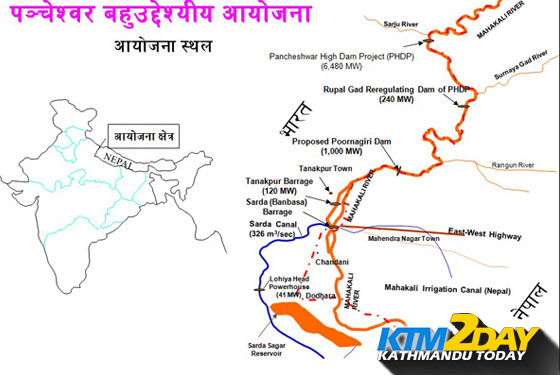
India should not push Pancheshwar Project in Nepal DIPAK GYAWALI asks a lot of pertinent questions here, including this one about PANCHESHWAR DAM: “Did it (India) not ram the Mahakali Treaty down Nepali throats in 1996 against all sane voices of caution and then has been unable to move an inch forward in all these two decades since then? As per the agreement, Nepal was to have received additional irrigation benefits from Tanakpur from an outlet with a sill level built maliciously high: Nepal has already spent billions building canals and distribution structures on its side but not only is there no movement on the Indian side, rather the latest Mughlani communication has been that you Nepalis can build all the canals you want on your side but we will do nothing until after the 6480 MW Pancheshwar high dam is built (when, in the next century?).”
Continue reading “DRP: 26 June 2017 (Pancheshwar Project in Nepal)”Tag: rivers

DRP: 12 June 2017 (Rain Bearing Clouds Thinning Out Over India: IMD Study)
A recent IMD study has found that rain-bearing clouds have been thinning out across the country over the last 50 years. The study, published in the IMD journal Mausam, shows that between 1960 and 2010, annual mean low cloud cover (responsible for the bulk of the rainfall) over India has been decreasing by 0.45% per decade on an average.
According to the study, the number of rainy days is also declining during the monsoon season at an average rate of 0.23 days for every decade. This means that the country has lost approximately one rainy day over the last five decades. The study found that while the number of rainy days is decreasing, there is not much change in the total amount of rainfall. This shows a trend towards shorter, heavier bursts of rain.
That is bad news, because heavier raindrops can dislodge wheat and rice grains from their stalks while on the farm. It also means rainwater flows down a slope that much faster instead of percolating underground.
Meanwhile, a new NASA study has warned the amount of rainfall in the Earth’s tropical regions will significantly increase as the planet continues to warm. As per study rainfall is not related just to the clouds that are available to make rain but also to Earth’s “energy budget” — incoming energy from the Sun compared to outgoing heat energy. High-altitude tropical clouds trap heat in the atmosphere. If there are fewer of these clouds in the future, the tropical atmosphere will cool.
Continue reading “DRP: 12 June 2017 (Rain Bearing Clouds Thinning Out Over India: IMD Study)”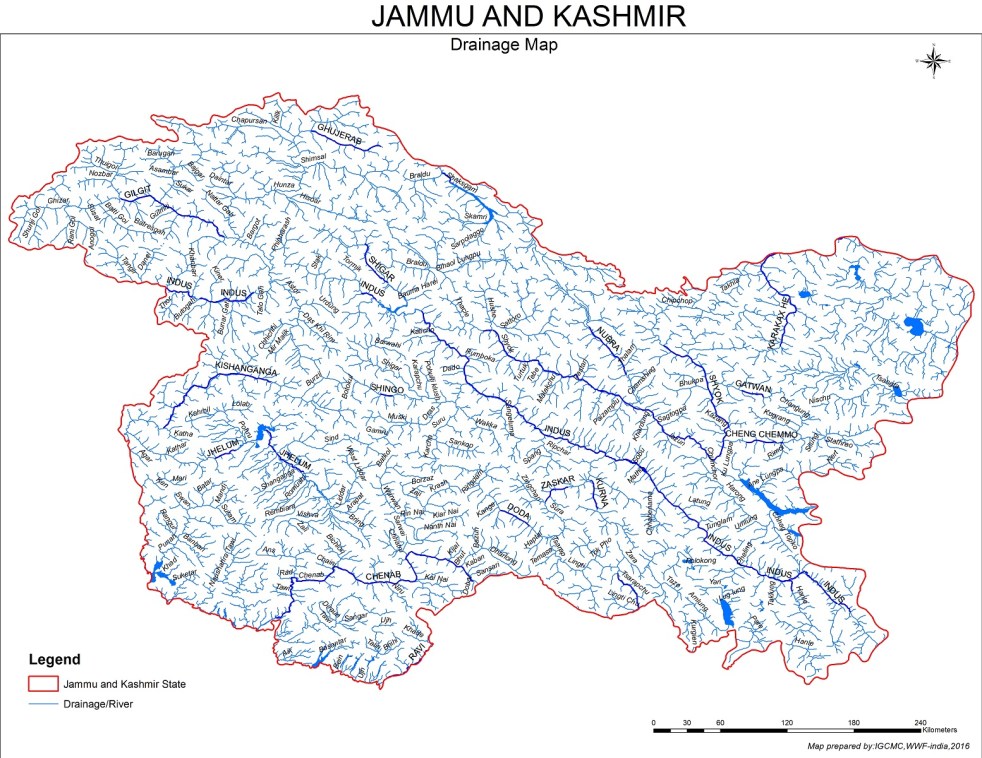
Jammu and Kashmir Rivers Profile (Jhelum and Chenab Basins)
This report discusses a few of the significant issues in the Jhelum and Chenab basin two of the main tributaries of the Indus and provides the readers a snapshot of the issues confronting the water resources development in the basins. On the basis of these factors, the health and status of the Jhelum and Chenab basins is determined using an assessment matrix providing qualitative weights to each of the indicators and influencing factors to arrive at the overall score of the river categorizing a riverscape as healthy, sick and dying.
Continue reading “Jammu and Kashmir Rivers Profile (Jhelum and Chenab Basins)”

DRP: 5 June 2017 (Agitation To Stop Illegal Mining in Ganga)
Today is 13th day of the Swami Shivanand fast unto death to protect Ganga River from illegal mining. The health of 70 years old Marti Sadan head is turning critical with each passing hour. If no intervention is done immediately, the Saint’s life will be in danger.
Matri Sadan resumed its fight against rampant mining in Ganga on May 13th, 2017 after State Government opened Ganga riverbed mining which the Ashram is strongly opposing for last many years.
For first eleven days two disciples of the Ashram observed hunger strike. But seeing no response from Govt, Swami Shivanand himself sat on fast unto death on May 24, 2017 against indiscriminate mining of national river. Still the Govt went ahead with Ganga mining activities stating that it was necessary to protect the city from flood.
In response the Saint shunned even taking water. But instead of communication with the protesters, the State Govt reportedly on May 28, 2017 tried to force feed the saint to fail the agitation for which the Govt was criticized greatly.
After mounting pressure the CM of Uttarakhand is learnt requesting to stop hunger strike. Following this mining was stopped in Ganga and the saint started taking water after six days but decided to continue fast as long as Government imposes complete ban on mining in writing.
On June 02, 2017, accusing the State Govt of blatant apathy towards Swami Shivanand’s hunger strike against illegal mining on the Ganga riverbed in the Kumbh Mela area, a group of scientists, activists and followers have written to the PM Modi requesting the PM to intervene without delay to stop unscientific mining of the Ganga.
Continue reading “DRP: 5 June 2017 (Agitation To Stop Illegal Mining in Ganga)”
Madhya Pradesh Rivers Profile
About Madhya Pradesh
The state of Madhya Pradesh (MP) was bifurcated in the year 2000. The total area of MP state is 3,08,245 sq. km. The state has been divided into 50 districts and 342 sub districts. The total human population of the state is 725.97 million. (2011 census) with a decadal growth rate of 20.3%. Key centres of growth are around the urban centres of Gwalior, Indore, Bhopal and Jabalpur.
Climate
It has a subtropical climate. Hot dry summer extends from April to June followed by monsoon from July to September and winter months (November to February) are cool and relatively dry. The average rainfall is about 1,370 mm and it decreases from east to west. Summer mean maximum temperature rises to about 42.5 deg C in northern parts and the average temperature during winters is as low as 10 Deg C again in the north while it varies from 10 – 15 deg C in the south. (Source: Gosain et al in Climate Change in Madhya Pradesh: A Compendium of Expert Views – II)

DRP: 29 May 2017 (Drought Options: Lessons from Rajasthan)
Rajasthan Lessons from a reborn river The district of Alwar in Rajasthan is water-stressed, receiving less than 650 mm of rainfall in a year, most of which falls during the Southwest monsoon. But Alwar exists in a stable equilibrium, where even if there is a drought, the Johad’s and the forests make it possible for water to be stored underground. Because of strong communal interdependencies, all villagers stuck to sensible crops for the region, and maintaines the Johads. The community, the Forests, the Johads, the choice of crops, all worked together and reinforces one another. Equilibriums are maintained by such reinforcing activities that fortify status quo. FASCINATING account of how Arvari community rejuvenated their rivers and what are the lessons.
Continue reading “DRP: 29 May 2017 (Drought Options: Lessons from Rajasthan)”
DRP: 22 May 2017 (SOLVE SILTATION OF GANGA OR REMOVE FARAKKA DAM TO REVIVE GANGA: BIHAR CM)
Bihar Chief Minister Nitish Kumar again has urged the central govt to remove the Farakka barrage in West Bengal and make a countrywide policy on silt management for letting river Ganga to flow freely.
“Siltation is destroying Ganga’s ecology and health. It’s due to heavy deposits of silt on the riverbed that stream of the river is being badly affected,” Kumar said at a two-day national seminar on ‘Obstacles in the Incessant Flow of the Ganga’.
Speaking on the occasion, Swami Avimukteshwara Anand criticised Union Water Resources Minister Uma Bharati for doing absolutely nothing for the cause of the river Ganga and said she seems more interested in her chair rather than the river. He also criticised Prime Minister Modi for claiming that he is son of Ganga, but doing nothing positive for the river. Swami ji said Nitin Gadkari seems bent on further destroying the river in the name of National Waterway.
Addressing the seminar Nitish Kukar said that Bihar’s demand for the framing of national policy on desiltation of the Ganga and clearance of silt in the state is not a political issue, as the matter is related to larger environmental and biodiversity issues facing the people.
He added, “Concrete steps have to be taken to ensure incessant flow of the Ganga. Otherwise, cleanliness of the river is not possible.” Referring to the need to protect biodiversity, he said conservation of the Ganga dolphins is dependent on the cleanliness of its water. He added the Farakka barrage constructed across the river in West Bengal has led to slow flow of water between Buxar to Bhagalpur, and consequent annual flood and waterlogging during the monsoon.
Nitish recalled the devastating flood that the state had witnessed in the Ganga basin last year and said Bihar had spent Rs 1,058 crore over the last five years to prevent soil erosion. He appealed to the Centre to frame a sound policy on silt management, stressing that it should be prepared by making on the spot survey and assessment of the prevailing situation. Nitish said even the report of the committee headed by Madhav Chitale had accepted the problem of siltation facing the Ganga.
Continue reading “DRP: 22 May 2017 (SOLVE SILTATION OF GANGA OR REMOVE FARAKKA DAM TO REVIVE GANGA: BIHAR CM)”
DRP: 15 May 2017 (MP talks about Narmada Seva after destroying the River with Dams, displacement of Lakhs)
On conclusion of five month long Narmada Sewa Yatra, Prime Minister Narendra Modi is today ( May 15, 2017) launching a road-map for steps to be taken for the conservation of the Narmada river. The MP state assembly has also recently declared river Narmada a living entity. Even otherwise quiet on rivers environment minister Anil Madhav Dave has expressed concerns for Narmada.
Contrary to all this, the Central Govt and 3 states of MP, Maharashtra and Gujarat have begun a process towards sanctioning completion of the Sardar Sarovar Dam, with closure of the 17 meters high gates. It is a countdown towards impounding waters in the 214 km land stretch where more than 40,000 families are residing till date. There are standing crops and massive plantations; thousands of pakka houses, schools, other public and private services erected; hundreds of temples, tens of mosques (as opposed to three temples claimed by the authorities), adivasi gods and worship places, all of which will be submerged. In protest thousands of people from Narmada valley, to be affected by Sardar Sarovar Project created a Human Chain on the borders of living village communities and on the banks of the river, protesting against any decision to close the dam gates.
Continue reading “DRP: 15 May 2017 (MP talks about Narmada Seva after destroying the River with Dams, displacement of Lakhs)”
DRP: 8 May 2017 (Inspiring: How Kerala Panchayat brings a dying river back to life)
The Kuttamperoor stream in Kerala, connecting the Pampa and Achankovil rivers, had been a nearly stagnant, shrunken cesspool of dumped waste and weeds for more than a decade. Some weeks ago, it was resuscitated as a flowing river, thanks to the will of the Budhanur gram panchayat in Alappuzha district, and the commitment of 700 local men and women who worked to bring the river back to life under the MGNREGA.
The Kuttamperoor was once a full 12 kilometres long and, at places, over 100 feet wide. The river originates from Achankovil at Ulunthi, near Mavelikkara, and flows through Ennackad, Budhanur, Kuttamperoor, Mannar, and Pandanad before merging with the Pampa at Nakkida near Parumala in Pathanamthitta district.
Continue reading “DRP: 8 May 2017 (Inspiring: How Kerala Panchayat brings a dying river back to life)”DRP: 1 May 2017 (Ken Betwa won’t help, here is what CAN help Bundelkhand)
Union Water Ministry has launched an extensive water conservation program for drought prone areas of Bundelkhand, Marathwada, Kalahandi, Bolangir and Koraput in Odisha on April 28, 2017 at Bandri, Sagar Madhya Pradesh. As per report, the Water Ministry has prepared a master plan for artificial recharge of ground water in Bundelkhand region.
In UP region of Bundelkhand, around 1100 percolation tanks, 14000 small check dams/Nala bunds and 7200 Recharge pits/shafts have been identified. In MP region of Bundelkhand, around 2000 percolation tanks, 55000 small check dams/Nala bunds and 17000 Recharge shafts have been identified. She said as a part of ground water exploration, 234 wells in UP are proposed to be constructed in five districts of Bundelkhand i.e., Banda, Hamirpur, Jalaun, Chitrakoot and Mahoba. As a part of ground water exploration, 259 wells in MP are proposed to be constructed in six districts of Bundelkhand.
Continue reading “DRP: 1 May 2017 (Ken Betwa won’t help, here is what CAN help Bundelkhand)”
