Dams · Wetlands

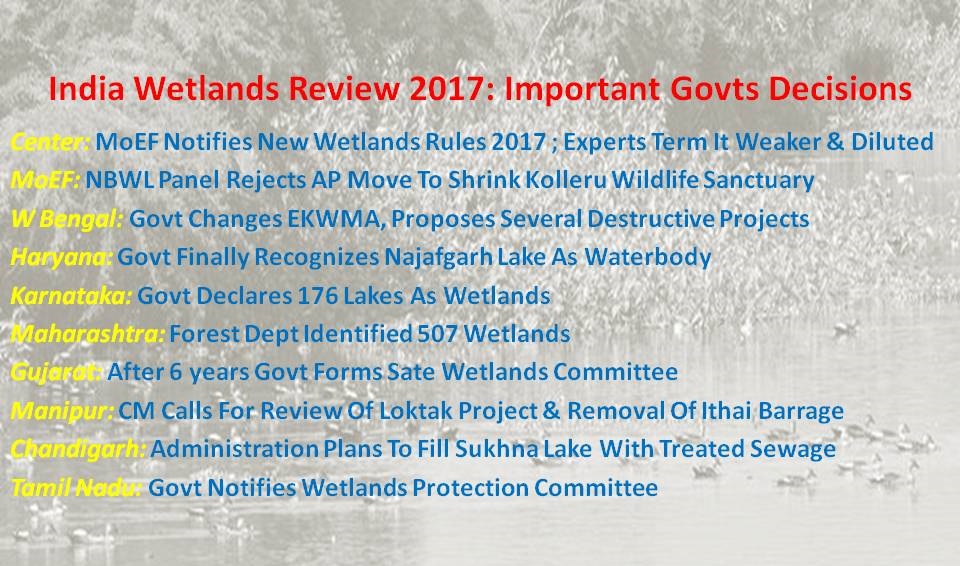
India Wetlands Review 2017: Important Governments Decisions

Central Government Decisions

Environment ministry notifies new wetland rules In a major decision, the union environment ministry notified the new Wetland (Conservation and Management) Rules 2017 on 26 Sept. 2017 replacing the 2010 version of the rules. The draft of the Wetland Rules was first presented by the Ministry of Environment, Forest and Climate Change (MoEF&CC) in March 2016. But they were severely criticized by conservationists who had alleged that the draft rules don’t mention anything about a national regulator and don’t list specific activities prohibited in these ecologically sensitive areas.

The new rules stipulate setting up of a State Wetlands Authority in each State and union territories that will be headed by the State’s environment minister and include a range of government officials. They will also include one expert each in the fields of wetland ecology, hydrology, fisheries, landscape planning and socioeconomics to be nominated by the state government.

The State authorities will also need to prepare a list of all wetlands of the State or union territory within three months, a list of wetlands to be notified within six months, a comprehensive digital inventory of all wetlands within one year which will be updated every ten years.

To oversee the work carried out by States, the rules stipulates for setting up of National Wetlands Committee, which will be headed by the MoEFCC Secretary, to monitor implementation of these rules. The Committee will also advise the Central Government on appropriate policies and action programmes for conservation and wise use of wetlands, recommend designation of wetlands of international importance under Ramsar Convention, advise on collaboration with international agencies on issues related to wetlands etc. http://www.livemint.com/Politics/y6Tr3tkrr3q28AmGKaBFII/Environment-ministry-notifies-new-wetland-rules.html  (Live Mint, 28 Sept. 2017)

Continue reading “India Wetlands Review 2017: Important Governments Decisions” →

Dams · Wetlands

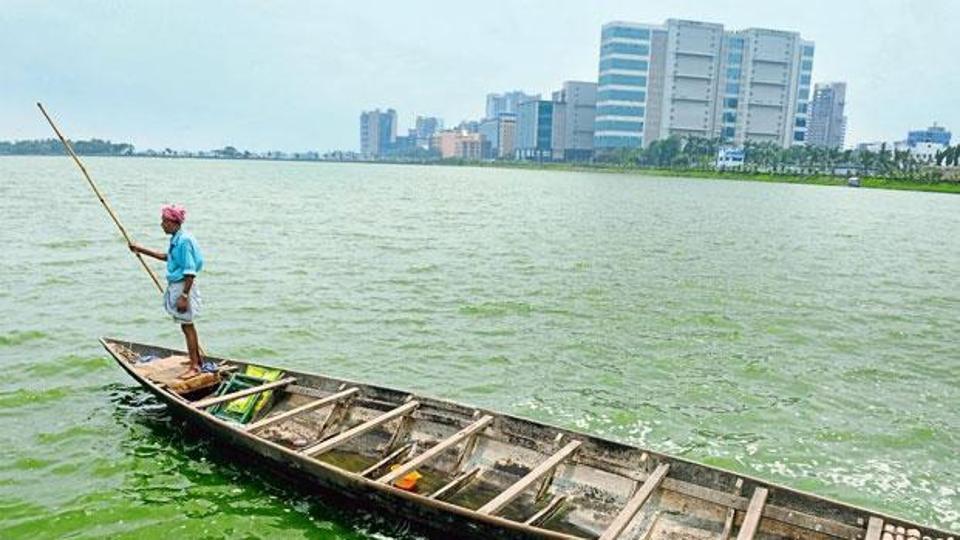
Karnataka Wetlands Review 2017: Bellandur Lake Remains On Fire

Wetlands For A Sustainable Urban Future : Text from Face Book post by Vishwanath Srikantaiah on occasion of World Wetlands Day 2018. 

Much grief, energy and monies can be saved if we imagine our ‘tanks’ as wetlands rather than water bodies in the city of Bengaluru.

World wetlands day is celebrated on the 2nd of February every year. For this year 2018 the theme is “Wetlands for a sustainable urban future”.

A simple definition for a wetland is that it is an area that tends to be saturated with water either permanently or seasonally and harbours a distinct type set of plants. Wetlands behave differently from a water body like a lake and need to be managed, if at all, completely differently.

Wetlands harbour bio-diversity much more than only water, have the ability to absorb pollutants and nutrients better, can manage floods, recharge groundwater, moderate temperature and area huge asset for a city.

In the city of Bengaluru itself the Karnataka State Lake Conservation and Development Authority (KLCDA) has sent a proposal to the central government that 176 tanks within the city be declared as wetlands. This would potentially protect these tanks better from encroachment and solid waste dumping as well as the construction of roads within.

The polluted stretches of the Vrishabhavati and the Dakshina Pinakini could also be brought under wetlands protection.

Wetlands, in combination with waste-water treatment plants, are a good way of reviving the tanks in the city. The example of Jakkur and Rachenahalli are possible starting points for an integrated approach to manage water in the city with wetlands playing an important role. Here waste-water treated to secondary standards are then allowed in to the wetlands which remove nitrates and reduce Total Suspended Solids, thus allowing for it to fill the water body. In turn , the lakes allow for fishing and recharge the surrounding aquifers.

Wetlands provide for a range of services including livelihoods for the poorer sections of society. Even now a range of fodder collectors pick up grass and alligator weed ( called Hongonney in Kannada ) for feeding their cattle almost all across the city.

Remedied waste-water from the city can be further treated in the wetlands and used for agricultural purpose. The proposal and project to transfer treated waste-water to the districts of Kolar and Chikballapur can also benefit substantially if wetlands are integrated in to the design at the first receiving tanks. This would also enhance flora and faunal biodiversity in the tanks of these drought prone rural districts at the same time benefiting agriculture there.

Integrating wetlands into the master plan and the urban fabric of cities is the need of the hour and that would be water wisdom.

Continue reading “Karnataka Wetlands Review 2017: Bellandur Lake Remains On Fire” →

Dams · Wetlands

East India Wetlands Review 2017: West Bengal Bent On Destroying World’s Largest Natural Sewage Treatment Plant

The East Kolkata Wetlands (EKW) are unique yet complex system of natural and human-made wetlands in West Bengal. The wetlands cover 125 sq km comprising of salt marshes, salt meadows, sewage farms and settling ponds. They are used to treat Kolkata’s sewage, and the nutrients contained in the waste water sustain fish farms and agriculture.

Devised by local fishermen and farmers, these wetlands served, in effect, as the largest natural sewage treatment plant (STP) for the city. And using the purification capacity of wetlands, Kolkata by transforming nearly one-third of the city’s sewage into a rich harvest of fish and fresh vegetables daily, has pioneered an environment-friendly system of sewage disposal. Because of this, the EKW were designated a “wetland of international importance” under the Ramsar Convention on August 19, 2002. https://en.wikipedia.org/wiki/East_Kolkata_Wetlands

However for past many years, these wetlands are under threat due to exponential expansion of real-estate projects. Recently illegal landfills are on the rise and unprecedented land development and urbanization have been creating concerns about the impact on EKW environment. 2017 has seen the situation turning only worse for EKW. 

Continue reading “East India Wetlands Review 2017: West Bengal Bent On Destroying World’s Largest Natural Sewage Treatment Plant” →

Dams · Wetlands

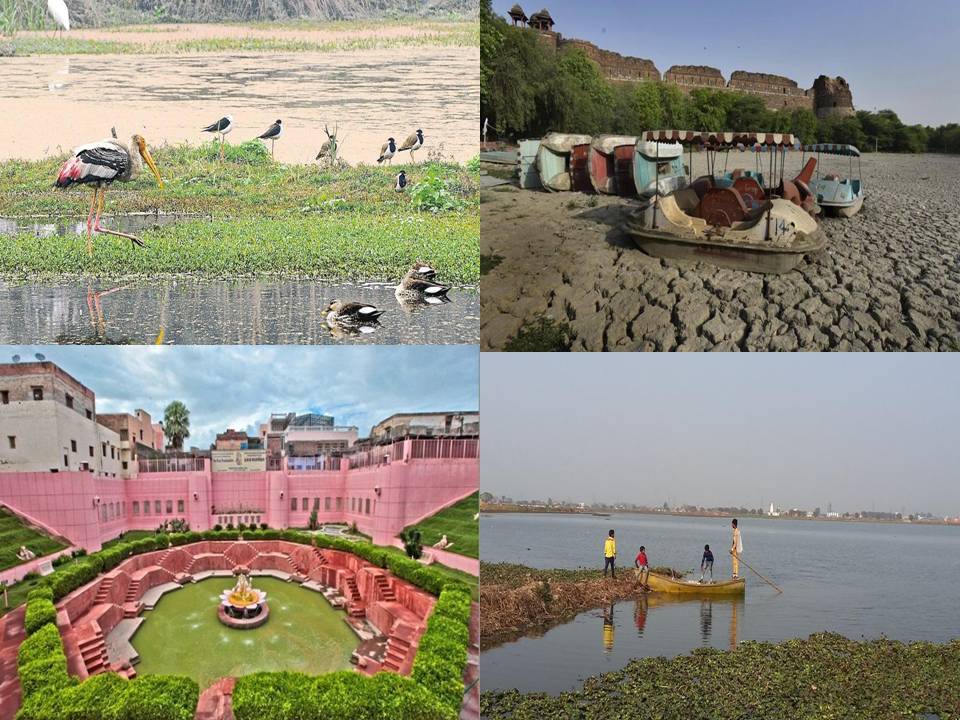
North India Wetlands Review 2017: Callous Governments

After separate reports on key developments surrounding wetlands in 2017 in North India including Jammu & Kashmir, Uttarakhand, Punjab, Chandigarh and Haryana – this final compilation in North India Wetlands Review 2017 series by SANDRP, highlights the plight of wetlands, lakes and water bodies in Uttar Pradesh, Delhi and National Capital Region.

Continue reading “North India Wetlands Review 2017: Callous Governments” →

Dams · Wetlands

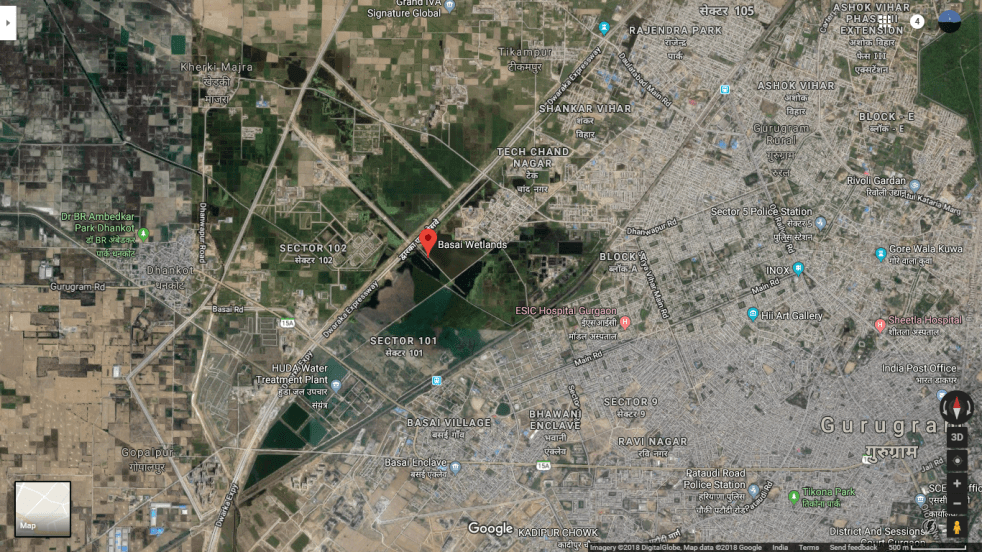
Haryana Wetlands Review 2017: Urbanization Taking Over Basai Wetland

All through 2017, Basai Wetland has been in news following Haryana Government plan to build a Construction and Demolition (C&D) plant in its close proximity. Activists, Birders left no stone unturned to oppose the plant. They approached National Green Tribunal (NGT) and even wrote to Haryana State Government to identity it as important wetland. The Ministry of Environment, Forest and Climate Change (MoEF&CC) also blamed Haryana Government for being negligent towards the cause of wetlands and asked it to give Basai legal protection by declaring it a protected wetland. All these efforts went futile and in sad turn of events, NGT, on 10 January 2018 revoked its stay over construction of the C&D plant thus closing the doors of hope for Basai wetlands and dependent eco-system.

Continue reading “Haryana Wetlands Review 2017: Urbanization Taking Over Basai Wetland” →

Dams · DRP News Bulletin

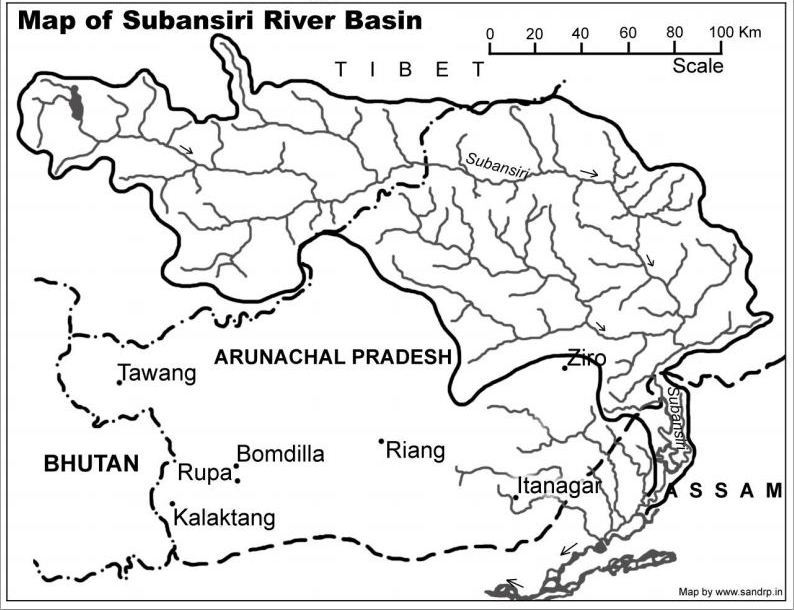
DRP: 1 Jan 2018 (NGT Ordered Com on Subansiri: MoEF Again Fails To Understand Conflict of Interest)

As per NGT’s October 16, order, the Ministry of Environment & Forest (MoEF) was asked to set up a “neutral” panel to objectively consider conflicting recommendations that have stalled the 2,000-MW Subansiri Lower Hydroelectric Project (HEP) on the Arunachal Pradesh-Assam border and come up with an “independent opinion” in three months.

The NGT said this was the only way to break the six-year logjam that has stalled a project vital to the “national interest.”

Contrary to this, MoEF on November 16, 2017 has set up a three-member panel with experts -who or their organisations- have all backed NHPC’s positions on the project in the past: Prabhas Pande, I D Gupta and P M Scott.

Continue reading “DRP: 1 Jan 2018 (NGT Ordered Com on Subansiri: MoEF Again Fails To Understand Conflict of Interest)” →
Dams · DRP News Bulletin

DRP: 25 Dec 2017 (CAG Report Shows Ganga River Has No Hope Under NMCG)

Apart from mentioning Govt failure in checking Ganga pollution, the Comptroller & Auditor General’s (CAG) performance audit report on Ganga rejuvenation tabled in Parliament on December 19, 2017 specifically mentions that National Mission for Clean Ganga (NMCG) “could not finalize the long-term action plans even after more than six-and-a-half years of signing of agreement with the consortium of Indian Institutes of Technology”. The fact that NMCG does not have a “river basin management plan even after a lapse of more than 8 years of National Ganga River Basin Authority notification”, mentioned in the report also has great significance. 

It is surprising that NMCG is working without a river basin management plan or a long-term action plan. The CAG performance audit is also lacking. It rightly mentions that infrastructure to treat pollution has not been created but does no assessment whether the creation of infrastructure alone would revive the river.

Further, CAG audit does not look into the issues if lessons from past failures have been learnt, corrections done, independent scrutiny institutionalised, participatory governance achieved, and if this business as usual approach is going to achieve any better results even if all the money were spent, all the DPRs were sanctioned, all the meetings happened, all the manpower available and all the STPs constructed?

Hence it critical that CAG performance audit should have tried to address these issues. Can the state of Ganga improve without improving the state of tributaries? CAG does not even look at this issue.

The CAG report shows that this programme provides no real hope for better future of Ganga and Modi and his government will have a lot to answer when they go to polls in less than 1.5 years. It’s a serious indictment for the govt in general and Modi in particular since he has said right from the beginning that Ganga is their priority and all that they have tried is audited here. http://www.livemint.com/Politics/KW6MIOrOvMvZvEGeozwifJ/CAG-slams-Centre-for-failing-to-utilize-funds-for-Ganga-reju.html;                                 http://indianexpress.com/article/india/ganga-pollution-hc-orders-uttarakhand-govt-to-seal-establishments-polluting-rivers-4991923/; https://timesofindia.indiatimes.com/city/dehradun/building-of-ghats-crematoria-on-ganga-misses-nov-deadline/articleshow/62234114.cms https://www.nationalheraldindia.com/environment/pm-modi-fails-to-clean-up-his-mother-ganga

Continue reading “DRP: 25 Dec 2017 (CAG Report Shows Ganga River Has No Hope Under NMCG)” →
Dams · DRP News Bulletin

DRP: 18 Dec 2017 (Also Needed To Mention This About Turial HEP)

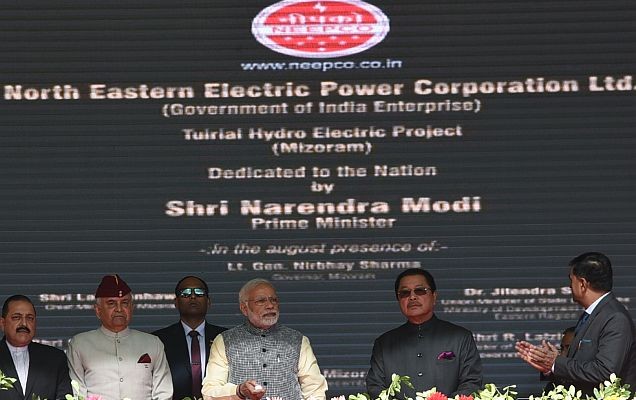
The Prime Minister, on Dec 16, 2017, while dedicating to nation the 60 MW Turial HEP, should have also mentioned:

– PUBLIC PROTESTS: The project faced strong protests from local people, so much so that work had to be stopped for over 7 years from 2004 to 2011. Even a day before PM dedicated the project, people took out a protest march.

– NO PUBLIC CONSULTATION:  One of the reasons people protested was that the project did not have any proper public consultation.

– NO PROPER IMPACT ASSESSMENT: Another reason for people’s anger was no proper environment or social impact assessment, or proper compensation and rehabilitation.

– HIGH COST: The project cost was Rs 368.72 Crores, but now already has gone above Rs 1441 crores officially, likely to go up further. That means per MW cost is already above Rs 24 crores, one of the highest in the country. WHO WILL PAY THE HIGH COST OF ELECTRICITY FROM THE PROJECT?

– HUGE COST ESCALATION from Rs 369 crores to over Rs 1440 crores

– HUGE TIME OVER RUN: The project was supposed to be completed many decades back but  has seen huge time over run, not only because of protests, but also because of inadequate mobilisation by the contractor, poor approach road, power house slope failure, among many other reasons.

This latest project once again shows that big hydro is no longer viable, one wishes, the Prime Minister would also highlight these realities in his speeches.

Continue reading “DRP: 18 Dec 2017 (Also Needed To Mention This About Turial HEP)” →
Dams · DRP News Bulletin

DRP: 20 Nov 2017 (GLOBAL SLOW DOWN IN HYDRO POWER PROJECTS)

It is getting increasingly clear that days of large hydro power projects are coming to an end. While in India large numbers of big hydro power projects are stalled, this week there was news from Meghalaya, Arunachal Pradesh, Sikkim and rest of North East India of cancellation or stoppage of hydro power projects. http://www.sentinelassam.com/story/main-news/0/subansiri-project-not-to-see-light-for-4-years/2017-11-12/1/325720#.WgpysVuCzIV

Pancheshwar project on India Nepal border continues to face opposition. https://timesofindia.indiatimes.com/city/dehradun/traders-oppose-pancheshwar-dam/articleshow/61705308.cms  

Nepal this week cancelled the agreement for 1200 MW Budhi Gandaki hydropower project. In Bhutan, the Prime Minister declared that they are in no hurry to go ahead with new hydropower projects. http://kathmandupost.ekantipur.com/news/2017-11-13/govt-scraps-budhigandaki-project-with-chinese-company.html  

In Pakistan, the agreement for the massive 4500 MW Diamer Bhasha hydropower company with China has fallen through. https://economictimes.indiatimes.com/news/defence/chinas-strict-conditions-force-pakistan-not-to-include-diamer-bhasha-dam-in-cpec-officials/articleshow/61660935.cms

In Mynmar, too the agreement with China for massive hydropower project stands cancelled. http://www.reuters.com/article/us-china-myanmar-energy/china-says-will-keep-talking-to-myanmar-over-stalled-dam-scheme-idUSKBN1D80X4?il=0

This is further reinforced by study by Dr. Luke Gibson, Honorary Assistant Professor of the School of Biological Sciences at the University of Hong Kong, which concludes that among so called green energy sources, hydropower is most dangerous. https://phys.org/news/2017-10-green-energy-hydropower-dangerous.html#jCp

Continue reading “DRP: 20 Nov 2017 (GLOBAL SLOW DOWN IN HYDRO POWER PROJECTS)” →
Dams · DRP News Bulletin

DRP: 6 Nov 2017 (NGT Asks For Fresh Appraisal Of Lower Subansiri Hydro Project)

In a remarkable development, the National Green Tribunal (NGT) on October 24 has suspended the clearances given to the 1750-megawatt (MW) Demwe Lower Hydroelectric Project  (HEP) planned on the Lohit river in Arunachal Pradesh.

In its detailed order, released on October 27, the NGT ruled that the Environment Minister as Chairperson of the National Board for Wildlife (NWBL), a statutory body constituted under the Wildlife Protection Act, 1972, could not “just brush aside” the views of the majority of NBWL standing committee members.

Suspending the clearances given by the Centre and the state govt, the NGT order added that “the decision taken by the Standing Committee is not in accordance with established principles of law and hence the Standing Committee shall reconsider the issue and pass appropriate orders within a period of six months from the date of the judgment”.

Environmental clearance for the project was given by the Union environment ministry’s Expert Appraisal Committee (EAC) for river valley and hydroelectric projects back in 2009. An in-principle forest clearance for the Lower project was given in February 2012 and agreed upon in 2013.

However, the in-principle clearance of the project was opposed by a majority of the Standing Committee of the NBWL but subsequently cleared by the then-environment minister of state (independent charge), Jayanthi Natarajan, who was also the chairperson of the Standing Committee.

Natarajan is currently under the CBI’s scanner for alleged anomalies in clearance given for diversion of land in Saranda forest in Singhbhum district, Jharkhand to mining company Electrosteel during the previous UPA regime.

The NGT said that it is “of the view that either the Chairperson (Natarajan) should have given a proper reason for rejecting the objection of the majority of the non-official members or the decision ought to have been arrived at based on the opinion of the majority of the members. Even though the Standing Committee is a recommendatory body, the same being a statutory committee, is bound by the laudable principles of justice and fair play”.

Continue reading “DRP: 6 Nov 2017 (NGT Asks For Fresh Appraisal Of Lower Subansiri Hydro Project)” →