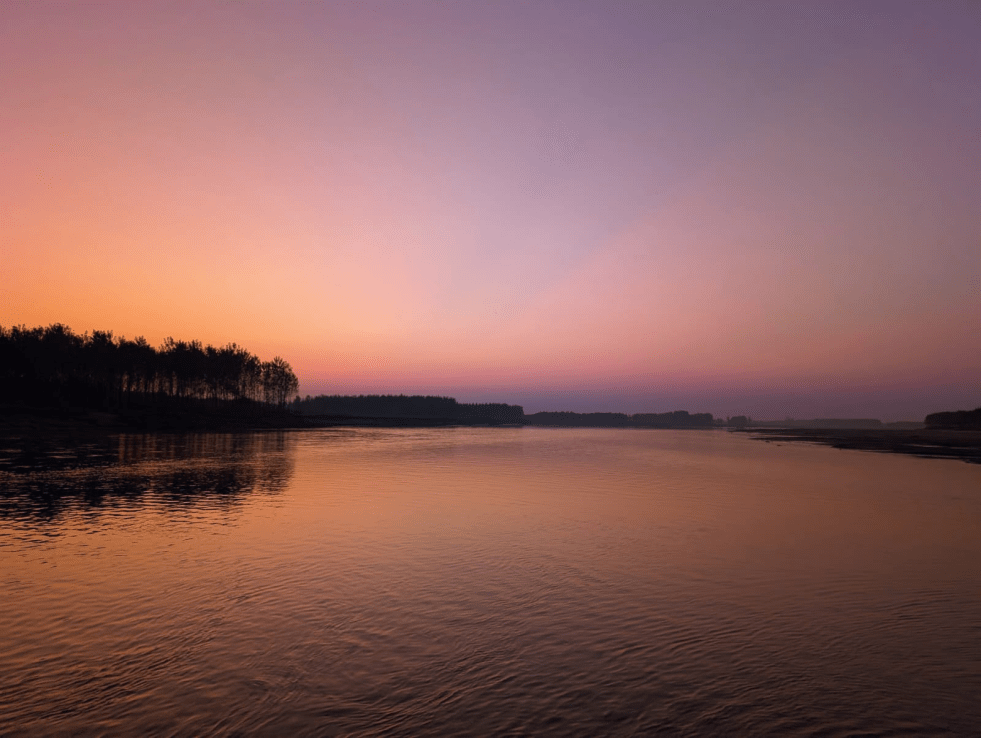
As we reached Makora Pattan, sun was setting over the River Ravi and before us spread a sea of oranges and rubies. Late October kash blooms crowded the high sandy banks and across the satin expanse of water, the other bank was barely visible. Rivers of the Indus basin are called Darya in the plains of Punjab. Darya: a word interchangeable with sea and I could see why.

While our team was filming the flood damage here, I was riding pillion with Sahib Singh, a paddy farmer who lost his entire fragrant Basmati harvest to the floods of Ravi this year. His bike was laboring along the riverbank through deep, rough sand and we had to push it forward with our feet at bends. On our left were sugarcane fields, wilted and forlorn and on our right was the majestic river. In that lonely space, rows of trucks and trailers appeared out of nowhere and a few men sauntered close to the trucks, watching us warily. I realized then that the sticks slung on their backs were guns. “Sand Mafia,” Sahib Singh whispered. “Don’t look at them.” I tried not to but failed.
This was Makora Pattan, a plain near the Indo-Pak border in Gurdaspur where Ravi meets one of its largest tributaries, Ujh. While Ravi meanders from Himachal, Ujh comes from Jammu, enters Pakistan and then comes back to India again to meet Ravi. That is, our borders have been drawn such. This confluence of two major rivers which flooded in 2025 has seen some of the most extensive flood damages in the region. Embankments, gabions and spurs on both sides collapsed and water spread over 20 kilometers inland, drowning basmati fields, destroying homes and buildings. Taking away people and animals. And with the water came a thick blanket of sand. Not the gentle, fertile silt which takes time to build, but angry, coarse sand which holds no organic matter, is sharp as glass shards and which smothers tiny saplings trying to grow. For months, hundreds of seva samitis had been trying to un-smother the fields of this sand.
At a distance, on the flaming river was a barge full of people, slowly making its way to the bank. We were hurrying to meet this barge which was carrying people from “Uss paar ke pind” “Villages from the other side” to the mainland. This barge is their only connection to the Indian mainland.
The villages of Bharial, Kherrian, Jainpur, Lasiyan, Toor, Mami Chak Ranga, and Chumbur on the right bank of Ravi, about 8 kms from the India-Pakistan border are surrounded on the three sides by Pakistan and on their east by the river.
The 4000-odd people living on the right bank of Ravi so close to the international border do not have a permanent bridge to reach the mainland.

During drier times, when the river is low, the seven villages are connected to the mainland by a Public Works Department Ferry and a pontoon bridge. But when the river is in spate, the ferry is discontinued, the pontoon bridge is hastily dismantled, and the villages are disconnected for weeks. I could see the pontoons lying on the sandy riverbank, the buoyant structures reminding me of the bridges Alexander’s army made 2300 years ago to cross the Indus. And today, thousands of Indians are at the mercy of the same technology at Makora Pattan. ‘Pattan’ in Makora Pattan means a ferry point or a river crossing. There are ‘pattans’ all across the subcontinent from Lahaul in Himachal to Kaveripattinam in Tamilnadu.
I ran to the tall sand bank just as the barge coming from the villages was mooring. As I jumped in the barge, I caught sight of a still figure on the bank in flowing robes and a flowing beard. It looked like he had stepped out of a Punjabi folktale. But then, I was sleep deprived and had been reading about the guardian of Indus River, Khwaja Khizr with his flowing robes and beard for days.

Several people got in the barge with me: Van Gujjars with henna stained beards, women holding on to children and their school bags, elderly men with bicycles, farmers in bright turbans with their bikes. When I told them I wanted to talk about the floods of Ravi, the common expression was fatigue and resignation. Amongst the commuters was the Sarpanch of Mami Chak Ranga, Sukhvinder Singh. He looked back at the river and said, “What difference will it make? We have told this story so many times. I met Prime Minister Modi about this when he came to assess Punjab Floods. And yet there is no change.” I had seen this resignation before and a conversation at such a time felt like a trespass.

But the response reminded me of Santosh Kumar who lost his entire village to dam induced floods of Ravi and who had also met the Prime Minister around the same time. “There is no change” he too had said.[1]
But Suneeta and Kuldip Kaur wanted to talk. With them were their children: Ravya, Tanveer and Rishi all around 6-7 years age. They crossed the river every day for school. Suneeta said, “We spend 3-4 hours every day just getting to and from school. The kids get so tired. They missed school for many weeks during the floods, how do they cope now?”
Roshan Deena ji from the Van Gujjar community came forward. “Look at us. We need a bridge, don’t we? People were about to die in the floods. It was terrible. There was nowhere to go. Only God knows why we don’t have a bridge yet.”

A tall man standing next to me said, “I am a Fauji, a National Security Guard. On the 26th August water was rising in all seven villages. My brother was caught in the floods. He was about to die. I called everyone: The Subdivisional Magistrate, Additional Magistrate, I begged them to send boats and rescue the people here. They told me they cannot help me, their hands are tied. Finally, I called the Army and NDRF. They sent a helicopter and rescued the people; they rescued my brother.”
We have reached the other bank by now. He got down the barge but kept talking from the gradually distancing shore.“Teachers don’t want to come to our villages. Many times, they just don’t come to school. Tell me, how are we supposed to live here? Are we not Indian enough?”

The 2025 floods marooned Makora Pattan villages for over 2 weeks. NDRF ferries and helicopters brought essential supplies and provided relief. People here are tired of the repeated promises[2] by the star politicians of the region including late Vinod Khanna, Sunny Deol and Sunil Jakhar.[3] Currently, some land acquisition notices have been issued for a “High level Bridge on Ravi and Makora Pattan”[4] but the villagers have seen these notices and empty promises for a long time and are waiting for signs on the ground.[5].
During Flood Survey in September 2025, Leader of Opposition Rahul Gandhi came here, but was not allowed to cross the river by Punjab Police and government officials including the SDM (who told the local villagers he could not send help) saying,[6] “There is no bridge for evacuation. Border fence has been washed away. This is a dangerous region.”[7] The villagers from the seven villagers were waiting for the leaders to come and talk with them. But that did not happen.
It is widely understood that the persistent delay in building a permanent structure is rooted in the strategic vulnerability of the location. A fixed, heavy-load bridge directly on the Zero Line presents a tactical risk. On the other hand, a seasonal pontoon bridge can be instantly dismantled or destroyed in emergency. If at all national security dictates that a permanent bridge must remain a pipe dream, then these border residents at least deserve comprehensive compensation, robust livelihood alternatives, and non-negotiable, responsive flood relief.
Along the borderlands of the Ravi and Sutlej, we witnessed decisions regarding infrastructure, dam operations, and emergency warnings governed more by geopolitical anxieties than the fundamental welfare of the local population. The question “Are we not Indian enough?” echoed in the Indus Basin precisely from the places which need to be secure from this question.

As the barge reached the mainland, Sarpanch Sukhvinder Singh asked me hesitantly if I would like to meet someone.
On the banks of Ravi, against the glowing orange sky stood the same immobile figure, his blue robes billowing in the breeze.
“This is Baba Lakhvinder Singh. All our 7 villages with thousands of people, pregnant women, elderly were cut off for 11 days from the mainland. No one came to save us. The ferry was closed, the bridge was taken out. It was Baba ji who put together this barge for us in matter of days. It was only then that we were connected to the mainland. He and his sewaks help the travelers get in and out of the barge. For the past month, they haven’t moved from here. The Mallah (boatman) and the diesel for the barge is theirs too. And even today they wait for us on the banks of Ravi Darya. They look out for us. Do you know what that means?”
Baba Lakhvinder ji does not say much. He bows his head and then looks towards the river. Throughout our journey across the basin, we heard version after version of this story: local saviors rising directly from the community when the mechanisms of the state faltered.

The legend of Khwaja Khizr travels across the rivers of the Indus Basin. At times he is Khwaja Peer, at times Jhulelal. He is the guardian of the river-farers, savior of the drowning. Worshipped by Hindus, Muslims and Sikhs alike.
Jhulelal’s enduring benediction across these waters is simple: “Beda Paar”: May the boat be ferried safely across. His footprints are sometimes seen on the river banks.
Parineeta Dandekar, SANDRP
parineeta.dandekar@gmail.com

[1] https://sandrp.in/2025/12/08/the-day-salun-village-fell-impacts-of-cascading-hydropower-projects-in-the-ravi-basin/
[2] https://www.indiatoday.in/india/story/punjab-gurdaspur-makora-pattan-village-problem-no-concrete-bridge-over-ravi-2405745-2023-07-14
[3] https://indianexpress.com/elections/punjab-beyond-star-craze-demand-for-infra-from-mp-send-us-to-pakistan-if-you-cant-give-us-a-bridge-5703741/
[4] https://cdn.s3waas.gov.in/s330bb3825e8f631cc6075c0f87bb4978c/uploads/2025/03/2025031515.pdf
[5] https://indianexpress.com/elections/punjab-beyond-star-craze-demand-for-infra-from-mp-send-us-to-pakistan-if-you-cant-give-us-a-bridge-5703741/
[6] Indian Express: https://www.instagram.com/reels/DOqIOz1ggRN/
[7] Press Trust of India: https://www.facebook.com/share/r/1B2m7oyZBD/,