Fish, Fisheries, Fisherfolk

Inland Fish, Fisheries, Fisher-folks: 2020 Overview

Inland fisheries support millions of people and remains a major source of nutrition for a very large number of poorest people. This includes riverine fisheries, reservoir fisheries, wetland and local water body fisheries. Here we try to provide an overview of developments in this sector during the year 2020.

The overview has following sections: Policy & Governance in Centre, followed by in States, some positive developments, Covid-19 & Fishing Community, Fisher folks’ struggles, New Fish Species, Invasive fish, Fish Deaths & Pollution, Over fishing & Extinction, Studies related to inland fisheries.

Continue reading “Inland Fish, Fisheries, Fisher-folks: 2020 Overview”
DRP News Bulletin

DRP: 16 Nov 2020: India’s Environment Governance continues downhill journey

There are a number of stories here that shows that India’s environment governance continues its downhill journey. The first is a Third Pole story that narrates how Indian govt, through the Minister of State of MoEF misled parliament about the state of decline of biodiversity in India. The second is how MoEF is trying to bypass public hearing and public consultation process in oil and gas exploration projects even in the face of the severe consequences India experienced in the Assam episode of similar mis-governance in the past. The third one is how Kerala govt has failed to assess the impacts of tunneling in Western Ghats. These are only some of the signs. There are much bigger warning writ all over. Until and unless people rise up against these, there is little hope of any change here.

Continue reading “DRP: 16 Nov 2020: India’s Environment Governance continues downhill journey”
DRP News Bulletin

DRP: 2 Nov. 2020: Citizen Efforts to Save our Rivers

It’s heartening to see at least three citizen efforts that media has brought to limelight this week, two in Odisha and one from the banks of Godavari river in Nasik. Besides being citizen efforts, one common theme is that all these initiatives is that they concern rivers. Great news to celebrate in this festival season, also when India Rivers Week is also conducting weekly Dialogues on River sand mining.

Continue reading “DRP: 2 Nov. 2020: Citizen Efforts to Save our Rivers”
DRP News Bulletin

DRP: 26 Oct 2020: Why Floods is not big issue in Bihar elections?

Or may be it is a major issue at a number of places. Like in Kishanganj district along Mahananda river in North East Bihar, as the report here mentions. We hope it is. Since floods and how they are managed affect so fundamentally and in so many different ways so many people, it should be an election issue. Particularly when the incumbent Chief Minister Nitish Kumar is fighting to be voted in after being the Chief Minister of the state for 15 years since Nov 2005 (except brief ten month period in 2014-15).

15 years is long enough time to have been able to make at least some dent in flood management. On ground, the situation seems to have only gone worse. It was in this 15 year period that the unprecedented Kosi floods happened after the Kusaha breach in 2008. But the word unprecedented has been used for several more floods in these 15 years, including by Nitish Kumar. He also raised a number of pertinent issues in this period, including impact of Farakka barrage on Bihar floods, need for its decommissioning, Bihar’s right to get Ganga water from the headwaters in Uttarakhand [currently it gets none except during monsoon]. He is currently silent on these issues, but voters and media do not have to be silent.  

Continue reading “DRP: 26 Oct 2020: Why Floods is not big issue in Bihar elections?”
DRP News Bulletin

DRP: 19 Oct 2020: India Rivers Week 2020: IS SAND MINING KILLING OUR RIVERS?

India Rivers Week (IRW) Organising Committee is excited to announce that the theme of the forthcoming annual event IRW 2020 will be: “Is Sand Mining Killing our Rivers?”. As part of IRW-2020, India Rivers Forum is organizing a series of Dialogues (digitally). This includes four regional dialogues focusing on North (Oct 31), South (Nov 7), West (Nov 12) and East (including North East: Nov 21)) India, and the final one (Nov 28) focusing on Sand Mining as a National issue.

Sand mining or mining of River Bed Material (RBM, including sand, gravel, boulders) has a huge impact on Rivers, in multiple ways: physical, ecological, livelihood impacts among others. While sand is also sourced from sources other than rivers, IRW 2020 will focus on sand sourced directly or indirectly from rivers. Sand is by definition, a key ingredient of the rivers. It provides habitat for multiple species of the biodiversity in the river. It provides both sub surface storage space and a mechanism to recharge the groundwater. The sand, along with silt, clay, pebbles and boulders are part of the river and are supposed to reach the deltas and provide a key existential medium in floodplain and deltas. To achieve that, sustaining river connectivities is very important.

Continue reading “DRP: 19 Oct 2020: India Rivers Week 2020: IS SAND MINING KILLING OUR RIVERS?”
Free flowing rivers

World Rivers Day 2020: Celebrating Rivers across the world

The World Rivers Day[i] (WRD) is celebrated annually on the fourth Sunday of September. The event strives to highlight the invaluable ecological, hydrological services and cultural, recreational values offered by the rivers. Indeed, the most of the once wild, scenic, free flowing rivers across the globe are facing existential crisis on account of various anthropogenic activities hastened over the past century.

However, there are small but significant steps being undertaken by individuals, organizations and governments to restore some of the flowing eco-systems. This account attempts to compile some such positive developments that have taken place in the one year.

We have already published a compilation of the positive river stories of India on the occasion of International Day of Actions for Rivers being held on March 14 2020. In addition to Indian rivers, this compilation also covers some remarkable development concerning river conservation worldwide. There could be many more stories and developments happening, we invite readers to send us such stories they know about. 

Continue reading “World Rivers Day 2020: Celebrating Rivers across the world”
DRP News Bulletin

DRP: 21 Sep 2020: IHA President accepts-Hydro faces massive slowdown & worse

International Hydropower Association (IHA) is essentially global leader of hydropower lobby. So when IHA President Roger Gill speaks about the problems hydro industry is facing, it becomes very interesting for all concerned.

In this interview the Roger Gill makes it clear that Hydro investments have been slowing down in last five years when compared with investments in immediate earlier decades. It has further slowed down in 2019 and has been further majorly affected by Covid-19 pandemic. Gill also accepts that the hydro is perceived as much more risky compared to solar and wind. The claim he makes of low levelised cost of electricity from hydro projects is a bit of fiction, since cost of any under construction or new hydro will be hugely costlier than solar and wind power projects. The IHA president is catching at the straws when he takes encouragement from investments in existing hydro projects and pump storage, though he keeps making it clear that market is still unclear as far as pump storage tariffs are concerned. A friendly interview also reveals a lot!!

It is high time that the Indian hydropower lobby led by NHPC and power ministry takes due note of the realities and would not push unjustified, unviable and destructive hydropower projects down the throats of reluctant states and people, using scarce public resources.https://energy.economictimes.indiatimes.com/news/power/hydro-power-requires-100-bn-investment-annually-roger-gill-international-hydropower-association/78131561 (17 Sep 2020)

Continue reading “DRP: 21 Sep 2020: IHA President accepts-Hydro faces massive slowdown & worse”
Dams · DRP News Bulletin

DRP: 15 June 2020: Athirapally, Bodhghat, Cauvery, Dibang, Etalin: New growth alphabets from the PMO?

A for Athirapally, B for Bodhghat, C for Cauvery, D for Dibang, E for Etalin, seems to be the new growth alphabets from the Prime Minister’s Office. With the economic growth in negative territory, depression in the corner, the old and trusted Big Dams as major infrastructure to push up expenditure and hope for the growth was a formula used even in 1930s by US president Franklin D Roosevelt to bring the US economy out of the Great depression of 1929. It started with the Tennessee Valley Authority Act of May 1933, which then was pushed as growth model to other countries. In India it came in the form of Damodar Valley Corporation (DVC) Act of 1948.

However that 20th century model was a failure even then, as the first CEO of the DVC, Sudhir Sen wrote. That model is no longer relevant in 21st century except possibly as an easy route to corruption and kickbacks. These dams and hydropower projects are no longer even economically viable and better options are now available for irrigation and power. In the changing climate scene they are even less relevant places of worship (temples). Dams and hydropower projects are seeing slow down across the globe, not just in India.

Continue reading “DRP: 15 June 2020: Athirapally, Bodhghat, Cauvery, Dibang, Etalin: New growth alphabets from the PMO?”
Arunachal Pradesh · brahmaputra · Hydropower

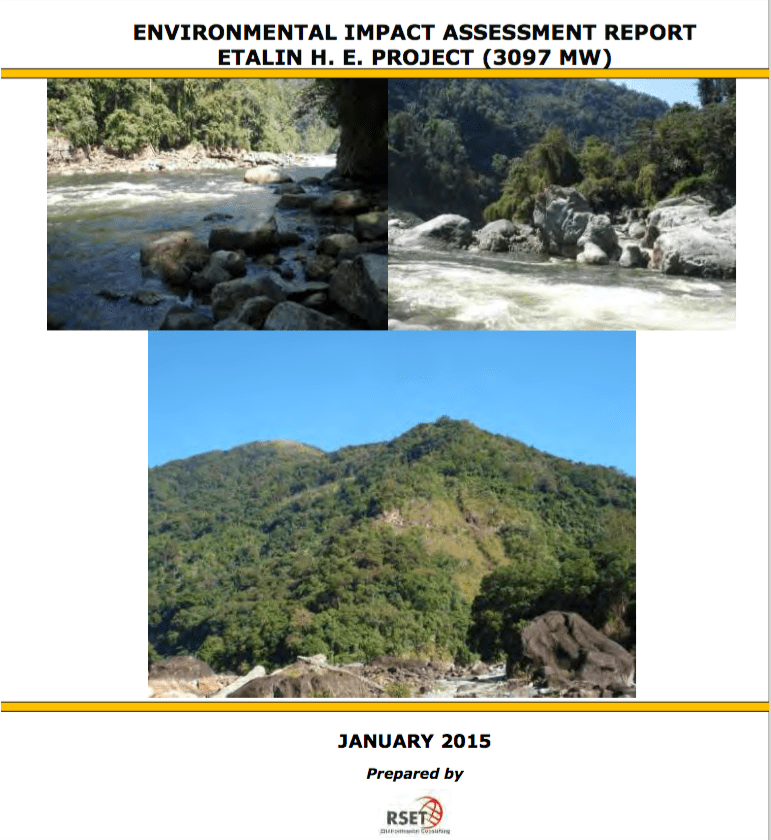
Open letter to MoEF & River Valley EAC: Review Recommendation to grant EC to Etalin HEP

The MoEF’s Expert Appraisal Committee (EAC) on River Valley Projects in its meeting in January 2017 recommended Environmental Clearance (EC) to the controversial 3097 MW Etalin Hydropower project in Dibang River Valley in Arunachal Pradesh. However, since the stage I forest clearance to Etalin HEP has not yet been accorded, the EC letter has not yet been issued. Hence there is an opportunity to stop EC to the project till the EAC reviews its decision.

It may be noted that Forest Advisory Committee (FAC) in its meeting on April 23, 2020, has decided in the context of Etalin Project: “As this is a large sized project in the Himalayas, inputs of IA (Impact Assessment) Division of the Ministry on whether environmental impacts of the proposed project and mitigating measures have been considered, will be obtained.” This provides an opportunity for the MoEF to direct the IA Division and EAC to review its decision to recommend EC to the Etalin Project.

Continue reading “Open letter to MoEF & River Valley EAC: Review Recommendation to grant EC to Etalin HEP”