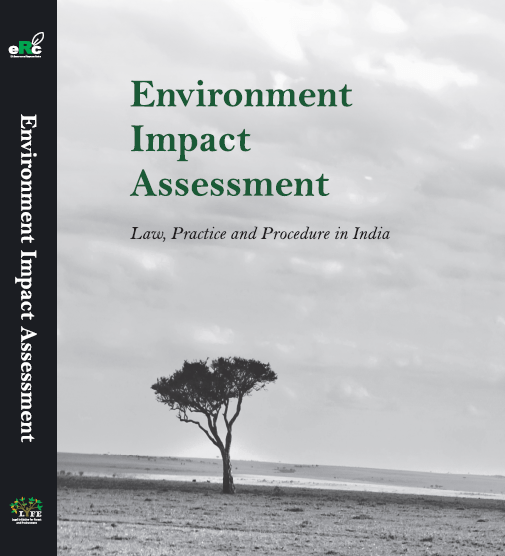
Review of new book titled ‘Environment Impact Assessment – Law, Practice & Procedure in India 2016’, edited by Dr R.K Singh and Ritwick Dutta, LIFE, New Delhi, Oct 2016, p 374 + xvi
About the Book This book is a comprehensive compilation of the Environment Impact Assessment Notification (EIA), 2006, along with the amendments. It also has all Office Memorandums and Circulars issued by MoEF&CC for implementation of the EIA Notification, 2006 up to March, 2016. Environment Resource Center (ERC) plans to publish the book annually with incorporation of new updates, amendments, Circulars and OMs. It provides subject wise classification various Office Memorandums (OMs) and Circulars. The book also contains the text of all the official orders and amendments, classified according to subjects like: Prior/ Scoping clearances, public hearings, appraisal, violations, etc.
This is a much needed document and ERC team has done a commendable job by compiling all the relevant amendments and notifications in a single book in useful format and organized way. The document will be of great value for all including Legal Experts, Academicians, Researchers, EIA professionals, Government Officers, Journalists, concerned NGOs, Civil Society activists, local community as well.
It has been two years since the Union Minister for Shipping and Transport, Mr. Nitin Gadkari, announced the Government’s ambitious plan to revive the National Waterways-1 (Ganga Waterway) between Haldia and Allahabad, justifying it on the grounds that India’s waterway potential remains highly underutilized, although six times cheaper than road transport. In a letter dated 18th June, 2014 forwarded by Mr. Gadkari to the Finance Minister, Mr. Arun Jaitley, a proposal for financial assistance to four navigational barrages was also made.
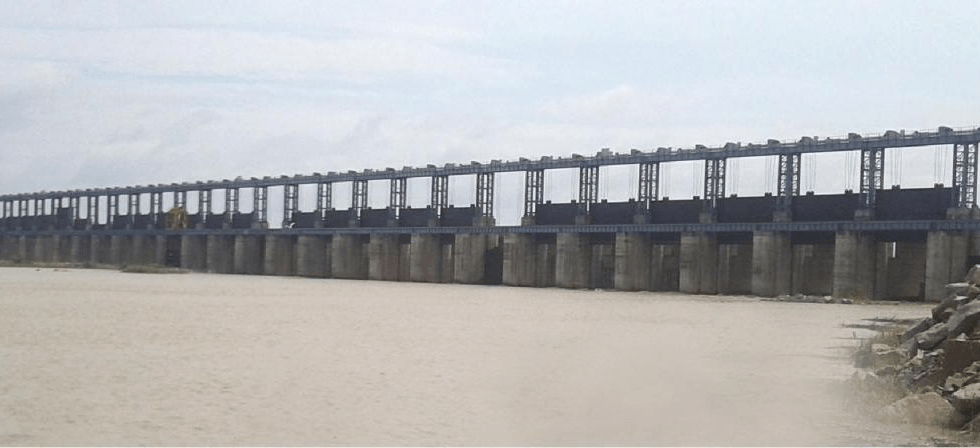
Above: Sonthi Barrage in Karnataka standing without Environmental Clearance
The Ministry of Environment, Forests and Climate Change has issued a Draft Notification which aims to “regularise” projects which have violated the basic tenet of Environment Law and Governance in the country: starting work without securing Environmental Clearance. While any such violation should be punishable to deter any contempt of the much-abused environment laws, the Ministry is seeking to do just the opposite: Regularize the violations by constituting a wishy-washy Environmental Supplemental Plan, as outlined in the Draft Notification.
This seems like one of Mr Prakash Javdekar’s last acts as Environment Minister (before he got transferred to HRD with promotion to cabinet rank) that, typically similar to his other acts during his seriously problematic two year tenure, was totally against what he was expected to do: Protection of environment. We hope the new incumbent at MoEF&CC will cancel this notification immediately. Continue reading “The New License Raj: License to Violate Environmental Laws through Environmental Supplemental Plan”→
Chairman and Members of EAC on River Valley Projects, MoEF, New Delhi
Urgent: Concerns about Ken Betwa Project on EAC agenda for Environment Clearance for meeting on June 2-3, 2016
Respected Chairman and Members,
No documents since Feb EAC meeting: In continuation of our earlier submissions of Aug 21, 2015, Oct 24, 2015, Feb 6, 2016 and April 15, 2016, we are writing to you again since the Ken Betwa Link is again on the EAC agenda for the meeting on June 2-3, 2016. It may be noted that after the project was earlier considered by the EAC latest in the meeting on Feb 8-9, 2016, no new documents are available on the EC website. This itself is a serious lacuna since this means that all concerned are in dark as to why the project is being reconsidered by the EAC, what progress has been achieved since the last meeting. This is also in violation of the orders of the Central Information Commission that required all such documents be available in public domain at least ten days in advance of the meeting.
The Environmental Impact Assessment (EIA) of Ken Betwa Riverlink project used for the public hearing to be held on Dec 23 (Silon village in Chhatarpur district) and Dec 27 (Hinouta village in Panna district), 2014 in Madhya Pradesh is, as can be seen from the details below, unscientific, incomplete, inadequate, biased, inconsistent (self contradictory), callous, making unwarranted conclusions/ assumptions, it accepts government claims uncritically and is generally a shoddy piece of work.
Background Agriculture Finance Corporation of India (now AFC Ltd) was commissioned in 2007 itself to conduct Environmental Impact Assessment (EIA) of Ken Betwa Riverlink proposal. This was even before National Water Development Agency (NWDA, a society of Government of India created in 1981-82 exclusively for studies on River Linking proposals) applied for the Terms of Reference Clearance for the EIA for this project in December 2010.
This review of the EIA of Ken Betwa project is based on the Executive Summary (English) of the EIA made available on the Madhya Pradesh Pollution Control Board (MPPCB) website in Dec 2014 before the statutory public hearing slated for Dec 23, 2014 at Silon village in Chhatarpur district and Dec 27, 2014 at Hinouta village in Panna district, both in Madhya Pradesh.
Since this executive summary is largely the same as the EIA made available to the Expert Committee set up on Inter Linking of Rivers (ILR) by the then Union Ministry of Water Resources (now Union Ministry of River Development, Ganga Rejuvenation and Water Resources – MRDGR&WR) for which I was a member, I have also provided the critique of that earlier EIA(in red font) in Annexure 1 to this Article[2].
The comments given below under each heading are only indicative to establish what is contended about the EIA here and not exhaustive.
Biased EIA In the very second paragraph of the EIA Executive summary[3], it is stated, referring to NWDA studies, “These studies established that Betwa is a water short basin”. But an EIA is not supposed to uncritically accept such assertions or assumption of the developer. In fact the EIA accepts this as gospel truth without critically examining it.
Incomplete EIA The EIA executive summary does not even have a project layout map, sections like biodiversity impact assessment, impact of destruction of substantial part of Panna Tiger Reserve, surrounding forests and livelihoods of the people dependent there on, options assessment, hydrological viability assessment, disaster potential assessment, how the project will be impacted by destruction of forests and climate change, additional green house gas emissions due to the project and downstream impacts, to name just a few issues..
EIA makes wrong claims The EIA claims in very second paragraph: “The scope of EIA studies inter-alia does not include water balance studies.” This is a wrong claim since water balance study of the Ken Betwa links establishes the hydrological viability of the project and by not going into the water balance study, the EIA has failed to establish hydrological viability of the project. SANDRP analysis in 2005[4] of the NWDA feasibility study of Ken Betwa Proposal[5] had established that the hydrological balance study of the Link Project is flawed and an exercise in manipulation to show that Ken has surplus water and Betwa is deficit.
As the collector of Panna district noted in 2005 itself[6], if the 19633 sq km catchment of the Ken river upstream of the proposed Daudhan dam (comprising areas of eight districts: Panna, Chhatarpur, Sagar, Damoh, Satna, Narsinghpur, Katni, and Raisen) were to use the local water options optimally, then there will not be any surplus seen in Ken river at the Daudhan dam site and by going ahead with the Ken Betwa Link without exhausting the water use potential of Ken catchment, which is predominantly a tribal area, the government is planning to keep this area permanently backward. But the EIA of Ken Betwa link does not even go into this issue, making the whole exercise incomplete.
Ken Betwa project destroys Panna Tiger Reserve but EIA claims project may benefit PTR! The Ken Betwa Project, as per the EIA, will submerge 4141 ha of Panna Tiger Park reserve, but the EIA Ex Summary says (para 58), “the reservoir may prevent encroachments of the park and invasion by livestock so that a relatively more secure and compact habitat is formed on Right flank of Daudhan dam which may be beneficial.”
In Para 63, the EIA executive summary goes on to claim that the project will not decrease tourists flow (due to destruction of Panna Tiger Reserve or drying of waterfalls in the downstream), but in fact increase tourist inflow because of the creation of reservoir! No word about the destruction of river!!
Absence of credible submergence figures The EIA has hugely reduced the area to be affected in Panna Tiger Reserve and in the surrounding forests compared to the figures given in the Feasibility report of the project, without any explanation. Well known conservation expert Kishore Rithe, in his article in December 2014 issue of Sanctuary Asia Magazine has raised doubts about these figures and has suggested that much larger area will be destroyed by the project than what is stated in the EIA. He has also said that the EIA does not take into account the biodiversity that will be destroyed in the forest because of the project. Using strong (& justified) words, he has said this is assassination of wildlife, to help the contractors.
EIA LIES on Biodiversity: Endangered and vulnerable species in Ken Basin find no mention in EIA Para 59 of the Ex Summary of EIA is about Aquatic Environment and it says: None of the species of aquatic plants come either under rare or endangered or endemic or threatened categories (REET). This is a shocking lie, since the following paper by Dr.K.D Joshi and B.K. Biswas of CIFRI (Central Inland Fisheries Research Institute) says that the Ken has at least 4 endangered and 9 vulnerable species. The EIA is also keeps mum about the existence of Ken Ghariyal Sanctuary in the downstream area, which will be destroyed due to the project.
CIFRI paper of 2010 said there are 4 endangered and 9 vulnerable fish species in Ken River According to a paper by Dr. K. D. Joshi and B. K. Biswas published in Journal of Inland Fisheries Society of India (42(2): 25-31, 2010) titled Piscine Diversity and Fisheries in the River Ken, proposed for the Inter-River Linking, “53 fish species classified under 40 genera, 19 families and 7 orders. Out of these, 51 species are native and 2 exotic. The river comprises some highly important threatened species including 4 endangered and 9 vulnerable species… The fish species available in the river have immense economic importance”.
Endangered species include: Tor tor (Mahseer), Chitala chitala, Eutropiichthys vacha, Ompok pabda.
The paper concludes that the proposed Ken Betwa link project will have “Deleterious impacts on piscine diversity and fishery may occur downstream to the Daudhan dam site in the river Ken, as a result of the depletion in breeding and feeding grounds and hiding sites of the fishes. This could be due to reduction in flow as a result of diversion of the water to the Ken-Betwa link.” The EIA has no word on this.
GEM of the EIA: Project canals help fish migration and will provide a ‘short cut’ for fish! This is indeed a GEM from the EIA executive summary. In para 59 the EIA executive summary says: “Interlinking of these basins through link canal will facilitate rapid migration of the fish easier… The fish has a tendency to migrate upstream. The inter linking of rivers provide another route for fish migration from Yamuna to Betwa and ultimately from Betwa to Ken. Further, the distance from Duadhan dam to the place of confluence of Ken with Yamuna is longer as compared to the distance from the place of confluence of Betwa with Yamuna and Daudhan dam through link canal. Thus, this route will facilitate rapid migration of fish.” This shows shocking ecological illiteracy of the EIA consultants. This para not only shows how poor is their understanding of fish, rivers and ecosystems, it also shows by AFCL should be blacklisted from doing any EIAs.
ANOTHER GEM FROM EIA: RESERVOIRS HELP REDUCE POLLUTION! In para 61 the EIA Ex Summary says: “Stagnated body can get rid of their pollutants by sedimentation while lotic body carries its load of pollutants downwards.” This narration of advantages of stored water as against flowing river clearly seems like a prescription that it is better to dam the river to reduce pollution! Another example ecological illiteracy of the EIA consultants.
Incomplete EMP The Environment Management Plan (EMP) in the EIA ex summary starting from para 66 is incomplete: It does not include environment flow assessment, muck disposal plan, compensatory afforestation plan, Compensatory land allocation for destruction of Panna Tiger Reserve, habitat improvement plan for the balance part of PTR, REET species plan mentioned in para 70(c) at cost of Rs 10 crores, upstream (of Daudhan Dam) water development impacts/ management plan, downstream impacts management, to mention only a few.
Outdated R&R Plan norms As stated in Paras 76 onwards, R&R (Resettlement and Rehabilitation) plan has been prepared based on norms of National R&R Policy of 2007 and MP R&R policy of 2002, but both are outdated in Dec 2014 where the applicable norms are based on The Right to Fair Compensation and Transparency in Land Acquisition, Rehabilitation and Resettlement Act, 2013. Thus the whole R&R plan is completely outdated and will need fresh assessment starting from Social Impact Assessment. The whole EIA has no mention of settlement of rights under Forest Rights Act. Thus the whole social impact and R&R section is outdated, incomplete and under estimated and hence unacceptable.
Fundamental contradictions in R&R figures Para 80 of EIA ex Summary says that 1585 families will be affected by the Daudhan Reservoir. In next para, this becomes population of 1585! Two paras latter, in para 83, the population affected by the reservoir becomes 7224! In para 92 the EIA executive summary says: “Therefore it is only 806 project affected families and there are no other affected families in the project affected villages.” This not only shows contradictions but absolute callousness of the EIA agency.
EIA says minimum agriculture wage is Rs 64/-! In para 94 the EIA executive summary says all the entitlement has been assessed based on agriculture wage rate or Rs 64/- of 2006-07! This is when the minimum agricultural wage rates for unskilled labourers w.e.f. 01.04.2014 is Rs 193[7], more than three times the rate assumed by EIA agency!
Joke of Land for Land by providing 5% of acquired land Para 96 of EIA Ex summary says that total of 6423 ha of revenue land is acquired and it is proposed to provide land for land to ST and SC families. Than it says for this purpose, a total of 358 ha of land will be required! This comes to 5.57% of acquired land and the EIA consultant says this is sufficient for providing land for land! This is clearly a cruel joke on the ST and SC families and shows how great an impoverishment programme this project is.
Social & Environmental impacts of backwater effect not assessed Para 67(c) says that 956 ha of land will be affected due to back water impact, but there is no social and environmental impact assessment of the back water impacts.
Contradictions in EMP
Para 59 says there are no REET species, and para 70(c) provides Rs 10 crores for REET species plan!
Para 70(a) says fisheries production from reservoir will be 470 MT / year and para 70(e) says the same will be 60 tons!
In para 70(a) the EMP says the reservoir fisheries will provide livelihood for 500 families and also that there will be sport licensing.
Questions over choice of AFCL for Ken Betwa EIA The Ken Betwa EIA work has been given to Agriculture Finance Corporation Ltd. (now AFC Ltd – http://afcindia.org.in/). Firstly, the basic mandate of this corporation is Agriculture Finance, and as we all know agriculture finance is in bad shape in India, one of the major reason for the agrarian crisis. In stead of focusing on its core area, this corporation has been majorly working on preparation of Environment Impact Assessment related work. Why should the government encourage such non core work by AFCL, [AFCL is itself is a quasi government body, it being owned by NABARD and EXIM bank]? Secondly, the track record of AFCL in EIA related work is quite bad. Some of the recent EIAs of AFCL that has invited adverse remarks include the EIA of Polavaram Multipurpose project (also one of the ILR links), Tipaimukh project in Manipur, Kameng Hydropower project in Arunachal Pradesh and Thoubal irrigation project in Manipur. In case of Tipaimukh and Polavaram EIAs, even some of the official agencies have found their EIAs to be wanting.
For example, the minutes of the minutes of the meeting of the Expert Appraisal Committee of the MoEF&CC for River Valley Projects, held on Oct 15, 2007 said that the EIA report for the Tipaimukh (even after several revisions spread over several years) “The revised EIA report incorporating the above mentioned information was considered by the committee in its meeting held on 15th October 2007. After careful examination of the report, the committee was of the opinion that the report has been prepared haphazardly… As such the data reported (flora and fauna) is of little value… No fresh study (on water quality) has been undertaken… No mention has been made about as to how many water bodies (ponds, lakes, Jheels, springs, etc.) are going to be submerged by the dam and what type of flora and fauna available there… The Biodiversity Management Plan as well as Fishery Management Plan are not up to the mark. Separate plan for rehabilitating the riverine species should be done. Fishery Management Plan does not say anything as to how measures will be taken for the conservation of the fish fauna occurring in the region. Instead, it talks about cultivation of economically important fish… Plan for the Biodiversity Management also needs significant improvement. IVI should be calculated for dominant species. Nothing has been said about the rehabilitation of mahseer (and similar other species), in spite of its endangered nature. The Financial outlay for both the plans has been prepared just as an eye wash and need thorough revision and enhancement of at least ten to fifteen times. The Biodiversity Management Plan is also having very small financial outlay. This also needs significant enhancement.” (Emphasis added.)
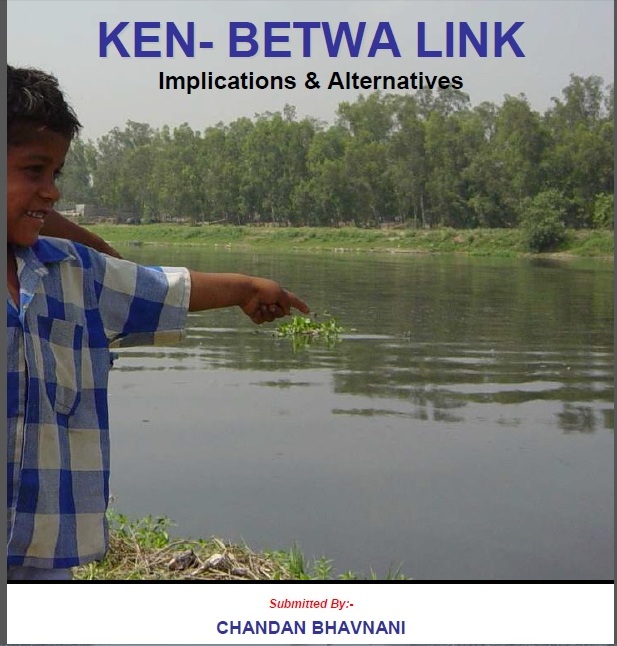
Cover Photo of B Tech paper by Chandan Bhavnani
CONCLUSION This analysis clearly shows that the EIA consultant does not have basic understanding of ecological issues related to rivers or river valley projects, ground situation in project area or laws of India. This EIA is clearly unacceptable and should be rejected. The EIA should be re-commissioned to a credible EIA agency. Appropriate steps should be taken against the current EIA consultants. The public hearing planned on Dec 23 and 27, 2014 should be cancelled as there is no basis for conducting an informed public consultation. This EIA and also the public hearing conducted based on this EIA will not stand public, scientific, social or legal scrutiny.
Ken Betwa River Link EIA from NWDA received in November 2009
WHY THIS EIA IS NOT ACCEPTABLE
This is in response to NWDA letter No.: NWDA(SCILR)/Tech-1/200/3/2006 (Vol.X)/67-86 Dated 23.3.10, requesting expert committee members to submit comments on the DRAFT Ken Betwa EIA, a soft copy of which was sent to the committee members in Nov 2009.
EIA AGENCY IS BIASED
In the very second para of the executive summary, EIA says Betwa is “Water short”. EIA agency is supposed to be unbiased and cannot parrot the assumptions of the developing agency, NWDA.
In para 1.02 (chaper 1, volume 1), it says, “It is noted that dams with reservoirs are among measures mostly resorted to as long term solution to mitigate flood losses as well as to prevent drought situations.” This is completely wrong statement, with no basis in reality, and in any case shows the bias of the agency at the outset.
In para 1.16 it says, “The anticipated benefits of the project include the following. The transfer of water to deficient areas from surplus areas;…” This clearly shows that the EIA agency has uncritically accepted the conclusion of the project developer, without so much as even an attempt to assess its correctness. How can such an agency be accepted as an objective EIA agency?
In Para17 it says, “There is no other alternative for irrigating the proposed CCA of about 3.436 lakh hectares, providing drinking water facilities to 16.98 lakh population and generating 78 MW power. This project is inevitable for removal of the backwardness and poverty of this Bundelkhand region of Madhya Pradesh. The no project option will adversely affect the development of this backward region of Bundelkhand and thereby increase the regional disparities. Such disparities contribute for large scale migrations from and unrest in the region. Therefore, no project option is an alternative to be considered.” Here again we can see the clear and repeated bias of the EIA agency. Firstly, the EIA agency does not even say what is the no project alternative. Secondly, it assumes that the project would remove the backwardness and poverty of the Bundelkhand region of MP, without any substantiation. Lastly, it says, no project option is to be considered!!! What does it mean??
EIA AGENCY IS INCOMPETENT
In para 14 of the Exe Sum, it says, “Out of the above, forest land accounts for to 5258 ha, rest of the area being agricultural lands, settlements, scrubs and water bodies. Ten villages are likely to be submerged. Area of Panna national park or Tiger reserve accounts for about 65.13 percent of total forest area under submergence with 4163 ha.” Simple calculation shows that 4163 is 79.2% of 5258, and not 65.13% as stated by the EIA. The EIA also does not explain why the forest land has reduced from 6400 ha in Feasibility report to 5258 ha and area of Panna tiger resevee has come down from 4586 ha in FR to 4163 ha now.
In Para 56 the EIA says, “The area (Daudhan project) under irreversible impacts is neither a home nor an important habit for the wildlife including birds”. To say this when the project is going to submerge over 4600 ha of Panna Tiger Reserve is shocking.
In para 58 EIA says, “Interlinking of these basins through link canal will facilitate rapid migration of the fish easier.” How can this become possible?
In Para 60 EIA says, “Stagnated body can get rid of their pollutants by sedimentation”. This is clearly wrong.
In Para 73 EIA says, “The budget for different management activities required to be carried out for mitigation and prevention of dam break is 60 lakh.”, However, none of the measures listed there can prevent dam break.
In para 1.04 it says, “In the nineteenth century British colonialism introduced technical and hydraulic principle by introducing perennial irrigation in the sub-continent… A third wave in hydraulic manipulation emerged in 1930s with new technologies put into operation to effect the virtual industrialization of river control. Now the entire river basin had become the focus for water planners and engineers. This facilitated to train the river through interconnected dams, reservoirs and diversions all the way to its estuary by harnessing its waters simultaneously for navigation, irrigation, flood control and power generation.” These statements make no sense and in any case are irrelevant and also show the ecological illiteracy of the agency and also its bias for such systems.
In para 1.10 it says, “The Gangau weir was constructed to augment supplies from Bariapur PUW for transferring the water from Ken basin to Betwa basin, as the construction of a reservoir is proposed at Daudhan village in Chhatarpur district. Before selecting the Daudhan site for construction of a reservoir, an assessment of two other alternative sites were considered.” Makes no sense. There are many other such paras and statements, but these samples should be good enough for any objective reader.
In Para 1.18 it says, “National Water Development Agency, New Delhi taken up feasibility studies of Ken-Betwa Link Project in Madhya Pradesh to cater to the needs of irrigation besides providing drinking water, power generation and diversion of waters to Betwa basin. Though there are large benefits that may accrue after assuring irrigation they are out weighed by social, environmental and economic costs.” (Emphasis supplied.) If the benefits are out weighed by the costs, than the project is non viable is it not? Why that conclusion is then not reflected in the rest of the report?
EIA INCOMPLETE
In para 66 (under Reservoir Rim Treatment) the EIA says, “The periphery line beyond the MWL will be in submerged condition for a few days only during flood period and will be vacant during other period.” No details are given as to how much area of which specific villages/ districts will be affected over how much period and what will be the impacts thereof.
EIA DRAWS UNWARRANTED CONCLUSIONS/ ASSUMPTIONS
Para 26 of Exec Sum says, “Due to drying up of leaves of trees, monkeys were found moving from one tree to another for their shelter in Panna Park near proposed Daudhan dam.”
In Para 40 it says, “Hence impact due to change in the hydrological cycle are not anticipated.” This is completely wrong, the hydrological cycle will change with the building of the dam and there will be impacts there of.
In Para 57 it says, “The Daudhan reservoir is capable of effecting the distribution of Tigers since the Tiger reserve of 4163 ha (National Park) will be submerged. But at the same time, the reservoir may prevent encroachments of the park and invasion by livestock so that a relatively more secure and compact habitat is formed on Right flank of Daudhan dam which may be beneficial.” There is no obvious logic to what the EIA says here.
In Para (on growth of aquatic weeds in reservoir) 59 it says, “The problems are manageable through bio-manipulation of reservoirs.” How can that be achieved and what will be consequences?
In Para 62 it says, “There are no places of tourist interest going to be affected due to the submergence.” This when the Daudhan dam will submerge over 4500 ha of Panna Tiger reserve, which is obviously a place of tourist interest.
In Para 66 (under compensatory afforestation) it says, “Assuming that non forest land is not available…” when the EIA is not supposed to make such assumptions.
In Para 69 the EIA talks about development of fisheries in Daudhan reservoir, without understanding that the most of the reservoir will remain under the forest dept and tiger reserve and such activities are not allowed in reserve area.
EIA MAKES CONTRADICORY STATEMENTS
In Para 69 the EIA says, “Funds to a tune of 1000 lakh are required for conservation of REET species in the submergence area.” However, earlier in para 57 it says, “…impact of the projects on REET species may not be too severe to prevent any recovery.” And in para 58 it says, “None of the species of aquatic plants comes either under rare or endangered or endemic or threatened categories (REET).”
In Para 69(a) the EIA says, “There is a proposal to develop carp based fisheries in Daudhan reservoir with an anticipated production of 470 MT/ year” and in para 69(e) it says, “Fish production from the reservoir will be increased steadily on a sustainable basis to attain a yield of 60 tones on full development by adopting the measures suggested.”
EIA AGENCY IS CARELESS
The EIA in para 34 says, “The Daudhan dam and reservoir area comprises of very hard, compact and dense quartz – arsenate”, but does not give any implications of the presence of dangerous Arsenate compound. According to Wikipedia, “An arsenate(compound) is any compound that contains this (AsO43−) ion.”[1]
The EIA says (para 4) that the Full reservoir Level is 288 m. When the FRL in FR was 287 m, the EIA should explain this change. It also claims that the MWL will be same as FRL, which is also a change from FR, no explanation is given.
EIA AGENCY USES WRONG TERMS
In para 39 it says, “No change in the regime of Ken River due to Daudhan dam or Betwa river due to Makodia dam is anticipated.” The line or the para does not explain what is meant by regime of river. If it means flood regime, since the para is talking about floods, its conclusion that there will be no change is completely WRONG. Such big reservoirs would completely change the flood regime downstream from the dams.
EIA Provisions are inadequate
In Para 91 the EIA provides for “Provision of land to land to the extent of land acquired, to the ST and SC PAFs.”. However this is completely inadequate. If the displaced population of Sardar Sarovar Dam from the same state of MP are entitled for minimum of 5 acres of irrigated land, why should the displaced population of Ken Betwa get anything less? All displaced families must get at least this.
The EIA does not indicate the R&R plan for the canal and other categories of displaced. This is also not acceptable. All categories of displaced must be treated the same way.
The R&R plan does not ensure improved and permanent livelihood for the displacement population. It also does not take into account the total resource base of the affected population, without which one cannot even assess if the affected people are better off or not.
THE EIA PROVIDES NO REFERENCES OR NAMES OF THE SOURCES OR EXPERTS IT USES IN THE REPORT. THIS MAKES SUCH FIGURES AND STATEMENTS UNVERIFIABLE AND HENCE UNRELIABLE.
The EIA also does not address many of the issues I raised following the earlier version of the EIA shared with the expert committee, this is pretty shocking too.
This brief note is sufficient to show why the current EIA for the Ken Betwa link proposal is unacceptable and the best course of action would be to go for a fresh EIA with a more credible agency. Pl include this note in the agenda of the 9th meeting of expert committee on ILR. This is not an exhaustive comment, but provides sufficient reason to reject this EIA and commission a fresh EIA from a credible agency, in consultation with the Expert Committee.
March 31, 2010, South Asia Network on Dams, Rivers & People (www.sandrp.in)