Climate Change · Dam floods · Floods · Gandak · Himalayas

Himalayan Disaster: August 2026 Bhote Koshi Deluge

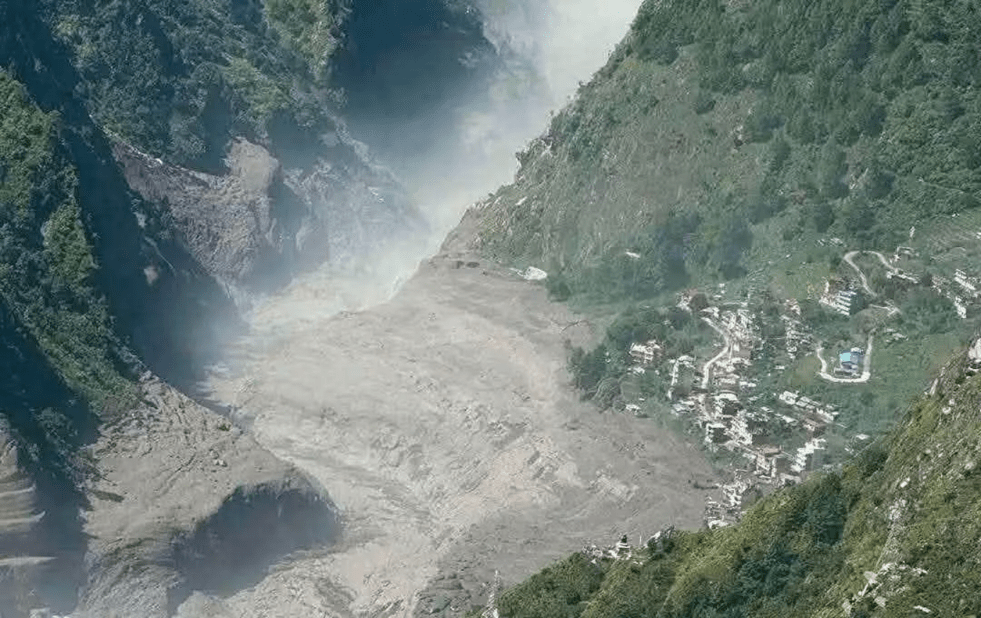
On the morning of Wednesday, August 26, 2026, one of the most severe high-mountain fluvial disasters struck the transboundary Tibet–Nepal frontier. By now we have seen the terrifying and incomprehensible footage of the disaster.

Based on the current understanding (which might change as the event unfolds), at approximately 8:37 AM NPT, an enormous mass of hanging glacier and bedrock sheared free at an elevation of roughly 5,200 meters near the glaciated ridge of Langtang National Park and the upper Gyirong catchment [3]. This region lies exactly on the Tibet-Nepal border, making it a literal transboundary disaster.

The collapse generated a seismic signal equivalent to a magnitude 5.2 earthquake as millions of cubic meters of ice and rock dropped into the gorge below [4]. “It looks like a glacier in the area basically snapped off in a clean break, allowing it to fall just over a vertical kilometer to the valley bottom,” said Daniel Shugar, a geologist at the University of Calgary in Canada who studied satellite imagery to analyze what happened [2]. The immense energy and friction liquefied the ice, converting the collapse instantaneously into a hyper-concentrated, high-velocity debris flood.

“An extreme landslide, equivalent in strength to a magnitude 5.2 earthquake, ruptured with the force of 950 tons of exploding TNT.” [5].

Hydrological Deluge and the Rishi Ganga Parallel

This is eerily similar to what happened at Rishi Ganga in the Indian Himalayas in 2021; some viewers on social media even mistook the footage for the same video. There, too, a part of a glacier and rock collapsed into the river below, forming a devastating rock and ice avalanche that killed more than 200 people, many of whom were hydropower laborers [12].

On the Nepal-Tibet border, the surging torrent roared down the transboundary Lhende Khola (Lende River) and slammed into its confluence with the Kyirong Tsangpo, obliterating the Gyirong inland port facilities situated right at this confluence. The CCTV video from this port will remain etched in the memory of anyone who has seen it [7].

The surge destroyed the port, an important stop for thousands of Indian pilgrims entering China from Nepal on their way to the Mount Kailash Mansarovar trek through private agencies. The flood then roared through the Bhote Koshi, as the upper transboundary trunk of the Trishuli River system is called. The flood wave traveled more than 45 kilometers downstream, with the channel width quintupling in several reaches. Downstream hydrological gauges at Galchhi recorded sudden stage increases of 9 meters (30 feet) within 30 minutes, drowning riverbank terraces and settlement centers with zero warning.

The wave tore through riverside towns, destroyed more than 10 hydropower projects in its path, including Nepal’s largest under-construction facility, Upper Trishuli-1, and scoured over 50 km of highways and 30 bridges. The scale and sheer ferocity of this flood, and the helplessness of humans in its way, is disturbing, even in the disaster-riddled Himalayas.

From Ratopati.com (https://english.ratopati.com/story/76415/trauma-center-team-leaves-for-rasuwa

New Flood Risk Looming Over Nepal

Even as this report is written, the disaster poses a second threat to Nepal. China’s Ministry of Water Resources stated that a significant barrier lake has formed near the confluence of two high-altitude rivers in Nepal [7]. Its water volume was estimated at 2 million cubic meters (as of the morning of August 27), and the lake is already overflowing. Another 3 million cubic meters of water is expected to flow into the lake over the next three days, posing a high risk of a breach within 72 hours.

Aerial photo of the barrier lake formed in Nepal Photo: zumapress.com/New York Post

Human Casualties and Transboundary Havoc

The suddenness of the Bhote Koshi flood caused widespread loss of life along the corridor. The numbers are climbing. On the Nepali side, authorities confirmed 389 deaths, with over 200 Nepali citizens unaccounted for, including approximately 80 security personnel from the Nepal Army, Armed Police Force, and civil police stationed at border checkpoints [6]. Because the upper valley serves as a prime trekking and pilgrimage route, nearly 400 foreign tourists were caught in the disaster zone, including 134 missing Indian nationals and 47 from the United States [10]. On the Tibetan side, Chinese state media reported three fatalities and 558 missing persons at Gyirong Port, an essential crossing for Kailash Mansarovar yatris [1]. There might be some overlap in these figures.

Country / CategoryConfirmed DeadReported MissingRescued / InjuredTasks & RolesAffected Locations
Nepal359~393460+ injuredLocal residents, domestic tourists, 85 security personnel (Army/Police).Rasuwa, Nuwakot, Dhading, Gorkha, Chitwan.
IndiaTBD28854 rescuedHydropower workers (UT-1), Mount Kailash pilgrims.Trishuli River corridor, border offices.
China (Tibet)3558Local residents, traders (includes 260 foreign nationals missing).Gyirong Port, Tibet-Nepal border.
United States0903 rescuedMount Kailash pilgrims, Isha Foundation groups.Gyirong Port, Langtang routes.
Ukraine55Tourists and alpine trekkers.Rasuwa district trails.
Malaysia51Trekking and tour groups.Rasuwa district.
Australia39Tourists and trekkers.Rasuwa / Langtang region.
United Kingdom33Tourists and trekkers.Rasuwa / Langtang region.
Canada25Tourists and trekkers.Rasuwa / Langtang region.
South Korea9Hydropower construction engineers.Upper Trishuli-1 (UT-1) site.
Other Foreign~67+Tourists from Singapore (8), Germany (8), Russia (8), South Africa (6), Japan (5), New Zealand (5), and others.Rasuwa district, Gyirong Port.
TOTALS3621,468 800+ rescuedIndustrial workforce, security forces, border personnel, pilgrimsTransboundary system (100+ km)

Systemic Devastation of Cascading Energy Infrastructure

The catastrophe highlights the extreme vulnerability of clustering intensive energy projects within fragile, narrow Himalayan river corridors. More than ten hydropower projects went offline, disabling an estimated 430 MW of generation capacity, amounting to roughly one-eighth of Nepal’s national installed power.

The 111 MW Rasuwagadhi Hydropower Plant, commercially operational for less than two years, saw its headworks, civil structures, and substation heavily damaged. Downstream, the 60 MW Upper Trishuli-3A facility was submerged, while the under-construction 216 MW Upper Trishuli-1 (UT-1) project suffered catastrophic inundation, leaving 73 Indian technical workers and nine South Korean engineers missing [9].

The disaster also crippled non-hydro renewables, sweeping away three blocks and the central substation of a 25 MW Nuwakot solar power plant [8].

Schematic Representation of Hydropower projects ( commissioned and under construction) in Trishuli-Gandaki Basin SANDRP ( made using Google LLM)
Hydropower ProjectCapacity (MW)Funding / Developer DetailsPost-Flood Status (August 2026)Reference
Upper Trishuli-1 (UT-1)216 MWDeveloped by NWEDC (Nepal Water & Energy Development Co.). Owned by KOEN (South Korea, 50%), IFC (15%), Daelim (15%), and Kyeryong Construction (10%). Under Construction, upto 84% complete. Heavily damaged by the transboundary flood on Aug 26, 2026. Works halted.Chosunbiz (Aug 27, 2026); AIIB APPROVED; Power Tech.
Rasuwagadhi HPP111 MWDeveloped by Rasuwagadhi Hydropower Company (an affiliate of the state-owned Nepal Electricity Authority – NEA). Funded through domestic institutions.Operational. Powerhouse and substation reportedly destroyed on Aug 26, 2026. Entirely offline and severely crippled.Rising Nepal Daily; NEA Spokesperson; ShareSansar.
Rasuwa-Bhotekoshi120 MWDeveloped under a public-private partnership with major domestic and regional funding stakeholders.Under Construction. The construction site was severely inundated and damaged. Access roads and local structures swept away. Construction suspended.Rising Nepal Daily; ShareSansar (Aug 2026).
Sanjen Khola78 MWDeveloped by Sanjen Jalavidhyut Company Limited (NEA subsidiary). Funded primarily by domestic financial consortiums.Operational. Powerhouse flooded and transmission connection cut off. Offline until detailed structural assessment is completed.Rising Nepal Daily; Ministry of Energy Report (MoEWRI).
Chilime HPP22 MWNEA subsidiary. Considered Nepal’s flagship community-hydropower model, built with local ownership and domestic funding.Operational. Flooded; intake/dam structures sustained damage during the high surge. Shut down and offline.The Kathmandu Post (Aug 2026); My Republica.
Langtang Khola20 MWPrivate developer-led run-of-the-river project with domestic bank consortium funding.Operational. Infrastructure along the riverbank sustained substantial damage. Completely offline.ShareSansar; Rising Nepal Daily (Aug 2026).
Upper Trishuli-3A60 MWState-owned, developed and operated directly by the Nepal Electricity Authority (NEA). Built with Export-Import Bank of China concessionary loans.Operational. Highly impacted. Substation and transmission line towers damaged, cutting the plant’s connection to the national grid.My Republica (Aug 27, 2026); Rising Nepal Daily.
Upper Trishuli-3B37 MWDeveloped jointly by NEA and Nepal Telecom. Run-of-the-river project under construction.Under Construction. Works halted. The crucial 220 kV Hub substation linked to the project sustained major damage, stranding other regional plants.Rising Nepal Daily; NEA Release (Aug 26, 2026).
Middle Trishuli Ganga15.6 MWDeveloped by Middle Trishuli Ganga Hydropower Ltd, funded through domestic private investments and commercial banks.Under Construction. Heavily affected by riverbank erosion and mud influx. Machinery and materials washed away. Works suspended.Rising Nepal Daily; ShareSansar (Aug 26, 2026).
Trishuli Hydropower Station24 MWOne of Nepal’s oldest hydropower stations, built jointly by the Government of India and the Government of Nepal (completed in 1967 for INR 140 million).Operational. Substantial damage to headworks, switchyard, and regional transmission lines. Plant offline, cutting power across Nuwakot.Wikipedia; My Republica (Aug 27, 2026).
Devighat Hydropower14.1 MWOwned and operated by the Nepal Electricity Authority (NEA). Built as a cascade plant to the Trishuli station.Operational. Affected downstream in Nuwakot district. Silted up by severe mud and debris. Shut down to prevent turbine abrasion.NEA Release; Rising Nepal Daily (Aug 27, 2026).
Mailung Khola5 MWDeveloped by Mailung Khola Hydropower Co. Ltd. Funded primarily through domestic commercial banks.Operational. Flooded and physically damaged due to its proximity to the lower banks. Plant completely offline.Rising Nepal Daily; ShareSansar (Aug 26, 2026).
Super Trishuli HPP100 MWDeveloped by Blue Energy Ltd. Located downstream across Chitawan, Dhading, and Gorkha. Estimated project cost of USD 136.1 million.Under Construction. Warned of downstream surge risks. Silted up with mud and debris. Structural works temporarily paused as precautions are implemented.Nepal Water Resource Portal; Power Technology; EJAtlas.

Downstream Surge into the Gandak Basin in India

The floodwaters propagated downstream through the lower Trishuli and Narayani river systems before crossing into northern Bihar, where the river is known as the Gandak. The surge pushed peak inflows towards 1.5 lakh (150,000) cusecs at the transboundary Valmiki Nagar (Gandak) Barrage. Water resources authorities in Bihar issued emergency flood alerts across riparian districts and opened all 36 barrage gates, allowing the sediment-heavy surge to pass through the Valmiki Tiger Reserve landscape before discharges stabilized down to 1.04 lakh cusecs the following morning [11].

Transboundary Governance and Early Warning Failures

This event marks the second severe flood down the Lhende Khola corridor in just 14 months, following a July 2025 glacial lake outburst on the Tibetan side of the catchment. Despite localized dialogues initiated after the 2025 flood, both riparians failed to operationalize a standing, automated, real-time early warning data-sharing mechanism prior to this event. While Nepal’s Department of Hydrology and Meteorology and the China Meteorological Administration convened an emergency protocol meeting in the aftermath, the recurring devastation exposes the acute perils of unchecked infrastructure expansion in unmonitored, climate-sensitive glacial headwaters without institutional transboundary safety architectures. SANDRP Report on 2025 Floods.

Role of International Financing Agencies in Himalayan Hydropower

The $647.4 million Upper Trishuli-1 (UT-1) hydropower project, which is now more than 90% damaged and where hundreds of laborers, engineers, and locals are stuck, is heavily backed by Multilateral Development Banks (MDBs), specifically the International Finance Corporation (IFC) and the Asian Development Bank (ADB), alongside the Asian Infrastructure Investment Bank (AIIB) [15].

ADB states in its project dashboard that the project supports ADB’s strategies: “(ii) tackling climate change, building climate and disaster resilience, and enhancing environmental sustainability” [13]. Under ADB’s support, the project received a loan from the Canadian Climate Fund for the Private Sector in Asia II (CFPS II) for USD 30 million.

The ADB dashboard itself acknowledges: “Climate change risk assessment previously concluded that the risks of climate change impacts on the project are low; however, extreme rainfall in previous years and a glacial lake outburst flood event in 2025 resulted in damage to some project facilities while under construction and significant alteration of river morphology along the Trishuli river” [13].

In fact, the Independent Panel of Experts (IPoE) Report in June 2025 specifically stated: “In its 3rd report, the IPoE had recommended the preparation of a Climate Resilience Assessment for the Project. This assessment has yet to be done. Following the September 2024 event, which showed that combinations of climatic and geological events can have severe consequences, we recommend expanding the scope of such climate resilience assessment to disaster risks” [14]. No such Climate Resilience Assessment is present on the dashboard.

Upper Trishuli I HEP Source: https://nwedcpl.com

International Financial Institutions seem to be pushing more hydropower development in the disaster-prone and vulnerable Himalayas without proper checks and balances. This same month, eight workers were killed in a hydropower project in Indian Himalayas which received loan from the World Bank. MDBs have the financial leverage to enforce climate assessments, early warning systems, transboundary risk cooperation.

Ignoring the risks while pushing hydropower projects is not climate resilience. It is playing a part in disaster. In fact, there is an urgent need for a moratorium on large hydropower development in the Himalayas unless a comprehensive Climate Assessment is complete.

Parineeta Dandekar, Himanshu Thakkar, Bhim Singh Rawat, SANDRP

References

1. The New York Times (Aug 27, 2026). ‘Himalayan Torrent Destroys Mountain Border Crossings in Nepal and Tibet, Leaving Hundreds Missing.’

2. University of Calgary / Cryosphere Research (Aug 27, 2026). Dr. Daniel Shugar, Statement on Satellite Imagery and Glacial Cleavage Dynamics.

3. ICIMOD (International Centre for Integrated Mountain Development) (Aug 27, 2026). Special Scientific Briefing: Geomorphic and Cryospheric Assessment of the Transboundary Lende Khola Flood Event.

4. USGS (United States Geological Survey) (Aug 26, 2026). Seismic Event Notification: M5.2 Mass-Wasting Event, Nepal-China Border Region (08:37 NPT).

5. MyRadar Weather (Aug 26, 2026). Event briefing and scale comparison.

6. Nepal Police & Ministry of Home Affairs (MoHA) (Aug 27, 2026). Situation Report on Search, Rescue, and Casualty Figures in Rasuwa and Nuwakot Districts.

7. CCTV / Ministry of Water Resources, PRC (Aug 27, 2026). Emergency Hydrological Advisory: Gyirong Port Rescue Efforts and Purepu Tsangpo–Chhochen Khola Barrier Lake Status.

8. Clickmandu (Aug 26, 2026). ‘Major infrastructure collapse in Nuwakot as flood sweeps away 60 homes and solar power plant.’

9. Chosunbiz (Aug 27, 2026). ‘Upper Trishuli-1 Hydroelectric Project Damaged in Nepal Flash Flood; Expatriate Engineers Missing.’

10. Embassy of India, Kathmandu / Ministry of External Affairs (Aug 27, 2026). Consular Situation Bulletin: Indian Nationals and Hydropower Workers in Rasuwa/Trishuli Valley.

11. Water Resources Department, Government of Bihar (Aug 27, 2026). Gandak Barrage Discharge Bulletin & Flood Advisory.

12. USGS (2021). ‘A massive rock and ice avalanche caused the 2021 disaster at Chamoli, Indian Himalaya.’

13. Asian Development Bank (ADB). Upper Trishuli 1 Hydropower Project Dashboard.

14. Asian Development Bank (ADB). Environmental and Social Monitoring Report (IPoE).

15. Nepal Water & Energy Development Company (NWEDC). Upper Trishuli-1 HEP Project Details.