Why is the Maharashtra Govt and the MoEF misleading people of Marathwada?
Press Release 29.06.15
On the 24th June 2015, the Union Ministry for Forests, Environment and Climate Change (MoEF for short) granted Environmental Clearance[1] to Krishna Marathwada Lift Irrigation Scheme for diverting 23.66 TMC (Thousand Million Cubic Feet) water from Krishna 1 Sub basin to Krishna 3 Sub basin of Krishna River Basin. The media has reported the development as a “Respite for Marathwada”.
Its two years since Uttarakhand faced its worst ever flood disaster during June 15-17, 2013. We remember such tragedies to ensure that we learn the necessary lessons. So that in future such tragedies are not repeated or their dimensions are reduced. One of the enduring debates since that the Uttarakhand tragedy has been about the role of existing and under construction hydropower projects in increasing the proportions of the disaster.
Above: The modest Yettinahole Stream, close to location of proposed weir. Photo: Parineeta Dandekar
~~~
Debate over Yettinahole Diversion Project has been raging in Karnataka for more than two years now. While Dakshin Kannada has been rightly raising issues of unassessed social and ecological impacts of the project on this region, fresh information now available, including a study by scientists of the Indian Institute of Science – Bangalore, and other experts proves that Yettinahole Diversion Project just does not have the water that the project developers claim it does, taking out the very hydrological foundation of the project.Continue reading “Yettinahole diversion Project (literally) holds no water”→
Above: Just a few hundred meters upstream the proposed Jhari Dam, a tribal woman struggles to find water in the dry Par river bed Photo: Parineeta Dandekar
Village of Jhari at the northern most corner of Western Ghats has some of the loveliest houses I have seen. Appreciation for the evolved vernacular architecture goes beyond the obvious urban romanticisng of anything tribal. Homes in this region of tribes like Kokani, Warli, Thakurs, etc, are unique in their architecture, building materials, craftsmanship and the seamless mix of beauty and functionality. The tiled roof of our host Haribhau had intricate wooden trimmings, the mudfloor was cool and the door frame was carved in exquisite motifs. Vines arched and spread in disarray over courtyards. We were assembled under a passion fruit or ‘Rasna’ vine, bursting with white flowers. Inside, cane baskets creaked under the weight of Ragi, Udid and Rice filled to the brim: This year’s harvest has been good, though that’s not always the case. The hosts, both men and women, were busy with lunch preparations. Continue reading “Par-Tapi-Narmada Link: Divided States, United Tribals”→
A three member committee set up by the Union Ministry of Water Resources, River Development and Ganga Rejuvenation (MoWR for short) has submitted a report in March 2015, which makes welcome recommendation on “Assessment of Environment Flows”. These recommendations on Environmental Flows (E-Flows) need to be implemented immediately for better health of our rivers. The committee members include Dr Vinod Tare of Indian Institute of Technology Consortium (IITC), senior officials of Union Ministry of Environment, Forests and Climate Change (MoEF for short, it was represented by Dr Shashi Shekhar, Special Secretary in MoEF) and MoWR (represented by Dr Amarjeet Singh, Additional Secretary, MoWR). Sushri Uma Bharti, Union Water Resources Minister[1] and even the recent meeting of National Ganga River Basin Authority (NGBRA) on March 26, 2015[2], headed by the Prime Minister referred to this committee. Continue reading “MoWR report on “Assessment of E-Flows” is welcome, needs urgent implementation”→
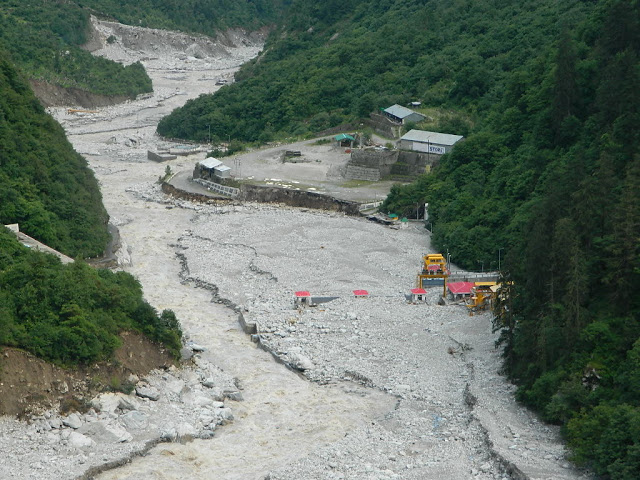
Above: 440 MW Vishnuprayag HEP post 2013 disaster in Uttarakhand. The project, its operation and location added significantly to disaster in the downstream. Photo: Matu JanSangathan
Post by- Ritwick Dutta, Lawyers Initiative For Forest and Environment, Debi Goenka, Conservation Action Trust, Manoj Mishra, Yamuna Jiye Abhiyan & Himanshu Thakkar , South Asian Network for Dams, Rivers & People
In its initial pages, TSR Subramanian Committee Report (High Level Committee Report) comes across as a well-written, even eloquent document. That the environmental laws and governance needed streamlining and a strong, unbiased review was beyond doubt. Such a step was welcome and not an issue for environmentalists or rights groups to take umbrage to,in principle. In reality, overlooking the socio-political realm that infuses political and executive discourse is hardly possible or advisable. As pointed in this critique published in EPW, the report came at a time when environmental issues were abused and made to stand in judgment like no other.
The report has been lauded by the Env Minister who has taken pains to reiterate that his ministry “will not be a roadblock to development anymore”. The report also comes at heels of PM’s affirmation at the overflowing Madison Square Gardens about dismantling old laws. Even the most unbiased observer cannot miss context in which the report is laid out.
Even so, looking at the implications of the report it deserves an unbiased analysis and this is our attempt at it [1]. (We have not dwelt too much on the structure or details of the report as these have been laid out clearly in other critiques.) The High Level Committee constituting of 4 members and 2 Secretaries[2] under the Chairpersonship of Shri T.S.R. Subramanian, Former Cabinet Secretary, was formed on 29th August 2014 vide OM No. 22-15/2014-IA.III. Terms of Reference of this committee were:
(i) To assess the status of implementation of each of the aforesaid Acts* vis-à-vis the objectives;
(ii) To examine and take into account various court orders and judicial pronouncements relating to these Acts;
(iii) To recommend specific amendments needed in each of these Acts so as to bring them in line with current requirements to meet objectives; and
(iv)To draft proposed amendments in each of the aforesaid Acts to give effect to the proposed recommendations.
The third objective of bringing “laws in line with current requirements to meet objectives” is unclear in the absence of stating what the current requirement pertain to: What requirement? Whose requirements? Environmental, Social or Economic requirements? What Objectives? Whose objectives? The committee did not even attempt to clear air about these issues, though questions were raised. The composition of the committee also raised serious issues. (See SANDRP blog and Ritwick Dutta’s guest blog.)
So we had a committee of 4 members and 2 secretaries with questionable credentials, with an unclear TOR and put together by a government which had taken a biased stand on environmental issues sitting in judgment on all 6 environmental laws of the country[3], related orders, institutions and mechanisms which would affect myriad communities, forests and ecosystems, in a period of initially 2 months, extended by a month. Unbelievably, in these three months the committee not only suggested radical changes in all of the above, but also recommended a brand new Law (strangely) called Environmental Laws (Management) Act or ELMA, which, they suggest, would prevail over all contrary judgments issued in past decades or provisions of any environment law promulgated till date!
The committee states in the preamble of the ELMA that conclusions were reached “after interacting with diverse groups of people in different parts of the country”. This may give an impression that the Law or the recommendations are based on wide consensus. This is not the case at all and the output has to be looked clearly as a 6-member committee’s recommendations.
Going through the report As pointed out by Shripad Dharmadhikary in his critique, the report does make a relatively sound diagnosis of the problems of environmental governance of the country. Anyone, either from civil society or industry, who has experienced Forest Clearance or Environmental Clearance procedures, cannot but help be amazed at the entrenched bureaucracy, pathological reluctance to be transparent, colossal lack of accountability while taking decisions affecting ecology-social systems-industries, laziness to change any of the problematic entrenched systems and lack of respect for the people who are affected by decisions. Anyone who has made rounds to Pollution Control Board offices cannot miss the apathetic atmosphere, the couldn’t-care-less attitude of the officials.
So the diagnosis did detect the aching nerve when it states: “The legal instruments have really served only the purpose of a venal administration, to meet rent-seeking propensity at all levels. This impression has been further strengthened by waves of large scale ‘clearances’, coupled with major delays in approvals in individual cases” or “The state – arbitrary, opaque, suspiciously tardy or in-express-mode at different times, along with insensitivity – has failed to perform.The administrative machineries in the Government in the domain of Environment & Forests at all the levels, authorized to administer by Parliament’s statutory mandate, appear to have abdicated their responsibilities.”
“Environmental management is currently seen as an anti-thesis to development; development is seen as inimical to the habitat, natural assets, and in certain circumstances undermining peoples’ livelihood.” “Legislations are weak, monitoring is weaker and implementation is weakest.” And: “Our businessmen and entrepreneurs are not all imbued in the principles of rectitude – most are not reluctant, indeed actively seek short-cuts, and are happy to collaboratively pay a ‘price’ to get their projects going.”
Finally when the report evokes not only current challenges, but even inter-generational equity, it sounds too good to be true! “That environment is sacrosanct; that the purity of air, water and land has been inherited by a generation in mortgage for children of tomorrow; that it is implicitly imperative for each generation to leave the environment to the next generation in a better state than they found it.”
Where are the people? But as you continue reading through the lucid prose, you get that strange feeling of missing the elephant in the room. Where are the people? Where are the millions of people who live in forests or mountains or river valleys and islands or far flung villages, who are most affected by shoddy environmental governance? Why is the report not even mentioning the hardships faced by thousands of such fishermen who lost their livelihoods due to pollution of Vashishthi creek while the MPCB sleeps, or the cracks on the homes of people in Uttarakhand due to hydel projects which received clearances from MoEF CC, or the remote hilly settlements in Himachal who lost their sources of water due to tunneling and blasting for hydropower, or millions of fisherfolk who lost their rights to their rivers, or millions of tribals and others who are still awaiting rehabilitation after being driven out of their homes and their livelihoods?
Why are they not a part of this discourse on environmental management? The report spouts Upanishads and Vedas but does not seem to acknowledge that coexistence with nature has been a part of our eco-region for millennia.
Tribal women protesting against Lower Suktel Dam Photo: Down to Earth
Suddenly, one stumbles on sentences like “India’s growing prosperity is increasing demand for environmental quality”. This reduces environment to a consumable product, aspired by the upper middle class and negates the battles ongoing in the hinterlands of India, where environment equates with livelihood and survival.
As one reads on, the bias against communities and community protests gets clearer, starker and more disturbing. Along with communities, there is hardly any mention of impacts of destructive projects on forests, communities and wildlife. The lines are clearly drawn at compensatory afforestation, raised NPV, monitised afforestation, web-based monitoring, priced data bases, etc. But we are not to question the rationale behind several large scale destructive projects. To illustrate, in the case of Wild Life Protection Act, the report does not talk about habitat destruction due to development projects as one of the major threats to wildlife, but limits itself to hunting, poaching, man-animal conflicts and loss of corridors. Just to put things in perspective, in Arunachal Pradesh, Dibang Basin projects and Siang Basin projects can together submerge more than 23,000 hectares of prime wildlife habitat and affect several Schedule I species.
Some other issues too start getting too big to ignore. In the 113 page report, the word “speed” in context of speedy clearances gets repeated thirteen times. As we move from initial sagacious pages, the emphasis swiftly shifts from concern for environment to “time consuming clearance processes”. After notable recommendations in Forest Conservation Act, (succinctly critiqued here), the report seems to get down the business: Environmental and Forests Clearances. It is here that the superstructures NEMA (National Environment Management Authority) and SEMA (State Environment Management Authority) are introduced. Briefly, NEMA is proposed to be a full time board which will deal with a whole gamut of issues from Project clearances, monitoring, database creation, creation of standards etc,. CPCB will be subsumed under NEMA and it will function under the central government. SEMA at the state level will appraise Category B and C projects, monitoring and compliance, etc,. SPCBs will be subsumed under SEMA which will be under the State Govt.
Public Hearings (PH) According to the report:
Only environmental, rehabilitation and resettlement issues can be raised at the Public Hearing.
Only “genuine local participation” is permitted. Mechanism to be put in place to ensure this.
Public hearing can be entirely dispensed with if local conditions are “not conducive”.
There is no necessity for holding a PH if project site is away from settlements, if the projects are in industrial zones or complexes, for power, mining and line projects, if the projects are of national or strategic importance.
Appeal against NEMA SEMA approval has to be filed first with the Board formed under ELMA (which is without any subject experts), which can summarily reject the appeal and levy heavy costs against appellants for pursuing frivolous matters.
Gram Sabha Consent for Linear Projects not required, Settlement of Forest Rights not a necessity for Stage I Forest Clearance, no site inspection required for stage I forest clearance!
Protest in Assam against Lower Subansiri Project in Arunachal Pradesh Photo: KMSS
Let us see how these provisions, if accepted, will play out in real life, for example in case of Assam, which faces downstream impacts of Hydropower projects in upstream Arunachal:
Assam will not be a part of Public Hearing for dams like Lower Siang, despite the fact that impacts of Siang basin projects will deeply impact Assam. This is because PH is restricted to distance from Project Site, and is delinked from the impact of the project! Diurnal fluctuations from the Siang project will result in change in water levels by 22 feet near D’Erring Sanctuary, very close to Dhemaji District of Assam, every day in lean season, but affected people will not be able to participate in public consultations.
Even population from downstream Arunachal or interested Ecologists, NGOs who have important points to make about the EIA will not be allowed as PH is limited to “Genuine Local Participation” (this violates NGT judgment about who is aggrieved by a project).
The population of Arunachal, which finally does get to attend, will not be able to talk about social impacts, downstream impacts, impacts of having too many projects in a cascade, safety issues, impacts on their homes and drinking water sources etc., as the scope of their inputs is limited to “environment and rehabilitation and resettlement issues.”
Requirement of Public hearing itself can be done away with, if the “Local conditions are not conducive”. So in places like Tawang where Monpas are leading nonviolent struggle against destructive dams, the public hearing can simply be cancelled and the project proceed!
In fact there may be no public hearing for hydropower projects or for any power projects or river link projects!
In case affected groups want to appeal against NEMA decision, they will have to file a complete case within 15-30 days of MoEFCC’s order, which is extremely difficult for rural communities
If surmounting all obstacles, a case is filed, the petitioners better be wary as the board has powers to reject their appeal summarily and levy heavy fine on them.
Monks protesting against dams in Tawang Region in Arunachal Pradesh Photo: Urmi Bhattacharjee
Does this look like a conducive, encouraging environment to bring out accountability, transparency and inclusive environmental governance? On the ground, this may mess up issues further, fuel conflicts and delay projects, rather than fast tracking them!
Process of Project “Approval”: All in Three months: The Report has also recommended how the clearance process should be. This is possibly one of the most problematic areas of the report where all the focus is centered on getting the file move in full throttle. The report recommends Model TORs (Terms of Reference) for sections, which already exist. It also assigns just 10 days for the NEMA to work on a site specific TOR failing which the proponent will use the Model TOR. Laying down TORs for an Environment Impact Assessment Study is one of the crucial parts of the clearance process. Many stalemates we witness today have their roots in inadequate TORs. In fact in some developing countries, there is a Public Hearing at the TOR stage also so that affected communities and interested stakeholders can raise points to be included in the study. NEMA is supposed to recommend approval or rejection (with reasons) within two months of receiving the application. The basis of 2 months is not clear as the EIA study itself has to be at least a single season (one year) study!
Fast track clearances: On this Clearance express, there are some compartments which belong to the bullet train. Because nearly three months is too long a time to wait for projects which have the potential to change an entire eco region evolved over thousands of years, linear projects, projects of strategic importance and power and mining projects which are “engines of the nation’s growth” are put on a separate fast track. It is not clear how soon they will be appraised, or, approved, but imagination runs wild here..
Villagers affacted by Gosikhurd Dam in Vidarbha. The construction has faced huge corruption charges, cost escalation, lack of proper clearances, no rehabilitation of affected communities, and extremely poor quality work Photo: Aparna Pallavi
So what constitutes projects of national importance? As pointed by Shripad, much debated Polavaram Dam which can submerge nearly 300 villages in three states or the GosiKhurd dam which can submerge 100 villages, hundreds of hectares of forest land and is mired in deep corruption charges, can be fast tracked for being of National Importance as they already have the tag of being “National Projects”.
As for Monitoring, the committee stresses an ironically-named tool “Mandatory provision of voluntary disclosure”! Monitoring will be web-based, technologically assisted and with minimal need for site visits. This leaves absolutely no chance for any local affected community to be a part of monitoring, or be able to voice its concerns which may not show up on the hightech monitoring devises. The only place where committee mentions accountability is with reference to speed of clearance, failing which the Chairperson of NEMA will be held accountable. There is no accountability demanded either about failing to address impacts on ecology or on people.
Overreach of the Committee: ELMA: Hugely overstepping their mandate, the committee then proposes a new law for streamlining clearance and approval for projects at state and center by proposing Environment Laws (Management) Act, ELMA. As stated at the outset, this is no product of interactive discussions with civil society or general public, but is a part of a report by 4 individuals assisted by 2 secretaries in a period of 3 months.
Uberrima fides? It’s the environment we are talking about! According to the committee, ELMA is based on the principle of Utmost Good Faith or Uberrima Fides, used in Insurance Laws, as against Caveat Emptor, or Buyer Beware principle, where the NEMA, SEMA and the Ministry will put absolute faith in whatever studies, impact assessment reports, compliance reports that the proponent submits. According to the committee, “The law of insurance (Utmost Good Faith) supposes that the insurer knows everything about himself or about his activity to be insured; and the insurance company cannot be expected to know anything about the insured nor will it be able to verify all that is stated, speed being the essence. If the statements made by the insured turn out to be incorrect or if material facts were suppressed or concealed, the insurance company could avoid its liability.” (Emphasis added)
This stress in Insurance Law is entirely misplaced and non-applicable in the realm of environment!
Firstly, the Insurer owns his body, and there is a solid footing to believe him. In case of projects, say for example a dam about to submerge 5000 hectares of prime forest or displace lakhs of people, the proponent is making a claims about something he does not own, but which is public property on which many others depend and whichwill be irreversibly impacted by the proponent. While in case of Insurance laws the Insurer does not have any concern for the Insured, in case of environment, it is exactly the opposite. The MoEFCC’s prime duty is to safeguard the environment. If the project affects environment in a bid for quick clearances, it is the MoEF which would be (should be) deeply impacted. It cannot just “avoid its liability” like the insurance company as the Report suggests!
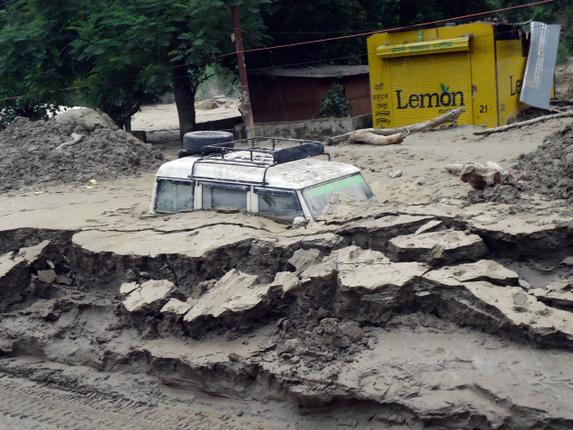
Vehicle drowned in muck, much of it dumped by Srinagar Hydropower Dam in Garhwal, Uttarakhand Floods, 2013. Photo: Kavita Upadhyay, The Hindu
There is absolutely no justification for using principle of Utmost Good Faith in the environmental realm, because most EIAs are fraudulent and compliances do not exist. Even currently, any false information provided at the time of appraisal process is a violation of Environment Protection Act and invites punishment. But there are examples by the dozen about how the MoEFCC refuses to take action even when clear evidence is presented to them about false information presented by proponent. This was violation of EPA 1986, how is this violation different than violation of ELMA?
We know that monitoring is the weakest link in environment governance and there no reason to believe that it will improve in any way by making it web-based. In the absence of this, taking proponent at his word about the information he provides at the time of clearance or monitoring is not workable, justifiable or acceptable.
Appealsagainst decisions of NEMA or SEMA: The primary space to file an appeal against decision of NEMA or SEMA is now taken by a board Chaired by a retired High Court Judge and two senior officials of the government and the National Green Tribunal is restricted to only judicial review. Merit-Based review and subject experts is one of the strongest assets of NGT, differentiating it from other courts and it is clear that this very role is being clipped by ELMA.
The ELMA will have an overriding effect on any judgments, orders of courts or tribunals under acts dealt with by ELMA.
ELMA also envisages Special Environmental Courts at district level which will take “Cognizance of the serious offences only on a complaint by the officers authorized by the NEMA or SEMA.” As an afterthought, these courts may also hear public only if they are satisfied that responsible authority failed to take action about their complaint in three working days. Taking action is a very vague term.
While the ELMA has provisions for “protecting officials acting in good faith”, it has a penal provision to scare litigation by a provision which says “Punishment for false or frivolous complaints”. So while the proponent will be treated in “Utmost Good Faith” aggrieved citizens will be treated with utmost skepticism and will have to: File appeal within 30 days, prove their bona fides, be wary and careful about filing as it may be deemed “frivolous” and they may be fined!
~~~~
The undercurrent of the HLC report is indeed that the environmental governance will have utmost good faith towards the industry and utmost suspicion towards the affected, the concerned or the civil society. There is no evidence till date to prove that this good faith in the industry is warranted without stringent checks and balances. Even in current compliance system the developers are supposed to voluntarily submit six monthly compliance report, but nothing happens if they do not and no one reads them if they do.This undercurrent overshadows some useful recommendations of the committee.
The HLC report cannot be accepted in this form. Any review of environmental laws needs a consultative and consensus-based process and not a rushed work of two months by a biased panel with unclear and open-ended TORs. The characteristic of ELMA, NEMA and SEMA of excluding participation and not attempting to address issues related to inclusive governance has the potential to polarize environment discourse rather than making it swift and accountable.
The remedy, unfortunately, seems more problematic than the illness. Reminds one of Sahir’s words, जो दवा के नाम पे जहर दे, उसी चारागर की तलाश है…
-Parineeta Dandekar, parineeta.dandekar@gmail.com
END NOTES:
[1] The report has already been critiqued excellently by various authors.
HLC – TSR Subramanian report: Climate blind or a climate disaster? Himanshu Thakkar, SANDRP https://sandrp.wordpress.com/2014/12/15/hlc-tsr-subramanian-report-climate-blind-or-a-climate-disaster/
Full Report of MoEF’s Committee to Review Environmental Laws Confirms Initial Apprehensions: Recipe for Dilution of Environmental Protection Regime– Shripad Dharmadhikary: http://shripadmanthan.blogspot.in/2014/12/full-report-of-moefs-committee-to.html
Executive’s Environmental Dilemmas: Unpacking a Committee’s Report: Manju Menon and Kanchi Kohli: http://www.epw.in/commentary/executives-environmental-dilemmas.html
[2]Members include: Shri Vishwanath Anand, Former Secretary, Justice (Retd.) Shri A.K. Srivastava Former Judge of Delhi High Court, Shri K.N. Bhat, Senior Advocate, Supreme Court of India. Secretaries: Shri Bishwanath Sinha Joint Secretary, MoEF&CC, , Shri Hardik Shah, Member Secretary, Gujarat Pollution Control Board
[3] [1] The Environment (Protection) Act, 1986, [2] The Forest (Conservation) Act, 1980; [3] The Wildlife (Protection) Act, 1972; [4] The Water (Prevention and Control of Pollution) Act, 1974; [5] The Air (Prevention and Control of Pollution) Act, 1981; [6] The Indian Forest Act, 1927.
As pointed out by Rohit Prajapati in his excellent critique, the HLC has also suggested changes to [1] The Forest Right Act, 2006 and [2] The National Green Tribunal Act, 2010, though these were not part of HLC’s TOR.
Reaching exasperating lows of environment decision making, the Forest Advisory Committee (FAC is a statutory body of the Ministry of Environment Forests and Climate Change (MoEFCC) formed under the Forest Conservation Act of 1980. FAC appraises Forest diversion proposals) has recommended Forest Clearance to the 3000 MW Dibang Project on Dibang river in Arunachal Pradesh.
While we had already written against this recommendation, what is nearly unbelievable is that this recommendation has come at just 10 meters height reduction of the dam from the proposed 288 meters.
This was the very same NHPC proposal which was rejected twice by the FAC in the past,[1] despite this token 10 meter height reduction. In fact in April 2014, the FAC said that 10 mt reduction does not take care of any pertinent impacts for which the proposal was rejected in the first place in July 2013! A 10 m reduction would still mean destruction of 3.24 lakh trees and submergence of 4577.84 hectares, nearly 12000 acres, of rich bio-diverse forest.
Dibang River. Photo with thanks from Global Post, Scot Ligare
The usually reticent MoEFCC (Ministry of Environment, Forests and Climate Change, MoEF earlier) too had issued a strong-worded rejection to this scheme in August 2014, stating that 10 meters reduction is nothing in the face of what is being lost. The rejection letter stated: “Such a marginal reduction in requirement of the forest land (445 hectares reduction, reducing forest requirement from 5056 hectares to 4577 hectares) for the project may not be able to reduce the adverse impact of project on such a biodiversity-rich mature forest ecosystem to the extent which could make the project environmentally as well as socio-economically viable in forest dependent tribal society of Arunachal Pradesh”.
This letter from the same ministry certified that the 10 m reduction proposal still leaves the project environmentally, socio-economically unviable. So an environmentally and socio-economically unviable project has been recommended clearance by the statutory FAC (and also the separate recommendation a week earlier by the same MEFCC’s Expert Appraisal Committee on River Valley Projects)!
This shows that the decision of FAC is devoid of merits, will invite huge opposition from Arunachal Pradesh, Downstream Assam, North East India, and even beyond and will not pass legal scrutiny. The decision seems to have been taken under pressure from the political masters. Union Power Minister Piyush Goyal has been dreaming of clearance to this project, as is clear from his road map published on completion of 100 days of office for the new NDA government[2]. He has also been pressurizing the MoEFCC to clear the project by hook or by crook. The FAC was reconstituted and the reconstituted FAC has obliged the minister in its very first meeting. In the process, the entire FAC has violated its mandate and should be held accountable for this.
Regrettably, MoEFCC seems to have become the willing punching bag of not only above-mentioned ministries, but even unrelated ministries like Ministry of Mines and Minerals, Ministry of Steel ,etc., whose ministers and Secretaries were present for the meeting: “to Expedite Clearances”. (Incidentally, when was the last time we heard MEFCC resisting such arm-twisting, or forthrightly suggesting any pro-environment measures to other ministries?)
Before the minutes of the September FAC meeting were out on Oct 22, 2014 (there was an inordinate delay this time, raising suspicion of negotiated minutes and again breaking all norms of conduct), there was discussion in media that Dibang was cleared, but even the hard-core skeptics believed that this recommendation must have come after a 20 meter or 40 meter height reduction, for obvious reasons.
But the FAC seems to have outdone itself. As stated above, the recommendation has come at 10 mts height decrease, for which the FAC had rejected the project and MoEF had issued a rejection letter in the past.
As we discussed in detail in our last blog on Dibang project, the twice-rejected project was up for discussions again in Sept 2014 only after considerable arm-twisting of the MEFCC by the Cabinet Committee of Investment, Ministry of Power, Project Developer NHPC and Arunachal State Government. This time it was for a supposed sensitivity analysis (done by the developer!)for studying the feasibility of reducing the height of the project upto 40 meters from its original height of 288 meters.
This sensitivity analysis was not shared with anyone, not even the FAC members till the day of the FAC meeting, breaking all codes of conduct of transparency, participation and informed decision making in governance. SANDRP wrote about this to the Minister and Secretary of MoEFCC as well as the Member of the FAC, but received no response.
Looking at the minutes, it is clear that the FAC members have lapped up the logic presented by the developer and the Ministry of Power which in a nutshell says that “10 meters reduction is sufficient as the ratio of forest land required per MW is lowest at 10 meters reduction.” This twisted logic reduces all decision making related to forests, even biodiversity-rich forests supporting endemic, unstudied species, local protests, downstream impacts etc., to mere number crunching of forest per MW. This criteria alone cannot be the basis for decision for forest appraisal committee.
Dibang Valley Forests Photo: The Telegraph
As per the sensitivity analysis by NHPC, the ratio forest land required per MW for 40 meters reduction is 1.67 MW/ hectare, which is same as no height reduction and 1.78 MW/ hectare in case of 20 meter reduction. In terms of tariff, for 40 meters reduction, the power tariff will be 6.24 Rs./unit while it is 5.66 Rs/unit 10 meters reduction, 5.94 Rs./unit 20 meters reduction and 5.64 Rs. at zero reduction. The installed capacity will reduce by 120 MW (4%) MW for 10 meters reduction, 600 MW (20%) for 20 mt reduction and 780 MW (26%) for a 40 meter reduction.
Height Reduction
Forest land required
MW capacity per ha Forest lost
First Year Tariff: Rs per unit
Reduction in installed capacity
Nil (288 m)
5056 Ha
1.67
5.64
None
10 m
4578 Ha
1.59
5.66
120 (2880 MW)
20 m
4284 Ha
1.78
5.94
600 (2400 MW)
40 m
3703 Ha
1.67
6.24
780 (2200 MW)
The proponent said: “Decrease in dam height and consequent sacrifice of power generation beyond 10 mt is not commensurate with saving forest land.”
How did NHPC reach this conclusion? What is the value of the mature, old growth forest land considered by NHPC? Without knowing this, how can this conclusion be acceptable to the FAC? It has to be remembered that Dibang is not an exclusive hydropower project, but a multipurpose project with a flood moderation component and costs have to be borne for this.
While the proponent and Ministry of Power did their best for pushing the project, the FAC did not do its duty of stating that the sensitivity analysis put forth by NHPC is a sham as it does not consider the worth of the forest being lost.
In this sabji-mandi haggling, when FAC had all the watertight justifications for rejecting the project, it did not bat for even a 40 meter reduction, which could have saved nearly 1355 hectares of forests and would have had a marginal impact on other factors. Its unclear why this happened.
Only one of the FAC members tried to battle the case saying that 10-40 meter reduction still does not address the upstream and downstream impacts, especially considering the biodiversity rich area. The minutes do not disclose the name of this member, but it seems the brute majority (majority of FAC members are govt officials) took the official line, alleging “subjectivity” and said that “To reduce subjectivity, it is important to analyse the issue objectively on objective parameters”. Forgetting that this is Forest Appraisal committee, not Power Developer Committee.
This is ironical. It was indeed the duty of the FAC to appraise the project “objectively” based on issues like destruction of 3.24 lakh trees, invaluable forests, unstudied biodiversity, rich wildlife and several Schedule I species, community dependence, traditional rights, downstream impacts, climate change impacts, options assessment, etc. But it did nothing of that and has in fact recommended the project “subjectively”, bowing to pressures outside their ambit.
Clearly, per MW forest land required and per Unit Tariff from a project are anything but objective criteria for FAC. FAC is supposed to apply its mind to a number of issues like the ones above. If FAC was not supposed to apply its mind to these aspects and its judgment, there was no need for an FAC, Power ministry and developer could have taken the decision independently.
The FAC decision does not address any pertinent issues raised by the same FAC while rejecting the project, it also does not address downstream impacts on Assam or assume any value for a rich forest. There is no discussion why 20 meters or 40 meters reduction is not seriously considered by FAC. Decision-making based on such biased, proponent-driven criteria is bound to be open to legal challenge and public protests.
Sham consideration of Downstream Impacts About Impact of the project on Dibru-Saikhowa National Park, the User Agency said that the issue was considered by EAC in its meeting on the 16th September (Please note this is just 6 days and 5 working days back from FAC meeting. There is no chance of minutes being firmed up by then. They were not in open domain in any case) and the EAC has recommended clearance based on the fact that there is less than 1 meter level fluctuation at DSNP.
This claim in any case is patently incorrect, again a case of project-friendly, anti-environment decision-making. The level fluctuation at DSNP can go way higher than a meter, anywhere from 7-8 feet every day in lean season, according to the studies considered by the EAC of the MEFCC itself. This has been pointed out by SANDRP to the EAC as well. There has been no study of the impacts of this project on downstream Arunachal Pradesh or Assam. The developer seems to assume that Dibru-Saikhowa is the only part of Assam worth considering.
Dibang Valley tribes Photo from go ibibo/dibangvalley
There is no compliance under Forest Rights Act (2006) for such a massive project and despite this, FAC under some supposedly progressive members working on tribal issues, does not bat an eyelid before recommending clearance!
To conclude, pricing mature, biodiversity-rich forests in terms of per MW terms is an insult of those forests, the communities that depend on them and to the mandate of FAC. Downstream impacts of Dibang project are not studied, the impacts on Dibru-Saikhowa are based on compromised studies.
There is no merit in this decision from the newly appointed FAC which includes members also from reputed environment protection organizations in North East and from Tribal Welfare groups like Friends of Baripada. It is also sad to see that there is no dissenting note from a single member. The unnamed member who expressed dissent in the meeting has not written anything about this in public domain.
Decisions like Dibang lay further foundations for poor, pro-developer, anti-people, anti-environment decisions taken due to pressure from proponent and other ministries. Such decisions will not be legally tenable, nor acceptable to affected communities, nor good for sustainability and equity. In fact, by such reversals, FAC decisions are losing their sanctity. FAC has done this in the past too in case of Kalu Dam in Western Ghats which would submerge 18 villages and 1000 hectares forest.
Isn’t it ironical that the new government changed the name of the MoEF to MoEFCC but is sanctioning massive projects like Dibang which will have far reaching impacts on Climate Change as well as adaption and mitigation abilities of the affected communities? Without even considering these aspects or even mentioning them?
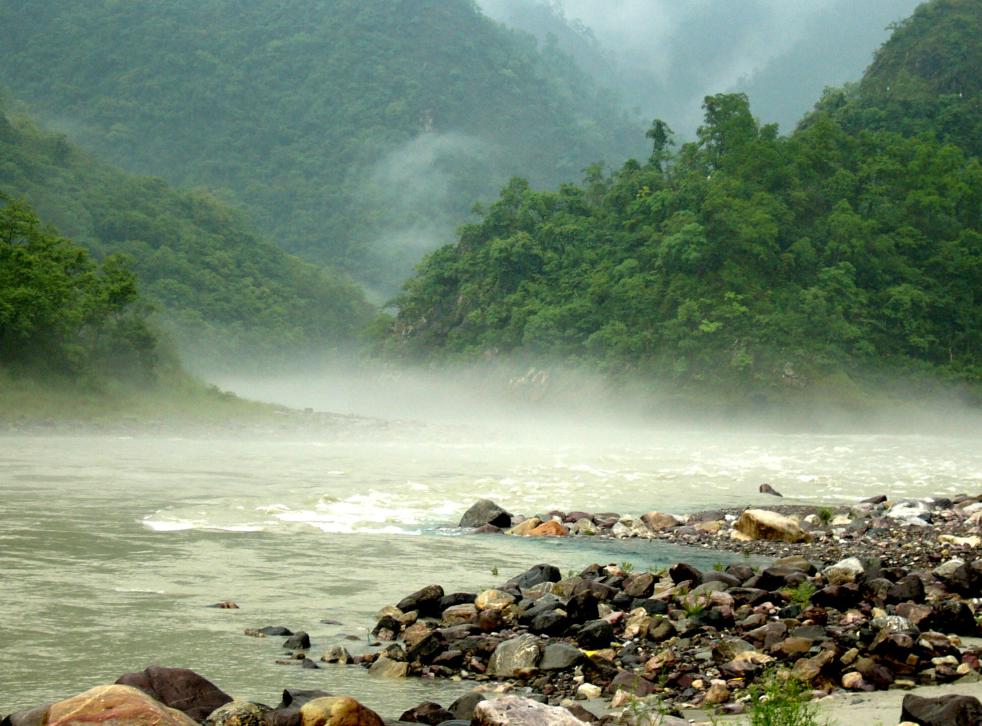
(Above: River Ganga at Rishikesh Photo with thanks from Ramesh Rawat, India Travelz)
– Guest Blog by: Manoj Misra (manojmisra@peaceinst.org. Author is the Convener of Yamuna Jiye Abhiyaan)
A ‘road map’ might be an inappropriate term for a ‘river’ rejuvenation plan. Thus I am using the term, a ‘river map’.
It is well known that despite the Ganga Action Plan (GAP) being in place since the year 1985 and the Supreme Court adjudicating public interest litigation on it since 1993 the river has become increasingly sick with some stretches notably in Kanpur deserving a biologically ‘dead’ status. So it came as a huge sign of hope when the Prime Minister Modi took upon Ganga rejuvenation as a personal mission and appointed Sushri Uma Bharti, a well known Ganga devotee and activist as the Union Minister of the renamed Ministry of Water resources, River development and Ganga rejuvenation. Soon the Finance Minister in the new government allocated financial resources to the tune of Rs 2037 Crores in the name of Nemami Gange (devotional bow to river Ganga) a flagship scheme of the new government, which is aimed at the rejuvenation of river Ganga.
Yet in recent days the Supreme Court time and again has chided the state on the lack of a sound action plan for its avowed objective of a rejuvenated river Ganga. So much so that it once, in an obvious exasperation on the state’s ‘business as usual’ approach to the issue, commented that “it might well be another 200 years before Ganga is actually rejuvenated”? Clearly notwithstanding its firm intent, the state continues to struggle with defining a ‘road (river) map’ that could while convincing the highest court in the land of its utility, set a clear and effective action plan on the ground for a rejuvenated Maa (mother) Ganga?
REJUVENATION
Let us try and see what does Ganga really require for its rejuvenation?
Term ‘rejuvenation’, which includes restoration, is a return of any living entity from what it is today to an agreed state of previous health and wellness. To unravel that we might first need to understand ‘what is’ and ‘where is’ river Ganga?
Most planners tend to view Ganga as a 2500 km long river from Gaumukh to Ganga Sagar, passing through the cities of Uttarkashi, Devprayag, Rishikesh and Hardwar in the state of Uttarakhand; Kanpur, Allahabad and Varanasi in the state of Uttar Pradesh; Patna in the state of Bihar and Kolkata in the state of West Bengal before merging with the sea in the Bay of Bengal.
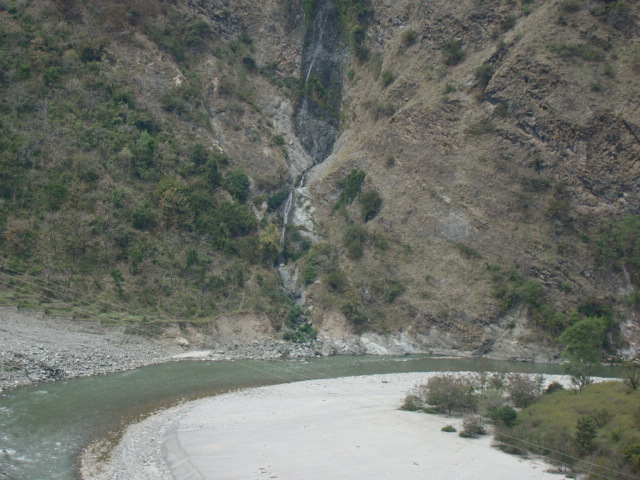
Herein, we understand lay the first fundamental planning mistake. For if Ganga were a simple linear entity as planners hold, then King Bhagirath would have unnecessarily carried out tapasya (penance) placating Lord Shiva to hold Ganga in his jata (matted locks) as she descended with massive force from the Brahm Lok (abode of the gods) with a presumed potential to wreck absolute havoc on the mrityu lok (earth) unless its speed had been broken. This mythical tale translates itself into an earthly reality whereby Ganga actually resides in each and every spring, in every water fall and in every stream that together form the vast network of its tributaries spread over its vast basin. So Ganga rejuvenation plan to make sense and desired impact must encompass actions to revive and restore all these numerous streams and tributaries.
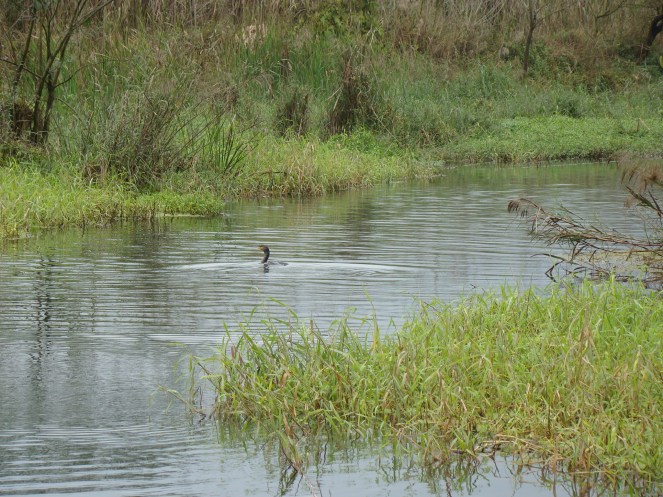
The water fall is as much the Ganga (Photo by Yamuna Jiye Abhiyaan)Small rivulets are as much Ganga (Photo by Yamuna Jiye Abhiyaan)
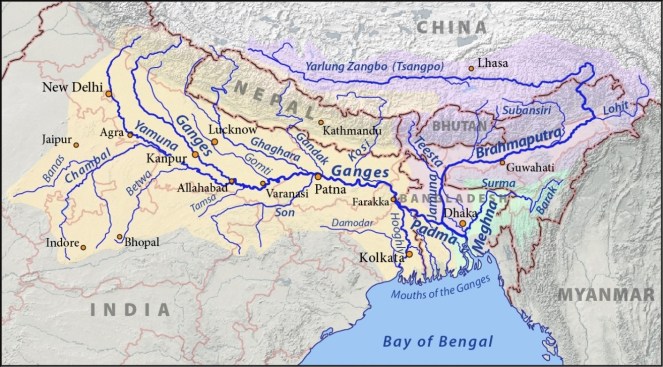
Thus any rejuvenation plan that fails to look at and factor in the Ganga’s larger reality is destined to fail, a la all the previous Ganga Action Plans. All put together Ganga is no less than 25,000 km in length, with a basin spread of some 1,086,000 sq km. (see map) These include areas in the states of Himachal Pradesh, Uttarakhand, Haryana, UP, Rajasthan, Madhya Pradesh, Chhattisgarh, Bihar, Jharkhand and West Bengal within and China, Nepal and Bangladesh outside of India. With such a huge basin, the rejuvenational challenge might appear daunting, leading to an alluring thought that let us first try and rejuvenate the 2500 km of the main stem of the river and then may be tackle the rest. This we believe to be a fatal approach akin to fire fighting, without getting to the root cause, with the most immediate organ of a cancer afflicted human resulting ultimately organ by organ in the latter’s demise. Let us not forget that a healthy river system is like a multi-strand chain which is ‘as strong as its weakest link’. Hence as long as even one tributary remains sick, there can be no respite or rejuvenation of Maa Ganga!
In other words there is no single river Ganga. It is actually ‘Ganga Rivers’ spread all over its basin and carrying names like the Yamuna; Ramganga; Gomti; Mahakali (Ghaghara); Son; Gandak, Koshi etc with each in turn having their own network of rivers and their rejuvenational requirements, since over time majority of them have as well gone ‘sick’.
RIVER INHIBITING PROJECTS
Some might ask, but then what could be done with tributaries lying or originating in Nepal, Bangladesh or in China? A lot actually, beginning with not promoting or supporting river ‘inhibiting’ projects there and then taking lead in a common futures dialogue (an International Ganga Rivers Commission) program on Ganga as the Ganga rivers are in need of rejuvenation there as well.
Dwelling more on what are the river ‘inhibiting’ projects we are led to what constitutes a river’s integrity?
A ‘healthy’ river must ‘run’ freely and must ‘flood’ freely. (Floods in Indian rivers are natural monsoonal occurrence which could become devastating when obstructed).
That is its longitudinal and lateral connectivities must not be allowed to be compromised through manmade structures like dams, barrages and embankments. Such connectivities are essential for a river system to fulfill its ecological roles of transport of water, sediment and energy from source to the sea; recharge of ground water; provision of habitat to aquatic and riparian biota and completion of the water cycle.
In other words, a healthy river is essentially an ‘aviral’ (unbroken in its various dimensions) river. Thus the key challenge and objective of any Ganga rejuvenation plan has to be first and foremost its restoration back to a truly ‘aviral’ state.
FIVE STEPS
Accordingly the following five steps are suggested as the ‘river map’ to a rejuvenated river Ganga.
Step 1 – Establish local level Ganga rejuvenation governance systems to ensure participatory bottom up planning and action plan execution. Support this with the establishment of a Ganga Rivers governance research centre.
Step 2 – Prioritise tributaries (Ganga Rivers) for restorative actions on the basis of their current level of threats and develop restorative action plans utilizing the governance systems as mentioned in step 1.
Step 3 – Establish through a participatory process a desired state of the rejuvenated Ganga; devise a national Ganga rivers policy and a Ganga rejuvenation law. Initiate dialogue with the Ganga nations for an International Ganga rivers Commission.
Step 4 – Review through independent experts, all past, present and planned river ‘inhibiting’ projects on the Ganga Rivers and then either re-design them to become river friendly or decommission / drop them. There should be a moratorium placed on any new structure (barrage, HEP, embankment) on Ganga Rivers till such time that all local level options of water harvesting and energy production (including solar and wind) have been exhausted with a policy that river waters and HEPs shall be the last resort for meeting such needs.
Step 5 – Set a time bound plan of action for ensuring aviral and wholesome Ganga ‘rivers’, with plans for ensuring their flows (water, sediment and energy) as well as the restoration of their catchment, flood plains and the associated biodiversity (aquatic, riparian and terrestrial).
The steps as suggested above are not sequential in nature and many could progress concurrently.
To a query “what then about the hydropower and water supply for fulfilling various human needs”, the response is twofold.
Firstly, this is the Ganga rejuvenation plan based on what Ganga Rivers need for the restoration of their health. Secondly, hydro-power generation and water diversion cannot be in excess of the thresholds as defined by the rejuvenational requirements of the healthy Ganga Rivers.
A rejuvenated Ganga has to be seen as a ‘provider within strict limits’ (as enunciated by the Prime Minister Modi on the banks of Maa Ganga in Varanasi, when he defined what a Maa (mother) is) and not what we in our flawed wisdom might wish to harness from her, with little concern for her deteriorating health and in disregard to the principle of inter-generational equity.
RIVER AND SEWER
The Indian state under the Ganga Action Plan had been investing time, money and efforts to restore the river Ganga through creation of pollution abatement infrastructure like the Sewage treatment plants (STPs) and the Effluent treatment plants (ETPs) in various cities and industries on the river in the name of ‘river cleaning’ with little ameliorative impact on the health of the river. In our understanding despite the poor maintenance being the cause of the failure of the created infrastructure, this approach to river restoration is fundamentally misplaced and hence wrong.
We believe that our rivers require restoration (based on the steps suggested before) of their ecological integrity in terms of their freedom to ‘flow’ and ‘flood’. Once thus freed, they possess all the power of self cleansing, subject to the observance of the fundamental principle of no mixing of ‘sewer’ with ‘river’. Here by ‘sewer’ we mean all kinds of grey water produced both by the cities and the industries.
Thus there is no mention of any river ‘cleaning’ or creation of STPs / ETPs as part of the suggested Ganga rejuvenation plan. The installation of such infrastructure is we believe to be an essential element of the process of urbanization and industrialization whereby the grey water from the cities and industries is converted into utilizable water for recycle and reuse to meet the non potable water needs both of the cities and the industries. But to do so in the name of river cleaning is in our understanding an ostrich like approach which takes away the attention and resource allocation from the real needs of river restoration based on the sound principles of river science.
Prime Minister Modi’s another oft quoted aphorism of “Zero defect and zero effect/ impact” should be made applicable not just to good manufacturing practices but also to good urban management practices with mandatory zero impact on any river that happens to pass by. AMEN!
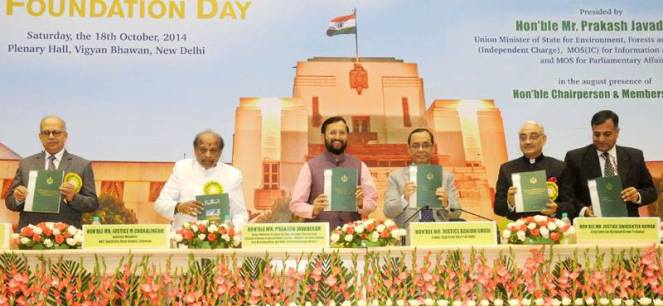
The National Green Tribunal, NGT marked its 4th Foundation Day on 18 October 2014, with an impressive fanfare. A full day function was organized at the Plenary hall of the capital’s iconic Vigyan Bhawan. NGT in this short span has acquired a formidable reputation as a unique, vibrant, active institute with independent & unbiased mind and forthright, quick redressal of petitions that come to it.
The function in two separate sessions, one in the forenoon and the other in the afternoon (a Seminar) was attended by large number of government officials, judicial officers, advocates, law school students, NGT petitioners and office bearers and members of the NGT Bar association.
NGT Foundation Function on Oct 18, 2014 (Source: FB page of Information and Broadcasting Ministry)
Invited dignitaries included Mr Justice Ranjan Gogoi (Judge, Supreme Court), Prakash Javadekar (Union Minister of State for Environment, Forests and Climate Change) and Ashok Lavasa (Secretary, MoEF&CC) in the forenoon session and Mr Justice Sudhanshu Jyoti Mukhopadhaya (Judge, Supreme Court) and Piyush Goyal (Union Minister of state for Power, Coal and new and renewable energy). Mr Justice Swatanter Kumar, the Chairperson of the NGT, Mr Justice Dr. P. Jyothimani, Judicial Member, Principal Bench, NGT, Prof. R. Nagendra, and Dr. D.K. Agarwal, Expert Members at the NGT also spoke and graced the dais.
The function included, in addition to the addresses by the invited dignitaries, the release of 2nd issue of NGT International Journal; the launch of new NGT Website (in the first session) and address by invitee experts (in the second session).
In the first session Mr Javadekar informed the gathering about his political beginnings from a water pollution struggle activist against factory pollution and Mr Lavasa categorically stated that the NGT is playing an extremely crucial role and that there is no move to dilute its powers in any manner. It was in the second session that very controversially one Mr M.K. Pandit was invited to speak as an invited expert.
The Minister of State for Environment, Forests and Climate Change (I/C), Shri Prakash Javadekar lighting the lamp at the 4th Foundation Day function of the National Green Tribunal, in New Delhi on October 18, 2014. The Secretary, Environment, Forests and Climate Change, Shri Ashok Lavasa and the Judge, Supreme Court of India, Mr. Justice Ranjan Gogoi are also seen (Source: FB page of I&B Ministry)
Mr Pandit began with highlighting how recent and how fragile the Himalayas were and that a 8+ richter scale earthquake in central Himalayas was round the corner that could flatten Dehradun. Very soon in his almost 25 minute speech changed track as if on a cue to how great the hydropower dam projects in the Himalayas were for the power security of the country. The Union Power Minister had by then just joined the function to nod in full agreement with all that the Mr Pandit was narrating. The audience on the other hand was left perplexed as to what was happening?
An invited speaker was eulogizing the great merits of high dams receiving approving glances from the power minister on an NGT seminar whose topic was “Natural Disasters, Environment & Role of NGT with special reference to Uttarakhand, J&K, Assam & Himachal Pradesh”. Clearly something was amiss, somewhere?
Secondly, Mr Pandit is not a neutral expert, but an interested party. As leader of scores of pro hydro Environmental Impact Assessments that he has led as part of the CISMHE[1] team (Center for Inter-disciplinary studies of Mountain and Hill Environment) has earned them millions as they also continue to mint more money. Typical of Indian EIAs, no EIA done by CISMHE has ever raised any difficult questions for the developers. It has also never concluded that any of the projects is unviable. CISMHE EIAs are as shoddy, incomplete and inadequate as any other[2]. For example on Luhri HEP, the CISMHE EIA was so problematic that even the Ministry of Environment, Forests and Climate Change’s Expert Appraisal Committee on River Valley Projects and the World Bank found it inadequate and unreliable.
Interestingly, CISMHE website says: “Ministry of Power, Government of India established CISMHE as an R&D Centre in power studies in environment in recognition of its excellent past performance”. This means that there is also conflict of interest here in CISMHE doing EIAs, since it has been set up as an R&D Centre by Ministry of Power, that is itself a promoter and developer of hydropower projects. No wonder, Mr Pandit said what the Power Minister wanted to hear and Power Minister made no efforts to hide his approval of what Mr Pandit was saying.
Very strangely, Mr Piyush Goyal claimed that Tehri dam was an example of good project in the Himalayas that saved Uttarakhand in the floods of June 2013. Mr Goyal should know that this claim had absolutely no basis and even an Expert Body appointed by the Supreme Court of India has shown, after listening to THDC, CWC and others that such a claim has no scientific foundation. Mr Pandit did try to support the unfounded contention of Mr Goyal, but the minister asked him to keep quite.
It became clearer, when a pointed question asked by Shri Manoj Misra of Yamuna Jiye Abhiyaan about what would have been the Tehri dam scenario if the Uttarakhand high rainfall event had occurred in the peak monsoon months of July, August or September and not on 16 June 2013 (as in fact happened in Sept 2010, when Tehri created a havoc in the downstream, damaging its own Koteshwar project[3]), when the dam was almost empty and only beginning to get filled, elicited an evasive response first by the Union Minister (we cannot have structures planned for every 365 days in a year). And later when Pandit ji tried to answer, he was asked to shut without him being able to even respond to the other two questions relating to how does he reconcile to the fact of a high intensity earthquake visiting a region where he had been advocating the dams; why was USA (as also some other countries), the mecca of large Dams bringing many of its dams down?
In any case, Mr Maharaj Pandit was contradicting himself, because he said something totally different in his article in The Hindu soon after the Uttarakhand disaster of June 2013: “Most downstream damage in otherwise flood-free areas is caused by dams and barrages, which release large volumes of water to safeguard engineering structures. Dam operators often release more water during rains than the carrying capacity of downstream areas, causing floods… Hydropower policy must consider building fewer dams and prioritise those that have the least environmental and social costs. Independent and serious monitoring of the catchment area treatment plans proposed by Forest Departments with funds from hydropower companies needs to be carried out and reported to the Green Tribunal.” In fact then in June 2013, he was on TV channels almost every night, talking about how Himalayas have the highest dam density in the world and that is such a big invitation to disaster! But he seems ready to change his stand to please the minister or the hydro project developers.
It seems as if Mr Pandit had been invited to justify the building of dams in the Himalayas in front of a large gathering of impressionable judicial officials and young student minds. It is possible that it was also intended to influence the minds of NGT members (judicial and experts) and other persons from judiciary in the face of a number of proposed dams being challenged before the various NGT benches and courts.
If a proper seminar was indeed planned on such an important matter, then there should have been several speakers on wide range of perspectives and topics and not just one speaker with conflict of interest and a clear agenda? The only other technical speaker, Dr R. Nagendran, an expert member with NGT southern bench spoke sensibly on how unscientific management of sanitary projects in hilly regions lead to parallel “Faeco-microbial disaster” which is difficult to tackle.
Mr Ritwick Dutta, secretary of NGT bar association said that the information about Mr Pandit speaking from NGT platform was not available in public domain and it is not clear how he was selected as a speaker.
Such blatant pro hydro bias in an NGT foundation day meeting is certainly unwarranted and out of place for an NGT function. An NGT platform should not have been allowed to be used for such biased presentation. We hope the bias apparent in this aberration is just that, an aberration and does not run deeper, considering that some hydropower professionals have been appointed on NGT benches.
We hope that at least in future the NGT, a statutory judicial body, otherwise doing a great job for the protection of environment, would be more careful in not letting its platform get used by the vested interests. The formidable reputation that NGT has acquired with a lot of remarkable orders should not be allowed to be affected by this one incident. NGT indeed needs to be strengthened in every way and not weakened in any manner.
It would also help if the NGT were to distance itself from this biased episode.
Pushp Jain, EIA Research and Response Centre (http://www.ercindia.org/, Pushp Jain pushp@ercindia.org) & SANDRP (based on interviews with those who were present at the NGT foundation day meeting)













 SANDRP