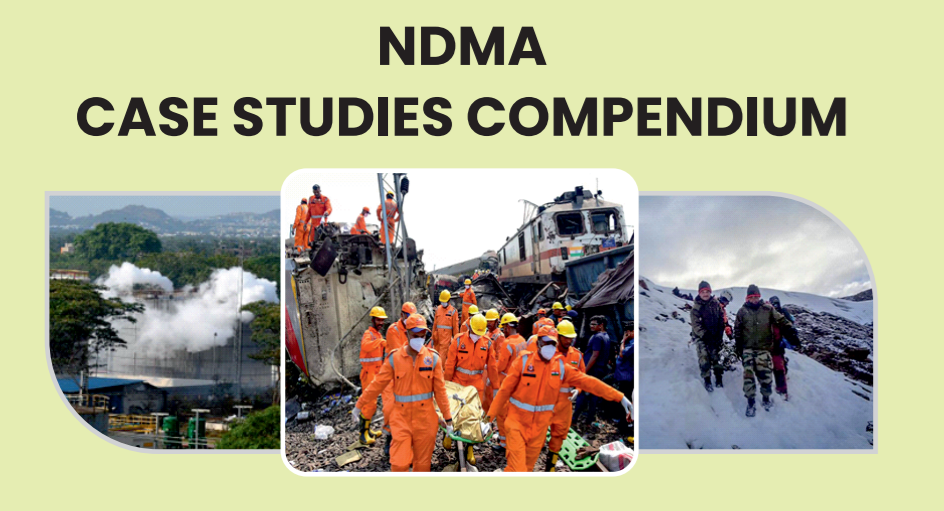
(Feature Image Cover Photo of NDMA Case Studies Compendium)
The National Disaster Management Authority has published “NDMA-Case Studies Compendium” in forward of this document, NDMA members and secretary state the following, which is worth quoting here:
“The NDMA – Case Studies Compendium represents a consolidated effort to capture ten significant disaster events across the country. Each case study provides a detailed analysis of causes, responses, challenges, and lessons learnt. Together, they form a repository of knowledge that not only serves as a record of past experiences but also as a guide for shaping future strategies. The document underscores the value of applying evidence- based learning to real-world scenarios, thereby enabling stakeholders to strengthen their capacities for prevention, mitigation, preparedness, response, and recovery… The compendium also brings out recurring themes such as the indispensability of multi-agency coordination, the role of technology and innovation, the importance of community engagement, and the need for continuous institutional reforms… It is our firm belief that these documented experiences will empower senior administrators and disaster managers to make informed, timely, and effective decisions when confronted with emergencies… This… is presented with the hope that it will inspire reflection, strengthen institutional capacities, and promote a culture of continuous learning in disaster risk reduction and management.”
A word about accountability here would have been appropriate. What is mentioned under that heading in the document is far from adequate, in fact it does not mention anything about accountability related to the reasons for the disaster and what could have been done in that context and also disaster response of that particular disaster. That is what is required as a first step. And that is not covered in the document.
HYDRO POWER PROJECTS
NDMA – Case Studies Compendium on 10 significant disaster events across the country includes Feb. 2021 Chamoli Glacier Outburst, Oct. 2023 Sikkim Teesta Flood Disaster; Nov. 2023 Silkyara Tunnel Collapse and July 2024 Wayanad Landslide cases, among others.
Chamoli Glacier Outburst; Feb. 2021: History of Previous Incidents The region has experienced significant disasters in recent decades. The 2013 Kedarnath disaster in the same state killed thousands and highlighted the vulnerability of Himalayan regions to extreme weather and geological events. The Rishiganga hydropower project itself had previously suffered damage in the 2016 floods, leading to the stoppage of power generation until its revival in June 2020. Historical analysis reveals that similar frontal ice-block failures occurred at the same site in early 2000, indicating a recurring pattern of glacier instability in this location.
Human Impact: The disaster resulted in catastrophic human losses, with 204 people reported missing or dead. The confirmed death toll reached 77 individuals, including 16 who perished in the Tapovan tunnel. Among the casualties, most were construction workers employed at the hydropower projects, highlighting the vulnerability of infrastructure workers in high-risk environments. Twelve workers were successfully rescued from the NTPC tunnel system in a complex operation lasting several days. Six people sustained injuries during the initial impact and rescue operations.
Economic Impact: The economic devastation was immense, with total losses estimated at over ₹4,000 Crore. The NTPC Tapovan-Vishnugad project suffered damages worth approximately ₹1,500 Crore, representing nearly 25% of the total project cost of ₹5,867 Crore. The project, which was 70% complete before the disaster, faced an uncertain timeline for completion, with questions about the feasibility of resuming construction.
The 13.2 MW Rishiganga hydropower project was destroyed, representing a total loss of the facility that had just resumed operations in June 2020 after previous flood damage. This project had been operational for less than eight months before its complete destruction. Infrastructure damage extended beyond the power projects, including the destruction of five major bridges, severely damaging the Joshimath-Malari highway, and cutting off road connectivity to multiple remote villages. The cost of bridge reconstruction and road rehabilitation added significantly to the overall economic burden. Additionally, the disaster resulted in the loss of heavy machinery, construction equipment, and facilities at both project sites.
Environmental Impact: The environmental consequences were severe and multifaceted. The debris flow transported approximately 27 million cubic meters of rock, ice, and sediment downstream, fundamentally altering the geomorphology of the river valleys. The artificial lake formation created new ecological conditions that required ongoing monitoring to assess stability and potential environmental risks.
River channel modifications occurred along a 32-kilometre stretch, with significant changes to flow patterns, sediment deposition, and aquatic ecosystems. The massive sedimentation affected water quality and aquatic habitat throughout the affected river system. Forest areas along the flow path experienced destruction, with vegetation cleared by the debris flow and subsequent flooding.
The disaster also resulted in the loss of approximately 186 livestock, affecting local pastoral communities and reducing genetic diversity in local animal populations. Agricultural lands in the affected areas suffered from sediment deposition and infrastructure damage, impacting food security and traditional livelihoods.
Sikkim Teesta Flood, Oct. 2023: History of Previous Incidents Historical records indicate a 1968 GLOF from South Lhonak Lake that caused downstream damage, though the lake was considerably smaller at that time. More recently, severe flooding in 2022 displaced tens of thousands of people and killed at least 24 individuals, demonstrating the state’s recurring vulnerability to extreme hydrological events.
Regional GLOF history includes several catastrophic events that informed understanding of glacial hazards in the broader Himalayan context. The 1985 Dig Tsho GLOF in Nepal destroyed the Namche Small Hydropower Project and caused numerous casualties, establishing precedents for GLOF impacts on infrastructure. The 2013 Kedarnath floods in Uttarakhand, while triggered by extreme precipitation rather than glacial processes, demonstrated the catastrophic potential of high-mountain flood events in the Indian context.
Impact Assessment: Human Impact: The Sikkim Teesta flash flood disaster resulted in devastating human casualties across multiple states. According to official reports, 42 people lost their lives, with 77 individuals reported missing, creating profound trauma for affected families and communities. The casualty distribution showed Pakyong district suffering the highest toll with 27 fatalities, including 11 Indian Army personnel, followed by Gangtok (8 deaths), Mangan (4 deaths), and Namchi (3 deaths).
The disaster affected a total population of 88,400 people across four districts in Sikkim, with thousands requiring immediate evacuation and temporary shelter. Over 2,563 people were successfully rescued from dangerous areas, while 5,665 individuals were evacuated to safety. The displacement crisis was managed through 30 relief camps accommodating 5,665 people at peak capacity, with additional arrangements made for 5,019 affected persons in rented accommodations arranged by civil administration.
Economic Impact: The economic devastation was catastrophic, with damages estimated in billions of rupees. The destruction of the 1,200 MW Teesta-III hydropower project represented the single largest infrastructure loss, eliminating a critical energy asset worth thousands of Crores. This facility was a flagship project under India’s hydropower development program in the northeastern region.
Housing infrastructure suffered extensively, with 2,004 houses damaged, of which 1,425 were destroyed and 579 partially damaged. The Sikkim government announced rehabilitation schemes, including the Sikkim Punarvaas Awaas Yojana for constructing 2,100 houses and Sikkim Janta Housing Colony for 2,000 rental units, requiring massive financial allocations exceeding ₹881 Crores.
Transportation infrastructure bore heavy losses with 33 bridges washed away and extensive damage to National Highway 10, the lifeline connecting Sikkim to the rest of India. State highways and rural roads suffered severe damage, isolating communities and hampering rescue operations. The economic disruption extended to loss of livelihoods, with 922 shops affected and agricultural losses impacting rural communities.
Environmental Impact: The environmental consequences were unprecedented in scale and severity. The GLOF mobilized approximately 270 million cubic meters of sediment along its 70-kilometre path from South Lhonak Lake, representing one of the largest sediment transport events recorded in the Himalayas. This massive sediment load fundamentally altered the Teesta River’s morphology, raising bed levels by 10-15 feet in several stretches and creating new flood vulnerability patterns.
The disaster triggered numerous secondary landslides due to slope destabilization and toe erosion caused by the flood. These mass wasting events contributed additional sediment to the river system while destroying forest cover and biodiversity habitats. The event resulted in 1,831 animal deaths and 29,389 poultry deaths, indicating significant impacts on local ecosystems and agricultural systems.
Water quality degradation affected downstream communities as the massive sediment load contaminated water sources. The destruction of sewage treatment plants in multiple locations created additional pollution concerns. Soil erosion and riverbank destabilisation increased long-term flood and landslide risks throughout the valley.
Silkyara Tunnel Collapse; Nov. 2023: History of Previous Incidents: The Silkyara tunnel’s troubled construction history provided numerous warning signals that were inadequately addressed. Before the November 12 collapse, the tunnel had experienced 21 documented collapse incidents of varying severity since construction commenced. These events ranged from minor rock falls requiring temporary work stoppages to more significant failures necessitating support system redesigns.
A particularly concerning pattern emerged in 2019 when the initial Authority Engineer (Spanish consultancy firm Eptisa Servicios De Ingenieria) flagged that rock conditions appeared to be “Class V” category (very poor) rather than the “Class IV” designation used in design calculations. This misclassification had serious implications for support system adequacy, as Class V conditions require significantly more robust support measures.
Several other infrastructure projects in Uttarakhand have experienced similar challenges. In 2007, the Vishnuprayag hydropower project’s tunnel began leaking, forcing the relocation of 12 families from Chaien village. The 2021 Chamoli disaster, which devastated multiple hydroelectric projects and claimed over 200 lives, further highlighted the risks of large-scale infrastructure development in the fragile Himalayan environment.
These precedents established a pattern of geological underestimation, inadequate safety margins, and reactive rather than proactive risk management approaches. Environmental experts and geologists had repeatedly warned that the Char Dham project’s scale and pace exceeded the carrying capacity of the Himalayan ecosystem. The Silkyara collapse thus represented not an isolated incident but the culmination of systemic issues in infrastructure planning and risk assessment in one of the world’s most geologically active regions.
Impact Assessment: The economic ramifications of the Silkyara tunnel collapse encompassed immediate rescue costs, project delays, and broader systemic impacts on infrastructure development. Direct rescue operation expenses, estimated at several Crores of rupees, were ultimately borne by Navayuga Engineering Company as part of accountability measures. These costs included specialised equipment procurement, personnel deployment, international expert consultation, and extended logistical support.
The tunnel project itself faced significant delays and cost escalations. Work suspension during the rescue operation and subsequent safety investigations pushed completion timelines further into 2024, adding months to an already delayed schedule. Debris removal, structural assessments, & required design modifications resulted in additional costs of ₹50-100 Cr.
Environmental Impact: -Environmental impacts of the Silkyara incident reflected broader concerns about large-scale infrastructure development in ecologically fragile Himalayan regions. The collapse itself created localised environmental disturbance through debris scattering, dust generation, and temporary alteration of natural drainage patterns. However, these immediate impacts were relatively contained given the tunnel’s enclosed nature.
2021 Chamoli Avalanche, 2024 Wayanad Landslides Were Preventable, Says NDMA After Assessment In a compilation by the NDMA wherein such incidents were assessed, it has been said that the Chamoli incident highlighted the inadequacy of conventional project assessment methodologies in the Himalayan region. The National Disaster Management Authority (NDMA) has said that incidents including the 2021 Chamoli avalanche and the 2024 Wayanad landslides have highlighted gaps in in long-term risk reduction planning and community preparedness measures.
One example cited in the compilation is that of the Silkyara tunnel, which already had a troubled construction history and provided numerous warning signals which were not addressed properly, leading to the 2023 collapse. The tunnel had witnessed 21 documented collapse incidents of varying severity since the construction had commenced.
The NDMA assessment said that the Chamoli disaster, which had resulted in the destruction of two hydropower projects showed that human activities create compound risk that exceed traditional engineering assumptions in the Himalayan region, where issues such as geological instability and impact of climate change are major concerns. It said that in the future, infrastructure development must incorporate dynamic risk modelling that accounts for changing environmental conditions and compound hazard scenarios. The NDMA said that thorough geological, seismic, and climate risk evaluations are a must.
Sikkim’s relentless earthquakes could spell disaster Hydropower tells perhaps the starkest story. Sikkim has invested heavily in damming the Teesta and its tributaries. But the track record of seismic and flood damage to these projects raises hard questions. The 2011 earthquake killed workers at a hydroelectric site. The 2023 flood obliterated the Chungthang dam. In 2024, a landslide struck the Teesta V power station at Balutar. Building and rebuilding expensive energy infrastructure in a zone that shakes this frequently is not just an engineering challenge — it is a question of whether the strategy itself is sustainable.
Most critically, the way Sikkim plans its growth must change. Roads carved recklessly into unstable slopes, settlements perched on riverbanks, and massive dam projects in shaking valleys all need to be reassessed against the reality of what Zone VI means. Development that ignores geology is not development — it is a gamble with lives. Sikkim’s mountains are among the most breathtaking on earth. They are also among the most dangerous. The tremors that have become a fact of daily life in the state are not benign rumbles. They are warnings — delivered by the planet itself — that the ground here is alive, restless, and unforgiving.
NHPC bets on AI to future-proof hydropower NHPC in its latest Sustainability Report, the state-run hydropower major flags AI/ML-driven performance analytics and early-warning systems as core tools to improve reliability, reduce outage risk and strengthen climate resilience across its Himalayan fleet. A key strand of this transition is AI-backed risk forecasting in the mountains. NHPC’s collaboration with NRSC (ISRO) spans 26 hydropower stations/projects and includes satellite-based monitoring and risk ranking of glacial lakes, with several potential glacial lakes identified across eight catchments.
The report notes that work is underway on an Early Warning System (EWS) methodology, supported by lake-level data and modelling. The company has also showcased an AI-driven Early Warning System as part of its wider adoption of artificial intelligence, describing it as a tool that strengthens dam safety, improves operational efficiency and enhances disaster preparedness using “real-time data analytics and predictive insights.”
Attunli HEP: NEHR urges APSPCB to republish hearing notice North East Human Rights (NEHR) has urged the Arunachal Pradesh State Pollution Control Board (APSPCB) to publish the public hearing notice for the Attunli hydroelectric project afresh in correct and authentic Idu Mishmi dialect that is spoken and understood by the affected villagers.
The NEHR stated that the language used in the notice dated 18.02.2026 is totally unfamiliar and bears no resemblance to the Idu Mishmi dialect like Midu/Mithu variations spoken and understood by the community members. NEHR chairperson Ebo Mili stated that for consent to be truly informed, it must be based on full, clear, accessible, and culturally appropriate information provided in a language and manner that the affected people can understand.
Dibang HEP: HC admits plea for PAF status of 75,000 downstream residents The Itanagar bench of the Gauhati High Court on Feb. 23 admitted a writ petition seeking recognition of downstream communities affected by the 2,880 MW Dibang Multipurpose Hydro Project as Project Affected Families (PAFs). The petition filed on February 13 seeks formal recognition of residents in the Lower Dibang Valley of Arunachal Pradesh and the Tinsukia–Sadiya belt of Assam as PAFs, making them eligible for rehabilitation and compensation benefits under the law.
The petition levels multiple allegations against authorities and the NHPC. These include the alleged arbitrary denial of PAF status to downstream communities despite official acknowledgements that inundation and flood risks could extend up to 63 km downstream. It also questions the validity of the 2016 Cumulative Impact Assessment Study, claiming it omitted the first 45 km stretch downstream; described as the most densely populated zone. The plea further alleges that mandatory public hearings were not conducted in downstream districts of Assam, in violation of the EIA Notification, 2006.
SUMP: 2 more villages sign MoUs From Simong village, 128 out of 144 families on Feb. 26 signed the MoU, while all nine out of nine families of Halleng signed the MoU. This progress builds upon earlier support extended by other villages, where 245 out of 258 families in Komkar and 93 out of 120 families in Karko had previously signed MoUs for the PFR stage.
J&K Assembly move to shift HEP assets under State A private member’s resolution scheduled for April 2 during the Budget session of the Jammu and Kashmir Legislative Assembly has revived the debate over control of the region’s hydropower assets. National Conference (NC) legislator Sajad Shaheen has sought the transfer of operational control or ownership of projects run by the NHPC to the UT government, saying Jammu and Kashmir should have greater authority over infrastructure built on its rivers. The resolution calls for consultations with the UT administration and other stakeholders in line with constitutional provisions, existing laws and inter-governmental arrangements.
MP defends party’s resolution on NHPC NC Rajya Sabha member Chowdhary Ramzan on Feb. 23 defended the party’s resolution concerning NHPC-run hydropower projects, asserting that Jammu and Kashmir must reclaim control over its major power assets. Ramzan said the NHPC has already recovered far more than its initial investment in the hydel projects operating in the region and argued that the time has come for their ownership to revert to Jammu and Kashmir.
Return of NHPC power projects among resolutions The J&K Legislative Assembly is set to take up a wide-ranging private members agenda during the second leg of its Budget Session, with 14 resolutions formally listed for consideration, including a proposal seeking the phased return of hydroelectric power projects presently operated by the NHPC to J&K government.
DAMS
2020-25: In 4 of 5 appeals, green watchdog NGT rules in favour of developers to clear projects Today, the threads to safeguard public interest against ecological degradation that the National Green Tribunal (NGT) was supposed to protect as suggested by a Supreme Court order in 2021, are fraying under the weight of a startling shift.
An investigation by The Indian Express of over 100,000 NGT orders since 2020 reveals a deepening asymmetry. In matters of environmental and forest clearances (EC/FC), the Tribunal has ruled in favour of project developers in four out of every five cases — either by upholding a contested clearance or staying its denial.
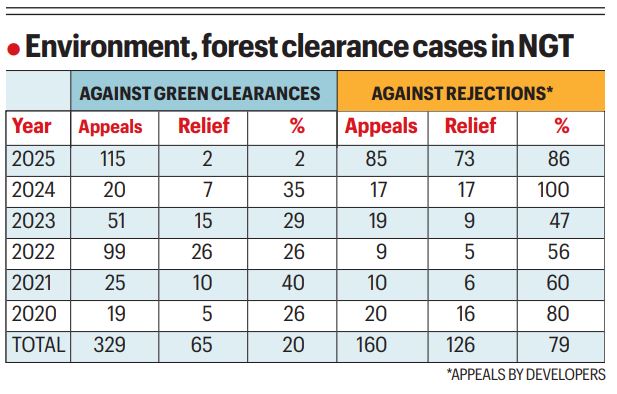
Between 2020 and 2025 (see above chart), of the 329 appeals filed by citizens and activists against the grant of clearances by the Government, only in 20% (65 cases), did the NGT rule in favour of the appeal. Conversely, when the project’s proponents appealed against the denial of clearances by the government, in nearly 80% (126 of 160) of the cases, they secured relief.
This pro-project trend has accelerated sharply in the last 24 months. Between 2024 and 2025, only 7% of appeals challenging clearances were successful. In contrast, 88% of industry-led appeals against clearance rejections got relief.
Most of NGT experts now are former Govt officers The NGT Act requires the tribunal to have 10-20 full-time judicial members and 10-20 full-time expert members. The experts are meant to be drawn from “reputed national level institutions” or government wings “dealing with environmental matters” to help the NGT affirm its mandate of protecting the environment.
The NGT today is a truncated body — functioning at half of its prescribed minimum strength of 20 with only four judicial and six expert members. That’s not all. As many as nine of 13 expert members appointed in the NGT since 2016 were part of the decision-making process for granting various green clearances at the highest level of the government during their stint in the Environment ministry and state forest departments. In contrast, before 2016, only two of the 11 experts were associated with the government’s green clearance process.
This trend raises questions of conflict of interests and propriety as the Tribunal’s appellate jurisdiction covers all government orders, including project clearances issued under the Environment Protection Act (EPA), 1986 and the Forest Conservation Act (FCA), 1980. Barring occasional recusals, these members have been adjudicating appeals against decisions they had made themselves while in the government.
Courts now justify environment degradation: former SC judge Former Supreme Court judge Justice Deepak Gupta on Feb. 25 said that courts now justify environmental degradation and attacked the judiciary over different decisions, ranging from a clean chit to Vantara to allowing the Great Nicobar project. “The Supreme Court and the High Courts were very active. They took a pro-active role in protecting the environment. Unfortunately, that is not true anymore,” he said at the Anil Agarwal Dialogue 2026, organised by the Centre for Science and Environment, in Nimli of Rajasthan.
“Now, there are certain phrases which the court uses to justify environmental degradation. Procedure has become more important than the environment,” he said, adding that courts mostly check only if procedure is followed. “I’m sorry, that is not where the court’s role finishes. The procedure may have been followed, but if the end result is an environmental disaster, the court is required to step in,” he added.
The former Supreme Court judge also said that the Central Empowered Committee (CEC), which was set up by the Supreme Court, earlier consisted of forest officials, bureaucrats, experts, and lawyers, among others, but now has only government officials. “And reports (of the CEC) tend to now favour the government, as we saw in the Aravalli case,” he said, adding that there are other issues with the Aravallis, but he does not want to comment on them as the case is pending before the Supreme Court.
Justice Gupta also said that there are many sensitive geographic areas where the court must step in. “It is because other things are at play, like the bigger the contract, you know there are other things that are big. So, the environment has taken a backseat,” he added. The former Supreme Court judge also said that eco-sensitive zones are being rolled back everywhere and permissions for the rollbacks are being given easily. “But now many times, the only thing that is checked is whether the procedure is followed,” he said.
Kaleshwaram project will be brought back to use: CM A Revanth Reddy on Feb. 22 said the Kaleshwaram project will not be abandoned and that Medigadda, Annaram and Sundilla barrages will be brought back into use, and also promised to complete all irrigation projects between Tummidihatti and Bhadrachalam on river Godavari.
Later, the CM held a review meeting with the engineers at the project site and told them that the govt would release 600 crore by June 2 for land acquisition, to repair the Devadula project pumps in a month, a special meeting with local MLAs and officials on Devadula would be held during the budget session, special corpus fund for land acquisition would be set up, compensation to affected families would be released through green channel. Uttam Kumar Reddy said the Devadula project would be completed by Dec 2027. Uttam Kumar Reddy said the govt was prioritizing the long-delayed project, which was started in 2001.
Bhakra Dam deflection exceeds design limit, safety review planned The Bhakra Dam has recorded structural deflection beyond its permissible limit amid consistently high reservoir levels. Technical observations show the dam recorded a maximum deflection of 1.17770 inches this year, compared to the designed static loading limit of 1.03 inches. On Feb 24 2026, the deflection was 1.04 inches. BBMB Chairman Manoj Tripathi said the Bhakra Beas Management Board (BBMB) was planning to engage international experts through the National Dam Safety Authority to examine the reasons behind it.
In recent years, the water level has not dropped below 1,550 feet (FRL 1680 ft and MDDL 1462 ft), preventing the dam from fully returning to its equilibrium position. Engineers believe the prolonged high loading cycle has contributed to the increased deflection. Officials are planning a controlled drawdown during the coming summer months, targeting a level between 1,490 and 1,510 feet. Engineers said lowering the reservoir level would reduce structural loading and allow elastic recovery. They said the move was precautionary and not due to any immediate threat.
Protests by Ken Betwa Project affected people “We want to move from protest towards resolution. But if the administration uses force and commits injustice, we will strongly oppose it,” Amit Bhatnagar says. The protests continue. In our conversations, the villagers repeatedly emphasised their demands for ₹25 lakh per family, separate compensation for every adult, fair land valuation, and separate compensation for women. They also, more importantly, emphasised the power of people in a democracy. Bhagwati frankly says that she will not allow the dam to be built unless their demands are fulfilled, even if it costs her life, says this Ground Report dated Feb 27 2026.
Decisions of MoEF’s Expert Appraisal Committee on River Valley Projects held on Feb 12 2026 1. Velimalai Pumped Storage Hydro Electric Project (1000 MW) in 159.25 Ha at Village Alur and Velimalai, Sub Dist Kalkulam, Dist Kanniyakumari, Tamil Nadu by Tamil Nadu Green Energy Corp Ltd – Terms of References: APPROVED
2. Chitawad Barrage Major Irrigation Project (CCA: 65000 Ha) in 4120.67 Ha at Village Thikriya, Alot, Amri, etc, Sub Dist Mahidpur, Nagda, Ghatiya and Tarana, Dist Ujjain, Madhya Pradesh for Terms of References: Deferred as requested by PP
3. Savitri Open Loop Pumped Storage Project (2400 MW) in 310.76 Ha at Village Javali, Dare, Haroshi, Karanje etc, Sub-dist Poladpur and Mahabaleshwar, Dist Satara and Raigarh, Maharashtra by NHPC ltd – Terms of References: APPROVED
Relevant Agenda of MoEF’s Forest Advisory Committee Meeting held on Feb 27 2026:
1 Diversion of 261.53 ha of unclassed forest land for the Attunli Hydro Electric Project (680 MW) on the Talo (Tangon) River, in Anini Forest Division, Dibang Valley District, Arunachal Pradesh.
2 Diversion of 49.850 ha of forest land for the Jagmadwa Minor Tank Project in Kabirdham District, Chhattisgarh.
3 Diversion of 111.0277 ha (originally proposed area: 173.3105 ha) of forest land from CH 000+00 to 261.690 km in Hassan and Tumkur Districts for the gravity canal under the Yettinahole Drinking Water Project, by Visvesvaraya Jala Nigam Limited, Karnataka.
4 Diversion of 6.6151 ha (revised from 9.08 ha) of forest land for the Marshall Small Hydel Power Project (24.75 MW) in Rewa District, Madhya Pradesh.
5 Diversion of 520.66 ha of forest land (308.96 ha under Satna Forest Division, Satna District, and 211.70 ha under North Panna Forest Division, Panna District) for the Panari Standalone Pumped Storage Project (1800 MW) by M/s Sri Siddharth Infratech & Services (1) Private Limited, Madhya Pradesh.
6 Diversion of 243.74 ha (Shahapur Division: 181.45 ha and West Nasik Division: 62.29 ha) of forest land (Reserved Forest, Protected Forest, and Private Forest) for the Bhavali Pumped Storage Project (1500 MW) of JSW Energy PSP Two Limited in Thane and Nasik Districts, Maharashtra.
7 Diversion of 107.596 ha (including 0.99 ha of forest land diverted earlier) of forest land for the Upper Indravati Pumped Storage Project (600 MW) at Mukhiguda, Kalahandi District, by Odisha Hydropower Corporation Ltd., Odisha.
RIVERS AS NATIONAL WATERWAYS
Panjim residents oppose new casino ship in Mandovi river As residents of several parts of Goa have been protesting against a provision of the Town Planning Act that opens green zones up for construction, many in the state capital have been up in arms against another development: the imminent arrival of a new 112-metre-long casino ship on the Mandovi river. The casino ship, which is likely to reach Goa by the end of February, will be anchored in Verem Bay in the Mandovi river, opposite central Panjim.
Goa is already home to six offshore casinos and 18 casinos in five-star hotels on land. Since at least 2008, Panjim residents and civil society groups have protested against the casinos, and documented how the ships and related infrastructure has polluted the Mandovi river with sewage and effluents, affecting marine ecology. Residents have also said noise from the casinos late into the night disrupts their lives.
URBAN RIVERS
Musi RFD plan sparks eviction fears Residents of Madhu Park Ridge apartments have objected to the state government’s proposal to acquire structures within a newly defined 50-metre buffer zone as part of the Musi Riverfront Development Project, saying their homes were built with valid approvals and warning that the move could displace more than 2,000 people.
Residents flagged the lack of transparency, noting that neither the DPR nor a preliminary report is publicly available. Residents have demanded that the acquisition process be halted and called on the government to release maps and project documents and hold consultations with affected families before proceeding. Residents are consulting lawyers and considering legal options, including approaching the high court.
Tushar Gandhi slams evictions Amid protests from the Opposition over eviction notices sent to residents of Madhu Park Ridge Apartments for the Gandhi Sarovar Project on the banks of Musi river in Hyderabad, Tushar Gandhi, the great-grandson of Mahatma Gandhi, joined in the criticism and asked the Telangana government to call off the move. A “Gandhi Circle of Unity” and the world’s tallest Gandhi statue will also be built at the confluence of the Musi and Esa rivers, where ashes of Mahatma Gandhi were immersed in 1948, the CM had announced earlier.
All structures within 50 metres of musi banks to be acquired For the implementation of the Musi Riverfront Development Project (MRDP), Rajendranagar Revenue Divisional Officer (RDO) K Venkat Reddy said revenue authorities of Rangareddy district have issued a notification for land acquisition in two divisions, Kismatpur and Dargah Khaleej. He added that properties in Bandlaguda Jagir and Upparpally will also be acquired soon. All residential and other structures within 50 metres of the Musi river boundary will be acquired for the project, he said, adding that there is no scope for further construction in the identified areas.
Waste dump caught fire along Mula-Mutha A fierce fire has been burning for two days at a garbage dump on the Mula-Mutha riverbed in Loni Kalbhor, spreading thick smoke and raising serious public health and environmental concerns. The blaze, which began late on February 26, continued into March 01 despite the efforts of more than 25 fire tenders working to control the flames. Trucks continued to dump waste at the site even as firefighters battled the blaze, causing the fire to repeatedly reignite.
Pune’s Rapid Urbanisation Could Erase Green Spaces in Three Decades, Says PMC Commissioner
RIVERS
SC closes 2021 Suo Motu case on river pollution The Supreme Court on Feb. 24 closed suo motu proceedings initiated in January 2021 on the issue of polluted rivers, with Chief Justice of India Surya Kant observing that little progress had been made since the Court took cognizance of the matter and that the responsibility should primarily rest with the NGT.
Closing the proceedings, the bench comprising Chief Justice of India Surya Kant and Justice Joymalya Bagchi said that the matter relating to river pollution should be pursued before the NGT and that parallel proceedings before multiple forums affected continuity and uniformity of directions. During the hearing, the Chief Justice candidly remarked on the lack of progress in the case. “In 2021 after we took suo motu, this case did not proceed,” he observed.
Justice Joymalya Bagchi also noted that the NGT had been “embarrassed” by the pendency of the proceedings, to which the Chief Justice responded that the Court did not wish to say much in open court but acknowledged that the tribunal had not heard the matter due to the pendency of the suo motu case in the Supreme Court, though nothing much happened in the suo motu case. The Chief Justice added that the tribunal had erred in closing the original proceedings in 2021 in haste and said the issue required sustained monitoring rather than one-time adjudication.
The suo motu case had originated from concerns about rising pollution levels in the Yamuna river. The Court had taken cognizance of the issue and expanded the scope to include pollution caused by untreated sewage discharge into rivers across multiple States. In the order passed, the Court observed that the right to live in hygienic conditions with human dignity and a clean environment forms part of the right to life under Article 21 of the Constitution.
It also noted that under the statutory framework relating to water pollution, the Central Pollution Control Board and State Pollution Control Boards are obligated to ensure that untreated sewage is not discharged into rivers.
The Bench emphasised that the NGT is empowered to perform judicial and quasi-judicial functions in environmental matters and should ensure continuous monitoring of compliance. The Court observed that the responsibility of the tribunal does not end with issuing directions and that it must ensure periodic status reports and implementation of orders by governments and other stakeholders.
Referring to the pendency of the proceedings, the Chief Justice said that “much water has flown” during the period and that in the absence of updated information, the Court could not assess whether conditions had improved. The Bench also noted that instead of initiating suo motu proceedings, the Supreme Court could have directed the NGT to ensure compliance with environmental norms. “Multiple and overlapping proceedings affect continuity and uniformity of directions,” the Court observed.
Holding that the NGT remained the appropriate forum for monitoring river pollution issues, the Court ordered closure of the suo motu proceedings while permitting revival of proceedings before the tribunal. “Is it possible for this court to look at all polluted rivers? We can look at it one by one. We also keep entertaining so many matters and issue directions. …we also have to see that we entertain matters together. Why to have a multiplicity of issues like this?” CJI remarked.
In memoriam: R Nallakannu, the comrade who stood guard over Tamil Nadu’s rivers With R Nallakannu’s passing away at 101, Tamil Nadu loses one of the last public figures who saw ecology as a moral question.
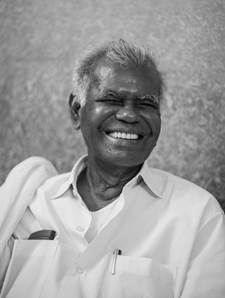
Photo of R Nallakannu. Photo Credit: M Palani Kumar, Source: PARI
R Nallakannu’s politics began with rivers. Long before environmentalism became a language of policy or climate summits, he understood something simple and elemental. When a river is wounded, the poor bleed first. Through decades of political life, he returned again and again to that truth, standing firmly against sand mining, resource plunder and projects that threatened fragile landscapes.
His campaign against river sand mining became one of the defining chapters of his public life. Tamil Nadu’s rivers were being stripped by mechanised mining. Riverbeds sank deeper, groundwater declined, agriculture suffered, and ecological balance began to collapse. He joined protests, backed legal interventions, addressed meetings across the state, and insisted that development without ecological restraint would ultimately destroy livelihoods. He believed that development had to be accountable to people who lived closest to nature.
India’s sinking river deltas A new global scientific study now reveals a troubling shift beneath these productive landscapes. More than half of the world’s major river deltas are sinking, and several of India’s largest deltas are subsiding at rates faster than global sea level rise. The driver is not only climate change or coastal erosion, but human activity itself, particularly unsustainable groundwater extraction.
Kharun Basin: Rising floods, falling water security A new peer-reviewed study in Environmental and Sustainability Indicators by Vipin Kumar Mishra and colleagues applies advanced machine-learning methods to examine how climate change and land-use transformation are reshaping water availability in the Kharun River Basin. The findings challenge conventional assumptions. The basin is projected to receive more total water in the future, yet become less secure.
This emerging paradox is stark: higher runoff, increased flooding, and greater sediment loads alongside intensified dry-season stress. In other words, abundance without assurance. The Kharun’s future mirrors a wider pattern unfolding across India’s monsoon heartland, where climate variability and landscape change are altering not just how much water flows, but when and how reliably it can be used.
Kaleshwaram Treasures – Temples, Tussar, Three Rivers Located at the confluence of the Pranahita and Godavari rivers, Kaleshwaram finds mention in ancient texts and treatises such as the Skanda Purana. A third, invisible underground river is believed to join the above two rivers at Kaleshwaram. Lord Shiva presides over this confluence, where the mystical Saraswati is said to remain subterranean. This holy place is revered much like the Sangam at Prayag in north India.
The forest deity Shiva presides over this picturesque meeting point of the Godavari and Indravati rivers, along with the subterranean Saraswati. Situated at the borders of Maharashtra, Chhattisgarh and Telangana, it attracts pilgrims from all three States for its natural beauty and religious significance.
Godavari Gold Rush For most people, a receding river is a sign of a dry spell, but for locals in Maharashtra’s Paithan town, when water levels in the Godavari dip, it is time for them to head to the riverbank in search of gold. The Godavari River has served as a place where grieving relatives perform final rituals for their loved ones and cast away jewellery, coins and other valuables that belonged to them.
A senior official from Paithan police station termed the phenomenon as “routine”. “Whenever the water level of the river drops, people arrive with small nets and sieves and venture into the river. They sieve the silt from the river bed in search of valuables,” he said. People believe that the holy river has given them a valuable object when they find something, the official said.
Forest mafia ravaging Shivaliks for farmhouses near Chandigarh Well-heeled forest mafia is levelling hills and diverting seasonal rivulets in eco-fragile Shivalik foothills at Mirzapur village in Majri block and other areas to carve out farmhouses in Chandigarh’s periphery. The violation is being done in areas protected under the Punjab Land Preservation Act (PLPA), 1900, and the adjoining areas that have been taken out (de-listed) from the Act’s provisions.
Despite intervention by the NGT and the Punjab and Haryana High Court, illegal construction in the Shivalik foothills is still rampant. Interestingly, this is the same area for which the state government had brought a farmhouse policy (de-listed areas) that was stayed by the NGT. A survey of the area reveals that in Chotti and Badi Naggal, Parol and other areas, seasonal rivulets have been diverted to reclaim land for farm houses. But no action on the ground is visible.
Long, dry spring season puts Himalayan rivers under stress For centuries, the forests of western Himalayas have quietly recorded every wet spring and every failed one. This record can be found in the rings trees form annually. If winter and spring precipitation is good, the trees grow wider rings. When it fails, the rings narrow. And when scientists studied this ancient data, one year stood out: 2022. Its spring was the driest in the western Himalayas, in at least 396 years.
Alarmingly, the scientists also found that the two decades from 2000 to 2022 were the driest sustained spring seasons in the region since early 1600s, an unprecedented drought. “When you extend the record back nearly 400 years, 2022 emerges as the driest spring we’ve seen,” said Pushpendra Pandey, a researcher from Birbal Sahni Institute of Palaeosciences (BSIP) and lead author of the study, which used tree-ring samples from high-altitude deodars forests in Himachal Pradesh’s Lahaul to reconstruct spring rainfall patterns from 1627. It was published recently in Science of the Total Environment.
Netrananda Sahu, associate professor at Delhi School of Economics, said drying signals have also emerged from hydrological studies in the region. “Our research shows a consistent decline in rainfall, rising heat and decreasing snow depth, all of which reduce soil moisture across seasons,” Sahu said, adding that the scale and persistence of recent drying suggested more than short-term variations. “Our analysis of IMD data from 1901 to 2021 shows a prolonged dry phase, and our field studies of springwater sources in Himachal Pradesh, indicates growing stress on Himalayan water systems,” he said.
Ganga among 46% of global rivers unfit for human use According to a recent study by the Federal University of São Paulo, 46 per cent of the world’s rivers, including the Ganga and the Yamuna, are now so polluted that their water is unfit for both drinking and bathing.
The report states that nearly 6 lakh tonnes of waste are dumped into the Ganga every year. In the capital city of Dehradun, rivers such as the Rispana, Bindal, Asan and Sasua, once primary water sources, are now heavily polluted with plastic waste and industrial effluents. Experts attribute the degradation to unregulated urban expansion, riverside encroachments and industrial activities.
Bengal govt to sign conservation MoU with German firm The Bengal government is all set to sign a MoU with German federal enterprise GIZ and the state mission for clean Ganga (SMCG) to develop a master plan for the Ichamati and Jalangi river basins. The Ichamati and Jalangi rivers — two key rivers in the upper Ganga delta — stand threatened because of a range of reasons.
“In the 2025-26 budget, the state govt had announced a project called Nodi Bandhan with a budgetary provision of ₹200 crore, which was basically mandated to develop the master plans of the river basins in the state in association with an international expert agency. We have decided to start the work in Ichamati and Jalangi basins and will sign a memorandum of understanding (MoU) with GIZ soon,” state irrigation and waterways minister Manas Bhuniya told The Telegraph.
The master plan is expected to devise ways to remove pollutants and other environmental hazards from the Ichamati and Jalangi rivers, minimise erosion, ensure groundwater recharge and mitigate floods. Dredging of the two rivers and ensuring more water flow are likely to be the key objectives of the master plan.
River activists, while hailing the initiative, are sceptical about its on-ground impact. “We are used to hearing about several projects, but there is no real change on the ground. The Jalangi has been plagued by the gradual receding of the water level, coupled with encroachments and pollution. Many have turned parts of the river into private properties by erecting fences,” said Debanjan Bagchi of a platform that fights for the rejuvenation of the river.The activists have demanded that the state government consult independent experts and local people before finalising the master plan.
Yamuna remains foul One year since the BJP came to power in Delhi, promising a cleaner Yamuna, the stench and situation remain the same. According to Bhim Singh Rawat of the South Asia Network on Dams, Rivers and People (SANDRP), the situation, rather than improving, has further deteriorated. “The river governance, which was already in a poor state, has worsened,” he said.
Rawat points to the Delhi Pollution Control Board (DPCC), which publishes monthly analyses of the Yamuna’s water quality. “Since October, we have been seeing delays,” he said. The reports for November and December were released late. January’s analysis is yet to be made public. “Earlier, whatever the condition of the river, the DPCC would at least put the data out in public,” said Rawat. “If you are serious about cleaning the Yamuna, you have to begin by analysing what’s wrong, what interventions are being made and what outcomes they are producing. Instead, the data is being withheld.”
Report flags Panipat textile recycling industry pollution The lack of a cluster-wide waste management protocol and the absence of tracking mechanisms has lead to informal burning and open disposal of the waste generated by the industry causing air and water pollution, said a report by the Foundation for MSME Clusters (FMC), released in New Delhi on Feb. 26.
The report “Panipat Textile Recycling – Sustainability Readiness Report” has identified a wide range of solid, liquid, and semi-solid wastes generated by the recycling and processing activities in Panipat across different stages of production including fibre residues, dye sludge, boiler ash, packaging plastics, and contaminated non-recyclables – each posing distinct environmental management challenges.
FISH, FISHERIES, FISHERFOLKS
Gitchak nakana the first groundwater-dwelling fish from Northeast Abstract: -Subterranean animals are commonly met with considerable fascination, by both laymen and biologists. While most of these animals have been reported from caves, some species have adapted to other underground habitats. One special subterranean aquatic habitat are aquifers, which are home to a number of invertebrates and fishes. Of the more than 300 known subterranean fishes, fewer than 10% have been recovered from aquifers and are encountered only rarely and serendipitously. Here we report the discovery of a tiny, blind loach of the family Cobitidae from a dug-out well in Assam, India, which exhibits a number of characters commonly associated with subterranean life, so-called troglomorphies. This loach, described here as Gitchak nakana, represents a new genus and species, differing from all other genera of cobitids by a number of unique characters. The most unusual among these is the complete lack of a skull roof with the brain covered dorsally only by skin. Gitchak nakana is the first aquifer-dwelling (phreatobitic) fish from Northeast India, and marks the first discovery of a previously unknown subterranean fauna in this part of Asia.

The discovery raises an exciting question: could Northeast India’s aquifers harbour more undiscovered subterranean species? Researchers believe this find signals the presence of a specialized and previously unknown groundwater fauna in the region, comparable to that known from the lateritic aquifers of the Western Ghats.
However, Gitchak nakana has so far been found in only a single well, and its exact location remains undisclosed to prevent over-collection. Past experience, such as the appearance of Meghalaya’s cave mahseer Neolissochilus pnar in the international aquarium trade, underscores the need for caution. Beneath the soils and sediments of Northeast India, an invisible ecosystem may be thriving, one that science is only just beginning to uncover.
Neglect, pollution push Sherbagh springs into ecological crisis Fish deaths at the historic Nagbal springs in Sherbagh garden have been attributed to fungal and bacterial infections triggered by highly contaminated and oxygen-depleted water, fisheries officials said. Indigenous cold-water fish (Schizothorax species) have been dying since Feb. 15 across two spring-fed ponds and their water channels at Sherbagh garden, raising concerns among locals and prompting an inspection by the Fisheries Department.
“The mass fish death is due to fungal infestation and bacterial infection,” Assistant Director of Fisheries Anantnag Shabir Ahmad told Greater Kashmir, adding that dissolved oxygen levels are very low and carbon dioxide levels are high. “The mortality cannot be attributed to a single factor.” It is a multifactorial problem, primarily driven by oxygen stress, low dissolved oxygen and excessive nutrient buildup, which weakened the livestock and made them vulnerable to infections,” Ahmad said.
SAND MINING
Illegal mining rackets used fake permits The Enforcement Directorate (ED) has unearthed a large-scale illegal sand mining racket operating in Nagpur and Bhandara districts of Vidarbha, allegedly using fabricated Electronic Transit Permits (ETPs) from Madhya Pradesh to pass off illegally excavated sand as legally sourced material. The agency has pegged the proceeds of crime at over ₹30 crore.
According to ED officials, multiple organised networks extracted sand from river ghats in and around Nagpur and Bhandara despite restrictions on mining. The syndicates allegedly procured fake ETPs purportedly issued for mining and transport operations in Madhya Pradesh, enabling them to show on paper that the sand originated from leased ghats in the neighbouring state.
Each forged ETP was allegedly purchased for ₹6,000 to ₹10,000 from a fraud network based in Madhya Pradesh. The permits carried vehicle numbers that appeared valid on government portals. However, analysis of the vehicles’ GPS data told a different story.
Illegal extraction near Annaram barrage pillars raises safety concerns In blatant violation of rules and regulations, sand is being extracted near the pillars of the Annaram barrage, triggering serious concerns over the stability and safety of the structure. This comes after CM A Revanth Reddy assured that repairs would be taken up at the Medigadda barrage, Sundilla barrage and Annaram barrages, and that they would not be allowed to fall into disrepair. However, in sharp contrast to the CM’s assurances, unauthorized sand extraction is reportedly continuing near the Annaram barrage. Despite strict regulations prohibiting such activity, illegal extraction and transportation of sand are continuing unabated.
Anger grows over ‘illegal’ sand mining in Korapuzha Resentment is growing over “illegal” sand mining being carried out under the guise of dredging to remove accumulated silt and other sediments in the Korapuzha river in Kozhikode. Last week, protesters blocked a contracting firm from transporting sand from Mattuvayal. Fishers and local residents also demolished a temporary bridge constructed over the Azheekkal canal, which was allegedly being used to transport sand. The protesters alleged that the company had been engaged in “indiscriminate” sand mining without adequate “government oversight”.
Desilting, illegal mining eroding Punjab’s ecology Illegal mining has emerged as a focal point of environmental concern in Punjab following a series of strong orders by the NGT, which has exposed how river desilting and hill mining slipped into large-scale commercial exploitation, bypassing mandatory environmental safeguards. In its February 17 order, the NGT stayed desilting work in rivers and seasonal rivulets across Punjab, including key sites in Ropar district, after observing that the exercise was being undertaken not merely for flood management but for commercial gain. The case arose from a petition challenging an auction notice issued by the Punjab Water Resources Department for desilting works, under which the excavated silt and sand were to be sold in the open market.
For the Shivalik foothills and along the Sutlej and Beas, the implications of illegal mining are serious. Environmentalists have long warned that aggressive extraction of river material in this region destabilises riverbanks, increases erosion, and threatens agricultural land. The NGT noted that once desilting crosses into commercial extraction of minor minerals, it squarely attracts the requirement of prior environmental clearance under the Environment Impact Assessment (EIA) Notification, 2006.
Unchecked mining activity in Mirzapur Illegal sand extraction persists despite bans in Mirzapura, disturbing nesting sites and undermining conservation efforts in India’s only freshwater turtle sanctuary, which is also home to rare crocodiles and dolphins.
Illegal mining in Mula Illegal sand mining has once again reared its head in the Balewadi and Wakad crematorium areas of the Mula riverbed that flows through the city. While the work on the river improvement project is underway, taking advantage of it, sand mafias have started encroaching on the river, and it has come to light that sand is being mined and smuggled at night with the help of JCBs and Pokelands.
Aravalli row: SC seeks names of domain experts The Supreme Court on Feb. 26 asked the Environment Ministry and other stakeholders to suggest names of domain experts for the panel which would define the Aravalli hills and ranges and observed that only lawful mining would be allowed in the region. It remarked that there was a need to resolve “critical ambiguities”, including whether the criteria of 100-metre elevation and the 500-metre gap between hills would strip a significant portion of the range of environmental protection.
Mining turns homes into death traps In the shadow of the Aravallis, five villages in Rajasthan’s Kotputli-Behror district live under the crushing impact of mining blasts unleashed by corporate giants.
WETLANDS, LAKES, WATER BODIES
HC halts constructions in Kozhikode’s Kottooli wetlands The Kerala High Court recently directed authorities to ensure that no new construction takes place in the prohibited area of the Kottooli wetlands in Kozhikode while the process to declare the site as a Ramsar wetland is underway.
A Division Bench of Chief Justice Somen Sen and Justice Syam Kumar VM observed that if permanent buildings or other developments are allowed in the Kottooli wetlands while the process to declare it a Ramsar site is still going on, then such action would defeat the very purpose of the Wetlands (Conservation and Management) Rules, 2017 (wetland rules) and the Ramsar convention, both meant to protect wetland.
Gujarat SWA fails to hold a single meeting in last two years The disclosure, made in the Gujarat Legislative Assembly, revealed that the 24-member authority, though formally constituted in 2017, has remained functionally inactive, with zero meetings during the last two years. Gujarat’s wetland governance framework now stands exposed as structurally established but operationally stalled, where detailed ecological definitions exist, international conventions are acknowledged, committee hierarchies are notified yet the core decision-making platform has remained inactive, leaving a silent regulatory gap over ecosystems that cannot afford institutional silence.
RAMSAR WETLANDS
Need paramilitary forces to protect EKW: HC Reprimanding the state for inaction in removing 505 unauthorised constructions on East Kolkata Wetland, Calcutta High Court on Feb. 23 roped in the Union govt to remove them, while stating, “The state does not have the infrastructure. Now the court is contemplating deploying paramilitary forces.”
Justice Amrita Sinha, in her order, flagged the East Kolkata Wetlands Management Authority (EKWMA)’s lack of infrastructure to deal with unauthorised construction on wetlands despite detecting it. It was noted that EKWMA disclosed its inability to handle mass agitation when steps are taken for disconnection of electricity at unauthorised constructions.
Justice Sinha said repeated reports by the EKWMA did not result in any action on the ground. “First of all, you were not in a position to prevent these unauthorised constructions from coming up. Now, when it is to be brought down, you are unable to do it. You do not have the infrastructure. The court has to take help from someone else who can do it,” Justice Sinha observed.
Justice Sinha directed to make the Centre and Union Environment Ministry as parties of the case. The next hearing of the case will be held on 16 March. According to the petitioner, private respondents and their associates forcibly occupied the government’s vested lands, which is the wetland. It was alleged that without any permission from competent authorities they have filled up the wetland and erected multistoried buildings without any sanction. Further, they are bent upon filling up the remaining portions of the wetlands.
Poachers target migratory birds at Chilika Lake Poaching activities have allegedly intensified at Odisha’s Chilika Lake, with foreign migratory birds allegedly being targeted using nets and snares.
WATER OPTIONS
Stepwells brought back to life India is famed for its stepwells – multi-storey structures built to provide access to groundwater, with steps and platforms descending to the water level. Thousands were built across the country near natural aquifers mostly between the 11th and 18th centuries. The Stepwell Atlas, a collaborative effort between researchers and organisations including the Intach, lists more than 3,000. About 100 are in Telangana, with nearly half of these in Hyderabad, reports The Guardian, on Feb 26 2026.
Of the thousands of stepwells that have fallen into disrepair, only a small number have been restored for their original purpose: providing water for domestic and local use such as washing, cleaning and gardening; fewer still provide drinking water. The well at Bansilalpet was the first of its kind in Telangana to do so and has become a template for the revival of other stepwells in the state. Since its restoration was completed in December 2022, the well has consistently maintained a water depth of nine metres (28ft) in the summer months.
“I was sure that the system of harvesting rain to recharge groundwater would work on a larger scale, even today when the built-up area in cities has left very little natural ground for rainwater to seep in,” says Kalpana Ramesh, the woman behind many of the successful rehabilitation of stepwells in Hyderabad.
GROUNDWATER
Farm lands remain submerged at Hisar villages Large tracts of agricultural land along the Sulkhani-Dhansu road in Dhansu, Mirzapur and some other adjoining villages remain submerged in rainwater. Farmers have missed two successive crop seasons without sowing their fields, resulting in financial hardship. Moreover, around 50 dhanis located in the region have been facing difficulties for nearly seven months, as they have been almost cut off from other areas. Some families have even migrated elsewhere due to waterlogging around their residences.
Farmers in the region allege that the severe problem has persisted since the monsoon season, when excessive rainfall and breaches in some canals led to the inundation of entire fields. They said the area is low-lying and already suffers from sem (permanent waterlogging). Excessive rains and the inflow of water from other areas due to canal breaches further aggravated the situation. Sarpanch of Dhansu village, Surjeet Singh, said the administration has installed electric motors to drain out the water, but the process will take more time.
Punjab: Alarming uranium level in Bathinda groundwater High concentration of uranium has been found in groundwater in several parts of Bathinda district, raising concerns over potential long-term health risks for resident’s dependent on borewells and hand pumps for drinking water.
URBAN LAKES, WETLANDS
Karnataka HC directs reinspection over SWD The Karnataka high court has on Feb. 28 directed the BBMP (now GBA) to reinspect and reconsider diverting the course of the storm water drains (SWD) to ensure free flow of water into Subramanyapura lake in at Gubbalala village, Bengaluru South taluk.
Justice R Nataraj gave this direction while dismissing two petitions filed by the Mantri Tranquil Apartments Owners Association along with Mantri Developers Private Limited and Royal Palms Residents Welfare Association, who have put up constructions in survey numbers 7, 9, 11 and 13 of Gubbalala village.
The court noted that the topography of the area, which is evident from the hydrological report conducted by the expert committee, shows that four drains carry the storm water from the catchment area in Gubbalala village into the Subramanyapura lake.
142 Bengaluru lakes water not fit for drinking According to the Board, water samples were collected every month between April and November 2025 for testing. The analysis revealed that none of the sampled lakes met the standards required for drinking water. In most cases, the water can only be used for industrial purposes. Only a handful of lakes were found suitable for supporting aquatic life and birds.
Even the relatively well-maintained Sankey Tank in Malleshwaram has been classified under the ‘D’ category. This means the water may support fish and birds, but it is not fit for drinking, even after treatment. The Pollution Control Board classifies surface water quality into five categories: A, B, C, D and E. Water under categories A, B and C can be treated and made potable. However, all 142 lakes surveyed in Bengaluru fall under categories D and E. This means that not a single lake in the city currently meets the higher standards required for drinking water, even after treatment.
Corporation reviews Bellandur, Varthur lakes The Bengaluru East City Corporation on Feb. 10 reviewed the rejuvenation of the Bellandur and Varthur lakes ahead of the monsoon season. Corporation Commissioner DS Ramesh directed the Bangalore Development Authority (BDA), the custodian of the lakes, to complete the removal of all silt on priority. The inspection comes as the BDA has proposed handing over both lakes to the corporation for future maintenance. He instructed the Bangalore Water Supply and Sewerage Board (BWSSB) to stop sewage from flowing into these lakes.
BDA drains two lakes In the past two weeks, two city lakes – Nagawara and Halasuru – were drained, leaving citizens puzzled and worried. The Greater Bengaluru Authority (GBA) stepped in to reassure them that the water had been drained as part of a comprehensive rejuvenation plan. Metrolife brings you an update on rejuvenation efforts at lakes across the city.
Flamingo haven awaits Protection Even as the yearly arrival of winter migratory flamingos to Mumbai’s eastern waterfront has been unusually delayed, the proposed protection of DPS Flamingo Lake in Navi Mumbai remains stuck in procedural limbo. The State Wildlife Board, chaired by the CM, approved the proposal in April 2025, but the final Government Resolution (GR)is yet to be issued. Environmentalists say the delay has left the wetland without clear conservation authority at a time when it is visible ecological strain.
The NatConnect Foundation has written to the CM seeking early issuance of the GR to formally notify the lake as a Conservation Reserve and transfer its management to the Forest Department. Large portions of the lake are currently covered with a dense layer of green algae, raising concerns about declining oxygen levels and habitat stress. Activists attribute the bloom to stagnant water caused by disrupted intertidal flow. Outlet pipelines are reportedly set at a height that prevents complete drainage during low tide, limiting the lake’s natural flushing process. DPS Flamingo Lake, along with TS Chanakya and NRI Lake wetlands, functions as an important high-tide refuge for flamingos from the Thane Creek Flamingo Sanctuary.
Mumbai’s Powai Lake clean-up spurs tree alarm Environmentalists and residents have lauded civic authorities for accelerating work to divert 18 MLD sewage from entering Powai Lake but raised serious concerns over the Brihanmumbai Municipal Corporation’s (BMC) plan to transplant 112 trees for the construction of a 8 MLD STP near Suvarna Mandir.
URBAN WATER
Bengaluru’s data centre boom deepens water crisis In a city already facing a daily water deficit, the rapid rise of data centres — the physical backbone of cloud computing and artificial intelligence — presents a difficult question: how should the metropolis accommodate one of the most resource-intensive forms of digital infrastructure?
Bengaluru is already a data centre hub, and its footprint is set to expand. Karnataka IT minister Priyank Kharge told TOI that of the 32 operational data centres in the state, 31 are concentrated in Bengaluru. “Ten more facilities are in the pipeline,” he said.
Data centres consume electricity to power servers — and water to cool them. Most large facilities rely on evaporative cooling systems, where water absorbs heat and is lost as vapour. According to Deloitte’s most recent study, 1 MW data centre needs 68,500 litres of water a day. A 20 MW facility — common among newer AI-focused campuses — would, therefore, require approximately 1.4 million litres daily.
That’s equivalent to daily water needs of around 27,000 urban households, based on average per-household consumption norms. The paradox is stark: a city struggling to secure drinking water must also secure cooling water for server farms that power global cloud services.
Each day, the city requires between 2,600 and 3,000 MLD of water for domestic and industrial use. Around 2,000 MLD is pumped from the Cauvery, with the remaining drawn largely from borewells. A significant share of the city’s 14,000 govt borewells have already run dry.
Adding to the strain, nearly a quarter of Cauvery water is lost as unaccounted flow. A BWSSB projection presented to the govt estimates the daily shortfall at 775 MLD, even after Cauvery Stage V becomes fully operational.
Hydrologist Shashank Palur of Well Labs estimates that data centres can consume roughly 26 million litres per megawatt annually. At city-scale capacities, cumulative daily demand could run into tens of millions of litres — equivalent to the needs of over a lakh people. Many facilities rely on groundwater or tanker supply, as industrial water from BWSSB is relatively expensive. Palur argues that the solution lies in shifting to treated water.
Vishwanath S of Biome Environmental Trust notes that environmental clearances require disclosure of water demand and sources, ideally limiting use to tertiary treated wastewater. “If it is groundwater, that is not sustainable,” he said.
Unlike coastal hubs, Bengaluru lacks direct access to submarine cablelanding stations and large water sources. Its inland geography compounds infrastructure pressures: data traffic must route through port cities and water must be pumped, treated and often transported over long distances. In this context, each new hyperscale facility adds not only electrical demand but also thermal load — frequently managed with water.
Report predicts water shortage in 65 wards An analysis by the Indian Institute of Science (IISc) of the city’s groundwater data has predicted water shortage in 65 wards, spread across the city and not just 110 villages, as was expected. An IISc-led team utilised Artificial Intelligence (AI) to analyse real-time data gathered through IoT (Internet of Things) technology. This advanced analysis pinpointed a potential water scarcity in 65 specific wards across Bengaluru, BWSSB said. “This is the first time in the country that an AI-based technological framework has been formulated to effectively predict and manage potential water shortages,” V. Ram Prasath Manohar, chairman, BWSSB, said.
Karnataka: Cabinet okays ₹6,939-cr Cauvery Stage 6 The state cabinet on Feb. 24 approved the Cauvery Stage 6 project at a cost of Rs 6,939 crore. Under Cauvery Stage 6, the BWSSB aims to bring an additional 500 MLD of Cauvery water to the city. The project will serve the residents of Madanayakanahalli, Chikkabanavara, Nelamangala, Hoskote, Devanahalli, Vijayapura and the surrounding areas.
In the last five decades, the BWSSB has completed six Cauvery Water Supply Schemes (CWSS). The first scheme – launched in 1974 – brought in 150 MLD of the river water to the city. Stage 4 was executed in two phases. The most recent one – Cauvery Stage 5 – was launched in October 2024 to supply 775 MLD. Under these schemes, Bengaluru receives 2,275 MLD of Cauvery water.
Bengaluru’s Peenya industrial area to get treated water The Rs 20-crore project is intended to promote the use of treated water and reduce the demand for Cauvery water. Nearly 4 MLD of treated water from the STP at Nagasandra will be supplied to the industrial area through the dedicated pipeline. This is the first such initiative undertaken by the BWSSB.
However, industrialists have raised concerns about on-ground implementation. They flagged issues related to water quality and the lack of infrastructure to store treated water. Several industrialists also expressed apprehension that the pipeline-laying work could further damage already deteriorating roads in the area.
Water Privatised in Salem-Tamil Nadu? The SUEZ has won a 25-year concession contract to provide water services to more than one million residents of Salem, in Tamil Nadu. The Letter of Award provides for a period of 45 days for the parties to enter into the concession contract. This is EUR 456 million contract with by the Salem City Municipal Corporation (SCMC) will involve rehabilitation and modernisation works, to deliver 24/7 water supply. Salem water supply concession contract will be India’s largest project by SUEZ.
Bhandup & Panjrapur WTPs to become operational by 2029–30 Welspun Enterprises Ltd (WEL) has been awarded a Rs 3,145 crore contract by the Brihanmumbai Municipal Corporation (BMC) to design, build, and operate a 910 MLD WTP at Panjrapur. The project includes a 15-year O&M component worth around Rs 1,156 crore. The Panjrapur plant will complement the 2,000 MLD Bhandup WTP, currently under construction, which will replace an ageing facility. Together, the two plants—executed by Welspun with global water management firm Veolia as the technology provider and O&M partner—will create a combined capacity of 2,910 MLD.
The Panjrapur project is scheduled for completion within 48 months, after which it will be operated and maintained for 15 years. The Bhandup plant is expected to be operational by 2029, followed by Panjrapur by 2030. Welspun Chairman BK Goenka said that upon completion of both projects, the company would be treating nearly 65% of Mumbai’s freshwater requirements. With an order book of over Rs 16,000 crore and multiple water and wastewater projects underway—including the 418 MLD Dharavi Wastewater Treatment Facility—Welspun’s expanding portfolio aligns with Mumbai’s broader push for sustainability, water reuse, and circular water management.
‘Halt new constructions amid water scarcity’ With water scarcity worsening in enclaves along the Ghodbunder Highway, BJP has now urged the Thane Municipal Corporation (TMC) to immediately halt permissions for new construction projects in the area.
The TMC draws nearly 585 MLD of water from various sources but still finds it difficult to supply it to over 25 lakh residents. While the administration promised an additional 50 MLd of water and then 100 MLD, these assurances did not translate into relief. Alarmingly, the crisis deepened even before the onset of summer, with the monsoon still three months away.
NGT pulls up Haryana for illegal groundwater use The NGT slammed Haryana govt for not acting against rampant illegal extraction of groundwater in the Gurugram city and ordered an inspection of construction sites, farmhouses, industrial units, educational institutions and pharma units to check if they are illegally drawing groundwater. The data by National Compilation on Dynamic Groundwater Resources shows the city extracted groundwater over twice its permissible limit in 2023 and 2024.
NGT also said all colonies and institutions must maintain functional rainwater harvesting systems, illegal borewells must be sealed and legal users must be monitored through piezometers. It gave the state govt six months to complete the entire process. The tribunal also noted that large-scale extraction happens at farmhouses for gardening and horticulture purposes. “These farm houses (must) utilise STP-treated water for such purposes,” the bench said.
VPP MLA calls for probe into water contamination from Marten VPP MLA from Mawlai, Brightstarwell Marbaniang, raised serious concerns in the Assembly on Feb. 24 about potential groundwater contamination from the long-standing Marten landfill site, prompting a commitment from Public Health Engineering (PHE) Minister Marcuise N. Marak to examine the issue and consider a dedicated scientific study.
IIT-G flags groundwater risks in Kamakhya Project Depth-related precautions identified by the National Institute of Hydrology (NIH) should be strictly adhered during construction of the Maa Kamakhya Access Corridor Project to avoid disturbance to the critical fracture-controlled groundwater pathways, IIT Guwahati has recommended. Following two petitions in the Gauhati High Court, the government had roped in Roorkee-based NIH to conduct detailed geophysical and hydrological survey on the possible impact of the Rs 500-crore Kamakhya corridor project. The NIH report was vetted by IITG. On February 12, the Gauhati High Court had given its go-ahead to the PWD to execute the project after it assured that the precautions recommended by the research institutes will be adhered to.
WATER POLLUTION
Unpackaging the myth of safe bottled water in India In contemporary India, bottled water has quietly shifted from an occasional convenience to an everyday necessity. Across railway stations, offices and restaurants, packaged drinking water is now routine, driven by declining trust in municipal supplies and the belief that water sealed in plastic is safer.
In recent years, however, scientific studies, including research conducted in India, have begun to challenge this perception. While bottled water is regulated and generally found to be microbiologically safe, concerns are no longer limited to bacteria and pathogens. Attention is now turning to less visible risks, including microplastic particles and trace chemicals that leach from plastic containers, and their potential long-term implications for human health and environmental sustainability.
E. coli found in drinking water in Srikakulam Drinking water samples in Srikakulam have tested positive for dangerous E. coli bacteria, confirming suspicions that contaminated water is behind the recent diarrhea outbreak linked to the municipal supply. Authorities had earlier suspected that drainage water was entering the drinking system as the primary cause of illness.
Officials said illegal connections and the use of motors to draw water from drainage channels are mixing sewage with the drinking supply, compounding contamination. Waste from livestock on roads and leaking pipelines have also been cited as factors contributing to the pollution of potable water.
A diarrhoea outbreak in Srikakulam district has triggered public health concern after one person died and at least 76 others were hospitalised, according to official updates reviewed by CM N. Chandrababu Naidu. Two patients are reported to be in critical condition at GEMS Hospital, one on ventilator support and another undergoing dialysis.
Microbial Genes could improve our understanding of water pollution The growing abundance of key denitrification genes (napA and narG) in the earlier samples, followed by a decline in the later samples, indicated a dynamic microbial response to the added nitrate. The researchers’ efforts to use mathematical models to match their observations showed the importance of microbial growth during denitrification to control the extent of nitrate removal. The researchers note that though MTDs do not act as a perfect proxy for studying real aquifers, overall, the findings provide insight into the use of biomarkers to track biogeochemical processes, such as denitrification, in nature. (Journal of Geophysical Research: Biogeosciences, https://doi.org/10.1029/2025JG009181, 2025)
JJM/ RURAL WATER SUPPLY
24% tap water fails test; 75% drink it untreated Pass rates were lower in schools, anganwadis and health facilities compared to households. One in four water samples collected from India’s household tap connections did not meet microbiological standards, according to a 2024 assessment of the Jal Jeevan Mission. While 76% of samples passed laboratory tests, 24% did not, according to the Ministry of Jal Shakti’s national report.
Public institutions recorded lower pass rates than households: 73% water samples collected from schools, anganwadis and health facilities passed microbiological quality tests. This means children, pregnant women and new mothers, and care-seeking Indians are drinking substandard water.
As of January 28, 2026, about 158 million rural households (81.6%) had tap water supply under the Jal Jeevan Mission, the government told Lok Sabha earlier this month. Some 98% households had connections, 87% reported the connections were functional, 84% said they received regular supply and 80% reported receiving adequate quantities of water (defined as more than 55 litres per person per day).
Between Har Ghar Jal and ‘Luxury Litigation’: A Question of Water Quality At a time when ‘Har Ghar Jal’ is celebrated as a milestone in public welfare, the Supreme Court’s refusal, in December 2025, to hear a public interest litigation on bottled drinking water standards should give us all pause. The court’s characterisation of the plea as ‘luxury litigation’ – something unworthy of judicial time when people still lack basic drinking water – unintentionally exposes the chasm between policy narratives and lived realities in India.
It is important to note that the plea did not seek to elevate packaged water above public supply, but to ensure that where the state permits its sale, it protects public health from preventable harm. However, this judicial rhetoric is striking when placed alongside the government’s own claims on water access. According to official figures, more than 81% of rural households now reportedly receive clean tap water under the Jal Jeevan Mission. The court’s assertion that drinking water itself remains largely unavailable directly unsettles that claim. The contradiction is difficult to ignore. If access has indeed expanded so dramatically, why is the assurance of safety framed as premature?
WATER
CWC weekly bulletin on live storage status of 166 reservoirs in the country as on 26.02.2026. Out of 166 reservoirs, 156 reservoirs reported more than 80% of normal storage & 10 reservoirs reported 80% or below of normal storage. Out of these 10 reservoirs 3 are having storage upto 50% of normal storage.
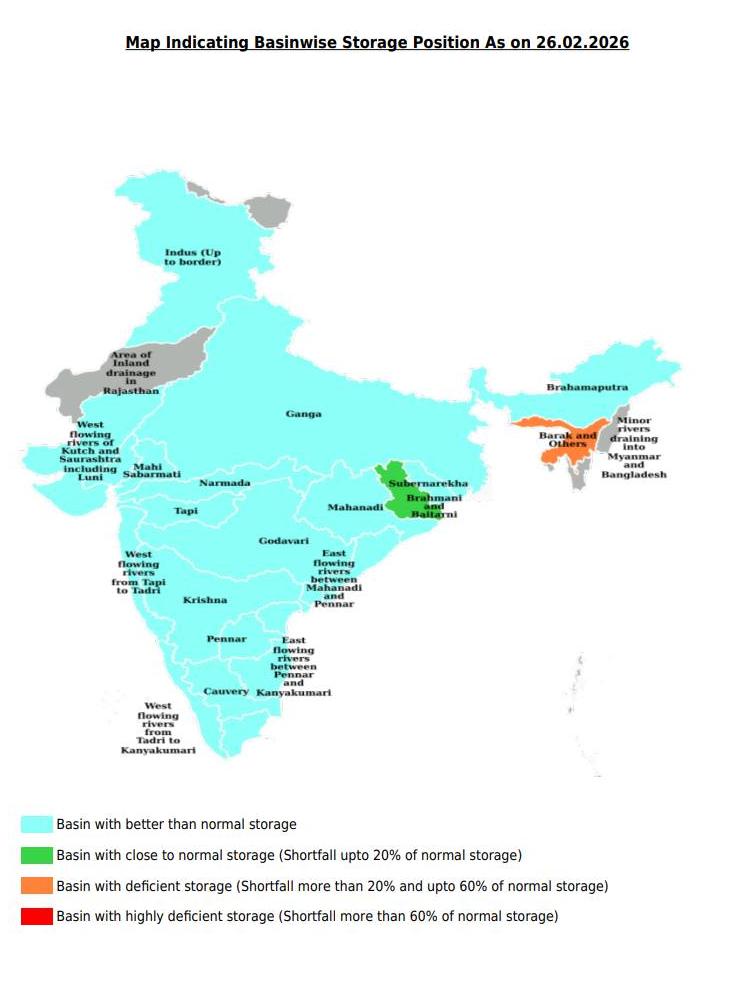
MONSOON
El Nin may emerge earlier than expected Climate Forecast Team at the NASA Goddard Institute for Space Studies/Columbia Center for Climate Systems Research has issued the Feb 2026 ENSO Forecast. As of mid-Feb, the equatorial Pacific is experiencing declining La Niña conditions. The CCSR/IRI ENSO plume forecast places the probability of La Niña at just 4% for Feb–Apr 2026 and shifts the odds in favour of ENSO-neutral conditions (about 96%) for the same period. ENSO-neutral remains the most dominant category through Mar–May (90%) and Apr–Jun (65%), while El Niño probabilities increase rapidly during the same period. Starting in May–July, El Niño probabilities become higher than ENSO-neutral in the range of 58% to 61%, with ENSO-neutral the second most likely outcome.
Strong to super El Niño seen Forecast consistency across multiple ensemble systems and evolving oceanic conditions suggest there is a very high probability of El Niño developing this summer, according to two renowned weather scientists/researchers. An El Nino typically brings a poor south-west monsoon to India, including droughts, though with exceptions.
60% chance of El Niño conditions There is a 60% chance of El Niño during August–October and September–November. In January, the probability stood at 50% for El Niño developing during or after the monsoon, according to the latest forecast from the National Oceanic and Atmospheric Administration (NOAA). El Niño years typically bring weak monsoons and harsh summers to India.
Further, the WHO said in its Global Seasonal Update issued on February 20 that for the March–May (MAM) 2026 season, forecasts for SST patterns indicate a period of transition across the equatorial Pacific. Below-average SST anomalies in the central and eastern equatorial Pacific are forecast to weaken, signaling a move toward ENSO-neutral conditions as the current weak La Niña dissipates.
Assam faces 70% rainfall deficit since Nov Assam has experienced a rainfall deficit of over 70 per cent since November last and 99 per cent since January 1, marking yet another unusually dry winter-a pattern that is increasingly becoming the norm amid growing evidence of climate change. Since January 1, there have been no rains in as many as 25 districts, while in others the deficit has been more than 90 per cent. Against the normal of 39 mm, the State received just 0.4 mm of rainfall since January 1, according to IMD data. In fact, the dry spell had persisted since the second week of November the previous year. In Guwahati, there were some rainy days in the first week of November 2025 (around 27.5 mm), but after November 6, rainfall stopped. The capital city got around 0.2 mm of rainfall on January 5, and barring that day, it has been completely dry since November.
FLOOD MANAGEMENT
Assam: 1,000 km of new embankments since 2021 Sources in the WRD told The Assam Tribune that about 1,000 km of new embankments have been constructed or are under various stages of construction across the State, and around 540 km of embankments have been raised and strengthened. With erosion causing havoc in different parts of the State, 280 anti-erosion schemes covering 320 km have been completed, while 43 sluice gates have been constructed. A total of 862 schemes have been taken up at an estimated cost of Rs 28,117 crore in the last five years.
Last year, Assam did not face major floods due to low rainfall, but the WRD is confident that the new schemes taken up by it would be able to mitigate floods this year. Sources revealed that Embankment Monitoring Committees involving district administration and local communities have been created in the flood-prone areas to ensure that the embankments are properly maintained. A Hydro-Informatics Unit has been established for flood forecasting, modelling and real-time monitoring, while an Integrated Process Management System under development for digitization of workflows has also been put in place.
DISASTERS
As the glaciers recede, so do the people Glacier retreat and erratic snowfall are disrupting farming and water cycles, pushing residents to leave hill villages. Outmigration from Uttarakhand’s hilly districts has reduced some villages to single-digit populations. Experts say infrastructure-led development overlooks climate adaptation and livelihood support needed to prevent further depopulation.
The transformation underway in the Himalayas is gradual but consequential. Migration is no longer driven solely by aspiration; in many cases, it is driven by ecological uncertainty. As glaciers retreat and snowfall patterns shift, the challenge for policymakers is to move beyond disaster response and address the structural links between climate, livelihoods, and governance. Without that shift, more villages may slip quietly into silence, their remaining residents counting in single digits against an expanding glacial lake.
ENERGY MANAGEMENT
Data Centre to put more pressure on State grids The data centre capacity of India is expected to increase six-fold from around 1.5 Gigawatt (GW) in 2025 to 8-10 GW by 2030. As a direct result of it, the electricity consumption from the sector is also estimated to rise from 10-15 terawatt hours (TWh) in 2024 to 40-45 TWh by 2030, reported Financial Express.
According to Deloitte Asia Pacific’s Powering Asia Pacific’s Data Centre Boom report, this fast expansion will increase the share of data centres in India’s total electricity demand from around 0.8% right now to as much as 2.5–3% by the end of the decade. It will position the sector among the fastest-growing power consumers in the country.
The report has also warned of the fact that the power generation growth and grid readiness are already being outstripped by the pace of the new data centre because it is creating a widening energy supply gap that could end up being the biggest bottleneck for India’s digital and artificial intelligence ambitions.
ENVIRONMENT GOVERNANCE
भारत में पशुचारण से जुड़ी अर्थव्यवस्था, नीतियाँ और पारिस्थितिकी- एक अवलोकन 12 फरवरी 2026 को प्रकृति और जन रक्षा अभियान (CDNP) और राष्ट्रीय जलवायु और पर्यावरणीय न्याय मंच (NACEJ) द्वारा आयोजित यह वेबिनार भारत के सन्दर्भ में पशुचारण और चरागाह भूमि की गतिकी (डायनामिक्स) का वर्णन करता है। भारत में कितने चरवाहे हैं? वे कौन से पारिस्थितिक संसाधन हैं जिन पर वे निर्भर करते हैं? पशुचारण से जुड़ी अर्थव्यवस्था का आकार और पैमाना क्या है? पारिस्थितिक तंत्र के बारे में चरवाहों का दृष्टिकोण राज्य के दृष्टिकोण से किस प्रकार भिन्न है? जब ये विचार टकराते हैं तो क्या होता है? ये कुछ ऐसे प्रश्न हैं जिन पर वेबिनार ध्यान दिया।
Silicon factory issue: Mothers launch indefinite fast Mothers from Ngorlung and Ralung villages in East Siang district on Feb. 23 began an indefinite hunger strike at the Ralung village community hall, vowing to starve until the authorities act against the hazardous silicon factory operating from the Industrial Growth Centre in Niglok.
The protest follows years of unanswered appeals and movements demanding the shutting down or relocation of the factory operated by M/s Aether Alloy LLP. The hunger strike has escalated public pressure on the administration and has thrust the issue of industrial safety and environmental justice into the spotlight.
2 protesters fall sick The indefinite hunger strike launched by mothers of Ngorlung and Ralung villages against the ferro-silicon plant at Niglok Industrial Growth Centre (IGC) in East Siang district entered its third day on Feb. 25. Two of the protesters fell ill and were admitted to Ruksin CHC (FRU) on Feb. 25 morning.
Reportedly, tea and rubber plants, areca nuts and other fruit plants in orchards in the vicinity are drying up due to the polluted atmosphere created by the silicon-factory. The locals have been demanding the state government to relocate the ferro-silicon plant, alleging that the factory is causing severe environmental and health risks to nearby villagers.
SOUTH ASIA
India–Bhutan deepen bilateral cooperation on Trans-Boundary Rivers & Hydro Projects Shri V. L. Kantha Rao, Secretary, Department of Water Resources, River Development & Ganga Rejuvenation (DoWR, RD & GR), Ministry of Jal Shakti, GoI, led an Indian delegation comprising officers from DoWR, RD & GR; the State Governments of Assam and West Bengal; and WAPCOS Ltd., to the Kingdom of Bhutan from 24–27 February 2026 to discuss matters related to cooperation on trans-boundary rivers and to review the ongoing activities of the Punatsangchhu-I Hydro Electric Project being implemented in Bhutan in partnership with the Government of India.
During the Secretary-level bilateral meeting held on 25 February 2026, the two sides reviewed the existing mechanisms of bilateral cooperation between India and Bhutan in flood management and flood forecasting. Further deliberations focused on strengthening and modernising the existing hydro-meteorological observation network in Bhutan on trans-border rivers, improving data-sharing mechanisms for hydro-meteorological and flood forecasting data relating to trans-border rivers, enhancing collaboration in capacity building and technical exchanges, and addressing emerging challenges arising from climate change, glacial lake outburst floods (GLOFs), and extreme weather events.
THE REST OF THE WORLD
Campaigners in Brazilian Amazon stopped privatisation of waterway “A victory for life.” That was the triumphal message from Indigenous campaigners in the Brazilian Amazon this week after they staved off a threat to the Tapajós River by occupying a grain terminal operated by Cargill, the biggest privately owned company in the United States.
“The river won, the forest won, the memory of our ancestors won,” said the campaigners in Santarém when it was clear their actions had forced the Brazilian government into a U-turn on plans to privatise one of the world’s most beautiful waterways and expand its role as a soy canal.
What was arguably most impressive about this historic win was the apparently mismatched nature of the contest: on one side were about 1,000 local river defenders, mostly from the Munduruku, Arapiun and Apiaká peoples, and on the other were some of the most powerful forces of global capitalism and climate breakdown.
GERD blunder on the Blue Nile? The Grand Ethiopian Renaissance Dam (GERD)’s saddle dam, the largest and most critical auxiliary dam globally, is an active geohazard hotspot showing critical signs of instability. If breached could threaten downstream regions, threatening millions in Sudan and Egypt warned a study published in International Journal of Disaster Risk Reduction, March 2026.
The GERD saddle dam is unique because it holds up to 89 per cent of the GERD reservoir’s live storage, which is more than the average yearly flow of the Blue Nile at the GERD site. This makes it one of the largest saddle dams in the world with implications for downstream water security and flood risk in Sudan and Egypt.
Why Arctic rivers are turning orange The emergence of rust-colored rivers in the Arctic is more than a striking visual. It is a reflection of broader, climate-mediated changes in freshwater systems integral to Arctic ecology, human health, and long-standing cultural practices. For communities reliant on local watersheds for drinking water, subsistence fishing, and traditional livelihoods, the shift toward acidic, metal-rich rivers may demand new water treatment strategies and adaptive resource management.
Ecologically, altered chemistry threatens fish populations and invertebrate communities that underpin food webs. The phenomenon is a stark indicator of how rapid permafrost thaw, an irreversible process on human timescales, is reshaping northern landscapes and freshwater chemistry, with consequences likely to intensify as warming continues.
Climate change is drying out the ‘forgotten rivers’ As the rivers of Australia’s largest system, the Murray-Darling Basin, experience a hotter and more variable climate, their headwaters are at the forefront of change. This year, the Murray-Darling Basin Authority is reviewing the basin plan. The plan sets sustainable, legally enforceable limits on water usage, and rightly identifies climate change as a central challenge. Yet its new discussion paper pays surprisingly little attention to the vast network of smaller tributaries that feed the basin’s larger rivers. We need attention on these “forgotten” rivers and streams, which are increasingly central to the survival of the Murray-Darling Basin as a whole.
The Enigmatic Echimamish River Found in the flat, swampy landscape of central Manitoba, Canada, the source of the Echimamish River is an unusual one. Instead of some remote babbling brook or fresh mountain spring, its headwaters are believed to be a pond formed by beaver dams in the middle of the river’s path. From there, the Echimamish, a Cree name meaning “water flowing both ways,” runs east and west, from the middle out.
A possible explanation for the ambiguity, according to Sowby’s analysis, is that the Echimamish is a river in limbo and its formation is still in progress. Perhaps it will eventually capture the upper Hayes, or it will separate completely into the Hayes and Nelson basins.
Although it may puzzle scientists today, the Echimamish River and its connected waterways have been culturally and economically important to people for thousands of years. Archaeological sites along the riverbanks demonstrate longstanding significance to Indigenous people, and Painted Stone Portage has remained a sacred site.
SANDRP
Also see: DRP 23 Feb. 2026 & DRP 16 Feb. 2026
Follow us on: www.facebook.com/sandrp.in; https://twitter.com/Indian_Rivers

 SANDRP